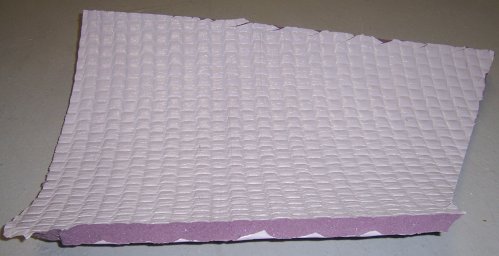
- For the several people who asked: The odor-free carpet pad that we used in carpeting the lower level here is called Napa Carpet Cushion, from Leggett & Platt.
- Apart from N&P’s Fallen Angels, Bob Tucker’s Ice and Iron, and possibly Mackelworth’s Tiltangle, what other SF novels involve an ice age on Earth in the near(ish) future? I have a concept that capitalizes on all my recent paleoclimate research, and I’d like to see if it’s already been done.
- Whoops, found a list just before posting this. I clearly have some reading to do, assuming I can find any of these items. What are your personal favorites?
- Today’s sunspot number is very close to zero. I haven’t seen sunspot activity this low in some time, and here we are supposedly barreling into the Cycle 24 maximum. The sunspot number is going in the wrong direction. 6M DX is evidently not in my immediate future.
- Joe Flamini and Jack Smith are both pretty sure that the mysterious Comco gizmo I presented in my February 6, 2012 entry is an early remote control unit for commercial and public service radio systems, allowing control of a transmitter or repeater through leased phone lines. More on this in a future entry.
- Having read briefly about hydraulic analog computing in a magazine decades ago, I built hydraulic calculators and computers into the technological background for my novel The Cunning Blood. Turns out the Russians did it on a pretty large scale back in the years running up to WWII. (Thanks to Jim Strickland for the link.)
- From the You-Probably-Couldn’t-Do-That-Today Department: The flipside of the Chad Mitchell Trio’s 1963 hit kid/Christmas 45 “The Marvelous Toy” was “The Bonny Streets of Fyve-I-O, about a colonel who shoots one of his own captains for insubordination.
- Tucows (does anybody even remember Tucows?) is launching a contract-free mobile service using Sprint’s network. The rates are interesting, and favor people who want smartphones but just don’t use them much, and data little or not at all.
- The Maker Shed has a $99 Geiger counter kit that allows logging of pulses through a serial port, and detects both beta and gamma radiation.
- A little gruesome maybe, but it’s real: When we lived in California in the late ’80s, there were reports of sneakers washing up on Santa Cruz area beaches…with human feet still inside them. At the time we assumed drug violence, but there’s a less scurrilous if no less ghastly explanation for a phenomenon that’s still happening. (Thanks to Pete Albrecht for the link.)
- Mmmph. Military combat aircraft should be able to fly in more air than we’re used to, no? Sweden had this problem recently. (I’m guessing that Saab has it too, now.) Thanks to Aki Peltonen for the link.
- The name of my company, Copperwood Media, LLC, was inspired by a set of traces on an old PCB that just happened to look (a little) like a tree. I had an artist draw me a better copper tree for the logo, way back in 2000. Now Rich Rostrom sends a link to the odd tradition in some parts of the UK of hammering coins into cracks in trees until the notion of “copperwood” takes on a whole new meaning.
- Some very nice steampunk watches and jewelry. “Chronambulator” is a great word, whether or not you’ve got a steampunk gizmo to hang it on. Note also the level-reading absinthe hip-flask. (Thanks to Bill Cherepy for the link.)
Odd Lots
Smelling (Or Not Smelling) Victory
As I posted on Facebook last night:
My family room now has a floor
And some fancy new tile by the door;
Though it took sixty days
We both knew patience pays–
Now it’s all that we’d hoped for and more!
Yesterday was Floor Coverings Day here. The poem doesn’t quite capture it. All of the lower level areas that were once carpeted were re-carpeted, and that includes two good-sized bedrooms, the hall, the big stairs, and our 20′ X 20′ family room. The total carpeted area is just under 900 square feet. Much of our original carpeting was pulled up or otherwise destroyed when we had the lower-level slab mudjacked back in December. The rest was torn up and carried out yesterday morning, along with a great deal of carpet padding, some tack strips that had gotten in the way of construction, and assorted trash that sure seemed like it came out of nowhere.
It took a little over seven hours, but the new padding was laid and then the carpet put down atop it. The stairs represented a great deal of fussy work, as was getting things cut just so for the closet insets and odd corners. We think it’s gorgeous. It’s much better carpet than what the contractor put down when we built the house in 2003. It matches the wood trim a lot better, and with some top-of-the-line padding underneath it, you feel like you’re walking on a firm mattress.
So we smell victory on the remodeling front. Things aren’t completely done. The roll vinyl for what we call the Harry Potter Closet (a huge-ish volume under the main stairs) was back ordered, and we may not get it laid until next week. But once that’s in, the construction is basically done. After that, I hire movers to put the furniture back where it was, and then start emptying 1,000-odd books out of boxes onto the shelves.
Why did it take so long? We smelled vectory when we didn’t smell it, basically. As anyone who’s worked with carpet should know, not smelling carpet and (especially) carpet padding is nontrivial. Our lower level stank of carpet pad plasticizers for a couple of years, and plasticizers are one of Carol’s migraine triggers. We looked at countless carpet samples, and the first thing we did when we laid hands on any sample was sniff it. If it stank of solvents or anything else, interview over.
This was a problem with carpeting. Our eventual choice was pure nylon and doesn’t smell enough to be an issue. The problem was a great deal worse with carpet padding. A lot of padding is made of chopped-up scrap padding salvaged from subdivision-scale construction, and to make it all stick together, well, they use solvents. Even what might appear to be new padding is plastic foam, and plastic is just polymers in solvent. They stink.
This was our major issue, and we said so. A number of carpet vendors did not take us at all seriously. I had to be a major hard-ass, which is against nature for me and requires practice. I got lots of practice: “This pad smells.” All padding smells. “This pad smells too much.” Padding that doesn’t smell is more expensive. “Brings us samples of what you have that smells less.” We have to order the samples. “Then order them.” It’ll take two weeks. “Good-bye.”
We shopped for almost a month. The pad we chose is some sort of unobtanium pseudo memory foam that looks like nothing I’ve ever seen. It’s purple, sheesh, and has a gray-lavendar impermeable film on both sides. It’s also a far better insulator than most carpet pad, and given that it’s basically sitting on a slab of concrete resting on the Colorado soil, that did matter. At the carpet store, we held it up to our noses, and when we realized that we couldn’t tell whether it was the pad that we smelled or just the general reek floating around in the store, we knew that we’d found it. We took a sample with us, and when we got it home we realized it didn’t smell at all. I don’t know how they did that.
Don’t care. Sold! It was interesting that the stink-free is warranteed for longer than the carpet itself. That was fine; dogs are hard on carpeting. Hell, ordinary life is hard on carpeting. If in another ten years the carpet starts looking sorry, we’ll have it pulled up and get new carpeting. That pad, now, well. It stays.
So. Slab is where it’s supposed to be. Paint’s done. Tile’s done. Plumbing repairs done. Carpet’s done. Victory is one small roll of back-ordered vinyl flooring away. I can almost smell it.
The Comco Whatchamacallit
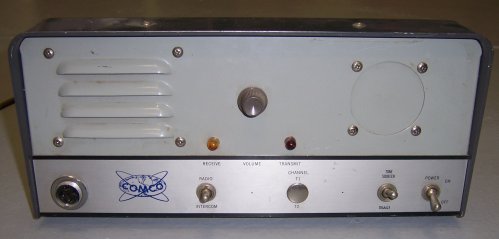
I hung yet more Elfa shelves downstairs the other day, on the only remaining blank wall in my peculiar workshop. I’m trying to get stuff off the floor and into some semblance of order. A number of tube-era radios went up on the shelves almost immediately, including a Heath HW-22A and a pair of Ameco TX-62s, one of which is a parts unit. So did something else: the tube-era thingie shown above, which has been following me around for almost twenty years. I bought it at a hamfest in the early ’90s for a dollar. The old guy who sold it to me didn’t know what it was. I bought it for the sake of the transformers inside, which were worth that much even in 1993. It turns on, lights up, and hums softly. I still don’t know what it’s supposed to do.

It’s made by Comco Communications Company, of Coral Gables, Florida. Its model number is 642-RCU. From the “RCU” I’d guess a radio control unit, or remote control unit. It has no RF parts inside. There’s an audio power amp with a 6AQ5A driving a speaker behind the grille. The front panel has a 4-pin PTT mic jack, a momentary action toggle switch marked “RADIO” above and “INTERCOM” below, with “RADIO” the default position. A hole marked “CHANNEL” with “T1” above and “T2” below is plugged. A conventional toggle switch is marked “TONE SQUELCH” above and “DISABLE” below, and beside that, an On/Off toggle switch marked “POWER”. At the center of the panel is a rheostat marked “VOLUME,” and two grain-of-wheat lamps, the orange one labeled “RECEIVE” and the red one “TRANSMIT.” A round hole the size of a panel meter is plugged. On the back panel is a fuse holder, a 5-terminal strip for spade connectors marked “PHONE LINES” and and empty rectangular knockout marked “EXT. CONTROL” from which a cut-off 4-conductor cable protrudes. That might have been a hack; the cut-off cable goes directly to the mic connector.
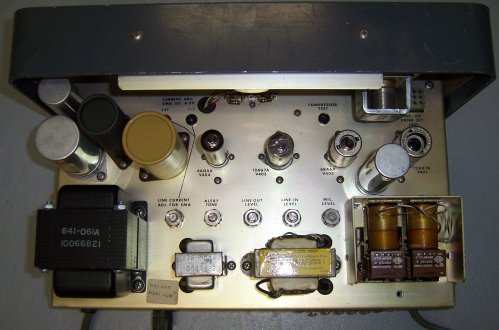
There are two pin jacks on the chassis (see above, just past the tan electrolytic) that say, “CURRENT ADJ. 5MA == 0.5V”. I’m guessing that the meter was dropped from the product to reduce its cost, and the pin jacks provided for service techs. To their right and a little way over is another pin jack labeled “COMPRESSOR TEST.” No idea on that one.
The tube complement is: 12AX7, 6BA6, 12AU7, 6AQ5A.
I suppose it might be some kind of phone patch, though it doesn’t look like any phone patch I’ve ever seen. The “RADIO / INTERCOM” switch throws me a little, since there’s no external connector for intercom lines. I haven’t traced the tangles under the chassis to any extent yet, so if I don’t know precisely what it does, it’s partly my own fault.
And I have other things to do. Even my voracious curiosity has its limits. If you’ve ever seen one of these or want to hazard a guess, please do!
Odd Lots
- Very cool: a home-made wire stripper that tells you when you’ve cut the insulation precisely as far as necessary.
- I’ve of two minds about the genre of infographics, but this one appears to capture a pretty complicated business in a fairly small space: That fat does not make you fat. (Thanks to Apostle of Eris on LiveJournal for the link.)
- Jim Strickland showed me something startling when I was up in Denver this past Monday: A cylindrical neodymium magnet slowly tumbling as it drifts down a 2′ length of copper pipe. Drop it at the top, and then watch it (against a reasonably bright floor) as it goes. Videos are on YouTube. No mystery; just physics, courtesy Lenz’s Law.
- Also from Jim is a link to some discussion about why McGraw-Hill seems willing to accept $15 iPad-based secondary-ed ebooks instead of $75-a-pop print textbooks. Most of it comes down to eliminating the resale market, and receiving that $15 from every student who ever uses that book. Expect resistance from many quarters, including this one.
- Those who remember the Steeleye Span song “Seven Hundred Elves” from the 70s may be interested to know that it was only the first part of a much longer and much older poem. (Long forum thread; read it all.)
- Here are some peculiar ways to deliver toothpaste, including Crest-flavored pudding and pie filling. No, I don’t understand that one either, unless it falls under the category of “business development.”
- This certainly sounds like a hoax to me, but whether it’s a hoax or not, it might be seed corn for some interesting fiction. (Thanks to Bishop Sam’l Bassett for the link.)
- Read the Wiki piece carefully, and you’ll discover that Graham crackers were invented circa 1829 by a preacher who thought that eating them would discourage masturbation. Oh…ditto corn flakes.
- In conclusion, don’t forget to watch The Puppy Bowl later today! (Football? Wazzat?)
Indies and Gatekeepers
Janet Perlman put me on to this article about why indie publishers (a category that may or may not include self publishers, depending on whom you talk to) get no respect. The whole piece might be summed up this way:
- Quality is hard work.
- Quality is expensive.
- Quantity is no substitute for quality.
I agree, as far as it goes. But that’s not the whole story. You can break a sweat and write a superb novel at considerable expense of time and energy. You can pay an editor to look at it and perhaps fix certain things. You can pay an artist for a great cover. You can pay somebody to do a great page layout, generate print images, ebook files, and so on. Having shelled out all that expense in time, money, and personal energy, you are not likely to sell many books or become especially well-known. Publishing is an unfair business in a lot of ways.
Perhaps the most unfair thing about publishing as we know it now is that it cares not a whit about quality. Sure, the publishers will tell you otherwise. So will the agents, and so will the retailers, assuming you can find any these days. Alas, it’s not true. Publishers, agents, and retailers are indeed our gatekeepers, and the gates are tightly kept. The gates do not open for quality, alas. The gates open in the hope of making money.
This is true not only in quirky markets like fiction (more on which in a moment) but in technical publishing as well. I’ve received and rejected beautifully written books that were well-organized and basically error-free, for a simple reason: The Radish programming language (I just made that up) is used by 117 people world-wide, which means the total worldwide market for a book about Radish is 116. (The author already has a copy.) On the flipside, the best possible book on Windows XP won’t be accepted at any traditional publishing house, because all the books on XP that the universe needs were written a long time ago.
The reverse is also true, to some extent. If a publisher thinks your book will make money, the book will probably be published. Being well-written doesn’t change this equation much. Back in the Coriolis era I spent a lot of money on developmental editors to make a manuscript readable in those cases where I suspected (after market analysis) that the book met a hitherto unmet need. I wasn’t always right, of course, but the point is that I didn’t accept or reject books based on any judgment of quality. What I was looking for was market demand.
This is true of fiction as well, in spades. I picked up Cherie Priest’s steampunk entry Dreadnought last year, and had to force myself to finish it. Two other people in my circle, who live 1,000 miles apart and don’t know one another, both described the book in a single word: Unreadable. (Another said the same of her earlier book, Boneshaker.) Dreadnought was dull, slow, short on ideas, over-descriptive in some places and far too sparse in others. Yet Cherie’s got a following and is evidently doing very well. Somebody at Tor thought her books would make money and took a chance. They were right. That doesn’t make them well-written. (I did like the covers, and covers do matter–if you can get them in front of the readers somehow.)
I don’t want to be seen as picking on Cherie, who will doubtless chew me out if she reads this. It’s a pretty common thing. Nor is it a new thing. Decades ago I read a lot of abominable novels, from Sacred Locomotive Flies to Garbage World. They got into the stores. They probably made their authors at least a little money. (They got mine, after all.) They were crap.
If Dreadnought made money, why would a book that was better written not make money? It’s a long list. The author may not have been able to get a hearing from the gatekeepers in the first place. Luck is needed here, as well as brute persistence, not that persistence is any guarantee. The topic may be considered out of style, or just worked out and already done to death. It may be too long. (I ran into this trouble with The Cunning Blood. Unit manufacturing cost matters.) The book may have been judged to push buttons in the public mind that the publisher would prefer not to push. (Back when I was in high school I read a purely textual porn comedy novel that was brilliantly written and hilarious. Would I publish it? Not on your life.) Books that demean women or minorities a little too much, or focus on cruelty to animals (or probably a number of other things) won’t be picked up as easily, and it has nothing to do with quality. It’s tough to make money in publishing, and publishers are trolling for as broad a market as possible.
This is why I think the article on HuffPo cited above is misleading. Quality is a problem, but not as much of a problem as the author thinks, and not in the same ways. Worse, solving the quality problem won’t make an indie publisher’s books any more likely to get into B&N, and suggesting to indie publishers that they will is just dishonest.
So what’s the answer? Don’t know. There may not be one. The publishing industry is in the process of changing state, and nobody knows what we’ll inherit in five or ten years. Losing B&N (or waking up one day to find that B&N is a tenth the size it was yesterday) could work to indie publishing’s advantage, at least if independent bookstores fill the subsequent vacuum. The more gates to the retail channel there are, the more likely it is that one will open when you buzz. Self-published ebooks have worked for people like Amanda Hocking with Herculean energy who write for twelve hours and then promote themselves the other twelve. Tonnage can get you noticed, even if it’s bad tonnage.
For the rest of us, again, I don’t know. Quality in all writing (fiction especially) is not the choke point. It’s an unfair and beneath it all a mysterious business. Submit good work if you can, but be prepared to have the gates shut in your face a lot. That’s just what gates do.
Theme Creep
Sorry for being gone so long. I guess I just had to get past January. We saw the last of the painters this morning, and the only remaining big piece of this ever-expanding remodeling puzzle is the floor coverings. I wouldn’t have thought that getting bids on carpeting would be this hard. It is, at least if you don’t want to get crap carpet and have it installed by idiots. (Now on our seventh house, we’re fussy. Real fussy.) I’m doing two more Elfa buildouts, and shopping for some new office furniture. When I’ve had the energy and presence of mind to write, I made an executive decision to devote it to Ten Gentle Opportunities rather than blogging.
I lost a lot of time in the last few months, but that had nothing to do with the novel. It’s cooking along, and I got another 1,600 words down yesterday. In reading the new material over last night, I realized that something interesting had begun happening when I wasn’t quite looking: The theme was changing, and not necessarily in a good direction.
Maybe that shouldn’t be a surprise. The idea came out of a thoroughly trunk-ish humorous novelette that I wrote in 1981 and buried in embarrassment, concerning a newly built but malfunctioning AI copier that decides that it’s God, and declares jihad against the hapless AI process controller that runs the copier factory. In 1984, my fiction mentor Nancy Kress agreed to collaborate with me on a revision of the concept at novel-length as a half-fantasy love story, adding in a universe-jumping magic hacker (in the manner of Harold Shea) who drops in on a small advertising agency in Rochester, New York to hide from a berserk magician, and magic that “maps” to software in our boring, magic-free world. The magic hacker acts as a catalyst to heal the relationship of two middle-aged people, and in the process learns about software. When he returns to his own universe, he discovers that software “maps” to a form of magic far more potent than anything his erstwhile tormenter can summon. End of story.
In our 1984 effort, there were only two AIs: one the factory controller, and the other a tinkered-up magical intelligence that maps to software in our world. In a brief (and silly) subplot, the magical software falls in love with the factory controller, and in a sort of virtual sexual union, they combine into something a good deal more capable than either was on its own. Mostly, the AIs were played for laughs and acted as foils to the human hero and heroine, whose relationship they loosely echoed.
The concept had promise, but in 1984 I was only barely a grownup (32) and just couldn’t pull it off. Nancy graciously ceded me her portions, and everything went back into the trunk, where it stayed until 2006. I pulled it out and read it over that year, and very abruptly, brand-new scenes began rising out of the cluttered back rooms of my subconscious. I sat down one evening and wrote a new opening, “just for fun.” Boom! Suddenly I had a rigorous system of magic, a magical intellect that spoke only in poetry, an evolved magical predator resembling a lamprey from the astral planes, zombies dancing the Macarena, a 3-D processor technology that packs tens of thousands of execution cores into a blade module, the Triumph of Pascal (as a fictional but heavily parallel language called HyperLang, get it?) and several more AIs.
The love story was still there in the middle of it all, at least in the outline. Now, I have this old habit of heaving ideas into a story with a pitchfork. Once I grabbed my pitchfork, the love story started to get buried in ideas, most of which lay in the AI characters. What does it really take to make an AI that looks and sounds like a human being? If you start with something powerful but alien and make it human by shooting it full of NOPs and bad animation, is that a win? What would the AIs think once they understood what was going on?
Is virtual suffering real suffering?
I’ve done idea stories all my writing life, but I’ve never done a love story. I guess it’s not surprising that I’m having a lot of fun with the ideas, and a lot of heartburn over the human relationships. I’m doing my best. The path of least resistance, however, is to have fun with the AIs and their virtual lives in the Tooniverse while the human characters recede into the background. If I’m not careful and don’t begin paying attention to my outline, that is precisely what’s going to happen. I looked in the mirror this morning while shaving and said, “Be warned.”
In some ways the story has come full-circle. It was originally a battle between a humorless factory controller system and a psychotic AI living in a faulty networked copier. I’m having to struggle a little now to keep it from becoming The League of Exceptional Software pitted against slobbering malware from another universe, while their human friends look on in befuddlement and occasionally cheer.
Most of my stories have evolved as they crossed the brain/fingers barrier. A lot of them have died in the evolving, which is why my trunk, in terms of paper alone, weighs thirty or forty pounds. I’m determined not to lose Ten Gentle Opportunities the same way. After all, it’s taken literally half my life to write, and I have only so many half-lives to go.
Odd Lots
- I’m still alive, and still remodeling. Designing two more Elfa buildouts, in fact, before the Container Store’s annual Elfa sale times out on January 31. Getting migraines from craning my neck during ladder work, too, which has made me disinclined to be perky in this space. It won’t be forever; the painting was finished today, finally. But it will be February before the carpeting’s in.
- From the Words I Didn’t Know Until Yesterday Department: plectrum, an implement used to pluck the strings of a stringed instrument such as a guitar or harpsichord. Among the many forms of plectra are guitar picks and harpsichord jacks.
- Here’s an intriguing list of major solar flare events, beginning with the Carrington Event in 1859. Is it just me, or has the Sun done a lot of quieting down in the last 100-odd years?
- Why Megaupload? Those guys had four percent of all Internet traffic worldwide, all of it Linux distros and Project Gutenberg mirrors. Yeah, that’s it. Yeah.
- On the other hand, there are a lot of people who were using Megaupload as a cloud server for their own files. And you wonder why I like local storage.
- As I take a break from remodeling to try and get my head around various current IP topics, it occurs to me that the well-covered Megaupload bust is Streisanding the hell out of the bitlocker concept itself. People who had never heard of bitlockers (alias “one-click hosting”) or indexes like FilesTube are doubtless adding lots of new bookmarks today.
- That swoopy one-piece telephone with the dial on the bottom that you used to see in a lot of spy movies and TV shows? The Ericophon.
- Nancy Frier has found a niche printing firm that can actually print from then original plates used in Alox kites, and so new kites using the original Alox designs may well live again. More as it happens.
- This dream is such a common phenomenon that the dream itself must have a name. What is it? (I’ve had it now and then for probably thirty years.)
- Is there a utility that will search a Web page or pages for a list of search terms every X minutes / days / weeks ?
Another Elfa Closet Done
The rehab of our lower level continues apace. The tile guys finished up today, replacing the tile around the tub and some floor tile that was damaged by the mudjacking last month. The grout has to cure for another week and the toilet has to be re-set, but the tub no longer leaks. Shortly we will have a guest bathroom again.
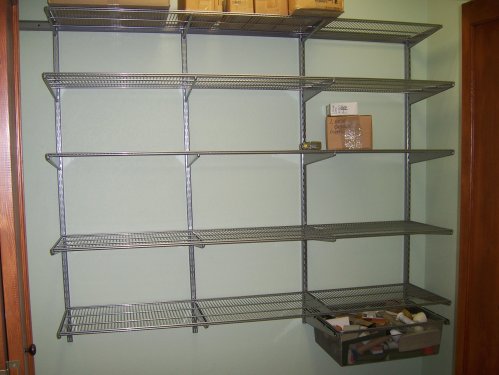
The painters begin their work on Monday. We haven’t ordered the new carpeting yet, so the carpeting won’t be replaced for probably another three weeks. In the meantime, there are plenty of odd jobs to be done down there, and yesterday I dove in on one of them: my workshop closet. I’ve been planning an Elfa buildout in that closet for literally years, but it hadn’t bubbled to the top of the stack until recently. To replace the crappy shelves I had in there with Elfa I first had to empty the closet completely, and there was nowhere to stack its contents until I was forced by the mudjacking to clear the eastern ten feet of my shop space. That in itself was an adventure in strength training; QST may be the only magazine in creation denser than National Geographic.
So last week I hauled hundreds of pounds of parts, tubes, sound boards, unfinished project lashups and much other junque out of the closet and stacked it in the newly empty space where those QSTs had been. And yesterday, level and cordless screwdriver in hand, I got the Elfa installed.
Elfa is a steel shelving system made in Sweden, built like a battleship and priced accordingly. As best I know it’s an exclusive from The Container Store chain here in the US. It’s based on a horizontal track mounted high (ideally in studs) from which vertical tracks are suspended. The vertical tracks are not fastened into the wall at all, so can slide side-to-side for fine adjustment. (Mine is biased four inches to the right.) There are several major styles (closet, kitchen, office, garage) and all kinds of interesting bits that click into the tracks. It’s basically a Meccano set for shelving.
I’ve used it twice before, in our upstairs office closet, and across two thirds of the back wall of our garage. It takes a little practice to get good at it, but there’s nothing especially subtle about the system. It was breathtaking to see just how much clutter we were able to scoop up off the garage floor and shovel onto the shelves.
Yesterday I filled an 88″ wide closet with a six-foot shelf bank, leaving a little room on each side for specialty storage for things like brooms, vac wands, and mobile antennas, including a full set of Hustler RM-series loading elements. The Elfa system includes pull-out bins, one of which I bought to see how useful it might be. Having filled it with plastic scraps, I’ve decided that it’s very useful, and on my next trip to Denver will get two more.
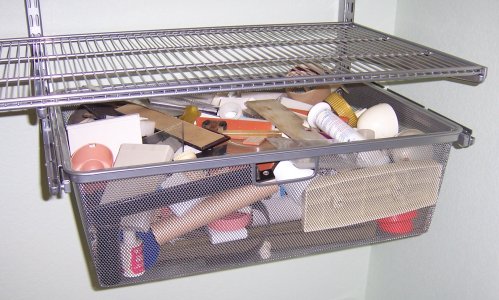
I’m still switching shelves around and moving them up and down to get a sense for the spacing, and may put a couple more 2′ shelves on the right side to make space for things more horizontal than vertical, like homebew lashups. That said, I’ve already re-shelved most of the stuff I’d pulled out of there last week, and still have almost twelve shelf-feet of completely empty space. As wins go, it was a biggie.
Highly recommended.
The Trojans Are Winning
Trojans sent as spam attachments are (thankfully) not as common as they used to be. Several years ago I would get fifteen or twenty every day. In the past year or so I only get three or four per week. Nearly all of them are executables of some kind, either simple Windows .exe or .scr files, or else an MS Office file (generally an Excel spreadsheet) containing a malicious script. This morning I got a flurry of phishing attempts delivered as PDF files. As I often do, I scanned the PDF file with both AVG and MalwareBytes to see which trojan was present. This time I got a negative from both utilities.
Now, an email telling you that you should open the attached file to see details of your order / bank transaction / payroll deposit etc. are guaranteed to be malware. If two well-regarded AV utilities call the file clean, I begin to wonder how effective our AV technology really is. I’m particularly disappointed in MalwareBytes, which has been razor-sharp so far at detecting email malware.
So I submitted the file to Jotti, which is an interesting one-file-at-a-time malware scanning service. I’ve known about it for some time but never tried it before, as I’d never received anything that managed to duck AVG and MalwareBytes both. What Jotti does is aggregate online file-scanning services, and then aggregate the results from all the services. The PDF exploit got past 14 of 20 scanning services used by Jotti, including AVG. Them’s lousy numbers.
Here’s a screen cap of the Jotti output report.
To get some perspective, I did a little additional testing. Things got worse. I saved a .zip payload out of an obvious phish email that came in yesterday, and submitted the zip to Jotti. One out of twenty scans came up positive. I then (carefully) unzipped the payload to a naked .exe, and submitted that. Zero. Zip. Nada. Nobody caught it. Wow.
What this tells me is that the Trojans are winning. Scanning things before you open them is no longer any sort of guarantee. Dodging malware now requires that you turn your paranoia knob up several notches. Here’s what I recommend for Windows users:
- Run Internet-facing apps from an LUA, or with a privilege-limiter like DropMyRights.
- Install and use NoScript, and allow scripting only on trusted sites. Be conservative on what “trusted” means. Javascript is evil.
- Install and use AdBlock Plus. Until sites can guarantee that their ads aren’t serving up malware, I reserve the right to block their ads. It isn’t just small sites that are vulnerable; Gawker Media got hit a year or two ago.
- Do not use Adobe Reader. There are lots of other PDF readers that are as good or better. I recommend PDF XChange from Tracker Software. What you want is a high-quality product with low market share. Adobe Reader is an exploit farm in part because the bad guys search it harder for exploits–and most of the exploits are highly specific to Adobe Reader.
- Whatever PDF reader you choose, go to the options dialog and turn off Javascript. I have yet to hear any compelling reason for a PDF to execute JavaScript. Oh, and did I say that Javascript is evil?
- Do not use Flash on a Windows system. Don’t even install it. Use a Linux instance to read YouTube or other Flash-based sites that you absolutely must browse.
- If you’re geeky enough, get a VM manager and run Internet-facing apps (or at least Flash-equipped sites) from inside a VM. This makes bookmarking tricky, but a VM is a very tough thing for malware to get out of.
- Don’t pirate software. In particular, don’t install something and then go looking for a crack to get past registration/activation. Cracks are virtually always malware, and the pirated apps themselves are infected as likely as not.
- It sounds nuts, but we do it: Get an entirely separate machine for any kind of online banking. Ours runs Linux. We do nothing on the machine at all other than online banking. We turn it off except when it’s in use, which is an hour or two per week, tops.
Both Macs and Linux machines are harder to infect than Windows, but most of their supposed immunity comes from their being scarce enough that the bad guys don’t attempt to exploit them. I’ve seen a troubling increase in the number of exploits tuned for the Mac, which means that Macs are now mainstream. With success comes danger. Also, more and more malware comes in via social engineering, and since that’s a wetware problem, Macs and Linux boxes are no more immune to that than Windows. (The real malware danger in running a Mac is the all-too-common conviction that Macs are immune to malware. Uh-uh.)
It’s certainly true that the vast majority of malware infections are the result of Computing While Stupid. Alas, the line we’ve heard for years about keeping AV software installed and up-to-date is increasingly irrelevant. There is no way to harden a PC to allow you to do any damned thing you want. Nothing’s bulletproof. You have to dodge–and you have to dodge harder and harder all the time.
Odd Lots
- Of all the essential elements of science, proving causation is by far the hardest. Correlation only points in a direction that further research should take; it has no value in and of itself. (The title of the article is very hokey, by the way: Science is not failing us. Human ignorance–and corruption–are interfering with the scientific process.)
- Marvelously wrought steampunk playing cards. (Thanks to Bill Cherepy for the link.)
- I went to high school with one of these guys. (Joe Lill.) Very impressive piece of work. (Thanks to Pete Albrecht–another high school colleague–for the link.)
- I got one of these for Christmas from Lee Hart. We’ll soon see if I can still write COSMAC binary machine code in my head, 35 years later. F8 FF A2…
- Carol presented me with Steven Pinker’s new book, The Better Angels of Our Nature, and I will report after I finish it. Pinker’s stuff is always worth reading, and I’ve been waiting for this one for a long time.
- The Ropers (my sister Gretchen, Bill, and her girls) gave me one of these for Christmas, and having tested it on a few Meccano parts downstairs, I suspect it may turn out to be the best hex nut starter I’ve ever had.
- This is the first waterproof (more or less) tablet I’ve ever seen, and in my preferred 4:3 format to boot. And a MicroSD slot for sideloading! Details are still sparse, but it’s the first CES 2012 announcement that hasn’t made me yawn.
- I bought a Nook Color last week; more in upcoming posts. I heard today that you can now get a Nook Color for $99 or a Nook Simple Touch for free with a one-year subscription to the New York Times or People. I don’t know if this is good for the industry or not, but it may well do wonderful things for the Nook’s market share.
- There are challenges to living in the best Effin town in Ireland. (But nothing like those of a certain town in Austria.) Thanks to G. McDavid for the link.
- I offer this interesting piece as a glimpse into my ongoing research into the drivers of climate. I have long intuited that climate is a chaotic system, and we see evidence of two states in recent geological history. What the attractors are, and whether there are other states are questions of enormous importance, as is the question of how bad a change to the other known state would be. Note well: My tolerance of Climate Madness is now close to zero. Please limit comments to the points made in the article. If you wander into politics or comment angrily your posts will be deleted without hesitation or regret.