- Southwest Airlines has just banned “human-like” or “animal-like” robots from its flights. Oh—and in checked baggage too. The concern is about biggish lithium-ion batteries, which does make sense. There’s also the issue of whether robots are considered passengers, checked baggage, or carry-on baggage that carries itself on.
- Interesting long-form piece about archaic homo sapiens, a genetic group close enough to modern humans to share a species name, but different enough to trace their rise and fall and eventual extinction. Modern humans carry some juvenile traits into adulthood, like friendliness, playfulness, curiosity and flexibility, in a similar way that our modern dogs carry puppy traits like playfulness and cuddliness into adulthood. Dogs are lifelong wolf puppies, and we’re lifelong cave-kids.
- Beef is not the big health risk that Certain Influencers have long been yelping about. Well, we’ve known that for a long time. Eggs are good for you too. As are protein and fat. The arguments will continue as arguments generally do.
- Keeping lithium-ion batteries on charge even after they hit 100% shortens the life of the batteries. I knew this, and don’t keep my phone or tablets on charge after they hit 100%, which I check for from time to time.
- Duke University scientists have created a 20-legged robot that merrily rolls along the Duke campus. Watch the videos; I’m a long-time robot fan and I think they’re cool.
- And if creating 20-legged robots isn’t your thing, consider scientists at ETH Zurich who have created (theoretically) perfect randomness using two superconducting chips cooled almost to absolute zero and connected to each other by a 30-meter long tube similarly cooled. I don’t quite understand it either (how do you prove a number is perfectly random?) but I have a hunch you could sell perfect random numbers generated with such a device and make a good buck. We’ll see.
- USB-C cables and ports can do a lot more than just charge your phone or tablet. Here are a few such things worth keeping in the back of your head.
- Well, this certainly wasn’t on my bingo card: A humanoid robot fashion show, where the robots and their, um, fashion models wear the same clothes on the runway.
- Here’s a map of America’s favorite house paint color—along with some discussion on when and why vivid colors fled from everyday American life. I remember when cars were all kinds of colors. The kitchen I grew up in was hot pink for a fair number of years—and then bright blue. Sure, all that was (many) years ago. Multiple colors increase costs for just about any product line. Shame, that—but a pretty solid explanation. (h/t to Rich Rostrom for the link.)
Odd Lots
Now Available on Kindle: “Morning Man”
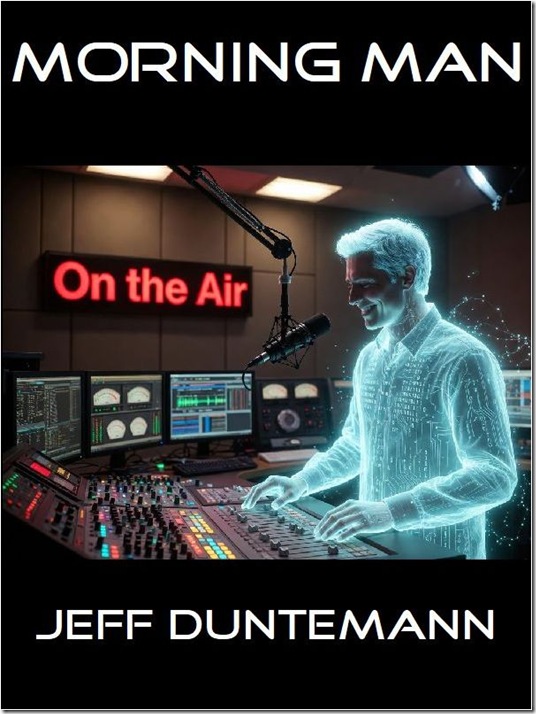
Amazon just messaged me that my latest Kindle title was now available. “Morning Man” is a 6,300-word short story with an interesting history. It’s about an AI DJ at a small farm-town AM radio station in Wisconsin. I wrote it in 1989. I never tried to sell it, but just threw it in a box full of old manuscripts, where it sat for the next 35 years or so.
Why didn’t I try to sell it? I couldn’t make the characters work. I’ve always been good with gadgets and world-building. Characters, well, I did my best, but the people in the story just didn’t sound especially real. Part of the problem may have been the fact that in 1989 we were preparing to launch PC Techniques and move to Arizona from Scotts Valley, California. My time and energy mostly went into that megaproject. By the time I retired in the teens and returned to fiction, I had mostly forgotten the story of Rusty the AI and his bewildered owner.
So I pulled it out, read it a few times, and rewrote it heavily. Now, having five novels and a couple of intense workshops behind me, I knew what I was doing. The characters now work. And you can have your own copy for 99c.
Well, AI DJs on broadcast radio are now real, and becoming common. Here’s one piece on the state of things as of 2025. Rolling Stone has another good piece on the topic, but it’s paywalled. My brief scan showed a few more, and if the topic interests you, you can probably find plenty.
I don’t expect the general public to believe that I predicted AI DJs in 1989. Nonetheless, I did. So take a look and see what you think. Reviews and ratings are always welcome; thanks in advance. And as I’ve said here more than once, I gotta go dig around in that box and see what else I wrote and then forgot about!
Odd Lots
- Asteroid Apophis will come within 20,000 miles of Earth during its close approach in 2029. Scientists say there’s no chance of the big rock hitting us, which is a relief, given that it’s the size of the Eiffel Tower (if a lot fatter) and could level any city it struck.
- I didn’t know this: A small red dwarf star passed well within a light year of our solar system about 70,000 years ago. It was dim enough that even at its closest approach, it would not have been visible to our naked predecessors’ naked eyes.
- A group of Earth scientists have created a site that will display your current location (or at least where your IP address suggests you are) on a graph going back over 300 million years. About 320,000,000 years ago, Phoenix, Pangaea was on the equator! (Nuts. Missed it.) H/T to Old Guy for the link.
- Google is installing a completely local, 4 GB AI on machines that have Chrome installed, without asking permission nor notifying the user that it’s there. The linked CNet article explains how to find out if you have it, and if so, how to flip the flag that enables it. I found it on one of our machines, and flipped that flag. We’ll see what happens going forward.
- Law professor Glenn Reynolds’ upcoming book (available 5/12) explains that the real danger inherent in AIs is not destruction but…seduction. Seductive AI explains how lonely people have used AI chatbots as friends and in weird ways, lovers, with all kinds of downsides. A piece in the New York Post focusing on the book suggests that people have been driven to suicide by excessive interaction with AI. So maybe there’s some destruction going on after all. I’ll review the book here once I get it.
- I take five grams of creatine monohydrate every day (and 10 on Mondays when I do weight training at the gym) and here’s a solid short summary of what creatine does for us. It’s not all about muscle and energy, but also about the brain. I’m sold!
- People who eat five or more servings of eggs per week are found to have a 27% lower risk of developing Alzheimer’s than those who eat eggs rarely or never. I eat them every morning for breakfast. My brain is my first favorite organ; sorry, Woody.
The Whistling Earworm
I was at our Fry’s grocery a few days ago, and while looking for a decent tray of organic radishes (I’m fussy about my radishes) the normally ignorable pop music they play above the low-level grocery store hubbub caught my attention. It was one or maybe two people whistling a repetitive theme. There were vocals between the whistles, but I couldn’t make them out, and was in truth way more interested in the radishes than than the music.
On the (short) drive home, I realized that the damn whistles were still playing, this time strictly in my head. I’m prone to this mental peculiarity, generally called “earworms.” I’ve evolved a mechanism to kill my earworms: I start creating parody lyrics for them. Oddly, this makes them go away. I don’t know why. As many of my long-time readers know, I’m good at parody lyrics. Here’s a sample of what I fired at the whistling earworm:
“I’m just a dope, just a typical mope, and that is all that I’ll ever be.”
That said, I sometimes hear store/restaurant music that appeals to me. Years ago I heard a piece in a restaurant in Colorado Springs that got stuck in my head, mostly for the guitar work. The lyrics were fuzzy and I heard them wrong, so having failed to identify the song on Google by its lyrics, it was years later that I heard it again on the radio of a rental car. It was “Found Out About You” by the Gin Blossoms.
But we now have better weapons: Google search on my phone listens, and you can tap a button to tell it to identify whatever music is playing. It worked beautifully for “Because the Night” by Cascada. Ten seconds and bam! I had the title, the artist, and a link to buying it. “Because the night belongs to muggers, / Because the night belongs to blood…”
Ditto last year, when they were playing an appealing item while I was standing in the line at the UPS Store. Pulled out my phone, and a coupla taps (and a few seconds) later, I had “Shut Up and Dance” by Walk the Moon. I enjoyed it enough that I didn’t try to filk it.
Back to the whistles. Now, I struggled for decades to identify an energetic instrumental for brass that I first heard at a grade school show in 1964 or ‘65. I tried to whistle it into my cell phone, but it didn’t work. (I figured it out by sleuthing, but at least I figured it out.) I’ve since found that Google can only identify recorded music. Whistling doesn’t work…
…unless the recorded music is made of whistling.
It was a perfect experiment: When I got home with the whistling earworm in my head, I pulled up Google on my phone, hit the song button, and whistled the whistle. I was startled when Google snagged it in a few seconds. The song was “The Walker” by Fitz and the Tantrums. Not generally something I like, but it was weird enough that I added it to my collection of $1.29 Amazon tracks.
There’s not a lot of whistling in pop music. I vaguely recall a song or two (Roger Whittaker?) which I’ll whistle for Google to see if whistling is just something that Google assumes is recorded music. One has to wonder if Fitz and his gang whistled it to make it easier for people to identify on Google. Or maybe dumb luck.
I’ll go with dumb luck, heh.
A Flood of “Free Gifts” Spam Scams
Over the past few weeks, I’ve received a serious flood of similar email messages that claim to be from well-known businesses like Harbor Freight, CVS, Kroger, Marriot, Costco, FedEx, Walmart, and even Cheesecake Factory. They often come in pairs, one to each of my two most-used email addresses. They all have a common theme: Something free is waiting for you; click here and claim it! Sometimes it’s customer points that were lost, for FedEx they apologize for losing your package, and offer gifts as recompense.
I’ve gotten as many as 150 of these in a single day. Fewer show up on weekends, and there was a week awhile back when they abruptly stopped coming, only to resume the following week.
I know they’re fake because the From address domain is never the domain of the business proper, but something silly like “goonads.com”. Furthermore, as best I can tell, the From domain is used once and never again. (I get two identical copies of each because two of my emails are on their list.)
The emails are often decorated with graphics copied from the supposed sender’s site to make them look legit. And there is only one URL embedded in any of them, labeled as “Click here to claim your gift” or “Click here to enter your delivery address” etc. No, I haven’t clicked on any of those bogus domains. There are well-known hazards in doing so. I’m posting here mainly to see if this is happening to any of my readers. Researching things like this online shows them going back several years, but mine started maybe 5 or 6 weeks ago.
So. Anybody else getting rained on with scammy free gift offers? Drop a comment below.
Odd Lots
- Here’s a fascinating history of AM radio technology, focused on WLW—the highest-power AM radio station the US ever had.
- If you’re trying to create an application with an embedded (non-server) SQLite database, this article may be of some help.
- The Friendster social media platform has risen from the grave. It’s got a new twist that sets it apart from other social media platforms: To add someone to your friends list, you have to meet that potential friend in person and tap phones.I like that a lot. With no ads it’s a little unclear how they’ll pay their expenses. We’ll see how it goes.
- The US Fifth Circuit Court just ruled that people can distill their own hard booze in their basements. That’s not anything I would try, but I’ll cheer any expansion of American freedom. Will the Supreme Court reverse this ruling? I kinda doubt it.
- We know less about Alzheimer’s Disease than we thought we did, and groupthink may be a major reason why.
- Since Carol and I never had kids, I didn’t hear about the Tin Can Phone until earlier today. Here’s a detailed discussion. And here’s the Tin Can Phone home page. It’s an Internet phone, but designed not to have a screen. It carries only voice, and thus is a throwback to the landline phones I grew up with and used until about 2000, when we went to pocket cell phones, and then smartphones in 2011. The idea is to let kids communicate with voice, as in the good old days, without screens and third-party web content to get in the way.
- AI is being used to generate revenge stories for…YouTube. (H/t to my friend Pete, who is a bigger YouTube watcher than I.) Here’s an example of its output.
- A non-humanoid robot has beaten top-level human players of…ping-pong. One wonders how a session with two robots of this design would go.
Oy vAI
I’m seeing more and more indie book covers that are startlingly good, and yet give that now-familiar impression that they were drawn by an AI. I’ve not studied prompt engineering but others have, and so I spent an hour using Musk’s Grok AI to generate a cover for my fantasy novelette “Whale Meat,” which I recently rewrote heavily and republished. Like an idiot I didn’t save the prompt that created the image. What surprised me is that by generating a second image from exactly the same prompt, I got a distinctly different image. I asked for a middle-aged homeless man with a heavy beard and a floppy work cap on a city street, summoning a whale through hyperspace. Here’s what I got:
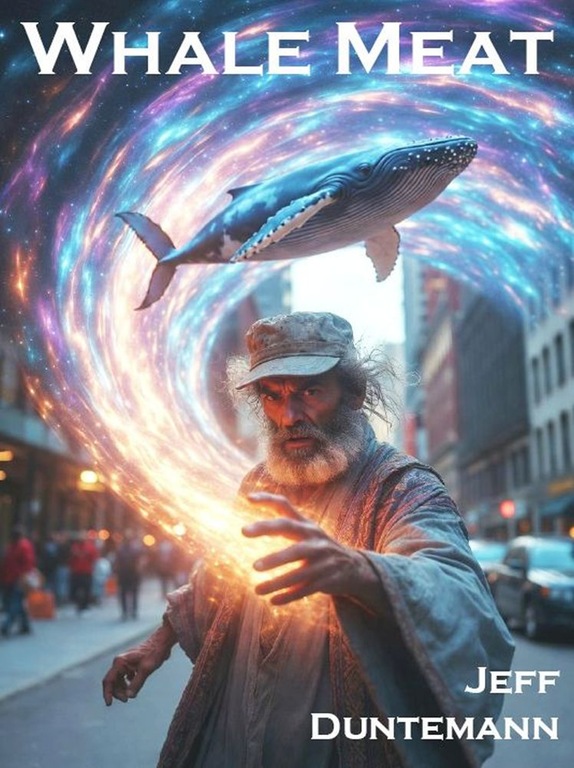
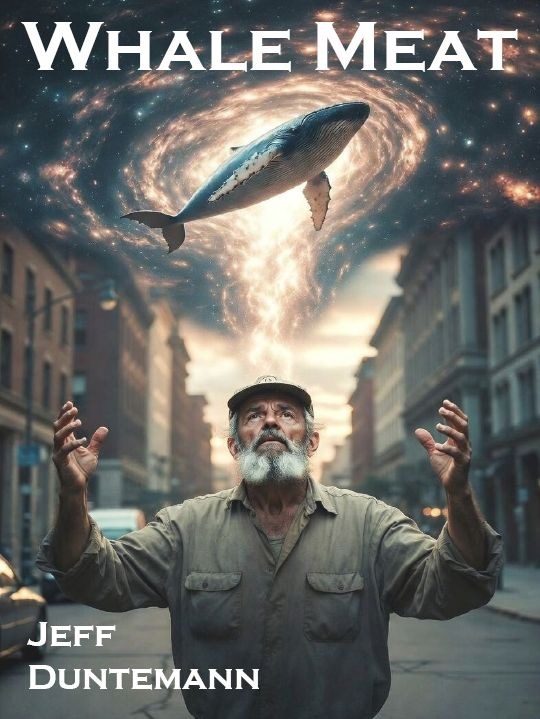
I chose the one on the left, because it displayed more sense of menace on the man’s face. I also liked the clear indication that he’s the one doing the trick with the whale. The other image could represent a vision the man is having. (No more spoilers. It’s only 99c; if you’re curious, buy it!) The real weirdness is that both images came from exactly the same prompt. (Save your prompts—but don’t expect a given prompt to produce the same thing every time. So save each image that you create with any given prompt!)
Now I had a cover. But…is it mine? That was the first hint to me of the huge problem of how copyright law applies to the output of generative AI.
I see five big legal questions that need to be settled, probably in court:
- Can material generated by an AI be copyrighted?
- If material generated by an AI can be copyrighted, who owns the copyright?
- If a piece of art created by an AI is incorporated into a larger work of art created by a human artist, does the AI art invalidate copyright on the work as a whole?
- Does material generated by AIs trained on copyrighted material violate the copyright of the training material?
- Is material generated by an AI trained on illegally obtained material (pirate downloads etc.) considered illegal?
There are smaller issues, but those are the important ones. #1 has supposedly been tried and resolved in the courts. It went up to the Supreme Court, but the claim stands: Copyright requires human contribution. (H/T to Jim Strickland for sending me the link.) My problem with this is that a human crafted a prompt that created an image specified by the prompt. I consider prompt engineering a human contribution to AI art. If you use a stencil to craft letters on a sign, the stencil did not create the letters. You did. My guess is that #1 will be litigated further, and with any luck, a ruling will also answer #2. I don’t think #3 is a yes—but again, we have no decisions either way thus far.
The biggie is #4. Here’s a scenario to ponder: Suppose an artist needs to draw a picture of a bichon frise dog but has never seen one. The artist thus looks at online photos of bichons and then draws a picture of a bichon. The dog in the drawing isn’t identical to any of the dogs in the photos in terms of factors like size, pose, or hairdo. (Hairdo is a big deal with bichons, trust me. We’ve had six.) So: Is the artist violating the copyright of the photos he scrutinized before drawing the bichon? He trained himself on somebody else’s photos to get a sense for the breed, and then based on that training drew a dog not identical to any of the photos.
I think this much is clear: If you teach yourself enough about dogs to draw dogs, the dogs you draw are copyrightable, and you own the copyright. Furthermore, nobody can claim that drawing a dog violates the copyright of other pictures of similar dogs, barring methods like tracing a photo through tracing paper.
Here’s a counter argument that I’ve heard, don’t recall where: Superman is copyrighted. If you draw Superman and the drawing isn’t identical to any of the Superman copyright holder’s drawings, is your drawing a copyright violation? I’m pretty sure it is. God created dogs. Humans created Superman.
So which one applies to AI?
 I’m not sure. I did some further experimenting with the Grok AI: I asked it to draw a bichon chewing on a bone. It did so, and the generated image (left) was photo-like and not cartoon-like as were the “Whale Meat” covers. I then did a Google image search on the created image, and got nothing remotely similar to the picture Grok had put together. Now, there are gazillions of photos of bichons online. Grok might have chosen one with a bone in its mouth and sent it back to me, unchanged. There’s no way I could ever know if that supposedly generated image were a literal copy or truly generated according to training.
The more I research the issue, the muddier the whole thing gets. It’s possible to copyright a recipe. However, the same steps in a recipe expressed in a different way are not a copyright violation, though the steps might be patentable. Fair use is the muddiest issue of all, made still muddier by questions of who (or what) is doing the using. Fair use still comes up in court cases, so it’s hard to know if training an AI on copyrighted material but not using the AI to precisely duplicate any of the copyrighted material is fair use. That issue may not be settled for decades.
Although it’s possible that an AI company would claim copyright on the images that its AI produces (point #2), that would light up our courtrooms in a big hurry—and possibly bring the curtain down on the company itself.
AI companies that pirate immense wads of copyrighted material for AI training should be sued into the ground, but that’s not really about AI. AI users who have no idea where the training material came from should not be held responsible for the piracy if they use the AI.
I’m just bringing up the problems here. I’m not a lawyer and even lawyers will probably admit that AI is a unique addition to the body of copyright law and that relevant law is not settled. I’m just speculating about the problems that we as writers and artists face. How well AIs can write fiction is a question I haven’t tried to answer, though I will run some experiments on that proposition as time permits.
I may or may not create another AI book cover. The “Whale Meat” cover was an experiment. I’d rather pay a human artist for science fiction / fantasy cover art and doubtless will. What happens in the greater publishing community across the next ten years or so will be fascinating. Grab your popcorn. Let’s watch.
Slow Dopamine
Several weeks ago I read a nonfiction book that I had bought and read in 1992 and not since. When I finished it, I felt peculiarly rested and happy, so much so that it surprised me when the feeling continued until the end of the day. I won’t name the book because among other things it involves church politics, and I don’t talk about politics in this space. What matters is that it put me at ease vis-a-vis some issues I’ve had with religion for a long time. Some books, while interesting, put me on edge. This one, while also interesting, put me at ease.
It took two days’ worth of easy-chair time to go through it. I didn’t rush; I learned back now and then and pondered certain of its many points, and stopped a couple of times to look up things that might have changed since 1992. I felt it was a worthwhile use of my time.
What I didn’t expect was a day-long dopamine rush.
Dopamine is a brain chemical. It’s what makes us feel good. I’ve known that for years. What I didn’t know is that the slower you do something that generates dopamine, the longer the dopamine lasts, sometimes long after you finish what you’re doing. Conversely, when you scroll through your phone or tablet hunting for memes, silly videos, or quick, short text posts that make you smile, the dopamine rises fast, and then goes away just as quickly. The faster the rise, the faster the fall. This even has a name: fast dopamine. Do too much fast dopamine, and all that falling after the brief hits can actually lower your background dopamine levels and drive you to depression or addiction.
What you really want instead is slow dopamine. The articles I’ve seen (like this one) emphasize slow pleasures over fast pleasures. But more than that, slow dopamine sticks around longer if you put effort into something that pleases you. The more effort and the more time expended in something you enjoy means that the dopamine generated will stick around longer and fade away a great deal more slowly.
I tested this again a couple of days ago when I constructed a PC board kit name badge that puts on its own light show. Building something that requires sharp-tip soldering is best done slowly, and sometimes requires a biggish frame magnifier. I took it easy, savored the smell of smoky core-rosin rising in wisps from the PCB, and periodically kicked back and remembered the fun I had with my SF nerd friends in the 1970s. The badge honors the 50th anniversary of an SF club I helped create back in 1975 (see the link above) and when it was over, I was practically glowing. The dopamine didn’t last quite as long as that generated by several hours reading a good book, but I felt good for another two hours at least.
I’m older than the Internet (hell, I’m older than the transistor) and whereas I check a weather app each morning and sometimes scan a news feed i’ve customized away from tantrum politics, I don’t sit around doomscrolling or watching TikTok for hours on end. I read, I write, I program, I exercise, and I build things, all of which require focus and effort. I trade emails with my friends. There are life events that will keep your dopamine down—I’ve just been through a major one of those—but between tragedies, stay busy with positive things that require effort and take awhile. The slower and more energetic your dopamine onset, the longer it will last. I’ve been there. It works. Try it.
General Technics’ 50th Anniversary

Fifty years and some months ago, I got together with a few of my friends in the science fiction fan community, and we started a…what? Club? Fanzine? A gathering of techie nerds?
Yes. All of the above, and then some. With me as the fanzine editor. I created a zine called PyroTechnics, with its first (undated) issue appearing in late winter or early spring 1976. I worked for Xerox at the time, and that helped, since I was given free rein of the many copiers/duplicators at the downtown Xerox Chicago offices, where I ran off the newsletters.
A lot of those early years’ activities have gotten a little fuzzy in my head, but we were (mostly) a midwest phenomenon, and we attended midwestern conventions like Windycon, Chambanacon, Capricon, and doubtless others. Several of us traveled to Kansas City for the 1976 Worldcon, where I (and doubtless some of the others) stood in line to shake hands with Robert A. Heinlein, who was pro GOH that year. We stole the name “General Technics” from John Brunner’s 1968 novel Stand on Zanzibar. I sometimes wonder if he knew about us, given the lack of Internet in the 1970s. (Brunner died in 1995, when the Internet was just getting out of second gear.) It wasn’t cold-hearted theft; we were honoring an excellent novel that wasn’t ishy-squishy New Wave.
Us, we wanted hard SF and lots of it. We talked about tech, we built things from blinkies to robots to much else, had fun, and wrote it up for Pyro. By 1979 we had almost a hundred members. I paid a GT member to assemble an S100 8080 CP/M machine for me in 1980, and used it for ten years. As time went on, subgroups within GT published issues of PyroTechnics themselves, with my enthusiastic blessing. I may not have all the issues that ever were, and I think my part of it faded out as Carol and I went bopping around the country while I chased jobs. I still keep in touch with a few members, though at least one of my best GT friends (and best friends generally ), George Ewing, left this world back in 2010.
Things got quiet for a long time. Then some time back, I was sent a kit by 2DKits, care of GTer physicist Bill Higgins. It was a blinkie name badge kit celebrating 50 years of General Technics, with a PIC processor and lots of LEDs. I finally finished it this afternoon, and it almost brought a tear to my eye. Fifty years, wow.
GT still exists, though I may or may not still be a member. We’ll have to see about that. As I like to say, friendship is the cornerstone of the human spirit. Time to rekindle that GT spirit if I can.
Odd Lots
- Artemis II is home safe! And showed off a little by going farther from Earth than any of the Apollo missions. It was cislunar (orbit around both Earth and Moon) so that there was no chance of getting stuck in Lunar orbit due to possible failure of the spacecraft’s thrusters. No, their only problem was with the bathroom plumbing. I flashed on the scene from 2001: A Space Odyssey, in which Dr. Heywood Floyd is shown reading the instructions for a zero-G toilet.
- I saw this too: Many big-name news outlets reporting on Artemis talking about “the dark side of the Moon.” There is a side we don’t see from Earth, but it gets as much light as the side we do see. This makes me glad I didn’t go into news journalism. (Yes, I considered it…50 years ago.)
- In the transition from Old English to Middle English, the language lost a fair number of pronouns, especially pronouns referring to two people only, not one, not more than two. Interesting story about how this came about over time, but we really don’t know why.
- New “smart” TV sets are very good at reporting on the habits of their users. Here’s a reasonable article on how to minimize that. Our big-screen flat TV is now 15 years old and isn’t especially smart. We’re probably going to keep it until it croaks.
- I don’t do social media as much as I used to—the novelty’s long since worn off—but there’s new research about how cutting down on social media time can help mental health in a variety of ways. I’ve got another Contra entry in the cooker about “slow dopamine” and how I experienced it, which is another factor in the social media takeover we see in modern life.
- Here’s an interesting piece about the history of SF, beginning with Hugo Gernsback’s Amazing Stories and stopping at…the New Wave? Well, it’s supposedly about how the SF genre was born and raised. The New Wave faded away in the 1970s, though there are still some holdouts. Indie SF is now changing the shape of the game, and the author doesn’t mention the long, slow death-throes of print publishing.
- I miss Radio Shack, sure, but earlier today I was assembling a kit that uses two CR2032 coin cells, and one of the battery holders was defective. I shrugged, took a deep breath, and then ordered a bag of six from Amazon. They’ll be here tomorrow afternoon. The kit is cool and celebrates an anniversary that I’ll describe here in an upcoming Contra entry.