- Artemis II is home safe! And showed off a little by going farther from Earth than any of the Apollo missions. It was cislunar (orbit around both Earth and Moon) so that there was no chance of getting stuck in Lunar orbit due to possible failure of the spacecraft’s thrusters. No, their only problem was with the bathroom plumbing. I flashed on the scene from 2001: A Space Odyssey, in which Dr. Heywood Floyd is shown reading the instructions for a zero-G toilet.
- I saw this too: Many big-name news outlets reporting on Artemis talking about “the dark side of the Moon.” There is a side we don’t see from Earth, but it gets as much light as the side we do see. This makes me glad I didn’t go into news journalism. (Yes, I considered it…50 years ago.)
- In the transition from Old English to Middle English, the language lost a fair number of pronouns, especially pronouns referring to two people only, not one, not more than two. Interesting story about how this came about over time, but we really don’t know why.
- New “smart” TV sets are very good at reporting on the habits of their users. Here’s a reasonable article on how to minimize that. Our big-screen flat TV is now 15 years old and isn’t especially smart. We’re probably going to keep it until it croaks.
- I don’t do social media as much as I used to—the novelty’s long since worn off—but there’s new research about how cutting down on social media time can help mental health in a variety of ways. I’ve got another Contra entry in the cooker about “slow dopamine” and how I experienced it, which is another factor in the social media takeover we see in modern life.
- Here’s an interesting piece about the history of SF, beginning with Hugo Gernsback’s Amazing Stories and stopping at…the New Wave? Well, it’s supposedly about how the SF genre was born and raised. The New Wave faded away in the 1970s, though there are still some holdouts. Indie SF is now changing the shape of the game, and the author doesn’t mention the long, slow death-throes of print publishing.
- I miss Radio Shack, sure, but earlier today I was assembling a kit that uses two CR2032 coin cells, and one of the battery holders was defective. I shrugged, took a deep breath, and then ordered a bag of six from Amazon. They’ll be here tomorrow afternoon. The kit is cool and celebrates an anniversary that I’ll describe here in an upcoming Contra entry.
language
Odd Lots
Do Italics Demean or Exalt?
I recently stumbled across a weirdness in the culture of writing: People (editors mostly, but some authors) objecting to the use of italics to set off literal text in another language. To them, the practice is othering, which after sniffing around for a bit I found a number of definitions. The Cambridge Dictionary’s definition is this: “The act of treating someone as though they are not part of a group and are different in some way.” There are others. What the definitions have in common is that othering is about people, not words in a language. I would use the word “shunning,” which is specifically about people, to demonstrate their otherness.
There are a lot of different uses of italics: simple emphasis, a term’s first definition, literal thoughts of characters, formal names of books, plays, ships, and so on. With one exception (stay tuned) I rarely use words from other languages unless they are being absorbed into common English usage and are already chin-deep. With a lot of these, the italics could go either way: Do we italicize “bon mot”? How about “fin de siècle”? or “que sera, sera”? I lean toward italics; again, stay tuned.
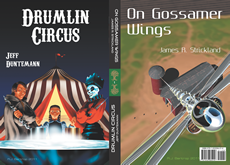
People who have read Drumlin Circus or The Everything Machine (and if you haven’t, please do!) are aware of the Bitspace Institute, a cult on the drumlins world obsessed with returning to Earth. They other themselves by excluding women, wearing distinctive clothes, living in a ritual-rich, monastic sort of setting—and speaking classical Latin among themselves, especially in front of non-Institute people, to further demonstrate their otherness. Here’s a sample, from The Everything Machine:
With one foot set a few decimeters ahead of the other, McKinnon tipped
his head back slightly and shouted his command in the Tongue: “Ego Alvah
McKinnon, Consul! Regulam ordinis nostri violastis! Arma ponite, exite et
ante me flectite!” [I am Consul Alvah McKinnon! You have violated the Rule
of our order! Lay down your weapons, come forth, and kneel before me!]
(McKinnon is the senior consul of the Institute. When he speaks a command, Institute men are required to obey.) The use of Latin is a characteristic of the Institute, so across the novel are short exchanges in “The Tongue” as they call it. I put a translation within square brackets after each Latin section. It’s part of the atmosphere surrounding the Institute, and I want it to be noticed. So in a way, it’s another use of italics as emphasis.
In my YA novel Complete Sentences, Eric’s mother speaks some Polish here and there:
Charlene set down her kielbasa. “Mrs. Lund, How do you say ‘Thank you’ in Polish?”
“Dziękuję.”
Here, that dziękuję is Polish is obvious from context. This isn’t always the case:
It might be too late. Bialek poked at the lock’s keypad. Szczury! Someone had gotten to it first!
You might guess from context that it’s some kind of expletive, and it is. Here, “szczury” is Polish for “rats”. The singular form is szczur. Now, there’s a problem with some words, especially from Slavic languages: If you’ve never seen them before, they could look like typos or evidence of corruption in the underlying file. The word “tak” in Polish means “yes.” Used alone, some readers might think it’s a misspelling of “tack.”
Another issue is that the same word might exist in two languages and mean very different things. In Tagalog (the language of the Philippines) the word for sister is “ate.” “Taco” in Japanese means “octopus.” “Slut” is Swedish for “the end.” There are lists of more here and here. My position is that italicizing a word from another language will warn the reader not to jump to conclusions. What italicization means is “this is a word in another language.” There is no judgment whatsoever in that caution.
To the contrary. English is famous for absorbing words from other languages into itself, essentially “othering” those words away from their origins and dropping them heedlessly into the English stewpot. In a sense, italicizing a word from another language honors it as a part of a language and a worthy culture that should be respected, and not treated as just another word collection that we can pick and choose from to fatten up our English.
All that said, it’s really not something worth fighting over. From what I read earlier today, the AP Stylebook recently picked it up. No big deal; I learned on and remain a Chicago Manual of Style guy. I just wanted to point out that most arguments of this type can go both or many ways, and there are nuances that should not be conveniently ignored in the cause of self-aggrandizement. I’ll keep writing the way I’ve always written. Others may do what they want. English survived Finnegan’s Wake. It’ll survive the nuanced uses of italics, whatever those turn out to be as the years roll on.
Odd Lots
- In response to numerous queries: QBit is still alive, and still pretty frisky, considering that our vet suggested he would be gone by now. Yes, his lymph nodes are still swelling, and we won’t have him for a whole lot longer, but he’s fighting lymphoma pretty well. We’re giving him a supplement called Apocaps, that supposedly accelerates apoptosis in cancer cells. I’ll keep you posted.
- A new study involving more than a million patients pretty much drives the last nail into the coffin of cholesterol alarmism. Cholesterol doesn’t cause heart disease, and therefore statins don’t do people any good. This is a very very big deal. It’s not enough to ignore government-issued nutrition advice. I’d recommend doing the opposite.
- There are 18 volcanoes in the US considered “very high threats.” I have never lived close to any of them, and that was (mostly) deliberate. Arizona has two volcanoes with a threat rating (one “moderate” and one “very low”) but neither of those is within a hundred miles of me. Click through to the PDF; it’s excellent, and will tell you what volcanoes in your state have threat ratings.
- Good article on life expectancy. (Thanks to Wes Plouff for the link.) As I read it, the US is doing pretty well compared to the rest of the world. I wish there were data on life expectancy plotted against habitual hours of sleep per night. My intuition is that people who short sleep die younger.
- 2018’s tornado count is the lowest in 65 years. STORMY, are you still at it?
- Merriam-Webster will show you what words were coined the year you were born, or any arbitrary year from 1500 to the present. On the list for 1952 are stoned, global warming, deep space, modem, nonjudgmental, softcover, field-effect transistor, plotline, sonic boom, and Veterans Day. So what are the cool words on your list?
- We don’t hear much about polar bears these days, in part because they’re thriving, in spite of any changes in the climate that may be happening. Three recent papers cited at the link.
- Our pool water is still at 84 degrees, almost certainly due to a warmish fall (it hit 90 in our neighborhood today) and especially our pool cover. We were in the pool today, and luvvin’ it.
- Best webcomic I’ve seen in some time. Carol and I just finished a whole box of pumpkin spice K-cups, and that may do us for another year. We think that coffee should be light, sweet, and spicy, like life. Goths we are not, evidently.
Odd Lots
- Where have I been? Chasing eclipses and home improvement contractors, for the most part. We found that a lot of people will cut down a diseased tree. The tricky part is finding someone who can dig up the stump. Also, I've been posting very short items on Facebook that in ancient times (Contra is now 19 years old, after all) would have been separate Contra entries. Finally, I've been out of sorts for other, darker reasons. (See below.)
- I will post a long-form entry on the recent total solar eclipse once my colleagues and I put together a cloud site for sharing our photos.
- Intriguing gadget: A flashlight basically printed on a sheet of paper, with two button cells and seven LED lights connected to the printed pattern. Rolling it up closes the circuit and lights the LEDs. But wait…it gets better: Because of the way the pattern is printed, the tighter you roll it, the brighter the light. Now, what magazine will be the first to include a flashlight to read it by on camping trips, bound in as the back cover?
- The sugar industry bribed Harvard University researchers to shift the blame for obesity from sugar to fat. Here's the backstory. I guess it wasn't all Ancel Keys' fault. He had lots of help from some very high places. As a direct result of that bribery, millions of people grew diabetic and died sooner than they should have. How can we guarantee that such things will never happen again? I'll hear your suggestions if you have them; I'm preparing a longer Contra entry on the topic.
- Heh. You don't escape the fattening effects of sugared sodas by drinking them with a high-protein meal. Sugar basically ruins everything.
- Now that it has bought up Whole Foods, Amazon is wasting no time cutting prices at the upscale food retailer, known among its critics as "Whole Paycheck." (Thanks to Instapundit for the link.)
- Great little rant from Jon Gabriel about weaponized offense-taking. In brief: That gun don't fire in the direction you think, bro.
- From the Words-I-Didn't-Know-Until-Yesterday Department: Sortilege, meaning divination (i.e., the prediction of the future) by the drawing of an item or items from a collection. This includes the casting of bones or dice. I always understood this as cleromancy, but as I've discovered, every damfool item in the occult toolkit has at least six names.
- Good long-form article on the Clovis people, and the mysterious (and still disputed) people who were here in North America before them.
- There is now a service that will test you for genes specifically affecting nutrition, and provide advice based on the results. This includes things like food sensitivities and ideal diet. Yes, I'm skeptical, but at least we've begun to move away from the "one advice fits all" fallacy. The more I research, the more I discover that individual differences matter crucially in almost every facet of human health. This has various implications for healthcare, none of them good.
- Nice short sociology piece: We actually have two different elites vying for control of our society, the moneyed and the cultured. My take: Neither is fit to rule.
- Tribalism will be the end of our culture unless we find some way to eliminate it. My thought: criminalize not speech, but attempts to suppress speech. Fine universities heavily for failing to control protesting crowds outside a legitimate event, especially once violence erupts.
- In connection with that, a fine essay by Megan McArdle on the dangers of online mob terrorism.
- It's not just online. Just a few days ago, some crackpot pulled a Denver man out of his car and tried to stab him because the psycho thought his haircut made him look like a Nazi. That probably wasn't Antifa, but it's a mindset Antifa popularized; recall the Antifa philosophy professor who hid behind some women, then jumped out and hit a man from behind with a huge bike U-lock…and went on to hit six other people with the same lock.
- No, I don't generally cover such political ructions here, but this recent violence rattled me a little, and brought to mind China's Red Guards of the 1966-1975 timeframe. Want Red Guards? Because Antifa is how you get Red Guards.
Remembering the Known Unknown, Redux
It happened again. I tried to remember a person (two persons, actually) and remembered several things about them, but not their names. This sounds ordinary enough (especially if you’re a Boomer) but hold on a sec. There’s more.
First, if you’ve never read this entry of mine, it’s might be worth a look. If it’s TL,DR, I’ll summarize: I tried to remember the name of a favorite poet, and failed. However, I did remember that his name was the same as the name of Indiana Jones’ rival in Raiders of the Lost Ark. I couldn’t remember that name either, but I knew it was the same name. After I had gone on to something else for awhile, the name popped up out of nowhere: The poet. The rival.
Clearly, human memory is not a set of SQL tables.
So the other night, I was reading some article online, and it mentioned the hapless Jayne Mansfield in passing, referring to her as a classic “blonde bombshell.” That’s a phrase I hadn’t heard in some time, and after I wondered briefly why there were no brunette bombshells, a peculiar thing occurred to me: There had been two blonde bombshells whose names were odd but very similar, structurally. I remembered that the women themselves were similar, but then again, “blonde bombshell” was a type in its day, and there were many, including Jean Harlow, Marilyn Monroe, and Jayne Mansfield. Ok. I dug deeper, and came up with another weird recall: Their names both had three parts…but no names appeared. Why is it that I could know that two names each had three parts and were structurally similar, without remembering the names themselves?
Two hours later, while I was reading ARs of the mass storage chapter in my Raspberry Pi book, two names surfaced in the back of my head simultaneously:
There’s nothing remarkable about either of them, and as I am not a fan of blonde bombshells to begin with, I had to wonder why I remembered them at all. Then again, I can sing the entire theme song of Car 54, Where Are You? which hasn’t been first-run since 1963. Memory is a weird business–especially when it stops working effectively.
Back in the entry I cited from 2013, I posited that we could think before we could speak, and so we probably store the names of things separately from their attributes. I still think this is true, but I think it’s even more peculiar that I could remember attributes of two names without remembering the names themselves. The key may be that we use different neural machinery to store names and attributes, so if the attributes of names are to be remembered, they get remembered by the attribute machinery rather than the name machinery.
It makes evolutionary sense: Knowing that the guy in the next cave is short, strong as an ox, has a stone axe buried permanently in his skull, and has a bad temper is a survival skill. It didn’t matter that he didn’t have a name when there were only four caves in the neighborhood. The attribute that needed to be remembered when looking his way was “twitchy badass.” Names probably evolved out of attributes; think “Eric the Red.” But the attributes came first. Names came about when the world grew so complex that passing knowledge among peers through shared experience was no longer enough.
Evolution doesn’t replace. It overlays. So all that weird freaky ancient stuff is still down there somewhere, and is more loosely coupled to the newer stuff than we might like–especially when it’s the newer stuff that starts to malfunction first.
Odd Lots
- In order to adfertote plus catuli, you had better facite plus catuli first. A number of very sharp people I know are working on this. Their feckless critics will doubtless help.
- September 12 was the annual peak in hurricane activity. Alas, there were no tropical depressions, tropical storms, or hurricanes anywhere on Earth. And as best I can tell from the National Hurricane Center sit, there still aren’t.
- I said this back in 2010. Now, according to a book reviewed by National Geographic, I was right. I love being right. (Thanks to Bill Roper for the link.)
- Carol and I tried several flavors of this stuff when we were in Phoenix recently, and it’s mighty good in coffee. (I also poured some of the black cherry flavor into a bottle of not-quite-meh Reisling and found it much more drinkable.) The manufacturer told me that Wal-Mart sells it, but we looked in two stores and didn’t find any. However, you can order it from Amazon.
- Here’s a nice article on the world’s first science fiction convention, held in Leeds, England, in 1937. Arthur C. Clarke and Eric Frank Russell were there.
- Reader Scott Schad put me on to a phenomenon he’s discovered on Amazon, in which somebody is concocting fake tech books and publishing them under the titles of popular books, including my own Assembly Language Step By Step. I’m looking into this, but (as if it needs saying) be careful what you buy online.
- Esther Schindler sent a link to the earliest use of the F-word, which appears in 1310. I’m guessing it goes back a little farther than that.
- What are asteroids made of? No snipes or snails, one would hope. However, 810 times the amount of ruthenium in the Earth’s crust sounds really good. (Thanks to Charlie Martin for the link.)
- While we’re talking exotic metals, here’s a YouTube video of gallium melting in someone’s hand. (It’s a slow process; FF to about 4:30, where it starts getting interesting.)
- And another showing what happens when you pour liquid gallium on your iPhone 6. I love the way the guy picks up liquid metal with his fingers and drops it on the phone. Mercury doesn’t work that way. Then again, mercury doesn’t eat aluminum phones, either.
- Gallium became a short-term character in Metal Men, the only comic book I ever paid my own money for and read regularly.
- From the ya-gotta-see-this department: My old friend Doug Rice was a designer and storyboard artist on a cartoon filk parody of the Macarena, starring the Animaniacs.
- Take a look at Pastime Projects for vacuum tube ham radio kits, mostly centering around the 6V6 power pentode. There’s an associated blog for the site, and it’s worth reading if tubes are your thing.
Odd Lots
- Amazon has announced and should now be shipping a new Kindle Paperwhite with 300 DPI resolution. That’s a magic number; it’s the resolution of most inexpensive laser printers, and will make reading on e-ink mostly indistinguishable from reading b/w paper.
- The physics behind those new “no-stick” ketchup and mayonnaise bottles.
- Egad: The 2015 USDA Dietary Guidelines has omitted cholesterol from its list of “nutrients of concern” and eliminated its upper limit on total fat consumption. People, we are winning. Ancel Keys’ corpse has been exhumed and is about to be burned at the (heavily marbled) steak.
- Reason ranks states in terms of numbers of libertarian citizens. Colorado is #16. Arizona is #10.
- Amazon released a figure for June page-reads that allows us to calculate the KU per-page payout. It comes to 0.6 cents. For a 500-page novel (again, remember that Amazon defines what a page is, and the algorithm is still unclear) an author realizes $3.00. That’s actually a good chunk more that what the author would get for a $2.99 sale, and fairly close to the author payout for a $3.99 sale.
- More on author earnings: Agency pricing for ebooks, which large publishers fought so hard for, looks like it’s being a disaster for them. Higher prices have meant lower sales; in fact, Big 5 ebook unit sales were down 17% in the first four months of 2015.
- 30% of ebooks sold in the US do not have ISBNs, and this seriously distorts industry reporting on ebook sales. Conventional industry metrics don’t count ebooks without ISBNs. I have lots of ISBNs and intend to use them—hey, they’re paid for—but this makes me wonder if it really matters.
- 23 newly coined words for emotions that we feel but can’t describe. Carol and I experienced Chrysalism the other day, and anecdoche seems to be the American Way.
- Most MMJ edibles are badly labeled, and contain less THC and CBD than they imply. Colorado has a testing program in place, but it’s new and not everyone is convinced the tests are accurate. So it still pays to be careful, do a little at a time so you know what you’re in for, and try your best not to pull a Maureen Dowd.
- It’s both.
- Before you shoot your mouth of about the Confederate flag, maybe you should learn a little bit about the several Confederate flags.
Odd Lots
- Sales of the Raspberry Pi board are closing in on four million. Wow. I’m an optimist, but I’ll confess that I wasn’t that much of an optimist!
- Some ISPs have apparently begun blocking encrypted traffic (especially VPNs) because VPNs make it difficult to throttle traffic based on what that traffic is. Basically, a user of Golden Frog’s VPN software started streaming Netflix in the clear and saw all sorts of stutter and other signs of throttling; the user then streamed Netflix through the VPN and the signs of throttling vanished.
- Internet toll roads? More evidence.
- Here’s a 3-D printed pump-gun that folds and fires paper airplanes. This should be on the cover of the Hammacher Schlemmer catalog before Christmas… (Thanks to Frank Glover for the link.)
- Stanford University reports that GMO foods appear not to bother farm animals at all; maybe we should look harder for cause and effect in humans. Conventional wisdom can be deadly.(Thanks to Jim Fuerstenberg for the link.)
- Deadly? Ancel Keys’ fraudulent science (which soon became conventional wisdom, once government got behind it) has killed many millions. Fat is good for you. Sugar is deadly. (Thanks to Tony Kyle for the link.)
- Adobe’s Digital Editions ebook reader sends your reading logs back to Adobe. As best I can figure, it’s DRM gone nuts–which is precisely what you would expect of Adobe. Don’t use Digital Editions.
- Whoops. Silly boy. Adobe isn’t the only one doing this. Once it becomes general knowledge, more and more people will pirate ebooks and sideload them, which will ultimately hurt publishers and retailers more than covert data mining will help. (Thanks to Esther Schindler for the link.)
- Lazarus/FreePascal 1.2.6/2.6.4 has been released. The damned thing is getting good.
- The Great Lakes’ water temps are about four degrees colder than average, (and six degrees colder than this time last year) after some lakes didn’t shed the last of their ice until June. It’s going to be an interesting winter here on the weather front.
- Scott Hanselman thinks that I might as well be Thomas Watson. (Go to 1:30 on the video and watch for a bit.) Alas, not only do I not think there will never be more than five computers in the world, there are already over five computers in this room. (Thanks to Ben Oram for noticing.)
- 18 English words that should never have gone out of style. “Spermologer” doesn’t mean quite what you’d think. Nor do “pussyvan” and “wonder-wench.” Me, I’d add “cerate” to the list. Look it up. (Thanks to Dermot Dobson for the link.)
Odd Lots
- Lenin’s head is missing. It was last seen rolling around a forest near Berlin 23 years ago, but nobody can find it now, even though it weighs three and a half tons. (Thanks to Pete Albrecht for the link.)
- Evidently Lenin loses his head a lot. Somehow that doesn’t surprise me. Shame it didn’t happen in 1890 or so.
- How far does $100 go in your state? (Backstory here.) Be careful; the figures are state-wide averages. It’s much worse in urban cores. (Thanks to Tony Kyle for the link.)
- If you’ve never seen one, here’s an ad-farm article. I’ve often wondered if these are machine generated, written by people who don’t know English well, or machine-obfuscated copies of legitimate articles, intended to duck news providers’ plagiarism bots.
- Wired volcanologist Eric Klemetti reports that a swarm of small earthquakes may presage an eruption from Iceland’s Barðarbunga volcano. The volcano is interesting because its name contains the ancient letter eth (ð) something I don’t recall seeing on Web news sites in a lot of years. To generate an eth on Windows, by the way, just enter Alt-0240.
- Wired misses as often as it hits. One of its supposed futurists is telling us that the educated elite should be able to license reproduction, and dictate who can and who cannot have babies. By the way, his description of who is unfit to reproduce sounds a lot like the nonwhite urban poor. Articles of this sort are about as wise as “The Case for Killing Granny,” which put Newsweek in a world of hurt back in 2009.
- To make you love this guy even more, let me quote a summary of presentation he did on Red Ice Radio: “Zoltan argues that ultimately technology will be helpful to the ‘greater good’ and must be implemented, even if by force and even if there are causalities along the way. In the second hour, Zoltan philosophizes about technology as evolution and luck as the prime mover of the human experience. He talks about maximizing on the transhumanist value for the evolution of our species. We parallel transhumanism with religious thinking. He’ll speak in favor of controversial subjects such as a transhumanist dictatorship, population control, licenses to have children and people needing to justify their existence in front of a committee, much like the Fabian Socialist George Bernard Shaw’s idea.” If I were a transhumanist, I’d be ripping him several new ones right now. Or is transhumanism really that nasty?
- Nobel laureate physicist Frank Wilczek is not proposing thiotimoline, nor anything else (I think) having to do with time travel. He believes that he’s broken the temporal symmetry of nature…which sounds devilish and full of interesting possibilities. As soon as I figure out what the hell it all means, time crystals will land in one of my hard SF concepts in -5 milliseconds.
- Michael Covington reminded us on Facebook that there are a surprising number of plurals with no singular form, including kudos, biceps, suds, and shenanigans. (I do wonder, as does Bill Lindley, if the very last bubble in the sink is a sud.)
- That discussion in turn reminded me of a concept for an END piece in PC Techniques that I took notes on but never wrote: the KUDOS operating system, which lacks error messages but pays you a compliment every time you do anything right. In 1992 I was thinking of purely textual compliments, but these days I imagine a spell-checker that plays “Bravo!” on the speakers every time you spell a word correctly. Wouldn’t that be fun?
Odd Lots
- Someone asked me via email the other day: How thick is 16 gauge aluminum? I’m old: My first impulse was to grab my caliper and measure some. My second impulse was to google it. This answers the question, for steel as well as aluminum.
- The page cited above is part of a large and fascinating Web compilation called “How Many?” and it’s a dictionary of measurement units. Other tabulations include shot pellet sizes and the Danjon scale for lunar eclipse brightness.
- Metallic cesium figures, um, explosively in my novel Drumlin Circus. You can evidently distill it on your barbecue grill. I’m guessing you shouldn’t do that right before a thunderstorm, however. (Thanks to Jim Strickland for the link.)
- Speaking of explosions, here’s a map summarzing the legality of fireworks by state. I thought more states restricted them than actually do. (Thanks to Pete Albrecht for the link.)
- It’s not brand-new, but I stumbled on the Actobotics product line in the latest edition of Nuts & Volts. It’s a very nice Erector/Meccano-ish system with more robust parts & real metal gears. No, not cheap–but neither was Meccano, at least on the scale I used it when I was building things like The Head of R&D.
- If you’re interested in following the progress of the recent collapse of sunspot activity, don’t forget Solar Ham. More data than SpaceWeather, and you don’t to know anything about amateur radio to find it useful. Given that the peak of the current solar cycle was probably this past March, coming down so hard so fast is something of a phenomenon.
- There is a utility that finds loops in videos suitable for making animated GIFs. Sometimes technology advances the human condition and sometimes, well…
- There’s something called the Northern Cities Vowel Shift, and if the maps are to be believed, I may be speaking it, though it sounds New Yawkish to me. This is a tweak on Inland North American English. Somebody oughta do an app that can tell me what accent I actually have. I’m a Chicagah boy but have been told I don’t sound like one. (Thanks to the Most Rev Sam’l Bassett for the link.)
- Pete Albrecht sends us a list of current and defunct bookstore chains worldwide. I spent so much money at Kroch’s & Brentano’s 40 years ago that the place should still be around but, alas, it’s not.
- If you’ve secretly longed to see a photo of Alfred Hitchcock eating a giant pretzel, or classic mustard ads of the 1950s, well, it’s all here. (Yes, I’m a sucker for vintage weirdness, but this is good vintage weirdness.)