Jeff Duntemann's Contrapositive Diary Rotating Header Image

ebooks

RIP Mass-Market Paperbacks

When I saw three articles on the death of mass-market paperbacks (MMPBs) in the last couple of weeks, I knew something was up—and the articles said what was up, if not why: ReaderLink, the largest book distributor in the US, announced that it would stop distributing mass-market paperbacks. The piece from The Guardian (an affiliate link) mentioned ebooks in passing as one factor in the collapse of the format. (The other two articles did not mention ebooks at all.) A Kindle Paperwhite is more or less the same size as an MMPB, and thinner. Furthermore, a lot of people—Carol included—now read ebooks on their smartphones.

MMPBs first appeared in the 1930s, as a means of spreading book retail sales beyond traditional bookstores. MMPBs were designed to be sold like magazines: In drugstores, grocery stores, gas stations, dime stores, train stations, and other places where casual, low-value sales occur. They were cheap to broaden the reader base beyond trade paperbacks and hardcovers. When I first began buying my own books with allowance money in high school (1966-70) MMPBs started at 60c or 75c, with fat ones (like Dune) sometimes 95c. (The obese 1970 MMPB of Blish’s Cities in Flight cost a stinging $1.25.)

How do I even know this? I still have the books. I have hundreds of MMPBs on my shelves, many going back to my high-school days. They look amazingly good for a peculiar reason: I coated most of them with my mom’s ConTact self-adhesive transparent shelf plastic. I don’t pull them off the shelf much anymore. When I have tried to read them in the past five or ten years, the yellowed and sometimes crumbly pages came loose in my hands.

I wasn’t surprised. Like the magazines that inspired them, mass-market paperbacks were intended to be read once and thrown away.

But there’s another issue that none of the articles I linked to mentioned at all: The audience is aging, and aging eyes often can’t read MMPBs comfortably. I remember when I tried to read Charles Harness’s The Ring of Ritornel two or three years ago, that I needed my strong readers to make the near-microscopic text readable. And even then, while possible, the reading was nothing anywhere near comfortable. Ink fades over time, and type contrast matters.

I’ve asked several of my contemporaries in their 70s and beyond, and they agree: The type is too small. It was small to make the books cheap. Now they’re mostly unreadable.

The answer is obviously ebooks. I don’t buy print books very often anymore, and when I do, the size of the type is often the decision hinge. I have two Samsung Galaxy Tab tablets, which I read ebooks on for a simple reason: I control the size of the type. This doesn’t work well on books containing photos/graphics or stuff like source code, but print books like that are often twice the size of MMPBs or more. And I don’t generally sit down and read print books like The Rust Programming Language from start to finish in long stretches. I read them until my eyes start to hurt.

Alas, the only serious downside to the death of mass-market paperbacks is that a lot of them haven’t made it to ebooks and probably never will. Most of the short story collections I read in high school are just gone. Groff Conklin did a lot of good anthology work. Amazon carries the crumbling print editions.

Anyway. Ebooks are the answer. My Galaxy Tab S9 is full of ebooks, many of which cost less than $5. Those old MMPB covers on my shelves remind me of being young. Sooner or later I’ll have had enough of that, and they will feed the dumpster. I just wonder what will take their places on my shelves.

“Whale Meat,” Second Edition

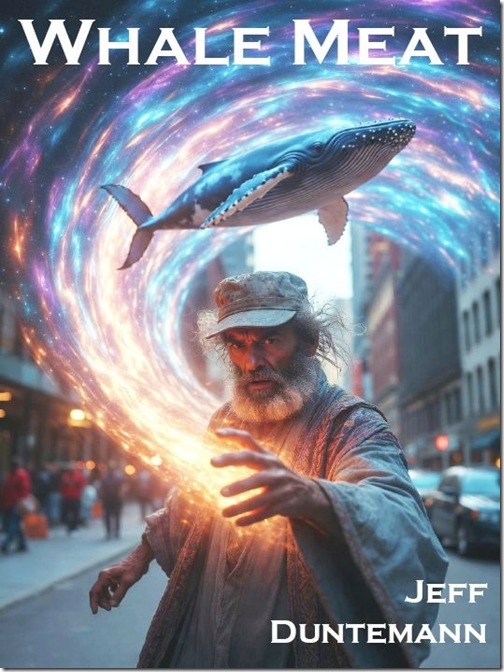
WhaleMeat AI Cover Mark 2

Amazon has just approved an update to my ebook novelette “Whale Meat,” which has been available on Kindle for 99c since 2011. Some of you have probably read it. Why did I update it? Glad you asked! There’s a story about the story. Here goes:

I was enthusiastic about Kindle since Amazon first made it available in the late oughts. I was already publishing paperbacks of things like Carl & Jerry via lulu.com, but ebooks finally seemed to be coming into their own. I needed a story to test how the Kindle system worked. I would be creating book-length ebooks soon enough, but the first one would ideally be shorter than books, and not one of my best-known works. “Whale Meat” shook a fluke at me to get my attention, and so it was that the story became my very first Kindle publication.

The story itself was not new. In fact, I wrote the first draft in early 1971, when I was still 18 years old. It was the first fantasy story that I had ever completed. I was trying to write something that didn’t reek of King Arthur or the Tolkien/Lewis canon. I made it contemporary, set in urban Chicago, and whereas it was about two witches, they were not wart-equipped elderly women in pointy hats riding brooms.

No. They were hippies. Or that’s what they wanted to look like. It was a tricky business, as they were born in the 1300s and were immortal. So in pondering what it might be like to be immortal, I hit upon a possible story gimmick: Telling the story in present tense. If you’ve been alive for centuries, maybe you see the world as a perpetual Now. And that’s how I told it.

I had not yet sold a story into a professional market, but I had a book by Writer’s Digest and knew how it was done. I sent it out to several magazines, including, sheesh, Analog. It came bouncing back from all of them with little or no delay. After five rejections, I started wondering why nobody seemed interested. Maybe it was that weird way of telling the tale in present tense. So I rewrote it in conventional past tense, and a few years later sold it for $35 to Starwind Magazine, published by Ohio State University. It appeared in their fall 1977 issue.

Now, I wasn’t the first to invent present tense in storytelling. John Updike generally gets that honor, beginning with his well-known novel Rabbit, Run. But as weird as it seemed in 1971, in 2026 it’s used by a great many authors, and sounds modern and savvy. So last summer I rewrote the story, top-to-bottom, in present tense. I cleaned it up and fleshed it out in other ways as well. My intention was to replace the 2011 “Whale Meat” on Amazon with a newer, present-tenser edition.

All I needed was a cover.

So I attempted the obvious: Get an AI to draw a cover for me. I subscribe to X, and get the Grok AI as part of the package. So one afternoon a few days ago I gave Grok a prompt: Draw a scruffy middle-aged male witch in modern Chicago, summoning a whale through hyperspace.

It drew me a scruffy man…in a black robe and pointy black hat. Heh. No sale. I took a breath and gave the prompt more thought: Draw a scruffy gray-bearded middle-aged sorcerer wearing a floppy work-cap in modern Chicago, summoning a whale through hyperspace. It drew pretty much what I’d asked for. I saved that image to disk and asked Grok to regenerate using the same prompt. I got another image much closer to what I wanted. I spent some fascinating minutes regenerating images, all of which were different, and saving them to disk until I had about 15. After a certain amount of staring, I chose the image you see above. Ok, the prompt is a spoiler, but I’m guessing whoever might have enjoyed “Whale Meat” among Contra readers has already read it.

Now, this was an experiment. I’ll gladly pay a human artist for a cover on a novel-sized book. This was a 9,000 word novelette that I sell for 99c. I wanted to see how close an AI could come to something that resonated with the story. Grok did pretty well. When I uploaded the new text and cover, Amazon asked if any part the ebook was generated by AI. I clicked Yes. Other writers I know are doing this. I think Amazon is just gathering stats, and they approved the new edition a couple of hours ago. The first edition sold 55 copies across 15 years. This one may do better. We’ll see. If you read it, please drop a review on Amazon. Thanks!

Firejammer: Go Get It!

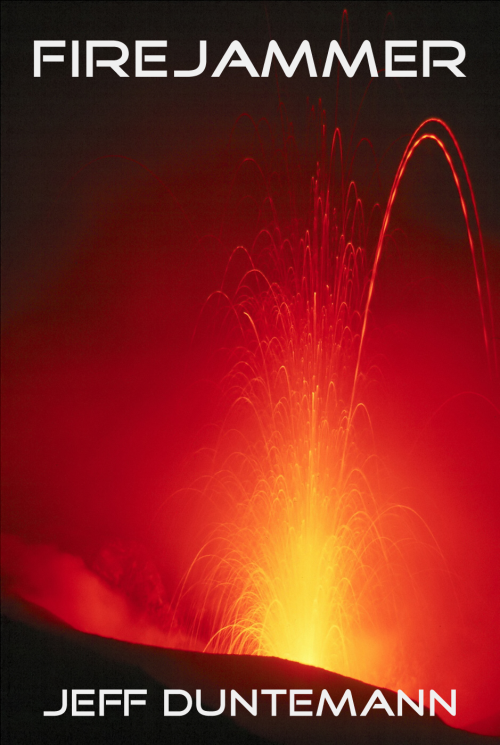
Ebook Cover with Type - 500 Wide.png

I’m not the fastest writer in the world. If I were even modestly faster than I am, I would be a lot better-known. So as a side project while I hammer on my new fantasy novel Dreamhealer, I went back to a short novel that sat in a box for forty years. After rather more work than I expected, I uploaded it to Kindle yesterday, and Amazon approved the ebook edition last night. (The print edition is still awaiting approval, since I had to fix an issue with bleeds and the cover image.)

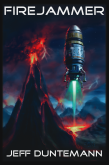
Behold Firejammer. I hate to call it my “new” novel, but I’m sure it’s new to all but a vanishingly small number of my readers. $2.99 from the Kindle Store, no DRM. It’s a humorous romp very much in the style of Keith Laumer, the author I imitated heavily while just getting out of first gear as a writer, back in high school. I dedicated it to him, since no other writer (with the possible later exception of Larry Niven) influenced my fiction as much as he did. Firejammer‘s mission is pretty much the same as the mission of most of Laumer’s writing, especially his Retief stories: Give the reader a wild ride, with some laughter thrown in for good measure. No sermons. No literary pretensions. Just good crazy fun.

As with most of the things I write, the story has a backstory. In 1977, I began selling stories to the late George Scithers, editor at Isaac Asimov’s Science Fiction Magazine (IASFM). Some time in 1978, he told me that he and his publisher were about to launch a new SF magazine, one slanted to a slightly younger audience, and intended to capture the atmosphere of some of the better SF pulps, like Planet Stories. It would be called Asimov’s SF Adventure Magazine. He asked me if I had any suitable concepts. Inside my head something was screaming hell yes!!! but I politely answered that I did, and would get to work on it immediately.

I did. I had gotten an idea in high school while turning into the parking lot at a Target-like store called Turn-Style (now long extinct) at Harlem & Foster Avenues in Chicago. (Yes, I remember the moment that clearly.) I was 16 at the time, and took some notes on it, but never actually started writing.

Now that I had a nibble on it, I started writing. I wrote. I wrote. And I wrote some more. I was still writing when the first issue of the new magazine appeared. I was still writing when the second issue appeared. I finished it in early 1979. I sent it to George Scithers, who informed me that, alas, the magazine had been canceled. I did due diligence and sent it to all the other existing SF magazines, all of which rejected it. The reason (where stated; I got a form slip from Fantasy & Science Fiction) was that it was just too long, by about, well twice. Maybe more. And yes, at 27,000 words, it was sitting square in the middle of what I would come to call “that hideous length.” It was too long for the magazines and too short to call a book. I wasn’t sure what to do with it. However, in 1979 I had other things on my mind: Xerox had offered me a promotion and relocation to Rochester, NY. So it went into a box of manuscripts and didn’t see daylight again for a long time.

It came out of the box in 2000, when POD services like Lulu.com began to appear. I trimmed it down to about 25,000 words and did some heavy edits. I even started talking to artists about a cover, figuring that I could throw in enough of my previously published short works to bring it up to a book of about 70,000 words or so. I played with that idea for a year or two. Then Coriolis collapsed, and once more, I had other things on my mind, like moving to Colorado. So back in the box it went, where it stayed until several years ago. I did some more rewriting, then had to set it aside (back into the box it went) because we had decided to move back to Arizona. That was a multi-year endeavor, and so totally involving that I had completely forgotten I rewrote the story in Colorado in 2015. I expected to take a piece of what (by now) I considered juvenalia, and rewrite it for the modern market. When it came out of the box earlier this year, I realized that I had already rewritten it.

So what was I waiting for? As time permitted, I created a print book design, tinkered with the layout, made some more edits, laid it out as an ebook, and finally found a cover image on WikiMedia. The image is an eruption of Stromboli, in Italy. Stromboli is my all-time favorite volcano. (Can anyone guess why?) I resisted my temptation to keep tinkering with it, but resisting temptation slows me down even when successful. So more tinkering happened.

Which brings us to yesterday’s uploads. Amazon approved of the ebook cover and body. I’m still waiting for approval on the paperback. The ebook is up there on Kindle and ready to (molten) rock.

Now it’s back to work on Dreamhealer, which is well on and should be finished this summer. So in the meantime, have fun–and don’t forget to leave a you-know-what.

Thanks!

Odd Lots

New Revision of FreePascal from Square One Is Now Up

I just uploaded a new, corrected and expanded PDF ebook edition of FreePascal from Square One to my website. It’s free, and (remarkably) it’s closing in on completion. It’s laid out for the A4 paper size, largely because there’s so much Pascal activity outside the US. You can read it on a screen, or else print it to paper to put in a binder. It’s currently at 294 pages, and when complete I hope to keep it under 325 pages, since that’s a whole lot of paper to print, punch, and bind.

Still to be covered are the standard string functions, locality and scope, and simple file/printer I/O. That’s not a lot of material, and some of it has already been rewritten and edited.

For those who haven’t heard of it before, let me describe the project: I’ve taken my 1993 book Borland Pascal 7 from Square One and heavily rewritten parts of it for FreePascal. Borland Pascal 7 from Square One was the fourth and last edition of my very first technical book, Complete Turbo Pascal, published in May, 1985. That title, by the way, was forced on me by the (now extinct) publisher. Its original manuscript title was Turbo Pascal from Square One. The four editions taken together were in print for almost ten years and sold about 125,000 copies back in the 80s and early 90s.

The book’s mission is to be what Assembly Language Step By Step is to assembly language: An absolute beginner’s tutorial on programming in Pascal. This includes people who have not yet learned what programming is and have never written a line of code in their lives. I start by explaining the ideas of programming, and move from there to Pascal. FreePascal is my compiler of choice, largely because it’s free, but even more because it comes with the Lazarus IDE, which contains a superb GUI builder very similar to the one present in Delphi. FreePascal from Square One doesn’t cover Lazarus beyond installing it and using the code editor. Specifically, it doesn’t cover the GUI builder or Windows programming generally. The example programs all run in the console window.

More than half of the original book explains things that no longer apply: DOS programming, overlays, the Borland Graphics Interface, tinkering the interrupt vector table, and so on. All of that is gone. I’ve made a decision to stop just before OOP, and will begin a Lazarus book with a thorough explanation of OOP and software components. I’m also leaving out pointers, since the topic is heavily intertwingled (to use a wonderful Ted Nelsonism) with OOP.

I intend to keep writing books of new material about Lazarus as time allows, and will sell them as PDF ebooks and spiral-bound POD paperbacks. No timetable; I’m trying to write SFF novels mostly, and will work on Lazarus projects as time allows. We’ve spent the last couple of years working on our Scottsdale house, but that’s largely finished, and I expect a lot more free time in the next few years. So stay tuned. I may do one more “unfinished” upload, but after that I expect to put the wraps on it.

Rant: The Dragon Awards and the Convergence of Exiles

Forty years ago exactly, Carol and I were there in the throngs of MidAmericon I. The con was a celebration of Robert A. Heinlein and (by implication) all of hard SF. It was a tremendously popular con. The newly adult Baby Boomers were pouring into SF and conventions by the thousands. Many people began to fret that these enthusiastic new fans would swamp the longstanding traditions of fandom and turn fandom into something that fandom itself wouldn’t recognize.

Never one to let a supposed crisis go to waste, con chair Ken Keller had the concom raise prices to levels never seen before, finally $50 at the door without an advance registration. (This would be $211 in 2016 dollars.) Keller did something else: He tried to pitch the con as strictly for fans of capital-S capital-F Science Fiction, and stated pretty clearly that “fringefans” (that is, Trekkies and gamers and media fans generally) would find the con boring and should stay away. I don’t know Keller and I’m not sure how serious he was; it sounded like a publicity stunt even then. Lots of people made fun of him in the runup to the convention, myself included. I wrote several filk songs mocking MidAmericon, and one specifically mocking Keller.

At the time I thought it was just some guy throwing his weight around, and I doubt anybody gave much thought to the question: What if they really do go away? Heh. Guess what? In 1987, the first DragonCon was held. During the years since then, Worldcon attendance wobbled around a few thousand truefen, while DragonCon (and other media cons like ComiCon) absolutely exploded. At this writing, media cons routinely out-pull Worldcons by a factor of ten or more. (Sometimes a lot more.) By 2015, ComiCon San Diego had 167,000 people in attendance. Sasquan, the 2015 Worldcon, had…3,418. 2% of ComiCon.

Alas, across these past forty years, Worldcon has become a rounding error.

I’ve never been to a media con and I don’t have first-hand knowledge, but seeing reports from other authors, it’s become clear that media cons are not entirely superhero cosplay anymore, if they ever were to begin with. There are programming tracks on purely textual SF and fantasy, with author guests and signings, and all the stuff we used to enjoy doing at Worldcons.

Ok. It took forty years, but media cons have now matured enough and broadened their focus enough to give birth to a new award that touches on most aspects of the creative fantastic, including textual SF and fantasy. The Dragon Awards were presented yesterday. The list of awards has been posted on the DragonCon site. The award is a popular-vote award rather than a juried award like the Nebulas. It’s a fan award, nominated by fans and voted on by fans. How many fans exactly has not yet been released, though I hope numbers will come out eventually.

What struck me as significant about the Dragon Awards is that there are seven different categories for textual novels: Best SF, Best Fantasy, Best YA, Best Military SFF, Best Alternate History, Best Apocalyptic, and Best Horror. (There are, as you might expect, Best Graphic Novel and Best Comic Book categories as well.) There are no awards for short fiction, no art awards, and no fan awards. I think one or two art awards would make sense, and with some luck we’ll have those someday. I’ll give them some time to get it right. This was the award’s first year, after all.

Even though I’m way behind in my reading because of the Big Move, several authors on the winners list are people I have read in the past and much like, including the late, great Terry Pratchett, Larry Correia, John C. Wright, and my friend Brian Niemeier. What these four authors have in common (perhaps with others like Nick Cole whom I’ve not yet read) is a knack for telling a damned fine yarn without getting mired in identity politics or self-conscious message pie. Furthermore, Brian Niemeier won the award as an indie, with his self-published second novel, Souldancer.

If the Dragons are any reflection of the shape of media fandom, one of my longstanding suspicions has been confirmed: Media fandom is absorbing traditional SFF fandom. Traditional fandom has become fussy, elitist, and ideologically uniform to the extent that there is active hostility toward anyone who doesn’t either salute the progressive left or stay fastidiously quiet. This was not always the case, and I used to count among my friends many on the left, some of them very frank Marxists. (Some are still my friends. Others have called me a fascist or some other damfool thing for my Puppy sympathies and are long off my roster.) We used to have lively discussions of various political issues at cons, and nobody went home mad. But that was the 70s. I had hair, and fandom was young, tolerant and diverse. It was a short time comin’, and it’s been a long time gone.

At MidAmericon II last week, the concom ejected Dave Truesdale of Tangent Online for making several panelists…uncomfortable. (Really. I am not making this up. It’s in the Code of Conduct.) I heard the audio of his schtick and read many descriptions of the panel itself. The schtick was funny. Yes, Dave was mocking political correctness, just as I was mocking Ken Keller back in 1976. Keller didn’t throw me out of the con; I’m pretty sure he was too mature for that sort of nonsense. MidAmericon II has a code of conduct so broad that it basically allowed the concom to throw out anybody they didn’t like. Suppose I had gone to a panel moderated by John Scalzi and he made me uncomfortable. Would they throw him out on my complaint?

Hang on. I’ll stop giggling in a minute or two…

Ok. There. Whew. [Blows nose. Is glad he wasn’t drinking Diet Mountain Dew.] The point I’ll close with is something we should have learned forty years ago: If you abuse and insult people, they will leave, and avoid you from then on. Back in 1976, MidAmericon I insulted media fans, and little by little, they left. More recently, SF’s Insider Alphas have been insulting people who dare question progressive orthodoxy in fantastic literature, and those people are leaving. I didn’t expect that the two groups of exiles would converge, but that’s what appears to be happening. A young, diverse (see Sarah Hoyt’s description linked to above) and ginormous fandom is coalescing outside the fandom I grew up with. It isn’t conservative in any identifiable way. People aren’t leaving fandom because it’s almost exclusively left-leaning. (I recall it leaning strongly left forty years ago.) They’re leaving because fandom is now intolerant of dissent, and because far too many in fandom demonize all opposition. That’s not the left wing I encountered during the Vietnam era in the ’70s and once identified with. That’s just tribalism in a fandom costume.

If media cons remain at 100,000 plus attendance levels, I’ll have some issues, because crowds that big make me twitchy. However, some interesting things are happening. The people who created Phoenix ComiCon have created a new, smaller, and more focused event called Phoenix Fan Fest. Its emphasis is on comic books, and on interaction between comics creators and their fans, with a mere 15,000 or so attendees. If the ComiCon creators can break out comic books into their own event, why not textual SFF? They could do it if they wanted to. Given the emergence of the Dragon Awards, my guess is that sooner or later, they will.

At that point, the schism becomes complete: 5% of fandom will remain grumpy and exclusionary. The other 95% will just get together–in events both large and, well, less large–and have fun in one another’s company.

That’s not a wish. That’s a prophecy.

Another Worldcon, Another Bonfire

So another Worldcon is now history, and people immediately began asking me what I thought. When Kansas City won the 2016 bid as MidAmericon II a few years ago, I’d had some hopes of attending. Then we decided to move to Phoenix, and our near-term lifestyle choices narrowed radically. Next year the con is in Finland, which would be a cool trip, but…well…no.

So all I know is what I’ve heard. And most of what I’ve heard about is, once again, focused on the Hugo Awards. Here’s the official summary. I wasn’t particularly surprised by any of it. Each of the three major factions won a little and lost a little. It’s a complicated business, and I’ve written several popular entries on the subject. If you’re coming to the Puppies Saga for the first time, you should probably read what I’ve written in the past:

The Human Wave, Sad Puppies, and SFF Monoculture, Part 1

The Human Wave, Sad Puppies, and SFF Monoculture, Part 2

The Human Wave, Sad Puppies, and SFF Monoculture, Part 3

The Human Wave, Sad Puppies, and SFF Monoculture, Part 4

The Human Wave, Sad Puppies, and SFF Monoculture, Part 5

Rant: Sad Puppies vs. Anti-Puppies, as the Kilostreisands Pile Up

Rant: You Can’t Shame a Puppy

Sad Puppies Summary and Wrapup

Rant: The Lasting Legacy of the Sad Puppies

Most of what I’ve linked to above applies to 2016, even though I wrote it all last year, and what I wrote focused on Sad Puppies 3. There was a Sad Puppies 4 campaign this year, coordinated by Kate Paulk, Sarah A. Hoyt, and Amanda S. Green. I wrote about that earlier this year, when the 2016 nominations appeared:

Sad Puppies 4 and the Doomsday Slate

As you can see from the marvelous SP4 logo from Lee “Artraccoon” Madison, the SP4 motto was “The Embiggening.” The goal was to bring still more people to Worldcon and the Hugo Awards process, as a means of fighting the worsening numeric irrelevance of the con and the awards. The other, more subtle goal of SP4 was to combat the ideological monoculture of Hugo-nominated fiction, art, and media, by nominating works and people outside the narrow boundaries of what’s acceptable to the ideological progressives in SFF.

Mike Glyer did a very good comparison of the final ballot against the Sad Puppies and Rabid Puppies lists back in April. Vox Day got 64 of his 81 recommendations on the final ballot, which I found nothing short of astonishing, especially considering some “poison pill” items like Chuck Tingle’s “Space Raptor Butt Invasion” and an episode of My Little Pony. Sad Puppies didn’t do quite as well, placing only 36 out of 80 recommendations on the final ballot.

A sidenote: I do not use the term “SJW” (social justice warrior) for a couple of reasons, which I’ll explain here on Contra at some point. Basically, it’s about accuracy and the objective meanings of words.

So what happened at MidAmericon II? These are the major items:

  • Sad Puppies 4 brought a significant number of new memberships to Worldcon. Attendance figures have not been released at this writing, but 4,032 valid nomination ballots were cast, and 3,130 valid voting ballots. That’s about twice last year’s numbers. Obviously, not all of those additional people were Sad Puppies supporters, but many of them were certainly APs (Anti-Puppies) who might not have joined except to counter the Puppies threat.
  • Virtually all of the winners were people and works favored by the Worldcon Elite and their loyal followers.
  • Vox Day continued his efforts to get the Worldcon community to destroy its own Hugo Awards by voting the doomsday slate of No Award over anybody recommended by either the Sad Puppies or the Rabid Puppies, or anything published by Vox Day’s publishing company, Castalia House. In the process, they gave him a fortune in absolutely free publicity, which he promptly used to build Castalia’s readership. I don’t know Vox and certainly don’t agree with all his positions, but I marvel at the hammerlock he has on his opponents’ attention. They. Just. Can’t. Get. Enough. Vox. Day.
  • MidAmericon II utterly soiled itself by expelling Tangent Online‘s Dave Truesdale from the con because he made several members of the Worldcon Elite…uncomfortable. Rob Kroese wrote up an excellent summary of that little disaster earlier today, and I won’t attempt to summarize here. Read The Whole Thing, as Glenn Reynolds says. Even Moshe Feder, definitely of SFF’s left wing, thinks that Truesdale did nothing even close to warrant expulsion from the con. As with Vox Day, Dave Truesdale got a fortune in free publicity. MidAmericon II basically lit a bonfire and threw itself into the flames.
  • The con venue made hotel room parties almost impossible, and so the much-anticipated Sad Puppies party had to be held sub rosa. I hope this isn’t a trend in con venues. Much of what we used to go for in the 70s and 80s were the room parties.

I’m not sure what more could be said, since I wasn’t there. Worldcon continued to make more enemies. John Scalzi smugly insists that the Puppies should all go home, a sentiment tweeted emphatically by the enigmatic Brianna Wu, who says that SF is her home, and not your (the Puppies) home. Howzat again? I was published and a member of SWFA before she was even born. Sheesh.

Scalzi has said more than once (and he isn’t alone) that Worldcon management should have the power to toss out any Hugo ballots that show evidence of slatework. Oh my, what could possibly go wrong? In essence, he and many others want the Hugos to become a juried award, with their people and only their people on the jury. He wants Sad Puppies supporters to leave the SFF fan community, perhaps not realizing that a great many of them already have, taking their money, their energy, and their insights with them. The great irony of the Worldcon progressive wing calling for more diversity is that diversity of worldview is quickly vanishing from Worldcon. It’s all progressive, all the time, all the way down.

To them that sounds like victory. To me and many others, it sounds like a bonfire.

Sad Puppies 4 and the Doomsday Slate

SP4 Logo 500 Wid.jpg

Earlier today I sensed a great disturbance in the Internet, as though millions of heads had suddenly exploded in anguish. Oh, wait–today was Hugo Nominations day! So I took a quick look around, and…

…the Puppies had done it again.

I would try to analyze the numbers here, but the folks over at Chaos Horizon have already done it for us. Check back there over the next few days; I suspect a lot more analysis is coming.

My first insight: Only novels get any respect in the SFF universe these days. 3,695 people nominated in the Best Novel category. The next category down only got 2,904 nominations (Dramatic Presentation, Long Form) with ever-slimmer pickins’ after that. Barely a thousand people nominated for the Best Fan Artist category.

The really good news is that there were 4,032 nominating ballots cast, roughly twice what Sasquan got last year. It’s impossible to tell where those new people came from, but whatever their provenance, I’ll bet MidAmericon II isn’t complaining about all that delicious money. That was the idea, after all: The subtitle of Sad Puppies 4 is “The Embiggening.” I was not alone last year in suggesting that the only thing really wrong with the Hugo Awards is that almost nobody participates. 4,000 ballots sound like a lot, but when you consider that 100,000+ people routinely attend events like DragonCon and ComiCon, the Hugos start to look like a rounding error. If 25,000 people registered for Worldcon, and 20,000 nominated, there wouldn’t be enough logs in the Western Hemisphere to roll any single faction to victory.

By my counts (starting with a nice tally on Breitbart) only ten nominees out of a total of eighty were not on one of the Puppy ballots. 70 of 80 is 87%. Obviously, a lot of those 87% were just really good people and works that probably would have been on the ballot anyway. However, one must consider finalists like the TV cartoon show My Little Pony: Friendship Is Magic, and (egad) “Space Raptor Butt Invasion” by Chuck Tingle. The works are real, and not hoaxes (though I had to check on Chuck Tingle to be sure) but the nominations sound to me like shows of force.

Which brings us to the Big Ugly: Which Puppy list was the most influential? Another count from the Breitbart results tells me that 61 out of the 80 nominees were on the Rabid Puppies list. 76%. 36 out of the 80 (45%) were on the Sad Puppies list. I grinned to see that, as much as the Puppies claim to loathe Mike Glyer and his fanzine File 770, both are on the final ballot–and both were on the Puppies lists. Anybody with an IQ greater than 17 knows what’s up with that: Last year’s tactic of voting against anything on the Puppy lists will be…complicated…in 2016.

What the anti-Puppies seem to be saying is that they’ll kiss off 2016 and bide their time, confident that E Pluribus Hugo will be added to Worldcon rules next year, and the Puppies will henceforth be out of luck. I’m not going to explain EPH here, though I’m willing to give the new rules a fair chance, knowing that they will be analyzed to death by people way better at number crunching than I. (I doubt I’m alone in thinking that changing the rules after you get your butt whipped sounds, well, weak-king-ish.)

The problem is this: The Puppies may not dominate the ballot in years to come, but one particular slate just might. Nothing in EPH makes the No Award slate difficult to use. (As I suggested earlier, having several anti-Puppy favorites on the Puppy lists will indeed make it a little tricky.) Last year the anti-Puppies encouraged their followers to vote a slate of one–No Award–against any category dominated by the Puppies. It worked: Five categories were reduced to irrelevance via the No Award slate. I suspect it’s going to happen again this year.

What happens in the wake of EPH? Well, c’mon. Do you honestly think Vox Day won’t use No Award too? He’s said straight out that he intends to burn down the Hugo Awards. Last year the APs pretty much did it for him, but if he can get his recs into three quarters of the slots, he can burn down as many categories as he wants via No Award. This isn’t the place to get into all the usual fistfights about Vox and where he gets his power and why we all need to condemn him. (That’s been done to death.) This is the place to realize that what one side can do, the other side can too.

It’s a mess, eh? Well, I have an audacious suggestion: Change the Hugo rules again so that No Award is outlawed. If EPH works as designed, the APs won’t need No Award. And if No Award is outlawed, somebody like Vox can’t use it.

No Award is The Doomsday Slate. Unless it’s outlawed, people on one side or another will use it until there’s nothing left of the Hugo Awards. Think hard now: Is that really what you want?

Odd Lots

  • Lazarus 1.6 has been released. It was built with FreePascal 3.0.0, a first for Lazarus. Mostly incremental changes, but there’s a new rev of the docked form editor that looks promising, even though it’s not quite stable yet. Wish I had more time to play with it!
  • Older versions of Lazarus have run well on the Raspberry Pi for me. However, installation on the newer Raspberry Pi 2 is much trickier. This installation tutorial is almost a year old, and I haven’t yet installed Lazarus 1.4 or 1.6 on my Pi 2, but it’s the best how-to I’ve yet seen.
  • From Glenn Reynolds: Indie author Chris Nuttall lays out his journey as an indie, emphasizing that all but the biggest names are being driven to indie by publishers who simply don’t understand which way the wind is blowing. Read The Whole Thing, as Glenn says.
  • Back when I reviewed the Baofeng handhelds, there was some discussion in the comments about the RDA-1846S SDR chip. Gary Frerking pointed me to the HamShield project on Kickstarter, which is an Arduino add-on board (a shield, in their jargon) that uses the RDA-1846S to transceive on 2M, 220 MHz, and 450 MHz. Like the Baofeng radios, HamShield will also operate on FRS, MURS, and GMRS, though the group doesn’t say that explicitly. (This is an SDR, after all.) It’s not shipping yet, but they’ve raised a fair amount of money (well over $100,000) and appear to be making progress. Definitely one to watch.
  • Cool radio stuff is in the wind these days. One of Esther Schindler’s Facebook posts led me to Beartooth, which is an SDR roughly similar to HamShield built into a smartphone battery case that snaps onto the back of your phone. Unlike HamShield, beartooth is going for FCC type acceptance and will operate on MURS. However, there’s been no activity on their Web site since mid-December and I wonder if they’re still in business. It’s not an easy hack; see this discussion from midlate 2014.
  • Oh, and I remembered GoTenna, which is similar to Beartooth except that it’s limited to texts and geolocation data. (That is, no voice.) It’s a Bluetooth-powered stick that hangs on your belt and uses your smartphone as a UI, basically, and allows you to text your hiking buddies while you’re out beyond the range of cell networks. I guess that makes it a sort of HT…a Hikey-Textie. Unlike HamShield and Beartooth, GoTenna is shipping and you can get two for $300.
  • Twitter continues to kill itself slowly by shadowbanning users for political reasons. What the hell is in it for them? When they collapse, something else will appear to take their place. They’re a tool. (Take it any or every way you want.) When a tool breaks, I get another tool, and generally a better one.
  • In case you’ve never heard of shadowbanning
  • I stumbled on something called Roblox, which is evidently a high(er) res take on the Minecraft concept. It’s looking more and more like what I was thinking about when I wrote my “RAD Mars” piece for the last issue of Visual Developer Magazine in late 1999. Anybody here use it? Any reactions?
  • Slowly but steadily, reviews are coming in on my Kindle ebooks. Here’s one that I particularly liked.
  • The Obamacare exchange in Colorado “smelled wrong,” so Carol and I avoided it. We were right. (Thanks to Sarah Hoyt for the link.)
  • I don’t care how many tablets and smartphones you have. Paper is not dead.

Guest Post by Brian Niemeier: Announcing Souldancer

Before I turn today’s entry over to Brian, a few words of explanation: In the wake of the Sad Puppies explosion almost exactly a year ago, my career as a writer changed. When 2015 opened, I was still locked in a state of existential paralysis, trying to decide if it was worth hammering on tradpub doors trying to get a (lousy, all-benefit-to-the-publisher) contract for Ten Gentle Opportunities and whatever works I might produce going forward. And I wasn’t writing very much at all. Moving to Arizona was time-consuming and didn’t help, but every time I tried to get a new writing project underway, I failed. I didn’t say much about it here. Why bitch online? You folks don’t need that. I started to get depressed again. Been there. Faced that abyss in 2002 for reasons you all know. Climbed out again. I’m not going back.

A year later, I have four books on KDP and KU, and they’re making money. I’m not talking about a buck here and a quarter there. Think hundreds of dollars most months. Not riches…but would I have made more in tradpub? Not likely. So I tossed tradpub overboard, and for the first time in my 42 years as a published author, I control my writing career completely.

What happened? Sad Puppies. In researching the phenomenon I found people who were facing the same problems I was. They were writing adventure stories in the old style, and getting sneered at. They dared question the elites who dominate tradpub and con-oriented fandom, and were called every name in the book. I reached out to them, and they pulled me in the door, handed me a drink, and made me one of the gang. I was called a moral coward at one point for daring to embrace the Puppy culture, but by then I just laughed. I had already won that argument. I had new friends, and they had my back.

One of those friends is Brian Niemeier, a new author whose path into indie publishing has been very much the same as mine. His debut novel intrigued me: Nethereal is a seamless blend of space fiction and a sort of theological fantasy that admits to a deeper strangeness in the universe than most are willing to accept. No spoilers here, but I will caution that people with an instinctive dislike of fantasy may not care for it. Radical materialists will probably loathe it. Their loss. In truth, I’ve never seen anything remotely like it. I’m now reading it a second time and will review it here as time allows.

So on that note, I’ll turn it over to Brian, who has a few words about his new novel. I bought it an hour ago and (obviously) haven’t read it yet, but I have this sneaking hunch that I’m not going to be disappointed.


SDcover-small-2.jpgAnnouncing Souldancer, Soul Cycle Book II by Brian Niemeier

First things first: thanks to Jeff Duntemann for lending me his platform. The higher elevation lets my voice carry farther. [Ed: About a mile less high than it used to be!] He’s given me a few digital inches to announce the release of Souldancer, the sequel to my debut space opera-horror novel Nethereal.

My indie publishing journey has felt like riding a spaceship at relativistic speeds. The past months have seemed like days, and in that time I’ve gone from an obscure SFF writer with a couple of short story publications to an obscure SFF writer with enough reader loyalty to get my first book into the Sad Puppies 4 top ten.

I’m quite sure that my readers wouldn’t have had Nethereal to suggest if I’d stuck with my initial plan of riding the tradpub rejection carousel. I can now focus on writing, and it took less time to release a second book than the big publishers often take to do initial edits. It’s a crazy time to be alive in a lot of ways (read the news much?) but it’s also the best time in recorded history to be a writer.

If you’ve got a story to tell and the discipline to tell it in prose fit for public consumption, you can be an author. You don’t need the Manhattan crowd. The only people you need are readers. If your primary motivation for writing fiction is anything other than pleasing your readers, you really don’t understand writing.

Yes, the money is thin. It’s a long game. Hardly any authors ever got rich, even back before publisher advances began imploding. Self-published millionaires are likewise extreme outliers, but the data show that indie allows more authors than ever to at least earn a decent living. Not only are NY publishers no longer the boss; they never were the boss, and it’s not surprising that readers are flocking to authors who understand that publishing sovereignty rightfully belongs to those same readers.

And so to my new book Souldancer. It’s a true sequel to Nethereal; not the second part of a single story split into two halves [Ed: Or three halves?] like certain Hollywood adaptations of popular YA books that I will not name. The action picks up a generation after the first book’s ending, and we immediately get to see the changes that resulted from the prior story’s climax.

As Jeff said of Nethereal, it’s almost impossible to say much more about Book 2 without spoilers. I can say that Souldancer features stronger romance and horror elements than its predecessor-and yes, it’s scarier than a book that’s largely set in Hell.

I appreciate the chance to launch Souldancer here, because my own SF sensibilities could justly be described as contrarian. Fans of Nethereal (including Jeff) have told me that, for all of its nods to classic SF, gaming, and anime tropes, they’ve never read anything quite like it.

You can buy the eBook right now from Amazon. For those with more old school tastes, the trade paperback edition will be available soon on Amazon CreateSpace.

Thanks again to Jeff, and as always, to the readers who make indiepub possible. We’re all in this together, and the fun is only beginning!