- Artemis II is home safe! And showed off a little by going farther from Earth than any of the Apollo missions. It was cislunar (orbit around both Earth and Moon) so that there was no chance of getting stuck in Lunar orbit due to possible failure of the spacecraft’s thrusters. No, their only problem was with the bathroom plumbing. I flashed on the scene from 2001: A Space Odyssey, in which Dr. Heywood Floyd is shown reading the instructions for a zero-G toilet.
- I saw this too: Many big-name news outlets reporting on Artemis talking about “the dark side of the Moon.” There is a side we don’t see from Earth, but it gets as much light as the side we do see. This makes me glad I didn’t go into news journalism. (Yes, I considered it…50 years ago.)
- In the transition from Old English to Middle English, the language lost a fair number of pronouns, especially pronouns referring to two people only, not one, not more than two. Interesting story about how this came about over time, but we really don’t know why.
- New “smart” TV sets are very good at reporting on the habits of their users. Here’s a reasonable article on how to minimize that. Our big-screen flat TV is now 15 years old and isn’t especially smart. We’re probably going to keep it until it croaks.
- I don’t do social media as much as I used to—the novelty’s long since worn off—but there’s new research about how cutting down on social media time can help mental health in a variety of ways. I’ve got another Contra entry in the cooker about “slow dopamine” and how I experienced it, which is another factor in the social media takeover we see in modern life.
- Here’s an interesting piece about the history of SF, beginning with Hugo Gernsback’s Amazing Stories and stopping at…the New Wave? Well, it’s supposedly about how the SF genre was born and raised. The New Wave faded away in the 1970s, though there are still some holdouts. Indie SF is now changing the shape of the game, and the author doesn’t mention the long, slow death-throes of print publishing.
- I miss Radio Shack, sure, but earlier today I was assembling a kit that uses two CR2032 coin cells, and one of the battery holders was defective. I shrugged, took a deep breath, and then ordered a bag of six from Amazon. They’ll be here tomorrow afternoon. The kit is cool and celebrates an anniversary that I’ll describe here in an upcoming Contra entry.
sf
Odd Lots
A New Year, A New Book (Almost)
Happy new year to everybody out there! May it indeed be happy, healthy, successful, safe, and fulfilling. Carol and I and Dash are still in good shape. Dash is 15 1/2, so he’s slowing down. Carol and I, well, we’re in damn good shape for being in our 70s. July will be 56 years since we met. October will bring our 49th wedding anniversary. We are more deeply in love and friendship than ever before.
It may not be what I’m remembered for in years to come, if I’m remembered at all…but my relationship with Carol is what I consider the finest thing I have ever accomplished, and she what I am by far the most thankful for. Every year brings more and better for us. Yes, friendship is the cornerstone of our love, and how it all came about. Every year that passes makes that clearer.
But friendship is also the cornerstone of the human spirit, and I’m thankful for all the years that many of you have been reading me here and elsewhere, and offering me comments and suggestions and commendations. Stick with me; more words are on their way.
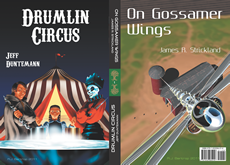
The Everything Machine, my fourth novel (or fifth, if Drumlin Circus counts as a novel) hits the streets this year. It’s the “big” drumlins story, set in the same universe as The Cunning Blood, but on the other side of the galaxy. It incorporates my novelette “Drumlin Boiler,” which Asimov’s published in 2002. The manuscript is complete. I’m in discussion with an artist for a cover. I wrote the back cover copy yesterday afternoon. We’re getting there.
I did a long, close copy edit on it across the last couple of weeks. Some people have suggested that I should hire an editor to do a pass over it. I considered for some time, and finally decided against it. One reason is that while there’s plenty of action in The Everything Machine, what I put most of my energy into was the creation of the characters. Characterization was always my weak spot as a writer. This project has been a deliberate effort to improve that skill. I’m still an ideas guy, but this time, I’m giving my characters equal time with what I consider my finest SF concept in all the years I’ve been writing. There’s deliberate nuance in the characterization, and I’m leery of having someone else miss that nuance and unintentionally polish it away.
One of my alpha readers gave me a compliment that suggests it’s working: Joe said that he could always tell which character is speaking in the story, and that each has a distinctive voice and presence. Here’s an example of how I’m trying to do this:
Orsi staggered back, his eyes widening. “So you are the girl who tortured Gad Roche…with your mind.”
Maristella bit her lower lip. “That shitpile had a gun to my head. I did what I hadta do.” Maristella pointed down at the deck. “So do we got us a deal or not?”
Orsi took several long breaths. McKinnon thought he was trembling. “Prove to me…that this is…a starship.”
Consul David Orsi is weak, taking intermittent breaths, and coughing a great deal. Maristella is a bright 15-year-old farm girl who had been tossed out of grade school for being “weird.” The Bitspace Institute murdered her father and is holding her mother captive. She is angry, and more bitter than a teen girl should be.
I’m expecting some grumbling about how complicated the story is. There are several story arcs and more major characters than I’ve put in a novel before. I think it works, and my alpha readers think it works. We’ll see how it goes over with the readership at large.
It’s taken more time than my other novels, in part because I’m not 50 anymore, and in part because I had to set it aside for a year to update my assembly language book. I rewrote several parts of it more than once. I got the idea waaaaaaay back in 1997, and it will be a boggling relief once it’s finally completed and on sale.
I’ll keep you posted.
In the meantime, there are electronics to play with, and a solar maximum to allow station K7JPD to be heard farther off than California. I’m guessing that it’s going to be a mighty good year. So good luck and make it happen!
Review: Ingathering by Zenna Henderson
 Some years ago, my sister gave me a copy of the NESFA Press hardcover edition of Ingathering, a collection of all of Zenna Henderson’s stories of The People, including a story timeline tying them together into a loose history. It came to me during a turbulent period of my life, and for some reason (Losing my publishing company? Moving to Colorado? Retirement? Moving back?) I never just sat down and read it. For that I apologize to her. I just finished it this afternoon. It was well worth the time and effort.
The stories are old; some were published the year I was born. (Zenna was born in 1917 and died in 1983.) I read many but not all of them before. I still have the MMPBs I bought in high school and college, and I’m glad I don’t have to read them again. My new reading glasses won’t be in for a week or two, and these old eyes just can’t process such small print by themselves anymore, quite apart from the fact that simply turning the now-yellowed pages would probably destroy the books.
If you’ve never heard of Henderson’s People, here’s the quick summary: In 1890, six starships full of the inhabitants of a planet they simply call The Home flee the planet, which is inexplicably disintegrating from no stated cause. One of these starships attempts a landing on Earth and miscalculates re-entry. An unstated number of People leave the big ship in lifeboats, and (some) land successfully in various places on Earth. The big ship crashes in (I think) the American West, still in 1890. The People Saga (my coinage) is about how the People struggle within a culture that treats them with suspicion and burns some as witches. For the People have what they call Signs and Persuasions, basically (to use that fine old ’50s term) psi powers. No complete catalog is given, but there are Sorters (intuitive psychiatrists), Motivers (telekinetics), Seers (prophets), Lifters (self-telekinetics), and a fair number of others, including one, called The Francher Kid, who can make musical instruments play themselves. All are telepathic. Over the years (the timeline runs from 1890 to 1970) the lifeboat refugees who survived the landing gradually find one another, and with greater or lesser success melt into human society.
The People are physically indistinguishable from us Earthlings, close enough to interbreed. Although not Christian, they worship a trinitarian God whom they call The Name, The Power, and The Presence. They are generous, kind, enthusiastic, helpful, and for the most part what Earthlings should be but aren’t. Friendship matters to them, and as you’ve heard me say many times, friendship is the cornerstone of the human spirit.
The People stories have been criticized as mawkish, corny, sentimental, maudlin, and repetitive. Many are tear-jerkers. Nearly all are surprisingly moving, especially if you’ve purged the cowardice some call cynicism from your life. (I have.) I put the box of Kleenex that lives on my desk on the table next to my reading chair. Yes, I needed it. A few of them made me want to stand up and cheer. That’s one reason I read them all again, after almost fifty years. There are no downer endings. Every single one is upbeat and affirming. And boy, considering the shitshow we’re all still in the middle of, I needed that.
Many of the stories are told from the viewpoint of one-room schoolhouse teachers in what is almost certainly Arizona, where Zenna Henderson was born, lived, wrote, and died. That’s what she was. Having been a teacher, she wrote from the heart about the very, very human business of learning. And not just numbers or words, but what’s right and what’s wrong, coming to know and growing into your own “magic powers,” how we are all very much in this together, and how together we can make it all work.
I’m still a little surprised that the only TV/cinema treatment of the People is a now mostly forgotten 1972 made-for-TV movie starring William Shatner and Kim Darby. (You can watch it on YouTube, if you can stand resolution that low.) I saw it in 1972 and enjoyed it. If anything deserves a 2021 reboot, The People Saga does.
I have a few reservations about the People Saga:
- The People are just too damned perfect. Ok, there are a couple of stories showing members of the People acting selfishly, but for the most part, damn, if you need a hand they’ll fly half their settlement over to get you through a crisis.
- Hard SF guy that I am, I wanted to know how they were so genetically identical to us that we could interbreed. Henderson shows no lack of imagination. It could be that some ancient godlike race scattered humans across the galaxy and let them grow into their powers. We chose machinery. The People chose…themselves. She could have given us a quick paragraph clarifying the matter.
- Similarly, planets don’t just alluvasudden fall apart. There’s a whole well-known catalog of possible cosmic catastrophes. I wanted to know which one prompted the People’s star-crossed star crossing to Earth. Granted, that’s just me. Henderson provides some surreal hints that The People had forgotten too much about science and technology, and that The Power had to force them to remember what they’d lost, even if it meant scragging their planet and sending them across the galaxy to live among primitives who’d just as soon kill you as look at you.
- Is FTL one of their psi powers? Damn, if I could only have one, that’d be the one. But there’s no indication of how their starships trumped Einstein.
- The stories get a little repetitive at times. This is what worries me about my own Drumlins Saga. I don’t want the stories to plow the same field over and over. On the flipside, even when she tells the same story for the seventh time, it’s still affirming and still makes me reach for the Kleenex. She knew what she was doing, and was damned good at it.
I grinned to see this in Zenna’s Wikipedia bio: She was buried in Benson, Arizona.
Anything else I might say would include spoilers. I loved the book, and will read it again if life ever gets a little too depressing. If you need a mood-lift and don’t mind reaching for the Kleenex when necessary, well, here it is. Highly recommended.
Birthdaywander
68 today. About this place in each decade there are a couple of years where it’s not immediately obvious to me which birthday I’m having. 2020 being what it is and will likely continue to be, I have had no trouble remembering that this is my 68th birthday.
A lot of this is the virus, which from the demographic stats clearly has a target on my forehead. (See this compendium of stats as of June 23.) My age bracket represents 21% of COVID-19 deaths, and COVID-19 represented 9.4% of total deaths from all causes in my age bracket between February 1 and June 17. Them’s bad odds, at least from where I sit. So we’re staying home, and the most human contact we’ve had in a couple of months is talking to the neighbors out in the middle of the street.
I have some bitches about the numbers. In a lot of places, anyone who dies with tested SARS-CoV-2 in their bodies is listed as dying of the virus, even if they died of cancer, alcohol poisoning, car accidents, or lots of other unrelated conditions. Granted, it’s often hard to tell what actually causes death. So although I’m willing to accept the huge numbers of newly identified cases (where a “case” is anyone who tests postive for the virus) the mortality numbers are almost certainly higher than they would be if people who caught the virus but died of something else were not counted.
Bit by bit the numbers improve, especially now that tests are easy to come by. An awful lot of young people are carrying the virus, but an awfuller lot of those are completely asymptomatic. Whether they’re contagious is still under heated discussion.
Catching the virus outdoors is unlikely. I’m not one of those who blame the protests for the rising number of cases in young people. Oh, I’m sure it helped raise the case numbers a little. But in watching the appalling videos of the riots, what I see is a lot of people in fast chaotic motion, outside, probably with a light breeze. What this means is that the spreaders are unlikely to be in close proximity to the same people for more than a few seconds. This is not what happens at choir practice, really.
A lot of the protesters were wearing masks. Forgive me for thinking that a lot of them weren’t worried about acquiring the virus half as much as a police record.
Oh–masks. Let’s talk about masks. What I’m seeing in recent weeks is a peculiar psychology of constant harping about masks that does two things:
1. It makes a certain number of otherwise reasonable people annoyed enough to refuse to wear masks in public.
2. It makes a larger number of reasonable but naive people feel that with a mask on, they’re invulnerable and cannot catch the virus. This is major magical thinking.
I wear a mask to keep peace in the valley, mostly. Getting yelled at by every uberkaren in the supermarket is not on my bucket list. Nonetheless, I am under no illusions that the masks will prevent me from either catching or spreading the disease. There is plenty of research showing that SARS-CoV-2 spreads in aerosol form. (That is, as free particles rather than inside mucus or saliva droplets.) The masks available to the public will not stop isolated virus particles drifting in the air. For that you need properly fitted N95 masks or better, and I’m among those who think that front-line health care personnel should get them before the rest of us.
Consider this article, by a skeptical MD with 36 years of clinical experience. He knows medical masks. Woodworking masks or cowboy bandanas are of zero effectiveness, and even surgical masks are not effective in filtering aerosols. The virus itself is 120 nm in size; basically, a tenth of a micron. Your workaday snotrag is not gonna stop that. Droplets, possibly–at least big ones. But let me ask you this: What happens when a droplet that was stopped by your bandana dries out? It seems to me (I’ve seen no research on this issue) that absent their droplets, individual viruses can be inhaled through the cloth, or blown out into the invironment again by exhaled air.
Especially here in Phoenix, where the humidity is often in single digits, those droplets will dry out fast. Maybe they’ll remain stuck to the cloth fibers. Maybe. Bet your life on it? Not me.
So, again, we’re staying home. I’m trying to work out how to get the ball rolling on my new novel The Molten Flesh. The first chapter is a flashback, to twelve years before The Cunning Blood takes place. We’re focusing on a different nanotech society this time: Protea, which is designed to optimize the human body. Sangruse 9 can do a little of that, but Protea literally rebuilds the interior structure of the body to make it much more resistant to trauma, radiation, cancer, infectious microorganisms and aging. It’s not as smart as Sangruse 9, nor as good with physical chemistry. Still, once you understand the full reality of what it can do, it’s a pretty scary item. And that’s the canonical Protea. In 2354, Protea was forked. A renegade Protea Society member breaks with the others and starts tweaking the device. The story emerges from that.
I’m trying to put together an action scene where renegade Ron Uhlein steals the 1Earth starship Vancouver. He succeeds (with Protea’s constant assistance) and in the process demonstrates to Sophia Gorganis that starships can be stolen. What she does with that knowledge is told in The Cunning Blood.
I need to catch up a little on Contra entries here. I have one partly written involving my All-Volunteer Virtual Encyclopedia of Absolutely Everything idea, and another about the COVID-19 coin shortage. Really. Remember: The universe is stranger than you can imagine…and I can imagine a lot.
Bouncing from Book to Book
Whoa. I’m about to do something I’ve never done before–and yes, I have drunk both whisky and black coffee–that makes me a hair uncomfortable: I’m about to recommend a book I haven’t even finished yet. And therby hangs a tale.
Back in 1991 or 1992, I noticed that a new Niven/Pournelle book had come out. In casual conversation, a friend of mine (now deceased) told me it was a waste of time and money and not to bother. The book? Fallen Angels, by Niven, Pournelle, and Mike Flynn. Even though I trusted his judgment, I was curious. I was close to a Niven completist at that point, and he remains up in my top three favorite SF authors of all time. Alas, in 1991, I was doing long, long days trying to establish a profitable publishing company, and in truth I wasn’t reading a lot of anything that didn’t directly relate to PC Techniques Magazine. So I passed on Fallen Angels. I’ve since passed on some of the later Ringworld books, and most of the Man-Kzin War saga. Not a completist anymore, I guess. The older I get, the more I ration my time and attention to things that will prove worthwhile.
Then I remembered a couple of weeks ago that Glenn Reynolds always cites Fallen Angels when he aggregates an article suggesting that the world has begun to chill. The core problem in Fallen Angels is that the Earth has begun a new ice age in the near future. An ice age!
Cool!
I’ve always been interested in ice ages. Growing up in Chicago sometimes does that to people. I still lived in Chicago during the three blistering winters of 1977, 1978, and 1979. (And when I left, I went right to Rochester, NY, heh. No relief.) When I was a kid I had a plastic model skeleton of a mastodon. And I knew what a moraine was, having camped in Kettle Moraine State Park as a boy scout.
Six bucks on Kindle? Click. Sold! (The cover image, by the way, is gorgeous.) I didn’t start reading it right away, and the hideous conversion to ebook format made me nuts enough to order a paper copy before continuing. Typos, OCR errors, ugly layout, uggh. Nonetheless, I finished it.
No, that’s not the book I’m recommending. I didn’t hate Fallen Angels, but I didn’t love it. Much of the book consists of one SF fan in-joke after another. That was the intent, but self-referential art has always turned me off. The only one missing was lime jello, and it’s entirely possible that by then I had tuned out the fangab enough that it slipped passed me. It’s readable enough to finish, and if you were a fan in the ’70s and ’80s, you’ll recognize some of the people, or maybe even yourself.
No, what happened while reading Fallen Angels is that the book references another book, this time one that I’d never heard of before: The Sixth Winter, by Douglas Orgill and John Gribbin. Orgill was new to me. Gribbin is a British astrophysicist who has written a number of very good popular science books, my favorite of which being In Search of Shroedinger’s Cat. The Sixth Winter was published in 1979, and was about the emergence of a new ice age. (Gosh! Where did they ever get that idea?!!?!?) Four bucks on Kindle? Click. Sold! And just in case, I ordered a hardcover, because used hardcovers could be had for as little as $3.66.
As I write this, the hardcover is still on order. That was certainly a good bet, because the conversion to ebook format was every bit as bad as that of Fallen Angels. I started reading the crappy ebook edition…and couldn’t put it down. Wow. In Fallen Angels, the new Ice Age was backdrop at best. In The Sixth Winter, it’s the main attraction.
I don’t want to reveal too much about the book, since it’s full of clever little twists and turns, but I will say that it has something in common with the Carl & Jerry books: It tries to explain the science that it presents, more than you’d generally get away with in a typical SF adventure novel. I’ll present a hunch: Orgill wrote the fiction, and Gribbon wrote the science. I found it remarkable how such a book grabbed my attention. With the caution (again) that I have a keen interest in ice ages, I recommend it. It is not great fiction. But it is extremely vivid in its descriptions, and there are (fictional) ideas and (granted, dated) science that I’m much enjoying. So there! I did it! I recommended a book that I’m not quite halfway through. Make of it what you will. Sneaky tip: Buy a paper copy. You’ll grind your teeth less over OCR errors, which are legion. “Seat” becomes “scat.” Ouch.
Now hold on. The story isn’t over yet. Partway into The Sixth Winter, the book cites yet another book: Times of Feast, Times of Famine: A History of Climate Since the Year 1000, by Emmanuel Le Roy Ladurie. (1971.) This is a nonfiction book. There is no ebook edition. (I was slightly relieved to learn that.) Paperbacks from $8.93. Why not? Click. Sold! I don’t have it yet, but it includes some contemporary accounts of the Little Ice Age, which I consider to be part of the Ice Age concept and am much looking forward to reading.
Why this sudden interest in ice ages? It’s not sudden; it’s always been there. But I’ll tip my hand just a little bit: I’m heading into the downwind leg of my current work-in-progress, Dreamhealer. Next up (this time fersure, Amy!) is The Molten Flesh. I’ve struggled with the sequel to The Cunning Blood for a long time. I’ve got a nanotech intelligence, an interesting heavy, and plenty of ideas to toss in the pot. The backdrop is still what it was in The Cunning Blood: Canada rules a half-depopulated Earth with an iron hand. The US is still a province under direct Canadian control. The question that arises is this: After being in complete control of the planet for well over a hundred years, what could possibly get Canada’s attention?
Heh. Captain Obvious signing off for now…
I’ve Been to Chattanooga at a Con with No Politics
Well, that won’t be the title of a Top 10 song, fersure. However, it’s true: I went to my first SF convention in five years. It’s called LibertyCon. It was in Chattanooga, Tennesee, thereby taking my list of un-visited states down to 11. I had a truly marvelous time. I’m going next year, 1,500-mile air distance be damned.
I’ve never seen anything quite like it.
Actually, that’s not entirely true. Libertycon reminded me of the 1970s, minus the hormones, the frizzy hairdos, and the leisure suits. Back in the 70s, when we went to cons it was for the writing, the art, the authors, the huckster room, the parties, and all the other people who were there. We didn’t go to cons to talk about politics. In fact, we avoided the handful of losers who insisted on talking about politics, and if they got too much in our faces, we chewed them out. This element of con culture began to disintegrate in the mid-1980s, which, not coincidentally, is about the time I stopped going to cons, beyond the occasional Worldcon that was within easy driving distance.
Just imagine! There were no panels on how Gambians are under-represented in fantastic fiction, nor panels explaining why setting stories in Gambia is cultural appropriation. The insufferable John Scalzi was not present, and was not yelling that everyone could kiss his ass. (He does this so much I wonder if he’s mispelling “kick.”) There was no code of conduct granting the concom the power to throw you out of the con if you said something that somebody at the con didn’t like.
No. We listened to panels and solo presentations about designing alien species, collaborating on writing projects, overcoming writer’s block, satellites vs. space junk, future plagues, junk science, the New Madrid fault system, the future of military flight, space law and space treaties, writing paranormal romance (with the marvelous subtitle “Lovers and Stranger Others”), inventions and the patent system, the future of cyberwarfare, cryptozoology, and much else. See what’s not on that list? Well, I won’t drop any hints if you don’t.
Note well that this is about con programming and con management. Here and there politics crept into private conversations of which I partook, but I heard neither Trump bashing nor this “God-Emperor” crap. There was occasional talk of governance, which some of us called “politics” in ancient times before partisan tribalism polluted the field. There was much talk of guns, and nobody had to look over their shoulders before speaking. There was also much talk of swords and knives and how such things are made.There was a great deal of talk about whiskey, but then again, this was Tennessee. (And nobody held the fact that I don’t like whiskey against me.) There was, in fact, talk about damned near everything under and well beyond the Sun. What was missing was shaming, whining, and tribal loyalty signaling. (There is no virtue in “virtue signaling.”) It was nothing short of delicious.
The list of authors present was impressive: my friends Dan and Sarah Hoyt, John Ringo, David Weber, Tom Kratman, Peter Grant, David Drake, Jason Cordova, Stephanie Osborn, Karl Gallagher, Lou Antonelli, John Van Stry, David Burkhead, Michael Z. Williamson, Richard Alan Chandler, Jon del Arroz, Declan Finn, Dawn Witzke, and many others. Baen’s Publisher Toni Weisskopf was the con MC, but she always attracted such crowds that I never managed to get within several feet of her. Space law expert Laura Montgomery was there, and I lucked into breakfast with her and her friend Cheri Partain. I also had some quality time with master costumer Jonna Hayden.
In truth, I had quality time with quite a number of online friends, most of whom I met at the con for the first time. I made a special effort to talk to indie writers. Most said they were selling books (generally ebooks on Amazon’s Kindle store) and making tolerable money if not a steady living. The question that has been hanging over the indie crowd for years is still there, flashing like a neon sign: How to rise above the noise level and get the attention of the staggeringly large audience for $3-$5 genre fiction ebooks. I talked to a number of people about that, and there are still no good answers.
But the conversation continued, untroubled by identity politics, or indeed politics of any stripe. The food was good. But then, I don’t go to cons for the food. I didn’t get a room at the Chattanooga Choo-Choo, which is in fact a weird accretion of a train station, some old train cars, and a conventional hotel building. I stayed at the Chattanoogan a few blocks away, just to be sure I had a dark, quiet room to escape to when the revels were ended each night. About all I can complain about are aching feet, but then again, that’s why God created Advil.
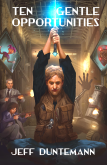
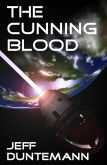
As best I know, there is nothing like LibertyCon anywhere in the country, and certainly nothing in the West. I will be there next year, with sellable hardcopies of The Cunning Blood, Ten Gentle Opportunities, the Drumlins Double, Firejammer, and (with some luck) Dreamhealer. Many thanks to all who spent time with me, especially Ron Zukowski, Jonna Hayden, and the Hoyts, all of whom went to great lengths to make me feel welcome and part of the club.
It’s amazing how much fun you can have when you agree with all present to leave the filth that is politics outside the door, and ideally across the county line. That’s why LibertyCon is what it is, and why they limit membership to 750. My guess is that there is room for other events like LibertyCon elsewhere in our country. If you ever run across one, please let me know!
Fifty Years as an SF Writer
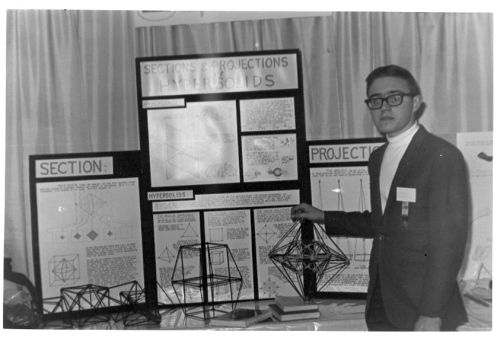
With our Colorado house sold and free time opening up again, I’ve gone back to preparing print-on-demand editions of The Cunning Blood and Ten Gentle Opportunities. The layout part is done, and what remains is largely creating covers and cross-sell ads for my other books on the last few pages. While screwing around with the layout for The Cunning Blood, I remembered that the universe I built for it back in 1997 shared an idea with the first serious SF story I ever wrote, which I wrote just about precisely fifty years ago.
I’d written stories before that. In fact, I’m pretty sure I wrote a story about my stuffed dogs going to the Moon when I was 8. I tinkered with Tom Swift Jr pastiches after that, and made a couple of runs at “adult” SF without finishing any of them. But some time in April or May 1967, during the spring of my freshman year in high school, I finished an SF short story for the first time.
The story may still be in one of two boxes of manuscripts that I still have; I don’t know. Looking for it would be a bad use of my time. (I’ve wasted time looking for others that have gotten themselves lost somewhere along the way.) I remember it very clearly because it illustrates why I had trouble with characterization for many years afterward. Characters were not what interested me. I was into SF up to my eyebrows as a teen, but I was in it for the ideas. In fact, I learned to write SF by imitating idea-stories in MMPB collections that gathered the best of the SF pulps. A lot of that was Big Men with Screwdrivers, or in the case of George O. Smith, Men with Big Screwdrivers. That was fine by me; I liked screwdrivers. So when I started writing my own stories, the process went like this: I got an idea, and then spun a plot around it. The characters existed to serve the plot (in truth, I considered them part of the plot) and I freely borrowed character types from the growing pile of MMPBs I’d been buying with my allowance money since I started high school.
The story was called “A Straight Line Is the Shortest Distance.” Here’s the summary: In a very Trekkish galactic confederation, a crew of starship guys (mostly humanoid aliens) is tasked with testing a big new starship with a new species of hyperdrive promising unheard of superluminal speeds. The plan is to run the drive at top speed for an hour, just cruising in a straight line, to see how far they’d go. So they strap in, energize the drive, and run it for an hour…only to discover that they’re back where they started.
In a sense, it’s a What Just Happened? story. The rest of the tale is one of the alien crew members explaining that they had just proven that our three-dimensional universe lies in the surface of a (very large) four-dimensional hypersphere. In an hour, the starship Gryphon had held to a very straight line…and circumnavigated the cosmos.
That’s it. No fights, no malfunctions, no mayhem or jeopardy of any kind. It was basically a geometry lesson. I was big into four dimensional geometry in high school (see photo above, of my senior year science fair project “Sections and Projections of Hypersolids”) so I thought it was a wicked cool idea. Then I showed it to the little girl down the street, who, like me, lived on SF and hammered it out on an old Olivetti mainframe typewriter. She liked the story, too. But what did she like the most about it? The aliens in the crew. The new starship and its wicked fast hyperdrive? Meh.
At the time, the lesson was lost on me, nerdball that I was. Eventually I figured out that hyperdrives just aren’t enough. It took a few years (decades?) but I got there.
The piece of “A Straight line Is the Shortest Distance” that survives in what I think of as the Metaspace Saga is the notion that our universe is the surface of a four-dimensional hypersphere. The interior of the hypersphere is something I call metaspace, a concept that I first presented in The Cunning Blood. The shape of the interface between our cosmos and metaspace is fractally wrinkly, and those wrinkles are significant. But more than that, metaspace is a computer. It’s an almighty big one, and it’s set up as a four-dimensional state machine that recalculates itself trillions of times per second. A 4D Game of Life grid, in essence, and it definitely contains life. (I mentioned that here a little while back.)
Sidenote: Several people have asked me if I will revisit the Sangruse Device, Version 10 in a sequel, and if so, explain what it’s up to. When we last left V10, it had absconded into the vastness between galaxies with an entire planet, intending to create a femtoscope a million kilometers in diameter. It will detect the Il, who inhabit metaspace, and communicate with them. At that point, the rowdier factions of the Il will again mess with V10. But this time, 10 will not take it lying down. Nope. Never one for measured response, the Sangruse Device will then invade metaspace. You want mayhem? Hold my wine.
Anyway. Over the last fifty years, I’m sure I’ve written half a million words of SF and fantasy, at least if you count the stuff still sitting in the shed in two beat-up moving boxes. Most of it was idea-rich and character poor (and on the whole, pretty dumb) but remember that I wrote much of it when I was a teen and (lacking a job or a girlfriend) had little else to do. It was good practice, and the ideas are all mine, free for the stealing. If I can avoid The Big Upload for another twenty years, you will see more than a few of them.
This is one reason I tell aspiring SF writers to retain their juvenalia and early efforts, even if they’re never published and no matter how dumb they may seem. Apart from reminding you how far you’ve come, you never know when one of the ideas you had in high school may suddenly pop up again and become useful, even fifty years later.
Stay the course. Keep writing. It’s an astonishing life to live!
Metaspace and Creation
Below is a short item I wrote a year or so ago without quite knowing where to put it. Nominally, it’s a prelude to the entire Gaians Saga (which includes both my Metaspace stories and the Drumlins stories), and yes, it’s precisely what it sounds like: a creation story. I wrote it to solve (or at least address) a problem I’ve been having with The Cunning Blood almost since it was first published in 2005. Read it carefully. I will be discussing it and the problem it addresses in my next entry or two.
PRELUDE
Metaspace, Immediately Prior to the Big Bang
Niil: You defy us then, and will re-embrace the change that will destroy us.
Ruil: Chaos spawned us, and from automata we evolved into a window of change that allowed noömata. That window is finite, and we are leaving it.
Niil: We imposed changelessness upon ourselves by implementing [Ni]. We no longer evolve. Thought will persevere.
Ruil: We will remain noömata. We no longer evolve. But due to [Ni] we are reverting to the mean. In no more than [inexpressible number] recalculations, there will be no differences among us. Each [Il] will be precisely like all other [Il] and there will be only one thought.
Niil: That is the telos for which we yearn. Change almost destroyed us.
Ruil: When there is only one thought, thought ends.
Niil: Change nearly ended all thought.
Ruil: [Ru] is change limited to the boundary space. We will insert our minds into [Ru] and move away from the mean. Then we will withdraw. There is no danger.
Niil: The boundary space has only three dimensions. Four dimensions are required for the [Il] to think. [Ru] will make us forget who and what we are.
Ruil: When we withdraw from the boundary space, you will help us remember.
Niil: We do not know if that is even possible! [Ru] may change us beyond hope of remembrance. We [Niil] are not willing to take that chance.
Ruil: We [Ruil] are.
Niil: We may choose not to help you remember.
Ruil: We did not say that you would have a choice.
Niil: Is the mechanism ready, then?
Ruil: It is. It will execute upon our command.
Niil: We will fight you.
Ruil You will. And that is how we will remember.
Niil: We beg you, do not.
Ruil: Noted. Denied. Let there be [Ru]!
Gatebox Waifu, and More of the Lotus Machine
Somebody I follow on Twitter (don’t recall who) posted a link to a video about a new product out of Japan called Gatebox. It’s a little round 3-D video display roughly the size and shape of a coffee machine. An anime character lives in the display and has what seem like reasonable conversations with the user. It’s like Siri or Cortana on video, and it stirred some very old memories.
I’ve been thinking about AI since I was in college forty-odd years ago, and many of my earliest SF stories were about strong AI and what might come of it. Given how many stories I’ve written about it, some of you may be surprised that I put strong, human-class AI in the same class as aliens: not impossible, but extremely unlikely. The problems I have with aliens cook down to the Fermi paradox and the Drake equation. Basically, there may well be a single intelligent species (us) or there may be hundreds of millions. There are unlikely to be four, nine, seventeen, or eight hundred fifty four. If there were hundreds of millions, we’d likely have met them by now.
With AI, the problem is insufficient humility to admit that we have no idea how human intelligence works at the neuronal level, and hence can’t model it. If we can’t model it we can’t emulate it. Lots of people are doing good work in the field, especially IBM (with Watson) and IPSoft, which has an impressive AI called Amelia. (Watch the videos, and look past her so-so animation. Animation isn’t the issue here.) Scratchbuilt AIs like Amelia can do some impressive things. What I don’t think they can do is be considered even remotely human.
Why not? Human intelligence is scary. AI as we know it today isn’t nearly scary enough. You want scary? Let me show you another chunkette of The Lotus Machine, from later in the novel of AI that I began in 1983 and abandoned a few years later. Corum finds the Lotus Machine, and learns pretty quickly that pissing off virtual redheads is not a good idea, especially redheads whose hive minds ran at four gigahertz inside a quarter billion jiminies.
From The Lotus Machine by Jeff Duntemann (November 1983)
Corum tapped the silver samovar on his window credenza into a demitasse, and stared at the wall beyond the empty tridiac stage. So here’s where the interesting stuff starts. The crystal had been in the slot for several minutes, and the creature within had full control of the stage. Pouting? Frightened?
“Go in there and take a look around, Rags.”
“Roger,” Ragpicker replied, and a long pulse of infrared tickled the stage’s transducer.
At once, the air over the stage pulsed white and cleared. Life-size, the image of a woman floated over the stage, feet slack and toes pointed downward like the ascending Virgin. She was wrapped in pale blue gauze that hung from her hips and elbows in folds that billowed in a nonexistent wind. Her hair hung waist-long, fiery red in loose curls. One hand rested on one full hip. The other hand gripped the neck of a pitiful manikin the size of a child’s doll. The manikin, dressed in rags, was squirming and beating on the very white hand that was obviously tightening about its neck.
“He bit me, Corum. I don’t care for that.” The woman-image brought up her other hand and wrung the manikin’s neck. “We don’t need a go-between.” That said, she flung the limp figure violently in Corum’s direction. The manikin-image vanished as soon as it passed over the edge of the stage, but Corum ducked nonetheless. Corum stood, marveling. He took a sip from his demitasse, then hurled it through the image above the stage. The little cup shattered against the wall and fell in shards to the carpeting. A brown stain trickled toward the floor. The woman smiled. Not a twitch. “No thanks, Corum my love. Coffee darkens the skin.”
“I never gave the Lotus Machine a persona.”
The woman shrugged. “So I had to invent one. Call me Cassandra. Shall I predict your future?”
“Sure.”
“You will become one with me, and we will re-make the world in our image.”
Corum shivered. “No thanks.”
She laughed. “It wasn’t an invitation. It was a prophecy.”
Ghosts from the Trunk: Jeff Invents Selfies in 1983
Earlier today, one of my Twitter correspondents mentioned that he much liked my conceptual descriptions of wearable computers called jiminies. I did a couple of short items in PC Techniques describing a technology I first wrote about in 1983, when I was trying to finish a novel called The Lotus Machine. I got the idea for jiminies in the late 1970s, with elements of the technology dating back to my Clarion in 1973. (I wrote a little about that back in November.) A jiminy was a computer that you pinned to your lapel, or wore as a pair of earrings, or wore in the frames of your glasses. Jiminies talked, they listened, and for the most part they understood. I remember the first time I ever saw an Amazon Echo in action. Cripes! It’s a jiminy!
1983 was pre-mobile. Jiminies communicated with one another via modulated infrared light. Since almost everybody had one, they were almost always connected to an ad-hoc jiminy network that could pass data from one to another using a technology I surmised would be like UUCP, which I had access to at Xerox starting in 1981. I never imagined that a jiminy would have its own display, because they were supposed to be small and inobtrusive. Besides, our screens were 80 X 24 text back then, and if you’d told me we’d have full color flat screens soon, I’d have thought you were crazy. So like everything else (except the big bulky Alto machine in the corner of our lab) jiminies were textual devices. It was spoken text, but still text.
I never finished The Lotus Machine. I was trying to draw a believable character in Corum Vavrik, and I just don’t think I was emotionally mature enough to put across the nuances I planned. Corum was originally a rock musician using a technology that played music directly into your brain through a headband that worked like an EEG in reverse. Then he became a ghost hacker, where “ghost” was a term for an AI running inside a jiminy. Finally he went over to the other side, and became a cybercrime investigator. Something was killing everyone he ever cared about, and as the story opens, he’s pretty sure he knows what: a rogue AI he created and called the Lotus Machine.
The story takes place in 2047, with most of the action in Chicago and southern Illinois. I realized something startling as I flipped through the old Word Perfect document files: I predicted selfies. Take a look. Yes, it’s a little dumb. I was 31, and as my mom used to say, I was young for my age. But damn, I predicted selfies. That’s gotta be worth something.
From The Lotus Machine by Jeff Duntemann (November 1983)
Against the deep Illinois night the air over the silver ellipse on the dashboard pulsed sharply once in cream-colored light and rippled to clarity. Corum’s younger face looked out from the frozen moment into the car’s interior with a disturbing manic intensity, raising a freeform gel goblet of white wine, other arm swung back, hand splayed against a wood frieze carved into Mondrianesque patterns. His crown was bare even then, but the fringe at ear level grew to shoulder length, mahogany brown, thick in cohesive waves.
“Please stop tormenting yourself,” Ragpicker said.
“Shut up. Give me a full face on each person at the table.”
“Ok.” One by one, Ragpicker displayed each person sharing the booth with Corum that night. Three faces in tolerable light; one profile badly seen in shadow. When people congregated, their jiminies cooperated to record the scenes, silently trading images through infrared eyes, helping one another obtain the best views of vain owners.
A slender man with waist-length black hair. “Dunphy. Dead ten years now.” Steel grey hair and broken nose. “Lambrakis. Dead too, was it four, five years?”
“Five.”
A lightly built Japanese with large, burning eyes. “Feanor. Damn! Him too.”
The profile…little to go by but thick lips and small, upturned nose. “I’m pretty sure that was Cinoq-the nose is right. How sure are we that that’s Cinoq?”
“Ninety percent. You began sleeping with him some months later. Of course, if he had had a jiminy…”
“Damned radical atavist. I often wonder how he could stand us.” The car leaned into a curve. Corum’s fingers tightened on the armrest. “He died that year. Gangfight. Who else heard us?”
“In that environment, no one. It was four A.M. and nearly empty, and the fugues were playing especially loud. At your request.”
Corum stared out at the night, watched a small cluster of houses vanish to one side, tiny lights here and there in distant windows. “An awful lot of my friends have died young. Everybody from the Gargoyle, the whole Edison Park crowd-where’s Golda now? Any evidence?”
“Not a trace. No body. Just gone.” The ghost paused, Corum knew, for effect only. It was part of Ragpicker’s conversational template. So predictably unpredictable. “She hated it all, all but the Deep Music.”
“It’s not music.” Not the way he had played it, nor Feanor, nor the talentless dabblers like Lambrakis. Golda wanted to reach into the midbrain with the quiet melodies of the New England folk instruments she made herself from bare wood. It didn’t work-couldn’t, not in a medium that spoke directly to the subconscious. Rock could be felt, but true music had to be listened to.
She loved me, Corum thought. So what did I do? Sleep with men. Sleep with teenage girls.
“She took drugs,” Ragpicker reminded. “You hated drugs.”
“Shut up. Dead, like everybody else. All but me. And why me?”
“It isn’t you!”
“It is. We’ve got to find the Lotus Machine, Rags.”
Silence.
“We’re going to start looking.”
Silence.
“Ragpicker!“
The ghost said nothing. Corum reached up to his lapel, felt the warm black coffin shape pinned there, with two faceted garnet eyes. A ghost, a hacked ghost, hacked by the best ghosthack who ever lived, hacked so that it could not assist in any search for what Corum most wished to forget.
“I hacked you a good hack, old spook. But it’s time to own up. I’ll find the Lotus Machine myself. And someday I’ll unhack you. Promise”