Jeff Duntemann's Contrapositive Diary Rotating Header Image

Coal That Doesn’t Conduct

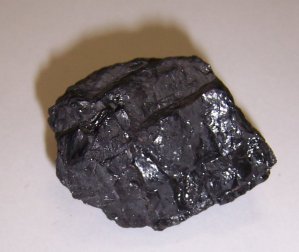
CoalLump-300Wide.jpgMy friend George Ott surprised me with a lump of coal yesterday morning, after church over at St. Raphael’s. He even wrapped it and put a ribbon on it! I could barely stand the wait to get home and check its resistance. And (drum roll, please) the lump is…an insulator.

Or a damned reasonable facsimile. With my DVM set on its 20 megohm scale, the resistance didn’t read at all, even with the probes set pretty firmly in the coal about an eighth of an inch apart. I tested at eight or ten different points on the lump, since carbon is funny stuff generally and coal is not a uniform substance. The DVM reads a 10 megohm resistor right on the money, and failed to read a 22 megohm unit. I use that DVM a lot and certainly haven’t seen anything wrong with it. But no matter how close I set the probes, I got no reading at all.

I put the lump against my belt sander and ground a flat face, which was interesting in terms of the tarry smell that came off the lump. No difference. I whacked a corner off the lump with a coal chisel. No difference, even on the fresh and very shiny fracture face. With the clean and very sharp points of the probes no more than a sixteenth of an inch apart, the resistance was higher than 20 megs. Wow.

I’m not enough of a rockhound to know what sort of coal it is, and George didn’t know either. (He got it from a blacksmith who fires his forge with coal.) It looks like anthracite in that it’s quite shiny, but beyond that I just don’t know.

Another of my readers is sending me a sample of both anthracite and bituminous, and that may help. Some of the online sources I’ve read describe coal as a semiconductor, but I think by that they only mean a substance with significant resistance. I’ve seen nothing to indicate that some types of coal would be insulators across very small fractions of an inch.

However, among other projects I hope to get to this winter is a crystal detector lashup, steampunk style, on an oak base with a copper pipe cap to hold a mineral sample for testing as a cat-whisker detector. One doesn’t think of coal as a candidate, but it certainly won’t take much work to do the science!

Basement Hydraulics

SunkSlab-500Wide.jpg

Talk about a weird feeling: I stood downstairs in one of the bedrooms after the mudjacking crew had drilled six 1 3/4″ holes through the 6″ slab and down almost two feet into the soil. They stuck a hose as thick as my arm through each of the holes in turn, forcing liquid concrete into the soil. Once all the holes had gotten a dose, the hose was moved to a hole near the north wall, and the crew boss pressed the pump button once, twice, three times.

I watched as the slab rose smoothly, almost half an inch in the space of two seconds. Whoa.

It’s been a messy, dusty, ad-hoc sort of project. In summary: They drill a number of holes through the slab. (In our case it was seventeen.) They pump liquid concrete (“mud”) through a hose into the soil and/or voids under the slab. The voids fill up as the soil rises beneath the slab. Eventually, with no more voids to fill, the pressure of the liquid concrete lifts multiple tons of concrete slab back to where it was before it began to sink. The liquid concrete stabilizes the soil beneath the slab, and with some luck we won’t see the slab settle again.

There were a few weirdnesses. Here and there liquid concrete forced itself up between the slab and the stem walls (and out of a few of the holes as well) like a glistening blob in a third-shelf horror movie. The bathtub didn’t quite return to its former position and may have to be pulled and re-set.

Still, as best we can tell, the operation was a success and the patient not only survived but rose from the dead. There’s much mess down there still, with plastic taped up all over the place and my fiction and magazine stacks all boxed and inaccessible, but the flaw that precipitated the whole business has at least been dealt with. Given that we had to empty the rooms completely, we decided to pull the carpet and replace it. And with the carpet gone, there’s no reason not to re-paint. Carol has been meeting with decorators. I’m designing a new layout for the furniture. It will have been a huge amount of work (and way, way too much money!) but when we’re done, the lower level will look very good.

More on the project as it happens. The wind you heard through the pines last night, however, was a massive sigh of relief.

I Want a Piece of Anthracite for Christmas…

Yes, I want a lump of coal for Christmas. Two actually: Santa, if you’re listening, see if you can get me four or five ounces of a good glossy anthracite, and a similar quantity of mid-grade bituminous. I’m not sure where else I’m likely to find it. (Ok, ok, eBay. Last resort…)

I haven’t been bad. I’ve been curious.

A question occurred to me the other day while I was hauling boxes around the lower level: Does coal conduct electricity? And if so, how well? I know that carbon does, but of course you have to specify which kind of carbon. Diamonds do not conduct electricity. Carol’s engagement ring is big enough for me to have put an ohmmeter across its large facet thirty-odd years ago. The carbon rods running down the centers of conventional carbon-zinc batteries conduct very well. Mechanical-pencil lead conducts electricity. Resistors, in fact, were basically painted lengths of pencil lead until relatively recently.

Coal, now. Hmmm. I would run downstairs and do the science right this minute, but I’m not sure I’ve held a piece of coal in my hand for forty years. Uncle Joe Labuda burned anthracite in a coal stove to heat his flat down Back of the Yards around 1960. I was fascinated by the lumps of coal in the bin behind his stove for their luster and even more by their smell, which was a less acrid form of the coal smoke that hovered over the neighborhood all winter, at least until people started installing natural gas space heaters.

Online research suggests that the resistance measured across the thickness of a one-centimeter cube of anthracite runs from the mid-hundreds to low thousands of ohms. That suggests that sand-grain sized particles of coal could be used to create a carbon button microphone. My friend Art Krumrey actually did this circa 1963, by beating on a carbon rod yanked out of a dead flashlight battery, and loading the grains between a soda bottle cap and half of one of the thin steel puck-shaped containers that large rolls of Scotch tape used to come in. He basically duplicated the circuitry of a primordial telephone connection, and we sent our voices over fifty feet of wire without any active devices at all, just a few dry cells in series with the cobbled-up carbon mic and a pair of dynamic headphones. It was boggling how loud the audio was, so loud that it overloaded the headset unless we spoke in practically a whisper.

This was how telephone systems worked before amplifier tubes were invented: The voice audio signal coming out of the carbon mic was already high-level, being a variable resistance in series with a high-current power source. In fact, electromechanical repeater amplifiers were created by mechanically coupling a dynamic earpiece to a carbon button mic. With decent batteries to drive the system, repeater chains like that could carry voice signals hundreds of miles without a vacuum tube in sight.

What I really want to know is whether a steampunk-era garage inventor could have created a usable carbon button mic using granules of coal, of if purer carbon would be required. If I can find a lump of coke that might work better, and turning coal to coke is not exactly alchemy. (I’m not sure I want to do it myself.) If the resistance of a lump of good anthracite were low enough, it could also function as the cathode of a carbon-zinc primary battery, which would be interesting all by itself. Water-cooled carbon mics the size of pie pans were used in series with high-speed alternators to generate voice-modulated RF before the advent of RF power tubes. It’s a delicious steampunkish concept, full of sparks and ozone and odd things turning too quickly for their own good.

Of course, I have a Drumlins World story concept that involves simple electromechanical wireless voice transmission systems. The sinister Bitspace Institute has a very secret radio communications network, and when a pair of spindly teenage boys independently invent spark radio, well, interesting things happen–especially when you throw a few drumlins into the mix.

Still taking notes, but even a few ounces of good coal could make for some interesting experiments, just as my steampunk Geiger counter did last year. Once the lower level is done I hope to lash something up to measure the effectiveness of different kinds of carbon granules in microphone service. Whether the story itself gets written or not, I expect to learn something, and that’s good enough for me.

Behold the EggMcSpamFin!

EggMcSpamFin-500Wide.jpg

The place is a mess. Not as messy as it’ll be by tomorrow night, but it’s still a mess. The movers got everything transferred to the uncarpeted portions of the lower level yesterday, and the carpeting has been pulled up. Plastic tarps are all over the place. Tomorrow the drilling begins.

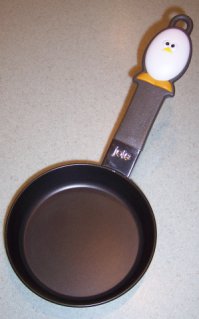
lilfrypan200wide.jpgIn the meantime, when Carol and I broke for lunch an hour ago, I tried something completely different. I scrambled a single egg in a bowl, dumped some butter into the little one-egg fry pan that I’ve had for years (left) and with the burner on medium made a scrambled egg disk. I then threw a Bay’s English muffin in the toaster, and while it was toasting I broke open a Spam Single onto a Corelle plate and heated it up to a nice sizzle in the microwave. When the muffin came out of the toaster I buttered it good and proper, threw the scrambled egg disk on a muffin’s lower half, lowered the sizzlin’ Spam Single onto the egg, and then slapped the muffin lid on the whole business.

Damn, that was good! Cheap, too, as lunches go. Eggs are about 20c each. Spam Singles run about a buck. A single Bay’s English muffin costs me about 40c. Might have used a nickel’s worth of butter. Total $1.65. Almost entirely sugar-free. Filled me up completely and will probably carry me all the way to suppertime without any need to snack. It would be less fattening without the English muffin, but try as I might, I can’t do completely without English muffins.

Highly recommended.

Odd Lots

  • The Big Honking Sliding Puzzle Project continues, and today Carol and I are mostly stuffing boxes downstairs. Mover guys coming Tuesday. The carpeting is coming out on Wednesday, and the plastic tarps will go up. Thursday they drill holes in the slab and start pumping gooey stuff underneath to stabilize the soil and raise the slab to where it originally was. We are shopping for new carpeting, and will begin choosing new paint colors tomorrow morning. The lower level will not be back in livable shape until mid-January, but when it is it will be much improved.
  • I do not do walled gardens. I absolutely do not do walled gardens. This gentleman from Harvard Law School has done a good job capturing my unease with vendor-controlled hardware and especially software.
  • Reader Nick DeSmith sends a pointer to a wonderful site on numeric-readout vacuum tubes of various species, from humdrum nixies to one I had never heard of before: A Compactron-based micro-CRT with ten guns. I consider Nixies at least to be steampunk-possible, since there’s no physics involved that wasn’t understood in 1900. Not sure they’ve been used in the steampunk canon so far; if they have, let me know.
  • There were giant beavers during the Pleistocene. There have been talking beavers on TV in the past, though they weren’t all that huge. Now there’s an angry giant beaver. Don’t piss one off unless you’re wearing the right overalls.
  • I’ll meet your giant, jeans-eating beaver and raise you a giant cricket so big it eats carrots! (Thanks to Esther Schindler for the link.)
  • If giant beavers or giant crickets aren’t your passion, how about miniature forests of old-growth moss that may be thousands of years old? Such are found in Antactica, and by spotting nuclear test fallout debris along the length of their stalks, we can see how slowly they grow. Think, slow. (Thanks to Frank Glover for the link.)
  • I keep tools and even a wi-fi bridge node in ammo cans. Why not wine?
  • The many faces of Superman. (Thanks once again to Frank Glover for the link.)
  • This has some steampunk resonance, but (oldster that I am; how old were you in 1966?) I keep hearing an endless loop in the back of my head: “Batfan! Batfan! Batfan, Batfan, Batfan. Na na na na na na na na na na Batfan!”

The Great Big Honking Sliding Number Puzzle

I’m doing one of those sliding number puzzles; you know, the ones that have fifteen tiles in a matrix that can hold sixteen, and you have to slide them around until they’re in order. Except that the matrix is the lower level of my house, and the sliding tiles are things like 7′ tall Hundevad bookshelves, credenzas, a 61″ TV set and associated tableage, a treadmill, a queen-sized bed, Carol’s desk and chair, two vertical filing cabinets, a two-drawer lateral file cabinet, eight or nine hundred books in boxes, and enough boxed back issues of QSTs to make me cease wondering where the missing mass in the universe is hiding. And that’s the abbreviated list.

The goal of the puzzle is to get everything now resting on carpet onto areas where there is no carpet. The problem is, three quarters of the lower level is either carpeted or already committed to Big Heavy Things That Don’t Move, like my workbenches and shelves piled nine feet high with stuff that has nowhere else to go. On Tuesday morning bright and early, a crew of much younger guys with strong backs are going to show up here and want to know where to put everything. That means I have to tell them. And that in turn means solving the puzzle.

I leveraged a good deal of work I did nine years ago, when we were gearing up to move everything from Scottsdale to Colorado Springs. I drew nearly all of the big furniture we owned at that time in Visio (or adapted furniture shapes already in the product’s stencil sets) and then drew a floor plan of the house to which we were moving. I dragged the furniture shapes around in Visio until they fit, and when the truck pulled up in front of our rental house, we gave the mover guys a printed copy of the floor plan as I drew it. A year later we did the whole thing again, this time for the new house we had spent a year building. I had to re-draw the floor plan, but the furniture hadn’t changed and the shapes were still useful. Tugging them around the plan allowed us to get the furniture where it had to go the first time, without much need later on to wrestle large massive objects onto dollies and shove them into new arrangements with my fiftysomething back.

That worked well and was actually a lot of fun. It was easy, furthermore, because we had a whole house to play with. This time I have the furnace room (where much of that Big Heavy Stuff That Doesn’t Move actually lives) a single unfinished and uncarpeted bedroom, and portions of my workshop. As it happens, I can get it all in there, but the furniture must be placed in a very specific order and with considerable precision. The treadmill will clear the furnace room door with about 1/2″ on either side. (It won’t clear the other doors at all.) It’s going to be intense, my friends.

The carpeting was damaged by condensate spilling out of our air conditioner this past summer, so we’re ripping it up and replacing it with something a little more robust and a little less pink. Since the carpeting will be gone, we figure it’s as good a time to paint as any, particularly the lower level great room, which looks like it was painted with melted strawberry ice cream. If you wonder we we don’t entertain guests down there, that’s certainly one of the reasons.

So our most intense week in well over ten years continues apace. Carpet samples litter the great room. Vinyl flooring samples for the rear entranceway lie about next to the woodwork while we search for harmony. About six shelf-feet of component data books still need to be boxed, as well as most of the contents of Carol’s office.

I’ll report our progress here as time allows. Christmas cards will be a little late this year, sorry.

The Critical Difference Between “Some” and “All”

BooksInBox500Wide.jpg

I am sore. Since we got back from Chicago a few days ago, we’ve been picking up the lower level of our house in preparation for some messiness: We have to have the east end of the slab mudjacked to raise it a little and keeping it from sinking any further. The damage isn’t huge so far, thanks to a little-known method of framing lower levels of homes like ours, which basically suspends the walls from the main level. The lower-level slab can thus move independently (mostly) of the walls.

The mudjacking contractor originally told us that they would only need to pull back the carpeting on the east and south facing rooms a few feet. Further analysis (which we learned only yesterday afternoon) showed that those east and south facing rooms will have to be emptied completely. My workshop is mostly unaffected, but the eastmost section of slab has sunk a little, and I have to move whatever sits on that section, to the first seam.

Alas, what sits on that section are two 150-pound particle-board shelves containing sixty years of QST (with a density only slightly less than National Geographic) plus 35 years of CQ, the full run of Ham Radio, a spotty collection of 73, plus fifteen ARRL handbooks, four shelf-feet of component databooks, and several dozen other miscellanous tech books. Oh, and the tops of the shelves are piled high with homebrew projects.

And that’s just my workshop. In the great room are another eight or nine hundred books on six robust Hundavad shelves, a treadmill, a couch, a 1937 Zenith cathedral radio, and two oak tables supporting a 61-inch TV and associated electronics. In the guest bedroom are two more tall bookshelves (fortunately not densely populated) a bed, a two-drawer lateral file cabinet, and two waist-high teak cabinets. In Carol’s office are another two-drawer lateral file cabinet, her desk, a rocking chair, a tall bookshelf, and miscellanous furniture.

Readers who have been here may begin to get a grip on the magnitude of the challenge. All that stuff has to be moved onto firmer slab, which exists in only three places: the furnace room, the unfinished bedroom, and the western two-thirds of my workshop. All three of these places have stuff scattered about in them. So we have to empty those places out so that we can fill them with furniture and boxes from the rest of the lower level.

Oh…we have seven days to do this, and counting. From a dead stop.

So last night I was downstairs stuffing books in boxes, schlepping stuff to the garage, and piling it on the higher sections of steel shelving that we already have. (I’m going to buy another Gorilla Rack when I go out later to buy more boxes.) One of the lateral file cabinets is broken and will be scrapped, but Carol has to empty it first. ARC is going to get several goody-bags of resale material, which means that more time will be spent culling the collection.

It’s almost like moving, except we’re not going anywhere.

So I’m sore from hoisting boxes of medical books and photo albums onto a cart and then onto shelves. The QSTs haven’t been touched yet. I had hoped to write a longish Contra entry yesterday evening, but by 8:30 PM I was too wrecked to do anything but sit in my big chair and take notes on the coming days’ logistical challenges. I think I can do this. It may well be excellent strength training. (Moving here from Arizona in 2003 certainly was.) But man, it’s gonna hurt.

Odd Lots

  • You’re getting two Odd Lotses in a row for a reason. Stay tuned–I’ll try and explain tomorrow, if I don’t run out of Aleve.
  • Bruce Eckel is returning his Kindle Fire because the damned thing will not render .mobi files. C’mon, Amazon. I mean, come on. (Thanks to Mike Bentley for the link.)
  • Xoom 2, where are you? Whoops, it’s going to be called the Droid XYboard to distance itself from the Xoom brand, which was done in because Somebody Didn’t Want It To Have a Card Slot. (Don’t know who. Have suspicions.)
  • Charlie Stross makes a good case that DRM on ebooks (as required by the Big Six) is a stick handed to Amazon with which to pummel the Big Six. Read the piece, follow the links (make sure you know what a “monopsony” is) and then read the comments.
  • Schumann resonance waves can apparently be detected from space. This is surprising, as my earlier readings suggested that they only exist by virtue of a sort of immaterial waveguide formed by layers in the Earth’s atmosphere–the same waveguide effect that allows hams like me to bounce signals around the world.
  • Femtotech? I postulated a “femtoscope” in my novel The Cunning Blood, but it was used to plot quantum pair creation and did not rely on exotic matter. I’m not sure such things are possible, or could be done in any environment where we could live or even work through proxies. But as with a lot of things (especially LENR) I would hugely enjoy being wrong.
  • I torrented down the brand-new Linux Mint 12 Lisa the other day, and like its predecessor it will not detect the video hardware correctly on my 2009-era Core 2 Quad with NVidia 630i integrated graphics. Somewhat surprisingly, it will install on an older Dell GX620 USFF with (as best I can tell) no video problems. Not sure if I like GNOME 3, though. MATE, a GNOME 2 fork, has promise.
  • I may have made this point once before, but hard steampunk authors should have the Lindsay Books catalog on hand, or at least have the site bookmarked. These are books explaining how to actually do steampunk technology, often in the form of reprints of original Victorian-era reference texts. Thermite, brass, steam engines, and loads of other goodies just as great-great grandpa learned them. (Thanks to Bruce Baker for the noodge.)
  • One of my German friends told me that plagiarism in German doctoral theses is so widespread that it’s spawned a crowdsourced mechanism for detecting it. That’s the abbreviated English-language version; if you have a reasonable amount of German, go to the richer, fuller main page.
  • Very spooky time-lapse video of a little-known physical phenomenon. (Thanks to Pete Albrecht for the link.)
  • I originally thought this was a hoax. On the other hand, I have a Tim Bird and I love it. It’s hard to believe that such things actually work as well as they do.
  • Sometimes you wear what you eat–or at least a reasonable facsimile.

Odd Lots

  • Happy Thanksgiving Day to all who celebrate it–and to those who don’t, well, this guy is still thankful that the world is big enough for both of us. In terms of Thanksgiving Day meditations, I’ll simply offer the one I wrote in 2008. I may not ever do better than that.
  • From the Words-I-Didn’t-Know-Until-Yesterday File: seedbox, a remote and generally headless system on a high-bandwidth Internet connection, used exclusively to seed torrents in defiance of ISP speed-throttling of BitTorrent users.
  • Also pertinent to yesterday’s entry: Penguin Books got into a snit of lender’s remorse, and basically shut down access to its titles previously available to public library patrons through Amazon’s Kindle lending program. Apparently the DRM wasn’t DRM-y enough, and Penguin (through the Overdrive technology) locked its titles out. Precisely what the technical issues are is still unclear, but I’m researching it.
  • We have lost Anne McCaffrey, at age 85. She died of a stroke at her home in Ireland on November 21. She was the first woman to earn a Hugo or a Nebula award, and did a great deal to drag SF out of the locker room to which the pulps had led it.
  • Having recently become an Android user (via my Droid X2) I have now begun to dream of SparkFun’s Electric Sheep.
  • Debsnews now has a wine channel. It’s one way to focus in on specific short videos (example: WalMart’s new $3 wine line) without having to spend a third of your life parked in front of a TV.
  • Anybody who’s tried to spread a Ziplock bag with one hand while pouring leftover spaghetti sauce into it with the other may appreciate this gadget. Everybody else, move along.
  • Many people are sending me links to stories about canned goods containing greater than acceptable levels of BPA. This is not new news. However, I didn’t know about it until yesterday, right after opening a can of Spam.
  • Maybe the new Spam Singles packaging is the answer. No can!
  • Carol met Colonel Sanders at the Mayo Clinic back in 1975, and the guy does get around. You can now see him from space. This is not photoshopped, but the real deal. It’s been there since 2006, and consists of 87,000 colored tile “pixels.” (Thanks to Frank Glover for the link.)
  • Make describes a steam-powered bristlebot. Somehow this reminds me of those little scrubbing-bubble guys on the TV commercials.
  • There may be another reason (quite apart from battery life) to turn your smartphone’s power off every night. (Thanks to Pamela Boulais for the link.)
  • If you’ve never gone up to the Car Talk Web site and looked at the staff credits page, you’re missing out on people you haven’t seen since your study hall attendance-sheet days. (Thanks to Pete Albrecht for the link.)

Pirates and Dummies

I used to go up to the Pirate Bay on an almost weekly basis, to see which Paraglyph Press books were listed there. It ceased to be a priority after Paraglyph folded, and I don’t think I’ve been up there for over a year. Then last week I learned that large NY publisher John Wiley & Sons is preparing a multiple “John Doe” style lawsuit focused on torrent piracy of its staggeringly popular “For Dummies” series. So I sailed back up to the Bay to see how bad it is on the ebook side.

For dummies in search of “For Dummies,” my initial impression is that it’s pretty good, which means that for Wiley, it’s pretty bad. The word “Dummies” can be found in TPB’s torrent catalog 691 times, and although some of those may not be “For Dummies” titles, I’m guessing that nearly all of them are. Individual books are listed, of course, but what probably worries publishers more is that a 6.3 GB file containing 572 “For Dummies” books is listed as well. 6.3 GB sounds like a lot. It’s not. It’s about the size of a single 720p feature-length Blu-Ray rip. 572 PDF ebooks in one lump, egad–in truth, I didn’t know that there were that many “For Dummies” books in existence. (GURPS for Dummies is not something I would have gone looking for.)

Alas, the pirates have forgotten about me personally, and for that matter, about Paraglyph Press itself. Only one Coriolis book is listed, Michael Abrash’s Graphics Programming Black Book. (There may be others that weren’t cited with the word “Coriolis;” I didn’t search deeply.) As I said, my own last name isn’t present even once. Much more startlingly, David Brin is listed only three times. Connie Willis, twice. Vernor Vinge, once. Nancy Kress, not at all. Being hot must help; Neil Gaiman is listed 49 times.

One gets the impression that reading isn’t a priority among pirates. To find out just what is, you need a better metric, and The Pirate Bay offers one: the number of complete torrents. “Seeders” are people who make available complete copies of a given file. “Leechers” are those who are currently downloading the file. The more seeders, the more popular a file, and the faster it will download to the leechers. (The protocol is interesting and described well here.)

Although there are hundreds of torrent trackers, the Pirate Bay is by far the most popular, ranking 91 on Alexa. I think it’s pretty characteristic of the pirate world in general. So let’s go count Pirate Bay seeders:

  • The top audio book is Double Your Reading Speed in Ten Minutes. 548 seeders. (Irony alert! Near-toxic levels!)
  • The top ebook is Do Not Open: An Encyclopedia of The World’s Best-Kept Secrets. 1,442 seeders.
  • The top pirated app is Photoshop CS5. 6,412 seeders.
  • The top music track is “We Found Love” by Rihanna. 7,010 seeders.
  • The top game is The Elder Scrolls. 12,438 seeders.
  • The top movie is Conan the Barbarian. 17,422 seeders.
  • The top TV show (in fact, the top torrent of any kind) is an episode of “How I Met Your Mother.” 23,259 seeders.

I hope I don’t have to beat you over the head with it: Video is twenty times more popular on torrent sites than ebooks. Down in Dummies land, it’s worse: The 572-book “For Dummies” collection has all of 99 seeders. Neil Gaiman’s best (46) is less than half of that.

So why is a major book publisher suing a relative handful of torrenters? I’m guessing that it’s because it can. BitTorrent is extremely “open” in terms of who’s doing it, and if you’re downloading you’re automatically uploading too. Recording the IPs of people in a torrent swarm is easy. Suing them is dirt simple. Some money can be harvested offering settlements, but at those minuscule usage levels, not much. I’m sure that Wiley wants to exert a “chilling effect” on sharing of Dummies books, and they are–but only in the torrent world. Even though my books vanished from the Pirate Bay, it didn’t take Sherlock Holmes to find them out on the bitlockers and Usenet, which for various reasons are much tougher nuts to crack on the legal side.

Video rules the torrent world because video is big, and the BitTorrent protocol is the most effective way to get video downloaded quickly. Small files like ebooks are elsewhere, unless they’re gathered into massive collections the size of Blu-Ray rips. Ebook piracy seems to be a minor issue today because ebook piracy is mostly invisible. It’s out there, and for all that I’ve pondered the problem, I return to the conclusion that the problem has no solution other than to sell the goods easily and cheaply, and to stop teaching people to be pirates by making the media experience complicated with DRM.

In the meantime, announcing mass lawsuits of torrenters of a specific product line pulls the Streisand chain hard. You might as well yell “Come and get it!” to people who hadn’t known that all 572 Dummies books (or ebooks generally) could be found on torrent sites. This has to be balanced against whatever chilling effect the lawsuits may have, and I can’t help but think that it’s a wash, at best. The real result of such suits over the years has been to push piracy into places where it’s difficult to see and almost impossible to police. The First Principle of whatever we try has to be this: Don’t make the problem worse. If this means that no solution presents itself, we may have to content ourselves with that.