- Pete Albrecht sent a YouTube pointer to some riot footage in Warsaw taken by an RC helicopter. If we can’t have flying cars here in the 21st century, well, this is better than nothing.
- Linux Mint 11 does not handle the integrated graphics on the Dell Optiplex SX270. Even the liveCD version doesn’t detect video correctly and is basically unusable. Kubuntu 11.10, by contrast, works correctly on this admittedly creaky machine. (Xubuntu is up next.) What is Mint doing wrong on the video side?
- Cyanogen will have an Ice Cream Sandwich version of their bootable Android distro in January.
- Back when I built telescopes, I used black spray paint for the inside of the tube. NASA now has something maybe a little bit better. (Thanks to Frank Glover for the link.)
- I have been unable to figure out what the active devices are on this audio power amp, but they’d better be good ones: It’ll cost you $650,000. (Thanks to Eric Bowersox for the link.)
- Nothing makes you feel old better than recalling that when the world’s first commercial microprocessor was released 40 years ago, I was already a sophomore in college. Hey you kids! Get off my accumulator!
- I inherited about a microgram of St. Francis of Assisi from my godmother, all mounted in a cool little monstrance. Alas, under the microscope it looks like dirt. If you want a bigger (and more self-evidential) piece of a saint, you can have St. Vitalis’ skull for as little as 800 euros. (Then again, considering his specialty, they probably got more for his pelvis.)
- Yes, death is nearly always fatal, poor guy.
- And if he was taking Avandia, he should call his lawyer, (very) long distance.
Odd Lots
Minty Failness
I gave it a good shot and I tried, honestly I did. But Canonical’s Unity UI simply doesn’t work for me. It’s obvious that Canonical is trying to create a single UI that will serve end-user computing from top to bottom. It’s just as obvious to me (now that I’ve had six weeks or so to play around with a Droid X2) that there is no single “end-user computing” anymore. Desktops are fundamentally different from smartphones, or anything else (tablets, possibly; we’ll see) that is primarily tap-and-consume. I’m having no trouble working the Android UI on my phone, and Android habits don’t intrude on my desktop synapses. I’m not confused or in any way slowed down by the differences between the two, no more than I’m confused about the differences between a shovel and a rake.
So if Unity is all I get under Ubuntu, Ubuntu has to go. Others seem to agree with me, and at times the discussion gets disturbingly violent. Online I’m seeing that huge numbers of people are fleeing Ubuntu for Linux Mint, which I’d barely heard of a year ago. I have to smile a little bit, because Linux Mint is Ubuntu, basically pulled back to a variation on the GNOME 2.3 interface. The upcoming release (Mint 12) will move to GNOME 3, which worries me a little (I like GNOME 2) but I’ve seen word that Mint 12 will allow users to have something very like the old UI–which is precisely what Canonical did not do with Ubuntu and Unity. It was Unity or the highway, and boy, it’s bumper-to-bumper out there.
There’s an enormous issue of why we’re suddenly tossing older and much-loved UIs away without nary a glance over our shoulders, when there’s no compelling reason to adopt one of the new models. Programmers like to create Shiny New Stuff, fersure. I in turn don’t like to change the way I interact with the machine I use, unless such changes make me a lot more effective. So far, the costs in relearning ordinary tasks far outweigh the fairly paltry benefits for me.
I’ll take up that issue eventually. In the meantime, I’ve hit the highway, and installed Linux Mint 11 Katya in its own partition here on the quad core. The OS looks great and works the way I’m used to working. I have some minor quibbles, like the failure of the Software Manager to tell me when it’s done installing something. Ubuntu does this well, but Mint installs and gives no sign. This was critical when I installed WINE, since (because WINE is not an app, strictly speaking) it’s tricky to determine if WINE was fully and correctly installed. Because running Software Manager again and selecting WINE still indicates “not installed,” I think there’s something wrong.
Small stuff. The big deal is that Mint doesn’t work well with the integrated graphics on my EVGA NForce e-7150/630i Core 2 Quad motherboard. The default graphics drivers worked, but looked clunky and don’t support effects. Installing the recommended proprietary NVIDIA drivers produced weird graphics failures, including windows refusing to render once they’re over a certain size. (Some windows would not render at all, and simply remained blank and white even when first instantiated.) Using the supposedly experimental NVIDIA 173 drivers worked better, but still fails on certain apps, especially Stellarium, which worked exactly once and then comes up with a blank, black window every time. I’m not willing to give up Stellarium, so at this point Linux Mint is on hold while I wait for Mint 12 Lisa.
Linux Mint has supposedly become the 4th most popular OS on the planet. It’ll be interesting to see if that continues to be the case once they cut in the mandatory GNOME 3 upgrade. I’ll give GNOME 3 the same consideration I gave Unity, but I’m also looking closely at the Xfce UI and Xubuntu. It’s going to be an interesting year in the Linux world. I’m keeping all my old Linux installer .iso files, trust me.
Big Banks and Small Customers
I haven’t seen this come up in recent discussions, but it’s something more people need to understand: You do not hurt large banks by withdrawing your own (small) accounts. Really. On the contrary, you’re doing them a huge favor, and making them more efficient and more profitable.
Even small banks make no money on consumer checking accounts. Big banks run a sigificant loss on such accounts (from what I’ve read, on the order of $300-$400 per account per year) and would prefer not to have them at all. Banks and bank-like institutions like credit unions and savings-and-loans make virtually all their money on loans. Checking accounts especially are loss-leaders to get consumers in the door so that bank reps can sell loans and (to more affluent customers) investments.
Large banks have angered consumers by attempting to raise fees to cover the service costs of checking accounts and small savings accounts. (The recent ATM fee debacle is a good example.) It’s become stylish to protest by closing accounts and going to smaller institutions, particularly credit unions. How this hurts the big banks I can’t imagine. Small accounts provide a certainly amount of liquidity but at a high cost in customer service manpower, printing, and general overhead. The best outcome for big banks would be to drop all customers with less than about $10,000 in cash in their accounts. They’d be flayed alive in the media if they just canceled and refunded such accounts. Now these costly customers are punishing big banks by canceling the very accounts the banks would love to cancel themselves.
I guess it makes about as much sense as anything in politics these days.
UPDATE: The article that triggered my line of thought here is paywalled and I couldn’t cite it, but I’ve since discovered this discussion with the Motley Fool guy in the Christian Science Monitor. (Thanks to gmcdavid over on LiveJournal for the link.)
There’s the additional issue that if everybody pulled small accounts out of the big banks, the big banks would feel it. However, if only a relative few participate in Bank Transfer Day, the banks benefit. The effect is not linear, and cooks down to the difference between eating their lunch and washing their dishes.
Odd Lots
- ESR on Canonical’s Unity interface. What He Said. (Thanks to Bruce Baker for the link.)
- Interfaces, yeah. Here’s a thoughtful take on touchscreen interfaces that’s worth hearing. I have a (now ancient) iPod and consider the clickwheel brilliant. I didn’t know it was becoming extinct.
- Last night Eric Bowersox showed me how he took a stock Nook Color and rebooted it from a MicroSD card into stock Android Gingerbread packaged by Cyanogen. Eric downloaded the OS and installed it on a card himself (he’s a hardware guy par excellance), but you can actually buy a MicroSD card with alternate Android distros like Cynamogen preinstalled. Just pop the card into the corner pocket of your Nook Colo and reboot. These include N2A and RootMyNookColor. I’d sure like a Xoom 2, but when we’re going to see it in the US is unclear.
- If the upcoming dual-core Nook Tablet’s screen is big enough to render technical PDFs well, I’d be sorely tempted–especially if Cyanogen and the like will boot it into stock Android. (I would like an 8″ display, though.)
- Many have sent me the link to Things That Turbo Pascal 3.0 Is Smaller Than. It’s actually a lot simpler than that: Turbo Pascal 3.0 is smaller than just about any executable file that does anything useful on a modern OS. How small? Under 40K. K, not M. You know, that letter we almost never use anymore.
- Steve Ballmer evidently didn’t blow Microsoft’s chances to compete in the tablet marketplace all by himself. Oh, no. He Had Help.
- Here’s a list of failed DRM schemes. Every one of them helped turn paying users into pirates, and accomplished nothing useful beyond stroking content industry gigaegos. DRM stinks.
- To an extent, I agree with this article: Cheap wine is not necessarily better than more expensive wine. That said, the very cheapest wines are not as good as wines in the $6-$10 range. Gallo in particular has disappointed me.
- There are USB air fresheners. I’m not kidding. If DRM stinks, is this the answer?
- FUNEX? S,VFX. FUNEM? S,VFM. OK. LFMNX.
Hephaestus Books and Deceptive Titles
Here’s an emerging story, first pointed out to me by Bruce Baker: There’s a new POD business out there selling free content that isn’t quite what it appears to be. A firm called Hephaestus Books in Richardson, Texas is listing literally hundreds of thousands of POD titles (166,000, as of this morning) on the major online booksellers, including Amazon, B&N, and BooksAMillion. Some are familiar public domain material. Some of them are eye-crossing minutiae that maybe seventeen people in the world would find interesting. Some sound scholarly. (Here’s an example.) But many of the newest sound like compendia of popular modern novels that in no way are in the public domain, like Jerry Pournelle’s CoDominium stories. And for $13.85, yet.
Sounds like. And here’s the catch: The POD books in question do not contain the novels listed in the title.
That would be difficult, considering that most of the books from Hephaestus are 40-80 pages long. They in fact contain discussion about the novels, much of it harvested from Wikipedia, all of it shoveled (presumably by scripts) into a file accessible by POD print machinery. Most of the big-name writers in SF are represented in the Hephaestus catalog, including Larry Niven, David Brin, and Charlie Stross, but lots of far more obscure names are there, too, like Robin Hobb. Check for yourself: Go to Amazon’s search page and type the name of any (reasonably) well-known writer, followed by “Hephaestus.” Prepare to be surprised–after all, there are 166,000 books to choose from. (Alas, don’t look for me. Already checked.)
So what precisely is this? Copyright infringement? Given the scorched-earth penalties called out by the DCMA, I doubt there’s any infringing material in these books. They’d be nuts to do that. Some online have suggested that this might be a legal issue called “tort of misappropriation” of a celebrity’s publicity rights (which, interestingly, are very well protected by Texas law) but I myself don’t think so. There are strong fair-use protections of discussion and criticism of events, things, and people, and a lot of redistributable content online. This seems to be what Hephaestus is selling. If they trip up, it’s likely to be on consumer-protection grounds, since the titles of many of these books are very deceptive. It’s a tough thing to prove, though, and the whole business seems to have been constructed with considerable skill.
One thing I still don’t understand is the cost of the ISBNs. Every book I’ve seen has an ISBN, and the ISBNs appear to be legitimate. ISBNs are not free, and in fact cost about a dollar each, even in blocks of 1,000. Given that the vast majority of these books are never likely to be ordered, even once, the burden falls on the rest to make back the investment in ISBNs given to all of them. ISBN’s for 166,000 books must have cost them about $150,000. That’s a hefty upfront cost for a revenue stream as dicey and unpredictable as this one.
How much they’re making per book is impossible to tell without knowing more about how they’re being distributed. Ingram and similar companies charge fees for mounting POD books on their systems, which would send the upfront cost for the press hurtling into the millions dollars–before they sell a single book. I’m still looking into this, but it’s a head-scratcher first-class. If you know anything more than I’ve summarized here, please pass it along.
Ah, well. This is only the latest emergence of a phenomenon that’s been with us for some time. I call such presses “shovelshops.” The big retailers could kill them in an hour by restricting the speed with which titles can be registered. Even presses like Wiley and Macmillan don’t publish more than a handful of books per day. The Hephaestus business model depends upon thousands upon thousands of books appearing very quickly. If no press can register more than ten or twenty books a day, it’ll take a long time to get the title count to the point where the number of clueless customers begins to pay off.
And then there’s always that sleepy dragon, the FTC, which may or may not be prodded enough to take notice. In the meantime, buy nothing from Hephaestus Press. You’ll be glad you didn’t.
Tweeting the Big Whistle
Wow. I think I finally happened upon a use for Twitter. The Union Pacific railroad tweets status updates on the tour of its restored 4-8-4 steam loco, #844, as I described in my entry for October 31, 2011. I have line-of-sight from my house to the BNSF tracks on which #844 would be taken south to Pueblo yesterday, and I wanted to actually see it from my back deck. Now, it’s a long line of sight–a little over five miles, according to MapPoint–but since I’m on the slopes of Cheyenne Mountain, 600 feet higher than the tracks, I have no trouble making out BNSF’s coal trains, though it’s easier with binoculars. On quiet summer nights I can hear their horns (faintly) when they go through grade crossings. Uphill seems a favorable direction for sound. As I’ve mentioned here several times, we hear Fort Carson’s bugle calls on most quiet days.
#844 has a whistle, a real steam whistle, but not just any old steam whistle: It’s got a whistle transplanted from one of the now-extinct but inexpressibly awesome Big Boy 4-8-8-4 articulated locomotives, which seventy years ago began hauling freight up Rocky Mountain grades. None of the Big Boys are still operable, but a piece of one of them remains in service, and #844’s got it.
I wanted to see #844 from my deck, and I wanted to hear it too. The window was short, probably two minutes or less, so if I wasn’t out there at precisely the right time I would miss it. Enter Twitter: By following the UP’s status updates while I worked here on my quadcore, I was able to grab my jacket and binoculars as soon as #844 pulled out of downtown, and be there on the back deck (along with QBit; Carol was still in Chicago) when the loco went past.
QBit sat next to my chair and gnawed a Nylabone. I leaned back and did a little deep breathing and some ten-second-meditation exercises. A couple of minutes later, I felt annoyed at the sound of some damfool 18-wheeler engine-braking on Highway 115. (We hear those a lot too.) But…it wasn’t engine braking. It expanded to the deepest, thrummingest whistle I’d ever heard, and for four or five seconds it blasted, echoing among the hills and against Cheyenne Mountain itself. It wailed the way nothing on earth but a steam whistle wails, a wail that doubtless inspired ghost-train stories and infused the history of steam traction with something like mythic sadness. Steam trains sounded sad long before they were an endangered species. (The physics of that wail is simple but surprises many people when they first learn of it. You all understand it, right?)
I stood up, leaned on the railing, and looked hard. Sure enough, a comet’s tail of cylinder-vented steam crept out from behind a hill, and for two minutes and change #844 crossed my field of view. Five times the big whistle sounded, and then it passed behind another hill on Fort Carson and was gone. It’s far from certain that I will ever see it again.
Why didn’t I go down there closer to the tracks and get a better view? I’m not entirely sure myself. I can guess, though. This house was a first for us: We’re 600 feet higher than Colorado Springs itself, and we get a view from a height. The wide view off my decks is a personal metaphor for the world as a whole. I can see buildings and cars and traffic lights and water towers and the aviation beacon from Butts Field. Houses and offices and a little bit of everything are right there, and I can take it all in at one glance. Seeing #844 from my deck made it feel like steam was still part of the world I live in, and I felt it viscerally. Big steam whistles will do that.
And yeah, Twitter made it possible. As silly as I consider it sometimes, broadcast IM may well have its (occasional) uses. I wonder how many years it will be before I run across another one?
Daywander: Halloween
It’s Halloween! Eggnog is in stock! Yes, today was the first day that Farm Crest’s almost unsurpassed eggnog goes on sale at the Farm Crest milk stores owned by (I kid you not) Pester Marketing. (Their eggnog is surpassed only, I think, by Oberweis in Chicago.) Stock up now; Christmas is only two months away!
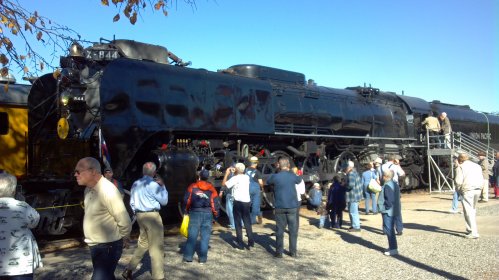
Mmmph. Maybe next month. I bought a gallon of high-fat milk instead. I may not be the 5%, but I sure as hell drink it. On the way, I stopped near the old downtown Colorado Springs train station on Sierra Madre to see the Union Pacific #844 Niagara steam loco, which is on tour and in town for yesterday and today only. #844 was the last steam loco ordered by UP, and it’s been lovingly restored as a sort of rolling, steaming, hot-and-dripping museum. I don’t see 4-8-4’s very often, and never before a live one, so it was well worth the detour. Smaller cities are great in that I scored a parking place right across the street, and could get photos with almost nobody else in the way. I doubt I would have done that well in, say, Chicago.

It’s tough to get size perspective on machines like this. The eight drive wheels are eighty inches in diameter, and the engine as a whole is 114 feet long. Because of a historical quirk, “standard” railroad gauge is four feet eight inches, meaning that the wheels are considerably wider than the gap between the rails. I always wonder, facing a behemoth like this, how they managed to keep it on the tracks. (One answer is luck. Another, gravity. Most of all, skill. Alas, sometimes the answer is, They didn’t.)
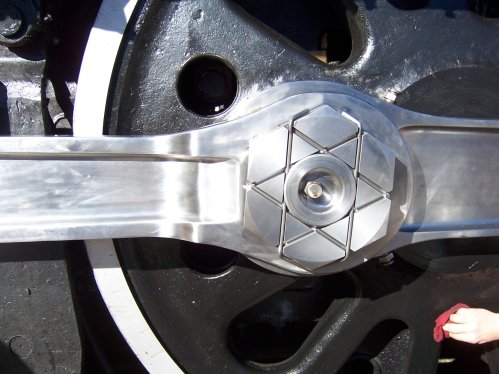
There were a number of people swarming the loco, polishing the connecting rods and valve gear and wiping dirt off the painted parts. It was surreal how shiny the metal bits were–I would guess it wasn’t anything like this clean back when it was earning a living. In fact, while I was admiring the dazzlingly burnished iron, a young mother walked over with a three-year-old on one hip. As she turned around to pose for dad’s camera, the small boy reached his hand out to the connecting rod. His mom jerked him away: “Danny, don’t touch that! You’ll get it dirty!”
Some time tomorrow morning, old #844 will head south on the BNSF main line to Pueblo. Given that we look down Cheyenne Mountain toward the tracks and hear the Diesel horns on the BNSF coal trains all the time from our back deck, there’s a nonzero chance that I may hear the 844’s transplanted Big Boy whistle as the consist roars by. I’m sure going to try: The weather will be decent and I may never get another chance to hear any steam locomotive–much less a Niagara!–roar past my house.
As for Halloween itself, well, the Kid Gods are delivering near-perfection this year in Colorado Springs: 68 windless degrees under a cloudless sky. The legendary Halloween of 1964 was something like this in Chicago, and better only because it was on a Saturday. I’m not expecting a lot of traffic this year, since small children are scarce in this neighborhood of retired lieutenant colonels. I did buy a bag of Smarties for the big bowl by the front door, intrigued by the presence of dextrose as the sole sugar. I’ve never seen dextrose explicitly called out in a list of incredients before, even on candy. It’s typically “sugar” (generally sucrose, which is half fructose) or “high-fructose corn syrup.” I wonder if the animus against fructose has become so great that manufacturers are leaving nothing to supposition. If so, it’s a quiet victory–and not a small one.
Finally, QBit and I watched Van Helsing last night on the Family Channel. (Carol is still in Chicago and the rest of the Pack at Jimi’s.) The film is a great, whacky over-the-top paean to Victorian monsterabilia. Lessee: Wolfman, Dracula, Dr. Jeckyll and Mr. Hyde, miscellaneous vampires, plus Dr. Frankenstein, Igor, and the Monster. (The Mummy was indisposed.) Oh, and what I consider the single most dazzling steampunk movie weapon of all time: An automatic-fire crossbow that spits bolts at flying vapiresses as long as you hold the trigger. Dip the front end in a holy water font and you are da bomb! (And if you miss, just flick a fingerful of gooey glycerin-48…)
Odd Lots
- Here’s yet another brick in the structure I’ve been seeing in psychological research suggesting that beyond a certain (reasonable) point, the more confident you are, the less competent you are.
- The Japanese word I heard at MileHi Con but could not spell (and thus not find) is yaoi (boys’ love) which is evidently fiction targeted at women which portrays homoerotic/homoromantic relationships between good-looking young men. (Thanks to Erbo and Eric the Fruit Bat for clarifying this. I just had no clue.)
- And while we’re identifying obscure pop culture icons and references, I’ve seen this guy somewhere. Who/what is he?
- NASA’s new-technology space-based atomic clock has eight pins, and relies on high vacuum. George O. Smith would approve. (Thanks to Larry Nelson for the pointer.)
- Switch to a “mechanical keyboard”? I never stopped using them to begin with. Modern “mush” keyboards were created solely to be cheap and are mostly useless. (I love it when I’m right–and thanks to Pete Albrecht for the link.)
- How many people lived on Earth when you were born? For me, it was 2,556,061,949.
- The 99c MP3 of the Month Award here goes to Sam Spence for “Classic Battle,” which was evidently commissioned by the NFL as incidental music for football games. Dayum. Why doesn’t baseball get music like that?
- Music, heh. Ever hear a piece of music that immediately made you head for the exits? Maybe that’s the whole idea. (Thanks to Pete Albrecht for the pointer.)
- I’ve found a good home for my old Ampro CP/M system, and will be shipping it out shortly. Thanks for all the suggestions and reminiscences.
MileHi Con 43
Just got back last night from MileHi Con 43, held at the Denver Tech Center Hyatt. I haven’t been to a lot of cons lately, and my congoing skills are definitely rusty. One of these skills is new to me: Remember that your phone contains a camera. Duhh. My V530 camera jammed with the lens open so I didn’t get any photos, but I’ve requested some from friends and will post a few here as time allows.
What was a little surprising is how much a con in 2011 feels like a con in 1981. The big difference comes down to one word: smartphones. Nobody spends any time searching for friends at cons these days because everybody always knows where everybody else is, and if somebody wanders outside a general understanding of their whereabouts, well, it’s one tap and they’re back within earshot.
Costuming has also changed, though this may be old news. However well-done, the costumes were basically hall costumes rather than elaborate and fragile stage-show assemblages that you could barely move in, much less sit down. The con organized a zombie crawl around the 16th Street Mall on Saturday afternoon, and it got into the Sunday Denver Post. The Post also did a good job snapping most of the better costumes, and you can see them in a slide show on the newspaper’s site. I had never heard of absinthe fairies, but boy, there were a lot of them around. (And, later, “wingfic.” Yes, there is a subsubsubsubgenre called wingfic. It’s about characters who have wings. Beyond that, anything goes.)
I hung a lot with close friends Jim Strickland and his wife Marcia Bednarczyk, as well as Taos Toolbox colleague Sean Eret. Jim and I both did panels, and we shared a late-night author reading slot at 10PM on Friday. The reading was interesting for a peculiar reason: I did not get an email that the other five panelists apparently did, reminding everybody (but me) that the reading had been slotted late to allow for sex and violence. I was fourth of five in order to read. In quick succession we heard some bishonen fiction (there’s a descriptive Japanese word for the genre that I can’t find right now but sounds like “yowee”) and some heavy-duty mayhem (including a gripping section of Jim’s novel-in-progress, Brass and Steel: Inferno) plus a sex scene with Dr. Moreau’s squid-woman. Then it was my turn. “And now for something completely different,” I said, and began: “STORMY vs. the Tornadoes…”
They loved it. Comic relief exists for a reason.
Speaking of which: I had chosen STORMY because I was on a panel about writing SF humor the next day. The panel was great: We dissected the machineries of humor, and delivered quite a bit of it ourselves. (I sang a little of my 1976 filk from “West Side Story,” “I’m a Trekkie,” if you can picture that.) I was a little surprised that out of an audience of forty or fifty, only two people had ever heard of The Witches of Karres, which I was using as an example of that rarest of things, SF whimsy. Another person asked me to spell “Laumer.” Egad. I guess I’ve been away a long time.
My other panel was about robots, and once we got past some problems with definitions (Robots, to me, are “AIs in a can,” not cyborgs) we did some good things. Again, I was puzzled that so few people were familiar with AMEE, which I consider the scariest robot in film history. I was delighted to be sitting on the panel beside longtime SF writer Cynthia Felice, whom I had read years back but never met. She is gracious, interesting, and, well, tall. (She also grew up in Chicago and now lives in Colorado Springs, which I did not know.) At the end of the panel, the moderator took a quick audience poll, and we discovered that (within this microcosm, at least) Marvin the Paranoid Android is our favorite robot.
I hugely enjoyed it, and with Carol away in Chicago and all of the Pack except for QBit vacationing at Jimi Henton’s, I hope to use some found energy to make progress on Ten Gentle Opportunities over the next few days. I talked to people at the con who write four novels a year. I started work on Ten Gentle Opportunities in 1984, and it’s based on an (unpublished) novelette I originally wrote in 1981. Gotta pick up the pace a little, whew.
Slabbed

We’ve had soil subsidence issues here for some time–years, in fact–the most recent occurring when the soil pulled down on our gas meter feed so hard that it cracked the pipe. Our driveway looks like someone carpet-bombed it. My garage slab sank enough so that my lathe pulled its wires out of the junction box in the ceiling. Now the slab on the lower level has sunk enough to cause cracks in the plaster. We’ve been patiently waiting for the settling to stop, but issue piled on issue suggests that the time to get the soil stabilized and the concrete fixed is now.
We’ve been talking with a local contractor and may get a deal done in the next few days. That means, of course, that a lot of stuff is going to be moving around, especially on the lower level of the house. Carol’s office is Ground Zero, and everything will have to be moved out of there to somewhere else. I have to move several bookcases, including one stacked full of QST, which is probably the only magazine ever printed that was denser than National Geographic. I am going to get my strength training in the next few weeks, is for sure.
What we’ve begun doing is going through boxes, setting aside things for the various charity pick-ups, and trying to restack the furnace room shelves for maximum density. This is a time-intensive business, and time I would rather use writing has gone into sorting and stacking. That said, I’ve unearthed a number of things I thought I had long-since dumped or lost. One is the stack of Paradox reports I used to track manuscripts and issue lineup for all ten years of PCT and VDM. The database itself is gone, unless it survives (doubtful) on a 5″ HD floppy in the box of 5″ floppies I mentioned some time back. I found the 1882 copy of Oliver Twist that is certainly the oldest paperback book I’ve ever owned, or even seen. Inexplicably, it was tucked into a box full of archival copies of my own books, probably to fill a crack too small to accept yet another copy of Assembly Language Step By Step. Careless packing is a peculiar and little-understood hazard. (I’m understanding it better all the time.)
I also found a Russian-manufacture metal construction set; something like Meccano but Metric. I don’t entirely remember where I got it.
And although I knew it was there, I just unpacked a peculiar machine: A Z80 CP/M computer I put together solely to run Borland’s virtually unknown Turbo Modula-2. I assembled it in my garage in California in 1988, and ran it once or twice more early in our Arizona tenure. It’s been sealed in a box since 2002, when I tried and failed to sell it for $5 at the Fort Tuthill hamfest near Flagstaff. It uses the Ampro Little Board Z80 board, plus two DS/DD 5″ floppy drives, and a spare IBM PC power supply. I would fire it up except that it uses serial I/O, and the time to locate cables and rig a link to a serial window is time I need to spend moving other stuff out of the way. Let’s say that it worked fine when it went into the box in 2002. I’m not sure I want to keep it, but I sure hate to just heave it into the trash. Still thinking.
I’ve culled a hundred pounds or so of boxed technical books, most of which I intended to sell on Amazon Marketplace some years back and found no market for. (And now I’m ineligible for Marketplace because of Amazon’s sales tax squabble with Colorado.) I’m putting the word out that the books are here to grab, cautioning that some of them are mighty old as computer books go, though a few may still be useful. If I don’t find homes for them in the next couple of weeks, they’ll be in the recycle bin.
Other stuff needs Carol’s processing, like her Barbie dolls and other childhood odds and ends, but we made some real process in opening up space in the furnace room, to which Carol’s office furniture is likely to be evacuated in the very near future. I’ll need an Aleve tomorrow, but the work–heh, that’s only beginning.