- Jim Strickland and I will be attending MileHiCon in Denver this weekend. Anybody else listening gonna be there?
- I’m on a panel about robots, and here’s a megatrivia question for you: What was the first film depiction of a robot that was not a mechanical man; i.e., not things on two legs like Robbie, Gort, or Tobor the Great? The oldest one I can think of is the 1954 Gog. (Writeup.) This was a rare form factor back then (because humanoid robots were actors in robot suits) and the only other one from the Fifties I can recall is the 1957 Kronos.
- Pertinent to that question: There was a serious and reasonably big-budget Japanese SF movie in the early 60s (not a let’s-stomp-on-Tokyo thing) depicting a spaceship with a small robot named Omega that ran on tracks. The other vehicles on the starship were also given Greek letters as names. Can anybody remember what that film was? All I get on Google for “Omega the Robot” are Sonic the Hedgehog references.
- Having flown the X-37B into space twice, Boeing is now officially looking into doubling the size of the vehicle and making it a sort of people-only space shuttle. Alas, it would probably kill all hope for anything like the sexy li’l X-38–but I’ll take what we can get.
- Red tide algae glows blue after dark, if you shake it up enough. Pete Albrecht has seen this, and it’s real; nay, surreal.
- Boston Dynamics’ uncanny and brilliant Big Dog quadriped robot now has a big brother, AlphaDog. Watch both videos; the second is a demo of Big Dog doing stuff I wouldn’t have imagined a robot doing when I was in high school. BTW, that tube sticking out of Alpha Dog’s front panel isn’t artillery…yet.
- These guys will sell you a 144-core CPU–and then make you program it in FORTH. Not x86; each core is an 18-bit F18A processor executing the colorForth instruction set. FORTH ties my head in knots and yes, I’ve tried it–on the CDP1802 processor, no less. (Thanks to Frank Glover for the link.)
- Gotta love Google Books. I recently found a Popular Science article I had read in 1967 summarizing various rotary engines under discussion at that time. Nobody answered the obvious question: How do you machine a piston in the shape of a piece of kielbasa?
- A short 1963 book on rotary engines by Felix Wankel himself can be found here. (Multiple PDFs; not an easy read.) Thanks to Pete Albrecht for spotting it.
- From Henry Law comes a pointer to the most boggling piece of amateur rocketry I’ve ever seen. High power? Heh. One doesn’t get to 121,000 feet on vinegar and baking soda.
- You don’t have to speak or read German to appreciate this photo tour of Vienna’s sewers. Why do they get such cool sewers in Europe? (I’ve seen a few Stateside, and they just…stink.)
- Sure, and while you’re at it, grab his beach towel.
Odd Lots
More Notes on a Victorious Vacation
I’m easily delighted. It’s one of the benefits of driving as much cynicism out of myself as I can. Cynicism is a kind of cowardice, in that it seems to consist of a morbid fear of being delighted. Screw that. Dare to be happy; it doesn’t hurt that much!
Case in point: The morning after we arrived in Honolulu, Carol and I took a walk around the immediate vicinity of the Hilton, looking for a breakfast that wouldn’t cost us $20 a head. McDonald’s might not have been my first choice, granting that I have a fondness for Egg McMuffins. But I like their iced coffee a lot, so when we stumbled on a McDonald’s, I ducked inside to get an iced coffee.
OMG: They had a spam and eggs breakfast plate!
We ate at McDonald’s. I was delighted. Their breakfast plates are a Hawaiian thing. Hawaiians of Polynesian ancestry seem to like spam, and whereas I have no least trace of South Seas blood, I too find Spam delightful. I didn’t have it every day (though I had it a lot) and now that we’re home from Hawaii, I probably won’t have it again until the next time we’re there. That way I won’t get tired of it, and it will retain its power to delight me.
Immediately adjacent to the Hilton Hawaiian Village is the Fort DeRussy Military Reservation, which these days is an R&R facility for current and retired military. This includes the Hale Koa Hotel, which is limited to military and retired military personnel, and several restaurants and bars, which are open to the public. I bought a tube of Pepsodent at the PX before I understood what the store was, and in doing so may have violated their policies; not sure. Their little outdoor fast-food restaurant (I forget its formal name) was spectacular, and the lunch I had there consisted of the largest and juiciest deep-fried chicken breast I’ve ever had. Like the Pepsodent, it was lots chapter than it would have been elsewhere.
I observed a phenomenon that I’ve observed before, and seems to be getting more common: talking on your cellphone in public as though no one else can year you. Granted, I was walking behind the young woman in question and there was no one immediately in front of her, but sheesh–we were on the grounds of the Hilton Hawaiian Village. I wasn’t really listening, but at her volume it was hard not to hear: “…yeah, and I scraped my f—ing pedicure off on the sand!” I only had to twist poor Bobbie Burns a little:
Oh wad some gift the Giftie gie us,
To hear oursels as ithers hear us!
Tripwander

By the time I finally crawled into bed last night, I’d been awake for almost 36 hours straight, which may be a new record for me. It’s an occupational hazard of certain kinds of vacations: The hardest part of going to Hawaii is coming home–and not simply because it’s nice in Hawaii. (Which it is; wow. See above.) Flights back to the mainland are invariably redeyes, and given that I sometimes can’t even sleep in my own bed, I’ve not been surprised to find that I can’t sleep in an airliner seat. So I take along books full of well-written ridiculania (this time it was Colin Wilson’s The Mammoth Encyclopedia of the Unsolved) and try to make the most of all that quality tin-can time. Worked. And now, having slept for close to 11 hours, I can get back to the universe as reality.
We took two weeks off on Oahu to celebrate our 35th wedding anniversary, and I made a conscious decision not to do any more computing during that time than I absolutely had to. I didn’t post here, didn’t do much surfing, ignored my aggregators, and pushed back answering most email until after our return. And y’know? As they say on Slashdot, Nothing of value was lost. We didn’t watch TV, either. We didn’t do any aerobic tourism. I brought a kite and chose not to fly it. We spent much time side by side, splashing in the gorgeous water, drinking pina coladas, laughing at ancient in-jokes, and reveling in one another’s company. That was, after all, the idea.

Our first few days were at the Hilton Hawaiian Village, in the venerable Rainbow Tower, which had gotten a little too venerable since 1969. All the time we were there the tower echoed with the sound of jackhammers. Our room was on the 16th floor, facing Diamond Head and the full length of Waikiki Beach. The view was amazing, and worth the trouble of having two of the four tower elevators out of service.

In the early evening darkness, we watched people launch these little LED-illuminated toys into the air off the beach. A rubber-band catapault takes them up forty or fifty feet at least, and then they spin down slowly in the fashion of a winged maple tree seed. I dug around a little and found that this is the item. I would have bought one, but the guy selling them out of his backpack wanted $10 each for what is evidently a $1.50 item. I’ll bet they’re at the dollar store, and will look. A Certain Somebody has her fifth birthday coming up, and a big field behind her house to launch it from. Way better than maple seeds!
The other thing that made me grin was watching the spectacular Friday night fireworks from our balcony. The east side of the Rainbow Tower was the best seat in the house. The beach was packed with people waiting for the fireworks, and dozens (maybe hundreds) among the crowds had smartphones, which shone blue-white in patterns like constellations. Silly? Maybe–but it was a startling and unexpected image. I’m sure that what they were doing was tweeting the experience to their friends, who didn’t have the good fortune of being in Hawaii like we did. It’s what the postcard has become, a century and a half after postcards were invented.

Thursday afternoon we were sitting in the Hilton’s beachside cafe having a drink, and Carol says, “There’s a drilling platform out there.” She pointed. I was lead-pipe sure there’s no offshore drilling a quarter mile from Honolulu, but dayum, there was a drilling platform off toward the airport. I looked again later in the afternoon and it was gone. The mystery was solved the next day, when we took a bus trip to Hilo Hattie’s for some souvenir hunting, and realized as we passed the docks that something rare was in town: The Sea Launch Odyssey. It was at the docks for refueling on a long, slow trip to somewhere for refitting. It has a 13,000 hp engine and evidently toodles around the oceans very well all by itself. I’ve stayed in towns smaller than that thing, and it suggested what may become a new short story, “Trash Angels,” about Penrose tiles and empty soda bottles.
Four days later, we retired to the other side of Oahu and took a vacation rental on the north beach near Kailua, with our terrace only 100 feet from the crashing 7′ waves. We read, lounged, got our sinuses cleaned out by the waves, and ate at some decent restaurants, especially Pinky’s Pupu Bar and Grill. I’m running long today, so I’ll get a fews more observations out in the near future.
Thirty-Five Years
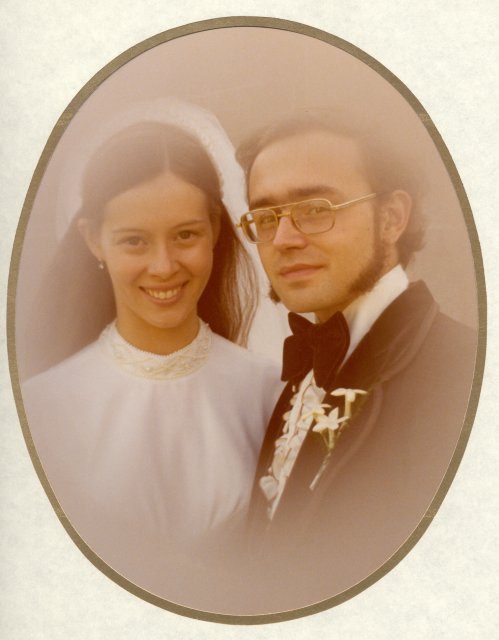
Thirty-five years ago today, Carol and I stood side by side at St. John Brebeuf church in Niles, Illinois, and promised before God that we would strive to be not simply together, but together as best friends and inseparable partners, until whatever end may come. That’s the short form; I’m not sure I could say it better than I said it five years ago in this space.
So I’ll add some backstory: It was a big Polish wedding, with the ceremony at Carol’s parish church and the reception (217 guests) that evening at the now-vanished Northwest Builders Hall in Chicago. There were eight in the bridal party, and, remarkably, we have been in regular touch with seven of the eight. My childhood best friend Art Krumrey (whom I met at Edison School kindergarten in 1957) was our best man, and Carol’s sister Kathy was maid of honor.

L-R: My locker partner Tom Barounis, my sister Gretchen, Fox Patrol colleague George Murphy, Carol’s friend Eileen Schultz, me, Carol, Carol’s sister Kathy, Art Krumrey, Carol’s sorority sister Roseann Such, and my high school astronomy club colleague George Hodous. The bridesmaid dresses were mostly timeless; the groomsmen’s tuxes very Seventies. The food was Polish and spectacular, and we had a polka band that wore everybody out, which is what we hired them to do.
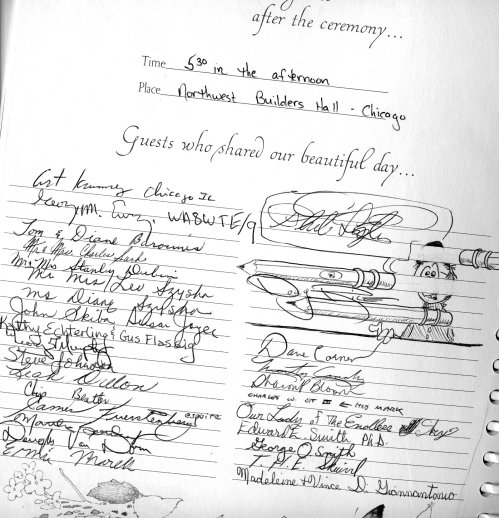
The family turned out in force, as did most of our friends. The page below is from our wedding guest signature book, and I consider it about as interesting as such things ever get. Edward E. Smith and George O. Smith were both there, though after signing the book they left at 40% the speed of light and I didn’t get pictures. The late (and terribly missed) George M. Ewing included his callsign, as always (portable 9!) and fan artists Phil Foglio and Doug Rice collaborated on some between-the-lines illumination. Mary the Mother of God signed in from the future (as Our Lady of the Endless Sky, straight from Sinus Iridum) though many of us wonder why the Blessed Mother had trouble with her handwriting.
It was huge good fun. Outside the church, family threw rice and friends threw punch-card chad, which I was picking out of my ears well into our honeymoon in the Cayman Islands. Carol’s sister caught the bouquet. (I don’t recall who got the garter.) We had a martini fountain, which was the first time I’d ever seen that technology, though not the last.

It’s sobering to look at the wedding photos and see an entire generation gone (except for Carol’s mom) as well as friends like George Ewing and Sharon Bloom who died far, far too soon. The photos are a snapshot of a time that few appreciate but which wasn’t as bad as conventional wisdom holds. Like the Forties (which we all mocked in our youth) the Seventies will come back someday, though I wouldn’t wait up for clones of the AMC Pacer.
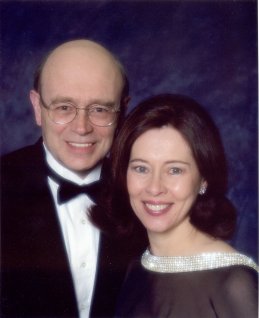 As for Carol and me, well, the promise has been kept. We’ve taken some hits down the years but the flag still flies. Marriage works. It does. Not always and sometimes not the first time, but in our case, luck was with us and love did the rest. Thirty-five years on we have transformed one another, as marriage is intended to do, and at this point Jeff without Carol is no more meaningful than dividing by zero. Mission accomplished. Thanks from both of us to those who’ve been with us all this time, and to those others who have by now taken their places in the Community of Saints, all of whom made it possible without fully understanding how much their simple kindness and unending faith would mean to two ordinary people who made those extraordinary promises so many years ago.
Early Halloween

I’m starting to get notes from people asking if I’m all right, and I am, though for the last few days I’ve been fighting an anomalous migraine headache and haven’t felt much like writing. Lots to catch up on, now that I’m feeling better.
First off, I guess, would be the fate of our closest Borders. No sooner did it close its doors than a crane hoisted a banner for Spirit Halloween Stores across the name. I’m not a big Halloween fan (my sister got that gene) and so haven’t paid much attention to Halloween retailing, but Spirit is a national chain with an interesting business model: lie in wait for a big-box store to go belly-up, and then quickly reanimate the corpse for a couple of months prior to October 31. We have at least one other Spirit outlet here in the Springs, up on the north side inside the vacated remains of Ultimate Electronics. They may have year-round stores somewhere, probably in larger cities with more of a Halloween culture than we have here. The new store (in Southgate Plaza) hasn’t opened yet, even though there’s only 30 shopping days left until You Know What. Somehow they make it work.
And while we’re talking about reanimating corpses, I want to recommend a short story to zombie fans who may not have heard of it: “Impulse” by Eric Frank Russell. It first appeared in Astounding in September 1938, but it’s been reprinted many times since then. I found it in my decayed and dustbound copy of Groff Conklin’s 1962 paperback horror anthology Twisted. That’s a little remarkable, because “Impulse” is not a horror story as we usually define it. It’s pure SF, and remarkably prescient SF at that. Consider this excerpt:
It was a space vessel that carried us from our home world of Glantok. The vessel was exceedingly small by your standards–but we, too, are small. Very small. We are submicroscopic, and our number is myriad.
“No, not intelligent germs.” The ghastly speaker stole the thought from his listener’s mind. “We are less even than those.” He paused while he searched for words more explicit. “In the mass, we resemble a liquid. You might think of us as an intelligent virus.”
Basically, Russell’s talking about a colony of nanomachines living inside a dead human body that it stole from a morgue. The nanons got it running again, and even accessed memory proteins in its brain. So we’ve got a zombie here, a real zombie that doesn’t rely on supernatural machinery to make it go.
The story is better than typical pulp, although it respects all the usual pulp tropes including a mostly unecessary damsel in distress. I’m a fan of the story for an odd reason: It was the first story I ever read to a group. In the summer of 1964, my scoutmaster at Camp West in Michigan tapped me to read the story to Troop 926 while gathered around the evening campfire. It was fun, if a little tricky, because I had not read the story before sitting down to read it, and didn’t know myself how it would turn out. I remembered the title but not the author, and it took some googling to find it–else I would be flipping through the hundred-odd anthologies I have on the shelves downstairs.
By the way, Conklin is a superb anthologist, possibly the best out of the 1950-1975 era, and if you ever spot one of his books, it’s worth grabbing. (Kingsley Amis is another; his Spectrum books should be stalked and devoured.)
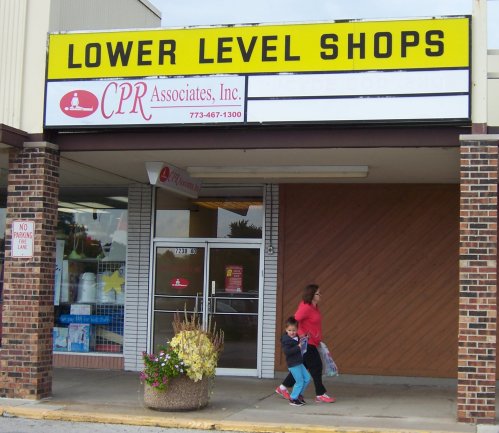
One more note about ghosts, albeit of the sign variety: While in Chicago last week I visited the strip mall retail complex at Harlem and Foster, which was an early shopping center (circa 1960) and when built contained the closest department store to where I grew up. (Turn Style, long-gone but the precursor to Target and K-Mart.) The strip mall contained the bank where I got my first account, and the Walgreens where I got my first job washing dishes at their grill. It also contained a slightly freaky windowless lower level divided into four small stores, one of which was the Arcade Bookshop. It was the first bookstore where I recall spending my own money, and I probably bought Conklin’s Twisted there. I also ordered several books on the fourth dimension from the very patient lady behind the counter. It opened when the mall as a whole opened. It became a Christian bookstore in the 1980s, and closed in the early 1990s. You can’t see it in the photo shown above, but the upper right sign space is the old Arcade Bookshop sign, reversed so the back side is out. However, if you’re there in front of it you can clearly read the store’s name through the plastic–backwards, sure, but that’s no real trick, and seeing the old store where I spent so much of my allowance in the 1960s was definitely a treat.
Daywander
Why would anyone read two histories of Byzantium? Well, if the first one is mainly useful in putting you to sleep on a bad night, you might need a second to actually understand Byzantium. I finished John Julius Norwich’s A Short History of Byzantium about six weeks ago, and I suspect it didn’t satisfy because it was, well, short. (It’s an abbreviation of a much longer 3-volume work by the same author.) Norwich tells us all the things that happened in the eleven hundred years that the Byzantine empire existed, but he doesn’t have room in a mere 400 pages to analyze why things evolved as they did. By the time I was done, the Byzantine empire seemed to cook down to pseudocode:
REPEAT
  New(Emperor);
  Rivals.SlitThroat(Emperor)
UNTIL MuslimsKnockOverConstantinople;
So unless you’re an insomniac like me, I recommend A History of Byzantium by Timothy E. Gregory (Blackwell, 2005) which trades some of the repetitive detail for more and better analysis. It’s a much more readable book overall, and seems targeted at laypeople who don’t already know the broad outlines of the story. (I’m guessing it’s a 300-level textbook.) Recommended.
In other recent reading, I went back to Colin Wilson’s New Pathways in Psychology (Taplinger, 1972) to locate his definition of a “self-actualizer,” which may help me in designing a character for an upcoming story. The book is an explication of Abraham Maslow‘s views on psychology, which Wilson admires and mentions in many of his other books. I ended up reading a lot more than I intended, and realize that I may have to buy another copy of the book. The one I have was cheap, sure, but it was previously owned by a person who underlined probably 50% of the book without more than a handful of marginal notes. How is it useful to have all that underlining, if the purpose of underlining is to call attention to especially brilliant or pertinent passages when you want to find them later? And when she (her name is on the flyleaf) decides to make a note, it only proves that she is stone deaf to Colin Wilson’s ironic sense of humor.
I’ll come back to Wilson’s books in a future entry on designing characters, but in the meantime, New Pathways in Psychology is useful, as is A Criminal History of Mankind (Mercury, 2005.) His 1956 breakout book, The Outsider, nails existentialism–right through the head. Not as engaging as his other work, but if you’re trying to design a disaffected young man (especially if you yourself are well-adjusted and generally happy) the blueprints are all right there.
Yesterday Amazon delivered the 32 GB MicroSD HC card I’d ordered for the Droid, and I had this insight: You know you’re old when the fact that a thing the size of your pinkie fingernail could swallow everything you’ve ever written without a burp (plus ebook editions of every book in the house, if they existed) still makes you boggle. I don’t know precisely how much stuff it could hold because I don’t have that much stuff. But I’ll do some math: At 3 MB per MP3, the card could hold 10,000 songs. At 3 minutes per song, that’s 30,000 minutes, or 500 hours of music. At 500 KB for an .epub novel, that’s 60,000 novels, which at a novel every single night is…165 years’ worth of novels.
I guess I’m old. My boggler is in excellent working order.
Odd Lots
- Maybe it’s some of the recent solar storms (the sunspots were not spectacularly high) but I heard both Guyana and the Cayman Islands on 17m the other day–the first time I’ve seen any significant life on that band in several years.
- I have yet to find an Android ebook reader app that will open and render an MS .lit file, of which I have several. No surprise: Having blown an early and promising start in ebook reader software, MS has recently announced that it is withdrawing the app. Reader is actually a nice piece of work, and the first ebook reader program I used regularly. DRMed .lit books are now just noise, and the rest of them will have to be translated by something like Calibre. DRM, especially when it’s abandoned, trains people to locate cracks and become pirates. Way to go, guys.
- SanDisk just announced a thumb drive about the size of its own USB connector cap. 4, 8, or 16GB. I’ve now broken two thumb drives by leaving them plugged into the rear edge of a laptop and then tipping the laptop back. If that’s a common problem, this is definitely the solution.
- What do you do with the Moon once you rope it down? (Watering it would be interesting, though Mars needs it more.)
- This guy thinks like I do. Just ask Carol. (Thanks to Michael Covington for the link.)
- I recently found a PDF describing the first computer I ever programmed for money. It was a…1 MHz…8080. It cost a boggling number of 1979 dollars, so Xerox ended up using most of the initial production run in-house. The 3200 cast a long shadow: I got so used to sitting in front of it that when I built a computer table later that year for my S100 CP/M system, I made it just high enough that the keyboard was precisely as far off the floor as the 3200’s, a height that I use in computer tables to this day.
- How long did it take you to figure out what this really was? (Thanks to Pete Albrecht for the link.)
- Russian President Medvedev has taken a liking to ReactOS, a long-running and mostly ignored attempt to create a driver-compatible, win32-friendly (via WINE) open source Windows clone. He’s suggesting that the Russian government fund it. Now if Medvedev can convince Putin, we could have quite a project on our hands.
- I’d never thought much about how you recycle a dead refrigerator. Now I know.
- Begorrah! Zombies are not a new problem. (Thanks to Frank Glover for the link.)
- And if that machine gun in your hollow leg won’t slow them down, send them into sugar crash.
Goggling Google Goggles
As at least ten people by now have written to tell me (though Eric the Fruit Bat gets credit for being the first) Google has a project targeted at recognizing things in the physical world and looking them up online, as I wistfully wished for in my September 17, 2011 entry: Google Goggles. I vaguely recall hearing of the product on its first release, which (because it was for Android) was not something I could fool with on Windows.
There’s even a word for the general concept, though it’s not one I would use: augmented reality. I’m not looking for things to augment reality so much as simply document it–but in this age of exaggeration, I guess that’s pretty much the same thing.
Google Googles is a mobile app currently available for Android and iPhone. You aim your smartphone (assuming it has a camera, as virtually all do) at something, and tap a button. The phone takes a photo, and then (I assume) there’s a conversation with the Google mothership to see if the photo resembles anything already in the recognition database. The app is free, at least for Android, and I’ve been having some good fun with it trying to see what its limits are. Here’s my report:
Google Goggles recognized the following things:
- A bottle of Coke Zero.
- A conventional painting of Jesus Christ.
- A conventional painting of St. Francis of Assisi.
- Two different contemporary paintings of Ben Franklin.
- A bottle of Campus Oaks Old Vine Zinfandel.
- The Colonel Sanders portion of the KFC logo. (Without “KFC”.)
- The Virginia Cavaliers alternate logo.
- The iconic Rolling Stones tongue logo.
- The Insane Clown Posse logo.
- The Dave Matthews Band logo.
- The Hieroglyphics band logo.
It did not recognize the following things:
- Me. No clue about my standard publicity photo, as seen in my blog header, even though it’s logged in Google Images.
- A headshot of Isaac Asimov, also found on Google Images. I guess I don’t feel so bad.
- QBit. (It states clearly that animals generally aren’t recognized.) It did say that he resembles a poodle, a kitten, and two bunnies. Goggles isn’t the first entity that thought QBit was a poodle, though I won’t mention the kitten part to him.
- My Celtic peat cross. It said the cross resembled several tall, skinny women dressed in black. I can almost see that.
- The Nike swoosh. Failed four times. Now that surprised me.
- A tape measure.
- A fork. It thought the fork resembled the Statue of Liberty.
- A knife. It thought the knife resembled a white bunny.
- A 430-ohm, 2-watt carbon resistor. It thought it resembled the Canadian flag.
- A cordless telephone handset.
- My Weber gas grill.
- A pair of headphones. It said my headphones resembled a wristwatch.
- A screwdriver, though it did say my screwdriver resembled photos of other screwdrivers.
I’m reasonably happy with this record, considering that Goggles is more a proof-of-concept than anything close to what I want to document (ok, awright already, augment) reality. It does seem to prefer things that are enormously popular. My first suspicion was that Goggles would not recognize anything that did not include OCR-able text, but most of the logos tested have no text, nor did the paintings of Jesus, St. Francis, and Franklin. Goggles had an impression that QBit was a small white animal, and there were flickers of recognition of a screwdriver. So far, so good. Cripes, it’s only 2011.
So. Share your success stories, if you have any. I’m modestly impressed.
Annotating Reality
We’ve had evening clouds here for well over a week. Maybe ten days. I’ve lost count, but I may well have to kiss off seeing that supernova in M101. That’s a shame, because I’ve downloaded the Google Sky Map app to my new Android phone, and I want to try it out under the stars.
The app knows what time it is and where you are, and if you hold the phone up against the sky, it will show you what stars/planets/constellations lie in that part of the sky. Move the phone, and the star map moves to reflect the phone’s new position. How the phone knows which way it’s pointed is an interesting technical question that I still need to research, but let it pass: The phone basically annotates your view of the sky, and that’s not only useful, it suggests boggling possibilities. I’m guessing there are now apps that will identify a business if you point your phone at it, and possibly display a menu (the food kind) or a list of daily sales and special deals. With a rich enough database, a phone could display short history writeups of historical buildings, identify landforms for hikers, and things like that.
That mechanism is not an original insight with me; Vernor Vinge described almost exactly that (and much more) in his Hugo-winning 2006 novel Rainbows End . Most of my current boggle stems from not expecting so much of it to happen this soon. When I read the book back in 2006 I was thinking 2060. We are well on our way, and may be there by 2040. (Vinge himself said 2025, but me, well, I’m a severe pessimist on such questions. How long have we been waiting thirty years for commercial fusion power?)
In general terms, I call this idea “annotating reality.” In its fully realized form, it would be an app that will tell me in very specific terms (and in as much detail as I request) what I’m looking at. I do a certain amount of this now, but with the limitation that I have to know how to name what I’m looking at, and that’s hit-or-miss. I have an excellent visual vocabulary in certain areas (tools, electronic components, wheeled vehicles, aircraft) and almost none in others (clothes, shoes, sports paraphernalia, exotic animals.) I was 25 before I’d ever heard the term “lamé” (metallic-looking cloth) and had no idea what it was when I saw it mentioned in one novel or another. I had indeed seen lamé cloth and lamé women’s shoes, but I didn’t know the word. It’s more than the simple ignorance of youth. As much as Carol and I are involved in the dog show scene, I still see dog breeds here and there that I don’t recognize. (Is that a bergamasco or a Swedish vallhund?) Even my core competence has limits: I received a Snap-On A173 radiator hose tool in Uncle Louie’s estate, and if it hadn’t had Snap-On’s part number on it I doubt that I’d know what it was even today, because I don’t work on cars.
I want something that lives in my shirt pocket and works like Google Images in reverse: Show it the image and it gives you the text description, with links to longer descriptions, reviews, and shopping. This is a nasty computational challenge; much worse, I’m guessing, than query-by-humming. (I’ve been experimenting with Android’s SoundHound app recently. Nice work!) Dual-core smartphones won’t hack it, and we’ll need lots more bandwidth than even our best 4G networks can offer.
But we’re working on it. Facial recognition may be worst-case, so I have hopes that the same algorithms that can discriminate between almost-identical faces can easily tell a tubax from a soprillo. I can’t imagine that identifying the Insane Clown Posse band logo is all that hard–unless, of course, you don’t follow rap. (I don’t.) Bp. Sam’l Bassett did some clever googling and identified Li’l Orby for me, but as with the Insane Clowns logo, the problem isn’t so much drawing distinctions as building the database. Pace Sagan, there are billions and billions of things right down here in the workaday world. Giving them all names may be the ultimate exercise in crowdsourcing. But hey, if we can do Wikipedia in forward, we can do it in reverse. C’mon, let’s get started–it’s gotta be easier than fusion power!
UPDATE: Well, if I read Bruce Sterling more I’m sure I’d have known this, but Google’s already started, with Google Goggles. I downloaded the app to the Droid X2, and surezhell, it knew I was drinking a Coke Zero. The app said clearly that it doesn’t work on animals, but when I snapped QBit it returned photos of three white animals as “similar,” including a poodle, a kitten, and two bunnies. Close enough to warrant a cigar, at least in 2011. More as I play with it. (And thanks to the six or seven people who wrote to tell me!)
Talking About Con Crud
I’ve been quiet here in part because Carol and I bought new smartphones on Saturday afternoon: a pair of Droid X2 units with which we are (so far) completely delighted. That said, I’ve discovered that research into the Dalvik VM and bytecode set does not help you learn how to move icons onto your Android desktop. Smartphones don’t come with manuals in the box anymore. Preston Gralla will sell me one on October 5. Until then, my learning process will consist of mildly Web-guided poking around.
More on this later. In the meantime, Michael Covington recently reminded me of a phenomenon I had not thought about in some years: con crud. Basically, people who go to SFF or media/gamer cons often come home with a nasty cold that sometimes borders on flu. Con celebrities have taken to refusing handshakes and hugs for fear of catching it (PvP guru Scott Kurtz is one) but nobody seems to agree on what-all causes it nor how to avoid it.
I’ve gotten con crud more than once. Interestingly, it wasn’t always at SFF cons. I came down with a nasty case after the 1983 (I think) Trenton Computer Festival. And the mother of all con crud episodes for me was a computer trade show in 1992, at which I came down with a bad case of bacterial pneumonia after three days in the PC Techniques show booth. It took some heavy-duty antibiotics and a week flat on my ass in bed to become functional again.
While there’s little agreement online as to causes, there are statistical bumps in the discussion on the following points:
- Not enough sleep. Staying up all night is a form of recreation in itself.
- Physical contact with other people. Hugs, not drugs!
- Bad food. People eat sugar and fat at cons. (Never at home, right?)
- Poor personal hygiene. We’re having too much fun to shower!
Sleep is certainly an issue. When I don’t sleep enough, I get sick. I have noticed that (within my own circles) morning people are generally healthier than night people, and among those I know well enough to ask, night people get way less sleep than morning people. There are of course causality questions here, but I think I can say confidently that the con crowd is dominated by night people.
The notion that fat and sugar suppress your immune system, and the flipside that fruits and veggies and whole grains strengthen it, is unproven and probably nonsense. (If it were true I’m sure I’d be long dead.) Skipping meals entirely may be more of an issue here. Hugs and handshakes may put some loose viruses on your skin, but breathing other people’s air is probably a more potent vector, and anybody who works in a big company cube farm is breathing other people’s viruses at con-scale all day, every day. Poor personal hygiene is an issue, though it may be as simple as not washing your hands as much as you do in mundane life.
I do have a suggested cause that I have not yet seen online: talking too much. Some people talk for a living. Most people work and study largely in silence. Then they go to a con and spend three days and three nights talking almost continuously. By the end of Day 2 of booth duty at early Coriolis show booths I generally felt scratchy in the throat, and when the whole thing was done and over I could barely talk at all. Basically, when you shred your vocal cords all weekend, you provide a stressed environment in your throat that’s easy prey for microorganisms. Not sleeping may then be enough to push you over the edge into serious infection.
If this is true, there’s no easy way around it. Cons are social gatherings, after all, and the real draw are not the exhibits or conference sessions but all the interesting people. My prescription will get some people angry but I think it will work: Talk all you want, but be in bed by midnight and sleep until 9:30. Try it. Let me know if it works.