- Michael S. Hart, founder of Project Gutenberg and generally acknowledged as the inventor of the ebook, has left us. He was only 64.
- That supernova that popped up in M101 about ten days ago keeps getting brighter, and the 8″ scope is out in the garage, collimated and ready to roll. I have never seen a supernova (mostly because I’ve never hunted for the pikers that have appeared in my lifetime) but this is starting to look too good to miss. Brightness should peak in the next few days, and if the clouds would break here for an evening I think it would be reasonably easy to spot.
- White dwarf stars may be able to exceed the Chandrasekahr Limit by spinning rapidly–and as soon as their rotation slows down sufficiently, they collapse and go supernova. Such stars may be more common than we think, and offer a cool SF gimmick for galaxy-level warfare: Subtract a little rotational energy from a super-Chandrasekar white dwarf, and wham! Supernova-on-demand.
- An earlier article from the same site suggests that such spinning white dwarfs may be messing up a long-established luminosity heuristic for measuring the distance to far-off galaxies. If all similar white dwarf stars collapse and blow up at the same mass, their luminosity may be assumed to be about the same. If more massive stars can delay their destruction by absorbing angular momentum along with accreted mass, the metric fails.
- Getting uranium out of groundwater is a good thing–and when you’re done, you still have the uranium. (In my view, uranium is just as useful as clean water.) I energetically wonder if this process can be generalized. If so, then anyone could become The Man Who Ploughed the Sea.
- Damn, I’ll believe it when I see it, and if I actually see it I may not in fact believe it, but Heathkit is going back into the kit business!
- I’ve never seen this before and I doubt you have either: A razor-sharp composite photo of the Moon’s north pole.
- From whence the above: I could do with more science and less Science Guy, but if you don’t visit NASA Goddard’s Flickr photostream regularly, you are missing out bigtime. (Site virgins, prepare to lose an afternoon…)
- T’hell with home theater: If this thing is quiet, it could be a spectacular desktop for office apps. (Alas, I see no published spec on how loud it is or isn’t.)
- If more ties like this were available, I might wear ties more. (Especially the, er, cable tie.)
- Back in 1948, Bell Labs polled their staff to decide on a name for what may be their most potent invention. Also-rans include the solid triode, crystal triode, and (my favorite) the Tom-Swiftish iotatron. That’s just so much cooler than “transistor.”
- Hmmm. It seems that Yale scientists may be offering me the choice between being a bald head and a fat head. I may stay where I am.
- But, Miles, it’s full of… marshmallows !
Odd Lots
A One-Tube Electroscope
I found the circuit below by accident, while flipping through my library of Popular Electronics looking for something else. It was published in the October 1961 issue, and caught my interest because a friend of mine built it back in 1964. It was a cool thing to watch in action. It’s an electroscope that detects static charge by using the grid in a vacuum tube to control conduction. Bring an object with a static charge on it within a couple of feet of the detector disk, and the NE-2 neon bulb will light or dim, its brightness proportional to the strength and polarity of the charge. Positive charges make the bulb glow more brightly. Negative charges will dim it, or even darken it completely if the charge is strong enough to force the tube into cutoff.
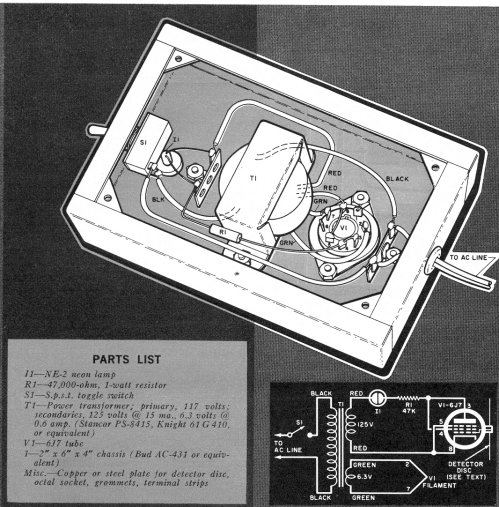
(The full article can be found here–2.6 MB PDF.) The detector is a metal disk five or six inches in diameter. It can be any conductive metal. When Art built his he used sheet aluminum and it worked just fine. The center hole is sized to press-fit on the grid cap of a 6J7, which is connected to the tube’s control grid. The 6J7 works well here because it’s a metal tube, and is inherently shielded by its metal shell. (The article doesn’t call it out, but I think pin 1, connected to the shell, should be grounded to the chassis.) A 6K7 or 6S7 will substitute pin-for-pin, and I think any metal tube with the control grid brought out to a cap will work if you get the pin connections right for the tube type. NOS tubes of this sort can be had for $5-$6 from places like Antique Electronic Supply. I don’t know how well the GT (glass) versions of the tube will work, since they lack the total shielding of the “standard” 6J7’s metal shell.
The power transformer called out was common and cheap back in the day, but you’d be hard-pressed to find one now. The usual dodge is to use two 6.3V filament transformers, and connect them back-to-back. (These used to be sold at Radio Shack. I’m not sure if they are anymore.) You can light the filament from the joined 6.3V secondaries, and take isolated 120VAC from the primary of the second transformer. The 6J7’s heater current is 300 ma. Any filament transformer that can source that much current will do.
I find it interesting that raw AC is applied to the plate of the tube without rectification. The current is in fact rectified by the tube (tubes conduct in only one direction) with rectifier current controlled by the 6J7’s first grid. My first thought was that it works like a thyratron, but there’s no latching effect. Current through the tube is controlled by the charge on the grid, and then in a linear way.
It would be interesting to figure out a circuit that would indicate with a sensitive meter rather than a neon bulb, and if I build it I may try a few things. The only cautions I offer here relate to the voltage: 120V, even isolated from the wall, is dangerous. Don’t work on the circuit with power applied. To be safe, yank the plug out of the wall before you open the box or flip the chassis over. There’s no voltage on the detector plate, so that can be touched even while the device is on.
All that said, it’s a great entry-level demonstration of how vacuum tubes work.
Odd Lots
- Wired has a nice piece on the 1859 Carrington Event; basically, the strongest solar storm in the last 500 years, assuming ice core data is a reliable proxy for storm strength. Early landline telegraph operators actually disconnected their batteries and passed traffic solely on power induced in the lines by solar activity. Whew. Now that’s QRP!
- Alas, even with sunspot numbers hovering at 120, I’m not hearing much DX out here. I’m not even hearing the East Coast. So much for Cycle 24.
- There’s a difference between “loving reading” and “loving reading what the literary class loves to read.” We can teach the first. By teaching the second, we may teach a good many students to stop reading completely. (Thanks to Rev. Sharon Hart for the link.)
- Here be the history of Godwin’s Law.
- From the September 1922 issue of Popular Science comes a crystal radio in a corn-cob pipe, shown in one of the geekiest Roaring Twenties radio geek photos ever taken. I doubt this would work (well) but I suppose it had to be tried. (Thanks to David Stafford for the link.)
- This radio geek photo shows a set that would certainly work (schematic here) but I’m not sure he would have been let on an airliner even in 1936.
- By 1949, radio geek photos were in serious decline, but 15-year-old Hope Lange gave it a damned good try.
- By sheer coincidence, the cover of that very same issue of Popular Science cited above for the corn-cob radio shows a drawing of a “monocopter,” an unlikely but at least physically possible device modeled on maple tree seeds, which I mentioned in Odd Lots back on July 28. This should be easy to model; has anybody ever seen it done?
- Maybe I’ve been writing SF for so long that this article sounds a little obvious to me, but some of the points do need to be borne in mind by writers new to the field, particularly #3. (Thanks to Frank Glover for the link.)
- This was Big News in Germany. Those people need to get out more.
- I’m not sure what it is either, but if you’re going to cite its name as PIGORASS, you’d really better expand the acronym.
We’re All 3 1/2″ Now
Just a quick update on the vintage 5″ floppy project: I bought a half-height Teac 1.2 MB floppy drive at OEM Parts earlier this afternoon, since I was buying silver mica caps anyway. I took the cleanest of the three or four they had on the shelf. Back home, I wrestled the side panel off an EMachines box built in 2004 and put some memory in it, then pried away the space-holder from the vacant front bay and slid the Teac drive into place.
The machine came from Best Buy with neither a floppy drive nor a floppy cable. The usual floppy drive cable connector is present on the mobo. As luck would have it (or maybe not luck so much as ancient habit) I found a very old floppy cable at the bottom of my Odd PC Junk bin. It’s the five-plug model, with two sets of both types of floppy drive data connectors. I plugged the controller end into the mobo, connected the pre-twist edge connector (that is, the one closest to the mobo) to the Teac, plugged a power connector into the drive, and powered the machine up.
XP ran as expected; it’s the old machine from our church, and I know it well. Windows knew that there was now a drive on the floppy controller, but reported it as 3 1/2″. I booted back into BIOS, but unlike the older machines I recall, there was no BIOS setting to specify what size floppy drive was in the box. Using the post-twist edge connector prevented Windows from seeing the drive at all.
I guess we’re all 3 1/2″ now, if we’re floppy at all.
The drive isn’t stone dead: When I put a 1990 TopSpeed Modula 2 floppy in it, the drive sounds like it’s indexing across the surface of the disk, but never returns any data to Windows. The drive may be bad, or the disk may be bad. Certainly the machine doesn’t appear to know what a 5″ floppy drive is. All in all, it’s really not 1990 anymore.
This was an hour’s project, not a day’s project or even an evening’s project. I’ve spent about as much time on it as I think it’s worth. I’m not going to dump the diskettes, but until a machine old enough to know 5″ from 3″ finds its way here, this is as far as I’m taking it.
Odd Lots
- Does anybody here use true peer-to-peer chat? I don’t use chat much, and when I do it’s with a very small number of people, typically one-to-one. By peer-to-peer I mean via direct connect from one IP to another, without intermediation at the server level, as with things like Trillian, Skype, Jabber, etc. I know that WASTE does this, though I’ve never tried it. What else might work? I don’t want to mount a new server if I can avoid it.
- New research suggests that low-salt diets increase insulin resistance–and thus propel otherwise healthy people toward diabetes. (Via Fat Head.)
- More on Amazon’s rumored Android tablet. Print Replica (as I discussed in yesterday’s entry) has almost nothing to do with it.
- Note well: Sony’s new tablet is not really sideload-able, since the device cannot render content directly from an inserted SD card. You have to copy all material from the card to internal storage. Also, the weird cross-section makes it almost inescapably a landscape machine. No thanks.
- Interesting short piece on the other Delphi–as in, Oracle of.
- For those who asked: The 400W power supply I just bought for my Core 2 Quad is the Antec Neo Eco 400C. So far…love it!
- Having sold out all the TouchPads there were at fire-sale prices, HP now intends to…make some more. Something flaky here: Lose a little money on each sale, and make it up in volume? Doesn’t add up…unless it was a slick and risky attempt to build a demand base.
- Didn’t know this before: Setting a .jpg to quality setting 7 in Photoshop degrades the image’s quality. Stay at 6–or bump to 8.
- How about Han Solo Carbonite Slab ice cubes? Brilliant gimmick, though I wonder (given that the product is marked as “unavailable”) if they’re really out of stock or just didn’t close the deal with Lucasfilm.
Amazon’s Print Replica
A few days ago, Mike Ward tipped me off to a new ebook format coming from Amazon: Print Replica. The new format is a lot like PDF, in that it presents a fixed page layout that cannot be reflowed, only panned and zoomed. A lot of people have been scratching their heads over it, but some things were almost immediately obvious to me:
- Amazon will some time (reasonably) soon release their long-rumored high-res color tablet, capable of displaying fixed-format color page layouts at high quality.
- Amazon wants a piece of the digital textbook market.
- The whole point of the format is time-limited DRM.
- And the whole point of time-limited DRM is to prevent any least possibility of a used ebook textbook market.
I’ve spent a couple of days sniffing around for details, though not much is out there yet. The format in question is .azw4, and you can buy some titles in the new format right now. However, .azw4 ebooks will only render on Kindle for Windows 1.7 and Kindle for Mac 1.7–and only in the US. It’s not only a great deal like PDF; it is PDF, inside a proprietary wrapper. For the moment, it seems that publishers submit a conventional print-image PDF to Amazon, and Amazon places it inside the wrapper.
I’m pretty sure that Print Replica is Amazon’s version of Nook Study, which I mentioned in my April 18, 2011 entry. Nook Study is also a DRM wrapper around a PDF. The DRM is draconian and mostly hated by everyone who’s ever tried it. I’ve never seen evidence that Nook Study is being adopted broadly, but if Amazon’s imitating it, that market must have begun to move.
If it is, it’s probably the only segment of the publishing market that is moving right now, where “moving” means “better than marginally profitable.” Textbooks are the cash cows of the publishing business, and because college education is a monopoly market for books, students shrug and pay well over $100 a copy, often more. There’s very little competition and almost no choice. The prof assigns the book and that’s that. The only shopping possible is for cheaper used copies.
The argument made for digital textbooks is that they are less bulky and can be cheaper than printed textbooks, but cheaper here means $80 as opposed to $120. The argument against is that the legal waters are still very murky on used ebook sales. The doctrine of first sale makes it legal to sell used print textbooks, though there are wrinkles involving importation. Current case law for software suggests that license agreements (even ones that can’t be examined before the sale) may prohibit resale of a physical boxed software product, like AutoCAD. It’s pretty clear that if ebooks are eventually considered software, first sale may no longer apply. To be certain, publishers want textbooks to vanish once each term is over, so that they cannot be resold irrespective of future legal decisions. Once most textbooks are ebooks, every sale is a new, cover-price sale, and if time-limited DRM is taken at face value, once the term is over, the book goes poof. (And whaddaya bet that that $80 e-text will be $85 next year, and $95 the year after that?)
I still have about a quarter of my college textbooks and still refer to them occasionally, most recently Listen, by Nadeau and Tesson (1972.) It’s hard to imagine not having any of the books I studied back then (granting that I only kept the better ones) but it’s sure starting to look like that’s the future. It’s also hard to think of a redder flag to wave in front of the nascent ebook piracy scene than an $80 price tag. As I’ve said many times, I’m glad I got my degree in the 70s, when a term cost $600 and you could keep your books forever.
The Last of the 5″ Floppies
 The AC works again, though now that it does, the hot spell has broken and we don’t really need it. (Love that 72 degree stuff!) However, Carol and I have some cleanup to do, as the air handler made a honking puddle on the furnace room floor downstairs, soaking the bottoms of a number of boxes. Some of those contained Christmas stuff, including my old Lionel trains. More intriguing, another, smaller, box contained a stash of 5 1/4″ floppies from the late 1980s and early 1990s. I went through it to see if there were any old backups to be destroyed (there were none) but the commercial software lineup in the box is pretty impressive:
- Turbo Pascal 2.0 (includig Turbo 87), 3.0, 4.0, 5.0, and 5.5
- Turbo Pascal for Windows
- Mystic Pascal
- QuickPascal 1.0
- TopSpeed Modula 2
- TopSpeed C
- Stony Brook Modula 2
- Smalltalk/V286
- Turbo Basic
- Quick C
- Reflex 1.0 and 2.0
- Turbo Lightning
- Paradox 2
- WordStar 3.02
- MS Word 6.0
…and lots of additional stuff from Borland and other companies, most long gone. Falk Data Systems; Software Science, Inc; Digitalk; Adapta Software, and on and on and on.
The box is toast, and I’m thinking that most or all of the disks have long since become unreadable. Still, it would be interesting to see how true that is. I checked my Paradox 4.0 3 1/2″ floppies from 1993 just now and they still read, so I suppose it’s possible. Alas, I haven’t had a 5 1/4″ floppy drive in the house in years. I’ll be going up to OEM Parts later this week to gather a few things to replenish my parts drawers, and I’ll bet they have a drive on the greasy old crap table. I’ve even got a working machine in the to-be-recycled pile with an open front bay to put it in.
I know, I know–bad use of my time. But at very least I’m going to rejoin the Turbo Pascal 2.0, 3.0, and 4.0 floppies with the manuals, which are still on the top here in my office. I’m sure I can part with the rest. Those, well…in a very real sense they helped pay for the house we’re now living in, so I’ll add them to my memoirs archive. And just in case they do read…I can bring up a DOS VM in ninety seconds flat!
Thermionic Detectors
The air conditioning condensate drain clogged earlier this week, and it may have been dripping water inside the air handler for several days. I only noticed it once it started spilling out onto the utility room floor. So we shut the damned thing off until Monday, which is as soon as the HVAC guys can get out here to poke at it.
Oh, and it’s been hot. 2003 was hotter here, but 2011 is right up there. My internal thermionic detector was detecting some thermic excess, so midafternoon yesterday I went downstairs to my shop, where it’s 5 degrees cooler. After spinning the dials to make sure nobody was having any fun on 10 meters that I wasn’t having, I sat at the bench and looked around. Something, somewhere had to need fixing.
Oh. Yes, of course. Back in 2008 I built a 1-tube FM BCB receiver pretty much on a lark, from the Popular Electronics article in which GE introduced the Compactron tube. The article, “Introducing the Compactron,” by Phil Hatfield W9GFS, talked about some of the challenges of stuffing as many active elements into a 12-pin bottle as could be done. This was the last gasp of the vacuum tube, but GE gave it a good shot, and in August 1961 having as many as four active devices in one envelope was still pretty hot.
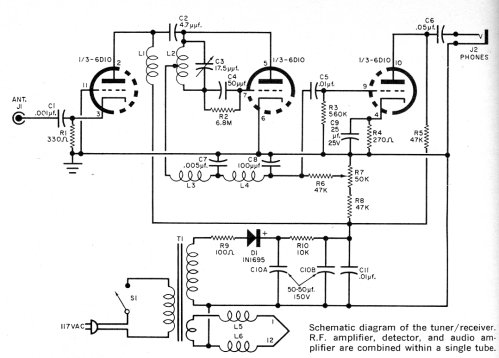
50 years ago…just about now. The example circuit was an FM BCB receiver using a single 6D10 triple triode tube. I had all the parts (even the tube) lying around, so on a whim I built it.
It worked, but it had several defects. One was touchy tuning due to hand capacitance. This is always a problem when both sides of the tuning cap are above RF ground. Another problem was that the tuning range was too wide (about 65 MHz – 120 MHz) and the entire FM band was crammed into about 20 degrees of rotation of the shaft. The last problem was that the regeneration control was just, well, nuts.
The first problem was beyond help; 50 years ago we just lived with hand capacitance. I tried to fix the second problem in 2008 but didn’t improve matters much. I’d painted myself into a corner with the physical arrangement of the tuning coil, and couldn’t easily swap it out. The third problem was still undiagnosed when I set the radio aside to do other things.
So I pulled it down off the shelf, patched it into my bench supply, and powered it up. Still worked; regeneration still nuts. I spun it, listened, spun it some more, and listened some more. (Why do I hear that song with “She wears short-shorts; I wear T-shirts…” every damned time I turn on the radio?) Regeneration was erratic, happening at different points on the pot, and sometimes didn’t happen at all. Alas, I was overanalyzing the operation of the superregenerative detector, thinking maybe I was driving the detector too far in one direction or another. Occam hit me in the head with a frying pan about then: The regeneration pot was bad.
Duhh. The wiper was making only marginal contact with the resistive element. Not sure why. Don’t care that much. Fished a new 50K pot out of the drawer, soldered it in, and wham! Regeneration worked as it should.
Having fixed one out of the three problems, I was on a roll, and being on a roll…I started to build another radio. John Baumann KB7NRN has a design for a similar detector with a grounded rotor. I’ve been intending to build it since, well, 2008, and had most of the parts set aside in a milk jug. So with the upstairs mostly uninhabitable until Monday, I got to work downstairs last night, and have gotten pretty far along on the RF portion of the circuit.
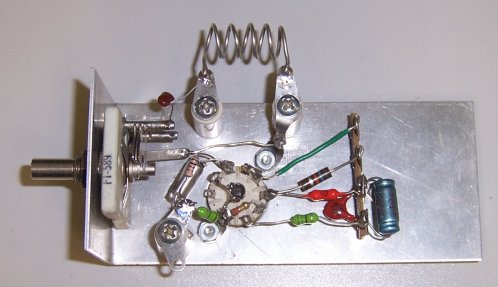
This is only a lashup; once I get the circuit working as I want, I’m going to build another instance on a conventional chassis with its own power supply. It’s going to take a few more evenings to get to the smoke-test stage, but I’ll let you know the rest of it comes along.
Perversity Dust
The perversity fairies are flitting about the last few days, scattering perversity dust in odd places. We noticed the air conditioner flaking out at 3:30PM on Friday. By the time we called the HVAC place that services it, we were on the list for bright and early…Monday. No emergency, and it actually still works. However, the drain port in the condensate tray is blocked, and the tray is overflowing into the rest of the air handler. So we turned it off, and it will have a couple of days for everything to dry out.
Air conditioners always go paws-up late Friday afternoon. It’s going to get hot in here later on, barring a nice juicy thunderstorm. (Possible, but unlikely with the perversity fairies anywhere in the vicinity.) I may have to do something radical like…go shopping.
Shopping. I need a smartphone, and have been ducking the decision for months. Of all the units I’ve researched, my favorite so far has been the Droid 2 which, alas, just went off the market in favor of the Droid 3, which is apparently on the market but hasn’t yet made its way out into the provinces. I’ve gone so far in my smartphone research as to make precisely dimensioned cardboard cutouts of the major contenders to see whether they’ll fit in my pockets. There’s evidently a format conflict in men’s shirts: All my pockets are 4:3, and the damned phones are 16:9.
Shopping for socks is easier. But I already have a drawer full of socks.
I ordered a quiet, lower-power supply for the main tower here last week. NewEgg had it on my doorstep in three days, as usual. The “We shipped it!” email never arrived, and I assumed it went out with the spam. This happens now and then, and I’ve learned to live with it. So of course, yesterday evening, three days after the arrival of the supply and a full day after I installed it, I got the message telling me that the order would be shipped soon, and would arrive three days ago. Yup. Gotcha. Knew that. Thanks for sharing. This batch of perversity dust must have had some thiotimoline in it.
The supply worked very well, by the way. Every time I come into my office here, I feel a twinge of panic because I can’t hear the machine. Damn. Did they drop power to the house again? But no: A product worked better than advertised, and I still can’t internalize my good fortune. Quick, Murphy: the Flit!
Odd Lots
- Fairness requires that I point this out: An article in the Guardian that I cited in my last Odd Lots was in error. NASA had nothing to do with the paper in question, which was written in his spare time by a postdoc who happens to work for NASA. That makes the paper no less ridiculous, but at least NASA isn’t doing stuff down that far along the dumb spectrum.
- And I’ll give this project a fair shot, though I would prefer to see NASA do this on a non-exclusive basis rather than for a particular publisher only. No word on whether and what Tor/Forge is paying for the deal. (Thanks to Pete Albrecht for the link.)
- Samsung has cited Kubrick’s film 2001 in a patent prior art case. (Engadget has a shorter entry with a still.) I wasn’t aware that fictional concepts can be raised in prior art challenges, but evidently it was done back in the 1960s when waterbeds were coming into common use. Robert A. Heinlein had described a waterbed in his 1942 novel Beyond This Horizon, and it was cited in a prior art challenge that cost Charles Hall his patent on the waterbed in 1968.
- My computer books and articles have been cited in patent applications 37 times, but I don’t know if it’s possible to look up prior art case citations. Will have to research this.
- While we’re citing citations, I was recently cited in a book by Paul J. Nahin, Number Crunching: Taming Unruly Computational Problems from Mathematical Physics to Science Fiction . The citation, on page 281, briefly describes my reprints of the Carl & Jerry stories from Popular Electronics. Alas, he cites me as “Copperhead Press” but mentions of the boys are way down in the last year and I’m glad they were mentioned at all. Thanks to Bruce Baker for letting me know.
- If you’re interested in hurricanes, here’s a nice summary page with automatically updating satellite imagery and lots of interesting graphics. The satellite imagery can be animated to show changes over the last several hours.
- I didn’t think this was new news, but apparently star formation is slowing down, as material that was originally hydrogen is “locked up” in white dwarfs, neutron stars, and heavy elements, even after a supernova has blasted a star’s substance back into interstellar space. I didn’t think that 70% of a supernova’s mass fails to return to the gas pool, but that seems to be the case.
- Jim Mischel sends along a link to a marvelous homebrew bandsaw made mostly of wood. (The blade and the hardware may be inescapably metallic.) The site as a whole has lots of interesting woodpunk concepts and projects. I especially like the wooden gear template generator, which calculates a gear outline that can be printed to paper and then cut out from wood.
- Whew. We get the message, guys.