
Jeff Duntemann's Contrapositive Diary Rotating Header Image

Ten Gentle Opportunities and Virtual Assistants

djdenise.jpgI’ve been getting notes from all corners the last few days about a $200 virtual DJ program that has been been given her own show on radio station KROV in San Antonio. The program is actually an application of a more general “virtual assistant” product from Guile 3D Studios. DJ Denise goes on the air at KROV tomorrow, from 1 PM to 4 PM. You can listen over the Web; I intend to.

Most of the horsepower in creating Denise seems to have gone into rendering her lip gloss, which is odd for something used as a broadcast audio DJ. I’m more interested in whatever AI lies behind the pouty face, though early indications are that she has more lip gloss than AI. It’s an issue of special interest now, because I’m making slow but steady progress on a near-future SF novel that explores (among other and stranger things) the border between real AI and “fake” AI, a category that goes back to the ELIZA program at MIT in 1966. Ten Gentle Opportunities contains both. A cheap coffee maker contains an animated barista that talks a lot and understands little. A model-year 2020 Mazda RX9 has an annoying dashboard cartoon that understands more deeply but very narrowly. Both handle natural language well, and people are easily fooled into thinking that smooth natural language processing implies true intelligence.

I don’t think that’s true, as the more advanced AIs in the story demonstrate. One of them is Pyxis (Latin for “compass”) a high-end commercial product sold at a five-figure price as an executive assistant. Brandon Romero, an executive trying to manage a completely automated AI-controlled copier factory, has his own copy of Pyxis. (I posted a glimpse of the copier factory and its AI controller Simple Simon in my June 26, 2011 entry.) Far from being a geek-dream sex kitten, Pyxis is obedient without being especially pleasant. Worse, she holds her boss to his word, to the point where he begins to wonder who’s working for whom.

Romero dislikes having human underlings, but as he soon comes to understand, AI staff might be described the way Jerry Pournelle once described the Bomarc as the Civil Service missile: “They don’t work, and you can’t fire them.”

Pyxis saw him approaching his office door, and Brandon heard the lock bolts snap back. The coffee machine on the teak credenza was hot and full, and the air was rich with the scent of dark roast and Irish Crème. The human interns always scattered magazines on the glass coffee table against his preferences; the day when paper magazines became extinct could not come too soon. One of those interns had recently left a stuffed moose on the credenza. This was at the direction of HR, which (as he later discovered after much annoyance) wanted to “soften the human side of his persona.” The ugly abstract art shotgunned at the eggshell walls was bad enough. God forbid he should meet with a Chinese parts supplier without his stuffed moose.

Brandon sat down at his teak desk, its oiled vastness divided into the rigorously rectangular regions he maintained at all times, including a small square for coffee and another for mints: charts, summaries, two tappers full of notes and test-run videos and model animations, all at his fingertips. Defining the far sides of his desk were three brushed-stainless OLED panels currently animated with some slow-flowing pearlescent liquid that looked like shampoo. Far too soon, the triptych would spring to life with more views of this lunatic’s kingdom than any one man could possible follow.

Pyxis saw him sit down, and a window in the panel to his right burst into existence with her scowling image. “Twenty-six messages vetted and queued, five urgent.”

“Later.” If it wasn’t from that ass-covering coward Amirault, he didn’t want to hear it. Brandon set his primary tapper down in its vacant rectangle on the desk, and pulled a few loose papers from his briefcase. Like everything else, each had an appropriate place, and he scanned the piles that had been accumulating for most of a week, dropping a sheet here and a sheet there. The stapled set describing Zircon’s looming Retirement Incentive Program (was that a hint?) needed to go somewhere. A new pile? For corporate suicide notes? Brandon scanned the desktop almost automatically, but there was only one empty rectangular region left.

He stared at the tidy strip of oiled teak and felt himself tighten inside. Not big enough for anything except bad memories-but like those infuriating little sliding-square plastic puzzles, he had never hit upon an arrangement that would eliminate it.

“Here it is, Mr. Romero.” A new window popped into view, with a high-res scan of the framed photo that had stood in that teak rectangle for many years: Carolyn in a white cotton V-neck sundress out in her garden, holding a cardboard sign reading, “Greek Fire.” To a newly minted second lieutenant on the ground after Desert Storm, it meant that Carolyn Helena Ankoris was waiting impatiently for him to come home and marry her. To Major Brandon Louis Romero, US Army, Retired, it meant only failure.

“I didn’t ask you to open that.”

“You were staring at the space where the photo had been.” Building 800 was as full of electronic eyes as it was empty of human beings. Pyxis not only knew where he was at all times, she knew where he was looking.

His AI assistant was unfailingly obedient, but Brandon had set her obsequiousness parameter to zero. What was the point of having a virtual suckup? It wasn’t like the physical world suffered a flunkie shortage. “Your job isn’t to read my mind.”

Pyxis folded her arms implacably. “My job is to anticipate your needs and help you stay productive. We have a line start in a little over an hour. You have a lot to do. Mr. Amirault asked you to copy him on a call to…”

“Ok.” Brandon tossed back the last of his Red Hen coffee, and flashed with sad longing to his Army B4 training, when he had aimed an M16A4 at line-drawn enemies printed on sheets of cardboard, and nailed every damned one through the heart. “Get me Simple Simon.”
Paradoxical Insomnia

For all the time I’ve been struggling with insomnia, I had never heard of “paradoxical insomnia” until Michael Covington recently called it to my attention.

Sleep is a weird business from top to bottom. I’ve encountered a lot of that weirdness, especially since 2001, when my company began to implode. I’ve never been a strong sleeper, but after that I began having nights when I might sleep for no more than an hour…

…or so it seemed at the time.

One of the weirdnesses of the post-Coriolis era is that, for as little as I thought I slept, I seemed to do reasonably well during the day. I certainly wasn’t at my best, but for the most part I wasn’t falling asleep in my chair. I wonder now if I experienced paradoxical insomnia, which is an unusual sleep disorder in which patients feel like they have slept little (or not at all) when in fact they slept adequately, if not normally. In paradoxical insomnia, a patient perceives time spent awake incorrectly. He or she might feel like it takes an hour or more to fall asleep when in fact it took only a few minutes. Early-morning awakenings during which hours seem to pass may again span only a few minutes. The condition is poorly understood. Researchers now think that patients are dreaming that they’re awake. This may seem bizarre to people who sleep normally, but let me tell you, I understand completely.

Here’s why: In my case, at least, the border between wakefulness and dreaming is rubbery. I’ve had some success with a technique I read in one book or another, which involves imagining some quiet activity that reflects daily life. Counting sheep may work for people who live and work with sheep. I’ve seen live sheep half a dozen times in my life, and you can have ’em. What works for me is imagining things like taking walks, sorting books on bookshelves, and having boring conversations with unexceptional people. Although I have “interesting” dreams about one shot in ten (along with the very occasional lulu) the vast majority of my dreams are very much like that: walking alone or sometimes with a nameless companion, or doing domestic things of little consequence, like taking towels out of the washing machine and putting them in the dryer.

I know that the technique works because a time or two I recall sliding from guided meditation into a dream without any change of scenery. I know that it was a dream because it stopped following the script. Here’s the best example: Jeff and a nameless and poorly imagined female companion are walking down a country road on a generic summer evening, talking about dumb stuff. No mosquitoes.

JEFF: Hey, there’s a sycamore tree! I like sycamore trees.

COMPANION: Me too.

JEFF: My grandfather planted one in the back yard when I was a kid. It had the biggest damned leaves.

COMPANION: I remember those.

JEFF: And seed balls. We used to throw them at each other.

COMPANION: That must have been fun.

JEFF: It was. We used to be able to burn the leaves in the street.

COMPANION (Turning): Jeff, what do you want most from God?

JEFF: Unconditional love.

Bzzzzt! In my directed meditations my imaginary companions do not ask me questions. So when my imaginary companions begin taking control, I know (in hindsight) that I’m dreaming.

In the grim days after Coriolis went under, I had plenty of experience lying awake much of the night and staring at the wall. At some point it became part of ordinary life, and thus completely unremarkable dream-fodder. I also seem to slide from conscious thought into dream states very smoothly. This is why dreaming about lying awake is no stretch at all, and may have continued long after I had gotten over the loss. It may continue to this day. Short of monitoring my own brain waves, I’m not sure how to tell.

But boy, it’s probably better than talking beavers.

Odd Lots

  • Antique Electronic Supply in Tempe, Arizona, has created a new DBA for their tube audio amplifier business: Amplified Parts. The tube stuff still predominates but it’s hardly “antique” and has definitely gone upscale. They rate their power tubes like fine wine: “This Russian tube [6L6GC] has tight lows, straightforward body, and smooth highs. In overdrive, it offers a tight and frosted crunchy bite.”
  • My Taos Toolbox 2011 colleague Alan Smale just won the Sidewise Award for Alternate History at the 2011 Worldcon in Reno. We workshopped an expansion of the winning story, “A Clash of Eagles” and it was terrific. I’m guessing this will make it perhaps a little easier to sell the novel-length work. Bravo, Alan!
  • Even though HP announced yesterday that they were killing their cloud-centered TouchPad tablet, Carol and I saw an expensive commercial for the device on The Weather Channel this morning. Cloud? Did you guys say “cloud”? (No wonder they got the ad…)
  • If you haven’t seen it yet, definitely take a look at Stellarium, a free planetarium program available for Windows, Mac, and Linux. It’s one of the best I’ve ever tried, more polished (if not as deep) as the venerable Cartes du Ciel, which is remarkable in part by being a Lazarus app.
  • David Stafford sends word that an elaborate steampunk loft apartment has gone up for sale in Manhattan. The price? A “mere” $1,750,000.
  • This is killer cool as binoculars go, but would they capture anything at night? (Somehow I doubt it.)
  • Bill Higgins writes to tell us that Catholic University has placed a scan of the 1964 Treasure Chest comics series “Pettigrew for President” online, for free download. I blogged about this years ago, but the comic was not available for download then.
  • Nick Kim does Cowboys and Heavy Metals. (Thanks to Pete Albrecht for the link.)
  • Fellow carnivore Jim Tubman and I share an appreciation for The Periodic Table of Meat. Most of it, anyway. (No thanks on Meat 75. Oh, and 95.)
  • Back from meat to metals again: Given that it’s the cornerstone material required to build the Hilbert Drive as used in many of my SF yarns, I was a little surprised that ytterbium is so cheap.
  • Did you ever wonder about the physics of coffee rings? Wonder no more.
  • From the Please-Give-Those-Guys-Something-To-Do Department: New taxpayer-funded NASA research tells us that unless we take prompt and serious action against global warming, aliens may invade and wipe us out. UPDATE: This turns out not to be entirely true: The chap who co-wrote the paper works for NASA but he did it on his own time and there was no public funding involved. The Guardian has corrected the piece.

Sixteen Inches in Seven Books

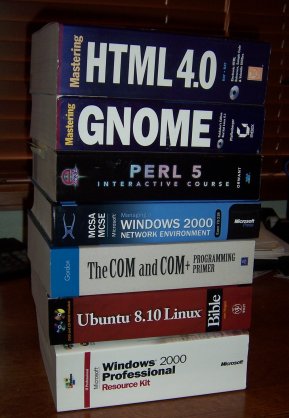
SevenBooksSixteenInches.jpgSpace is getting tight in here again, and books are getting tossed on top of other books. It’s long past time to thin the ranks a little–both on the shelves and in the closet–and in standing in front of the computer section here it occurred to me that if I were attempting to free up shelf-inches I should probably go after the biggest spines first.

And so I did. After no more than five minutes, I freed up sixteen inches of shelf space–in seven books. None of these are essential. I have other, much newer books on HTML and GNOME, and given that I haven’t written a line of Perl in five years or more, one Perl book (out of two) is plenty. There is no longer a single instance of Windows 2000 here beyond a VM, so monster Win2K tomes are doing nothing but crowding out other, more useful things from my shelves.

Speaking of which: The top two titles date back to the mid-1990s, and illustrate the “spine wars” raging at the time among computer book publishers. If your books were all three inches thick, there would be fewer shelf-inches in the bookstores for your competitors, so we all wanted to make ours three inches thick. (Sybex was a champ at that, as you can see.) Coriolis published a few thick books, the thickest of which was Michael Abrash’s Graphics Programming Black Book, but compared to the other presses we were pikers. Huge spines tended to crack and spill pages in regular use, as we discovered after Michael’s book was out there for awhile. Page count was not always in proportion to spine width, either. Mastering HTML 4.0 was barely 1,000 pages long. The Coriolis HTML Black Book by Steve Holzner (2000) was 1,200 pages long, and only 1 5/8″ thick. That’s 200 more pages in one fewer inch. The difference was thicker, pulpier paper.

The Microsoft Press book at the bottom is a sort of circus freak and may never be equalled in the spine wars: It’s 1,800 pages long and a full 3″ thick. It’s not a bad book, but I’ve wondered here before it it was mostly a stunt.

Anyway. I’ve already culled an additional six or seven books, but I doubt I will ever have a stack equalling the one shown above. Ahh, computer book publishing in the spine-swellin’ 90s–what a ride that was!

Old Faceful

OldFaceful190Wide.jpgCarol bought a new water bottle the other day. She put some juice in it for our shopping wander this morning, and we set out, with the bottle in the cupholder in the front console. We spent some time at Best Buy, shopping for smartphones, all the while the August sun sweltered down upon the 4Runner. When we got back forty minutes later, the car was an oven. The juice was warm but it was still fluids, and necessary in our land of 20%-or-less humidity. She grabbed the bottle, flipped up the little straw thingie in the lid…

…and got a face full of juice.

On the surface, the design would seem like a good one: With the straw up there’s a vent port that lets air in while you draw fluids out. With the straw down the bottle is sealed, and won’t spill fluids if it’s not dead vertical. However, if you leave the bottle in a hot car, the air above the juice expands, and evidently the pivot mechanism in the lid opens the path to the straw just before it opens the vent port. Whooosh!

Science lesson learned. The bottle is going into the recycle bin, and we’re back to looking for something similar with a slightly better awareness of basic physics.

Our Reading At Who Else! Books

WhoElseBooks08-13-2011.jpg

As I mentioned in my entry for August 10, 2011, Jim Strickland and I landed a reading/signing slot yesterday afternoon at the wonderfully quirky Who Else! Books at The Broadway Book Mall in Denver. I wasn’t sure what to expect; but let’s call that needless anxiety. It was all good: Who Else! Books owners Nina (pronounced Nye-Nah, not Nee-Nah) and Ron Else were wonderful, and had the coffee machine running and a table set up for us long before we got there. How many people would show was the great mystery. I was expecting six or seven–and by my count, we got 19. That was actually a lot of people for a smallish space filled with that many books, especially on a hot Saturday afternoon in the summer.

We followed Mark Stevens, a local writer of what I might characterize as eco-mysteries set in western Colorado. Mark has two well-regarded novels in print from People’s Press, and I think most of the people who attended stopped by to hear him. However, almost no one left when he was finished. Our friend Eric Bowersox was there, as was our fellow workshopper Sean Eret from Taos Toolbox 2011. Sean, who had broken his ankle shortly before the workshop began and was wheelchair-bound the whole two weeks, was on a walking crutch yesterday and is getting around pretty well.

I did a brief intro to the Drumlins World concept, and then Jim and I both did short readings from Drumlin Circus and On Gossamer Wings. After the readings we took questions. One gentleman in the first row looked familiar, and asked some excellent questions. It was a hard virtual whack to the side of the head to realize that this was Ed Bryant. I had met and spoken with Ed at some length back at LACon in 1984, but as I suggested (and he confirmed) I’d had more hair then, and he less.

A few rows back was Eytan Kollin, author (with his brother Dani) of The Unincorporated Man and its two sequels, The Unincorporated War and The Unincorporated Woman. Eytan asked whether 800 people (the number cast away on the Drumlins World) represented enough genetic diversity to survive long-term. I’d fretted over that issue, and added another thousand or so frozen embryos to bring it up closer to 2,000 genetically distinct individuals. Eytan suggested (and there’s research to back him up) that the number is closer to 10,000–but that’s a big starship! (I’ll freely admit that I fudged a little there, though I’ve seen some speculation that fewer than 5,000 individuals were the forebears of nearly all of modern humanity.)

So overall it was a very sharp crowd. We sold some books, we had a lot of superb conversation, and I dropped $80 on various titles at the store, much but not all of it SF. The photo above is toward the end of the event, after most people had left the store. L-R: Ed Bryant, Jim Strickland, Eric Bowersox, and Ron Else.

Overall a fine time, and very heartening to see a small indie bookstore almost literally packed to the walls with people. I came home with a head full of ideas for another short novel called Drumlin Strongbox, and those notes still need to be taken. Tomorrow fersure.

Odd Lots

Jeff & Jim at Who Else! Books in Denver

Carol and I just got back from a short trip to the mountains near San Isabel, Colorado, so we’re a little bit beat and (especially Carol) just a little bit sunburned. We rented a cabin at Aspen Acres campground, and walked the dogs all the way around Lake San Isabel. Not much else got done there, which was the whole point. Some new scenes from Ten Gentle Opportunities occurred to me, and that’s as far as the doing went.

But I do want to remind my Denver metro-area readers that Jim Strickland and I will be at Who Else! Books this coming Saturday, August 13, to talk about and read from our double novel Drumlin Circus / On Gossamer Wings. We’re slotted at 3 PM. The bookstore is at 200 S. Broadway, Denver 80209.

I’ve not been to the Broadway Book Mall before, so I may be up there a little earlier than that to poke around. I’m hoping to find some evidence that independent bookstores are on the rise again, after two decades of deepening eclipse. I remember the first time I ever saw a Borders, when Carol and I visited Rochester NY in 1991. I recall thinking: This is going to put a huge dent in the indie bookselling business, and I was right. What I couldn’t guess in 1991 was that the Internet was eventually going to put a huge dent in Borders–like, right between the eyes.

The Internet can do a lot. It can’t do everything. Something will replace Borders. Sooner or later we’ll find out what.

Anyway. I like bookstores. Always have, always will. Most that were in Colorado Springs when we arrived in 2003 are now gone. We have to go to Denver for certain things like Elfa shelving, and it’s starting to look like we’ll have to go there for books as well. I’ll be going on Saturday with my usual hunger for serendipity, and if you’re in the area see if you can stop by.

Odd Lots

The Mystery Hi-Fi AM Tuner and Amp

Jeffs1974StereoSystem.jpgHere’s a challenge for some of my older readers, particularly those who were in the hi-fi hobby in the 1960s. While looking for the photo of Carol’s banner mentioned in my entry for July 31st, I ran across a blurry photo of my basement office in 1975, including the portion shown at left. The unit on the top of the pile is definitely a Heathkit FM-4 monaural FM tuner. I had it for quite a few years after 1975, and may still have the manual somewhere. I don’t clearly remember the identity of the other two. The middle item is an interesting one: an AM-only hi-fi tuner. I dumped both the AM tuner and the stereo amp on the bottom shortly after I married Carol and bought a Realistic STA-64 AM/FM stereo amp unit for Christmas 1976. Bogglingly (but why dump it if it works well?) the Realistic is still our main stereo here.

AM hi-fi tuners are something of an oddity, and unless I misrecall, the unit shown above had very good sound for the bass-deprived, static-enhanced AM pop radio signals we all listened to in the 1960s. I think it’s an AJ-21, the AM partner to the Heath AJ-31 FM tuner. The color scheme is about right, including the red Heathkit logo on the lower-left edge of the front panel. The knobs look wrong, but it’s as close as I’ve come in scanning Heathkit photos on Google Images.

As for the stereo amp, I have utterly no clue. I’m almost certain it wasn’t a Heathkit. Any ideas?

The system worked very well as a sort of college-kid junker “stereo” (both tuners were purely mono) from 1971 or so to 1976. I am not an audiophile and don’t have an especially good ear, so equipment like that may have been precisely what I needed at the time, as it was all hamfest-cheap. I don’t need a tube stereo amp anymore (I built my own back in 2005) but it would be interesting to see what the two Heath tuners would do with it.