Jeff Duntemann's Contrapositive Diary Rotating Header Image

Dash Nails It. Twice.

L-R: Jeff Duntemann, Dash, Carol Duntemann, Jack

(Photo above courtesy Dr. Kathy Jordan.) We got back from Denver Monday night with a folder full of ribbons and, in the kennel in the back seat, a new Bichon Frise champion: Ch. Jimi’s Faster Than Light, better known to most of you as Dash. I also came back with a miserable headcold, so if this (rather late) entry is thin gruel, it’s because my head still feels like very thick gruel.

We’ve gone to the annual Rocky Mountain Cluster Dog Show now for several years. It’s the largest AKC event in the mountain west, and consists of four separate dog shows on four consecutive days. This makes it worthwhile for people to travel a fair distance to get there, since for each breed there are four chances to win. With more dogs entered, there are also more chances for the coveted “major win,” two of which are necessary for a dog to achieve championship. At smaller shows you can collect conformation points toward championship, but without those two major wins, that last step can’t happen. (Dog show rules are complex, and I can’t do them justice in a single blog entry.)

It’s a big show, and in fact dwarfs the Bichon Frise National Specialty, which we call Bichonicon and attend when it isn’t too far. This year the lousy economy reduced attendance from a typical 3,000 dogs to about 2,500–which is still a lot of dogs.

We already have a champ in the house: Aero became a champion in 2010. We’ve been working on Dash and Jack since then. Dash has been racking up points fairly regularly since we began showing him as a puppy. In fact, he’s been “singled out” now for some time, which means that he had more than the required fifteen conformation points, but lacked a second major win to become a champion.

The Rocky Mountain Cluster doesn’t always present an opportunity for Bichon Frise majors (which depends on the number of breed dogs entered) but this year it did, for both males and females. The Rocky Mountain Bichon Frise Club was there in force, with a bichon enclave roped off down in the lower-level cattle pens at the National Western Complex, near the junction of I-25 and I-70.
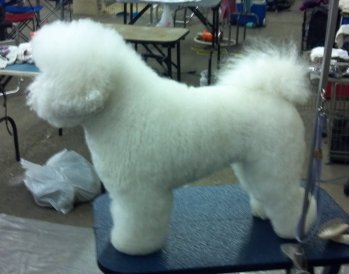
Ch. Jimi's Faster Than Light (Dash) on grooming tableCarol had been working on Dash’s coat for some time, having studied under long-time bichon groomers including Jimi Henton here in the Springs, and Lorrie Carlton of Belle Creek Bichons in Plymouth, Michigan. Dash certainly looked about as good as he ever has, and on Friday morning mostly needed fluffing up. Carol did a very good groom job on Jack as well, but Jack has special problems unrelated to his coat, which is superb. Jack is shy, and has a hard time keeping his tail up and over his back (as required by the breed standard) when in the midst of dog show pandemonium. We’re working on that, and in fact have made great progress since he came to us in 2009, but when he’s in the ring his tail drops.

Carol and I both “handle;” that is, we both usher a dog around the show ring. She typically handles Dash, and I typically handle Jack. On Friday the judge in our ring was the formidable Edd Bivin, an intense and cerebral dog expert who has been an AKC judge since 1961, and regularly chairs the Best In Show panel and provides commentary on the televised Eukanuba National Championship dog shows. (No pressure!) Dash, now two and a half, still has more than a touch of puppy in him, and did not behave as well as we had hoped. Nonetheless, when all the male bichons had marched around the ring for the final review, Edd Bivin pointed at him for the #1 position. Dash had beaten all (male) comers, and nailed his second major. He was a champ.

Dash didn’t win Best of Breed that day, an honor taken by Lindsay Van Keuren’s bitch Barbie. (Remember that “bitch” is a technical term in the dog realm, and simply means “female.”) Several people who watched him suggested that when he matures a little more (and stops squirming like a sixth grader) he will be unstoppable. Carol is considering going on with him to compete for the title of AKC Grand Champion, which is a much tougher climb.

We’ll see on that. As for the rest of the show, Dash squirmed his way out of winning on Saturday and Sunday, but again pulled down a major win on Monday, under veteran AKC judge Carl Gomes. So he now has three major wins and 23 points. Since he needs only two majors and fifteen points to be a champion, he has a comfortable margin. Jack looked great but just couldn’t keep his tail up, and will need some additional training. We all came home dog-tired and covered with dog hair, not to mention this peculiar brown dust that churns up in the cattle pens. (You can guess where that comes from, keeping in mind that these are not dog pens…)

By the next morning I had come down with a whomping headcold, which is still with me as I write. Doesn’t matter. Dash got his championship. The whole Pack got some chicken liver. Carol shared a couple of malted milk balls with me and then ordered me to bed. Dog shows are hard work, and a hairy business. Still, we had more fun than we’ve had in a good long while.
Odd Lots

An Informal Theory of Tribalism, Part 1: Background

I’m much of the way through an excellent book: The Better Angels of Our Nature by Steven Pinker, whose previous works on my shelves here include How The Mind Works, The Language Instinct, and The Blank Slate. The book’s dual mission is to demonstrate with hard research and reliable numbers that violence in human societies has declined and continues to decline, and perhaps to explain why. So far I’m persuaded by the first element of its mission. The second, well, I’m not as sure–but I’m also not finished with the book. However, I’ve read enough to recommend it, assuming you don’t mind long, dense books that require focus and an open mind to get through. The Better Angels of Our Nature provides solid backing to the impression Colin Wilson gives in his 1984 tome A Criminal History of Mankind: that the past was a bogglingly cruel and violent place, not only in certain parts of the Earth and in certain societies, but everywhere. Today, by contrast, we live in the safest and most peaceful era in human history. The improvement has not been linear, but graphed over centuries (and not merely years or decades) it’s been steady. This is counterintuitive if anything is. Still, the citations Pinker presents are beyond my ability as an amateur historian to challenge. Much of his thesis involves things I’ve not read of in detail before. Pinker’s description of the widespread practice of infanticide in our past is especially chilling. I may recognize the evolutionary logic for some of it, but the repugnance nearly all of us feel when contemplating the idea reflects how far we’ve come.

In short, we are not fallen angels. We are risen apes.

I’ve had a suspicion for quite a few years that the root cause of human cruelty and violence is tribalism. Pinker’s book provides more evidence that I was right. He cites a number of causes of violence, but most of them are either the consequences of tribalism, or tribalism outright. Furthermore, tribalism is something primal, something we inherited from the killer primate ancestors we share with creatures like gorillas and chimpanzees, who are enthusiastic and highly calculated murderers of their own kind. We see it in our own historic records as far back as they go, and also in the societies of aboriginal peoples who have avoided contact with modern societies until recent times. (Jared Diamond has written much about his experiences with recently contacted tribes in the new Guinea highlands; see The Third Chimpanzee for a sample.)

It’s easy for those of us in the Intellectual Elite to cluck and roll our eyes at any suggestion that tribalism is still with us. Don’t. What we’ve made great progress suppressing are warfare and murder, mostly by sheer dint of will enforced via societal pressures against fountains of violence like polygamy (polygyny, more precisely) and honor cultures. We’re still having trouble with deeper evils like idealism, but idealism is not a consequence of tribalism. (It certainly takes advantage of tribalism, as Marxism did with great success in the past hundred-odd years. Let’s not confuse the horse with the rider, even if both need shooting.) Tribalism is very much with us, and whereas it causes less murder than it used to, it still shapes our thought and our societies in ways that should give us pause. It generates hatred like nothing else out there, and enslaves even the brightest of us.

The quickest way to find evidence is to read the comments sections of forums covering anything less technical than the alignment of IF strips. Everyone knows what flamers and trolls are. They’ve been around since there were online forums. I saw them in my bang-path days in the early 80s. Anonymity amplifies the temptations to flame and troll; see the very brilliant take that Penny Arcade has on the topic. I was a little surprised to see how much the psychology of flaming and trolling is rooted in tribalism. As with a lot of insights, once I knew what to look for I saw it everywhere. I’ve actually engaged the trolls here and there, to see how they react to certain kinds of provocation. (If you ever stumble across any otherwise uncharacteristic or inexplicable posts of mine online, it’s almost certainly me poking a troll with a stick and taking notes.) I now think I know enough to summarize my research and toss out an informal theory of tribalism, especially as it applies to our online world.

The series here will not be contiguous. It’s a difficult thing to write about, and I have other topics on my do-it list, most of them more fun if less provocative than this. I do want to ask that you put on your Cloaks of Heroic Courtesy before you click the Comment link. I always welcome thoughtful and polite discussion. However, if you insist on flaming or trolling, I have a perfect opportunity to tap my pointer on our virtual blackboard and use you as an example: “Kids, here’s still more evidence supporting my theory. Let me explain what’s going on in this comment…” Be the student. Don’t be the lesson.

Next: What tribalism is.

Dare I Believe It?

I remember a sunny Monday morning in early June, 1974. Classes had ended at DePaul University the previous Friday, and I would graduate the following Saturday. Since entering kindergarten in September 1957, I had been going to school from September to June, and repeating the cycle again the following September. It was literally the only life I knew. School for nine months, vacation for three months. Lather, rinse, repeat. But wait, I thought–not only do I not have to go to school today, I never have to go to school again.

Dare I believe it? I was done.

It shook me to the core.

I remembered that feeling last night, after the burly young men packed all the scraps and fuzz and staples and things out the front door and roared off in their Ford van. I looked around at our lower level. Slab. Plumbing. Tile. Paint. Carpeting. Linoleum. It’s all there, functional and gorgeous. Things that had been breaking or leaking or cockeyed (or just plain plug-ugly) for several years were now as they should be. We were done.

Wow. This project was starting to feel like a way of life. I will confess that by June of 1974 I was getting tired of going to school. I was tired of getting ready. I wanted to dive in and get some things done, which I did. (Two weeks later I got a job at Lafayette Radio fixing burned-out stereos, portable radios that somebody’s kid had thrown up in, CBs that some dork had hooked to a TV antenna, etc.) I am long past ready to have my workshop and exercise room back, and a guest room for nephew Matt and his lady Justine to stay in when they visit next month.

Ok. I admit that it’s really not quite sincerely done. We now have a beautiful, empty lower level. There is one more job for burly young men to do: drag all the furniture out of the furnace room, the unfinished bedroom, and the odd corners of my workshop and put it back where it belongs. I guess I then have to unpack 1,000 books and re-shelve them.

No biggie. That’s just rearranging things I already have. The hard stuff, the stuff that had to be chosen, matched, paid for, delivered, and glued to the floor or slobbered on the walls, that’s all done.

Which is simply to say that it’s a big hearty Deo gratias and the dawn of the first day of the rest of our lives. Oh, and note to self: Our next house will not be on the side of a mountain.

Odd Lots

  • For the several people who asked: The odor-free carpet pad that we used in carpeting the lower level here is called Napa Carpet Cushion, from Leggett & Platt.
  • Apart from N&P’s Fallen Angels, Bob Tucker’s Ice and Iron, and possibly Mackelworth’s Tiltangle, what other SF novels involve an ice age on Earth in the near(ish) future? I have a concept that capitalizes on all my recent paleoclimate research, and I’d like to see if it’s already been done.
  • Whoops, found a list just before posting this. I clearly have some reading to do, assuming I can find any of these items. What are your personal favorites?
  • Today’s sunspot number is very close to zero. I haven’t seen sunspot activity this low in some time, and here we are supposedly barreling into the Cycle 24 maximum. The sunspot number is going in the wrong direction. 6M DX is evidently not in my immediate future.
  • Joe Flamini and Jack Smith are both pretty sure that the mysterious Comco gizmo I presented in my February 6, 2012 entry is an early remote control unit for commercial and public service radio systems, allowing control of a transmitter or repeater through leased phone lines. More on this in a future entry.
  • Having read briefly about hydraulic analog computing in a magazine decades ago, I built hydraulic calculators and computers into the technological background for my novel The Cunning Blood. Turns out the Russians did it on a pretty large scale back in the years running up to WWII. (Thanks to Jim Strickland for the link.)
  • From the You-Probably-Couldn’t-Do-That-Today Department: The flipside of the Chad Mitchell Trio’s 1963 hit kid/Christmas 45 “The Marvelous Toy” was “The Bonny Streets of Fyve-I-O, about a colonel who shoots one of his own captains for insubordination.
  • Tucows (does anybody even remember Tucows?) is launching a contract-free mobile service using Sprint’s network. The rates are interesting, and favor people who want smartphones but just don’t use them much, and data little or not at all.
  • The Maker Shed has a $99 Geiger counter kit that allows logging of pulses through a serial port, and detects both beta and gamma radiation.
  • A little gruesome maybe, but it’s real: When we lived in California in the late ’80s, there were reports of sneakers washing up on Santa Cruz area beaches…with human feet still inside them. At the time we assumed drug violence, but there’s a less scurrilous if no less ghastly explanation for a phenomenon that’s still happening. (Thanks to Pete Albrecht for the link.)
  • Mmmph. Military combat aircraft should be able to fly in more air than we’re used to, no? Sweden had this problem recently. (I’m guessing that Saab has it too, now.) Thanks to Aki Peltonen for the link.
  • The name of my company, Copperwood Media, LLC, was inspired by a set of traces on an old PCB that just happened to look (a little) like a tree. I had an artist draw me a better copper tree for the logo, way back in 2000. Now Rich Rostrom sends a link to the odd tradition in some parts of the UK of hammering coins into cracks in trees until the notion of “copperwood” takes on a whole new meaning.
  • Some very nice steampunk watches and jewelry. “Chronambulator” is a great word, whether or not you’ve got a steampunk gizmo to hang it on. Note also the level-reading absinthe hip-flask. (Thanks to Bill Cherepy for the link.)

Smelling (Or Not Smelling) Victory

CarpetPad500Wide.jpg

As I posted on Facebook last night:

My family room now has a floor
And some fancy new tile by the door;
Though it took sixty days
We both knew patience pays–
Now it’s all that we’d hoped for and more!

Yesterday was Floor Coverings Day here. The poem doesn’t quite capture it. All of the lower level areas that were once carpeted were re-carpeted, and that includes two good-sized bedrooms, the hall, the big stairs, and our 20′ X 20′ family room. The total carpeted area is just under 900 square feet. Much of our original carpeting was pulled up or otherwise destroyed when we had the lower-level slab mudjacked back in December. The rest was torn up and carried out yesterday morning, along with a great deal of carpet padding, some tack strips that had gotten in the way of construction, and assorted trash that sure seemed like it came out of nowhere.

It took a little over seven hours, but the new padding was laid and then the carpet put down atop it. The stairs represented a great deal of fussy work, as was getting things cut just so for the closet insets and odd corners. We think it’s gorgeous. It’s much better carpet than what the contractor put down when we built the house in 2003. It matches the wood trim a lot better, and with some top-of-the-line padding underneath it, you feel like you’re walking on a firm mattress.

So we smell victory on the remodeling front. Things aren’t completely done. The roll vinyl for what we call the Harry Potter Closet (a huge-ish volume under the main stairs) was back ordered, and we may not get it laid until next week. But once that’s in, the construction is basically done. After that, I hire movers to put the furniture back where it was, and then start emptying 1,000-odd books out of boxes onto the shelves.

Why did it take so long? We smelled vectory when we didn’t smell it, basically. As anyone who’s worked with carpet should know, not smelling carpet and (especially) carpet padding is nontrivial. Our lower level stank of carpet pad plasticizers for a couple of years, and plasticizers are one of Carol’s migraine triggers. We looked at countless carpet samples, and the first thing we did when we laid hands on any sample was sniff it. If it stank of solvents or anything else, interview over.

This was a problem with carpeting. Our eventual choice was pure nylon and doesn’t smell enough to be an issue. The problem was a great deal worse with carpet padding. A lot of padding is made of chopped-up scrap padding salvaged from subdivision-scale construction, and to make it all stick together, well, they use solvents. Even what might appear to be new padding is plastic foam, and plastic is just polymers in solvent. They stink.

This was our major issue, and we said so. A number of carpet vendors did not take us at all seriously. I had to be a major hard-ass, which is against nature for me and requires practice. I got lots of practice: “This pad smells.” All padding smells. “This pad smells too much.” Padding that doesn’t smell is more expensive. “Brings us samples of what you have that smells less.” We have to order the samples. “Then order them.” It’ll take two weeks. “Good-bye.”

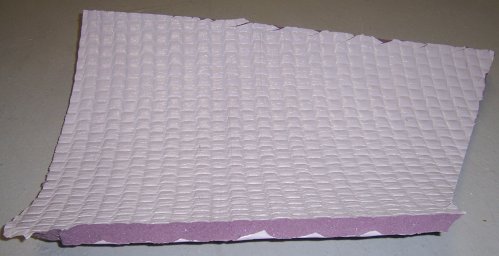
We shopped for almost a month. The pad we chose is some sort of unobtanium pseudo memory foam that looks like nothing I’ve ever seen. It’s purple, sheesh, and has a gray-lavendar impermeable film on both sides. It’s also a far better insulator than most carpet pad, and given that it’s basically sitting on a slab of concrete resting on the Colorado soil, that did matter. At the carpet store, we held it up to our noses, and when we realized that we couldn’t tell whether it was the pad that we smelled or just the general reek floating around in the store, we knew that we’d found it. We took a sample with us, and when we got it home we realized it didn’t smell at all. I don’t know how they did that.

Don’t care. Sold! It was interesting that the stink-free is warranteed for longer than the carpet itself. That was fine; dogs are hard on carpeting. Hell, ordinary life is hard on carpeting. If in another ten years the carpet starts looking sorry, we’ll have it pulled up and get new carpeting. That pad, now, well. It stays.

So. Slab is where it’s supposed to be. Paint’s done. Tile’s done. Plumbing repairs done. Carpet’s done. Victory is one small roll of back-ordered vinyl flooring away. I can almost smell it.

The Comco Whatchamacallit

ComcoThingFrontpanel500Wide.jpg

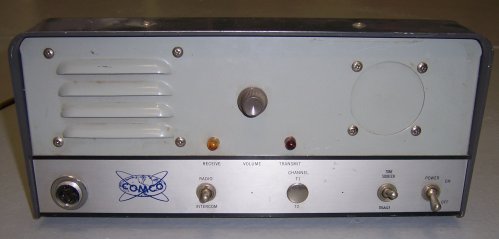
I hung yet more Elfa shelves downstairs the other day, on the only remaining blank wall in my peculiar workshop. I’m trying to get stuff off the floor and into some semblance of order. A number of tube-era radios went up on the shelves almost immediately, including a Heath HW-22A and a pair of Ameco TX-62s, one of which is a parts unit. So did something else: the tube-era thingie shown above, which has been following me around for almost twenty years. I bought it at a hamfest in the early ’90s for a dollar. The old guy who sold it to me didn’t know what it was. I bought it for the sake of the transformers inside, which were worth that much even in 1993. It turns on, lights up, and hums softly. I still don’t know what it’s supposed to do.

ComcoThingNamePlate500Wide.jpg

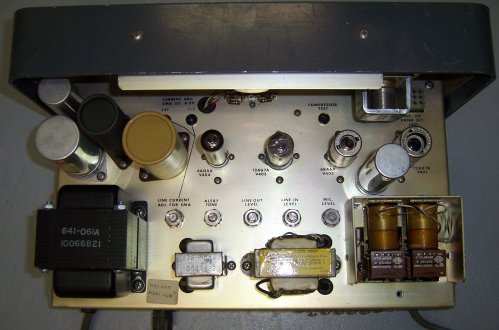
It’s made by Comco Communications Company, of Coral Gables, Florida. Its model number is 642-RCU. From the “RCU” I’d guess a radio control unit, or remote control unit. It has no RF parts inside. There’s an audio power amp with a 6AQ5A driving a speaker behind the grille. The front panel has a 4-pin PTT mic jack, a momentary action toggle switch marked “RADIO” above and “INTERCOM” below, with “RADIO” the default position. A hole marked “CHANNEL” with “T1” above and “T2” below is plugged. A conventional toggle switch is marked “TONE SQUELCH” above and “DISABLE” below, and beside that, an On/Off toggle switch marked “POWER”. At the center of the panel is a rheostat marked “VOLUME,” and two grain-of-wheat lamps, the orange one labeled “RECEIVE” and the red one “TRANSMIT.” A round hole the size of a panel meter is plugged. On the back panel is a fuse holder, a 5-terminal strip for spade connectors marked “PHONE LINES” and and empty rectangular knockout marked “EXT. CONTROL” from which a cut-off 4-conductor cable protrudes. That might have been a hack; the cut-off cable goes directly to the mic connector.

ComcoThingChassisTop500Wide.jpg

There are two pin jacks on the chassis (see above, just past the tan electrolytic) that say, “CURRENT ADJ. 5MA == 0.5V”. I’m guessing that the meter was dropped from the product to reduce its cost, and the pin jacks provided for service techs. To their right and a little way over is another pin jack labeled “COMPRESSOR TEST.” No idea on that one.

The tube complement is: 12AX7, 6BA6, 12AU7, 6AQ5A.

I suppose it might be some kind of phone patch, though it doesn’t look like any phone patch I’ve ever seen. The “RADIO / INTERCOM” switch throws me a little, since there’s no external connector for intercom lines. I haven’t traced the tangles under the chassis to any extent yet, so if I don’t know precisely what it does, it’s partly my own fault.

And I have other things to do. Even my voracious curiosity has its limits. If you’ve ever seen one of these or want to hazard a guess, please do!

Odd Lots

Indies and Gatekeepers

Janet Perlman put me on to this article about why indie publishers (a category that may or may not include self publishers, depending on whom you talk to) get no respect. The whole piece might be summed up this way:

  • Quality is hard work.
  • Quality is expensive.
  • Quantity is no substitute for quality.

I agree, as far as it goes. But that’s not the whole story. You can break a sweat and write a superb novel at considerable expense of time and energy. You can pay an editor to look at it and perhaps fix certain things. You can pay an artist for a great cover. You can pay somebody to do a great page layout, generate print images, ebook files, and so on. Having shelled out all that expense in time, money, and personal energy, you are not likely to sell many books or become especially well-known. Publishing is an unfair business in a lot of ways.

Perhaps the most unfair thing about publishing as we know it now is that it cares not a whit about quality. Sure, the publishers will tell you otherwise. So will the agents, and so will the retailers, assuming you can find any these days. Alas, it’s not true. Publishers, agents, and retailers are indeed our gatekeepers, and the gates are tightly kept. The gates do not open for quality, alas. The gates open in the hope of making money.

This is true not only in quirky markets like fiction (more on which in a moment) but in technical publishing as well. I’ve received and rejected beautifully written books that were well-organized and basically error-free, for a simple reason: The Radish programming language (I just made that up) is used by 117 people world-wide, which means the total worldwide market for a book about Radish is 116. (The author already has a copy.) On the flipside, the best possible book on Windows XP won’t be accepted at any traditional publishing house, because all the books on XP that the universe needs were written a long time ago.

The reverse is also true, to some extent. If a publisher thinks your book will make money, the book will probably be published. Being well-written doesn’t change this equation much. Back in the Coriolis era I spent a lot of money on developmental editors to make a manuscript readable in those cases where I suspected (after market analysis) that the book met a hitherto unmet need. I wasn’t always right, of course, but the point is that I didn’t accept or reject books based on any judgment of quality. What I was looking for was market demand.

This is true of fiction as well, in spades. I picked up Cherie Priest’s steampunk entry Dreadnought last year, and had to force myself to finish it. Two other people in my circle, who live 1,000 miles apart and don’t know one another, both described the book in a single word: Unreadable. (Another said the same of her earlier book, Boneshaker.) Dreadnought was dull, slow, short on ideas, over-descriptive in some places and far too sparse in others. Yet Cherie’s got a following and is evidently doing very well. Somebody at Tor thought her books would make money and took a chance. They were right. That doesn’t make them well-written. (I did like the covers, and covers do matter–if you can get them in front of the readers somehow.)

I don’t want to be seen as picking on Cherie, who will doubtless chew me out if she reads this. It’s a pretty common thing. Nor is it a new thing. Decades ago I read a lot of abominable novels, from Sacred Locomotive Flies to Garbage World. They got into the stores. They probably made their authors at least a little money. (They got mine, after all.) They were crap.

If Dreadnought made money, why would a book that was better written not make money? It’s a long list. The author may not have been able to get a hearing from the gatekeepers in the first place. Luck is needed here, as well as brute persistence, not that persistence is any guarantee. The topic may be considered out of style, or just worked out and already done to death. It may be too long. (I ran into this trouble with The Cunning Blood. Unit manufacturing cost matters.) The book may have been judged to push buttons in the public mind that the publisher would prefer not to push. (Back when I was in high school I read a purely textual porn comedy novel that was brilliantly written and hilarious. Would I publish it? Not on your life.) Books that demean women or minorities a little too much, or focus on cruelty to animals (or probably a number of other things) won’t be picked up as easily, and it has nothing to do with quality. It’s tough to make money in publishing, and publishers are trolling for as broad a market as possible.

This is why I think the article on HuffPo cited above is misleading. Quality is a problem, but not as much of a problem as the author thinks, and not in the same ways. Worse, solving the quality problem won’t make an indie publisher’s books any more likely to get into B&N, and suggesting to indie publishers that they will is just dishonest.

So what’s the answer? Don’t know. There may not be one. The publishing industry is in the process of changing state, and nobody knows what we’ll inherit in five or ten years. Losing B&N (or waking up one day to find that B&N is a tenth the size it was yesterday) could work to indie publishing’s advantage, at least if independent bookstores fill the subsequent vacuum. The more gates to the retail channel there are, the more likely it is that one will open when you buzz. Self-published ebooks have worked for people like Amanda Hocking with Herculean energy who write for twelve hours and then promote themselves the other twelve. Tonnage can get you noticed, even if it’s bad tonnage.

For the rest of us, again, I don’t know. Quality in all writing (fiction especially) is not the choke point. It’s an unfair and beneath it all a mysterious business. Submit good work if you can, but be prepared to have the gates shut in your face a lot. That’s just what gates do.

Theme Creep

Sorry for being gone so long. I guess I just had to get past January. We saw the last of the painters this morning, and the only remaining big piece of this ever-expanding remodeling puzzle is the floor coverings. I wouldn’t have thought that getting bids on carpeting would be this hard. It is, at least if you don’t want to get crap carpet and have it installed by idiots. (Now on our seventh house, we’re fussy. Real fussy.) I’m doing two more Elfa buildouts, and shopping for some new office furniture. When I’ve had the energy and presence of mind to write, I made an executive decision to devote it to Ten Gentle Opportunities rather than blogging.

I lost a lot of time in the last few months, but that had nothing to do with the novel. It’s cooking along, and I got another 1,600 words down yesterday. In reading the new material over last night, I realized that something interesting had begun happening when I wasn’t quite looking: The theme was changing, and not necessarily in a good direction.

Maybe that shouldn’t be a surprise. The idea came out of a thoroughly trunk-ish humorous novelette that I wrote in 1981 and buried in embarrassment, concerning a newly built but malfunctioning AI copier that decides that it’s God, and declares jihad against the hapless AI process controller that runs the copier factory. In 1984, my fiction mentor Nancy Kress agreed to collaborate with me on a revision of the concept at novel-length as a half-fantasy love story, adding in a universe-jumping magic hacker (in the manner of Harold Shea) who drops in on a small advertising agency in Rochester, New York to hide from a berserk magician, and magic that “maps” to software in our boring, magic-free world. The magic hacker acts as a catalyst to heal the relationship of two middle-aged people, and in the process learns about software. When he returns to his own universe, he discovers that software “maps” to a form of magic far more potent than anything his erstwhile tormenter can summon. End of story.

In our 1984 effort, there were only two AIs: one the factory controller, and the other a tinkered-up magical intelligence that maps to software in our world. In a brief (and silly) subplot, the magical software falls in love with the factory controller, and in a sort of virtual sexual union, they combine into something a good deal more capable than either was on its own. Mostly, the AIs were played for laughs and acted as foils to the human hero and heroine, whose relationship they loosely echoed.

The concept had promise, but in 1984 I was only barely a grownup (32) and just couldn’t pull it off. Nancy graciously ceded me her portions, and everything went back into the trunk, where it stayed until 2006. I pulled it out and read it over that year, and very abruptly, brand-new scenes began rising out of the cluttered back rooms of my subconscious. I sat down one evening and wrote a new opening, “just for fun.” Boom! Suddenly I had a rigorous system of magic, a magical intellect that spoke only in poetry, an evolved magical predator resembling a lamprey from the astral planes, zombies dancing the Macarena, a 3-D processor technology that packs tens of thousands of execution cores into a blade module, the Triumph of Pascal (as a fictional but heavily parallel language called HyperLang, get it?) and several more AIs.

The love story was still there in the middle of it all, at least in the outline. Now, I have this old habit of heaving ideas into a story with a pitchfork. Once I grabbed my pitchfork, the love story started to get buried in ideas, most of which lay in the AI characters. What does it really take to make an AI that looks and sounds like a human being? If you start with something powerful but alien and make it human by shooting it full of NOPs and bad animation, is that a win? What would the AIs think once they understood what was going on?

Is virtual suffering real suffering?

I’ve done idea stories all my writing life, but I’ve never done a love story. I guess it’s not surprising that I’m having a lot of fun with the ideas, and a lot of heartburn over the human relationships. I’m doing my best. The path of least resistance, however, is to have fun with the AIs and their virtual lives in the Tooniverse while the human characters recede into the background. If I’m not careful and don’t begin paying attention to my outline, that is precisely what’s going to happen. I looked in the mirror this morning while shaving and said, “Be warned.”

In some ways the story has come full-circle. It was originally a battle between a humorless factory controller system and a psychotic AI living in a faulty networked copier. I’m having to struggle a little now to keep it from becoming The League of Exceptional Software pitted against slobbering malware from another universe, while their human friends look on in befuddlement and occasionally cheer.

Most of my stories have evolved as they crossed the brain/fingers barrier. A lot of them have died in the evolving, which is why my trunk, in terms of paper alone, weighs thirty or forty pounds. I’m determined not to lose Ten Gentle Opportunities the same way. After all, it’s taken literally half my life to write, and I have only so many half-lives to go.