Jeff Duntemann's Contrapositive Diary Rotating Header Image

Juggling Three Trillion Eggs

June is likely to be a pretty thin month on Contra here for a number of reasons, most of them cooking down to the degree that my time and energy are committed to other things. I appreciate your emails, though. The boy is alright, if winded and maybe a little grouchy.


I knew that Obamacare was in trouble when its supporters stopped calling it “Obamacare.”

One of the law’s politer fans among my readership sent me a note earlier today, certain that the Supreme Court was going to hand down its ruling on the Affordable Care Act this afternoon. She knows I’m interested in the topic and that I have skin in the game. (I’m a freelancer and thus have to buy a policy on the individual market. It’s the largest single expense that Carol and I have.) We’ve discussed it before. She and I always used to call it “Obamacare,” without any suggestion that the term was some sort of epithet. No more. Well, there won’t be a decision today, but whatever you want to call the law itself, the issue’s been much on my mind.

I’m a skeptic of the ACA, mostly because of the risk of an adverse selection death spiral in the private insurance business. The bill enacts penalties that are trivial compared to the cost of either buying or providing coverage, which means that some people and small businesses are likely to pay the fines rather than comply, particularly since the bill forbids any kind of criminal sanctions for noncompliance. (Most of my earlier points may be found in this post.) The nature of the Supreme Court’s decision is critical. If the Court throws out the individual mandate while leaving the rest of it in force, the death spiral is almost inevitable. If the court throws out the entire bill, we’re back where we started. If the bill continues as passed, nobody knows what state the health insurance business will be come 2015.

“Affordable care”, alas, is a false promise, even if the entire bill survives intact. Revealingly, the bill’s key architect now says that the ACA will raise insurance premiums, especially for young people. My own premiums will likely rise by 19%. Given that Carol and I are square in the demographic that the insurance industry loves to hate, I guess I should be glad that we have coverage at all.

Even that isn’t a sure thing. I’m going to make a point here that I haven’t seen anyone else make in the years-long discussion: No matter what you intend to do, reforming a sector of the economy as large as health care guarantees that there will be a certain amount of blood in the streets. Health care expenditures now consume about 17% of GDP–three trillion dollars–a number that makes most American industries look like rounding errors. Any change that embraces that much turf and that much money will be disruptive down here in the waiting rooms. Any change. Insurance companies will reduce their presence in some areas. People will game the system. Prices of drugs and medical equipment will rise, triggering layoffs and outsourcing and trimming of insurance benefits. Doctors who are approaching retirement age may leave the field early rather than endure the paperwork and the fee limitations, leaving us with an even greater shortage of skilled practitioners. There will be mistakes and confusion on a truly epic scale, and a substantial number of people will slip through the cracks. Tumors will grow, conditions will fail to be diagnosed, and many will suffer.

This, furthermore, is best-case. If something goes wrong, well, the consequences are impossible to predict, beyond their being bad.

Do I have any better ideas? No. There are too many pathological conditions in play here: Nobody knows what their current health insurance costs. Everybody wants somebody else to pay for it. Human variability among individuals is broader than we’re willing to admit. We know far less about the workings of the human body than we claim to. Health care costs are hugely concentrated among relatively few individuals (I’ve heard 90/10 most often, but have not seen good numbers) so even policies with spectacularly high deductables will cost a great deal. Healthy people are too willing to ascribe their health to moral superiority, and bad health to bad behavior. (This is a phenomenon I’ve dubbed “Higgsism,” from the hero of Butler’s Erewhon.) Almost everyone is still repeating Ancel Keys’ scientific fraud, that carbs are good and fats are bad. The “death panels” meme cannot be un-coined.

Etc. The end result is that I consider universal health care an unsolvable problem, as most people understand the term “solvable.” (My definition of “solvable” does not include “imposing a solution by force on the public that the public does not want.”)

Whatever happens next week when the Supreme Court hands down its decision, we are in for a wild ride. You can’t juggle three trillion eggs without breaking some. Before you say that’s ok, imagine that one of those splats on the national carpet is you.


Pause before clicking that comments link, and recall that my tolerance for tribal hatred is close to zero. Note well that I did not use the words “liberal,” “conservative,” “Democrat,” or “Republican” in this post, nor any of various possible synonyms. If you intend to comment, I dare you to do the same.
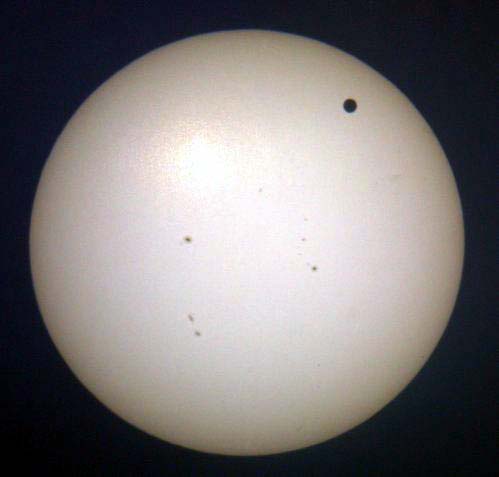
Sic Transit Gloria Veneris…

Sun With Venus 1.jpg

…for another 105 years. By 2117, I’ll be heavily involved in other pursuits and may not be able to watch–but man, did we get a show this time!

Catching any short-lived astronomical phenomenon always involves a strong measure of luck. In 1972, seven friends and I drove 1200 miles to Cap Chat, Quebec, to see a total solar eclipse. We brought out the big guns–my 10″ telescope looks superficially like a big gun, and took a little explaining at customs both coming and going–but alas, two hours before totality the clouds rolled in. We had the novel experience of watching the umbra hurtling toward us by the darkening of the undersides of the high clouds, but of totality we saw nothing.

Luck, yeah. While planning for the event I noticed that my sister Gretchen’s back yard has a near-optimum line-of-sight to the place on the NW horizon where the Sun would set on June 5, 2012. Her lot fronts on a large open space running roughly E-W, with high-tension lines and their towers the only significant obstruction. Given that my western horizon is a 9,800 foot mountain and I see granite up to about 35 degrees, Gretchen’s back yard seemed flukily ideal.

Transit Setup-500 Wide.jpg

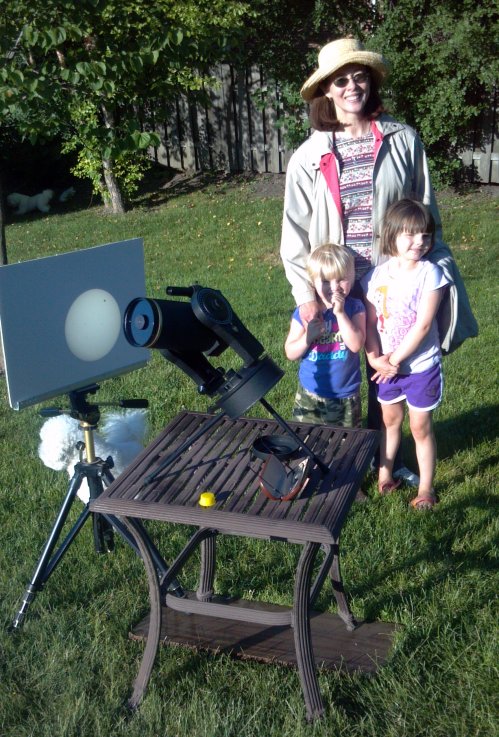
So there we chose our ground. (Without hawks but with hounds–sort of–and elves be damned.) The instrument was my Bausch & Lomb Criterion 4000 suitcase scope, which has gone on a number of expeditions with us, including two total solar eclipses and Halley’s Comet in 1986. The technique was what I generally do for solar observing: project an image on a piece of foamcore supported by a separate tripod. The image at the top of this entry was a shot of the foamcore, taken with an ordinary and slightly ancient Kodak V530 pocket camera.

I logged first contact at 5:05 PM. Second contact (when the trailing edge of the disk of Venus enters the disk of the Sun) came at 5:22 PM. After that it was the long slow crawl of Venus downward (on the foamcore) as the Sun slowly set in the northwest. Gretchen’s girls thought it was interesting, and before the transit I showed them how the telescope brings in a magnified but inverted image of things far away, like a 55-gallon trashcan across the open space. I’m sure they didn’t completely understand what was going on, but as with all Uncle Jeff tricks they did consider it a lot of fun.

The weather was nothing short of astonishing: high 60s F, light breeze, crystal blue skies down to the horizon. So it had been the whole day, and so it stayed every minute until the Sun vanished behind some trees at 8:03 PM. I got a lot of good photos, considering that the photos were of an image projected on cardboard. Toward the end of visibility, the scope was directed square across the approach to O’Hare Field, and five, count ’em, five jet aircraft crossed the disk of the Sun while we watched. The exhaust from the engines, though invisible directly, distorted the solar image in an interesting way.

Fifteen minutes before the Sun vanished, it passed behind one of the high-tension towers across the open space, allowing me to fiddle the focus a little and get some remarkable shots, like the one below:

Sun Behind Tower.jpg

Gretchen made one of her trademark pot roast feasts, with Yukon Gold mashed potatoes almost the color of the solar disk. (A dollop of real butter yellowed ’em up gorgeously.) Dash and QBit ran around in circles, chased balls, and slept like rocks last night. As did we all.

Success just don’t get any more successful than that.

Review: The Thermaltake V9 SATA Toaster Case

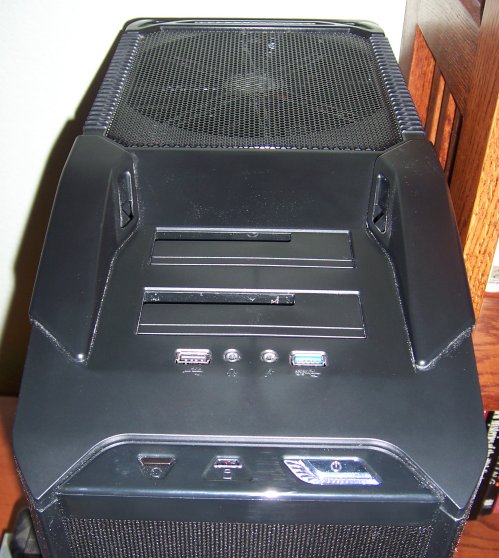
V9 Case Top Dock.jpg

After I fried my 2009-era Antec quad core tower machine, I had my favorite local box shop put me together a new quad core, this time in an interesting case: the Thermaltake V9 BlacX. Like virtually all cases you buy on the parts market these days, it’s a gamer case, complete with lots of fans and the obligatory plexi window on the side so (I presume) your friends can admire your junk. The fans are there to cool ranks of screaming graphics cards. If you’re using integrated graphics, as I am, you can probably turn most of them off. With just the front panel fan going, the inside of the case here runs at 75-77 degrees F (I measured it with a Radio Shack probe digital thermometer) which is hardly molten death.

I bought the V9 for a very particular reason: It has a double SATA toaster dock built right into the top panel. I’ve been using an Ineo USB toaster dock for some time, and like it a great deal. As with any gadget of its class, it needs its own wall wart, and there’s the inevitable data cable. The notion of having a toaster dock like that right on the machine means that I can lose a wall wart and a data cable from the ratsnest. The V9 case provides two.

The Gigabyte mobo I’m using has six SATA ports. Four of them are SATA 2.0 ports, capable of data transfer rates up to 3 Gbps, and two are SATA 3.0 ports, which can go as fast as 6 Gbps. (The choke point is most likely the drives you’re using, not the ports themselves.) The two 6 Gbs ports go to the internal drives. Two of the 3 Gbps ports go to the twin toaster docks on the top panel. Another 3 Gbps port goes to the optical drive. That still leaves me with a spare SATA 2.0 port, and the V9 even leaves me an empty bay in the front panel if I ever want to put a second sled slot in it.

Each of the two docks are almost identical to the Ineo dock, in that they can accept either 2.5″ SATA laptop drives or standard 3.5″ SATA drives. The dock ports do not use USB connectivity, as I initially suspected. There is no electrical or logical difference between drives plugged into the top dock ports and drives mounted internally and connected to SATA ports of similar speed.

SATA drives are hot-swappable, which means that yanking them out of a SATA connector with power on will not physically damage them. However, the OS needs to manage removability, and I haven’t poked at that aspect yet. From what I’ve read, there is a TreatAsInternalPort registry key governing whether a given SATA channel is removable or not. I believe that making a SATA port removable cuts down its throughput some. (Further research may be needed.) For the moment I’m happy to plug drives into the dock while powered down. When XP boots up, it sees them as though they were internal drives, which (electrically) they are. I’ll play around with the removability bit as time allows.

The case is too new to judge, really. I have a quiet Antec power supply in it, and the front fan makes barely a whisper. It has all the external ports I need. Key here isn’t functionality so much as survival in daily use. The Antec 900’s USB ports started to die after only a year or so in service. Check with me again after the V9 has lived for three or four years in my new downstairs office with the Wimhurst carpeting. USB ports may be the least of my worries.

So far: highly recommended.

Odd Lots

Eclipse Wrapup

By four PM yesterday I knew we were in trouble: The western sky was overcast, and weather radar showed various precipitation clouds squirming around in our line of sight to the western horizon. However, the scope and the folding chairs were already packed in the back of the 4Runner, so on the outside chance a miracle might happen, we put QBit and Dash in the back seat (Aero and Jack don’t like crowds of admirers as much) and steamed six miles east to St. Raphael’s Episcopal Church.

We had announced the event at both morning services, and several of our fellow parishioners were waiting eagerly for us as we got there about 5:30. I chose a spot in the parking lot to maximize western coverage, then stood around talking to our friends with one eye on the sky. Well, call it miracles or just call it a side benefit of chaos (in the rigorous sense, as the math that governs complex systems like weather and climate) but a little before six the sky in the northwest started to clear.

With a little help from fourteen-year-old Fred Jones (below left) I got my vintage 8″ vent-pipe junkbox scope (details and better photos here) set up in record time. We put it in the wind-shadow of the 4Runner, and while I adjusted the optics Fred went and got some additional folding chairs from the parish hall. By then a few more people had arrived, and by 6:15 we had a small crowd of chairs in a half-circle around the scope and its foamcore screen.

Eclipse Group 500 Wide.jpg

The skies were not great. We had runs of clear air and runs of dense cloud. While it was clear I pointed out the several sunspots, and at 6:24 Fred announced that there was a flat edge to the Sun’s image at the bottom of the screen. We had a chance to see that flat edge grow to a small scallop before the clouds closed in again.

At about 6:45 it cleared up, and for over half an hour we actually had a decent line on the Sun as the Moon took a greater and greater bite out of it. The coolest event of the evening happened so quickly that only a few of us caught it: A jetliner clipped across one of the horns of the sun’s roughly 50% eclipsed disk. Remarkably, Dianna Jones was taking a video of the foamcore screen when it occurred, and she’s going to try and fish out the frame or two of the plane’s passing when she goes through the video on her PC.

Eclipse 350 Wide.jpgWe had a decent view up to about 65% or so coverage, when the clouds closed in what turned out to be for good. In the meantime, there was a profound weirdness: A southeast wind blew light rain out of clouds that had already passed over us, and even though it was (mostly) clear from well east of the zenith to the Sun, we watched the best part of the eclipse in the rain. As God may well have been telling us: “Here’s your miracle. Just don’t get cocky.” And to seal the deal He gave us an intense double rainbow. What does it mean? It means we didn’t mind getting a little wet, we laughed, and we all had a wonderful time. (I threw my jacket over the most vulnerable portions of my scope.)

My emphasis was not to take great photos but to make the eclipse accessible to people who would otherwise have to be content with a few shots on TV. Our friends were able to walk right up to one side of the foamcore and see the umbrae and penumbrae of sunspots on the image. Most snapped their own pictures of the Sun’s disk, and we talked about things like heat distortion at the edges of the image (because the Sun was very low in the sky) how reflector telescopes differed from refractors, and much else.

I had hoped to catch the crescent Venus after sunset, but by then the western sky was solid clouds. We packed up and went home. I still call it a great success. After all, in 1972, a group of my friends and I drove 1400 miles from Chicago to the mouth of the St. Lawrence River for a total solar eclipse, only to be clouded out a bare hour before totality. Carol and I have seen two unobstructed total solar eclipses since then, including the “big one” in Baja in 1991. Two out of three ain’t bad.

Next stop: Grand Island, Nebraska on August 21, 2017.

Ready for the Eclipse

Solar Projection Setup 500 Wide.jpg

I put the 8″ scope together on the driveway to make sure nothing was amiss (and to be sure I could find all the parts) before packing the whole thing off to the parking lot of St. Raphael’s Episcopal Church. Observing the eclipse where I live is impossible, because I’m on the eastern slopes of Cheyenne Mountain, which rises almost 30 degrees above the western horizon. Today’s eclipse will occur while the Sun is setting here in Colorado Springs. In fact, even with a perfect western horizon, the Sun will set before the eclipse is fully past.

The church is almost seven miles east of us, and while there will still be mountains on the horizon, they will obstruct nowhere near as much of the sky as they do from my driveway. It also becomes an opportunity to have parishioners who may be interested come out and see what of the eclipse can be seen from here. The full annular eclipse will be visible from Albuquerque, about 250 miles south of us. We’d considered heading down for it, but there’s just too going on in our lives right now to spare the time.

The projection screen is simple Hobby Lobby foamcore attached to a length of aluminum angle stock with a 1/4-20 threaded hole at its center. I had to crank up my tripod almost to its vertical limit to get it to catch the image of the noonday Sun. The eclipse here doesn’t begin until 6:27 PM, when the Sun will be a great deal lower in the sky. Maximum coverage is about 7:30. The Sun sets here at 8:09.

Of course, all of this assumes that it will be clear later this afternoon. There are a lot of big puffy cumulus clouds up there now, and we had a thuderstorm here yesterday evening. So far so good. I’ll let you know how it goes tomorrow.

Odd Lots

  • Don’t forget the annular solar eclipse that will touch the Southwestern US this Sunday, May 20.
  • From the Words-I-Didn’t-Know-Until-Yesterday Department: Ignorosphere, the region from about 120,000 feet altitude to the lowest stable orbit. (It’s a flip term for the mesosphere.) It’s too high for winged aircraft or balloons, and not empty enough for orbiting spacecraft. Sampling it is difficult (one-shot sounding rockets are all we have in terms of tools) and we know less about it than any other region of near space.
  • After a long conversation on the subject with mobile developer David Beers the other day, I stumbled on an article that drives home the problematic nature of Android app development: There are actually four thousand different Androids. (Maybe more.)
  • I’m seeing more and more videos in, um, bad taste being posted to my friends’ Facebook feeds by something called Socialcam. The suggestion is that those who post have actually viewed the videos, but that’s not true. Socialcam reserves the right to post stuff to your Facebook feed that you have not viewed and have no knowledge of. Tear that damned thing out by the roots.
  • This certainly makes me wish that I liked corn more than I do.
  • An interesting study here adds fuel to the fire over suggestions that keeping a consistent sleep schedule helps you lose weight. I.e., don’t try to “make up” lost sleep on the weekends. Doesn’t work. I’ve been saying this for years, based on a lecture series I took at the Mayo Clinic: Getting five hours of sleep a night will make you fat and kill you before your time. People get angry at me for suggesting that they be in bed, lights-out, between 9:30 and 10 PM if they have to get up at six to get to school or work, but that’s probably what it takes. A handful of people may be able to get by on five or six hours a night. The usual human-traits bell curve suggests that you are almost certainly not one of them.
  • If you remember a speculation I made some time back about dogs and human origins, well here’s another: That dogs helped us drive the Neanderthals to extinction. I’m dubious. My sense is that their lack of dogs allowed the Neanderthals to drive themselves to extinction via dawn raids. Dogs made dawn raids difficult, and so we failed to wipe our own species out. (I haven’t seen any evidence yet that Neanderthals kept dogs, but of course I’m still looking.)
  • If you don’t know what a “zoetrope” is, go look it up before you behold the pizzoetrope, which is essentially an edible animation created by spinning a pizza. Sounds loopy (as it were) but it works.

Four Mothers, One Photo

4GenDuntemanns.jpg

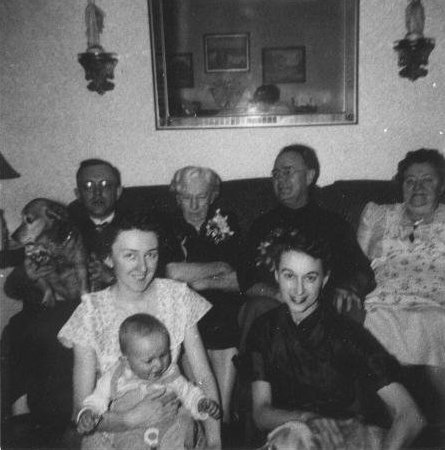
Mothers Day. The photo above, from sometime early in 1953, is an interesting one: It presents four generations of Duntemanns, including four mothers. Back row, L-R: Frank W. Duntemann 1922-1978. Martha Winkelmann Duntemann 1871-1967. Harry G. Duntemann 1892-1956. Sade Prendergast Duntemann 1892-1965. Front row: Kathleen M. Duntemann 1920-1999. Victoria Pryes Duntemann 1924-2000. Basically, my father, my great-grandmother, my grandfather, my grandmother, my godmother, and my mother. (And me. My godmother Aunt Kathleen is holding me to keep me from harrassing my mother’s poor cocker spaniel.) I miss them all, and thank them all for various things, but mostly for just being who they were.

Martha Duntemann was a remarkable woman. She survived all four of my grandparents (including her oldest son Harry) and lived longer than anyone in my direct line of descent, as far back as I can see. (Only one person anywhere in my family tree lived longer, and by less than two years.) She lived in a second-floor flat, and went up and down the (outside) stairs without assistance until three weeks before she died at age 96. I didn’t get a great deal of time with her (I was one of 19 great-grandchildren) and didn’t appreciate at age ten or eleven that when she hugged me hello I was touching a living link to the 1870s.

I appreciate it now. And I can show Martha in a better light in the photo below, from 1900:

Frank Martha Duntemann Boys.jpg

The man is her husband Frank W. Duntemann (after whom my father was named) 1867-1936, and the boys are Elvin F. Duntemann 1895-1979 and my grandfather Harry. Frank was the postmaster of Orchard Place, Illinois (from which the abbreviation ORD for O’Hare Field was derived) and owned the little town’s general store.

I guess people just didn’t say, “Smile for the camera!” in 1900. The good news is that when I remember Martha in her 90s, I remember her smiling. If I live that long (and I certainly hope to give it a good shot) I intend to do the same.

Hipster You Want? Hipster I’ll Give You!

Chrysanth WebStory Is Not Free

Because as best I can tell Zoundry Raven is abandonware (it hasn’t been updated in almost four years) I’ve been sniffing around for a client-side blog editor that’s still alive and kicking. I came across something peculiar the other day, which highlights a trend in small-scale commercial software that I find extremely annoying: Hiding your pricing structure and obfuscating your business model.

The product in question is Chrysanth WebStory. I went up to the firm’s Web site to see what it is, what it does and what it costs. Figuring out what it is was not easy. Figuring out what it does was easier, though I keep getting the creeping impression that I don’t have the whole story. Figuring out what it costs is impossible, apart from near certainty that it is not free. (More on that shortly.)

When I evaluate commercial software, I do a certain amount of research before I even download the product. I look for a company Web site. I look for buzz, in the form of online discussion and product reviews posted by individuals on their own blogs, and not sites supported by ads. I make sure I understand how the company makes money (one-time cost? subscription?) and how much money is involved. Only then do I download the software and give it a shot.

The first red flag with WebStory is that there is almost no buzz online. The free download is available all over the place, but almost no one has anything to say about it. The site itself is extremely stingy with hard information. I managed to dope out that what WebStory really is is a blogging service. There is a free client-side editor app that connects to the company servers, where blog entries are stored in a database. From the database you can feed one or more blogs hosted elsewhere, or a blog hosted on the firm’s own servers.

There are two license levels for the service, casual and professional. The casual license is limited, and to activate it you must present a certain unstated number of undefined “credits.” Here’s where it gets a little freaky: To find out more about the service’s cost you have to establish an account with WebStory, which involves handing them an email address and creating a password.

Read that again: You have to create an account before you can even find out what the service costs. Nowhere on the public portions of the site do I see any mention of what credits cost, nor what the professional license costs. It’s true that they do specify that credits can be earned by writing reviews of the product, but for people who would just prefer to pay for the service, there’s no clue at all. The service is thus “free” in the sense that you can use it without paying money for it as long as you keep reviewing it and earning credits. (Or something.) In my view, it doesn’t matter if you are required to pay in money or credits. Paying anything at all for the Chrysanth WebStory service means that it is not free.

The almost complete lack of discussion of the product online makes me wonder if more than a dozen people are actually using it. The online forums have 14 posts total, across all forum topics. Discussion of the product in other online venues is virtually absent. Of the handful I found, this one was not reassuring.

I do not object to paying for software or online services. I do it all the time. I have a lot of sympathy for developers who want to explore new business models and ways to make money. I can also understand that linking a piece of client-side software to a server-side system is one way to eliminate software piracy as an issue. None of that bothers me in the slightest. What I object to is the secrecy. Tell me up front and in big type: What does your product/service cost?

And how in any weird dimension of the multiverse can it help sales to keep the price a secret?