- Not posting often here, but I’m ok. Working hard on several things, chief of which is getting my office and Carol’s exchanged, outfitted, and fully functional. This involves furniture, wiring, lighting, and sorting an immense quantity of glarble. I hope to return to regular in-depth posting soon.
- I have a new favorite cheese: cave-aged gruyere, which can be had sometimes at King Soopers, and is lucious with a good dry red wine. Get the oldest cheese you can find, as young gruyere tastes nothing like old gruyere. A year is as young as I buy.
- The asteroid that whacked the dinosaurs must have thrown an immense amount of material into space. How much rock might have made the journey, and how far far did it go? Here’s a good quick take on the topic. It would take a million years or more to get to Gliese 581, but suitably rugged bacterial spores might have survived, and made the origin of life on planets there unnecessary. (Thanks to Pete Albrecht for the link.)
- A book I’m not bullish on: Steven Johnson’s The Ghost Map, which describes how the cause of cholera (infected water) was proven by the persistent John Snow through charting of cholera deaths upon a map of London neighborhood water pumps. Why? The book does not include the actual ghost map named in the title. (So what else is missing or wrong?) Whatever editor let that past should be fired and spend the rest of his/her days stuffing toddler clothes in racks at Wal Mart.
- Could the TRS-80 Mod 100 possibly be 30 years old? Yes indeedy, and it was ubiquitous among tech journalists when I was at PC Tech Journal in ’85-86. Its keycaps made a distinctive sound, and sitting in a significant press conference back then was like sitting under a tin roof in a rainstorm. I yearned for one myself (the keyboard was wonderful for such a small device) but didn’t pull the trigger because the machine did so little other than keystroke capture.
- Toward the end of my tenure at Xerox I saw the Sunrise, which was a more ambitious take on the “lapslab” concept. My department was considering writing an app for it, so I had a loaner for awhile. Even better keyboard than the TRS 100, cassette data storage, modem…but the 3-line display was harder to read. Xerox private-labeled the hardware from another company, and basically killed it with a $1500 price point. (There was a flashier version that cost…$2500!) Xerox abandoned the market in 1984, after sinking what rumor held to be an obscene amount of money into it.
- One machine I did consider was the Exidy Sorcerer, which also had a good keyboard and didn’t cost $3000. Lack of software made me spend the $3000 anyway, on a huge honking S100 system running a 1 MHz 8080.
- One of the big issues between Amazon and the Big Six is an explosion of co-op fees, which according to some reports have increased by 30 times since 2011. The whole “co-op” business has always smelled gamey to me, but it had a purpose in the B&M bookselling world. How it fits into online ebook retailing is less clear, and in my view starts leaning perilously in the direction of bribery.
- Most of us think that reading is in decline. Gallup poll results suggest otherwise. Nor are today’s books worse than those of 40+ years ago. This quote is significant: “The bad [books] of yesteryear have gone out of print while the bad ones of today are alive and being sold in supermarkets.”
- I’m still watching the ASUS Tranformer Prime (their botch of its GPS support has kept me away for the time being) but the Prime has a little (as in cheaper) brother now, and it looks like a decent machine in its own right. Here’s Engadget’s detailed review of theTransformer Pad TF-300.
- Here’s another wonderful gallery from Dark Roasted Blend, this time of high-speed photos of liquids. Some of it is photoshopped, but it’s all startling. (Thanks to Ernie Marek for the link.)
- Santorini is smouldering again. Yes, the volcano that may have made the Minoans extinct and launched the legend of Atlantis (or at least put an older legend on the map) is getting restless. Like the Greeks need that right now.
- Eating meat allowed our hominid ancestors to reproduce more quickly, by accelerating infant brain growth and thus shortening the breastfeeding period. (Breastfeeding naturally inhibits ovulation.) This on top of several other issues.
- From the Words-I-Didn’t-Know-Until-Yesterday Department: Beatboxing , which is vocal generation of sounds like drums and synthesized sound effects. I heard of this in an interesting way: There’s a slightly silly commercial for the Honda Pilot that involves a Pilot full of bored tweens beatboxing the rhythm of Ozzy Osbourne’s “Crazy Train,” and by chance we had captioning turned on. When the kids started making noises, the captioning read, “Beatboxing.”
- Pete Albrecht sends a link to a map color-coding US gas prices by county. The very abrupt differences between states suggests that gas prices are more a question of state and local taxes than regional differences in demand.
- It was inevitable: A 3D printer that prints chocolate novelties. Now we need a 3D printer that prints spice-cake Easter lambs with ears that stay on.
Odd Lots
Odd Lots
- I’m behind on a great many things, especially fiction writing and replying to email, so bear with me until I get dug out from under the pile. Exchanging offices within a house is precisely the same as moving two offices, and that means a lot of boxes and a lot of bother, exploding intercoms being the least of it.
- I didn’t expect this wine to be as good as it actually is. About $11.
- The weather’s been beautiful here, so yesterday I was going to get out on the back deck with my Icom 736 and work the world. That was, of course, the day that sunspots basically vanished on the visible face of the Sun. What does it mean to have solar flares but no sunspots? Nobody knows.
- Thanks to many people (Jim Strickland being the first) who wrote to tell me about a “smart sand” project at MIT that is the first step toward the sort of nanoreplicator I postulated in my Drumlins stories: Tap in a 256-bit code, and some “smart dust” (very smart) in a stone bowl assembles something for you. I love it when my crazy dreams come true!
- Single-atom nanotransistors can now be reliably made, rather than hunted for. (Thanks to Roy harvey for the link.)
- From Michael Covington comes a link to a fascinating article about the other kind of abduction: abductive logic. If you’re a Sherlock Holmes fan, don’t miss it!
- The Colorado state law that led Amazon to nuke my Associates account has been declared unconstitional. No word from Amazon as to whether I can have my account back.
- I would probably buy one of these if I could find one in stock somewhere.
- Jack Tramiel has left us, having created quite a raft of famous computers, including the very best forgotten computer ever.
- I checked the date on this one, but it was nine days too late to assume it’s a hoax. One might argue that solar panels are more elegant, but you can’t make buffalo spaghetti sauce in a solar panel.
- I’ve seen more dumb YouTube posts than I’m willing to admit, but this one takes the cake for sheer willful stupidity. I knew how this worked in 1959, when I was 7.
- Kids, this is futurism. All we need now are better tacos.
The Wonderful Exploding Intercom

Carol and I are trading offices, and trading offices is a lot of work. I’m trying to do it right and not have piles of unsorted glarble on every horizontal surface, accruing new mass like black holes. That may be impossible; I don’t know. I’ve never had an office without piles of unsorted glarble. The nature of the glarble changes over the decades, but a quick trip through the photo albums confirms that the glarble has always been there.
There’s another problem I intend to fix this time: Carol has always wanted an intercom between her office and mine. Lacking an intercom system we use our cellphones, but cellphones are not intercoms. I was born in the 1950s and I know an intercom when I see one: Intercoms have things that light up, ideally inside as well as on the front panel; and they buzz. The buzz is to remind you that their magical souls are yet alive within them. If they’re good intercoms, you can hear remote audio over the buzz.
And so it was a while back that I bought a pair of 1964-era Lafayette PA-405 4-tube wireless intercoms on eBay, for the remarkably low price of $30. A wireless intercom is a very cool thing. You don’t have to run wires between the two stations because they use your house wiring as a signal conduit. Each station has a little radio transmitter and receiver within it, and so using them is a little like using CB radios. (If you don’t know what CB radios are, well, you’re not a Baby Boomer.) Push the button labeled Talk, and you talk. Otherwise, you listen. (How ’bout that Girlfriend! This is Contraman! What’s yer 20?)
The two units are beautiful; practically pristine visually. I plugged them both in, one in Carol’s office and one on the kitchen island. Got some buzz (natch) and random racket on both sides. I was playing with the silencing control on the back panel of the unit in Carol’s office when I heard a weird concussive sound through the air from the kitchen, followed by Carol yelling, “IT EXPLODED!”
This is not something Carol yells very often, even across a 35-year marriage to yours truly. I got back to the kitchen pronto and found smoke curling out the holes in the masonite back panel and Carol cranking wide the kitchen windows. I suspected (as old-timers will agree) that a 50-year-old electrolytic had decided to go out kicking, as has happened to me more than once. Not so: Once I opened it up I found a relatively modern .05 tubular capacitor that had blown out one end and pewked up its foil-and-mylar guts in a spectacularly spiral fashion.

I’ve never seen a cap die quite that way, and I can only assume that it had shorted internally. Its function in the circuit appears to be feeding low-level RF signal onto the power line from an RF coil. If shorted, the cap would bridge one side of the wall mains connection to the other side, through the secondary of the RF coil. (I may be wrong about this, but that’s how it looks through a magnifier.) Although the coil looks fine, the circuit isn’t working, and shorting wall current through a small coil of #30 wire is rarely good for the coil.
I’ve ordered the schematic from Manualman and will go back to the units when it arrives. Am I annoyed? Not hardly. 1964 was one of my favorite years, and the good thing about electronics from that era is that the parts are big enough to see. If I did in fact burn out the RF coil I may have to find a parts unit, but that sort of surgery is no great challenge with parts in hand. (I may also be able to rewind the coil, which looks like about 12 turns of #28 or #30 enameled.)
Why am I so happy? Call me weird, but it’s like this: If it didn’t explode I wouldn’t have the fun of fixing it. So there.
Review: John Carter (of Mars)
I wrote this three weeks ago and then forgot to take the file to Chicago, duhh. I assume everybody’s seen the film by now, but I’m not sure what else to do with the review but post it.
 Saw John Carter with a few geek friends, all of them (but me) EEs. It got lousy reviews for the most part, but I was intrigued by the idea of a quarter-billion dollar pulp novel. Because I know what pulp novels are (and because I read A Princess of Mars when I was 15 or so) I was by no means disappointed. Guys, it’s a pulp novel. This means that it’s either about cleavage or else bashing your enemies to a pulp.
Disney made this one, so the cleavage is minimal, and the pulping quite bloodless. The costuming and CGI creations, on the other hand, were breathtaking in a sort of half-Spartacus, half-Steampunk way that we don’t see very often. (I really can’t think of another example, though the very uneven 1961 George Pal film Atlantis, the Lost Continent comes close.) Much of the film was shot on location on an alien planet called Utah. The rest came out of whole CGI cloth.
And that, my friends was worth seeing. The tusked, four-armed native Martians called Tharks looked absolutely real, right down to the eyes. They fidgeted, they pouted, they even wept, and they did not all look alike. It is a credit to the production quality and attention to detail that in other films the Tharks might be consider monsters; here they were more or less the bad boys you stayed away from in high school or (very) occasionally befriended. There actually weren’t a lot of monsters, once you discount the Tharks as ugly but mostly human dumbasses. One of them, however, was my favorite living thing in the whole film: Carter’s six-legged Martian dog sidekick Woola (technically a calot) who might accurately be described as Jabba the Mutt.
I liked the human characters a lot less. After all, I’ve already seen Spartacus. Carter himself (Taylor Kitsch) was forgettable beefcake. The bald guys were unconvincing, and reminded me of mysterious, hair-challenged heavies in a multitude of bad media pieces all the way back to Ming the Merciless. The princess-scientist Deja Thoris had remarkably durable eye makeup considering the roughousing she engages in. Then again, so did Sophia Loren in the underappreciated 1957 big gun epic The Pride and the Passion. (So, in fact, do most movie heroines who aren’t ugly by design.) The Zodangans and the denizens of the city of Helium (what was Burroughs thinking?) were toga-epic extras, who brought all the passion of plum pudding to their parts.
I twitched every time I heard someone say, “…then Helium falls.” Hey, if Helium falls, why do we fill blimps with it?
The steampunkish walking city of Zodanga was a nice touch, explaining as it does why Mars appears to have long lines spanning its deserts. That’s just Zodanga tracks, and Zodanga has a lot of legs. Nonetheless, it’s a very big item, and if you’re not so dumb as to just sit and wait for it to step on you, I’d guess it’s fairly easy to outrun.
Unfortunately, the one big thing that bothered me immensely in the film was key to the plot: Carter’s Supermannish ability to jump a hundred feet straight up, supposedly because of the lower gravity on Mars. Sorry, no. Mars’s gravity is 3/8 that of Earth, so a 200-pound ruffian would still weigh 75 pounds. I might believe fifteen feet straight up, or 60 feet in a horizontal long jump with a good running start. And if Carter can, the slender and apparently muscular Tharks should be able to. Not so.
That’s my main complaint, apart from the fact it’s sometimes difficult to tell exactly what’s going on. I’ll freely admit that I didn’t care. John Carter is about spectacle; fights among improbable flying machines, goofy aliens, and endless startling things purchased by the compound interest of Moore’s Law. Don’t expect it to make sense. (Alas, don’t expect it to make much money, either.) Resist the temptation to crack helium jokes. (If Deja Thoris is a Princess of Helium, why doesn’t she have a squeaky voice?) Just turn your brain off and enjoy the scenery.
Guiltily recommended.
Sparking Ideas
Carol and I traded offices here after completion of our downstairs rehab, and while the process is ongoing (much stuff is still lying around in boxes) I’ve come upon a problem I didn’t have before. Back in late March, I touched the metal bezel of a conventional USB 2.0 port on my desktop quadcore, and drew a 1/4″ spark. As you might expect, the machine died instantly. The new carpet generates a lot more static than the old carpeting did–and our customary 7-9% humidity doesn’t help.
Why the USB port bezel wasn’t grounded is a mystery, since the wire coming out of the top panel encapsulated port assembly was screwed tight to the case, and the case to the third wire. I can only assume that something was broken inside the port assembly. I’ll tell you right now, I am not going to buy any Antec cases anymore. This is the second one that’s gone bad in precisely the same way: wonkiness in the front/top panel port assembly. Furthermore, I had to destroy the top panel to remove the port assembly, since the case metal completely blocked access to two of the plastic release tabs. No wonder they wouldn’t sell me a replacement port assembly, since the assembly could not be changed without destroying the case itself. Antec is off my list, now and forever.
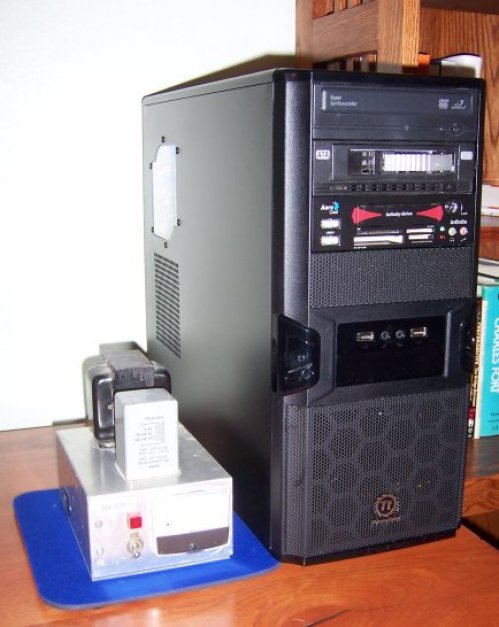
There’s nothing bleeding-edge in the new machine. The mobo is a Gigabyte Z68A-D3H-B3, if that means anything to you, with an Intel Core i5-2400 Sandy Bridge processor on it. The cores run at 3.1 GHz, vs 2.4 GHz for the old machine. I had them put it all in a Thermaltake V3 case, which is smaller and simpler than the Antec Nine Hundred I’ve been using since late 2008. I am not a gamer and am quite content with integrated graphics, so elaborate cooling machinery is unnecessary. The case fans are quiet (though one of them seems to rattle periodically) and overall I consider it a winner.
Now to figure out how not to kill the new machine. The quick fix was to pull a homebrew 350V power supply off the shelf and plug it in beside the new quadcore. The aluminum chassis is grounded to the wall through the 3-wire cord, so touching the chassis before touching the quadcore should do it. (The blue mouse pad is just to keep the supply from scratching the table.) I know it works because I can pull quite a spark by touching it after scuffing around the lower level. Better still, if I hold an NE-2 neon bulb by one lead and wave it a few inches from the grounded power supply, I can see the static bleed off through the bulb, without even touching the other lead to the chassis. (Turning the lights off makes it more dramatic, but I can see the orange flickers in full daylight.)
The neon bulb experiment suggests that something more graceful than an old power supply could be put together as a grounding station. I have a wonderful 5″ bronze worm wheel given to me by Carol’s dad circa 1987, and with a little skill and some copper pipe fittings could build something with a VR-75 tube at the center, and the gear as the touchplate. Touch the plate, flash the tube, kill the static. I’m going to lash it up before putting a lot of work into it, but I see no reason why it wouldn’t work. More as it happens.
You Can’t Go Home Again

We’re back and I’m ok; you can stop worrying about me now. (Nonetheless, many thanks for all the concerned emails.) We flew to Chicago to house-sit for Carol’s sister for a week or so, and most of what I did there was read books and visit family and a few old friends. My arm no longer hurts…much, and that only when I put significant weight or torque on it. I’m going to strength training tomorrow, a session I suspect will be interesting.
In the meantime, I passed through my old neighborhood on the way to visit my kindergarten friend Art, and cruised down the street where I grew up, to see the house I lived in until I was 23. I was halfway down the block when it hit me: This is all wrong. I stopped where I knew my old house had been, and looked at something that was no longer my old house. In fact, it looked a lot like Dorothy’s tornado had dropped somebody else’s house on top of the house of my birth and somehow got the alignment right.
Let me show you the house shortly after its completion in 1949:

It was a fairly common design, by the well-known Chicago developer Maclennan, and there were lots of them in our neighborhood. The original floor plan was just 900 square feet, with only two bedrooms and one bath. When my sister came along in 1956 my parents put a floor under the cathedral ceiling and made a third bedroom out of it, with a new dormer for a half bath upstairs. Shortly after that, they put a good-sized family room off the back side of the house that ran the full width of the structure. The family room included a brick fireplace with its own chimney. It was a little tight (especially by today’s standards) but I finished the basement in knotty pine when I was 15 and after establishing my desk and workbench there spent a great deal of my time downstairs.
My mother lived there for 47 years, and when we sold the house in 1996 I figured that somebody would put some work into it. Whew. Was I right or what? It looks like they literally shaved off the second story and the family room completely, or possibly gutted the place down to the brick walls and started over. (I’m guessing my knotty pine walls in the basement did not make the cut either.) The house as it is today looks a little topheavy, but the lot is only 35 feet wide, and it takes some creativity to maximize the useful space buildable on that little land.
No hard feelings, though forgive me for thinking that it just looks funny. The most striking change was the removal of both chimneys, which made me sigh because my first ham radio antenna was 30′ of #22 wire strung from one chimney to the other. I worked 34 states from that house (on a hacked-up Knight T-60) and saw eight planets from the front lawn. It was, let’s say, formative.
Much more to talk about. I’ll try and catch up in coming days. I have a new desktop machine here, having scragged the old one by touching it before grounding myself. When you see a quarter-inch spark jump from your finger to a USB port, you know that nothing good is about to happen. I have a sketch for a steampunk discharge station coming together, with a 5″ bronze gear and a VR-75 gas regulator tube for visual effects. Touch your quadcore before touching the discharge station, and it’s back to your Babbage barn, bunky!
Living One-Handed
Left arm is definitely getting better. I’ve actually devised a technique for two-handed typing that doesn’t hurt too badly: I cross my right leg over my left, and then prop my left wrist on my right knee. With my wrist supported I can actually type reasonably well on the left side, but of course I’m nowhere near my accustomed 100+ wpm speed.
It’s been an interesting experiment in not using my left hand. For the first couple of days life was tough. Getting dressed was an experience. Cutting a steak proved impossible the day I pulled the muscle, though I managed the next day with only some minor screaming when I moved my wrist the wrong way.
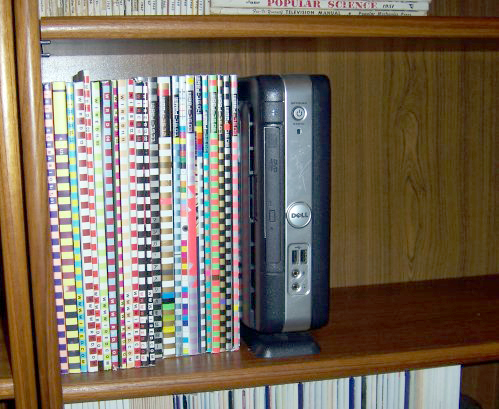
Much of what I’ve been doing has been sorting magazines on the lower level prior to re-shelving them. My Atlantics were in a disorderly heap before, as were Electronics Illustrated, Commonweal, and Wired. I ended up sitting tailor-style on our newly cushy floor and creating year-piles all around me. Then I shell-sorted each year-pile into month order, and finally hoisted each sorted year one-handed and placed the mags on the shelf. I’ve wanted to do that for years, but it always seemed a bad use of my time…until a bad supinator suddenly made it a good use of my time.
I discovered earlier today that a dead SX270 makes a dandy bookend; see above. Very good way to keep sorted year-stacks of mags vertical while I sort the rest of the pile on the floor. I have another one upstairs that isn’t dead, but may be of more value to me as a bookend than as a computer. Then again, I use my Sixer and my Twoer as bookends, even though they’re in tip-top condition. If I can ever find anybody who wants to QRP QSO on AM, I’ve got more than enough old power transformers to hold up my QSTs.
Have some hope that tomorrow will see a return to something like normal life, with occasional yelps. I’ll let you know.
No Supinator for You!
On Wednesday I hurt my left arm, and am still typing one-handed. Carol (who is a physical therapist) tells me that I may have pulled my left supinator. I didn’t even know I had a supinator, which to me sounds like a brand of crockpot. Whatever a supinator might in fact be, I know by now that it hurts like hell when mistreated.
Bottom line: I may not be doing much posting for the coming week. Lesson: I am 59, not 19. I cannot throw boxes full of books around with the aplomb I once exhibited. I would like to get my aplomb back, but like my hair, that train may have left the station.
I’ll be back when I can use my left hand again.
Odd Lots
- Movers are coming imminently to reassemble my lower level, so I will be mostly out of touch for the rest of today.
- If you’ve never had an account with Verizon in the past, don’t get one now. Verizon sold a huge number (over a million!) of expired debt accounts to a debt collection agency called AFNI, which has been attempting to collect on some of them, even when the debt has long since passed over the horizon of the statute of limitations. Some of these debts were long since paid off, some were mistakes, and some may possibly be complete inventions. Verizon’s action was legal; AFNI’s may not be. Still, Verizon started it, and I’m encouraging people not to do business with them.
- Here’s an aurora prediction site I’d not seen before. We’re a little too far south to get much from the current outbursts, but having seen some of the 2005 auroras here (if barely) I’m certainly watching that red line. (Thanks to Jamie Hanrahan for the link.)
- From the Words-I-Didn’t-Know-Until-Yesterday Department: A tuya is a volcanic landform created by a smallish volcanic eruption that occurs under a kilometer-class ice sheet, as from our most recent ice age.
- Roy Tellason wrote to tell me about his tube data sheet page, which has more scanned data sheets (all PDFs; typically under 1 MB) in one place than I’ve ever seen, with no ads nor any fussing (registration, etc.) required to access them.
- Rich Rostrom sent a wonderful link to a collection of photos and drawings of the Hindenburg, including its passenger areas, which included (egad) a smoking room! Originally (it was later expanded a little) the airship could carry only 50 passengers, tops. Those must have been expensive tickets…
- I was starting to get this message almost fifteen years ago: Heart disease is about inflammation. It’s not about meat or fat. Inflammation comes from smoking, chemicals of various sorts, infections, and (most commonly) sugars and vegetable oils. No inflammation, no heart disease. (Thanks to Mike Bentley for the link.)
- I’m shopping for vacuum tube intercoms, and found that someone on eBay has listed the Talk-A-Phone set that my parents bought (they were made in Chicago then) and used as a baby monitor after my sister was born. I’d really prefer one of the mid-60s tube-based carrier-current models. All the majors had them. (Carol wants a better way to reach me when I’m in my office than yelling down the stairs…)
- The beautiful 1920s Des Plaines Theater has reopened after some major restoration, and is now slotting upscale live acts rather than movies. It’s literally around the corner from our Chicago-area condo, and I’m itching to find an event as an excuse to go in and look around.
- If you’re afraid of spiders, don’t go to Australia for awhile. (Thanks to Pete Albrecht for the link.)
- Dinosaur fossils don’t get a whole lot better than this.
- While doing my semiregular scan for pirated copies of my books, I happened across something fascinating on alt.binaries.e-book.technical: a scan of the original service manual for the Nazi V-1 flying bomb. I don’t know how to create an NZB that points directly to the file, but the item was posted on 10/25/2011. Search for “Gerate-handbuch FZG-76”. A dieselpunk pulse-jet is what it was, and now you can see what was inside it. (Being able to read German is a plus, but the photos are very good.)
- A wonderful photo collection of vintage ice-cream trucks. We saw the Good Humor trucks regularly on our street in the 50s and early 60s. The driver rang bells by pulling on a string. He did not play obscure hymns or creepy recorded voices saying “Helllo!”
- How’s your scene? (I had to look it up to see what a “scene” was in this context.) My “scene” is not listed, but you can see what the chap thinks of steampunk. And if you want a timeline, it’s here. (Alas, it starts in…2000. Do you feel mondo-creaky old looking at this? I do.)
Beware the Zombie Debt Apocalypse
One of the things that may be going on with all the NCTUE letters people in Colorado have been receiving in recent days (see my last two entries) is a debt collection agency fishing for “zombie debt.”
There’s a great deal about this online. It turns on a peculiarity in the law regarding debt and the statute of limitations: If a debt collector can persuade a debtor with an expired debt to pay even a penny of that debt (lying through their teeth that doing so will remove the negative event on their credit report) the statute of limitations can be reset, and the debtor may then be liable for the full amount of the expired debt.
The debt is basically brought back to life to haunt the debtor.
This is the sort of thing that may technically be legal but strikes most people as a species of fraud. Doesn’t matter: Whatever you do, never pay anything to a debt collector to settle an expired debt–or that debt’s teeth will soon be gnawing at your wallet. Brains, feh. All it wants is your money.
We don’t know yet what’s going on involving NCTUE letters in Colorado. But a zombie debt scam is possibly underway. It might working something like this:
- A shady debt collection agency buys (or simply invents) a bunch of old (or fictitious) debts.
- The agency files these debts with NCTUE.
- NCTUE dutifully sends out notices that they’ve received negative information for your account. (These are the letters that people have been getting.)
- At this point, the collection agency may begin calling or sending letters to the people named on its expired (or fictitious) debts. They may also simply wait for concerned consumers to contact them. (Don’t! Especially by phone.) They may offer to settle a debt and remove the negative credit entry for a small sum.
- A few people may consent to do this. As soon as the collection agency receives the settlement payment, they begin dunning the hapless submitter for the full amount of the expired (or fictitious) debt. That’s the payoff. Note that the collection agency probably bought the debt, and owns it. Whatever money they can get out of those named in the debt goes to them and belongs to them. The original owners of the debt are no longer involved and have no stake in the debt payments.
- In the case of truly fictitious debts, the supposed debtor isn’t on the hook for anything–but any money sent to the collection agency is probably gone forever.
This has been done many times before. Note that the scenario is still hypothetical in this case. I’m in the process of checking to see who filed an entry under my name with NCTUE. I’m also waiting for some contact by a debt collection agency. I always screen phone calls, but I’ll be doing so a lot more consistently now. What I do later on depends completely on what I learn in the next few days. Stay tuned.