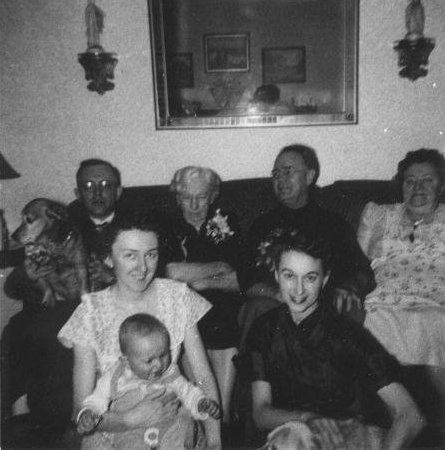
Mothers Day. The photo above, from sometime early in 1953, is an interesting one: It presents four generations of Duntemanns, including four mothers. Back row, L-R: Frank W. Duntemann 1922-1978. Martha Winkelmann Duntemann 1871-1967. Harry G. Duntemann 1892-1956. Sade Prendergast Duntemann 1892-1965. Front row: Kathleen M. Duntemann 1920-1999. Victoria Pryes Duntemann 1924-2000. Basically, my father, my great-grandmother, my grandfather, my grandmother, my godmother, and my mother. (And me. My godmother Aunt Kathleen is holding me to keep me from harrassing my mother’s poor cocker spaniel.) I miss them all, and thank them all for various things, but mostly for just being who they were.
Martha Duntemann was a remarkable woman. She survived all four of my grandparents (including her oldest son Harry) and lived longer than anyone in my direct line of descent, as far back as I can see. (Only one person anywhere in my family tree lived longer, and by less than two years.) She lived in a second-floor flat, and went up and down the (outside) stairs without assistance until three weeks before she died at age 96. I didn’t get a great deal of time with her (I was one of 19 great-grandchildren) and didn’t appreciate at age ten or eleven that when she hugged me hello I was touching a living link to the 1870s.
I appreciate it now. And I can show Martha in a better light in the photo below, from 1900:

The man is her husband Frank W. Duntemann (after whom my father was named) 1867-1936, and the boys are Elvin F. Duntemann 1895-1979 and my grandfather Harry. Frank was the postmaster of Orchard Place, Illinois (from which the abbreviation ORD for O’Hare Field was derived) and owned the little town’s general store.
I guess people just didn’t say, “Smile for the camera!” in 1900. The good news is that when I remember Martha in her 90s, I remember her smiling. If I live that long (and I certainly hope to give it a good shot) I intend to do the same.
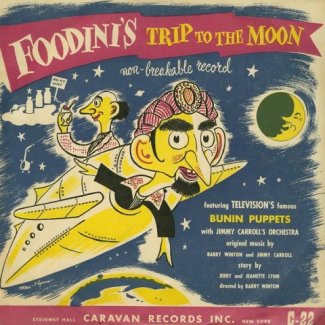 Like most record players in that era, it could do 33 1/3, 45, and 78 RPM. Most of my records were 45s. (The older ones, including Foodini, were 78s.) Playing a 45 at 33 1/3 was interesting for a moment but ultimately boring: Small children run at inherently higher clock rates than adults, and slow music is not a big draw. 78, now: I had a Disney extended-play 45 containing music from the 1955 “Lady and the Tramp” and I loved it a lot. One cut in particular was my favorite: “Lady,” the instrumental theme for the female cocker spaniel lead. It was bouncy (like me) and I quickly learned how to pick up the needle and drop it again at the beginning of the track, playing it again and again. And when that got boring, I nudged the speed lever up to 78.
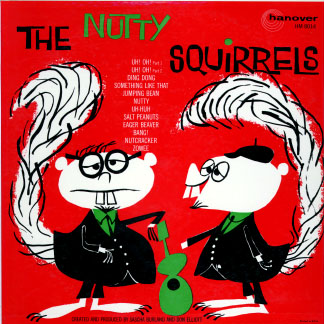 This was a fad in the late 1950s, starting with Sheb Woolley’s “Purple People Eater,” which had a couple of sped-up spoken vocals (“I wanna get a job in a rock and roll band…”) but no sped-up singing. That was a Seville invention, with his 1958 song “Witch Doctor,” setting the stage for The Chipmunks at Christmas time that year.