Jeff Duntemann's Contrapositive Diary Rotating Header Image

Pirates vs. Ebooks: A Webinar

Very quick note here: I will be giving a webinar today on ebook piracy and DRM at noon Mountain Time (11:00 Pacific Time, 1 PM Central Time) to a site called Book Street Cafe, based in Phoenix but not geographically limited except by time zones. It was founded by some of my friends from the now-folded Arizona Book Publishing Association, which I belonged to all the time I lived in Scottsdale and acted as president for two years. The webinar is scheduled for 45 minutes, with another 15 minutes for questions and discussion.

Book Street Cafe is a paid membership organization, but they’ve given me a one-time link for my webinar that I can post. If you want to participate, click here.

You’ll have to either have Java running or download the Citrix app that underlies the GoToMeeting technology. You’ll be able to do the download when you click to the site. I know that Java is in a bad odor right now, but the Citrix app is relatively small and only takes a few seconds to download and install.

The presentation is oriented toward print book publishers who are nervous about ebook piracy and are considering DRM. It is not a techie show. It draws on research and positions I’ve presented on Contra for several years.

We’d love to have you. Try to log in a little early so that you make sure you’re properly connected.

Odd Lots

The Head of R&D

Rad Head Complete-500 Wide.jpg

Among the people we miss most in Arizona are our then-neighbors Pat Thurman K7KR and his wife Sue “Starshine” Thurman. Back in 1998, Sue approached me about building her a sort of robotic ventriloquist’s dummy for a kid’s show she was working on (starring her character Starshine) to promote reading in grades 1-4. She wanted a character who looked like a robot, and suggested that Meccano might be just the thing. I’ve done a lot of Meccano work down the decades, and thought it was a great idea. I soon realized that a full-sized dummy would be mostly steel and weigh far too much to sit on anyone’s lap. As a counter proposal I suggested a disembodied robot head, which would be controlled by a puppeteer under a table. Sue loved it, and gave the character a name long before I finished designing and building him: The Head of R&D, aka “RAD.”

The show itself was no small production, and included a cameo by Jane Hull, then governor of Arizona. Sue worked fiendishly hard on it, and recruited many of her theater friends to play parts and generally help out. Carol played Madame LePinswick, a fortune-teller. I sat under the modified card table on which RAD was mounted, so that I could work the controls. RAD could turn his head from side to side, roll his eyes, move his bushy eyebrows independently, and work his jaw. All of this was done with a vertical control column running down from his neck, and with both hands on the controls (which resembled a movie-submarine periscope) I could do it all at once. Sure, it took some practice, but the range of expression RAD could display was surprising.

RAD Head Top Inside 500 Wide.jpg

The inside of RAD’s head was a ratsnest of gears, sprocket chains, levers and push rods, and took a great deal of fooling-with to get right. During performances I sat on a peculiar folding beach chair underneath the card table, and watched the stage on a 9″ portable color TV so that I could see where everybody else was on stage and make RAD interact with them. (There was a CCTV camera mounted on a seat in the front row of the grade school auditorium where the show was presented.) Two of Sue’s friends were voice actors, and provided RAD’s slightly British voice and the voice of TC, the Heathkit Hero robot who was Starshine’s sidekick. I basically lip-synced RAD to his voice actor, who was off-stage with a mic. I added as much additional facial expression as I could manage, given that moving his mouth was primary.

Earlier today, Sue posted a video of the full-half-hour show on YouTube. RAD first appears at about 15:30. Carol appears at several points in the video, including a brief close-up with RAD at 25:00 and again at 26:05 and 30:00. My book The Delphi Programming Explorer makes a cameo at 30:34. RAD himself was later featured in an article in Constructor Quarterly (the Meccano hobbyist magazine) in the September 2000 issue.

After the live presentation to the students at the school where the video was filmed, several of the boys came up on stage so I could show them how RAD worked. One earnest 8-year-old asked me, “What number Erector set do you need to build that!” (By my calculation, he should be just about through engineering school by this time. I hope I gave him a nudge.) All in all, it was terrific fun, and as his 15th birthday approaches RAD still sits on my workbench, fully functional if maybe a little out of adjustment. I’m guessing he will always rank as the single most peculiar mechanical thingamajig I have ever put together. Many thanks to Sue for letting me get involved. I hadn’t seen the video in over ten years, and it was terrific to see it again.

The Raspberry Pi Keyboard Stutter Problem

When I first cabled up and ran my Raspberry Pi board, it worked like a charm, first time. I was powering it with the Motorola Droid X2 charger that I had stolen from the kitchen desk upstairs. To keep peace in the valley, I went out and bought a cheap Micro-USB phone charger at Best Buy. It booted normally, but then, when I tried to log in, the keyboard began repeating characters. I’d type in “pi” and see a parade of extraneous i’s march in stately fashion across the display:

piiiiiiiiiiiiiiiiiiiiiiiiiiiiiiiiiiiiiiiiiiiiiiiiiiiiiiiiiiiiiiiiiiiiiiiiiiiiiiiiiiiiiiiiiiiiiiiiiiiiiiii

Needless to say, I couldn’t log in. Now, this didn’t happen every time, but probably half of all logins I attempted failed, with the same keyboard jitter. I tried two other USB keyboards I had on the shelf plus the known-good one attached to my GX620 USFF, and saw exactly the same behavior. It clearly wasn’t the keyboard itself. I’m using a Dell SK-8135 keyboard, which has a 2-port USB hub to which a Dell USB optical mouse is connected. This leaves one USB port on the RPi free, with any luck to use for thumb drive add-in storage. More on that once I figure it out.

Anyway. Some googling suggested a power supply shortfall. I got out my DVM and put the probes on test points 1 and 2. These are minuscule “doughnut” pads on the RPi circuit board. One is labeled TP1, the other TP2. Hunt around on the board for them; it’s not like there are a lot of square inches to search. TP1 is located next to the 220 uF filter cap at the Micro USB jack. TP2 is right next to the yellow RCA jack.

The RPi is designed to work at 5V. Anything much below that and things may start getting flaky. My reading across the test points was 4.72V. Aha! We now have a new phone charger for the kitchen desk–a cool one with a retractable cord–and I decided to dedicate the old one to the RPi. With the original Motorola Droid X2 charger in the wall, I measured 5.03V across the test points. Shazam! No more keyboard stutter.

I’m not sure it’s a question of the RPi drawing more current than the charger can provide. The Droid X2 charger that works is rated 850 ma. The no-name charger that provided only 4.72 volts is rated 2.1 A. Current sourcing ability is important, especially since different USB keyboards and mice draw different amounts of power–but accurate voltage is just as important. I’m guessing it’s sloppy voltage regulation in the cheap charger. If you’re getting keyboard weirdness, put your DVM on the test points and see what your charger is feeding the RPi.

What? You don’t have a DVM? No Pi for you!

Odd Lots

  • From the “…And Then We Win” Department: Lulu is eliminating DRM on ebooks published through the site. (I was notified by email.)
  • The Adobe CS2 download link everybody’s talking about (see my entry for January 10, 2013) is still wide-open. If it was indeed a mistake, you’d think they would have fixed it by now. New suggestion: They’re arguing about it. New hope: They’re really going to allow CS2’s general use without charge.
  • I didn’t get the art gene from my mother, but I did indeed enjoy the Museum of Forgotten Art Supplies. I still have my full drafting set in a drawer somewhere, replete with bow compasses, French curves, triangles, and so on. How many years will it be before nobody under 50 has any idea what those are? (Thanks to Jim Rittenhouse for the link.)
  • And while we’re doing peculiar museums, check out this selection of implements from the International Spy Museum. I believe the surplus houses were selling CIA turd transmitters twenty or thirty years ago. Shoulda bought one when I could. As the late, great George M. Ewing would have said: “Forget it, Jeff. Nobody will pick that up.”
  • Strange transmitters you want? From Bruce Baker comes a video link that no steampunker will want to miss: The annual fire-up of the only Alexanderson alternator left in the world, station SAQ in Sweden. From the sparks to the swinging meter needles, it’s just like Frankenstein, only it’s real–and sends Morse telegraphy at 100 KHz or so. No vacuum tubes, and I don’t see any reason why it couldn’t have been in operation in 1890.
  • Every wonder who was behind Information Unlimited? Here’s the guy.
  • Here’s more on how fructose messes with your brain. It’s not just the number of calories. It’s the chemical composition of those calories. Whoever says “a calorie is a calorie” is wrong, and probably has an agenda.
  • It’s almost pointless to link to the first video ever made of a giant squid (since we won’t see the whole thing until January 27) but Ars Technica has a background page that’s worth reading. “Hello, beastie!”
  • The BMI is worse than worthless. But I told you that years ago.
  • Brand fanboys may have low self-esteem. Or they may just be tribalists. Or tribalists may be people with low self-esteem. No matter: Defend no brand but your own. Big Brands can damned well defend themselves.

The RPi Enthroned

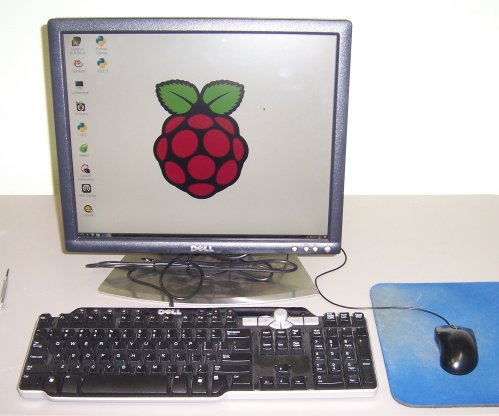
I wonder how many Raspberry Pi boards will spend their entire working lives sitting cockeyed on a desk somewhere, at the center of a tangle of cables. That’s how mine was until a couple of days ago, when despite my cough I allowed myself a few minutes of quality screwdriver time to pull a proper RPi system together.workstation-500wide.jpg

It didn’t take much. Mostly what it took was a 2004-era Dell SX270 all-in-one system minus the SX270, which I now use as a bookend. The key component is a heavy stainless steel base with a VESA monitor mount and a bracket to hold the SX270 behind the monitor. The monitor itself is an unexceptional Dell 1704fp, with a native resolution of 1280 X 1024. (Those now sell for ~$50 on eBay.) That’s more than enough pixels for an RPi, although I tested it on one of my 21″ 1600 X 1200 behemoths and the little gadget did quite well overall.

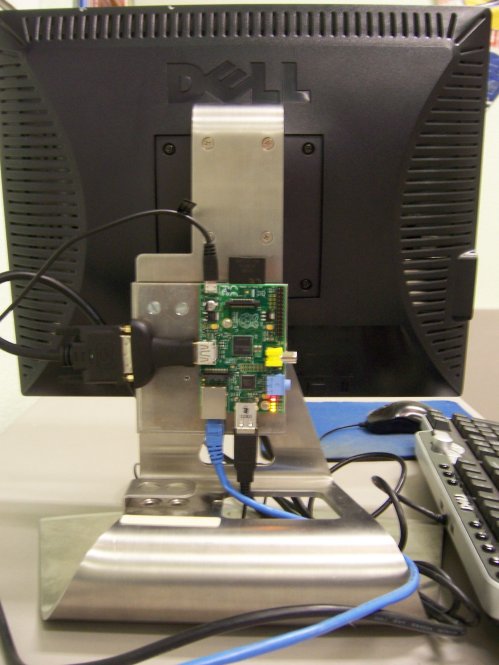
BackView-500wide.jpg

I had already mounted the board on an aluminum plate, and all I had to do this time was drill two holes and bolt the plate to the SX270 mounting bracket. I may dress the wires a little to keep them from placing any torque on the connectors, but it works well as-is.

I was surprised to find out that the MagPi magazine is actually laid out on an RPi, using the open-source Scribus layout program. I installed Scribus via apt-get and poured some text into a layout. (I’ve been playing with Scribus for years.) Brisk! I guess we need to stop boggling at the capabilities of tiny little computers with all of two ICs on the mobo.

It certainly does a good job with FreePascal and Lazarus, which is why I went to all this trouble. They’ve now sold half a million of these things. At least a few of those people ought to be willing to buy a Lazarus tutorial for it. We’ll see.

CS2 Flies In From Adobe’s Left Field

Colds are like…well, you know what colds are like. Right now, everybody has one. I’ve been climbing out of this one now for about six days, and the top is not yet in sight. At least my flu shot worked, or I could have been in lots worse shape. If I’ve been quiet, that’s most of it.

But something remarkable happened yesterday that still has a lot of people scratching their heads. Michael Covington and several other people alerted me to the fact that Adobe had opened a download link to an installable instance of Creative Suite 2 that didn’t require activation. Rumors were thronging like Illinois mosquitoes that Adobe was just turning it loose. This is outside of type for them, let’s say.

The truth is subtler: Adobe is shutting off CS2’s activation servers, and once it does, people who have legitimate licenses to CS2 will not be able to reinstall it after a hard disk crash or whatever. So they’re providing an activation-free instance to those customers.

Why, then, did they put the download links to the installer files right out where anyone could see them? The links have been live for several days and were still live this morning, though the server has been choked here and there by activity that suggests more than just CS2 atavists clicking on the links. One would expect at very least a requirement for users to log into their Adobe accounts to get the install suite, but not so. Any code monkey could suggest four or five other ways to do it that would not present all of CS2 on a platter to the whole world.

Adobe insists that they’re not giving CS2 to everybody. So what’s really going on here? I’ll hazard a guess: They’re afraid of the Gimp, and to a lesser extent, Scribus. I think they’ve been afraid of both programs (and a scattering of others) for a long time. At some point, a bean counter probably did some spreadsheeting and realized that activation support on a long-tail product isn’t worth what it costs, and told the techies to shut it off and send the phone reps home.

Faced with that decision, somebody there may have gotten clever enough to realize that people were leaving the CS plantation for cheaper realms. The Gimp is good enough for most Photoshoppish work, according to people I respect, and if I didn’t already own InDesign 2.0, I’d probably be laying out books in Scribus. I think Adobe may be quietly trying to get more people hooked on the CS product, which is a huge revenue-generator for them. Photoshop is probably the most pirated non-OS in software history, and I wonder if they’re just making CS2 easier to pirate and looking the other way to pull a little pressure off CS6, while allowing the curious to give Creative Suite a go. There are legal reasons why they won’t admit to a strategy like that. Furthermore, as many have said, never attribute to cleverness what is better explained by incompetence. It may just be a booboo. If it is, it’s one of the longest-lived booboos of its sort I’ve ever seen.

I won’t post the link here, out of respect for Adobe’s copyrights. Trust me, you won’t have to flatten your nose to find it. I have only one more point to make: I’d like to buy that software. Yes indeed: Adobe, I’ll give you money! I won’t pay several grand for CS6. But I’ll pay a couple hundred for CS2. Alas, the product is not for sale. So what could be a revenue generator for Adobe is just another gift to the pirates, with people like me who’d like to remain legal looking on enviously.

I respect their copyrights. But still. Dumbasses!

Odd Lots

Out, Out, Damned 2012!

I think we misunderstood the Mayans. (Like that’s hard?) They weren’t talking about the end of the world. They were telling us to hang in there: The end of 2012 was at hand. I’d drink to that, and tonight I probably will.

Boy. I’d like to wash this year right out of my hair–and I don’t have a whole lot of hair.

I had had high hopes of relaxing on the shores of Lake McConaughy with a kite string in my hand and one foot in the water on the day I turned 60, but no: Damfool Colorado had to catch fire. Jimi Henton fled to our house with all her dogs (and two of ours) when the smoke got too thick at her place, and while no one we knew well was injured or lost their homes, it was a near enough thing, especially having seen it on the news from 1100 miles away.

Deaths and serious illnesses continued to whittle away at my circle of friends. A lot of that simply happens as you climb into your sixties, but that doesn’t mean I have to like it. It was unnerving to check the Facebook page of a woman I knew in college, only to find that she had died over a year ago. Other good friends had open-heart surgery, cancer surgery, and lesser but nonetheless confounding failures in the meat-suit machinery. Indeed, I had a few of my own.

Then of course there was the tribal hatefest we call elections, when people I thought I knew gave themselves over completely to a species of slobbering, eyes-rolled-back-in-the-head rage against The Other that was terrifying to behold. This is the way that genocide begins, and I was under a pall until it was over. Even then, it took weeks to shake off the depression. And even now, there are a few people who simply will not let it go. It’s a psychological truth that I originally found in Colin Wilson’s writings: Once we grant ourselves permission to hate, it feels good and is devilishly hard to give up.

I know it makes me sound like a crank, but maybe it’s a cause worth cranking on: We must stop this national orgy of partisan hatred.

I guess there were some upsides to 2012. I finished my first full-sized novel since 1999, and only the second I’ve done since high school. My nephew Brian proposed to his beautiful girlfriend of many years, Ali, and we have a big-bash wedding to look forward to next September. I gave my accumulated hoard of Lego to our nieces Katie and Julie, and they’re loving it. I continued to be startled by the richness to be found in loving Carol, as I have now for 43 years. (I’m fond of saying that I fell in love with her half an hour before I even met her.) QBit still jumps into my lap whenever he can. I’ve made new friends (particularly in my Thursday night writing group) and rekindled my love of Pascal programming, now that Lazarus is ready for prime time. We threw a couple of nerd parties that people are still talking about.

2012, bleahhh. I’m going to go downstairs and watch a movie with my forever girlfriend, and toast to Lady Julian with a glass of Roscato wine and a slice of Lou Malnati pizza. Hope heals. Stomach lining regrows. Scar tissue means that you weren’t hiding behind the couch the whole time.

Cut to the chase: All manner of thing will fersure be well. But man, the bottle of Advil is empty.

SATA as the New Thumb Drive

I’m giving a webinar next month to a publishers’ group on the challenges of ebook piracy. So I’ve been taking notes and making sure that things haven’t changed much over the past year. One thing that surprised me a little came through on the backchannel (that is, email comments from people who for whatever reason don’t want to use Contra’s comment system) in June, concerning the resurgence of “sneakernet” piracy. I posted a link to a piece on TechDirt indicating that only 15% of music acquisition is done through all P2P technologies together. The bulk of piracy happens between friends, off the Net, where Big Media can’t see it.

What’s interesting came in through a backchannel correspondent whom I didn’t know and haven’t heard from since: Much or even most of the in-person file trading is done by treating entire high-capacity SATA hard drives as thumb drives. He saw my post on the Thermaltake BlacX case with a 2-drive SATA toaster dock built into the top panel. He has one too and wanted to see how common they were. He and his friends swap files by copying entire SATA drives onto blank drives via toaster docks, whether built into cases or standalone. I’ve had a 1-slot Ineo toaster dock since 2010, but it gathers dust now that I have the BlacX. I do my monthly off-site backups by copying everything onto a pair of 750 GB SATA drives using the docks on the top of the BlacX. I keep the backup drives in plastic flip-top cases made precisely for that purpose.

The correspondent (known only as “Don”) pointed out that there are now 2-slot standalone toaster docks that can clone drives from one to another without requiring any connection to a computer. Here’s one example (which even looks like a toaster!) and another. They’re evidently sector copiers and do not send files individually through a file system. Don and his friends get together and watch movies while popping SATA drives into and out of the docks.

I asked him if the drives ever fail by being plugged and unplugged so often. After all, internal SATA connectors are rated for only 50 matings. (ESATA connectors are rated for 5,000.) He hasn’t seen it happen so far, and if it happens, new drives are only $60-$80.

My experience with thumb drives goes the other way: I’ve had more USB ports fail on me than thumb drives. SATA drive connectors are really just etched PC board edge connectors, which can get scratched or dirty. (This is one reason I keep my SATA backup drives in plastic boxes.) I think with careful handling, drives should go a lot longer than 50 plug/unplug cycles.

Every time I think piracy can’t get any scarier, somebody comes along and says “Boo!” even louder. I keeping wondering what’s next. My hunch: Seedboxes, which still don’t entirely make sense to me. Once I figure them out, I’ll report back in this space.