Jeff Duntemann's Contrapositive Diary Rotating Header Image

The Five Minute Electrostatic Charge Detector

ChargeDetector500Wide.jpg

I’ve been building electronic gadgets for almost fifty years, and I don’t think I’ve ever managed a working five-minute project before. If the photo above shows a slightly random assembly style (I’m typically more artful, whether or not the circuit requires it) that’s because I wanted to complete it in five minutes.

I did. And it works. When I snapped the picture, I was holding my hand about six inches from the gate lead of the MPF102. When I pulled my hand back about a foot or so, the LED went out. If I scuff around my static generator of an office, it “sees” me even two or three feet away. The sensing “antenna” is nothing more than the gate lead of the FET, left loose in mid-air. A short scrap of wire three or four inches long would have increased the range greatly.

The circuit came to me from Bill Beaty, who posted a comment with the link to my February 18, 2013 Odd Lots entry. It consists of an MPF102 JFET, a generic red LED, and a 9V battery plus its associated connector. I lashed it up on a scrap of perfboard with a total of three solder joints. Bill found me because of this post, to an old Popular Electronics electroscope project using a 6J7 tube instead of an FET. (They didn’t have MPF102s in 1961.)

Sure, it’s a stunt, but I was in a stunt mood. Remember, if you try this and it takes a little more than five minutes, that I’m good at this stuff, and had gathered all the parts to my workbench before starting the clock. And clock it I did: the stopwatch said 4:39 when I snapped in the battery, leaned toward the gate lead, and saw the light come on.

I’m still considering a tube-based device using some sort of neon light more exotic than an NE-2. I’m considering an NE-34, and would have had one by now if they didn’t cost so much. Or an Aerolux bulb, if I’m feeling Art Nouveau-ish. Those cost even more.

I can feel my resistance crumbling. Remember: It’s futile.

Odd Lots

  • Carol and I are now home from Chicago, still bumping into walls but doing better. If you haven’t heard from me in a couple of weeks that’s why.
  • Chicago burned on October 8, 1871. The cow did it, right? Well, there were a lot of other serious fires around the American midwest that same night. Tucking my ears into my tinfoil hat here: What if a cluster of biggish small meteorites hit the country that night, sparking fires wherever they fell? The more Russian dashcam videos I see, the less outrageous I think the idea is. (Thanks to Michele Marek for the link.)
  • And for people who say that the Russians seem to attract meteorites, look at this. I’d say The Curse of the Splat People has been laid upon northern new Mexico.
  • Why am I so fascinated by the Neanderthals? Aside from the fact that I may well have a Neanderthal-ish skull and ribcage, it’s hard to beat our big-brained, musclebound brothers for idea triggers. I had never considered Taki’s startling question: Would they vote Republican? Or would they just tear your arm off for asking? (Thanks to Bruce Baker for the link.)
  • Search Google Patents for Edward F. Marwick, and you will find 205 different patents filed by my very own late high school physics teacher. He told us about a few of them (like this one) in 1969. We thought he was kidding. The man was a damned good physics teacher, and he thought big.
  • Bill Beaty posted a comment on Contra for my September 7, 2011 entry describing a very simple solid-state equivalent using an MPF102 and a 9V battery. A full description is on his site, and it’s worth seeing if you have an unscratched itch for a half-hour project.
  • I think I aggregated the Steampunk Workshop before, but it’s worth mentioning again. Beautiful stuff, startling craftsmanship. Like this Mac Mini mod. Wow. (Thanks to Bill Cherepy for pointing it out.)
  • Carol and I had to cancel our entry of Dash and Jack in the big Rocky Mountain Cluster dog show for obvious reasons, but one of our Bichon Club members posted a wonderful video of her seven-year-old son Adam showing their puppy, Ruby. Ruby and Adam got a blue ribbon. The kid is amazing. Sheesh, when I was that age I was still throwing mushrooms at my sister at the dinner table.
  • I guess this was inevitable, at least in Washington State and/or Colorado. I suppose the research is useful. (Thanks to Frank Glover for the link.)

Delores Ostruska 1924-2013

1948_07_Clam Lake_Scan17-500Wide.jpg

Carol’s mom has left us. She died quietly this past Saturday after a long illness, at a nursing facility near her Crystal Lake, Illinois home. Her daughter Kathy was by her bedside, and her two grandsons Brian and Matthew had visited her earlier that day. She was 88.

Most people in our time are lucky to have two loving parents. Somehow, incredibly, I had four. I met Delores on August 2, 1969, when I came by their house to pick up Carol for our first date. I was 17, a little scruffy, and undoubtedly, well, odd. No matter. Delores smiled and welcomed me, a welcome that never faded. Carol’s dad was a slightly harder sell, but I won his esteem by treating his daughter with respect and kindness. When I bought a lathe in 1977 he stabled it in his basement, and over time he taught me what he knew about its use, which (considering that he could grind a carbide die to a ten thousandth of an inch accuracy) was pretty much everything.

On many Sundays Delores prepared family dinners for which her sisters Marie and Bernice and her Aunt Marie and Uncle John drove up from the South Side. Pork roast, salad, vegetables, bread, dessert; a huge spread brought to the table hot and perfect in all ways. I had a place at that table, as later on Kathy’s boyfriend/fiance/husband Bob did as well. It was decades before I knew the term for the feeling that hovered all about us in Delores’ dining room, but when I found it, many things fell into place. It was unconditional love.

I had had that from my own parents, of course. And even my own father was a bit of a hard sell, since I bore little resemblance to the rowdy boy that he himself had been and expected his own son to be. All the more remarkable that Delores and Steve embraced me almost immediately as one of their own.

Delores was a child of Polish-American heritage, youngest daughter of a large family, who was born and grew up on the Near South Side of Chicago. She belonged to a group of very close teen girlfriends who called themselves The Comets. They were capable and confident girls, journeying around the city for fun, and even slept on the sand of Chicago’s 31st Street Beach. She quietly rejected the dour Polish pessimism of her own parish church, and far preferred the exuberant Catholic culture of an Irish parish a few blocks away. She believed all her life in an infinitely loving God and the goodness of all His creation. When I began struggling with my own life of faith at the dawn of middle age, it was her example that helped bring me to the unbounded and unshakable Catholic optimism that I hold today.

Delores worked at the US Treasury in downtown Chicago, where she helped trace lost and stolen US Savings Bonds. During WWII she met and in 1947 married Steve Ostruska, one of her brother Charlie’s Navy shipmates. After Carol was born the family moved to Niles, Illinois, where Delores lived for over forty years before moving in with her daughter Kathy in Crystal Lake.

Every summer while the girls were small the family vacationed along the lakes near Hayward, Wisconsin, where Steve fished for walleye and city girl Delores learned to love the outdoors. The photo at the head of this entry is from a vacation that she and Steve took to Clam Lake in July 1948. It’s not fair to picture her as an elderly woman when she has already broken the bonds of this Earth and risen triumphantly into the arms of the God she so strongly believed in. I prefer to recall her as the beautiful, vigorous person she was most of her life. In truth, all the time I knew her she glowed wth the quiet, invincible light of unconditional love, and if there’s anything closer than that to the ineffable light of God, I don’t expect to see it in this world.

Odd Lots

Sledding in January–on the Quadcore

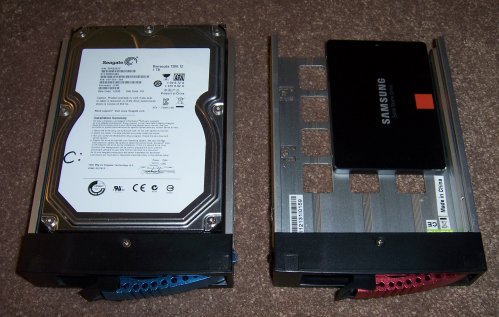
Drive Sleds-500 Wide.jpg

Having had a certain amount of trouble with keeping multiple OS images on a single drive, I’ve been looking for a reliable way to pop a bootable SATA hard drive into my quadcore. The goal is to have one OS per drive. Drives smaller than 128GB are fairly cheap, and drives 80GB or smaller are dirt cheap. The challenge is purely mechanical, and I think I’ve got a line on it: the IStarUSA T-7M1 mobile rack. It can be had in a number of places, including Newegg and Amazon. About $35. It’s a full-size SATA drive holder that contains a removable sled to which the drive itself is bolted. The sleds themselves are available separately, at about $15-$20 each. They come in several different colors, including silver, blue, black, and red.

In use, the drive can be spun down while the machine is operating, or you can wait until you power down the machine as a whole before popping a drive and tucking a new one in. (That’s what I do. The Windows feature allowing hot-swapping of the drives slows down drive throughput, or so I’ve read.) I’m currently in the process of building a new Windows image on a Samsung 120GB SSD, and being able to swap sleds between my current image and the new image means I can take my time and do it right.

The only serious question about this is how many times the SATA leaf connectors on the backs of SATA drives can be cycled without compromising them. The SATA spec says 50 times, which does seem low but is probably conservative. The truth is that I don’t think of these as bigger thumb drives and won’t be yanking them anywhere near as often. Although I occasionally boot into Linux on this machine, I have a dedicated multiboot Linux box in my shop. I doubt I’ve gone into Linux here since last fall. Also, I have a case that contains two toaster-style SATA slots on top, and I’ve been using them for monthly backups since last summer without incident. A backchannel correspondent who swaps files using a BlacX case like mine says the danger is overrated. He’s had drives in and out of various docks well over 50 times and the drives still work perfectly. Even if I plug drives in monthly, I still get 5 years of backups without going beyond the spec. That’s more than good enough for me.

I’ve wanted to try an SSD for a couple of years. My reaction so far is that software comes in quite a bit faster from an SSD, especially the first time after boot-up. And with one less motor spinning, the machine is mildly but noticeably quieter. (I don’t have an outboard graphics card, and the case stays quite cool with only a single 120mm fan running.)

I’ve got a couple more evenings of configuration to do on the SSD image, but after I’ve been using it awhile I’ll post my impressions here. So far, the sledding has been fine.

Odd Lots

Hypothesis: Reason vs. Anger

I’ve been developing a hypothesis in the back of my head for some time now:

Evolution developed anger as a countermeasure to reason.

That anger and reason are forces in opposition is obvious to anyone with an IQ over 75. That’s not what I’m talking about. What I’m trying to explain is how anger came to be. And with so much else in my recent research, it all comes back to tribalism.

We evolved from killer apes, and from killer apes we inherited a peculiar but very effective survival mechanism: the tribe. Tribes are an interesting piece of biological machinery. They’re actually genetic amplifiers for what we now call “alpha males,” and the idea is to select for the genes of the meanest badasses in the neighborhood, so to better compete with the badasses living on the other side of that hill over there.

While we were killer apes and primitive hominids, it worked very well. Evolution is always trying new things, however, and a few tens of thousands of years ago something new appeared: abstract thinking. On an individual level it was a big win. Hominids who could think their way through a sticky situation would leave more children than hominids who just followed their killer ape instincts. But on a group level, it tended to erode the much older tribal mechanism. Let me demonstrate what I mean with thirty seconds of drama:

[Foot Soldier:] Boss, out on the front lines, we’ve been thinking. Ten of our guys took a spear in the guts this week alone. The yukfoos have some newfangled spear-thrower thingie that works way better than bare hands. If we keep this up sooner or later we’re going to run out of foot soldiers.

[Tribal Leader:] Nonsense, my friend! The yukfoos are pure evil! If we don’t fight them to the last man they’ll steal our women! They’ll steal our food! They’ll slit our throats! They’ll destroy everything we stand for! Get out there and kill! Kill! KILL!

[Foot Soldier:] Yeah, I keep forgetting! Arooo! Ngrglar! [Runs off waving spear.]

[Tribal Leader:] Damn, that was close. [Turns.] Hey, Jeeves, run down to the village and drag me up a woman, willya? See if you can find one I haven’t had in awhile. If her husband objects, just slit his throat. Oh, and if anybody down there has any meat, grab it while you’re at it. Cut off a chunk for yourself if you want, but bring me as much as you can. Man, I haven’t eaten for an hour and a half!

[Exeunt omnes.]

There’s nothing worse than tribal foot soldiers who begin to think about their situation in the abstract. They might just quit the game, run off and start a new tribe somewhere else, or possibly sneak back with one of the yukfoos’ spear-throwers and nail the tribal leader through an eye socket. This would bode poorly for the continuing success of the tribal mechanism. So the blind watchmaker tries lots of things, and what works is a way to amplify tribal loyalties and cloud the emerging rational mind. This new countermeasure is anger.

From my readings in ethology and anthropology, it seems like anger is a fairly recent tool in the kit compared to the tribal mechanism. Animals seem blase about killing, as do most of the newly contacted primitive tribes that Jared Diamond studied decades ago. It’s very much a “nothing personal, Mac” kind of thing. What we call psychopaths may simply be throwbacks. They don’t get angry. They don’t even get worked up. When they feel so moved, they don’t think about it. They just kill. The possibility that they themselves may die in the attempt doesn’t seem to bother them.

Anger makes it possible to bypass abstract thinking in ordinary people and make them do stupid and damaging things, ideally directed against other tribes. It can be triggered by a number of things, sexual jealousy in particular. Still, nothing seems to rev it like the notion of Us vs. Them.

Killing members of other tribes is now illegal in the developed world, but tribal leaders still stoke the fires of tribal anger to keep their omegas outward-facing and loyal, and damaging opposing tribes whenever possible, through the ballot box if not through the eye sockets. The end result is that the tribal mechanism remains very much alive, and very much at work transferring wealth and sexual opportunity up the turtle pile to tribal leaders at the top. Why anybody plays the game is a puzzle, unless it really is genetic and those who do it really can’t help it.

Note well that this is a hypothesis. I’m not a sociologist, psychologist, or anthropologist, and I have no idea how one proves such things. I’m guessing it can’t be proven at all. But man, that’s how it looks from my window.

Odd Lots

  • Cisco has sold their Linksys home-router business to Belkin. I’ve used Linksys gear for ten years now, know it well, and like it as much as I like any given brand. Getting it out of Cisco’s hands, where it had languished, is a good thing.
  • From a long-time Contra commenter I know only as bcl, here’s a very detailed technical review of USB chargers, which are not all the same based on equal output specs.
  • I’m trying to figure out what Ten Gentle Opportunities is “like” (a comp, I think they call it) and have asked those who’ve read the first draft. Someone recommended Piers Anthony’s Apprentice Adept series, which I’ve never seen nor heard of. Will begin looking for copies in local used bookstores.
  • IBM is perfecting an anti-microbial gel that they claim bacteria cannot develop resistance to. IBM. God love ’em–because the way things are going, we are gonna need this, and need it bad.
  • Then again, IBM also says that Steampunk will be the next big thing. Wait a minute. I thought Steampunk was the last big thing. (Thanks to Bill Cherepy for the link.)
  • I’m getting recommendations on surplus dealers I’ve never heard of from all corners. Here’s Twin Cities retailer Ax-Man Surplus, courtesy Lee Hart.
  • Lee also passed along the sad news that Glenwood Sales in Rochester NY, where I spent a great deal of money 1979-1984, is no more.
  • Pete Albrecht sent word of C&H Surplus in Duarte California. I used to have a print catalog from them and it vanished somewhere along the way, but the firm exists and sells mostly industrial surplus (motors, fans, compressors, etc.)
  • I stumbled on a nice free wallpaper site while looking for wood texture images, and there’s a lot of very good stuff there. That said, the single picture they have of a bichon is awful.
  • Bill Cherepy sent a link to a Steampunk workspace. Looks cool. As with most Steampunk keyboards, it looks uncomfortable. Love the tube amp, though it’s not really Steampunk. He needs a new (old?) mouse.
  • Sex with Neanderthals may have ram-charged our immune system and in other ways made us stronger. Genetic diversity is always good. And I’ll reiterate here that I have serious doubts about Homo Sap wiping out the Neanderthals. I think the Neanderthals wiped themselves out. Tribalism is fatal. Make sure your loyalties are diverse. Never throw poop at other tribes. Throw it at your own tribal leaders. If you can’t do that, well, you’re pwned.
  • Cats with jet packs…in 1584. Except I don’t think it’s really a jetpack. Given the bird’s unnecessary jet pack, I suspect that they are acting as living firebombs. The past sucked. I’m glad I’m here.
  • We’ve had a so-so winter so far; could use more water coming out of the sky. However, it’s about to get cold again. Perhaps I could use one of these. (Does anybody else flash on H. R. Giger looking at that damned thing?)
  • There are certified zombie shotgun shells. Haven’t seen Bigfoot flip-flops yet, though.

The Adobe CS2 Copyright Conundrum

People have mostly stopped talking about the link page that Adobe exposed a few weeks ago, allowing the download of an activation-free copy of the entire Creative Suite 2. The page is still there, still wide open, and you no longer even have to sign in to your Adobe account to get it. What they’re up to remains unknown, though the firm has said many times and in many places that the downloads are for customers who already own the software. Adobe turned off the CS2 activation servers late last year, for reasons that remain unexplained. I’m thinking that they did the math and realized (duhhh!) that activation has its costs, and just cutting off paying customers who legitimately need to reinstall will only make those customers hate them, and very likely turn them into pirates.

I’ve said this for years: There’s no better way to teach honest people to be pirates than by “grabbing back” the use of content (software, ebooks–1984, anybody? music, anything) that they’ve already paid for. It’s untested in the courts as best I know, but to me this is very clearly fraud.

So the mystery remains. This morning, a backchannel friend (“backchannel” means email or texts relating to something on Contra) pointed me to all the original used copies of CS2 that can be had on eBay for as little as $40 or $50. He asked if it would be legal to buy one of those copies, which are original CDs in their original packaging, and then download the activation-free images from Adobe and install them.

Good question, and with a lot of questions pertaining to copyright, subject to interpretation. Big software firms have furiously fought the First Sale doctrine on software, and have pretty much won on products that are pure downloads without any physical media. They can deny activation on used software, and claim that it’s their right to do so. Adobe is very fussy about transferring ownership of their licenses, which is one reason I have not upgraded my 2002-era copy of InDesign 2.0. I consider this a sort of “hardass tax” that firms like Adobe seem willing to pay: They don’t get money I would gladly pay for an activation-free product.

Here’s the real question: If I have the original physical CDs for CS2, is my use of the activation-free download images legal? I don’t know. Could Adobe come after me (or anybody else) in court for doing so? There is some way-thin chance that they might, but it would open the gates of Hell upon their heads.

Will I try this? Still thinking. When I come to a decision I’ll let you know.

The Surplus Survivors

I’m trying to clean up the shop a little and free up space, and one of the places I need space the most is in my file cabinet. I’ve been accumulating catalogs for electronic parts and equipment for years untold, and each gets a folder in the top drawer, so that invoices and catalogs can live together. (I want to know what I ordered from who, when. The system works well.)

So I asked myself a week or two ago, How many of these firms are still in business? I began looking them up on the Web. An amazing number are still out there and still selling parts and odd junk like they were back in the 90s. Here is a list of the survivors so far:

There were, of course, some casualties:

  • Brigar Electronics, Binghampton NY.
  • Burghardt Amateur Center. Still there, but now a repair shop only.
  • Classic Radio, Houston.
  • DC Electronics, Scottsdale. Sold to Philmore.
  • Edlie’s Electronics, Levittown.
  • Fertik’s Electronics, Philly. Leon was a character. Appreciation here.
  • Ocean State Electronics, RI. Flood apparently did them in.
  • Two Fox Electrix, Tivoli, NY

I didn’t list firms that vanished prior to 1990. I used to order lots of stuff from Poly Paks in the 70s, but they’ve been gone a long time. Ditto Tri-Tek, with their embarrassing mascot Amp’l Annie. Nor am I counting the manufacturers’ distributors like Mouser, Digi-Key, and so on. The file drawer has folders for tool vendors, wood products dealers, and non-electronics firms of many sorts, which also had winners and losers that I won’t tally here. (Many of you may know that Small Parts, Inc. has been bought and converted to Amazon Supply.) A number of used book dealers I bought from regularly in the early 1990s are, not surprisingly, gone. One survivor in that category is Bequaert Old Books, which I knew as Rainy Day Books in the early 90s and heartily endorse, especially for old ham books and “boys'” electronics and science books. Frank survived by moving his sales fulfillment to AbeBooks, as the others did not.

The upshot is that the file drawer isn’t a great deal emptier than it was yesterday. I’m good with that, since some of these firms (like Playthings of the Past) are very nearly the sole source for certain items. What I marvel at is how long some of these companies have been around, and how well they’ve weathered our near-constant recession since 2008. The Web helps. Print catalogs and postage are expensive. The good news is that there seems to be enough people like me to float a quirky industry that looks like everybody’s picture of a hoarder’s basement. As grim as these times may be, there’s always something worth celebrating!