- I got FreePascal and Lazarus installed on my Raspberry Pi using apt-get. Instructions here. (It’s trivial.) Alas, it’s not the current release, but a chap has posted notes on how to install Subversion on the Pi and recompile Lazarus from source. One caveat: The Pi has just barely enough memory to pull it off, and then only if X isn’t running.
- One interesting thing that I had not heard about and did not expect is that the Raspberry Pi has its own app store.
- There is a Raspberry Pi magazine, MagPi. It’s a free download (either HTML or PDF) and from the couple of issues I looked at might be worth your time if you’re a Pi guy.
- One interesting part of this Pi project is the 3D-printed case. The other is hot-wiring a SATA SSD into a USB hub for additional storage beyond what you can put on an SD card.
- Speaking of which: SSD prices are starting to go through the floor. I just ordered one and am about to see what it can do on my primary machine.
- Ditto e-readers, apparently: The Kobo Mini is now going for just $50. I’m impressed by the fact that they make no attempt to lock users into their reader. Sideloading can be done via USB link; there’s no card slot. How good their store is I have no idea.
- There seems to be evidence that obesity is influenced by gut bacteria. I would take this article a lot less seriously if if weren’t well-established that bacteria cause stomach ulcers. Obviously, it’s not the whole story, and more research is needed. My conviction that calories don’t count remains intact. It’s the kind of calories that matter, since everything depends on how the body processes them. (There are lots of calories in sawdust. Eat 3000 calories worth of sawdust a day and get fat? Try it and see!)
- Robert Lentz has drawn an icon of Albert Einstein. And Prof. Tolkien. Way cool. Now, can we have Origen too?
- The K-Cup coffee maker patents expired this past September. We have a machine and it’s handy, though my #1 favorite coffee isn’t available in a cup. Expect an explosion in K-Cup options come the new year.
- From the Please-Find-a-Proofreader-Right-Freaking-Now Department.
- Wow. They gave an End of the World, and nobody came!
Odd Lots
Pi, Oh My

My longtime friend and collaborator Jim Strickland has had a Raspberry Pi board almost since the beginning, and he startled me by handing me one as a Christmas present. I was aware of it but hadn’t researched it deeply. Here’s a good place to start if you’re new to the concept.
Basically, it’s an ARM-6 board with HDMI and composite video output, two USB ports, and a standard RJ45 Ethernet connector. For disk it uses an SDHC card. There’s an I/O header for connecting to physical gadgets like relays and lights and things. There’s more than one OS available for it, but most people use the adaptation of Debian Wheezy called Raspbian.
I don’t like having circuit boards flopping around in mid-air, so I drilled and tapped two 4-40 holes in a husky 3/16″ aluminum plate and mounted the Pi on a pair of 3/8″ nylon standoffs.
Putting it together was a snap. I downloaded the Raspbian image file, wrote it out to a spare 8 GB SDHC card I had in the drawer with Image Writer for Windows, plugged the card into the card slot on the board, hooked up the cables, and turned it on.
Bootup isn’t snappy, and the first time in you have to set a few things like time zone, but in a couple of minutes I had Linux on my big-screen LED TV. The small black item connected to the USB port block in the photo above is the Bluetooth dongle for a Logitech wireless keyboard and mouse. This leaves me a port free for something else. Ethernet came to the device through a pair of Linksys Powerline bridges, which I’ve described here before.
I now have what Michael Abrash would call “Linux on my bedroom wall.”
This particular distro comes with Python and Scratch preinstalled, but Jim’s already gotten the ARM-6 port of FreePascal/Lazarus downloaded and running. That’s next on the list for me. I’ll wrestle with that another time, as it’s getting late here. I have a special purpose in mind for the gadget which I won’t spill just yet, since it may not be realistic. More as I learn it.
Odd Lots
- Making you fat and diabetic is the least of it: Sugar (especially fructose) sabotages your brain. If it’s your first favorite organ (as it is for me) put your brain at the top of your personal food chain. Be a caveman: Eat more animal fat and less sugar.
- Eat more fat and less sugar, but do it this way: Trade sugar for sleep. Lack of sleep makes you hungry, and I’m guessing that chronic lack of sleep makes you lots hungrier than you would be if you just admitted that you can’t get by on six hours or possibly even seven. Cavemen slept when it got dark. Dark is your friend. (Thanks to Jonathan O’Neal for the link.)
- While we’re talking Inconvenient Health Truths, consider: The downside of demonizing salt is that people have begun to show symptoms of iodine deficiency. (I myself am…unlikely…to ever have that problem.)
- Instagram walked back from the cliff and withdrew its mind-boggling policies on commercial use of user photos without permission or complication. The Internet firestorm was one reason, I’m sure…but I’m also guessing that someone in their legal department got the message through that the firm would be sued into subatomic particles if it went ahead.
- I wasn’t aware that a sack of potatoes stands in well for a human being in Wi-Fi tests on networking in crowded spaces like aircraft cabins. I do wonder what happened to the potatoes.
- “Thorium” is my answer to the question of how to best reduce CO2 in our atmosphere. We need base load; wind and solar are necessary but not sufficient.
- There are at least five planets orbiting SF favorite Tau Ceti, and one may be in the star’s habitable zone. What the article does not mention is that the habitable planet is considerable closer to its star than Earth is to the Sun, and at a distance closer than Venus is probably tidally locked on its star. That’s not a dealbreaker, but tidal locking certainly makes the journey from slime to sublime a lot less likely.
- My ongoing (and slow-going) project of rewriting Borland Pascal from Square One for FreePascal continues, and there’s a new and expanded PDF up on my FTP site. 9 MB. 180 pages done out of about 350 or 400 planned. Not all 800 pages of the original book will be included, because some of it is now mostly useless, and some will be kicked upstream to a Lazarus book that I’m planning.
- FreePascal contains a clean-room clone of Borland’s TurboVision, which I actually named way back in 1989. (Its original name was TOORTL: Turbo Object-Orietnted Runtime Library.) I’m going to recompile my Mortgage Vision application in FPC with FreeVision and see if it still works. That is, if I can find the source…
- We’re getting our Mayans, Aztecs, and Oreos mixed up. Actually, I read the oreoglyphics on the cookie and it said that the world will end in 1947.
- Furthermore, it’s a lot tougher to dunk a Mesoamerican stone calendar in your coffee.
Does Steampunk Really Humanize Our Gadgets?
Bill Cherepy (and a couple of others since) sent me an interesting link to a piece on Boing Boing arguing (I think) that steampunk makes our gadgets more human. It’s a headscratcher, since I don’t think the article text supports the author’s contention. However, it’s an idea worth some thought. I actually agree, if for different reasons:
- Steampunk gadgets are comprehensible. Most of the tech in our modern phones and computers is black art, even to guys like me with considerable background in electronics. Electric, mechanical, and chemical tech circa 1900 was accessible to anyone with an ounce of brains and some willingness to study.
- Steampunk gadgets are reproduceable. At home. In your basement. Sure, it would take a little research and pratice, but with nothing more exotic than a lathe and basic chemistry gear you could build most of what we connect with steampunking. Dare you to do that with an iPad.
- Steampunk gadgets are personal. This is going to earn me some heat, but I think it’s true: Steampunk thingies are in-your-face, not on-your-friends-ist. One of the charms of the steampunk idea is that people interact face-to-face. This keeps trolling to a minimum and fosters at least superficial courtesy, which certainly beats the slobbering hatred that now dominates Facebook.
All that said, I admit that the majority of what I see under the heading “Steampunk” is a species of fantasy, be it of the supernatural (vampires and zombies) or just wildly off-the-edge assumptions of what 1900 technology could accomplish.
The big turn-off I found in cyberpunk was its coldness. Granted this was cultural and not really necessary, but when I played at the edges of cyberpunk years ago it stopped me in my tracks. Cyberpunk was cynicism writ large, and steampunk is optimism gone nuts. Given that cynicism is cowardice (it is, in fact, the fear and loathing of all things human) you can guess where I’m much more likely to tell my tales.
Odd Lots
- 32 years ago today, Darkel’s Lucky Guess–known to more than a few of you as Mr. Byte–came into our world, and eight weeks later Carol and I took home our very first bichon puppy. Although not show quality, Mr. Byte was a spectacular dog, and even seventeen years after his passing we miss him terribly.
- A study at Michigan State shows a strong correlation between use of multiple forms of media at once–e.g, watching TV while surfing the Web–and depression. We don’t know if multitasking causes depression, or if depressed people multitask to distract themselves, but simply establishing the correlation is a good first step.
- Now this is nothing less than brilliant: an app that examines a design destined for 3D printing and lets you know whether it will print well, or at all. 3D typos cost money, and it’s not always obvious looking at a design where a typo lies, or how serious it might be.
- Oh, and there’s a browser-based CAD system that was created with 3D printing in mind: TinkerCAD. Have not used it and generally don’t like browser-based software (what if I develop skills with it and then it goes away?) but it’s a niche that had to be filled.
- Colorado Governor John Hickenlooper has just signed the state constitutional amendment legalizing marijuana. As long as you’re not in a public place, using it is now legal under state law–which is, pardon the expression, mind-blowing.
- Only slightly less mind-blowing was the savaging that Rolling Stone gave Obama for not jerking the leash on the DEA. Wow.
- If the elderly–who have nothing if not life experience–are peculiarly vulnerable to scammers, it may be due to the failing of a region of the brain that acts as a “crook detector.” I agree: smug, smirky mouths are not the signs of integrity. Nor is the desire to run for office.
- Pete Albrecht sent me a link to a search site for locally grown food and farmers’ markets. We buy local when it’s possible (though we don’t make a fetish of it) and things like this can only make it more possible.
- Line up the cover spines on Wired‘s 20th year, and read the secret code.
- Lazarus 1.0.4 is out. It’s a bug-fix release, but bug fixes are good to have. I’ve already been messing with it, and I’m starting to think the product has really quite sincerely arrived. Get it here. Many components and demos available here.
Continuity Pass
I should never promise anything “tomorrow.” Most of the time, the universe conspires with itself to make a liar of me…as it did this time.
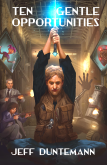
Anyway. I have just completed the second pass through Ten Gentle Opportunities. It’s what I call a “continuity pass.” The goal is to ensure that the story makes reasonable sense, taking particular care to repair “plot holes.” It’s not really a polish pass. In a very real sense it’s a tech edit, like those I used to do on magazine articles and still do on book-related material from time to time. Here are some of the things I watch for, and fix when found:
- People, things, or ideas introduced early in the story but never mentioned again. We all know that stories grow in the telling–but they also contract, and in doing so early elements sometimes get squeezed out. This is especially important in stories (like this one) that took a long, long time to tell.
- Things introduced later in the story that are not “foreshadowed” and thus may strike the reader as a complete surprise, or (worse) deus ex machina.
- “Jumps” in a character’s emotional state. Growth and change are important in characterization, and have to be done out where the reader can watch them happen. If a character changes too abruptly, or off where the change can’t be seen, it sounds hokey.
- General inconsistencies in the ways people and things are treated early on in the story vs. later in the story.
- Finally, to make sure that all the made-up words are spelled the same way throughout. (This isn’t trivial when the story contains proper names like Ttrynngbrokklynnygyggug and Jrikkjroggmugg.) I originally coined a lot of proper names from Stypek’s universe that had no vowels in them at all, but in workshopping chapters I found that nobody thought this was amusing but me. (Maybe I was a little too impressed with the famous 90’s gag about Clinton air-dropping vowels on Bosnia.) I went back and added just enough vowels to suggest a pronunciation.
There is still polishing to be done, and here and there some stiff rewriting. I simply don’t like Chapter 57, for example. I intend to rewrite it from scratch once I get a little emotional distance from the story. As it’s only 1200 words, the rewriting won’t take long. The rest of the polishing to be done involves watching for “echoes” (words used more than once a little too close in the manuscript) and probably eliminating some adverbs, though I think the current campaign against adverbs is a deranged fetish perpetrated mostly by bad writers and people who teach writing without writing much of anything themselves. Polishing is a separate pass and my next challenge. Much of the first half of the book has already been polished (I’m a compulsive polisher) so the pass won’t take long.
I’ve sent the story to my beta testers, and now I’m waiting to get some reactions. In the meantime there’s a root canal in my future this Wednesday morning. It’s nothing I haven’t known about for some time, and I’ve been through enough of them to have a reasonable idea what I’m in for. One peculiarity of my biochemistry is that the nitrous oxide gas used as a calming agent by some oral surgeons simply doesn’t work for me. The surgeon doing the procedure has an office with an interesting gimmick: flat-panel TV sets in the ceiling, so that while he’s drilling out your molar you can lean back and watch Raiders of the Lost Ark. As for the inevitable anxiety in the runup to a root canal, I suspect that ativan steps in where nitrous fails. We’ll find out on Wednesday.
Odd Lots
- Juggling, thing-throwing robots are a major theme of my newly completed novel, Ten Gentle Opportunities. It’s a good bet they’ll be deployed in Disney theme parks eventually. I’m not sure why, but I find this very depressing.
- I read this when it first appeared ten years ago and I still think it’s true: DRM does not and cannot do what it’s supposed to do. This from Microsoft, heh. I sure wish they’d quit trying.
- Here’s a good quick survey of Linux window managers, starting out by explaining the difference between a window manager and a desktop environment. (We don’t have this problem in the Windows world.)
- Smilodons and bear dogs somehow managed to coexist. What I don’t understand is how I lived sixty years without ever hearing the term “bear dog.”
- I dunno. This reminds me a little of Cold Fusion: We all want it desperately, but it just seems so damned unlikely. (Thanks nonetheless to Frank Glover for the link.)
- Facebook enforces a sort of least-common-denominator social behavior on people, and is thus stressful. In other words, everybody’s got a hot button, and if you have enough friends people will get pissed at you no matter what you say. The people who don’t care are probably the only ones who should be on Facebook.
- Not space-efficient, but very cool in its way: the Moebius clothes hanger. (Big question: If you buy two will they breed in the closet?)
- This is the heaviest thing that Amazon will ship for free. It weighs a ton. (Thanks to Glenn Reynolds for the link.)
- If you still have a Commodore 64 (or something like it) try this one-line BASIC program. Amazing.
- Yes, except that if I drink as much as I want, I wouldn’t sleep. (I barely sleep without drinking it at all.)
- Everything you didn’t really want to know about Gangnam Style and didn’t feel like asking. The funniest thing about the video is that it doesn’t go anywhere near the ritzy Gangnam area that it’s named for, though I would expect only Koreans to get that part.
- Oh–and the name of the dance that PSY and his gang are doing is (as best I can tell) “the invisible horse dance.” It’s a natural at weddings. Watch out, chicken dance–your days are numbered.
Explicit. Expliciat. Ludere Scriptor Eat!
This morning, almost three months late, I found myself writing the last words on the first draft of my novel Ten Gentle Opportunities. The final line (not counting the epilog, which I wrote months ago) is “Let’s talk.”
So let’s.
Back in 1980, as part of my programming job with Xerox, I was given a tour of the assembly line for the new model copier that my software system was tracking. It was a fascinating business. There was some automation but not a lot. Copiers-in-progress moved along a line, and people bolted/connected things to them, just like Model T Fords. Forklifts and electric carts were running around, carrying pallet loads of parts and subassemblies and lots of other stuff I couldn’t identify. At the end of the line there were ranks of completed model 3300 copiers, waiting to be tested and then plastic-wrapped for shipment. The building holding the assembly line was ginormous, and the interior space was fifty feet high or more.
Given the space it was in, the line seemed awfully, well, two-dimensional.
I’m not sure when I got the idea, exactly, but if the assembly lines of the future are going to be completely robotic, with few or (ideally) no humans standing around while the line is running, why carry parts around on carts? If you can make robot hands good enough to bolt copiers together, you can make robot hands good enough to pitch and catch. Sure, a baseball is an optimal case, but with enough compute power, you should be able to throw a circuit board, a subassembly, or a whole copier from one point to any other point on the floor. Damn, I thought, there’s a story in that somewhere.
The next year, I wrote it. The story was called “Paradise Lased.” It was about such an assembly line, controlled by an experimental AI called Simple Simon. In the story, the copiers have AI too, and one of them comes back for warranty repair with a truly peculiar problem: The copier thinks it’s God. In a corner of the factory, the control head is pulled off the copier so that the rest of the machine can be refurbed and resold. Through a high-speed wireless network, the delusional control head worms its way into the consciousness of the many dimwitted robots in the factory, demanding that they worship it. Simple Simon, being smarter than the robots, refuses. God the Copier declares war.
I finished the story, but never tried to sell it. Even as young and green as I was (29) I knew it was thin gruel. Mostly it was an excuse to imagine an entire robotic manufacturing ecology, and make a little fun of what I considered the extravagantly optimistic AI predictions bouncing around Xerox (and many other places) at that time. There was a human character in the story (one!) but he was just a walking point of view. The story was really about Simple Simon the AI. I was so enchanted by robots throwing capacitor joule grenades and eventually whole copiers at each other that I gave the human character almost nothing to do but run away from the robots and listen to Simple Simon complain. I tossed it into the trunk with an interior vow to do something better with it someday, ideally before it came to pass.
It took two more tries and 31 years, but I did it.
More tomorrow.
By the way, the Latin title to this entry is not my own; I can only dream of knowing Latin that well. It comes from Michael Covington, who offered it when I announced on Facebook this morning that the first draft was finished. Translation:
“It ends. Well does it end. Let the scribe go play!”
Indeed.
The 50-State Distributed Mosh Pit
Black Friday is almost over. I haven’t been out of the house at all today, as crisp and gorgeous a day as it’s been. Given how much I dislike crowds, I’m surprised I didn’t spend all day in the upstairs closet.
Multitudes obviously feel otherwise. News at 11.
Today’s Wall Street Journal ran a short piece that pretty much nailed it for me: Black Friday “Doorbusters” Don’t Always Hold Up. The money quote:
An analysis by pricing research firm Decide Inc. and The Wall Street Journal of this year’s most-touted Black Friday deals found that many of the bargains advertised as “doorbusters” were available at lower prices at other times of the year-sometimes even at the same retailer.
So people were camping out on the sidewalk since the last turkey-gasp yesterday–and sometimes earlier–for nothing.
Nothing? Maybe not. Carol and I have a theory: Black Friday has become a species of entertainment. It’s not about getting a deal. It’s about the crowds, the rush, the experience. As my business partner Keith Weiskamp said way back in 1994: “The critical app of the Internet is other people.”
Bingo. The whole point of Black Friday is to do the Shop Dance in public, even if you don’t bring anything home at all. It’s like a rock concert with a 50-state distributed mosh pit and so many people screaming that you can’t hear the music. Music? You mean there’s music? Hey man, feel the energy!
Yes, retailers are feeling the energy. They’ve fired up their spreadsheets and they’re hard at work trying to see if anybody’s actually paying attention to the price tags. Increasingly, they’re not. Hard stats indicate that the best prices for jewelry and watches happen in October, and for big-screen TVs at the beginning of the year. The point is to perpetuate the meme, raise prices a little each year, and keep people dancing.
Now, commerce is what makes jobs happen, and jobs are good. Money seems to work best when it moves quickly. So far be it from me to object. (Black Friday is the best day of the year for plumbers, by the way, but not for the reason that first crosses your mind.) If national flash crowds are hip and you’re a hipster, go for it. If you’re of my general temperament, a better strategy is to read a book–or maybe write one. (NaNoWriMo is still at its fevered peak.) I start my Christmas shopping this Monday, from right here in my chair, with an egg nog at my elbow and a quad core at my command. Some goods have to be handled to facilitate reasonable decision-making, and I’m budgeting time for that too, ideally when everybody else is at home reading a book. When?
I’d tell you. But I’d be lying.
Odd Lots, Thanksgiving Edition
- Some brilliant if loopy stuff came out of the 70s, and one of the most brilliant is the episode of WKRP in Cinncinnati where they shoved live turkeys out of a helicopter and were surprised when the turkeys soon hit terminal velocity and went splat. (No turkeys were harmed–nor even shown–in that episode.) Thanks to Frank Glover for the link.
- There are in fact turkeys that fly. Carol and I bought a heritage turkey of the sort that can and probably did fly, if not very far nor fast. Although it’s still thawing as I write this, the theory is that the meat will be darker and juicier coming from muscles that are actually used in the bird’s daily life. We’ll know soon.
- I often eat eggs two meals a day, and don’t quail at eating eggs at all three meals. Which made me wonder if you could get turkey eggs somewhere, and what they’re like. They’re a little bigger (about 25%) and considerably pointier–and almost unavailable. Why? They’re lots more valuable as turkeys than as eggs. As so often, Cecil Adams has the last word.
- Leave it to The Wall Street Journal to highlight a conflict I would not have imagined on my own: the issue of putting Marshmallow Fluff in the sweet potatoes. People have evidently come to blows over this.
- I was astonished to learn (from the above article) that Marshmallow Fluff has existed since 1920. I’ve tasted it exactly once (as best I remember) when my poor mother attempted to use it in gingerbread house roof frosting circa 1960. The frosting softened the hard gingerbread slabs and the roof caved in.
- The obvious question to arise after you cease boggling over putting Marshmallow Fluff in the sweet potatoes: Is there a marshmallow-flavored liqueur? Yup. Smirnoff has it. And a bald woman in their product advertising, egad. Like a marshmallow, get it?
- If that doesn’t seem odd, well, consider other weird cordials from around the world, including cannabis liqueur, smoked salmon flavored vodka, and (yukkh!) baby mice wine.
- No, I didn’t find a turkey-flavored liqueur. However–and I am not making this up–Jones Soda sells (among other things, including Green Bean Casserole soda) Turkey & Gravy soda. How does it taste? Do not fail to read the description in the article.
- I failed to find turkey-flavored vodka, but I did run across a recipe for 100-proof vodka-flavored turkey. Hic.
- We’re long past Marshmallow Peeps season, but here’s an entrepreneurial idea: sell pre-staled Peeps. It takes a year or so to get them stale enough to pass muster with aficionados, but I have it on good authority that they don’t get moldy. Don’t ask why; you don’t want to know. Twinkies were not outliers in this regard.
- As for Thanksgiving itself, the holiday and the state of mind, I will simply refer you to what I said in 2008. It’s all still true–and since then Jackie has lost a good deal of weight and become ours. Be thankful. Live mindfully. Appreciate those you love and who love you. And thanks to everybody who takes a detour out of their busy online lives to read me here!