- Wired ran a nice piece on how little we know about brain function—and therefore how silly it is to claim that we'll have “superhuman” computation by 2020. If we can't model it, we can't duplicate it, and the model has proven extremely slippery. Good-bye singularity, not that it ever made much sense even granting astonishing increases in computer power.
- Here are some nice comparison tables showing how the pricing models of the leading POD houses affect publisher take-home revenues at various sales levels.
- I now have a photo of John T. Frye on my Carl & Jerry page, in case anyone wondered what the man himself looked like. Many thanks to Michael Covington for processing the scan for me.
- Vista is not bulletproof, Microsoft's assurances to the contrary. (Thanks to Pete Albrecht for the link.)
- I'm not quite sure what it's good for, but damn, this is as fun as it is weird. (Thanks again to Pete.)
Odd Lots
Off By One Error
Carol and I got up at 3:30 AM last night and found the skies crystal clear, so we hauled out onto the back deck in our fuzzy robes (along with a couple of doubtless-puzzled bichons) sat down in two of the patio chairs, and leaned back, facing generally east. The Perseids did not disappoint; in forty minutes we saw twenty or so, and most of them were quite bright. We didn't have access to the whole sky with the house behind us, so I'm sure we missed quite a few. Still, the count is about in line with what we've seen in past years, and for Carol and me (and the Perseids) there have been a lot of past years.
In fact, I'm pretty sure we watched them from her back yard two weeks after we met in 1969, though not at three in the morning. No matter. I see meteors almost any time I spend more than a minute or two scanning the skies, even from as light-befouled a place as the close-in Chicago suburbs. One reason Carol came to love as scruffy and odd a specimen as me was that I was willing to talk science with her. I pointed out the constellations to her, and dragged my junkbox telescope out into her driveway to show her the moons of Jupiter. Over the years, the Perseids have become something of a tradition for us.
I have a talent for pastiche, and when I was young it was almost a compulsion: If I read enough of something I almost always tried to imitate it, with greater or lesser success. During my sophomore year in the English Literature program at De Paul I was taking one damned poetry course after another, so it was inevitable that I would try my hand at poetry. During my Robert Frost period (which was roughly the last three weeks of April, 1972) I penned a lot of metered drivel in down-home country dialect. One effort was a sonnet, just so I could say I had written a sonnet. Even though I was a New Formalist long before there was a New Formalism, I knew the Prime Directive of modern poetry (Thou Shalt Not Rhyme) and withheld any rhyme until the final couplet. I gave the poem to Carol the night we watched the Perseids from my parents' summer home at Third Lake, Illinois:
Perseid
I saw a shooting star last night, you see.
It bothered me to think that golden streak
That split the sky half-raw and hung awhile
As though to rub the wound with pale white salt
Was washed clean-gone by night's soft-rushing flood
In just the time you'd take to poke the coals.
You know, they say it's just a grain of sand
So small you'd never see it in your cup
Once all the tea was gone. I wonder now
What made God give a speck like that such spunk
While here I balk and eye our road so roundly…
You know, I think I'd not so fear the night
If, going out, I knew I'd make such light.
Carol read it appreciatively (as she always did, irrespective of what it was I had handed her) and then, giving me a peck on the check, asked, “Don't sonnets have 14 lines?”
“Well, sure!” I said, taking the sheet back from her hands. A quick count reassured me that it had…13 lines. Damn.
Ever since then, I've been famous around the house as The Guy Who Writes 13-Line Sonnets. Clearly, rhyme was good for something—like helping numerically illiterate poets keep track of the number of lines they were producing. After that, I returned to my more freeform e. e. cummings period (which had been the first three weeks of May, 1972) until I found the wisdom to understand that I was a better astronomer than I was a poet. I've stopped writing poems, but the Perseids—heh, like Carol and me, that's forever.
Odd Lots
- I'm a sucker for a Depression-era railroad oddity called the Galloping Goose, which is a stitched-together Frankenrailcar made of bus and truck parts and other odd bits. Pete Albrecht sent me a link to a nice history/photo site, revealing something I had not known: That there's a Goose still running and giving rides, down in southwestern Colorado. Won't happen this year, but next year fersure!
- The Perseid meteors hit their peak tonight; they're very reliable and I've watched them pretty regularly for almost forty years. As with most meteor showers, they're at their best in the very very early morning, within two hours of when the sun rises. However, there will be little skysplatters going off all night long, and after the moon gets down in the west, you'll see more of them. Whenever you can get somewhere dark, break out a lawn chair or just lie back in the grass and look generally toward the east. I doubt you'll be there more than ten minutes without seeing at least one, and they can surprise you by coming in bunches. It's not as mathematical as an eclipse or an occultation. You just won't know until it happens. (PS: The Sun is still blank!)
- I accidentally deleted a bunch of fonts that I was bringing back from Chicago, but a nice free undelete app named FreeUndelete saved my clumsy bacon. It's not a no-install app, but it's pretty lightweight, and works like a champ. Free for personal use. Recommended.
- Several people have mentioned Lexcycle's Stanza ebook reader app to me in recent days. I downloaded it earlier today and installed it downstairs on the XP lab machine (it's another app that claims not to support Win2K) and I will say, it has some promise. It does require the Java Runtime, and it certainly needs to do a little growing up, but I'm glad to see any serious effort to build a universal reader app for ebooks.
- And while we're talking books, take a look at Zoomii, a Web front end for Amazon that shows books on shelves bookstore-style, though every one is face-out. (Now that's a switch!) You can zoom around and click on a book to get the details. The shelves come up zoomed back enough so that the covers are undiscernable smudges; make sure you click on the plus sign in the navigation cluster to bring the display in close enough to read them. I found this fascinating and fun (at least for the ten minutes I spent on it) though I don't know whether I'd use it except for the serendipity value. However, given that Amazon sells books that will never see the inside of a bookstore, Zoomii may bring back the importance of cover design to small and very small press books.
One Ebook Reader Inside Another
The programming tracks at Denvention 3 didn't get me terribly fired up to see them, and that was evidently a common reaction. Instead, I spent a lot of time with friends camped out on couches talking tech. Intense discussion went on about ebook readers and what they ought to be, along with much flashing of Kindles and Sonys and iPhones—which, I might suggest, would make reasonable reflow readers if a Certain Somebody of Inconsistent Insight wasn't so convinced that nobody reads anymore. (And if Apple didn't reserve the right to reach down to your iPhone and nuke any application it doesn't like…) So it may be time to outline what several years of thinking (and a certain amount of messing with various reader thingies that I have owned, borrowed, or simply beaten on) have converged to, in my own vision of an Ideal Ebook Reader.
The shouting war between those who want to read fixed pages and those who want to read reflowable text is pointless, and after awhile, silly. There is more than one possible view of a document, and as with suits and dresses, some documents look better in certain views than in others. A novel or nonfiction volume lacking illustrations can be read reflowably on a small screen. Anything with useful page structure or significant illustrations requires a genuine page view. Page views require large displays. There's no getting around that. On the other hand, the conventional wisdom that you must have either a full-page view or a pocket-sized device is also dead wrong.
Envision this: A rectangular block roughly the size and shape of an iPhone. It's really a storage module, with an SSD of a decent size. (I'd suggest at least 32 GB for starters.) The storage module has some minimal intelligence, and a battery. On one end, there's a high-bandwidth serial connector. USB 2 isn't quite broad enough. ESATA would work, or whatever comes after USB 2. Now, note well that the storage module is not only a storage module. It has an display and touch controls, and a renderer for reflowable ebook text, as well as a viewer for images and videos. It may also be a cell phone; certainly, there's room for the jelly beans in something that size.
Now envision a second, larger device, which is basically a tablet, or a convertible clamshell. It isn't necessarily a competitor to a full-featured laptop or Tablet PC, but something more resembling a 10″ or 11″ netbook, with enough processor muscle to handle Web browsing, email, and light text/spreadsheet manipulation. It has a slot for a removable drive…and the storage module I described above plugs into the slot. The tablet uses the smaller module for its data storage, but the data storage device itself can operate independently, as a pocket ebook reader or even a cell phone. No sync problems: There's only one SSD for both devices. But when you don't need the tablet reader, you pop out the pocket reader and stick in your pocket. If you have an idle moment, thumb it on and read another chapter from The Molten Flesh. Or call ahead to reserve a table at Chez Geeque.
What we basically have here is a GSM-equipped pocket reader that “wears” a larger tablet reader for the sake of its display and battery, and possibly its keyboard. The two devices (tablet and pocket reader) don't necessarily have to be made by the same firm. The two physical form factors and interface mechanisms should ideally be an independent hardware/software standard, so that people could choose one device or another from several vendors, mixing and matching tablets and pocket readers to fit their own preferences. Not everybody may want a pocket reader, so a “dumb” storage block without a display would be possible, and cheaper. Putting GSM on the pocket reader would allow the pocket reader to be a cellphone, and the docked assembly to work like a Kindle.
I don't know how likely this is, and I know it's not going to happen next week. I just need to make it clear that this is what I want, and what I think might serve the needs of the greatest number of ebook people in the greatest number of ways. I do know that getting into the either-or mindset is a trap, for ebook readers or anything else. We are engineers. We solve problems. And sometimes one solution lies inside another.
A Worldcon of Unusual Size (WUS)
At Denvention 3, at the Denver Convention Center. I used to hit just about every worldcon or NASFIC, but my life got a lot more complicated in the mid-80s, and the energy I used to put into writing SF began to go into computer books. Then when Keith and I kicked off our own publishing company, yikes! So I haven't been to a Worldcon in 8 years, and haven't been to a con at all since the 2005 Windycon when ISFiC Press launched The Cunning Blood.
It was nice to be back, and it took me awhile to discern why: This is a Worldcon of Unusual Size, which is to say, small enough not to exhaust me with its hugeness, but still big enough to draw old friends from the far corners of the country into a single graspable space. Why it wasn't more popular is a puzzle; Denver is a Huge City of Unusual Size (HCUS) too, small enough to not overwhelm but large enough to be quirky and interesting. It's also one of the cleanest and most beatiful huge cities in the US, followed by Seattle and then (perhaps) Chicago, both of which suffer incresingly from size and congestion. I'm getting to be more of a small-town guy as I get older, and in my perspective even Denver is a shade big for permanent residence, but if somebody bombed Colorado Springs, I'd probably just scoot up I-25 and stay here. (Pete Albrecht continues to worry about us moving to Nebraska, but I've grown mighty used to dry climates since I first discovered them in 1987.)
I got here Thursday about suppertime and checked into the Westin Tabor Center, which has great beds and showers but lousy soundproofing, and perhaps the noisiest plumbing of any major hotel I've ever visited. This morning I awoke to a sequence of three showers, one to either side of me and then another above me. I know, I know, I'm an Insomniac of Unusual Sensitivity (IUS) and waking me up doesn't take much. The toilet tank refilling made a sound that should be sampled for a film involving spacecraft of unusual propulsion systems (SUPS) which is odd, considering how gutless the low-flow flush process itself proved to be.
But the first item on the agenda was the Flying Pen Press premiere party over at the Tattered Cover Bookstore, at which Jim Strickland would be reading briefly from his second novel, Irreconcilable Differerences. The book is terrific and I'll post a detailed review here shortly; I want to read it again now that I have it in paper. But it may establish a brand-new subsubgenre that I might as well call “cyberbilly,” which is to say, cyberpunk in the small-town American heartland. Jim reads fiction well for an audience, and while most of the other books presented left me cold, I was left giggling by a short snippet read from David Boop's new book, She Murdered Me wth Science, which, well, defies description. David has done time as a stand-up comic and it shows, and the event as a whole reminded me that I've read my own work in front of an audience precisely once, and need to practice a little.
Yesterday morning I finally got down to the convention proper, and started running into people almost immediately; first Eric Bowersox, then Alex and Phyllis Eisenstein, then Bonnie Jones, Kelley Higgins, and (later) Bill Higgins. I had lunch with Mike and Alice Bentley, and eventually collided with Jim Strickland and his wife Marcia Bednarcyk. We camped out on one of the nice sofas set near the autographing tables and ended up spending the rest of the afternoon there, hashing out the issues of how the SF publishing business is changing, and how writers of insufficient reputation (RIR) can take advantage of the changes we're seeing. “Write more!” was Eric's completely incontestable answer (directed primarily at me), but tonnage, while important, is not sufficient. The issue remains open, but I got some great insights from both Marcia and Alice Bentley, who works part-time for Studio Foglio and pays attention to other small and very small press operations in this industry. There may not in fact be a general solution to the problem, but being more visible among the people who read your kind of material is something that kept coming up. This (obviously) leaves less time for actually writing it, especially for guys like me with Unusual Sleep Requirements (USR) but as with almost any system of many equations, there's a sweet spot on the curve somewhere. The main challenge is just finding it.
I'm about to go back over there and see what else may be going on. I have a couple of sessions marked with stickies in the nicely-implemented pocket program, but I will be heading home again later this afternoon. A little con goes a long way with me, but as Worldcons go, I have so far enjoyed this one a great deal.
Odd Lots
- I'll be staying at the Westin Tabor Center in Denver for Worldcon, so leaving messages there is one way to reach me if you don't have my cell number.
- I like the word “feckless”—it describes so many people so completely, without an excess of venom—and often wondered if there were a word “feckful” to describe the opposite state. Yes indeedy: Both words come from “feck”, an old Scots root from which we also get “effective,” but somehow “feckful” never caught on with non-Scots speakers of English.
- This mystifies me. 3.7 miles per hour is a modest walk, and this doesn't look like something a disabled person would be likely to get on and stay on. And if you're a guy and don't stay on it, ouch! That vertical pillar between your thighs could go to a very bad place…
- And speaking of Odd Things That Go, here's a cross between a Smart car and a Unimog. (Again, thanks, Pete!)
- And also speaking of Odd Things That Don't Go: The concrete thingie we saw in Ogallala (see my entry for August 5, 2008) bears strong resemblance to the Czech Hedgehog (thanks to Bishop Sam'l Bassett for the link) but I'm pretty sure it's a closer relation to the A-Jack and the Xbloc, both of which are used for building breakwaters. (Thanks to Pete Albrecht for spotting those for me.)
- Amazon has purchased ABEBooks, from which I have purchased most of the used books I've read over the past three years. I don't know if this is good or not. Actually, I don't know if this is bad or not. The best we might hope for is retaining the status quo.
- The Fat Nazis are once more struggling to keep ground gained long ago. It's gotten to the point where I just don't trust medical advice anymore. I eat lots of protein (meat, eggs, and peanuts), lots of dairy, a fair amount of fruit, as much vegetables as I can choke down (which I admit is not much; they mostly taste like poison to me) some carbs (but not a lot) and almost no sugar. I cut obvious fat off of meat and then stop thinking about it. My blood chem and pressure are good. I weigh less than I have in 15 years. On nights when I can sleep well, I feel great. For me at least, this war is over.
Back in Time for Worldcon
Well, we're not hobbits but we're back—having returned late yesterday afternoon, a whole week later than we thought we would, but we just didn't get as much done out in Chicago as we had to in the four weeks we'd allowed. The trip was hot, but dry; we saw no rain all the way across a route we now would know blindfolded. The weather broke a little by the time we got to Ogallala, and so we decided to take a day to recuperate on the clean sand shores of Lake McConaughy. It was a little hotter than I'd like, but the water in the shallows of the south shore was 83°, and even out up to my neck my little Kodak photography thermometer showed 74° down off my right hip.
We started out on the north shore, but the flies were out in force, and after less than an hour we packed the puppies and the chairs back into the car and drove around to the south shore. We stayed there most of the rest of the day. I flew my supposedly cranky parafoil kite, but in the strong breeze off the lake it performed flawlessly, almost skyhook-style, sitting stock still at 200' while pulling my 80-pound test line so hard the line was humming loud enough to hear above the racket from the ubiquitous jet skis. Carol and I swam while QBit and Aero watched, distressed, from the shore. They were willing to frolic in the water if we frolicked with them, but when we went out to deeper water for some simple swimming, they sat on the sand, dodged waves, and whimpered.
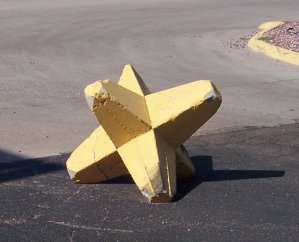 While filling up at the local Shell station for the last stretch home, I spotted the item at left used as a traffic barrier. It was about waist high. I've seen these before, mostly larger and piled up on shorelines as breakwaters, but I've never been able to determine what they're properly called. They're not exactly caltrops (they have two points too many) but they're clearly related, at least structurally.
There was high overcast our last day on the road, and even though the temps were in the mid-90s, the lack of glare made the driving a great deal easier. We got back just in time to dinner with Laurraine Tutihasi and her husband Mike Weasner, who were on their way to Worldcon in Denver from Tucson. We knew Laurraine from our Rochester NY days 25+ years ago, and Mike is the Web's leading authority on Meade ETX telescopes.
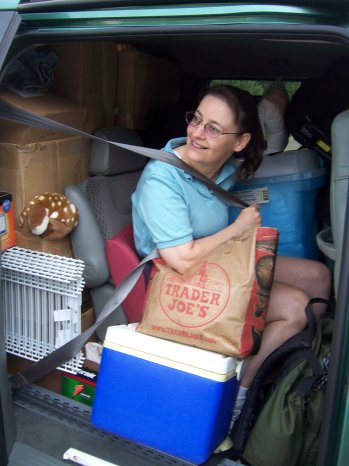 About an hour after parting with Laurraine and Mike, a carload of friends also on their way to Worldcon arrived, this time from Chicago, to spend the night and then head up to set up Steve Salaba's huckster table early this morning. Now, I'm a black belt car packer, but I have met my match, and then some: There wasn't a wasted cubic centimeter in that minivan. There was just enough room in the back seat for one person, blocked in on all sides by coolers and shelves and boxes of plush puppets and stuffed animals. (Note the “Bambi butt” that worked its way out of an overstuffed box toward the left.) It's not how I would have chosen to travel to Worldcon, but Steve, Bonnie (shown), and Eloise are all Worldcon pros from way back, and rotated positions in the vehicle often enough so the person in back didn't get suicidal.
We were away from Colorado Springs during the worst heat spell in several years, and when we got in the front door the temperature was 85 degrees, and the air rich with plasticisers and solvents still being driven from the woodwork. It was hot for awhile while we cranked open every window to get some less toxic air through the place, but it had to be done. I'll willingly admit that I'm still exhausted from our trip, but we're recuperating, and one more good night's sleep should do it. Then, probably Thursday morning, we're off to Worldcon ourselves, if not for the whole stretch then at least long enough to see Nancy Kress again (along with numerous other friends we used to see every Worldcon) and get a sense for what the SF convention scene is like these days. We used to go to Worldcon almost every year, but eventually real life intervened. I have a soft spot for Denver Worldcons; at Denvention 2 in 1981 I had two stories on the Hugo ballot. I lost, of course, but wow: What a rush that was!
Becalmed in…Nebraska
It really is Nebraska. It just feels like Hell. As we pulled into North Platte about an hour ago, the 4Runner's outside thermometer read 108°. And outside, well, we're reminded of a mild summer's day in Scottsdale, except with three times the humidity. In short, uggh.
We're on our way back to Colorado Springs from almost five weeks in Chicago. We got our new niece Juliana baptized and almost everything else on our substantial do-it list done, but it took more time and energy than we thought.
Just like, well, always.
We spent last night in Newton, Iowa, the former home of Maytag, back when there still was a Maytag. The hotel we stayed in was awful enough that I will issue an all-points avoidance notice: Whatever else you may do to abuse your body, mind, or soul, do not stay at the Newton, Iowa Holiday Inn Express on 4th Street. Unless, of course, you wish to confront:
- Mold growing on the walls. Not the bathroom walls, either. The walls in the main room.
- A hole in the ceiling. It was too dark to see where it went, but it was about 1 1/2″ in diameter and looked like it had been poked with a piece of pipe. (This makes you wonder what the ceiling was made out of.)
- Wireless Internet that did not work, would not connect, and kept giving me weird error messages. At least it was free.
- Carpeting that smelled like dead fish or ocean bilge. Or both.
- Stale Raisin Bran at the breakfast bar.
- Coffee (again, at the breakfast bar) so bad I couldn't force a second cup down.
 You've been warned.
Now, we like Nebraska and have been here a lot. However, there is a local weirdness I'm seeing that I don't entirely understand: Mid-grade gas is cheaper than regular. Gas is generally a bargain here, especially compared to Illinois. Why Plus should be 15c a gallon cheaper than the low-octane mix remains a puzzle.
We're going to stop at Lake McConaughy tomorrow morning (it's about fifty miles west along I-80) but if the heat remains as bad as it was today, we may dunk and run the final 275 miles to the Springs rather than spend the day. There's no shade there, and at some point I just can't deal with long periods in that kind of heat, lake or no lake. We won't know until we get there. I'll keep you posted.
Alox Kites and Toys
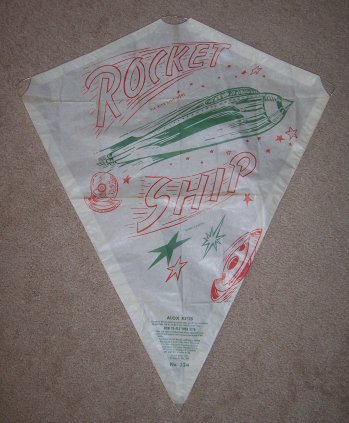 I've had a little time to look at and photograph the material I received from Nancy Frier a few days ago. (See yesterday's entry.) I've begun work on a new Web article on Alox products and especially Alox kites, but I can post some early photos.
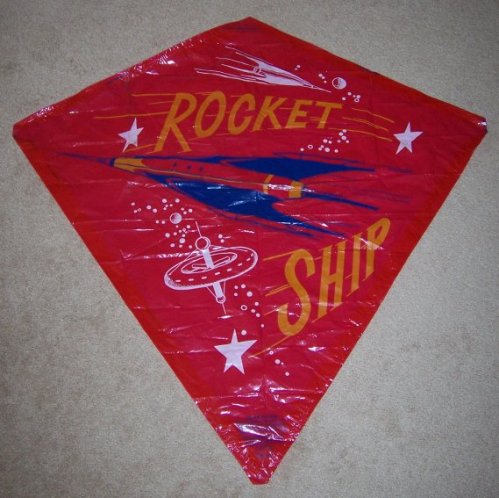
At left is the “Rocket Ship” kite design, but it's not printed from the plate I showed you yesterday. The text and the spaceship are in different colors, indicating that they had separate plates at some point for two-color printing. The kite is 30″ high and 24″ wide, the same as Hi-Flier's Playmates of the Clouds. The Rocket Ship kites were printed on four different colors of paper, in either a single color or a two-color design. The catalog number of this size of kite was #324. As best I can tell (and I will ask Nancy about this) there was no specific SKU number for a given design in a given size. Kites in this size were printed two-up on sheets of paper 30″ X 50″ and then cut and trimmed to the final diamond shape. The kite shown here is post-1964 because the Alox patent #3,330,511 is printed on it. Alox did a big business in promotional kites in this size. I have a few, and will photograph them when we get back to Colorado.
Later on Alox sold a larger kite in a form factor I don't think Hi-Flier or any other contemporary firm used: 40″ X 40″. The one I have is in plastic, with a more modern Rocket Ship design. This is size #420, and was sold in this design and an American Eagle design, in several colors of plastic and ink. Most diamond kites are a little taller than they are wide for stability (useful given that most kids have no idea how to fly kites and learn by painful experience) but bow kites in this proportion or even wider than they are tall can be flown with only a little more skill. These are called Malay kites, presumably because their design originated in Malaya.
Alox also sold barn door kites and box kites. I have a couple of the box kites and will post photos once I get back home and can (carefully) assemble them for display. (One will need some careful repair to the paper sail.) As best I know, Alox was unique in selling a plastic box kite, which was dimensionally similar to the Hi-Flier paper box kite—and probably a lot more durable.
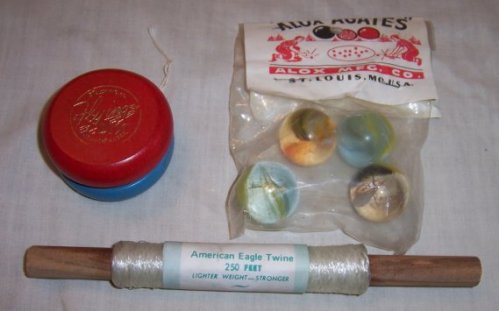
Alox sold kite string pre-wound on hardwood dowels rather than on cardboard tubes, as Hi-Flier did. Lengths included 200 feet, 250 feet and 700 feet. Early kite cord was the familiar cotton twine, but in later years Alox sold a polyester fiber cord called “American Eagle twine” that was much stronger than cotton, and similar to Hi-Flier's Megalon. Other toys in the Alox line included yo-yos of various designs (called “Flying Disks” to avoid the Duncan trademark on “yo-yo”), whistles, sound-effects whips, “carnival canes,” jacks sets, Chinese checkers boards, and many kinds of marbles. Their sales sheets are fascinating, and once I scan them I will incorporate them in my upcoming article on Alox.
Alox closed in good part because a lot of their bread-and-butter items, especially toys, began coming in from China in huge quantities in the 1980s. Anybody who gets the Oriental Trading Company catalogs will know just what I mean here. You can get plastic kites from China (I have a few, and they're in the Oriental Trading catalog every spring) but they are lousy kites, and diabolically difficult to fly. I still think that nothing has ever beaten the 36″ paper diamond kite in stability and “getting up to speed” in young, inexperienced hands. Even with a sail badly glued from newspaper, such kites went up enthusiastically and practically flew themselves. It's a bit of a tragedy that diamond kites have become rare (the ubiquitous deltas are cranky and in my opinion hugely overrated) and a serious tragedy that paper kites as a whole have become extinct.
They don't have to be. The sticks can be had at Hobby Lobby or Michael's. The newspaper is in the recycle bin. Cotton twine is at Home Depot, and Elmer's Glue will stand in for mucilege. What are you waiting for?