- Yet another take on the Amazon vs. Hachette dust-up: The publishers contributed to Amazon’s monopsony power by demanding platform lock-in via Kindle DRM. And now they’re surprised that Amazon controls the ebook market. (Thanks to Eric Bowersox for the link.)
- Pete Albrecht sent word that some guys at the University of Rochester have figured out how to trap light in very small spaces for very long times, on the order of several nanoseconds. (This is a long, long time to be stuck in one place if you’re a photon.) It’s done with evolvable nanocavities–and that gives me an idea for a tech gimmick in my long-planned novel The Molten Flesh. So many novels, so little time…
- Related to the above: The reason I stopped working on The Molten Flesh three or four years back is that I ordered a used copy of the canonical biography of Oscar Wilde (who is a character in the story) and the book stank so badly of mold and mildew that I threw it out after sitting in a chair with it for about five minutes. Time to get another copy.
- Yet another reason not to bother with The Weather Chanel: WGN’s weather website is hugely better, doesn’t require Flash, and works nationally, not only in Chicago.
- Lazarus 1.2.4 has been released. Go get it.
- OMG! STORMY, have you been messing around in Nebraska again?
- Over at Fourmilab we have a superb scan of the 1930 Allied Radio catalog, which carried not only radios and parts but waffle irons, home movie projectors, coffee percolators, toasters, copper bowl heaters, electric hair curlers, and much else for the newly minted upper middle class. (Thanks to Baron Waste for the link.)
- One interesting thing about the radios in the Allied catalog above is that they’re shouting about screen grid tubes. Tetrodes were invented in 1919 and weren’t in mass production until the late 1920s. I’m guessing that tetrodes were what separated the extremely fussy triode-based radios of the 1920s from the turnkey appliance radios of the 1930s and beyond. What the tetrode began the pentode completed, of course, but the watershed year in appliance radio seems to have been 1930.
- Our current Pope has abandoned the bullet-proof Popemobile. It’s one step closer to the end of the Imperial Papacy.
- What dogs think of dog impersonators. Hey, man, the lack of a tail gives it all away…
publishing
Odd Lots
The Manhattan Hardcover Conundrum
Judging by the online commotion, people are still arguing about whether Amazon or Hachette (and by implication, the rest of the Big Five) will win the current fistfight over ebook pricing. The media has generally positioned Hachette as the plucky little guy trying to take on Saurazon by getting everybody in the Shire to stand up, face east, and yell, “Huzzah!” It’s not that easy, heh. But then again, nothing is.
My position? I think the fight may already be over. The Big Five lost. I say that for several reasons:
- The Feds are against them. The whole fight is about how to keep ebook prices from falling, which in antitrust law hurts the public and becomes actionable when producers collude. Even the appearance of collusion will start that hammer on its way down again. Hachette has one leg in a sling before the kicking contest even begins.
- The public has already decided that ebooks can’t be sold at hardcover prices. In fact, this decision was made years ago. Although the issues are subtle, it’s completely true that producing ebooks is considerably less costly than producing print books, especially hardcovers. What publishers have tried to declare the floor ($10) is probably now the ceiling. That ship has not only sailed, it’s folded into hyperspace.
- Monopsony power (one buyer facing many sellers; e.g., Amazon) is not illegal. I’ve read in several places that Section 2 of the Sherman Antitrust Act does not outlaw monopsonistic practices unless they are acquired by exclusionary conduct. There’s not a lot of settled case law about what sorts of conduct are considered exclusionary by a goods retailer, as opposed to an employer. Future cases may change this, but it’s going to be a near-vertical climb.
- Virtually all recent technology works in Amazon’s favor. Ebook readers, cheap tablets, fast ubiquitous broadband, POD machinery, thermonuclear sales data collection, online reviews, you name it: Amazon has almost no legacy baggage.
- Almost everything works against print publishing generally, and the Big Five in particular. I’ll come back to this.
I’m still not entirely sure how I feel about the whole business. In general, letting publishers set their own prices via agency agreements with retailers is a good thing because it allows startups to undercut them. The value to the public of any individual publisher (or conglomerate) is low, as long as startups have access to markets and can replace them. Access to bricks’n’mortar retail shelves has always been and still is tricky. Access to other retail channels has never been easier. If I were ten years younger I might be tempted to try again.
Now, why is Big Print in such trouble? Somebody could write a book (and I wish Mike Shatzkin in particular would) but here are some hints:
- Trade book print publishing is a big-stakes wager against public taste. It’s hard to predict what the public will want even in categories like tech. Literary fiction? Egad. Guess wrong, and you’ve lost what might be a million-dollar advance plus the full cost of the press run and any promotional efforts.
- The economics of trade book publishing are diabolical. Trade books are basically sold on consignment, and can be returned by the retailer at any time for a full refund. This makes revenue projection a very gnarly business. Books assumed to be sold may not stay sold.
- Online used bookselling reduces hardcover sales. Buying a hardcover bestseller soon after release is a sort of impatience tax. The impatient recover some of the tax by listing the book on personal retailing sites like eBay or Amazon Marketplace at half the cover price. The patient get a basically new book for half-off, and then sometimes sell it again…for half the cover price. This would not be possible if online searches of used book inventory weren’t fast and easy.
- Related to the above: Remaindering teaches the public that new hardcovers are cheap. Most print books are eventually remaindered. The remainders are generally sold online for as little as three or four bucks. They’re new old stock books with a marker swipe on one edge. The more publishers guess wrong about press runs (see Point #1) the more books are remaindered, and the more hardcovers lose their mystique and (more important) their price point.
- Fixed costs for the Big Five are…Big. There is a very strong sort of “Manhattan culture” in trade book publishing. Big publishers are generally in very big, very expensive cities, which carry high premiums for office space and personnel. My experience in book publishing suggests that none of that is necessary, but as with Silicon Valley, it’s a cultural assumption that You Have To Be There, whatever it costs.
Bottom line: The Big Five need the $25 (and up) hardcover price point to maintain the business model they’ve been evolving for 75 years. If hardcover sales ramp down, they need ebook sales to make up the difference. Ebooks are cheaper to produce and manage (i.e., no print/bind costs, shipping, warehousing, or returns) and it’s quite possible that a $20 ebook price point could stand in for a $30 hardcover price point. However, Amazon has trained the public to feel that an ebook shouldn’t cost more than $10. Indies have put downward pressure on even that, and the demystification of hardcovers via used and remainder sales hasn’t helped.
What options do the Big Five have? Culture is strong: They’re not going to cut the glitz and get out of Manhattan. (That may not be invariably true; Wiley US moved from Manhattan to New Jersey some years ago. Wiley, however, does not publish trade fiction and has never been deep into glitz. I doubt, furthermore, that they would have moved to Omaha.) A reliable midlist might help, but midlist titles now exist mostly as ebooks. Most publishers, big and small, have long since outsourced design and production to third parties, and are already doing a great deal of printing in China. Beyond that, I just don’t know.
Don’t misunderstand: My sympathies are with publishers, if not specifically large publishers. I was in the trenches and I know how it works. Books can only be made so cheap before quality suffers, especially ambitious nonfiction like Steven Pinker’s The Better Angels of Our Nature. We may be in a race-to-the-bottom that cannot be won by either side. What I’d really like is honesty in all quarters about the issues and (especially) the consequences. Rah-rah tribalism helps no one.
Both sides have points in their favor. Amazon has done something not well-appreciated: It’s made it possible for self-publishers and indie publishers to reach readers. Physical bookstores have long been barriers to entry in publishing. Quality remains a problem, but hey, is that a new problem? Traditional publishers claim that they guarantee quality, even though “quality” is a very tough thing to define. Most of my life I’ve abandoned a fair number of print books every year as unreadable, not because I dislike the approach or the topic but because the writing is bad. This is supposedly the value that publishers add. The adding is, shall we say, uneven.
My suggestions sound a little bit banal, even to me:
- Publishers need to pay more attention to objective quality. Bad writing is a fixable problem; you either don’t buy it, or you fix it after you buy it if you judge the work important enough to go forward. This is the edge traditional publishers have over the indies.
- Amazon needs to consider that book publishing is an ecosystem in which many players have important roles. Market share won’t matter if you kill huge segments of the market. They may not care; there’s plenty of money in selling thumb drives and diapers.
- Readers need to meditate on the realities of writing. Writers need to be paid. Cover price isn’t everything. Quality matters.
- The hardcover as the core of trade publishing must die. Hardcovers need to become a luxury option. If I read an ebook or paperback of a truly excellent work, I may want a hardcover, and we’re very close to having the machinery to do hardcover onesies at reasonable cost. I’ve upgraded to hardcover many times, but generally on the used market, since by the time I read a paperback the hardcover may already have been remaindered and unavailable new.
- Publishers need to ask themselves if Manhattan and San Francisco really deliver benefits comcomitant to their astronomical cost.
- Amazon is a given. The Internet leans toward channel capture. If it weren’t them it would be someone else. Grumble though we might, we need to start there and figure out the best way forward.
In the meantime, remember: There are countless sides to every argument, and no easy answers to anything. You are always wrong. And so am I. Get used to it.
Print and Ebook from the Same PDF
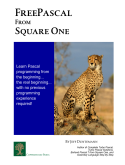
I’ve been tinkering with a recast of my 1993 book Borland Pascal 7 From Square One since 2008, for the excellent FreePascal compiler. One reason I set the project aside after a year or so is that I wanted to see if the Lazarus IDE would mature a little. I had originally planned to use the text-mode IDE bundled with the compiler, but it had what I considered dealbreaker bugs. Besides, if Lazarus became usable, I could create a tutorial for it as well. Lazarus is now at V1.2.2 and (at least to the limits of my tests so far) works beautifully. I’ve gone back to the FreePascal From Square One project, yanking out all mention of the text-mode IDE, and deliberately tilting it toward a prequel tutorial for a future book on OOP and creating GUI apps in Lazarus, Delphi-style.
One of my goals with the project has been to create a single PDF that can be used as both an ebook and a print image. I’ve experimented with implementing it as an epub, with disastrous results. Layouts containing lots of art just don’t work as reflowable text. On the other hand, PDF images are painful to read and navigate unless the reader device can render a full page legibly. Back in 2008, we didn’t even have iPads yet, and the target display for my PDF ebooks was my 2005-era IBM X41 Tablet PC. You could read the PDF…barely. I spun a couple of page layouts that used smaller pages and larger fonts. They were readable, but looked bizarre (almost like children’s books) when printed to paper.
I left it there for some years. Come 2010 we met the iPad, with the multitude of Android slabs hot on its heels. Displays improved radically. I got an Asus Transformer Prime in 2012, and found the 1280 X 800 display startling. I took the page design that I had originally created for my X41 and tweaked it a little. The page size is A4 rather than letter or standard computer trim, for three reasons:
- Whereas some POD houses can give you computer trim, sheets aren’t readily available at retail and thus can’t be printed at home.
- A4 paper is the default paper size in Europe, where I suspect that most of my readers will be. It can be had in the US from the larger office stores, and modern laser printers will take it. Lacking A4 paper, the book can be printed to letter sheets with only a little bit of reduction.
- A4 paper is taller and narrower than letter, and maps a little better to the wide-format displays that dominate the non-iPad tablet segment.
The layout still looks odd to me. Half a century of reading has made me used to fine print, so the larger type jars a little. However, the layout has plenty of room for technical art and screenshots, and full pages read very well on the Transformer Prime. (This is not true on the much smaller Nook Color.)
With print publishers struggling terribly, I’m guessing that this is one possible future for technical publishing: new layouts that allow the same PDFs to be either printed or rendered as ebooks. More and more specialty books that I buy are POD (I know how to spot them) and the customary high prices on computer books leave plenty of margin to make POD copies profitable.
You can help me out a little. The ebook is far from finished, but I’ve posted the PDF here. I’d be curious to know how legibly it renders on other tablets, particularly those smaller than 10″ but with 1280 X 800 or better resolution. Again, it’s not a complete book and there are plenty of typos and layout glitches in it. What I want to know is whether or not technical readers will find it usable on modern tablets. Thanks in advance for any feedback you can provide.
New Photo of John T. Frye

Reader George Cohn sent me a photo of John T. Frye that I had not seen before. It’s from the May, 1948 issue of Radio News, which contained the second installment of his very long-running “Mac’s Service Shop” column. Assuming the photo was recent when published, Frye would have been 38.
For those who don’t recognize his name, John T. Frye was the author of the Carl & Jerry educational stories from Popular Electronics, “Phone Phunnies” from QST, and a whole metric passel of other things in other places, including two books on tube-era radio servicing that from what I can tell have passed into the public domain. See my article on Frye and his creations Carl & Jerry. I republished all 119 stories in five books several years ago (plus one new storyI wrote myself, and another one from the late George Ewing WA8WTE) and they’re still selling. Frye was a paraplegic who never walked, and how he did what he did in his life is one of the great success stories of disabled people who just didn’t let anything get them down. Legs? We don’t need no steenking legs!
Odd Lots
- Wired ran a wonderful photo piece on one of the weirdest aircraft ever to fly: the Soviet Union’s ground-effect ship-killer seaplane Lun. (Thanks to Mike Bentley for the pointer.)
- Surezhell, a faint tickle of a memory led me back to even more Lun-y goodness at Dark Roasted Blend. Don’t forget Part 2.
- Which led directly to Awesome Armored Trains. (Steamfrack? Again, the Russians seem to be the masters of this game.)
- Yet another photo gatherum from Spiegel, highlighting zany transportation ideas that didn’t pan out. Or get anywhere near the pan.
- Ars has a nice article on a very new category of aircraft: the solar-powered “atmospheric satellite,” a robot plane that flies in the high atmosphere for indefinite periods without fuel.
- Sakurajima is acting up again. That was one of my favorite volcanoes when I was a kid, right after now-extinct (probably) Paracutin. One thing to note here is how good the comments are. I read Klemetti’s blog as much for his community as for his own (excellent) posts. No politics, no hate, no incessant tu quoque from tribal slaves. You don’t see that very often.
- As with all claims in this category, whether fission or fusion, I’ll believe it when I see it, but damn, I would like to see this.
- The Nook business is in trouble. We’ve seen that coming, but it makes me wonder if the Nook is alone, or if the rest of the color-screen ebook readers are falling into line behind it. (E-ink will remain as a niche for daylight reading.) I read ebooks on my Transformer Prime. Works. It’s a general-purpose tablet with a keyboard dock that makes it an only slightly crippled laptop. The number of specialized gadgets I’m willing to cart around is limited.
- That said, B&N’s print book business is in reasonably good shape, especially its very profitable textbook division. (Thanks to Janet Perlman for the link.)
- Ouch. “There’s no real ebook piracy problem because most people don’t think books are worth stealing.”
- Publishing is an ecosystem, and the parts don’t thrive without the whole. The ecosystem can change, of course, but the changes take time, and not all parts of the system will survive the changes. (Again, thanks to Janet Perlman for the link.)
- Forget underage women. Crossing state lines with rented textbooks can get you into trouble.
- Composers on acid? I’d be curious to hear from experienced musicians whether most of these, um, compositions are playable at all.
- Now this is the sort of drought I can celebrate: We’re looking at a record low tornado count this year.
- On the hurricane side, the accumulated cyclonic energy (ACE) value, which is an aggregate of how much power has been seen in cyclonic storms so far this year, is 48% of normal to August 21. Less than half. The Coriolis Gods are evidently taking a break. Let’s hope it’s a long one.
- The latest Duluth Trading catalog is pushing a product called Ballroom Jeans. Huh? For cowboy proms? Ballroom…wait. Ok. I get it.
- Always read food labels carefully.
Odd Lots
- The length of the Earth’s day varies more than I would guess, and the cause seems to be a certain amount of slosh in our molten core.
- PC World is shutting down its print edition. I still have early copies of both PC World and PC Magazine in boxes, including issues from those heady days when the PC universe was exploding like a supernova and the magazines could be an inch thick and heavier than some small dogs. If I could still make money in magazines I’d still be in magazines making money, but that train has left the station, the station has been razed, and the tracks sold for scrap.
- I smell careers burning.
- Which might be one reason the Chicago Tribune’s owners are doing this.
- And yet another reason (among many) for this.
- On a whim I went out and checked the Adobe CS2 download link that got so much attention this past January. Gone. I guess they calculated that anybody who was entitled to it already had it, and all the rest were pirates. I wonder if they understood that genii don’t return to their bottles once let loose.
- How about some extreme swimming pools? Damn. I’d just like to have a really boring swimming pool right now.
- Or maybe nine peculiar (old) vending machines. Read the comments, which contain more cool vending machine links. I saw beer vending machines on Japanese streets when I visited Tokyo in 1981. It shouldn’t be too long before a modern descendant of the Book-O-Matic actually prints and binds your book from scratch, while you watch. Alas, it will cost more than a quarter.
- Speaking of descendants: I knew this. Did you?
- Bill Higgins sent a link to some sort of German WWII tank training manual, written in German rhyme and illustrated in a very surreal fashion, including God carrying a tank on one shoulder and a chubby redheaded Aryan angel in leather boots, holding a cannon rammer. The Jaegermeister stag-and-cross is there too, which might explain a few things. Yet another reason I should have taken German in high school.
- Speaking of Jaegermeister: I asked my nephew Matt what it tastes like. His answer: “You don’t want to know.” When pressed, he added, “Malort.” Only a little research confirmed that, yes, I really don’t want to know.
- Choice is always good.
UPDATE: A little research on the Panther Primer shows that the figure I thought was God is St. Christopher; the angel in red braids is St. Barbara, and the guy chasing the buzzard is St. Hubert, who was a master hunter…a Jaegermeister. Siegfried is in there too, as are some Classical Greek figures. German tank crews must have been a pretty educated bunch.
An Ebook Piracy Mystery
For the most part, the ebook pirates have forgotten about me. Five or six years ago, I was all over the pirate sites. Now I’m not even on the Pirate Bay, and haven’t been for some time. Binsearch shows that the last time I was uploaded to Usenet was almost a year ago. It’s enough to give a guy a complex. (It’s certainly enough to make me feel like I need to write more books.)
So last week the backchannel sent me a link to an article about how several major textbook publishers have subpoenaed a couple of Usenet service providers demanding the identities of two prolific Usenet uploaders operating under the pseudonyms Rockhound57 and HockWards. Both upload technical books to a certain newsgroup devoted to technical nonfiction.
Boy, do they.
I fired up my newsreader and took a look. I’d been there before, and have gladly downloaded crufty scans of old Heathkit and classic tube gear manuals and the occasional supreme oddity, like the German-language service manual for the Nazi V-1 flying bomb. There are scans of military field manuals and much other odd junk, plus all the spam, trollery and asshattery we’ve been accustomed to seeing in newsgroups since, well, there were newsgroups. (I first got on Usenet in 1981.) Rockhound57’s posts are, for the most part, academic science books of almost vanishing narrowness. If you’re ever curious about Dipetidyl Aminopeptidases in Health and Disease, well, Rockhound57’s got it. Ditto Automorphisms and Derivations of Associative Rings. I actually thought that “cobordism” in Algebraic Corbordism was a typo. Then I looked it up. Man, if you can make head or tail of that one, you’re a better geek than I.
If you think about what those books (and they are indeed books, and not articles) have in common, you may understand some panic on the part of the big presses: Those books have very, very small audiences and very, very high cover prices. Algebraic Cobordism has a cover price of $99. Small potatoes. Hold on to your manifolds: Automorphisms and Derivations of Associative Rings will cost you $269. I’m not exaggerating when I suggest that there are maybe 500 people on Earth who might conceivably buy such books, most of them starving graduate students. (I suspect that the publishers make what money they make selling to university libraries.) Having perfect PDFs flitting around on Usenet is an academic publisher’s worst nightmare.
But that leads us to a very important and completely unanswered question: Where did all those perfect PDFs come from? Not a single one of the titles I spot-checked is available as an ebook on Amazon. These copies are not slap-it-on-the-glass pirate scans. They are as perfect as the print images we used to generate for our books at Coriolis and Paraglyph. If they’re not being sold, how did the pirates get them to begin with?
I can think of a couple of possibilities:
- They’re DRM-stripped versions of e-texts that aren’t sold on Amazon but rather through heavily protected textbook sales channels like Adobe’s.
- They’re the print book equivalent of “screeners,” sent out for review, proofing, indexing, etc.
- They’re downsampled print images lifted somewhere along the pipe leading from the publisher to the printing presses.
My gut is going with #2, though #3 is certainly possible. Publishing services have been thoroughly commoditized. Most publishers use freelancers for proofing and editing, and many outsource layout itself. Any time a print image goes outside a publisher’s doors, there’s the chance it will “get legs.”
That said, I boggle at how many perfect PDFs were uploaded by those two chaps. We’re talking literally tens of thousands. Are there that many leaks at the major presses? Or is something else going on here? I still can’t quite figure it. I do know that a number of backchannel sources have told me that ever more file sharing is being done locally and off-Net, often by passing around now-cheap 1TB SATA hard drives. There’s no stopping that. Publishers need to start taking a very close look at their own internal processes. Pulling production back in-house might help, but it wouldn’t be a total solution, at least as long as desktops have USB ports. Problems don’t always have solutions, and piracy is probably one of those increasingly common nuisances.
There were times when I miss being in publishing. Alas, there are other times when I’m glad I’m not.
Odd Lots
- Ars has the best article I’ve yet seen on the recent ruling in the Apple ebook price fixing trial. Insight: Publishers get less under agency than they do under wholesale, but they’re willing to accept it to keep control of pricing. Book publishing is a freaky business. This may not work out as planned for the publishers.
- Also from Ars: Weird search terms that brought readers to the Ars site. I used to publish these too, but I don’t get as many as I once did. Web search has always been a freaky business. I guess the freakiness just wanders around.
- The sunspot cycle still struggles. Cycle 24 will be freaky, and weak–even with our modern tendency to count spots that could not be detected a hundred years ago.
- Not news, but still freaky if you think about it: The Air Force tried building a flying saucer in 1956. The aliens are still laughing at us.
- Actually, the best flying saucers are all triangles. In the greater UFO freakshow, these are by far my favorites.
- There’s a quirk in the insurance industry that will allow young people to opt out of the ACA and still get health insurance–while paying much less they would buying traditional health policies under ACA. Life insurance policies often allow for accelerated payouts of benefits while the insured is still alive. My insight: Such a policy would be a way to finesse limited enrollment windows by paying for catastrophic care until enrollment opens again. (Which would be no more than ten months max.) And you thought publishing was a freaky business.
- We thought we knew how muscles work. We were wrong. Human biology is always freakier than we thought.
- As is washing your hair–in space.
- Streaming is the ultimate end of the DRM debate. Music, movies, sure. Could one stream an ebook? Of course. Would people accept such a system, or would they freak out? Well, we thought DRM for serial content was dead, too. (Book publishers have become much more aggressive against piracy lately. More tomorrow.)
- And finally, if you want freaky, consider the humble cicada killer, which vomits on its own head to keep from frying in the summer. We had them living under our driveway in Baltimore. I didn’t know what they were and they scared us a little until I called the county ag agent, who said, “They’re cicada killers, but don’t worry. They’re harmless.” I immediately called Carol at work to give her the good news. The receptionist at the clinic wrote down: “Jeff called. The things living under your driveway are psychotic killers, but don’t worry. They’re harmless.”
Summer Doldrums
Yes, I’ve been gone for awhile, and for any number of reasons found it inconvenient to put anything together until this evening. I’ve been having some trouble with that old book-hauling injury in my left arm, spent ten days in Chicago, fixed some stuff (including an interesting repair on a dog grooming hair dryer) and learned some new things that I didn’t expect to learn, including a few that I probably didn’t need to learn.
In short, I’ve had nothing much to report, and in the summer heat just felt better reading books and taking it easy in the cause of getting my whiny supinator to shut the hell up. The gruel here is on the thin side, but that’s summer.
My younger niancee, Justine, made me aware of something called Prancercise by demonstrating it in front of the whole family. Damn. I thought she was kidding. Then I watched the video. Wow. It has nothing on the Invisible Horse Dance, but it could be the next craze at weddings. Or maybe not.
Weddings. We did attend a terrific wedding, of the daughter of my oldest friend Art. At her reception I saw something called the Casper Slide–not to be confused with the skateboarding stunt of the same name. And if you are confused, you’re not alone. I think this is why the real name of the dance is the Cha-Cha Slide, developed by a Chicago DJ named Casper. I watched the dance, and apart from some stomping, it looked a lot like the Electric Slide. But hey, what do I know about cultural tropes?
Another bit of knowledge that was true but unwelcome is that Barnes & Noble comtinues to come apart at the seams. Their CEO quit the other day over the failure of the Nook tablets to capture any significant part of the tablet market. The Nook division is for sale, and Microsoft is making slobbering noises. The Nook guys have been on my you-know-what list for some time, for pushing down updates that freeze in mid-install and can’t be removed. (I don’t use AMV, but I wonder if it works at all after the installer gets stuck.) Leonard Riggio wants to take back the retail division. A lot of stores are closing, and half the remaining stores have leases that expire in 2016. And everybody’s wondering what happens after all this happens. Especially publishers.
I learned that the Chicago Tribune has a page dedicated to documenting every single homicide that happens in Chicago. That this would be a big, frequently updated page is bad enough. That is exists at all is worse. I guess Chicago is a terrific place to be from.
There’s a video on domesticated fox, pointed out to me by Pete Albrecht. I mentioned the Russian research on Siberian fox years ago, but this is the first time I’ve seen videos of the animals themselves. It’s sad in a way; the poor things are stuck somewhere between fox and dogs, and are at best unreliably tame. It’s pretty clear to me, however, that this was the same process our ancestors used to turn wolves into dogs. And it didn’t take thousands of years.
I learned that the backlight behind the controls of my new car stereo changes color continuously.
Ok, ok, I can see eyes glazing over. That’s it for tonight. I hope to get back on my usual schedule shortly.
Odd Lots
- Well. Amazon (finally) pulled my name off Garth Williams’ book Baby Farm Animals. Years of polite complaints didn’t do it. Making fun of them in the comments did. Thanks to my friends Eric, Steve, and Dave for working the magic. Poor Garth can rest in peace now without having to learn x86 assembly language.
- Erik Klemetti has a good overview of the 1783-84 Laki eruption in Iceland, which caused a sulfuric haze that Benjamin Franklin said reduced the intensity of the sunlight so much that a magnifying glass could not concentrate it sufficiently to ignite paper.
- Here’s a good if technical discussion about what’s wrong with X and why Wayland almost can’t help but be better.
- Yet another force pushing print magazines into the torn-off-cover return racks of history: People are checking Facebook on their smartphones while waiting their turn in supermarket checkout lines. Good-bye to starting a story in People and then tossing the mag in the cart to finish at home.
- I don’t always agree with Stallman. But this time I sure as hell do. (Thanks to Pete Albrecht for the link.)
- Bruce Eckel pokes holes in a couple of recent SF films. I hate to think of what he might have said about Independence Day. (Thanks to Jason Bucata for the link.)
- I’m not sure that Beowulfing boxfuls of Raspberry Pi boards makes sense, but it can be done.
- As can using a Raspberry Pi to take video through a telescope.
- There will be another perigee moon on June 23. It’s not especially close as such things go; for a really close perigee moon, consider January 14, 1930, when our lesser light was only 356,397 km away. It won’t be that close again until 2257. Nice page on the topic here.
- And the sunspot count of our greater light was down to 27 this morning. This sure doesn’t look like a sunspot maximum to me.
- Tor has been publishing DRM-free ebooks for a year now, and reports that piracy has not increased as a result. They’re mostly mum on how they measure piracy rates, but it’s encouraging that a major print player would even do the experiment.
- Nice reminder that nobody died at Fukushima, and according to the UN it’s unlikely that many will even get sick. Nuclear is not the demon that Certain Parties insist it is.