- Big, big news today: The Raspberry Pi foundation is now shipping the rumored Raspberry Pi 2 board. (What this means in practical terms is that all your usual suppliers are sold out.) Will write more once I learm more, but geddaloadadis: Quad 900 MHz Cortex A7 CPU, plus a full gigabyte of RAM. And the sleeper, which is still tying my head in knots: The foundation has cut a deal with Microsoft to provide a version of Windows 10 that will run on the RPi2. The cost? Free. No more details than that right now, but I’ll be watching it closely. (Thanks to Bob Fegert for alerting me. Twitter has already earned its keep.)
- Update: The new Windows 10 deal with the RPi community is part of Microsoft’s larger strategy on the Internet of Things, and will be available without charge through the Windows Developer Program for IoT.
- Jim Strickland sends a link to Microsoft BASIC for 6502, in assembly. This is from 1978, and the oldest publicly available source code written by Bill Gates. The interpreter exists for the COSMAC 1802 as well, and I may still have it somewhere. It’s on paper tape, and I think in a metal 35mm film can. This was a great use for 35mm film cans, back when there were 35mm film cans, and paper tape to put in them.
- Wired‘s vulcanologist Erik Klemetti has a fascinating article on how magma forms hexagonal pillars a la Devil’s Postpile and Giant’s Causeway in Northern Ireland. These figure in the yet-unbegun novella prequel to The Cunning Blood, so it was nice to get some science on them.
- If you liked the Panjundrum (see my Odd Lots for January 29, 2015) you will love this thing, whatever they call it: It’s a Panjundrum that flies. (Thanks to Pete Albrecht for the link.)
- UPDATE: One of my readers just wrote to tell me that it’s called a “girandola.”
- Yes, this is short for an Odd Lots, but I wanted to get notice out on the RPi2 sooner than tomorrow or the next day.
Odd Lots
Review: T-Bob’s Barbecue

Carol and I are planning another of our canonical nerd parties for later this month, which requires a fair pile of food. We’re tolerable cooks but we’re not foodies, and the skill of putting together enough chow for thirty-odd highly educated and culturally sophisticated eccentrics was not a gene we received. So once again, we’re looking at catering.
Which means we’re thinking about T-Bob’s Barbecue. I’d have Ted (the “T;” Bob has been gone for some time) cater the party like a shot. Only snag: He’s at Algonquin and Elmhurst Roads, which is…1,100 miles away. So it goes.

When Carol and I are in Chicago, we have an emerging ritual of piling over to T-Bob’s with my sister and Bill after they drop the girls off at school, for a late (or for us, often second) breakfast. Wonderful place, the sort of one-off eatery we don’t have many of here in the Springs. It’s got deli-style blackboards and daily specials and…egad…Diet Mountain Dew. Better still, the guy who owns the place is, as often as not, the guy you see behind the counter.
Much good stuff here. Obviously, the barbecue, which comes highly recommended from afionados whom I trust, like Bill. (For still-unknown reasons, nearly all barbecue sauce from all sources disagrees with me, as much as I enjoy it.) I’ll personally vouch for the pulled pork, which you can get as a conventional sandwich or a wrap. Ditto the fried catfish, which is about as good as catfish gets, and swims rings around any other fast-food fish I’ve ever tried. Excellent fries and cornbread.
Given that we’re there mostly in the morning, I generally have scrambled eggs, bacon, and hash-browns, and although it’s easy to say you can’t do those badly, trust me, you can. Not here. The eggs are done and the bacon is crisp, the hash browns just brown enough. Coffee’s very good, though in truth, I generally cave to temptation and have Diet Mountain Dew, even with breakfast. (I don’t drink it at home anymore, so having it at all is a bit of an event, given that Carol and I eat out maybe three times a month.) Bob’s got a number of other things you won’t see in fast food contexts very often, like pulled chicken, cane-sugar sodas from Mexico and baked sweet potato.
Open 8:30 AM to 8PM, 9PM on weekends. Caters (sigh.) Highly recommended.
Practical and Impractical Swag

Carol and I were digging out the far dark corners of our walk-in pantry, and an interesting artifact came to hand: A plastic thermos bottle with the following inscription:
It keeps hot food hot, and cold food cold. How does it know? Is it the most “artificially intelligent” object in the galaxy?
At the bottom of the front face was Borland International’s logo. The jug was a teaser for Turbo Prolog, and I think I received it while I was still at PC Tech Journal in the fall of 1986. I had to quote the text here, because as you can see from the photo, a good part of the inscription has been worn away. Why? Because I used it. I used it a lot.
That is not generally the case for swag.
Once I became a computer journalist in 1985, I was offered a lot of swag, and took more of it than I had any need for, mostly to be polite. These were, after all, advertisers and potential advertisers. Carol and I have gotten (and still get) swag from various persons and organizations, and it’s interesting to look around the house and see what we still have, fifteen years after I ceased to have advertisers:
- In the summer of 1976, Carol attended an open house at a local real estate office in Rochester Minnesota, where she was at grad school. They gave her a yellow plastic noodle strainer reading “Joe Maas Gallery of Homes” and a phone number. Almost 39 years later, we still use it to strain noodles and dumplings and anything else that needs to stay in the pot while dumping the water. Joe Maas’s name is long gone to friction and detergent, but I still remember it. For swag, I’d say mission accomplished.
- Seven or eight years ago, we received a plastic flyswatter in the shape of a house from the realtor in Chicago who helped us buy our condo. It’s a little smaller than most flyswatters, meaning that it has less mass and is more maneauverable, as a good many flies have found to their sorrow. I’m not sure I’d want my company name slobbered up with bug guts, but I use it most days in the summer and will never forget Rohn Realty.
- In 1985, Quadram gave me a nice leather reporter’s notebook with their logo on the front. I used to use it a lot for pen-and-ink jotting, until technology made pen-and-ink mostly obsolete. Technology did the same number on Quadram, so I guess it doesn’t matter that I misplaced it some years ago. (I think I know where it is, but I don’t want to dig that deep in a pile that big.)
- Premia gave me a nice little pen knife / nail file / micro-scissors in 1992 or so with the CodeWright logo on one side. It’s still in my desk drawer and I still use it.
- Screwdrivers. I still have and use a pocket screwdriver from PK Ware, as well as the one that came in the box with Windows for Workgroups.
- Thumb drives. These didn’t exist back when still I went to trade shows, but Eric Bowersox gave me a couple of teensy little items that came loaded with just about every piece of documentation AMD was giving away about its processors and motherboards. Double brilliant.
- Canvas bags. Too numerous to mention. All that came to hand just now long outlived their vendors. A particularly good specimen from the 1991 OOPSLA is still my designated hamfest trick-or-treat bag.
Not everything makes good swag. Here are some cautionary pointers:
- Pens. Live fast and die quick; that’s the pen motto. All are long gone, although a spring-loaded Levitra gimmick pen given to me by a doctor friend remains in my Personal Museum of Very Odd Things.
- Coffee mugs. Part of the problem is that everybody gives out coffee mugs, and your swag mug gets lost among all the others, and is eventually given to the local thrift store. The other part of the problem is that coffee mugs aren’t always microwaveable, and if you can’t nuke the brew, that mug is on the short path to oblivion. I gave away the nice OS/2 Warp mug I once had because it was plastic. And early on, swag cups often had foil trim, which catches fire in the microwave. The Borland mug shown above is a very nice item, but man, you should have seen the fireworks when I turned the microwaves loose on it in the early 90s.
- Clothes. Ok, folks, look at me: Am I an XXL? Then why are all these trade-show T-shirts size XXL? Because you can’t stock six sizes at your booth? Well, look at whose canvas bag I’m toting. It isn’t yours, hint hint.
Not all those XXL T-shirts are gone. We still have a couple, and Carol uses them for nightgowns and swimsuit coverups. A famous example has those cute little whatevertheyares from the cover of O’Reilly’s book Sed and Awk. When we were in St. John’s in 1998, a vacationing geek chatted up Carol, hoping that she was that rarest of beings: a beautiful woman who uses sed and awk. (Carol referred him to me. His disappointment was palpable.)
I’m sure there are others in drawers and cabinets around the house. The wonder isn’t that we still have them (we’re legendary packrats) but that such cheap and usually plastic geegaws can actually serve real needs for longer than ten minutes. Borland’s AI thermos will doubtless see ice-water service again this summer, now that it’s no longer in the bottom of a box. Houses have flies, and thus realtors will give away flyswatters. And a swag strainer that sees near-daily use for 38 years with no end in sight? That should be in a glass case in the Vatican, because God in heaven, it’s a miracle.
Odd Lots
- Although I created a Twitter account back in November, I haven’t done much with it until a day or so ago. I’ve begun posting what amount to instant Odd Lots on Twitter, so if you were waiting for me to do something useful before following me, well, the wait is over.
- Twitter has been using its own link shortener t.co to shorten all links in tweets since 2011 or so. It’s automatic and requires zero additional keystroking. Why, then, do tweeters still use services like bit.ly and goo.gl?
- The FCC may change the definition of “broadband” today, which could demote tens of millions of people (mostly DSL users) to some weird limbo between dialup and broadband. Most of the DSL connections I’ve used have been hideous, some providing measured speeds right down there with 1994 dialup, along with weird lockups and general bit-mayhem.
- Update to the above: Yup. It happened. Next on the agenda: net neutrality.
- NASA’s New Horizons probe is now waking up. We’re about to get our first close-in views of the last (known) un-visited planet in the solar system. Pluto and its gigantic moon Charon are only 12,000 mles apart and orbit one another in 6.3 days, so I’m expecting that some of the upcoming images will be startling, to put it mildly.
- Your coding style gives you away. Mine certainly does–all my reserved words are in uppercase. Why run with the pack?
- Wired tests five wine-stain removers. $18 a bottle? I dunno. At $3.50 or so, Spray & Wash Resolve Stain Stick always works pretty well for us. (Me, actually. Carol drinks white wine.)
- Apple’s app store billed more than Hollywood’s entire box-office take last year.
- It’s easy to say “We’re going to tie health-care payments to health-care outcomes. It’s a lot harder to measure those outcomes objectively.
- This thingmajigger–called a “Panjandrum”–is almost certainly the silliest weapon in 20th century military history. I invite you to nominate competitors, but I warn you, it’s a tough act to beat. (Make sure you scroll down to the video, even if you don’t read the whole thing.)
- Finally, from the Global Vaporizing department: 2,960 degrees in Cave Creek. Boy, it didn’t get quite that hot back in the 90s… (Thanks to Bill Roper for the link.)
The Strangest Computer I’ve Ever Built

Lee Hart sent me the guldurndest thing for Christmas: One of his RCA COSMAC CDP1802 Face Card kits. I needed a distraction from a number of things, starting but not ending with publisher disputes. Lee’s Face Card was just the ticket. I haven’t done much PCB soldering in the last few years. Most of what I have done in the electronics sphere was point-to-point, generally on tube circuits. I hadn’t soldered a 40-pin DIP in, well, um…decades?
There’s a knack to it, and I had to dig around a little to find my roll of Ersin .022 Sn63 solder, but after a few minutes’ careful practice it all came back. The kit doesn’t include a 40-pin socket, but I always socket CPUs. The CPU chip I used (see above) has a distinguished history: It was the very same chip I ordered for my original COSMAC Elf project in the fall of 1976. Later it migrated to my second, heavily hacked Elf design (here’s the board mounted on what really was a scrap Xerox 3100 platen cover) with ten banks of CMOS memory (2,560 bytes!) a breadboard block, and a hex keypad. That second Elf board, in turn, became one of two CDP 1802 machines in my well-known robot Cosmo Klein:
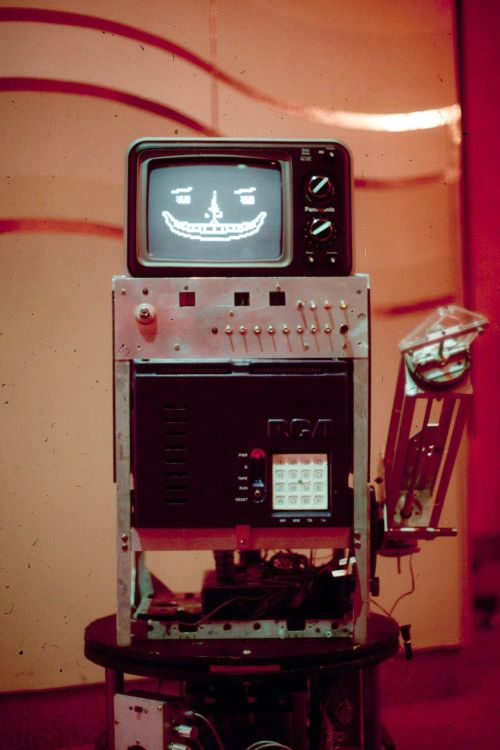
Cosmo and I did the SF con circuit from 1978 to the early 80s, and we were actually featured in Look Magazine, as well as an early cable TV program that no one saw.
So I have a certain history with RCA’s peculiar COSMAC architecture, and have built a number of peculiar computers with it. I’m pretty sure none of them were ever quite as peculiar as Lee’s Face Card. Why? The Face Card has no memory, volatile or nonvolatile. It does not run software. Actually, it’s strapped specifically so that it doesn’t run software. (More on this in a moment.) What it does is light up groups of LEDs to make an animated face. How it does this is, well, peculiar: The LEDs are driven from the 1802 chip’s address lines. The data bus is left floating. The 1802, when reset, begins executing code starting at address 0000 in memory. If there’s no memory and the data bus is floating, the chip just executes empty air. The patterns that appear on the address lines aren’t quite random, but close enough so that the LED eyebrows, face, and mouth move in almost random variations. Oh, and the clock speed? One cycle per second.
Peculiar enough for you?
One of the data bus lines has to be pulled high to prevent the binary instruction 00 from executing. This is the HALT opcode, and if empty air delivers 00 to the data bus, the Face Card will freeze and the face pattern will no longer change.
I have special affection for the Face Card because one of the two COSMAC machines in Cosmo displayed an animated face on a portable TV atop his body. Cosmo could look around, smile, frown, and (on a touchtone signal from my 2M HT) lick his chops.
I built the Face Card in about an hour and a half. I’m careful, I work slowly, and I test most components before soldering them into a circuit board. It worked as designed when I turned it on. Theoretically, the system can run on any power source from 4-6VDC. I found that a 5V supply didn’t quite cut it. Some of the LEDs didn’t light fully, and the patterns seemed to get “stuck” now and then. The board has been running at 6V for two days now, and things are brighter and livelier. They’ll be even livelier when I cut the clock generator resistor in half and double the clock speed to two cycles per second.
$19.95 + $5 shipping. CPU socket not included, but I think using one is a good idea.
Highly recommended.
Odd Lots
- This item may not be visible after a few more days, so catch it now: A very weird “hotspot” turned up in the satellite water temperature record at the far eastern end of Lake Superior. For a short while, water temps excursed from the 30s up to the 60s F. Instrument Error? Cargo ship on fire? UFO exploding? STORMY baiting and then rounding up firenados? No one can tell me, though I suspect that the truth is out there.
- The FCC is trying to redefine “broadband” as 25 Mbps down / 3Mbps up. The big carriers are livid. And what are they saying? “Nobody needs Internet that fast!” Just like Esther Dyson said that no home computer user would ever need a CPU as fast as the 286.
- The dropoff in some ebook author revenues this past fall (which many blamed on Kindle Unlimited) may have been a sales cycle thing, unrelated to Amazon.
- Dare we hope that this new Facebook feature will be the end of hoaxes and hate memes? Be on notice that I intend to use it a lot.
- Slashdot inadvertently invited all the Pascal-haters out of their caves for one more hatefest. Heh. Maybe not a hatefest. The emotion I pick up when C partisans’ eyes roll back in their heads over Pascal is not hate, but…fear.
- Angry Twitter posts are harmful to your health. Duhhh. Angry anything is harmful to your health. Anger is jack-in-the-box suicide: You can’t tell quite when, but the more you turn that crank, the sooner the thing’s gonna pop.
- The Pirate Bay has a phoenix logo and a countdown timer on their old site, suggesting that they’re coming back online on February 1. I consider this unlikely, but I’ve been surprised by these guys before.
- From the same site: Dozens of Pirate Bay clones are not nearly as useful as the real thing.
- And while we’re talking about (if not like) pirates, whatever happened to Antigua’s blanket permission to distribute copyrighted files? Lots of news about that in midlate 2013, nothing since.
- The highest-paid YouTube video author films herself unwrapping Disney toys. That’s it. And for that she earned $5M. I think I’m in the wrong damned business.
To KU or Not to KU, Part 4: Who It Helps
Continuing a series begun in my entry for 1/13/2015:
Judging by the ruckus indie authors have been making for a couple of months, you’d think that Amazon’s Kindle Unlimited (KU) service was universally hated by the author community. Not so: A few vehement dissenting voices have piped up. Christa Lakes blogged that because of KU, October was her best sales month ever. Kathryn Le Veque‘s revenues are up 50% C. L. R. Dougherty writes that although his revenue per unit has declined by 9% for the second half, his total revenue was 46% higher than the first half. Here’s the money quote from his essay:
Borrows increase rankings and make your book more visible, as well as making it less risky to people who don’t know your work.
That may be it, in a nutshell: KU is a mechanism to promote your writing, and like all promotion efforts, it comes at a cost. The downside is that the cost remains even if the promotion won’t make you much more popular. The more popular your work is already, the more damage KU seems to do to your revenues. In the case of an extremely popular author like Holly Ward, it can do a great deal of damage.
Understanding this requires understanding how KU affects author visibility and reader risk-aversion. The risk effect is easily explained: A couple of power readers have already told me that because there is no marginal cost to trying unknown authors, they’re much more willing to do so. If you borrow a book and the first chapter makes you gag, you can return it and borrow another one immediately, having lost nothing more than a little time.
Alas, for readers to try you, they first have to be able to see you, and as you might imagine, the noise level in the Kindle universe is astonishingly high. This is why sales rankings are so important to the KU indie community: They get you above the noise, and if you’re lucky you’ll get noticed. The more borrows you get, the higher your rankings become, and the greater your visibility. It’s precisely the sort of feedback loop you want to kick off, especially if you’re just starting out and don’t have much of an existing fanbase. If you get high enough in the Kindle rankings, KDP Select pays “All-Star” bonuses every month that are not trivial:
- Top ten KDP Select authors get $25,000.
- Authors in the 11-20 rank get $10,000.
- Authors in the 21-30 rank get $5,000.
- Top ten KDP Select titles get $1,000.
with other, smaller bonuses further down the ranks. So there is more than just visbility at stake: That Christmas tree has a golden angel at the top.
KU is an outgrowth of KDP Select, and KDP Select is basically KDP with two major promotional features: Kindle Coundown Deals, which are limited-time discounts, and “Free Days,” which are limited time periods during which a book may be downloaded free of charge. Quite apart from letting your titles go cheap or free, the cost of KDP Select is exclusivity. If a title is there, it isn’t anywhere else. Beyond the drop in revenues, this is what much of the commotion is about: Since KU revenues are unpredictable, authors would like to have alternate revenue streams outside the Kindle ecosystem. Exclusivity makes that impossible.
Although borrows cannibalize sales to some extent, the effect is complex. You can’t “keep” a KU book, so in those cases where a borrowed book is a big hit with a reader, that reader can turn around and buy the book from KDP. This sounds to me like a subtle push toward quality writing, or at least writing of a quality that exceeds what most other KU authors are producing. I’ve read a lot of books that I will only read once, but when books are spectacularly good, I read them more than once, and keep them close at hand.
There’s a pecular unintended consequence of the way that KU pays: Short works are more lucrative than long ones. All titles pay the same on a borrow, irrespective of length. A short story pays you the same $1.40 (or whatever it is this month) as a 100,000-word novel. So little by little, KU titles are shortening up. This has been a trend in ebook fiction generally; I recall thinking a year or two ago that ebook retailing might herald in a new golden age of the short novel, which since the demise of the pulps has been an almost-forgotten form. Things have gone much farther than that on KU: We may be seeing a whole new publishing venue for short stories.
A related consequence: Authors are cutting up their novels into what amount to serials, and making each installment a separate title. Recall that there is no limit to the number of borrows you can do on KU, as long as you only have ten titles on your shelf at any given time. So if a novel consists of five chunks, you can read one in an hour, return it, borrow the next installment, read it in another hour, return it, and so on until the serial has been consumed. (This reminds me of binge-watching TV series.) It’s a minor nuisance to the reader, since each installment has to be separately borrowed and returned, but a major revenue enhancement to authors. I’ve seen some grumbling from readers about this already. Authors are jumping in with both feet.
I’m going to leave the question of whether KU devalues ebooks, or reading itself, for another time. There are different types of reading, each of which engages a different suite of mental machinery. I’ve seen speculation that power readers are creating a new type of reading, in which they skim familiar descriptions and pay greater attention only to what differs from other titles in the same category. I’m going to have to think a little more about that.
But for the moment, I think I have a grip on who is best-served by KU: The new genre fiction writer (especially in romance and mystery) without a fanbase but with some skill and a great deal of determination. In a way, KU is like an online game: You compete with other writers for the attention of readers, and keep score by sales rankings. Money earned is also feedback, but not as immediate as the rankings. If you’re just getting started, playing this game is mandatory. I can’t think of any other way to get noticed faster beyond pure genius or insane luck.
If you’ve got some time in grade and some sort of fanbase, KU is a tougher call. For writers in this category (like me) KU can make the long tail work in your favor. Put your older stuff on KU and use it to keep your flag flying. Put your new stuff on KDP (not KDP Select!) and draw attention to it among your fans any way you can. How well this works I don’t know, and won’t know until later this year, after I get my novelettes out there on KU. I’ll certainly keep you informed. I’m guessing that SF works less well on KU than romance. Since I don’t write romance, it’s a test that I’m unable to run.
If you’re already famous and making a living off your writing alone, KU may not help. It may hurt. The good news is that Amazon’s KU exclusivity runs for 90 days, after which time the title may be pulled from the program. You can run tests. A lot of writers have run those tests, and like dieting, individual differences seem to dominate results. The tests should still be run.
In conclusion, there’s something to remember: Amazon is a force of nature. You may not like it, but it’s not going away. Your challenge is to make the most of it, and not just stand on the sidelines, bitching. If KU benefits enough readers and enough writers, Amazon will keep it alive and feed it. There’s money on that table. Most of the other tables are bare. You can take the money or sit it out.
So…what will it be?
Odd Lots
- Verizon refuses to stop using tower-side cookies (which can’t be deleted by mobile device users) even as AT&T has caved on the issue. The solution is to stop using Verizon. That’s what Carol and I are about to do.
- Relax. Microsoft did not pull the plug on Win7 updates on 1/13. That won’t happen until 2020. What’s going away are new OS features and phone support, two things I don’t think the world desperately needs.
- I like molten lava as much as the next guy. (Just wait until you read my novella Firejammer, coming out–finally–this spring.) That said, I’m not sure I like it quite this much…
- With January only half over, the Great Lakes ice cover is now up to 34%. Lake Erie has pretty much iced over completely.
- Britain’s Royal Society has published some evidence that people born during solar maxima do not live as long as people born during solar minima. It may be folate depletion by UV. Or something else. However, the correlation appears to be real. (Thanks to Neil Rest for the link.) Carol and I are solar minima babies, whew.
- Discovered two very good red wines recently: Menage a Trois Red, and Menage a Trois Midnight. Both are dry reds, both are fruit-forward, and (in contradiction of the vintner’s Web writeups) neither has any detectable oak. I guess if you’re going to get the hipster market you have to claim oak, even if you lie about it. In this case, nothing of value was lost.
- I doubt that my readers are dumb enough to think you can lose weight by ingesting chemistry sets like Slim-Fast. But just in case, read what Tom Naughton says about recent diet rankings in content-free publications like US News. Hint: The same doofi who bleat endlessly against “processed foods” (which now means “any foods I don’t like”) are endorsing fructose cocktails like Slim-Fast over Atkins and paleo.
- Popular Mechanics lists the 14 best cities in America for startups. None are in Silicon Valley, and all are in relatively low-cost areas. Maybe hipster city cachet is finally starting to lose its cachet. Or so we can hope.
- Lots has happened in CPU architectures since the 1980s, when a lot of us learned it. (I started a little earlier, but the IBM PC brought most of us to a new starting gate at the same time.) Here’s a decent summary. One consequence of all this is that human-written assembly language is less of a win over compilers, and the best reason to learn assembly these days is to understand what your damned compilers are up to in there.
- Before he broke into the SF business, Keith Laumer was an ace model airplane designer. (Thanks to Pete Albrecht for the link.)
- Physically small, fanless PCs have been around for awhile, and I was bullish on them until I began using Dell USFF (ultra-small form factor) machines like the Optiplex 780, which are pretty small and almost entirely silent. Should we settle for 1.6 GHz? Only if there’s a specific application in mind, like education (think RPi) or embeddedness.
- Bill Cherepy sends us news of a thermostatic butter keeper that can keep a stick of butter (block? It’s a form factor we don’t make in the US) at any arbitrary temp from 15 to 23 degrees C. Butter is definitely coming back into its own, bravo halleluia!
To KU or Not to KU, Part 3: How It Pays
Continuing a series begun in my entry for 1/13/2015:
The benefits of Amazon’s Kindle Unlimited (KU) program are reasonably clear for readers, especially “power readers,” who read over ten books per month. In fact, the program seems to have been designed for power readers, and I’m starting to hear from power readers who use KU and consider it a good deal for the money.
Now let’s look at the flipside: Is it a good deal for authors? That’s a kind of a tangled question.
First of all, my research suggests that Kindle Desktop Publishing (KDP) has been very good for indie authors and publishers. As I mentioned earlier in this series, much depends on what you’re writing and how quickly you can crank it out. Amazon has a program called KDP Select (KDPS) which is mostly about promoting your work, and all titles on KDP Select are also on KU. I’ll explain how KDPS works in a future entry; it’s complicated.
A fair number of authors writing in popular categories have been making their sole living off Amazon’s various Kindle programs for some time now. With KDP, payment is pretty simple: For books with cover prices falling between $2.99 and $9.99, authors get 70%, Amazon gets 30%. For those 99c novels you hear about (or anything with a cover price less than $2.99) authors get 35%, Amazon 65%. Authors are paid after the customer orders the book and pays Amazon for it, whether the book is actually read or not.
Under most author agreements with KU, this all changes. KU books are borrowed, not sold. A borrowed book generates a royalty payment when the customer has read 10% or more of it. (Yes, Amazon knows how much of a KU book you’ve read. It’s a cloud system, and the cloudowner knows everything about what goes on in its cloud.) KU borrows of books published by traditional publishers generate the same royalty payment as a conventional sale, but that’s a much smaller group of authors, and not what I want to talk about in this series.
So: How much is the payment for a KU borrow? It depends on two things:
- How much money Amazon has placed in a payment fund for KU borrows, and
- How many borrows actually happen.
Yes, you read that right: All KU borrows share funds from a fixed pool that Amazon “fills” at the beginning of every month. If the pool contains a million dollars and a million borrows happen, each author of a borrowed book gets a dollar for that borrow. That simpleminded example is not far from real-life. Roger Packer published a nice chart of KU payouts from July to October, 2014. In July, payouts were $1.86. Payouts dropped each month, until by October they were $1.33. Then, in November, payouts rose to $1.40.
Why? My guess: All hell was starting to break loose.
On a thread in the KBoards forums, bestselling author Holly Ward reported that since she started with KU, her income from both KU borrows and KDP sales had gone down by 75%. Lesser-known authors complained about the same drop in sales later in the thread. (Read it all; it’s an eye-opener.) It wasn’t just a reduction in the payment per borrow; conventional KDP sales had dropped as well. KU was evidently scavenging sales from KDP, and authors were starting to yell. Amazon allocated more money for KU borrows, hence the November rise. (The December 2014 payout level is not yet known.)
Remember that titles published under KU are exclusive to Amazon. Authors give up sales from B&N, iBooks, Kobo, and every other channel. So if KU and KDPS revenues fall, there’s no other money pipe running.
KU is still pretty new, and author discontent is even newer. Nobody knows if Amazon will respond with a bigger money pot or just ignore the author anguish and ride it out. I’m following the matter closely now and will report here when anything interesting happens.
In the meantime, in the wake of November’s author explosion, the question arises: Why do any authors stay with KDPS/KU at all? There are certainly costs, and as Holly Ward discovered, those costs are significant. Are there benefits? Well. Let me scratch my head a little, and in the next entry in this series I’ll explore that, which is the gnarliest KU question of all.
To KU or Not to KU, Part 2: How It Works
Continuing a series begun in my entry for 1/13/2015:
Amazon’s Kindle Unlimited (KU) is an ebook subscription service currently available to the US market for $9.99/month. KU books aren’t “sold” (the term used is “borrowed”) and you don’t get separate ebook files. The service is totally cloud-based, and (unlike the Kindle Owner’s Lending Library, from which KU evolved) works with the Kindle app as well as Kindle hardware. So you can read KU books on any device for which there’s a Kindle app. However, maintaining your KU account must be done from either a Kindle device or a Web browser.
When you establish a KU account, you’re given a bookshelf on the cloud with slots for ten books. You can borrow books to fill all ten slots without any sort of time limit, but to read an eleventh book, you have to “return” one of the ten on your shelf. Otherwise, the books you place on your shelf stay there until you return them or until you cancel your KU account. Interestingly, your place in the book and any notes and highlights you create are retained, and if you borrow the book again, your place and your notes come back down with it. This is true even if you cancel your KU account and start it up again later on.
Here’s a link to the KU browse screen. The collection is quirky, though what you see initially looks pretty reasonable. Life of Pi is there, along with the Hunger Games books, The Handmaid’s Tale, and a fair number of other things that I recognize. The catch is that power readers have probably already read most of the good stuff.
There is only so much good stuff by that definition. At this time, the vast majority of KU books come from Amazon’s Kindle Desktop Publishing (KDP) Select program. All books published with KDP Select are automatically available through KU. Authors who want to stay out of KU (more on this in my next extry) need to stay out of KDP Select. (Note that KDP Select is not the same as KDP.) Amazon is cutting deals with conventional publishers for ebooks to include in KU, but the larger publishers are holding back. Statistically, a KU title is a KDP Select title. For the vast majority of KDP Select authors, KU requires an exclusive; that is, if you sell a title through KU, you can’t sell it through the B&N store, Kobo, iBooks, etc. (Amazon granted an exclusivity waiver to many larger publishers and a small number of very popular KDP authors to rope them into KU.) I’m getting a little ahead of myself with that; the exclusivity thing is worth further discussion, which I’ll get to in connection with author issues.
As I suggested in my previous entry, whether KU makes sense for you as a reader depends entirely on two things:
- How many books you read a month; and
- Whether the books on KU are what you’re looking for.
If you read at least a dozen 99c novels a month, KU may be just the thing. A lot of power readers (and I know more than a few) read a whole book every day. For those who prefer novels in the higher-priced brackets, breakeven on the $10 monthly hit happens a lot sooner…if the sort of material you like is on KU at all. Right now that’s an imponderable, though I’ll say straight-up that nonfiction is pretty scarce. You won’t know until you go digging.
Well. That’s how it works. Now, what about those unintended consequences? And is it a good deal for authors? Stay tuned, kiddies: The head-scratching gets serious in my next entry.