Jeff Duntemann's Contrapositive Diary Rotating Header Image

Doing the Numbers on CreateSpace POD

TGO Sample Layout Page - 500 Wide.jpg

I’m hard at work on a print edition of Ten Gentle Opportunities. Several people have asked for one, and it’s something I’ve been meaning to do for the last six months or so. On the surface it’s easy enough; I’ve done many print books in the past. This time I got seriously tangled up in a critical issue: How many words should I attempt to put on a page?

It’s a critical issue that doesn’t come up at all in ebook layout, where fixed-length pages don’t really exist. (That is, unless you’re distributing PDF files, which almost no one does for fiction anymore.) The problem is that there is a fixed cost per page for POD books, so the bigger the type, the greater the page count, the higher the unit cost, and the smaller your profit margins. The page shown above may look dense, but it’s about par for trade paperback fiction from traditional publishing houses. Bigger type or greater leading would mean a longer book and a higher unit cost. In this entry I’ll try and explain how that calculation is done and what it means to your bottom line.

I’m not done with the layout yet, but a castoff (length projection) falls somewhere close to 300-310 pages. Unit costs add up this way: CreateSpace (Amazon’s POD division) charges $0.012 per page, plus $0.85 per copy, making the unit cost $4.57 for a 310-page book. As best I know, the unit cost doesn’t vary depending on the page size. More on this later.

Now, that’s just for the unit cost. There’s another factor that isn’t present in all POD systems, particularly Lulu.com, where most of my POD titles are currently hosted. This is the sales channel charge, which amounts to Amazon’s profit margin on the title. Adding to the confusion is that there are two different percentages for the sales channel charge, depending on how the customer ordered the POD book:

  • When customers order the book through Amazon.com, the charge is 40% of cover price.
  • When customers order the book through the CreateSpace e-store, the charge is 20% of cover price.

The CreateSpace e-store provides a page for each book. You basically earn the smaller sales channel percentage by driving buyer traffic to the book’s link on the e-store. I’ve never tried this so I don’t know how many sales I can steer to the e-store. I guess I’ll soon find out.

In terms of knowing how much you earn for each copy, then, you need to set a cover price and then calculate the channel sales charge for Amazon vs. the CreateSpace e-store. Let’s use $12.99 as a cover price example here:

  • For Amazon, you multiply 12.99 X 0.4 = $5.20. Knock $5.20 off the cover price and you get $7.79. Out of that value comes the unit cost of the book: $7.99 – $4.57 = $3.22 as the money you clear on each sale.
  • For the e-store, you multiply $12.99 X 0.2 = $2.60. Knock $2.60 off the cover price and you get $10.39. Subtract the unit cost of the book: $10.39 – $4.57 = $5.82 as the money you clear on each sale.

You don’t have to do the math manually like this; CreateSpace has an online calculator. I just wanted to show you how the calculation works.

That’s a significant difference, and my guess is that Amazon is trying to provide an incentive for actively marketing your POD books. Keep in mind that you don’t choose one sales channel or the other. Your book is present on both stores at the outset, and your sales will be a mix of both. Your challenge is to get as many people as possible to order through the CreateSpace e-store.

The other way to boost your royalty value is to use a larger trim size. I’m laying the book out as a 6″ X 9″ trade book because that’s a very common size for fiction and it’s what I’ve used on all my other POD titles. Now, the unit cost doesn’t vary by trim size, but a larger trim size (holding the type size and leading constant) will hold more type per page and thus give you fewer pages and a (slightly) lower unit cost. I played around with this and decided that the minimal difference isn’t worth altering my standard layout template.

You could, of course, raise the cover price. Be careful: Readers who have come to expect ebooks to cost $4 or so might consider $12.99 off-putting. In fact, I consider $12.99 to be something like a maximum for a trade paperback novel by an unknown, and I may drop that to $11.99. Pricing is a black art, alas.

So there it is: You sell a POD novel for $12.99 and you get some mix of $3.22 and $5.82 per sale. That’s modestly more than you’d get for the Kindle ebook version priced at $3.99, and close to what you’d get for the same ebook at $4.99. (I don’t think this is an accident.) Is it worth the trouble? I don’t know. Indie authors I’ve talked to say they like having a physical book to show around, but they really don’t sell many compared to the ebook edition.

I’ll admit: I’m doing it because I enjoy book layout and I’m good at it. The schedule isn’t clear yet. I’m still wrapped up in house issues. (Health insurance too; right now my insurance agent tells me there are no individual policies for sale in Maricopa County, as bonkers as that sounds. There may be some by November. Nobody knows yet.) I’ll certainly launch the print edition here when it happens.

The key point is that if you can’t lay the print edition out yourself, you may lose money on it, and sticking with ebooks could be the most prudent choice financially. Do the math and sleep on it. This can be a very weird business.

On the Cover of the Trolling Stone

Well, we’re big clown hoaxers;
We got loads of coaxers
And they freak everywhere we go:
They freak about noses and they freak about clothes
And they freak when we simply don’t show.
We’re takin’ all kinds of risks
To get arrested and frisked,
But the risk we’ll never know
Is the risk that they’ll hail us
‘Stead of screaming to jail us
On the cover of the Rolling Stone!

Kreepy Klown Kraziness

DrumlinCircusCoverAdjustedFinal With Text 500 wide.jpg

Attention Mr. & Mrs. America and all the ships at sea! The White House has issued a statement on the Creepy Clown hysteria now gripping the nation. Although the Press Secretary wasn’t sure the President had been briefed on the Clown Crisis, he did say that the White House defers to the FBI on clown issues. A Bay Area paper has an interactive map of clown sightings. Police in Utah have warned the public not to shoot random clowns. (There’s been no mention of polite, orderly, or non-chaotic clowns.) It’s still three weeks to Halloween, and clown costume sales are up 300%.

As Dave Barry used to say (often): I am not making this up.

Ok. I have an interest in scary clowns. I was still in Chicago when John Wayne Gacy AKA Pogo the Clown was strangling teen boys and stuffing them into his crawlspace. In fact, I lived a little less than two miles away from him. (One of Carol’s high school friends lived only three blocks away.) A guy I met once but didn’t know well (he was the friend of a friend) used to go to movies with Gacy, but somehow managed to stay out of the crawlspace. I saw portions of Killer Klowns from Outer Space on TV once, in part because it was filmed in Santa Cruz, California, while Carol and I lived there. I consider It to be Stephen King’s best work; so much so that I’m planning to lampoon ol’ Pennywise in a future Stypek novel.

In 2011, I finally realized a longstanding goal of building a short novel around scary (if not evil) clowns. In Drumlin Circus, circusmaster Bramble Ceglarek has four clowns who are also his bodyguards. In the first chapter we get a very good look at how scary they can be, when they capture an assassin sent by the shadowy Bitspace Institute. The novel can be seen as a sequel to “Drumlin Boiler,” though the only common character is Rosa Louise Kolze, the tweener girl who has a peculiar rapport with the mysterious Thingmaker alien replicators, and the “drumlins” that they produce. It’s available on Kindle for $2.99, and includes a second short Drumlins World novel, On Gossamer Wings, by Jim Strickland. (You can also get a paperback for $11.99.)

So what precisely is going on here? Is it just the latest moral panic? If so, why clowns? Why now? Or is it something entirely different?

There are some theories. One is that our secular society rejects traditional religious images of devils/demons/evil spirits, and somebody had to be the face of Demonic 2.0. Clowns were handy.

Another: Clowns may scare small children because they violate the template of what a human being should look like. We’re hardwired by evolutionary selection to recognize faces (which is why it’s so common to see Jesus’ face in a scorched tortilla, or generic faces in smoke marks on a wall, etc.) and as a consequence we’re repelled by facial deformities. Clown makeup is calculated facial deformity.

Yet another: We’re watching the emergence of an archetype in the collective unconscious. Evil clowns are not a brand-new thing. Pennywise, Stephen King’s evil-incarnate clown from the fifth dimension, got a whole lot of play in the midlate 80s, and started the nasty clown idea on its way to cultural trope. He may in turn have been drawing on “phantom clown” sightings, popularized by Loren Coleman, who wrote several book-length compendia of “unsolved mysteries” and other weirdnesses in the early 1980s. Coleman lent support to the notion that clowns are the new demons, though the whole business (like much else in his books, entertaining though it might be) sounds like a tall tale. He’s on Twitter, and has been covering the clown thing in recent days on his blog. (Coleman figures into this in another, more serious way that I’ll come back to.)

But first, I have a theory of my own: The nature of humor is changing. What most people think of as “clowning” is physical comedy, which goes back to the dawn of time. A lot of physical comedy down through history was hurtful. In our own time, the Three Stooges were considered hilarious, and most of their act was slapping or poking each other in the eyes. Much humor involves pain. “Punch & Judy” goes back to the 17th Century, and a big part of it is Punch slugging people with a club. Tormenting animals (often to death) as entertainment was common in past centuries. A lot of people saw it as funny.

Why? Humor appears to be a coping response to pain and suffering, confusion and disorder. (“Twenty years from now, we’ll all laugh about this.”) At least in the West, we’ve gone to great lengths to minimize pain, suffering, and disorder. At the same time, we’ve achieved near-universal literacy. In consequence, a great deal of humor is now verbal rather than physical, and much of it stems from incongruity and confusion rather than pain.

So the image of guys in exaggerated costumes and facial makeup tearing around being random, honking horns, falling on their faces, and sometimes engaging in sham mayhem among themselves is just not as funny as it used to be. It’s a short tumble from “not funny” to “nasty,” and that’s I think what lies at the core of the fall of clowns from grace.

Now, there’s something else. Loren Coleman published a book in 2004 called The Copycat Effect. It’s not about clowns or Bigfoot or urban legends, but about the media’s ability to take a concept, twist it toward nastiness for maximum effect (“If it bleeds, it leads”) and then be surprised when reports of violence or other crime take on a life of their own, sometimes spawning violence or criminal activity of a similar nature.

I have a hunch that this sort of feedback loop is behind Kreepy Klown Kraziness. The concept has gone pedal-to-the-floor viral, to the point where Penn State students went out on a frenzied nocturnal clown hunt that only lacked torches and pitchforks to be considered a lynch mob. Social networking barely existed when Coleman’s book appeared in 2004. Today, Facebook and Twitter turn the dial up to 11.

Between the transformation of clowns into unfunny secular demons like Pennywise and the amplifying effect of clickbait sites and social media, we find ourselves with a genuine case of national hysteria. It may take some time to burn out, but if #ClownLivesMatter becomes a real thing, the phenomenon may be gone sooner than we think.

In the meantime, leave your rubber nose in a drawer until the heat dies down.

Third Parties Don’t Work. They Really Don’t Work.

Oh, dear. It’s time for my quadrennial warning against third parties. This year is worse than most, because we have two of the strangest and least appealing candidates competing for the Oval Office in my considerable lifetime. I won’t be talking about them here, and I’d prefer not to talk about them in the comments either. Remember, all: heroic courtesy.

Here’s the deal: I’m hearing a lot of people saying that they want to vote for a third party, because neither of the two major parties has put forth a candidate they can stomach. There are third parties, the two largest of which are the Green Party and the Libertarian Party. Why not vote for them? Why not? Perhaps because of the First Law of Third Parties in America:

Third parties hurt the chances of the major parties that they most resemble.

It’s true. Follow along with me here, as this isn’t differential equations. We do not have a parliamentary system in the United States. We have a two-party system, and it is very spectacularly and exclusively two-party. This would be true even without the electoral college, so don’t claim that eliminating the electoral college would fix the problem. (The electoral college does make for trickier math.) Third parties are legal, but they don’t do what you probably hope they will do, which is to elect a President that you can look at without losing your lunch. Instead, they can help elect a President that will make you lose your lunch twice as fast.

This year, in fact, they may help elect a President that will make it difficult for you to ever eat again.

Consider the Green Party. Which party does the Green Party most nearly resemble? The Democratic Party. If the Green Party weren’t on the ballot, for which party would Green Party supporters vote? Not the Republicans, let’s say. Same deal with the Libertarians. If the Libertarian Party were not on the ballot, for which party would Libertarian Party supporters vote? Not the Democrats, ditto.

Let’s consider political reality at this point: Are there Libertarian-leaning people who generally vote Democratic? Maybe a few; I’ve never met nor heard of one but some may well exist. Are there Green people who generally vote Republican? Somehow I doubt it.

Here’s the critical point: Presidential elections are winner-take-all affairs. The candidate with the most electoral college votes takes the office. All the other candidates are out of the picture. Read that again. The person with biggest electoral college ballot pile wins. End of story.

So this is how it works in real life: A vote cast for the Green party candidate is in almost all cases a vote not cast for the Democratic candidate. If enough people vote for the Green party to bring the Democratic candidate’s vote count down below the Republican candidate’s vote count in your state, the Republican candidate wins your state, and your Green vote counts for less than nothing. Same on the flipside: If enough people vote for the Libertarian candidate to bring the Republican candidate’s vote count down below the Democratic candidate’s in your state, the Democratic candidate wins your state, and your Libertarian vote counts for less than nothing. If there is enough of this vote siphoning in enough states, a different President takes office than the one who would have in the absence of any third parties.

I simply cannot comprehend why so many people don’t get this.

It’s happened at least once in recent history: The Greens under Ralph Nader threw the election to the Republicans in 2000. Whether Ross Perot threw the 1992 election to Bill Clinton is debatable. If all the Perot voters would have otherwise voted Republican in all the right states, perhaps. But Perot was an odd case, in that he had support (if not equal support) on both side of the political aisle, largely from genuine independents who mostly hated the status quo at the time. I’m pretty sure John Anderson did not throw the election to Reagan in 1980, though being sure of that is made hugely more complex by the intricacies of the electoral college system. Everything depends on who the third-party voters would have voted for in the absense of the third party in question, and that’s an alternate-universe issue that is almost by definition unknowable.

So let me be annoyingly repetitive: You can choose between one of two parties, or you can generate electoral weirdness by voting for a third party and possibly bringing the candidate you most loathe into office. You may consider both parties evil. Evil, however, is what’s on the menu. It’s either hot dogs or hamburgers, and vegans are out of luck.

This may be unpleasant, but it’s how things work. You choose between the lesser of two evils. I do it all the time; in fact, I do it almost every time. You’re going to do it this time too if you have any sense at all. There is no least of three evils, or four. Only two count.

We have a Republic. It may not be the Republic you want, but it’s the Republic we have. Do your best to keep it.

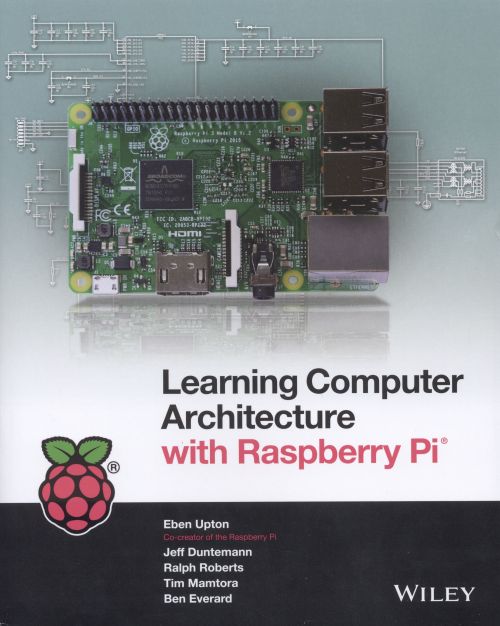
It’s Here: Learning Computer Architecture with Raspberry Pi

RPiBookCover-500Wide.jpg

I had just tossed a salmon filet on the barbie yesterday evening when the UPS man rang the doorbell. There it was: an author case of a book I signed in 2013, finished in early 2014, and have been waiting for ever since. I confess there were times I approached despair and thought the publisher might cancel it, but the concept had legs, and (more important than legs) Eben Upton was behind it.

It’s not all my own work. My co-authors include Ralph Roberts, Tim Mamtora, Ben Everard, and Eben himself. I wrote Chapters 2-7, which entailed about 100,000 words and 90 hand-drawn technical figures. (My chapters come to about 300 pages out of the book’s 507.) Eben wrote a few thousand additional words in my chapters on things that I don’t know well, like compiler internals. (I’m sure he contributed to other chapters too.)

The publisher hasn’t done an especially good job positioning the book, and it’s already being reviewed badly by people who thought it was something other than what it is. So let me position it for you.

Learning Computer Architecture with Raspberry Pi is an introduction to computer architecture for senior high students, and bright junior high students. It’s not a university-level treatment, though it might have application in community colleges. Like the Raspberry Pi itself, it was designed to be affordable to young people, and so it’s not 1,000 pages long. The cover price is $30 (exactly, no .95s or .99s!) and you can get it on Amazon for the inexpensive if peculiar sum of $18.07. It’s not a standalone manual for the board, nor programming the board, nor learning any given language or operating system. It’s about what all the pieces are, and how they work together.

This is important. Today’s young people are digital natives, in that there were cheap desktop computers, lots of them, since before they were born. Kids who are interested in computers have studied and experimented with those parts of the computer that interest them. This is the sort of learning that trips up autodidacts, since it runs very deep in places, but is shot full of holes, some of them huge. The way to fill those holes is to take a survey course, and that’s precisely what this book is for. The course syllabus itself may not exist yet, but I have a hunch that a lot of educators in a lot of places are already hard at work on curricula using the book as the primary text.

People who have read my other books will recognize the approach I took in these chapters: Start at Square One, at the absolute beginning, and tell readers up front that they can skip a chapter if they discover early on that they’re already familiar with the material. Chapter 2 is titled “Recapping Computing,” which goes back to the idea of “a box that follows a plan,” and continues from there. Some people will skip that chapter. Many won’t. A few may be annoyed that it exists at all. (There’s no pleasing some people.) Once you get past Chapter 2, each chapter is much more focused, and covers a specific continent on the larger world of computing:

2: Recapping Computing

3: Electronic Memory

4: ARM Processors and Systems-on-a-Chip

5: Programming

6: Non-Volatile Storage

7: Networking

Chapters 8-12 were written by others, and provide a Raspberry-Pi specific slant on things, especially graphics and I/O. I had not seen those chapters until yesterday, so I can’t say a whole lot more about them just yet. A cursory glance suggests that you won’t be disappointed.

That’s pretty much the story. I had something additional in mind that I didn’t talk about while I was writing my chunk of the book back in 2013: homeschooling. I wanted the treatment to be so clear and comprehensible that parents could use the book in a homeschool environment. I think I succeeded, but I won’t know until I hear from a few homeschoolers. Sooner or later, that’ll happen.

I needed a book like this back in 1970, but of course, it didn’t exist. Computers themselves were mysterious, and the computer gatekeepers seemed to like it that way. Not me. Nothing should stand between people who want to learn and what they want to learn. Nothing. If my lifetime mission as a nonfiction writer could be stated in just a few words, that would be it. I loathe elitism, credentialism, and exclusive-club-ism. I learned stuff, I wrote books about it, and now you can learn it too. If you haven’t started learning about computers yet, well, this is a pretty good time to start. And forgive me for saying so, but this is a pretty good book to start with.

Go for it!

Odd Lots

Rant: The Dragon Awards and the Convergence of Exiles

Forty years ago exactly, Carol and I were there in the throngs of MidAmericon I. The con was a celebration of Robert A. Heinlein and (by implication) all of hard SF. It was a tremendously popular con. The newly adult Baby Boomers were pouring into SF and conventions by the thousands. Many people began to fret that these enthusiastic new fans would swamp the longstanding traditions of fandom and turn fandom into something that fandom itself wouldn’t recognize.

Never one to let a supposed crisis go to waste, con chair Ken Keller had the concom raise prices to levels never seen before, finally $50 at the door without an advance registration. (This would be $211 in 2016 dollars.) Keller did something else: He tried to pitch the con as strictly for fans of capital-S capital-F Science Fiction, and stated pretty clearly that “fringefans” (that is, Trekkies and gamers and media fans generally) would find the con boring and should stay away. I don’t know Keller and I’m not sure how serious he was; it sounded like a publicity stunt even then. Lots of people made fun of him in the runup to the convention, myself included. I wrote several filk songs mocking MidAmericon, and one specifically mocking Keller.

At the time I thought it was just some guy throwing his weight around, and I doubt anybody gave much thought to the question: What if they really do go away? Heh. Guess what? In 1987, the first DragonCon was held. During the years since then, Worldcon attendance wobbled around a few thousand truefen, while DragonCon (and other media cons like ComiCon) absolutely exploded. At this writing, media cons routinely out-pull Worldcons by a factor of ten or more. (Sometimes a lot more.) By 2015, ComiCon San Diego had 167,000 people in attendance. Sasquan, the 2015 Worldcon, had…3,418. 2% of ComiCon.

Alas, across these past forty years, Worldcon has become a rounding error.

I’ve never been to a media con and I don’t have first-hand knowledge, but seeing reports from other authors, it’s become clear that media cons are not entirely superhero cosplay anymore, if they ever were to begin with. There are programming tracks on purely textual SF and fantasy, with author guests and signings, and all the stuff we used to enjoy doing at Worldcons.

Ok. It took forty years, but media cons have now matured enough and broadened their focus enough to give birth to a new award that touches on most aspects of the creative fantastic, including textual SF and fantasy. The Dragon Awards were presented yesterday. The list of awards has been posted on the DragonCon site. The award is a popular-vote award rather than a juried award like the Nebulas. It’s a fan award, nominated by fans and voted on by fans. How many fans exactly has not yet been released, though I hope numbers will come out eventually.

What struck me as significant about the Dragon Awards is that there are seven different categories for textual novels: Best SF, Best Fantasy, Best YA, Best Military SFF, Best Alternate History, Best Apocalyptic, and Best Horror. (There are, as you might expect, Best Graphic Novel and Best Comic Book categories as well.) There are no awards for short fiction, no art awards, and no fan awards. I think one or two art awards would make sense, and with some luck we’ll have those someday. I’ll give them some time to get it right. This was the award’s first year, after all.

Even though I’m way behind in my reading because of the Big Move, several authors on the winners list are people I have read in the past and much like, including the late, great Terry Pratchett, Larry Correia, John C. Wright, and my friend Brian Niemeier. What these four authors have in common (perhaps with others like Nick Cole whom I’ve not yet read) is a knack for telling a damned fine yarn without getting mired in identity politics or self-conscious message pie. Furthermore, Brian Niemeier won the award as an indie, with his self-published second novel, Souldancer.

If the Dragons are any reflection of the shape of media fandom, one of my longstanding suspicions has been confirmed: Media fandom is absorbing traditional SFF fandom. Traditional fandom has become fussy, elitist, and ideologically uniform to the extent that there is active hostility toward anyone who doesn’t either salute the progressive left or stay fastidiously quiet. This was not always the case, and I used to count among my friends many on the left, some of them very frank Marxists. (Some are still my friends. Others have called me a fascist or some other damfool thing for my Puppy sympathies and are long off my roster.) We used to have lively discussions of various political issues at cons, and nobody went home mad. But that was the 70s. I had hair, and fandom was young, tolerant and diverse. It was a short time comin’, and it’s been a long time gone.

At MidAmericon II last week, the concom ejected Dave Truesdale of Tangent Online for making several panelists…uncomfortable. (Really. I am not making this up. It’s in the Code of Conduct.) I heard the audio of his schtick and read many descriptions of the panel itself. The schtick was funny. Yes, Dave was mocking political correctness, just as I was mocking Ken Keller back in 1976. Keller didn’t throw me out of the con; I’m pretty sure he was too mature for that sort of nonsense. MidAmericon II has a code of conduct so broad that it basically allowed the concom to throw out anybody they didn’t like. Suppose I had gone to a panel moderated by John Scalzi and he made me uncomfortable. Would they throw him out on my complaint?

Hang on. I’ll stop giggling in a minute or two…

Ok. There. Whew. [Blows nose. Is glad he wasn’t drinking Diet Mountain Dew.] The point I’ll close with is something we should have learned forty years ago: If you abuse and insult people, they will leave, and avoid you from then on. Back in 1976, MidAmericon I insulted media fans, and little by little, they left. More recently, SF’s Insider Alphas have been insulting people who dare question progressive orthodoxy in fantastic literature, and those people are leaving. I didn’t expect that the two groups of exiles would converge, but that’s what appears to be happening. A young, diverse (see Sarah Hoyt’s description linked to above) and ginormous fandom is coalescing outside the fandom I grew up with. It isn’t conservative in any identifiable way. People aren’t leaving fandom because it’s almost exclusively left-leaning. (I recall it leaning strongly left forty years ago.) They’re leaving because fandom is now intolerant of dissent, and because far too many in fandom demonize all opposition. That’s not the left wing I encountered during the Vietnam era in the ’70s and once identified with. That’s just tribalism in a fandom costume.

If media cons remain at 100,000 plus attendance levels, I’ll have some issues, because crowds that big make me twitchy. However, some interesting things are happening. The people who created Phoenix ComiCon have created a new, smaller, and more focused event called Phoenix Fan Fest. Its emphasis is on comic books, and on interaction between comics creators and their fans, with a mere 15,000 or so attendees. If the ComiCon creators can break out comic books into their own event, why not textual SFF? They could do it if they wanted to. Given the emergence of the Dragon Awards, my guess is that sooner or later, they will.

At that point, the schism becomes complete: 5% of fandom will remain grumpy and exclusionary. The other 95% will just get together–in events both large and, well, less large–and have fun in one another’s company.

That’s not a wish. That’s a prophecy.

Odd Lots

Another Worldcon, Another Bonfire

So another Worldcon is now history, and people immediately began asking me what I thought. When Kansas City won the 2016 bid as MidAmericon II a few years ago, I’d had some hopes of attending. Then we decided to move to Phoenix, and our near-term lifestyle choices narrowed radically. Next year the con is in Finland, which would be a cool trip, but…well…no.

So all I know is what I’ve heard. And most of what I’ve heard about is, once again, focused on the Hugo Awards. Here’s the official summary. I wasn’t particularly surprised by any of it. Each of the three major factions won a little and lost a little. It’s a complicated business, and I’ve written several popular entries on the subject. If you’re coming to the Puppies Saga for the first time, you should probably read what I’ve written in the past:

The Human Wave, Sad Puppies, and SFF Monoculture, Part 1

The Human Wave, Sad Puppies, and SFF Monoculture, Part 2

The Human Wave, Sad Puppies, and SFF Monoculture, Part 3

The Human Wave, Sad Puppies, and SFF Monoculture, Part 4

The Human Wave, Sad Puppies, and SFF Monoculture, Part 5

Rant: Sad Puppies vs. Anti-Puppies, as the Kilostreisands Pile Up

Rant: You Can’t Shame a Puppy

Sad Puppies Summary and Wrapup

Rant: The Lasting Legacy of the Sad Puppies

Most of what I’ve linked to above applies to 2016, even though I wrote it all last year, and what I wrote focused on Sad Puppies 3. There was a Sad Puppies 4 campaign this year, coordinated by Kate Paulk, Sarah A. Hoyt, and Amanda S. Green. I wrote about that earlier this year, when the 2016 nominations appeared:

Sad Puppies 4 and the Doomsday Slate

As you can see from the marvelous SP4 logo from Lee “Artraccoon” Madison, the SP4 motto was “The Embiggening.” The goal was to bring still more people to Worldcon and the Hugo Awards process, as a means of fighting the worsening numeric irrelevance of the con and the awards. The other, more subtle goal of SP4 was to combat the ideological monoculture of Hugo-nominated fiction, art, and media, by nominating works and people outside the narrow boundaries of what’s acceptable to the ideological progressives in SFF.

Mike Glyer did a very good comparison of the final ballot against the Sad Puppies and Rabid Puppies lists back in April. Vox Day got 64 of his 81 recommendations on the final ballot, which I found nothing short of astonishing, especially considering some “poison pill” items like Chuck Tingle’s “Space Raptor Butt Invasion” and an episode of My Little Pony. Sad Puppies didn’t do quite as well, placing only 36 out of 80 recommendations on the final ballot.

A sidenote: I do not use the term “SJW” (social justice warrior) for a couple of reasons, which I’ll explain here on Contra at some point. Basically, it’s about accuracy and the objective meanings of words.

So what happened at MidAmericon II? These are the major items:

  • Sad Puppies 4 brought a significant number of new memberships to Worldcon. Attendance figures have not been released at this writing, but 4,032 valid nomination ballots were cast, and 3,130 valid voting ballots. That’s about twice last year’s numbers. Obviously, not all of those additional people were Sad Puppies supporters, but many of them were certainly APs (Anti-Puppies) who might not have joined except to counter the Puppies threat.
  • Virtually all of the winners were people and works favored by the Worldcon Elite and their loyal followers.
  • Vox Day continued his efforts to get the Worldcon community to destroy its own Hugo Awards by voting the doomsday slate of No Award over anybody recommended by either the Sad Puppies or the Rabid Puppies, or anything published by Vox Day’s publishing company, Castalia House. In the process, they gave him a fortune in absolutely free publicity, which he promptly used to build Castalia’s readership. I don’t know Vox and certainly don’t agree with all his positions, but I marvel at the hammerlock he has on his opponents’ attention. They. Just. Can’t. Get. Enough. Vox. Day.
  • MidAmericon II utterly soiled itself by expelling Tangent Online‘s Dave Truesdale from the con because he made several members of the Worldcon Elite…uncomfortable. Rob Kroese wrote up an excellent summary of that little disaster earlier today, and I won’t attempt to summarize here. Read The Whole Thing, as Glenn Reynolds says. Even Moshe Feder, definitely of SFF’s left wing, thinks that Truesdale did nothing even close to warrant expulsion from the con. As with Vox Day, Dave Truesdale got a fortune in free publicity. MidAmericon II basically lit a bonfire and threw itself into the flames.
  • The con venue made hotel room parties almost impossible, and so the much-anticipated Sad Puppies party had to be held sub rosa. I hope this isn’t a trend in con venues. Much of what we used to go for in the 70s and 80s were the room parties.

I’m not sure what more could be said, since I wasn’t there. Worldcon continued to make more enemies. John Scalzi smugly insists that the Puppies should all go home, a sentiment tweeted emphatically by the enigmatic Brianna Wu, who says that SF is her home, and not your (the Puppies) home. Howzat again? I was published and a member of SWFA before she was even born. Sheesh.

Scalzi has said more than once (and he isn’t alone) that Worldcon management should have the power to toss out any Hugo ballots that show evidence of slatework. Oh my, what could possibly go wrong? In essence, he and many others want the Hugos to become a juried award, with their people and only their people on the jury. He wants Sad Puppies supporters to leave the SFF fan community, perhaps not realizing that a great many of them already have, taking their money, their energy, and their insights with them. The great irony of the Worldcon progressive wing calling for more diversity is that diversity of worldview is quickly vanishing from Worldcon. It’s all progressive, all the time, all the way down.

To them that sounds like victory. To me and many others, it sounds like a bonfire.

Whirly Birds and Wherethehells

Move to a new house in a new state. Keep your stomach lining intact.

Dare ya.

Ok. Barely a day after we got here, I was putting stuff away in one of the 10-foot-high walk-in closets, lined on both sides with the best infrastructure that Closet Factory can offer, all the way up to the (distant) ceiling. Alluva sudden:

Drip.

I looked up. Took another direct hit on my forehead. The ceiling was leaking. WTF? The leaks were right next to one of our two heat/AC air handlers in the attic. As we later found out, there was a bad PVC pipe joint in the condensate drain line. By chance I had discovered the leak early: While I watched, three more drip spots appeared on the ceiling wallboard. This was on Saturday afternoon; I tried to contact the home warranty people, and was told by their answerobot to call back on Monday.

Screw that. It was 112 outside. We called a local firm that does service calls on Sunday and hoped that they would arrive before the closet ceiling caved in. They did. They found the bad glue-job in the drain line and fixed it. Now we have to get the ceiling wallboard replaced. Home warranties? Don’t get me started.

Oh. And birds. Last December we took delivery on an expensive patio table-and-chairs set, which spent the several months that we were in Colorado on the patio under the patio’s pair of ceiling fans. Well, without either dogs or humans to disturb them, the local birds took a shine to sitting on the fan blades, comfortably out of direct sun. Sitting, and something else that rhymes with it, in quantity.

Fortunately, the water pressure here is quite high, and our pressure nozzle got everything clean again. But…yukkh!

Carol came up with a solution: Turn on the fans to their lowest possible speed, which is about how fast ceiling fans turn in bad movies set in the African desert. We’ve watched some of the local birdies trying to land on the blades. They hover for a moment, confused, and then go elsewhere in a hurry. If I haven’t told you lately, I married a brilliant woman.

A few days later, I was carting a large and heavy plastic bin of recyclables out to the can. I stumbled, and hit my head on one of the light fixtures to either side of the garage door. No damage to my skull, but the light fixture’s pot-metal casting cracked off from its mount, and is still there swinging from its wires. The fixtures haven’t been available for probably ten years. So do we replace all eleven outside light fixtures with new ones? Or do we quietly swap in one of the fixtures from the hot tub courtyard?

Guess.

We have close to a quarter acre of quarter-minus pea-gravel. It has dawned on us that sun-baked dog poop is precisely the color of quarter-minus pea-gravel.

My new workshop is so small that there isn’t room to swing a ten-foot length of 1/2″ conduit. Don’t ask me how I know. I’ll be cleaning up the mess for some time.

I have misplaced my entire box of hookup wire. There will be no hooking up until I unearth it.

Having consolidated several toolboxes and bags, I realize that I own nine pairs of dykes, and three spring-loaded wire strippers. This sounds more interesting than it is.

The rat’s tangle of cables in a panel at the far rear wall of my walk-in closet includes four Cat 5 runs that vanish into the ceiling. There are exactly three RJ45 jacks in this house. So where does that fourth cable go? Is it flapping around loose in the walls? Or was it mistakenly wired into an RJ11 landline phone jack? (We don’t have a landline phone and don’t intend to get one.) I’d start removing RJ11 wall plates, except that it would rip up the paint on the plate edges. There is probably a gizmo that can tell me where that fourth Cat 5 is hiding. If you know what it is, please send me a link. I could probably lash something up, but there’s too much else to do.

And…finally…the wherethehells. The boxes are mostly gone, and in their place are piles of wherethehells. A “wherethehell” is something that you don’t want to get rid of, but have no idea where the hell it should go. Wherethehells breed freely in houses without basements. I still have several decks of punch cards from the FORTRAN course I took in high school in early 1970. Wherethehell should they go? What about my last remaining 8-track tape? My two photo tripods? The bundle of 4′ long Lionel track sections? My Lunar globe? We brought a great deal of stuff here in plastic bins. They’re now empty. What do we do with the bins?

The pool has largely kept us sane. Alas, when I jump into the pool, Aero panics and tries to hide on the other side of the house.

There is a second meaning to the command, “Don’t move.” It’s not in any dictionary I have (and I have more dictionaries than dykes) but trust me, I now know what it is.