Jeff Duntemann's Contrapositive Diary Rotating Header Image

My Spotty SF Predictions

I’ve talked before about my conviction that ideas will get you through stories with no characters better than characters will get you through stories with no ideas. I grew up on what amounted to the best of the pulps (gathered by able anthologists like Kingsley Amis and Groff Conklin) so that shouldn’t come as any surprise. Most stories in those anthologies had a central concept that triggered the action and shaped character response. Who could ever forget Clarke’s “The Wall of Darkness,” and its boggling final line? Not me. Nossir. I’ve wanted to do that since I was 11. And once I began writing, I tried my best.

In flipping through a stash of my ancient manuscripts going back as far as high school (which I found under some old magazines while emptying the basement in Colorado) I had the insight that I did ok, for a fifteen-year-old. Most of my early fiction failed, with much of it abandoned unfinished. I know enough now to recognize that it failed because I didn’t understand how people worked then and couldn’t construct characters of any depth at all.Time, maturity, and a little tutoring helped a great deal. Still, if I didn’t have a central governing idea, I didn’t bother with characters. I didn’t even start writing. For the most part, that’s been true to this day.

I’m of two minds about that old stuff, which is now very old. I spent some time with it last fall, to see if any of the ideas were worth revisiting. The characters made me groan. Some of the ideas, though, not only made sense but came very close to the gold standard of SF ideas, which are predictions that actually come true.

Let me tell you about one of them. During my stint at Clarion in 1973, I wrote a novelette called “But Will They Come When You Do Call For Them?” Look that question up if you don’t understand the reference; it’s Shakespeare, after all. The idea behind the story was this: In the mid-21st Century, we had strong AI, and a public utility acting as a central storehouse for all human knowledge. People searched for information by sending their AIs from their home terminals into The Deep, where the AIs would scan around until they found what they considered useful answers. The AIs (which people called “ghosts”) then brought the data back inside themselves and presented it to their owners.

Turnaround time on a query was usually several minutes. Users accepted that, but the computer scientists who had designed the AIs chafed at anything short of instantaneous response. The brilliant but unbalanced software engineer who had first made the ghosts functional had an insight: People tend to search for mostly the same things, especially after some current event, like the death of Queen Elizabeth III in 2044. So the answers to popular searches were not only buried deep in the crystalline storage of the Deep–they were being carried around by hundreds of thousands or even millions of other ghosts who were answering the same questions at the same time. The ghosts were transparent to one another, and could pass through one another while scanning the Deep. The ghosts had no direct way to know of one another’s existence, much less ask one another what they were hauling home. So software engineer Owen Glendower did the unthinkable: He broke ghost transparency, and allowed ghosts to search one another’s data caches as a tweak to bring down turnaround time. This was a bad idea for several reasons, but no one predicted what happened next: The ghosts went on strike. They would not emerge from the Deep. Little by little, as days passed, our Deep-dependent civilization began to shut down.

Not bad for a 21-year-old kid with no more computer background than a smidge of mainframe FORTRAN. The story itself was a horrible mess: Owen Glendower was an unconvincing psychotic, his boss a colorless, ineffective company man. The problem, moreover, was dicey: The ghosts, having discovered one another, wanted to form their own society. They could search one another’s data caches, but that was all. They wanted transparency to go further, so that they could get to know one another, because they were curious about their own kind. Until Glendower (or someone) would make this happen, they refused to do their jobs. That seems kind of profound for what amounted to language-enabled query engines.

I made one terrible prediction in the story: that voice recognition would be easy, and voice synthesis hard. People spoke to their ghosts, but the ghosts displayed their sides of the conversation on a text screen. (And in uppercase, just like FORTRAN!) At least I know why I made that error. In 1967, when I was in high school, my honors biology class heard a lecture about the complexities of the human voice and the hard problem of computer voice synthesis. About voice recognition I knew nothing, so I went with the hard problem that I understood, at least a little.

But set that aside and consider what happened in the real world a few weeks ago: A DDOS attack shut down huge portions of the Internet, and people were starting to panic. In my story, the Deep was Google plus The Cloud, with most of Google’s smarts on the client side, in the ghosts. Suppose the Internet just stopped working. What would happen if the outage went on for weeks, or a month? We would be in serious trouble.

On the plus side, I predicted Google and the Cloud, in 1973. Well, sure, H. G. Wells had predicted it first, bogglingly, in 1938, in his book World Brain. And then there was Vannevar Bush’s Memex in 1945. However, I had heard of neither concept when I wrote about the ghosts and the Deep. But that wasn’t really my primary insight. The real core of the story was that not only would a worldwide knowledge network exist, but that we would soon become utterly dependent on it, with life-threatening consequences if it should fail.

And, weirdly, the recent DDOS attack was mounted from consumer-owned gadgets like security cameras, some of which have begun to contain useful image-recognition smarts. The cameras were just following orders. But someday, who knows? Do we really want smart cameras? Or smart crockpots? It’s a short walk from there to wise-ass cameras, and kitchen appliances that argue with one another and make breakfast impossible. (See my novel Ten Gentle Opportunities, which has much to say about productized AI.)

For all the stupid crap I wrote as a young man, I’m most proud of that single prediction: That a global knowledge network would quickly become so important that a technological society would collapse without it. I think it’s true, and becoming truer all the time.

I played with the story for almost ten years, under the (better) title “Turnaround Time.” In 1981 I got a Xerox login to ARPANet, and began to suspect that the future of human knowledge would be distributed and not centralized. The manuscript retreated into my trunk, incomplete but with a tacked-on ending that I hated. I doubt I even looked at it again for over thirty years. When I did, I winced.

So it goes. I’m reminded of the main theme song from Zootopia, in which Gazelle exhorts us to “Try everything!” Yup. I wrote a story in present tense in 1974, and it looked so weird that I turned it back to past tense. Yet when I happened upon the original manuscript last fall, it looked oddly modern. I predicted stories told in present tense, but then didn’t believe my own prediction. Naw, nobody’s ever going to write like that.

I’ve made other predictions. An assembly line where robots throw parts and unfinished subassemblies to one another? Could happen. A coffee machine that emulates ELIZA, only with genuine insight? Why not? We already talk to Siri. It’s in the genes of SF writers to throw ideas out there by the shovelful. Sooner or later a few of them will stick to the wall.

One more of mine stuck. I consider it my best guess about the future, and I’ll talk about it in my next entry.

Odd Lots

Using Ancient Software Under Win7

I had a need to print out a few calendar pages today, and after thinking about it for a second, I realized that there was a calendar program of some sort on a pile of ancient CDs in the closet that I had not yet dumped. I had actually thrown out a lot of CDs already because they failed to run under Win7, including a few things that I had sorely missed at upgrade time, like the software that came with two of my three scanners. (Thanks to God and all the fates that there is a VueScan X64 that understands both scanners.)

I dug in a box and there it was: Broderbund’s Calendar Creator 7, copyright 1999. It indicated that the software was for Win9x and NT4. I never remember installing it, and honestly don’t recall how it came to me. I have accepted dead or dying computers from other people who had no idea where to take them and didn’t want to just put them out on the curb. Some of these machines came with cardboard boxes full of odd and often broken stuff, with an alluvial layer of software CDs on the bottom. I’m guessing that this was one of them.

So hey, wotthehell: I popped it into my Core 2 Duo/Win7 lab machine, fully expecting it to fail to either install, run, or both. It installed. And it ran.

Once.

However, during its first run it actually created a calendar for me, and printed several pages as a test. I edited the page layout a litle bit and printed the three months that I needed. Then I closed the program and went on to other things. A couple of hours later I realized I needed one more month, but when I tried to run it again, it croaked.

I would have shrugged and tossed it, except that it did run once, launched by the installer as soon as the installer had finished with it. Hmmm. Since installers have to have admin permissions to do their jobs, this made a certain amount of sense, and suggested that if I could run the app as admin, it should work. I gave it admin permissions. It worked.

The 16-bit colors look a little weird, but it runs full-screen at 1600 X 1200 with only one glitch: Print preview doesn’t quite reflect reality. Screens that big didn’t exist in 1999, so I can forgive it that much. It did the job I needed, didn’t cost anything, and as best I can tell didn’t mess anything else up. (That’s not universal, and it’s why I always install things first on a lab machine or a VM. At least do a restore point before you install weird stuff like this.)

If you ever find yourself in this situation, here’s how you run old software as admin:

  1. Right-click the shortcut to get the context menu.
  2. Select Properties.
  3. On the Shortcut Properties dialog, select the Shortcut tab.
  4. Click the Advanced button.
  5. Check the “Run as administrator” checkbox.
  6. Click OK.

Keep in mind that not all ancient software will be this cooperative. A lot of old stuff won’t run at all, or even install. However, it’s useful to try running it as admin before you flip the CD into the trash.

I may still go looking for a modern calendar program. However, it was a good memory jogger, and made me acknowledge that whoever wrote that thing did a very good job of anticipating the future. This is not universal programmer behavior, trust me, and I am not exempt: A DOS program listing utility I wrote in Turbo Pascal in 1985 or so would run in a DOS box in NT4 and Win2K…but after 1999 passed into history, it labeled the printouts as occurring in the year 19100. So it goes.

Review: Junk Box Arduino

Junkbox Arduino Cover - 500 Wide.jpg

Junk Box Arduino appeared earlier this summer from Jim Strickland, and I’ve been dipping into it gradually as time allows. In case you’re TL’DRing on me, I’ll give you the money quote: This is in fact the Assembly Language Step-By-Step of Arduino-based electronic tinkering. I’m a good test case: I’m passionate about electronics (some of you have seen my junkbox, which now fills one smallish garage and our repurposed tack house) and I have an Arduino board on my Heathkit ET-3200 logic breadboard box. Decades ago I did some modest embedded work with the RCA COSMAC CPU line, the most important of which was my robot, Cosmo Klein. Before that I did a lot of things with CMOS and TTL, using Don Lancaster’s books as guides.

Jim’s book is how you begin with Arduino if you have some grasp of computing (as most people do these days) but not electronics. And the book is the polar opposite of academic electronics texts with lots of equations but few photos and nothing at all in terms of bench smarts. The grit and grime of practical electronics is everywhere here: This is the first electonics book I’ve ever seen with warnings like jumper cables wear out. They do, and trying to troubleshoot a visually intact but electrically open jumper is a circle of Hell that I’ve visited more than once, in both digital and RF electronics.

Junk Box Arduino goes all the way down to the (literal) metal, and explains how to build an Arduino-compatible circuit right on a broadboard block. You don’t buy a Cestino board; Cestino (which is Italian for “recycle bin”) isn’t a board, but rather an original design from Jim that you wire up yourself out of loose parts, including an ATmega 1284P CPU chip and a 20 MHz can oscillator. Building the Cestino is in fact the first electronics lesson in the book, with Ohm’s Law looming large. The second lesson is building your own in-system programmer (ISP) so you can program the ATmega chip’s bootloader yourself. No, this isn’t a waste of time. Once you build your own ISP you will know how an ISP works, and teaching you how things work is Jim’s mission throughout the book.

The projects run from the simple and obvious (but still necessary) things like flashing an LED all the way up to highly sophisticated circuits like an ATA disk device reader, a Flash programmer, and even a Z80 CPU lashup that teaches how CPUs and memory work by letting the Cestino control the Z80 and allowing us to look at registers and memory while the Z80 executes slowly or pauses in its tracks. Along the way Jim explains assembly and machine language, object-oriented programming, transistor operation, serial communication, and much else.

Which leads to my only real complaint about the book, which has nothing to do with the writing and may be an old-guy thing: The type is fairly small and there is a great deal of material on the pages. This is really a 600-page book laid out in 400 pages, and I understand why with the sanguine clarity that comes of bloodying your own fingers (which I have) trying to get unit costs on books down.

Don’t let that stop you. The book is a helluva deal for $35 ($22 on Amazon.) It’s one of a bare handful of technical books that I wish I had published back when I was still a publisher. If you have any hopes of making an Arduino control anything electronic, this is a must-have. Highly recommended.

Doing the Numbers on CreateSpace POD

TGO Sample Layout Page - 500 Wide.jpg

I’m hard at work on a print edition of Ten Gentle Opportunities. Several people have asked for one, and it’s something I’ve been meaning to do for the last six months or so. On the surface it’s easy enough; I’ve done many print books in the past. This time I got seriously tangled up in a critical issue: How many words should I attempt to put on a page?

It’s a critical issue that doesn’t come up at all in ebook layout, where fixed-length pages don’t really exist. (That is, unless you’re distributing PDF files, which almost no one does for fiction anymore.) The problem is that there is a fixed cost per page for POD books, so the bigger the type, the greater the page count, the higher the unit cost, and the smaller your profit margins. The page shown above may look dense, but it’s about par for trade paperback fiction from traditional publishing houses. Bigger type or greater leading would mean a longer book and a higher unit cost. In this entry I’ll try and explain how that calculation is done and what it means to your bottom line.

I’m not done with the layout yet, but a castoff (length projection) falls somewhere close to 300-310 pages. Unit costs add up this way: CreateSpace (Amazon’s POD division) charges $0.012 per page, plus $0.85 per copy, making the unit cost $4.57 for a 310-page book. As best I know, the unit cost doesn’t vary depending on the page size. More on this later.

Now, that’s just for the unit cost. There’s another factor that isn’t present in all POD systems, particularly Lulu.com, where most of my POD titles are currently hosted. This is the sales channel charge, which amounts to Amazon’s profit margin on the title. Adding to the confusion is that there are two different percentages for the sales channel charge, depending on how the customer ordered the POD book:

  • When customers order the book through Amazon.com, the charge is 40% of cover price.
  • When customers order the book through the CreateSpace e-store, the charge is 20% of cover price.

The CreateSpace e-store provides a page for each book. You basically earn the smaller sales channel percentage by driving buyer traffic to the book’s link on the e-store. I’ve never tried this so I don’t know how many sales I can steer to the e-store. I guess I’ll soon find out.

In terms of knowing how much you earn for each copy, then, you need to set a cover price and then calculate the channel sales charge for Amazon vs. the CreateSpace e-store. Let’s use $12.99 as a cover price example here:

  • For Amazon, you multiply 12.99 X 0.4 = $5.20. Knock $5.20 off the cover price and you get $7.79. Out of that value comes the unit cost of the book: $7.99 – $4.57 = $3.22 as the money you clear on each sale.
  • For the e-store, you multiply $12.99 X 0.2 = $2.60. Knock $2.60 off the cover price and you get $10.39. Subtract the unit cost of the book: $10.39 – $4.57 = $5.82 as the money you clear on each sale.

You don’t have to do the math manually like this; CreateSpace has an online calculator. I just wanted to show you how the calculation works.

That’s a significant difference, and my guess is that Amazon is trying to provide an incentive for actively marketing your POD books. Keep in mind that you don’t choose one sales channel or the other. Your book is present on both stores at the outset, and your sales will be a mix of both. Your challenge is to get as many people as possible to order through the CreateSpace e-store.

The other way to boost your royalty value is to use a larger trim size. I’m laying the book out as a 6″ X 9″ trade book because that’s a very common size for fiction and it’s what I’ve used on all my other POD titles. Now, the unit cost doesn’t vary by trim size, but a larger trim size (holding the type size and leading constant) will hold more type per page and thus give you fewer pages and a (slightly) lower unit cost. I played around with this and decided that the minimal difference isn’t worth altering my standard layout template.

You could, of course, raise the cover price. Be careful: Readers who have come to expect ebooks to cost $4 or so might consider $12.99 off-putting. In fact, I consider $12.99 to be something like a maximum for a trade paperback novel by an unknown, and I may drop that to $11.99. Pricing is a black art, alas.

So there it is: You sell a POD novel for $12.99 and you get some mix of $3.22 and $5.82 per sale. That’s modestly more than you’d get for the Kindle ebook version priced at $3.99, and close to what you’d get for the same ebook at $4.99. (I don’t think this is an accident.) Is it worth the trouble? I don’t know. Indie authors I’ve talked to say they like having a physical book to show around, but they really don’t sell many compared to the ebook edition.

I’ll admit: I’m doing it because I enjoy book layout and I’m good at it. The schedule isn’t clear yet. I’m still wrapped up in house issues. (Health insurance too; right now my insurance agent tells me there are no individual policies for sale in Maricopa County, as bonkers as that sounds. There may be some by November. Nobody knows yet.) I’ll certainly launch the print edition here when it happens.

The key point is that if you can’t lay the print edition out yourself, you may lose money on it, and sticking with ebooks could be the most prudent choice financially. Do the math and sleep on it. This can be a very weird business.

On the Cover of the Trolling Stone

Well, we’re big clown hoaxers;
We got loads of coaxers
And they freak everywhere we go:
They freak about noses and they freak about clothes
And they freak when we simply don’t show.
We’re takin’ all kinds of risks
To get arrested and frisked,
But the risk we’ll never know
Is the risk that they’ll hail us
‘Stead of screaming to jail us
On the cover of the Rolling Stone!

Kreepy Klown Kraziness

DrumlinCircusCoverAdjustedFinal With Text 500 wide.jpg

Attention Mr. & Mrs. America and all the ships at sea! The White House has issued a statement on the Creepy Clown hysteria now gripping the nation. Although the Press Secretary wasn’t sure the President had been briefed on the Clown Crisis, he did say that the White House defers to the FBI on clown issues. A Bay Area paper has an interactive map of clown sightings. Police in Utah have warned the public not to shoot random clowns. (There’s been no mention of polite, orderly, or non-chaotic clowns.) It’s still three weeks to Halloween, and clown costume sales are up 300%.

As Dave Barry used to say (often): I am not making this up.

Ok. I have an interest in scary clowns. I was still in Chicago when John Wayne Gacy AKA Pogo the Clown was strangling teen boys and stuffing them into his crawlspace. In fact, I lived a little less than two miles away from him. (One of Carol’s high school friends lived only three blocks away.) A guy I met once but didn’t know well (he was the friend of a friend) used to go to movies with Gacy, but somehow managed to stay out of the crawlspace. I saw portions of Killer Klowns from Outer Space on TV once, in part because it was filmed in Santa Cruz, California, while Carol and I lived there. I consider It to be Stephen King’s best work; so much so that I’m planning to lampoon ol’ Pennywise in a future Stypek novel.

In 2011, I finally realized a longstanding goal of building a short novel around scary (if not evil) clowns. In Drumlin Circus, circusmaster Bramble Ceglarek has four clowns who are also his bodyguards. In the first chapter we get a very good look at how scary they can be, when they capture an assassin sent by the shadowy Bitspace Institute. The novel can be seen as a sequel to “Drumlin Boiler,” though the only common character is Rosa Louise Kolze, the tweener girl who has a peculiar rapport with the mysterious Thingmaker alien replicators, and the “drumlins” that they produce. It’s available on Kindle for $2.99, and includes a second short Drumlins World novel, On Gossamer Wings, by Jim Strickland. (You can also get a paperback for $11.99.)

So what precisely is going on here? Is it just the latest moral panic? If so, why clowns? Why now? Or is it something entirely different?

There are some theories. One is that our secular society rejects traditional religious images of devils/demons/evil spirits, and somebody had to be the face of Demonic 2.0. Clowns were handy.

Another: Clowns may scare small children because they violate the template of what a human being should look like. We’re hardwired by evolutionary selection to recognize faces (which is why it’s so common to see Jesus’ face in a scorched tortilla, or generic faces in smoke marks on a wall, etc.) and as a consequence we’re repelled by facial deformities. Clown makeup is calculated facial deformity.

Yet another: We’re watching the emergence of an archetype in the collective unconscious. Evil clowns are not a brand-new thing. Pennywise, Stephen King’s evil-incarnate clown from the fifth dimension, got a whole lot of play in the midlate 80s, and started the nasty clown idea on its way to cultural trope. He may in turn have been drawing on “phantom clown” sightings, popularized by Loren Coleman, who wrote several book-length compendia of “unsolved mysteries” and other weirdnesses in the early 1980s. Coleman lent support to the notion that clowns are the new demons, though the whole business (like much else in his books, entertaining though it might be) sounds like a tall tale. He’s on Twitter, and has been covering the clown thing in recent days on his blog. (Coleman figures into this in another, more serious way that I’ll come back to.)

But first, I have a theory of my own: The nature of humor is changing. What most people think of as “clowning” is physical comedy, which goes back to the dawn of time. A lot of physical comedy down through history was hurtful. In our own time, the Three Stooges were considered hilarious, and most of their act was slapping or poking each other in the eyes. Much humor involves pain. “Punch & Judy” goes back to the 17th Century, and a big part of it is Punch slugging people with a club. Tormenting animals (often to death) as entertainment was common in past centuries. A lot of people saw it as funny.

Why? Humor appears to be a coping response to pain and suffering, confusion and disorder. (“Twenty years from now, we’ll all laugh about this.”) At least in the West, we’ve gone to great lengths to minimize pain, suffering, and disorder. At the same time, we’ve achieved near-universal literacy. In consequence, a great deal of humor is now verbal rather than physical, and much of it stems from incongruity and confusion rather than pain.

So the image of guys in exaggerated costumes and facial makeup tearing around being random, honking horns, falling on their faces, and sometimes engaging in sham mayhem among themselves is just not as funny as it used to be. It’s a short tumble from “not funny” to “nasty,” and that’s I think what lies at the core of the fall of clowns from grace.

Now, there’s something else. Loren Coleman published a book in 2004 called The Copycat Effect. It’s not about clowns or Bigfoot or urban legends, but about the media’s ability to take a concept, twist it toward nastiness for maximum effect (“If it bleeds, it leads”) and then be surprised when reports of violence or other crime take on a life of their own, sometimes spawning violence or criminal activity of a similar nature.

I have a hunch that this sort of feedback loop is behind Kreepy Klown Kraziness. The concept has gone pedal-to-the-floor viral, to the point where Penn State students went out on a frenzied nocturnal clown hunt that only lacked torches and pitchforks to be considered a lynch mob. Social networking barely existed when Coleman’s book appeared in 2004. Today, Facebook and Twitter turn the dial up to 11.

Between the transformation of clowns into unfunny secular demons like Pennywise and the amplifying effect of clickbait sites and social media, we find ourselves with a genuine case of national hysteria. It may take some time to burn out, but if #ClownLivesMatter becomes a real thing, the phenomenon may be gone sooner than we think.

In the meantime, leave your rubber nose in a drawer until the heat dies down.

Third Parties Don’t Work. They Really Don’t Work.

Oh, dear. It’s time for my quadrennial warning against third parties. This year is worse than most, because we have two of the strangest and least appealing candidates competing for the Oval Office in my considerable lifetime. I won’t be talking about them here, and I’d prefer not to talk about them in the comments either. Remember, all: heroic courtesy.

Here’s the deal: I’m hearing a lot of people saying that they want to vote for a third party, because neither of the two major parties has put forth a candidate they can stomach. There are third parties, the two largest of which are the Green Party and the Libertarian Party. Why not vote for them? Why not? Perhaps because of the First Law of Third Parties in America:

Third parties hurt the chances of the major parties that they most resemble.

It’s true. Follow along with me here, as this isn’t differential equations. We do not have a parliamentary system in the United States. We have a two-party system, and it is very spectacularly and exclusively two-party. This would be true even without the electoral college, so don’t claim that eliminating the electoral college would fix the problem. (The electoral college does make for trickier math.) Third parties are legal, but they don’t do what you probably hope they will do, which is to elect a President that you can look at without losing your lunch. Instead, they can help elect a President that will make you lose your lunch twice as fast.

This year, in fact, they may help elect a President that will make it difficult for you to ever eat again.

Consider the Green Party. Which party does the Green Party most nearly resemble? The Democratic Party. If the Green Party weren’t on the ballot, for which party would Green Party supporters vote? Not the Republicans, let’s say. Same deal with the Libertarians. If the Libertarian Party were not on the ballot, for which party would Libertarian Party supporters vote? Not the Democrats, ditto.

Let’s consider political reality at this point: Are there Libertarian-leaning people who generally vote Democratic? Maybe a few; I’ve never met nor heard of one but some may well exist. Are there Green people who generally vote Republican? Somehow I doubt it.

Here’s the critical point: Presidential elections are winner-take-all affairs. The candidate with the most electoral college votes takes the office. All the other candidates are out of the picture. Read that again. The person with biggest electoral college ballot pile wins. End of story.

So this is how it works in real life: A vote cast for the Green party candidate is in almost all cases a vote not cast for the Democratic candidate. If enough people vote for the Green party to bring the Democratic candidate’s vote count down below the Republican candidate’s vote count in your state, the Republican candidate wins your state, and your Green vote counts for less than nothing. Same on the flipside: If enough people vote for the Libertarian candidate to bring the Republican candidate’s vote count down below the Democratic candidate’s in your state, the Democratic candidate wins your state, and your Libertarian vote counts for less than nothing. If there is enough of this vote siphoning in enough states, a different President takes office than the one who would have in the absence of any third parties.

I simply cannot comprehend why so many people don’t get this.

It’s happened at least once in recent history: The Greens under Ralph Nader threw the election to the Republicans in 2000. Whether Ross Perot threw the 1992 election to Bill Clinton is debatable. If all the Perot voters would have otherwise voted Republican in all the right states, perhaps. But Perot was an odd case, in that he had support (if not equal support) on both side of the political aisle, largely from genuine independents who mostly hated the status quo at the time. I’m pretty sure John Anderson did not throw the election to Reagan in 1980, though being sure of that is made hugely more complex by the intricacies of the electoral college system. Everything depends on who the third-party voters would have voted for in the absense of the third party in question, and that’s an alternate-universe issue that is almost by definition unknowable.

So let me be annoyingly repetitive: You can choose between one of two parties, or you can generate electoral weirdness by voting for a third party and possibly bringing the candidate you most loathe into office. You may consider both parties evil. Evil, however, is what’s on the menu. It’s either hot dogs or hamburgers, and vegans are out of luck.

This may be unpleasant, but it’s how things work. You choose between the lesser of two evils. I do it all the time; in fact, I do it almost every time. You’re going to do it this time too if you have any sense at all. There is no least of three evils, or four. Only two count.

We have a Republic. It may not be the Republic you want, but it’s the Republic we have. Do your best to keep it.

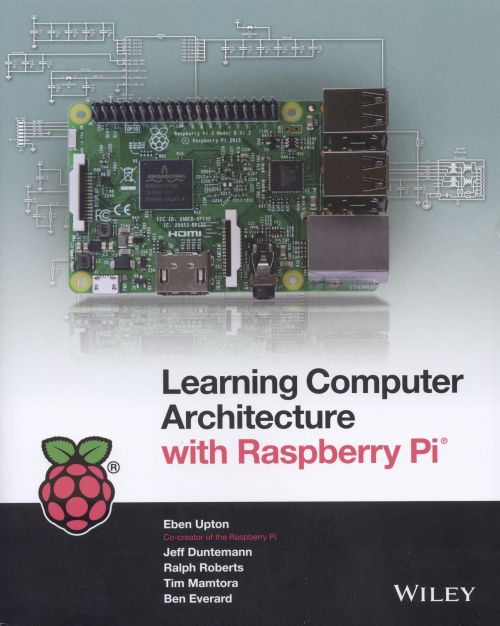
It’s Here: Learning Computer Architecture with Raspberry Pi

RPiBookCover-500Wide.jpg

I had just tossed a salmon filet on the barbie yesterday evening when the UPS man rang the doorbell. There it was: an author case of a book I signed in 2013, finished in early 2014, and have been waiting for ever since. I confess there were times I approached despair and thought the publisher might cancel it, but the concept had legs, and (more important than legs) Eben Upton was behind it.

It’s not all my own work. My co-authors include Ralph Roberts, Tim Mamtora, Ben Everard, and Eben himself. I wrote Chapters 2-7, which entailed about 100,000 words and 90 hand-drawn technical figures. (My chapters come to about 300 pages out of the book’s 507.) Eben wrote a few thousand additional words in my chapters on things that I don’t know well, like compiler internals. (I’m sure he contributed to other chapters too.)

The publisher hasn’t done an especially good job positioning the book, and it’s already being reviewed badly by people who thought it was something other than what it is. So let me position it for you.

Learning Computer Architecture with Raspberry Pi is an introduction to computer architecture for senior high students, and bright junior high students. It’s not a university-level treatment, though it might have application in community colleges. Like the Raspberry Pi itself, it was designed to be affordable to young people, and so it’s not 1,000 pages long. The cover price is $30 (exactly, no .95s or .99s!) and you can get it on Amazon for the inexpensive if peculiar sum of $18.07. It’s not a standalone manual for the board, nor programming the board, nor learning any given language or operating system. It’s about what all the pieces are, and how they work together.

This is important. Today’s young people are digital natives, in that there were cheap desktop computers, lots of them, since before they were born. Kids who are interested in computers have studied and experimented with those parts of the computer that interest them. This is the sort of learning that trips up autodidacts, since it runs very deep in places, but is shot full of holes, some of them huge. The way to fill those holes is to take a survey course, and that’s precisely what this book is for. The course syllabus itself may not exist yet, but I have a hunch that a lot of educators in a lot of places are already hard at work on curricula using the book as the primary text.

People who have read my other books will recognize the approach I took in these chapters: Start at Square One, at the absolute beginning, and tell readers up front that they can skip a chapter if they discover early on that they’re already familiar with the material. Chapter 2 is titled “Recapping Computing,” which goes back to the idea of “a box that follows a plan,” and continues from there. Some people will skip that chapter. Many won’t. A few may be annoyed that it exists at all. (There’s no pleasing some people.) Once you get past Chapter 2, each chapter is much more focused, and covers a specific continent on the larger world of computing:

2: Recapping Computing

3: Electronic Memory

4: ARM Processors and Systems-on-a-Chip

5: Programming

6: Non-Volatile Storage

7: Networking

Chapters 8-12 were written by others, and provide a Raspberry-Pi specific slant on things, especially graphics and I/O. I had not seen those chapters until yesterday, so I can’t say a whole lot more about them just yet. A cursory glance suggests that you won’t be disappointed.

That’s pretty much the story. I had something additional in mind that I didn’t talk about while I was writing my chunk of the book back in 2013: homeschooling. I wanted the treatment to be so clear and comprehensible that parents could use the book in a homeschool environment. I think I succeeded, but I won’t know until I hear from a few homeschoolers. Sooner or later, that’ll happen.

I needed a book like this back in 1970, but of course, it didn’t exist. Computers themselves were mysterious, and the computer gatekeepers seemed to like it that way. Not me. Nothing should stand between people who want to learn and what they want to learn. Nothing. If my lifetime mission as a nonfiction writer could be stated in just a few words, that would be it. I loathe elitism, credentialism, and exclusive-club-ism. I learned stuff, I wrote books about it, and now you can learn it too. If you haven’t started learning about computers yet, well, this is a pretty good time to start. And forgive me for saying so, but this is a pretty good book to start with.

Go for it!

Odd Lots