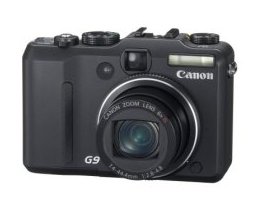
 Our neighbors Lena Olson and David Kuchinski came by for dinner last night, and Lena brought her Canon G9 digital camera. I've been looking for the successor to my well-used Kodak V530, and the G9 is an extremely impressive item. I was thinking that to get all of what I wanted, I would have to stay small and also go big, all the way up to a Digital Rebel SLR or something like it. The G9 falls somewher in the middle, and is about the same size and heft as the compact 35mm film cameras that Carol and used in the 80s and 90s.
I have some complaints about the V530, but it slips easily into my pocket and is all-metal on the outside, which is good if it's sharing the pocket with my keys and my usual quarter-pound of loose change. The V30 is great if you're going walking and want to catch the elusive Colorado wild turkeys that I seem to see only when I don't have a camera in my pocket. (Local bears are not as shy.) However, I do need something with more control over exposure, a somewhat better flash, more battery life, and (especially) better macro capability.
One of the things I want to do is take better pictures of smallish, small, and very small objects. Not microscopic objects—just things down, perhaps, to the size of a quarter. The V530 can focus on things that small, but its depth of field isn't good, its auto focus feature sometimes focuses on the wrong part of the artifact, and exposure control is poor for anything at macro range.
Lena is an award-winning sculptor, and artistic in ways I can never hope to be. I trust her judgment about artist tools generally, including cameras. She thinks the G9 is the best camera she's ever tried—and after I explained what I was looking for, she declared it just the thing and left it with me for a couple of days to see for myself. I took a few test shots with it this morning out on the back deck (where the diffused light of a mildly cloudy day was especially good) and am much impressed.
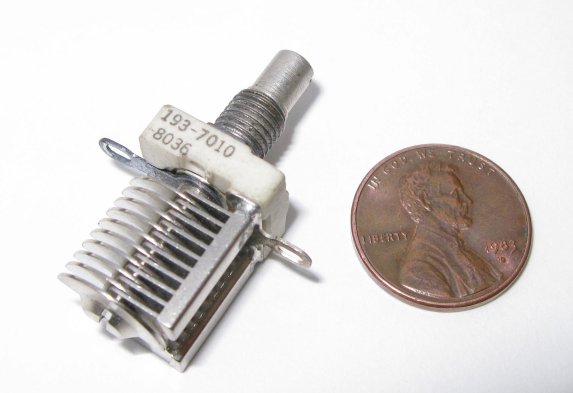
This was taken without knowing anything at all about what can be done with the camera's special options, and at least for Lulu projects, I consider it publication-quality. I want to see about increasing the depth of field while reducing shadows, but what I got was probably good enough.
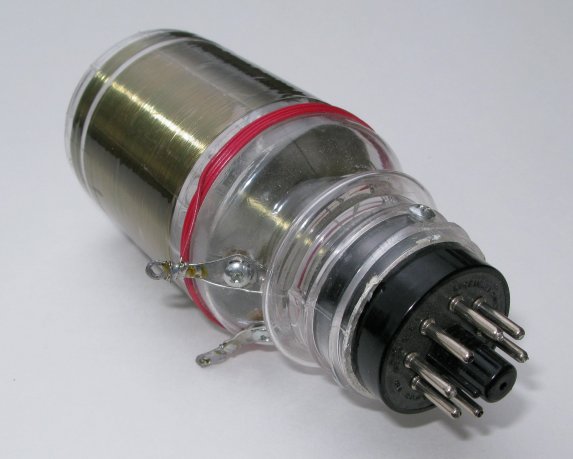
The photos I show here (both taken this morning) don't really put across how much detail is present in the digital files, which in their native mode are 3000 X 4000 pixels in size. You can zoom in until you fill the screen with an octal tube socket, which (for tube geeks like me, at least) was mighty surreal.
It's not significantly more expensive than the V530 was a couple of years ago (about $400 online) and looks like it will do the job. We'll see.
As an aside, I'm going in tomorrow morning to get a tooth pulled and the socket bone-grafted. The surgeon is also going to trim the gumline around the opposite molar. I'm likely to be under a fog all day tomorrow (and perhaps part of Wednesday) and may not post for a few days. Man, this dental project is getting old.
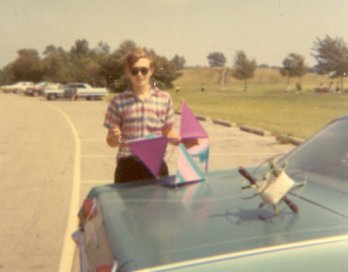 As we concluded our first date back on July 31, 1969, I somewhat apprehensively asked Carol if she would go out flying a kite with me on the following Saturday. I was building a tetrahedral kite out of my D-Stix set, and although my intuition was that this was not the way to impress girls, I gave it a shot, and she accepted. And so it was that we piled into my mom's '65 Biscayne and took my D-Stix tetra out to the huge Forest Preserve field at Irving Park Road and Cumberland.
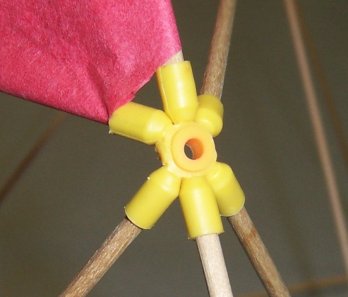 It was a natural. I took the same damned D-Stix pieces, bought some 1/8″ dowels, and I made us another tetrahedral kite. At some point I will create a Web page describing its construction in detail, but I'll just insert a few photos here. A typical joint is at right. The yellow connector originally had eight “ears,” but I snipped two off with a dykes to make the requisite six. (The four outer vertices were six-bangers from which I snipped three.) The paper was ordinary Hobby Lobby artsencrafts tissue, which I glued with Elmer's glue. Mucilage would be better—or at least more historically accurate—but they don't sell that at Hobby Lobby anymore.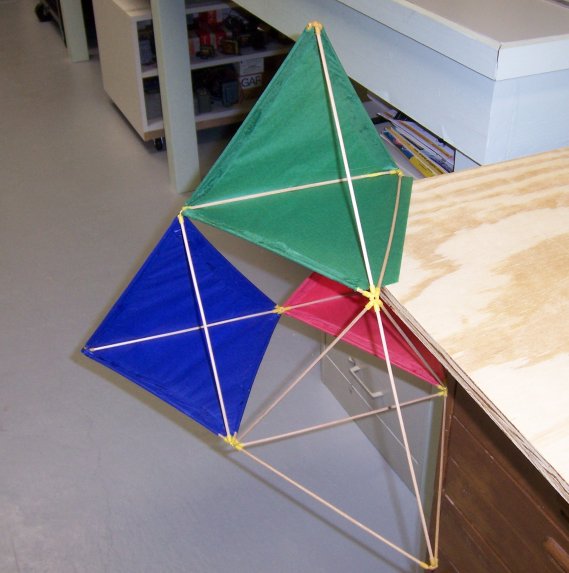
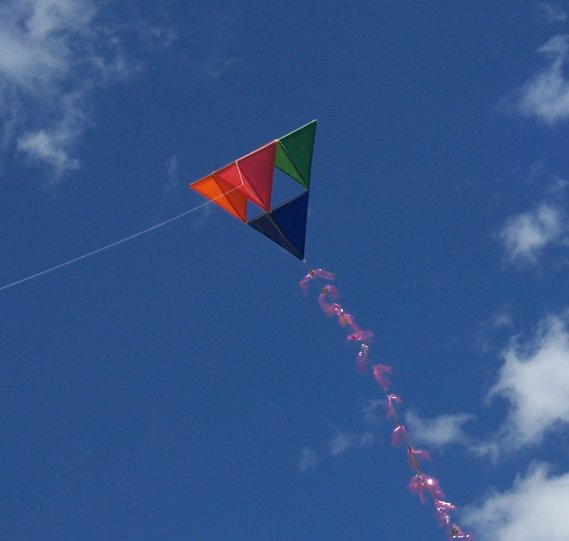
 I'm not as sanguine about
  And then there's