- Here at the condo this morning, I can't bring up squat on the Web because everybody's out there trying to figure out who won the Democratic primaries last night. So I did an absolutely unheard of thing: I went down to the White Hen, got some of their great coffee, and picked up a newspaper. What a notion.
- I'm hearing more and more people say that Wi-Fi doesn't work as well as it used to, which is weird because microwave physics hasn't changed recently. But…look at how many APs Windows can see from wherever you are. From my kitchen table here, NetStumbler sensed twelve APs…and walking around inside our dinky little condo picked up four more. Three of the strongest signals were on default Channel 6—and five out of sixteen were cleverly named “linksys.” I don't think it's the physics, folks.
- After Meetup.com went all-paid (and highly paid) I investigated an alternative called Gatheroo, which later (in response to another damfool lawsuit from somebody) became Zanby. The site's been redesigned and is worth a look if you want to start a meatspace social network where you live. There are both free and paid levels of participation, and it's certainly not as expensive as Meetup.
- Matthew Reed (and lots of others after him) sent me pointers to articles about the recent implementation of memristors, which are a species of passive electronic component postulated in 1971 but not actually implemented until HP researchers made some earlier this year. Whether this interests you varies directly by the strength of your passion for electronics, and whereas I understand the concept now, my head is still spinning trying to figure out what it implies. Everybody's talking about better computer memory, sure…but what could this do in simple analog circuits?
- Jim Strickland sent me a pointer to a YouTube video about a flame triode amplifier/oscillator lashup, and guys, you gotta see this. It's basically a vacuum tube without either vacuum or tube: When the electrodes get hot, it starts amplifying. I don't fully understand the physics yet, but this would be one fantastic high school science fair project. The question arose in our local group as to whether this could be considered steampunkish, and I'm not sure. People in the steampunk era had no problems generating reasonably hard vacuum and blowing glass envelopes. What they had problems with was understanding electrons. Nonetheless, with a big enough flame and some honkin' batteries, you could have done some impressive things back in 1888.
- Global Cooling adherents have been sending me pointers to Watts Up With That, and Icecaps.us. Fascinating reading, including numerous facets of the climate change discussion that you won't see in Big Media. F'rinstance: Weather monitoring installations that were built sixty or seventy years ago out in the leafy countryside have recently become surrounded by new development, buildings, pavement, etc., and as a result are now in the middle of heat islands. What might that do to long-term temperature data? Hmmmm….
Odd Lots
Josef Fritzl, Evil, and Dumb Luck
Most of you have probably heard by now of Josef Fritzl, an Austrian psychopath who created a custom dungeon under his home, kept his daughter a prisoner there for 24 years, and sired seven children by her. I haven't been this disturbed by a crime since the boggling case of John Wayne Gacy, right here in NW metro Chicago, who tortured, murdered and then buried 33 young men under his house back in the 1970s.
Like it or not, crimes like this prompt one to ask an ugly question: If evil like this is possible, why are we still here? Why are we not already extinct? (Those who have studied the history of the 20th Century might say it was a very near thing.) I have a theory, though I admit it's a little thin to hang the future of humanity on: It's difficult to be brilliant and evil at the same time. Evil as we define it generally comes with limitations, primarily the limitation of not being able to see yourself and your own situation very clearly.
Right Men (as described by A. E. Van Vogt and Colin Wilson) are the best example: They just cannot conceive of the possibility that they are wrong. A huge number of Right Men thus never get very far in life. We see through them easily, recognize them as egomaniacal psychopaths, and do our best to avoid them. They have a bad habit of getting injured or killed in conflicts with others. Even when they somehow succeed in society to a degree, they are almost invariably humbled at some point, which is unbearable to them and often causes them to die young.
This is a good thing for us, as truly brilliant evil is extremely dangerous. What most “ordinary” evil people (like Fritzl) have that isn't often remarked upon is simple, dumb, statistical luck. Most criminals get caught eventually, and the worse their crimes are, the more likely they are to get caught. Some vanishingly rare few end up skating past justice for years and years (like Fritzl), and we only see a couple per century who are so lucky that they end up in command of armies. (Think Hitler, Mao, and Stalin.)
There are a lot of Fritzls out there. Most try evil things and get caught very quickly; you see them on the news all the time with their coats over their heads. Some get by for awhile, through a combination of luck and unusual intelligence. Only a handful are lucky enough to get away with the sort of depravity that John Wayne Gacy or Josef Fritzl got away with. Choosing an easily concealable form of evil is part of that luck, and sometimes there is a lot of cunning hard work involved. (Like creating a custom dungeon with flush toilets in the basement, or burying 33 bodies under your house without stinking up the neighborhood. I still don't entirely understand how Gacy managed that.)
As for where individual evil itself comes from, I think (against all political correctness) that it's primarily genetic. We're born along a bell curve, with Mother Teresa on one end and Stalin on the other. The optimist in me would like to think that the curve is biased toward the good. But whether or not we're evenly distributed across that bell curve, good and evil as success strategies are not symmetrical. Good is outward-looking, cooperates with others, and is generally supported by society as a whole. Evil handicaps itself in various ways. (Read Colin Wilson's A Criminal History of Mankind for hundreds of pages of examples.) Evil overestimates its chances, isolates itself, picks fights, and operates within a seriously distorted view of reality. This is fortunate, otherwise we'd long be extinct. But every now and then an evil individual gets catastrophically lucky, and we witness crimes that make us gasp. Given the huge number of moving parts in our seriously overstuffed world, this is inevitable, and the real astonishment, perhaps, lies in the fact that evil remains as rare as it is.
In the Port 2525…
Finally got out to Chicago and spent a mad few days visiting family and running errands, after presenting two sessions at the annual conference of the American Society for Indexing in Denver last Friday. I gave the keynote talk and it was well-received—my position that pages are essential and reflowability is a fetish that carries a lot of subtle dangers—but the other talk, which was basically a how-to on getting Windows to work tolerably well, was SRO. People are still struggling with Windows, and when I asked, their reaction to Vista was basically unprintable. I got the impression from their questions after the session that something like Degunking Windows needs to be done again, but covering both hardware and software in the same volume. We did a separate book a couple of years ago called Degunking Your PC, and if I do something again, it will draw on both books. I'm taking notes. We'll see if and where it wanders.
Computer crankiness always seems to erupt as soon as I kick my shoes off and get to work at my Chicago-area satellite office. When I tried to answer some email here, I found to my supreme annoyance that ATT/Yahoo had changed the game again: Simply blocking port 25 and requiring that all outbound mail pass through their SMTP servers was not enough. Now they require that every From: address has to be explicitly registered on their Web site or the SMTP connection to their servers will be blocked.
Screw that. I did a little research based on a fleeting memory that some hosting services listen on ports other than 25 for outbound email, and voila! My hoster listens on port 2525, and after 90 seconds' worth of tweaking Thunderbird's settings, I was able to answer mail again.
Ructions didn't end there. About ten minutes after booting up, my video signal started going crazy. I took the SX270 apart, determined that the insides were squeaky clean and not especially hot, and was scratching my head after seeing the problem persist after a couple of reboots. In frustration I gave the Samsung 204B a hard whack on one side, and the video signal fell immediately back into line. Because the cables were quite tight, I can only assume that the damned thing has a loose connection somewhere internally.
Anger sometimes works, heh.
My Last Brin. Really.
Not ten minutes ago, my brother-in-law
Those who haven't been following Contra for very long may not know precisely what's going on here, and I still boggle a little myself, SF guy though I claim to be. Recapping: For medical reasons, my sister cannot carry children to term herself. After conceiving in vitro years ago and storing the embryos under liquid nitrogen, Gretchen and Bill went off to find a gestational carrier to bring their children to term. It wasn't exactly easy, but mission accomplished: Katie Beth Roper now has a sister, born at 8:10 AM this morning, central daylight time. Nine pounds nine ounces, no problems reported.
Deo gratias.
My immediate family is complete. We'll be on a plane Saturday to head out there and celebrate.
Between Fire and Ice
Sure, maybe the guy's a nut, but I'm a contrarian and I love heresies. There certainly seem to be fewer sunspots this cycle than we're used to, and cooling climate trends are definitely correlated with things like the Dalton Minimum and the Maunder Minimum. I've sometimes wondered if the Little Ice Age was “little” because we aborted it by throwing CO2 into the atmosphere in serious quantities. Absent that, we might all be cavemen in an ice wilderness by now.
Ahh. Maybe the Earth really has a little old lady named Gaia somewhere pulling strings. Maybe prescient whales (or sentient mushroom rings in the English forests) saw it coming and carefully guided the evolution of humanity so that it would control fire. Fire is addictive. Do enough of it, and you can keep the atmosphere warm through the greenhouse effect. Maybe the Earth got tired of being cold, and it evolved us because it didn't have any leg warmers.
Climate is an interesting business. The Earth seems to teeter between fire and ice, but from what we know of our geophysical history it prefers ice. If the sunspot dearth is a leading indicator of reduced solar activity, we may have a few years to do…what? Buy Hummers? Whoops. We already tried that.
Ok, ok, correlation is not causation. I'll shut up. Still… At least in Colorado Springs, this was The Winter That Wouldn't End. And it snowed in Chicago last night. If this keeps up I'm moving back to Arizona, thank you very much. I hear that when the ice sheets get as far south as Nebraska, the mammoth hunting is better there.
Clay Shirky’s Cognitive Surplus
- The consequences of the invention of gin are very well covered by Colin Wilson in his book A Criminal History of Mankind. The problem was not solved for 200 years—the urban poor drinking themselves to death was the primary reason for Prohibition—and it's still not entirely clear to me how it was solved. My guess: Universal education and technology (think TV) allowed the poor to entertain themselves in less destructive ways.
- Do we really watch two billion hours of TV every year, or are TVs simply on for two billion hours? In many households, TVs provide a sort of background noise to prevent too much disturbing silence, but how much attention is paid to the box is a lot more difficult to measure, and I suspect Big Media would prefer that no one try.
- TV is often watched for the many but very small time slices that it takes to catch the news or weather. Carol and I watch very little TV but The Weather Channel, and we watch it in small chunks of a few minutes a few times a day. It adds up, but converting those dispersed minutes into productive brain-time may not be possible. The problem here is not a shortage of time but a shortage of focus, which is a separate and worthy discussion.
- Almost incredibly, Shirky does not say much about the immense cognitive energy already spent on collaborative noncommercial cognitive projects. Think Linux and all open-source software, tens of thousands of free ebooks scanned and formatted from out-of-copyright sources (and a few in-copyright sources, like some of mine, sigh) not to mention the work of all those Pixel-Stained Technopeasants who had their day (April 23) last week. This is not new news, though it's good for it to be pointed out now and then.
- Nor is much said about the general rise in volunteering in more traditional social service pursuits, which by and large are not cognitive in nature. As problematic as I consider some of his conclusions, much good data on volunteering is cited in Arthur Brooks' Who Really Cares? Not all time and energy released from TV watching now goes into, or would go into, cognitive pursuits.
- And the ugly truth that no one seems willing to recognize: A huge percentage of people simply don't have the ability to contribute meaningfully to cognitive projects. This may be by genetics or by adverse circumstances, but it's true nonetheless. I keep thinking that a lot of them, if there were no TV, would go back to gin or to worse things that didn't exist when gin was invented in 1740.
My early conclusion: There's less cognitive surplus than the article suggests, and less upside to be gained by turning away from TV. People inclined to be creative already cluster toward the bottom of the TV time curve, and a lot of the people I consider brilliant don't watch TV at all. There is almost certainly an irreducable minimum number of people who need TV as an anaesthetic, and this number may be higher than we care to admit. Loneliness, clinical depression, and other psychiatric problems dissipate and render useless an immense amount of human energy, and we don't seem any closer to solving those problems than we were in 1740. Those problems may not in fact be solvable, though saying so won't make me any friends.
Still, anything that nudges people away from the box toward creative or collaborative pursuits of any nature is a good thing. My problem at this point in my life is not TV but sleep, since I need ten hours in bed to yield eight hours of useful sleep cycles. The time I used to spend commuting I now spend wondering why I'm not asleep, and if I could lick that problem I would get a great deal more done.
Odd Lots
- We had rockfish for dinner the other night, and since I didn't know exactly what I was eating, I researched it (it's nothing remarkable; a sort of domesticated sea bass) but in the process I happened upon a brilliant little animated hard SF short about an unflappable interstellar sportsman of the future who goes out with his faithful pet monkeydog and trolls for The Big Catch: “Rockfish.”
- While we're doing animated videos, don't miss the charmingly inane steampunk short “A Gentleman's Duel” from the same studio.
- From Frank Glover comes a pointer to an interesting article about whether there are “habitable zones” in our galaxy. We're caught between our schedule, our metals concentration, and our supernovas, and ferdang, somehow we got placed “just right.” I'm always a little suspicious of charts that somehow get us dead-center. Supernovas may trigger lots of interesting things, from radiation-proofed cellular reproduction systems to “novel” stars and planets. I'm far from sure that zones closer to the Core are so deadly as to preclude the evolution of any kind of life—just Life As We Know It.
- Are you nervous about European-style national health care? You should be.
- Also from the NYT: The housing crash will likely cut the US birth rate, which roughly tracks housing availability and may be the reason that the birth rate is so low in Europe, with its staggeringly high housing costs.
- A compendium of really weird products, including wedgie-proof underwear and a Hilary Clinton toilet bowl brush. What boggles the mind is that this is not a collection of hoaxes: All of these items are real.
- Here's an eye-crossing but interesting paper that explains a lot of why I dislike competitive sports.
- From David Stafford comes news of one of the most bizarre motorcycles ever imagined. It's electric. It works a little like the Segway. It gets points for design, fersure, but…you ride. I'll watch.
Nothing is Sewn Up Yet
By the grace of the Pennsylvania Democratic primary, tonight we may know who will face off against John McCain this fall. Many were saying that by tonight we may know who our next President will be, but even though Big Media long ago declared Obama the King of the Universe, our Great Pretender has been caught saying the same stupid condescending things about rural whites that the educated white elite used to say about urban blacks. Hilary's gotten herself caught in a few gaffes herself, but she's not the naïf that Obama is and has kept herself closer to the center. It's still a tossup between them. Tonight may nail it, but it may not.
I don't do politics here very often, so I'll offer a few notes on the race so far and be done for another month or two:
- There are clearly no such things as “private remarks” or “this is off the record” anymore. We've taught our young people for years that politics has no rules, that outright hatred of whole groups for political reasons is completely acceptable under the banner of the First Amendment and “political speech,” and that it doesn't matter how you do it as long as you win. Those striving for elected office these days have to be very careful what they say and where they say it, because the blogosphere is full of people who will gleefully publish it and by doing so make it eternal. The Internet never forgets. Better to just shut up and quietly stand on your record, if you have one.
- Something I've noticed in talking with political independents for many years is that independents don't believe campaign promises. They understand completely that lying is legal, and that the only way to judge a candidate is to look at his or her record in detail (including—or especially—where their money is coming from) and then extrapolate linearly into the future. When you give stirring campaign speeches full of promises, you are reassuring your base, not persuading the center to move in your direction. Independents call BS on anything candidates say since they first declared themselves.
- There is a difference between what people say to friends (and to pollsters) and what they do in the privacy of the voting booth. It's something like caucusing in the months leading up to the election: People will say the things that they think they are expected to say (like “I'm voting for Obama!”) to avoid unpleasantness and conflict within their inner circles. This is a survival tactic if you live among political tribalists from either side of the spectrum. On election day, the magic of the secret ballot makes it possible for “survival centrists” to vote their true hearts, knowing that no one will catch them out in any lies made earlier to keep their scalps intact.
- The American electorate is still very closely divided, and it doesn't take a lot of votes to tip an election. Nobody has anything sewn up.
Some final speculation pertinent to this last point: Many across the political spectrum have already written off John McCain, but that's a mistake. McCain is not seen as a “real” Republican in some quarters on the right, but Republicans are better nose-holders than Democrats, and come November McCain will get their votes irrespective of the Democratic nominee. McCain has cleverly kept his VP spot open (and generally kept a low profile) and probably will until he is absolutely sure what he's up against. Having played the race and gender cards intensely for a couple of years now, the Democrats have legitimized this kind of tokenism in the public eye. McCain could easily win against Obama by partnering with either a black or a Hispanic. He could win against Hilary by partnering with a woman of any color. In either case, it doesn't matter who. It's sad that it's come to this, but that's how American politics is now played, and both political parties had better be ready to reap the whirlwind in unexpected ways.
We Caught Bigfoot!
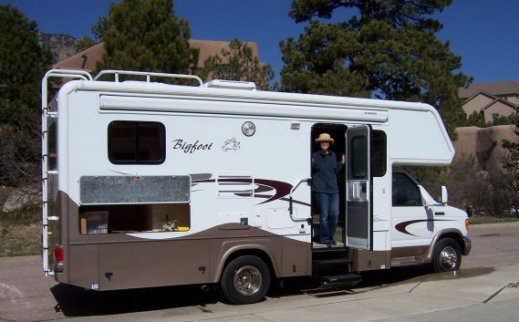
Yes, Carol and I caught a Bigfoot a couple of weeks ago. Big, yes: 25 feet long, and just under 12 feet high. Feet, no: Our bigfoot has wheels. What we caught was a never-used 2006 Bigfoot Model 30MH24DB RV, and the capture was a bit of an accident. The local Bigfoot dealer here in Colorado Springs went bankrupt, and we heard that their inventory was being liquidated. So although it wasn't precisely what we were looking for, the price asked was so stunningly good that we decided to give it a shot.
Carol and I have rented RVs before, and I've described our adventures in this space. We haven't been able to travel as much as we would like, especially here in the West. Our experience staying in hotels in out-of-the-way locations has been very mixed (you can't always find a Hyatt when you want one) and this is one solution.
We bought it about a month ago, but that was serendipity, and we didn't have a chance to actually take it out on the road until this weekend, when we went out with our church's RV group. The destination was Mountaindale Campground, which is only 16 miles from our front door, south down Highway 115 toward Cañon City. We think traveling with more experienced RVers is a good idea until we get our RV chops, and that has worked out very well, especially considering that two of the people in our group are RV repair technicians, one of whom actually worked for some time at the Bigfoot dealership that went under.
The Bigfoot is a little taller than a lot of Class C RVs (Class Cs are the ones with van-ish cabs and a bulge over the cab) and what that buys is storage space. Beneath the floor are several compartments that can hold a lot of stuff, one of them big enough to lug a considerable telescope. Being from Canada, the unit is much more heavily insulated than RVs built here, not that I intend to do a lot of cold-weather camping. Insulation works both ways, and we have hopes that it will take less A/C to keep it cool in summer.
The weather for our first outing was stunningly good. Most of what I did was learn how to operate and maintain the unit, which has a manual so thin and poorly done that it may well be worse than blissful ignorance. (I had to slap myself to keep from outlining Bigfoot RVs for Beginners in my head as I was struggling to make sense of the electrical system.) Carol and I did take QBit and Aero for a hike up to the top of a nearby hill, but most of the time we spent taking it easy in the company of friends, and listening attentively to RV war stories. I may well write my own damned manual just to keep all the heuristics straight, and if it gets good enough to go up on Lulu, so much the better. In the meantime, we have a vehicle in which to see some of Colorado, and attend local dog shows where Carol will be showing Aero. (There is a lot of RV culture in the dog show world—and in fact at the recent Tarry All show north of Denver we ran into a couple who travel in a Bigfoot unit identical to ours while showing Gordon Setters.)
I'm not sure I could live in it for weeks and weeks, but it will get us around to the mountains I've never seen and don't want to miss in this life. As for computing in an RV, more on that as time allows. I learned a lot this weekend, and am learning even more reading the RV forums online. One addditional thing I learned is this: Don't use Vista. Really don't use Vista. Every time I have to rescue somebody from its clutches—as I did this weekend—I hate it more. Ubuntu 8.04 comes out in three days, and there's a partition waiting for it, on an SX270 machine that I may “build in” to the Bigfoot. Again, more on that has it happens.
Odd Lots
- Ok. It's April 16, and outside it's 30° and blizzarding. There's about two inches on the ground already and we may get another 4″ – 6″ tonight. Would you fools please stop calling it “global warming” and start calling it “climate change” before the whole world decides we're idiots?
- In one respect the snow is welcome: There were two very bad wildfires here in the last couple of days, one of them only about fifteen miles due south of me, and the smoke was bad enough to make my allergies go ballistic this morning.
- Interestingly, the fire broke out about a quarter of a mile from where we intend to go RV camping the day after tomorrow. (As best we know, the campground has not seen any fire or other damage on their land.) Snow seems to follow us on camping trips. (That little adventure was on the last day of summer, people!) We're hoping this time will be different.
- Democrats in Congress are spearheading an effort to compel states to collect state taxes on out-of-state online vendors. Far from targeting corporate fat cats, the effort will cost ordinary people, including some fairly poor ones, a great deal of money. Tell me, now: How is this supposed to help you win elections?
- I just bought an off-lease, nearly flawless Dell Optiplex SX270 3.2 GHz Pentium 4 with a 60 GB hard drive and a DVD-ROM…for $199. Computers, like books, have gotten so cheap that they're basically disposable. If this machine dies any time soon, I'll just buy another, wincing a little to imagine that my 1978 Intersystems DPS-1 S-100 bus machine with a 1 MHz 8080 CPU cost me $3600 1978 dollars. (It was the first and still the coolest-looking computer I have ever owned that I did not build myself.)
- The story I could not identify in my April 10, 2008 Odd Lots (about a guy who extracted gold from seawater) was “The Man Who Ploughed the Sea” by Arthur C. Clarke, and it was a Harry Purvis story from Tales from the White Hart.
- From Bruce Schneier's CryptoGram comes a pointer to a wonderful little piece on what sorts of books bookstore shoplifters lift, and what sort of man a bookstore shoplifter is. (You do subscribe to CryptoGram, don't you?)
- The lyrics to one of the funniest pop songs ever to hit the Billboard Top 20 are (legally) online, at the author's Web site: Dean Friedman's 1976 “Ariel.” It's one of the few songs I would ever consent to perform in public, though that would require that I learn to play some kind of an instrument. Maybe this.
- Bob Thompson sent me a link to one of his posts relating (as my entry for yesterday did) to catalogs of the 1960s, in this case the Sears Catalog. His comments pertaining to chemistry sets are bang-on, though I would add that a significant amount of the value of chemistry sets lay in allowing kids to imagine themselves as scientists—chemistry has more identifiably iconic paraphernalia than almost any other scientific discipline—and what kids can't imagine themselves as, they generally won't become.