- I've posted a significant update of my Carl & Jerry page, with new material on John T. Frye, including the conclusion I've drawn (with help from 1910, 1920, and 1930 census records provided by Bob Ballantine W8SU) that Bailey Frye was not John Frye's brother. Bob also sent out a scan of W9EGV's QSL card, worked up against a 50s cover (not sure precisely what issue) of Boy's Life. New details from newspaper clippings sent me by Michael Holley flesh out the man a little. He was quite a guy. Do take a look.
- Science is good at puncturing legends, and German researchers digging around in the former backyard of Martin Luther have deflated the legend that Luther was a humble monk (and, by implication, starving) but was instead born to an upper-class family and became a prosperous man who weighed 23 stone, 8 pounds (330 pounds for us Yanks) and ate goose, young piglet, several kinds of fish, and (egad) robins. Nor did he pound his 95 theses to the door of the Wittenburg cathedral in a fury with nails, as legend holds, but instead used drawing pins—what in America we call thumb tacks. Oh, the humanity…
- While researching Marian apparitions for a seminar I'm teaching at our church in November, I ran across the Apparitions of Jesus and Mary Reference Chart. It sounds silly, but trust me: The apparition curve has gone exponential in the last 30 years, and you can't tell the Marys without a program anymore.
- I'm in the Chicago area for a few days, and found on my arrival that the legendary Choo-Choo Restaurant in Des Plaines (just down the street and around the corner from our condo) is in danger of being razed to make room for a new police station. There's a Web site for gathering protest and forwarding it to the City of Des Plaines, which apparently can either raze the Choo-Choo or the defunct Masonic temple across the street. I don't quite understand why that's a hard decision.
- Harry Helms sends word that TV Guide, which Rupert Murdoch bought ten years ago for three billion dollars, has been sold for…a buck. Boy, the magazine business is not what it used to be. (If it were, I'd still be in it.)
- Slashdot reports a bit of useful black humor, in that Codeweavers (makers of the Crossover product line) gave the Bush administration a challenge: Reduce the cost of gasoline in the Twin Cities below $2.79 a gallon, and they would give away their products for an entire day. Well, courtesy the recent financial meltdown (which was not caused exclusively or perhaps even primarily by the Bush administration, by the way) gas has gone south of $2.79, and while the Codeweavers site has been Slashdotted into paralysis, there is a facility online whereby the firm will email you an unlock code for something. I've been meaning to try Crossover Linux for some time. Here's my chance, I guess. And gas in Colorado Springs is even cheaper than that. Inc(Boggle);
Odd Lots
The "Pepper Riots" and the PNCC
History is often written by the victors, and one of the gnarliest problems with victor history is not what the victors say, but what they leave out. You can ask the losers what they think, but sometimes what the victors leave out is something the losers would just as soon forget as well.
I learned something today about the founding of the Polish National Catholic Church, the first significant Old Catholic jurisdiction in America. The history we have of the PNCC describes the the tension between the predominantly Irish Roman Catholic clergy in America and the waves of dirt-poor Polish immigrants who started arriving in the late 1880s. This tension did exist and was the energizing force behind the Polish Old Catholic movement, but the actual triggering incident in the split between Polish immigrants and the Roman Catholic Church may have been a riot at St. Hedwig's Church in the Bucktown neighborhood of Chicago.
Some of the story is here; scroll down about a third of the way through the article. I'll summarize: Overwhelmed by the numbers of new immigrants pouring into Bucktown, the Polish-American pastor of St. Hedwig's brought in Fr. Anthony Kozlowski, a fiery, European-educated young Polish priest to help minister to the parishioners, few of whom spoke English. St. Hedwig's was under the administration of the Resurrectionists, an order of priests of mostly Polish extraction. Their former nationalities aside, the Resurrectionists were conservative and fiercely loyal to the Pope. The order attempted to play down the Polishness of religious expression at St. Hedwig's. Many of the younger immigrants were suspicious of the order, thinking that it was being pressured by the Irish hierarchy that otherwise ran the American church, and the Chicago church in particular. Details are thin, but in early 1895, Kozlowski led a revolt against the Resurrectionist pastor, Thaddeus Barzynski, and his brother Joseph Barzynski, that eventually resulted in two-thirds of the St. Hedwig's congregation quitting the church and following Kozlowski away from governance by the Pope.
The revolt went critical on February 7, 1895. Kozlowski's hotheads broke into the St. Hedwig's rectory, where the Barzynskis had barricaded themselves, and assaulted the priests. The police were called, and found a crowd of 3,000 immigrants milling around the church. When the officers attempted to disperse the crowd, several protesters threw powdered red pepper in their faces. Dozens were injured in the ensuing brawl, and Chicago's (Irish) Roman Catholic archbishop shut down St. Hedwig's for several months.
By that time, the 1,000 or so immigrants who objected to Papal rule had bought land a few blocks away and began built their own church, All Saints Cathedral. This is where my other histories pick up: Kozlowski traveled to Berne, where he had earlier met the the leaders of the European Old Catholic Church. The Old Catholic bishops of Germany, Switzerland, and Holland consecrated him as the first bishop of the Polish Catholic Church of America. A similar but unrelated situation was then playing out in Scranton, Pennsylvania, in which a parish priest named Francis Hodur broke with the Pope and in 1897 founded the Polish National Independent Catholic Church, again outside Papal control. Still more Polish-American groups broke with the Pope as the 1890s wound down, including a major one in Buffalo and smaller ones in Cleveland and other cities. In the years after Kozlowski died unexpectedly in 1897, the European Old Catholics persuaded the various American parishes of independent Polish Catholics to unite under a new banner, the Polish National Catholic Church. In 1907 Hodur was consecrated bishop by the same groups that had consecrated Kozlowski, and he led the PNCC throughout his long life until his death in 1953.
It's interesting to see where the various histories disagree: The current Roman Catholic pastor of St. Hedwig's of Chicago provided the factual information on Kozlowski's revolt that I summarized above, but suggested that the Polish National Catholic Church never really went anywhere. Not so: The PNCC was a force in American Catholicism as long as there were Polish-speaking communities in America, and only began to decline after the children of Polish immigrants assimilated into English-speaking American culture after WWII. (There has been a resurgence of PNCC parishes in Wisconsin and other places in the past few years, serving recent Polish immigrants.) Histories of the PNCC emphasize the heroic efforts of Bishop Hodur, even though Kozlowski was the first Polish American Catholic to quit the Roman church, and made the European Old Catholics aware of Polish discontent with Papal Catholicism. Riots of Poles against the Roman Catholic Church happened in other cities as well as Chicago, but PNCC histories tiptoe very lightly around them. Histories of the PNCC published by the PNCC mention Kozlowski only in passing, if they mention him at all.
Once again, the lesson is this: If you want anything approaching the truth, you have to listen to both sides. And sometimes, you have to fill in the gaps that neither side wishes to fill. But hey, who ever said history was an easy subject?
Bending Your Thumb
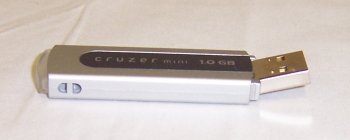 I was given Carol's sister's old 2002-era Dell laptop recently, in hopes of degunking it and making it useful in Carol's hobby room for Web lookups. My approach in dealing with the machine was what I generally do: Leave it off-network, and plug in a USB thumb drive full of portable degunking utilities. Being in a hurry rarely leads to anything good, and what I was not used to was a laptop in which the USB ports are on the spine of the machine rather than one side or another. So I plugged it into the back, and at some time during my first ninety seconds in front of the laptop, I tipped it back and up on its spine to see if the battery lock had come loose on the bottom plate. The obvious result is shown above.
Dratz. Cruzer Minis are getting increasingly uncommon, and this was literally the first time that I have ever had one go bad on me, whether I was the proximal cause of badness or not. Astonishingly, the drive still works, though the metal USB connector is now holding on solely by its printed circuit contacts. Fortunately, there was nothing on the drive but software that I have elsewhere, so it went into the trash without huge regrets. Not huge. Not small. Middling.
Odd Lots
- Sorry to be gone so long here; I haven't felt well for some days and did not do my usual daily quota of follow-your-nose Web exploration. Part of it is the politics; I seem to be hitting the I-Can't-Stand-It-Anymore level about three weeks earlier than I did in 2004. The rest seems to be the result of eating too many MSG-laden barbecue potato chips.
- Or maybe it's all the purely amateur reporting on the current financial crisis, declaring that it's either the end of the world or already well past it. Michael Covington (who would probably win any contest for World's Sanest Man) has some perspective on both the financial crisis and the stock market's recent fall. Read them, and heed the advice printed on the front cover of the Hitchhiker's Guide to the Galaxy.
- I learned yesterday that Herb S. Brier W9EGQ was a paraplegic and could not walk. Like John T. Frye, he lived in Indiana (Gary) and was almost entirely self-taught in electronics. Bob Ballantine W8SU wrote up a short bio on Brier, and if you ever followed his Novice columns in the 50s and 60s, do read it. The closeness of the two men's call signs (W9EGQ and W9EGV) is probably a coincidence; as best we can tell the two men did not know one another.
- If you build radios, particularly tube or crystal sets, The Radio Board is worth a look. The sheer amount of cumulative tube-hacking expertise there is mind-boggling.
- The local newspapers have been breathlessly reporting rampant theft of campaign signs from both sides of the spectrum, and now that several perps have been caught, it turns out that they were…junior high kids! Wow! (Like I couldn't have told you that.) The little snots are not being charged with anything; after all, theft is political speech. Solution: Force them to give their allowances for the next year to the parties whose signs they stole, and wear a T-Shirt printed with that party's canididate's portrait.
- Pete Albrecht sent me a link to a PDF railroad map of Illinois, containing all currently active routes.
- And while I'm at it, let me point you to Pete's photos of Stephan's Quintet, a group of five close-set galaxies (two are actually foreground objects) that are one of the meanest challenges for backyard galaxy collectors—especially if your backyard is in Costa Mesa. The group is fascinating, and this article about them is worth reading.
- From David Stafford comes an article about what it's like to be a professional term paper writer.
- Once again, The Economist proves itself to be one of the few intelligent print mags remaining by explaining why even peer-reviewed scientific journals are not as trustworthy as we would like. (The Atlantic is on my S-list again for running too much politics; maybe I'll resubscribe in December.)
- Here's a robot that carries your houseplants to a spot in the livingroom where there's more sunlight. It's unclear what happens when the robot tries to share the sunbeam with the dog. I guess it depends on the dog; QBit would tear it to shreds; Aero would lift his leg on it. Suum quique.
Odd Lots
- Speaking of sunspots (see yesterday's entry) The Boston Globe posted a series of some of the most amazing photographs of the Sun that I've ever seen. I'm not sure there's much more I can say but go look.
- More sunspot stuff: Wikimedia has a very nice graph of sunspot peaks since we started tracking them more or less scientifically in 1749. I have sometimes wondered if better instruments built in the last 100 years have led to higher sunspot counts, simply because we can see smaller and shorter-lived spots, but supposedly that's been taken into account. My one serious quibble with the associated writeup is that it's the Wolf Minimum and not the Maunder Minimum that corresponds to the beginning of the Little Ice Age. Maunder just made it worse, and Europe's coldest era does indeed correspond to a 70-year near-absence of spots between 1645 and 1715.
- The Make Blog aggegated an item on a beambot built in…1912. It works essentially the same way as the Popular Electronics Emily robot that I built in 1966, minus the solid state current amplifier. Relays can “amplify” current in a snappy, sparky, ozone-y kind of way, and this device has a definite steampunkish air about it.
- I am two days older than musician/composer David Arkenstone, and we're both Chicago boys. Didn't know that until ten minutes ago. Will probably forget it sooner or later, but not in time to make room in my head for more useful knowledge.
- More of what my sister calls “brain sludge”: I built my first kite in September 1962. How do I know this? I remember pulling a sheet of newspaper off the top of the pile in the basement, and seeing the ad announcing the premiere of “The Beverly Hillbillies,” complete with an Al Hirschfield caricature of the Clampett clan in their truck. I had read of his habit of sneaking his daughter Nina's name into every one of his cartoons (I think in the Saturday Evening Post) and took time to find it. I then used the sheet in the kite, which flew well, and was the first of many to be made of newspaper, and other (odd) things. Now, howcome I can remember this so vividly, and still have to think hard about where I left my damned cellphone ten minutes ago?
- This says something about human nature, and nothing good. Me, I prefer cars that don't go off the road, though I have eaten and enjoyed a number of smoked chubs that looked very angry.
- The email consensus is that the Turtle Wax Turtle was indeed atop the Wendell Bank Building at Ashland and Ogden. One correspondent asked the obvious: “Why not email the Turtle Wax people who posted the video?” Duhh. Will do. Sorry.
The Sunspot Curse
Sure as hell, every time I go looking for sunspots, they run screaming. I was first licensed as a ham radio operator three whole solar cycles ago, and when I finally got my haywire, buzzing, borderline lethal homebrew transmitter running in 1973, Cycle 20 was rolling over on its back and kicking its legs in the air. It didn't seem fair: Most of the reason I started studying for the ticket was that my friends were speaking glowingly of how you could work Rangoon on three milliwatts into a bent paperclip in 1968. (And you only needed one milliwatt in 1957…) By the time Cycle 21 was peaking in 1980, I had discovered computers in a big way, and my trusty Kenwood mostly gathered dust. And of course, when the next peak rolled around in 1990, I was working myself to exhaustion getting PC Techniques off the ground. When Cycle 23 peaked in early 2001, the ionosphere was screaming again, and my publishing company, which had expanded so amazingly in 1990, was imploding along with the tech bubble. I had other things to think about.
So now life has settled down, and I have a marvelous multiband dipole up in the rafters. I need to talk some sense into my fire sensors, but the shielded alarm wire is on order and the rest is seat-of-the-pants attic carpentry. By the time the warm-weather QRN has receded south of the equator to deafen the VHs instead of me, I will have the best antenna system I've had in a long time. (Not like I've ever had anything especially jazzy.) Alas, the sunspots ran screaming three years ago, and the sun's complexion has rarely been this clear nor healed so rapidly once the occasional blemish appears. Supposedly, the first Cycle 24 sunspots have begun showing up, but they are so small that they can only be seen in significant telescopes, and disappear again in only hours. I'm sitting here starting to stress: What's going to keep me from getting on the air at the next peak in 2012? Oh, wait, I forgot: The world's going to end that year.
Bummer. I need to work on my timing.
The Turtle Wax Turtle
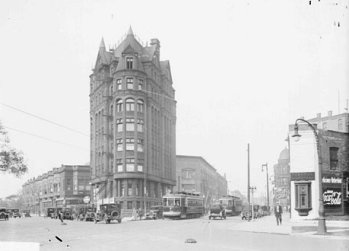
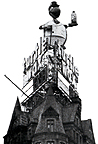 Somewhere in Chicago (Pete Albrecht and I are still trying to figure out precisely where) there was once a very Gothic-looking building with a giant turtle on top of it. It was the Turtle Wax turtle, of course, and it existed when I was quite young. Any time we'd be in the car passing by it, my folks would very carefully point it out. That would have been 1958-1962 or so. Pete thinks the building is the Wendell Bank Building at the intersection of Madison, Ashland, and Ogden, and it certainly looks right, though Pete remembers the sign being somewhere on Cicero and not Ashland. I confess that I have no idea, but that intersection would have been on the way to visit my grandfather and Uncle Louie, so it's a plausble hypothesis.
 The search for the abode of the Really Big Turtle did turn up an interesting little video on the main Turtle Wax history page about Ben Hirsch and the genesis of Turtle Wax. Hirsch invented Plastone Car Polish, which became Turtle Wax after Hirsch stopped by Turtle Creek near Beloit and had the brainstorm that his car polish created a “hard shell finish.” Hirsch also invented the chocolate-covered banana on a stick and a few other things, though I suspect he made most of his money on Turtle Wax. The video shows some stills of the Big Turtle being erected and is worth a look, especially since it shows the monumental size of the statue. The video also includes an animated ad from the 1950s that's worth the cost of admission. The turtle sounds like Jimmy Durante.
I'm a little surprised that something that big and that iconically Chicago has been so little recorded online. It may be that it existed for only a few years, and it may have been moved to another location at some pont. We're looking for better information and I'll post any updates here as they happen.
All Dogs Go to Heaven
Sam Paris sent me an image that's been bouncing around the Net for some time now, and I roared. It's funny on the face of it, whether you know anything about religion or not—but if you've struggled like I have with the difficulties of understanding the several competing concepts of God, salvation, and the life to come, it was, well, ineffably hilarious.
I understand that it's not real, and in fact was created with Church Sign Generator. I don't know where it came from so I can't credit it, but read it all the way down. Yee-hah!
Where the topic comes up for discussion, I've heard many people say that the descriptions fed to us in childhood of Hell were vivid and very detailed—but Heaven was always vague, colorless, and ultimately boring. I keep flashing on the classic Gahan Wilson cartoon of some guy with wings and a halo sitting alone on a cloud, thinking to himself: “I sure wish I'd brought a magazine.”
Although the Catholic Powers go out of their way to deny it, buried deep in Catholic culture and tradition is a very radical kind of universalism. God did not create the physical universe as a temporary nuisance to be endured and then left with no regrets. The physical universe is in fact a crude, low-res reflection of higher realities that we simply cannot apprehend in this life. One metaphor might be Olaf Stapledon's cosmology from Star Maker, in which the Star Maker crafts a steady succession of increasingly mature creations, each creation “better” in a metaphysical sense than the one before. Another metaphor might be one I heard in college 35 years ago: That our physical creation is a faint echo of a higher world, which in turn is a slightly clearer and louder echo of an even higher world, and so on far beyond our ability to grasp. At each level there will be challenges, struggle, and probably suffering appropriate to our levels of spiritual development. Creation was in fact a far, far bigger Bang than we think.
So do dogs go to heaven? Hardly. They are already there. And when we leave this world and continue our long walk back toward the Creator, they will be right beside us.
Odd Lots
- Small, short-lived sunspots are starting to turn up on a fairly regular basis. (I monitor spaceweather.com daily.) Their polarity suggests that they belong to the long-delayed Cycle 24, but they are so small as to be almost invisible without a powerful solar telescope, and many vanish within 24 hours of their initial detection. So we could still be facing something like a Maunder Minimum, with small and short-lived spots keeping the count up even with generally minimal solar activity. The coming year will be especially interesting in solar astronomy.
- I ran across a fascinating couple of homebrew radio projects, and the tube design is especially intriguing. If you understand tubes even a little bit, read the article (PDF) on the low-voltage 3GK5 “Hellenedyne” one-tube reflex AM receiver. This is like nothing I've never seen before, and it's making me itch to throw one together just to see what this peculiar tube can do.
- This is humor for deep, deep railroad geeks only, but wow: Parodies of classic locomotive designs, some of them realized as HO scale models. Ok, you may not think these are funny without knowing a little bit about railroad history, but hey, there's just something inherently silly about a locomotive painted with the legend “Wrong Island.” Thanks to Pete Albrecht for the link.
- Also from Pete: Suppose that Tolkien's Hobbits, out from under their terror of the Dark Lord, had a thousand years or so (Hobbits don't hurry) to develop a reasonable technological civilization. Their astronomical observatories might well look like this, which is in fact a working observatory in Potsdam, Germany, named for Albert Einstein (I can picture Buildo Baggins, a distant descendent of the Sackville Bagginses, analyzing variable star luminosity curves at those desks, between bites of bread spread with entirely too much butter…)
- Interestingly, the ebook edition of my Souls in Silicon collection is outselling the print edition 3 to 1. Even more interestingly, I make 23c more per copy on the ebook edition, priced at $3.99 vs. $11.99 for the print edition. This is an extremely useful dataset, and I'm tempted to drop the price on Cold Hands to $2.99 when I release it in December, just to see how it does.
Three Days in Hot Water, with Color
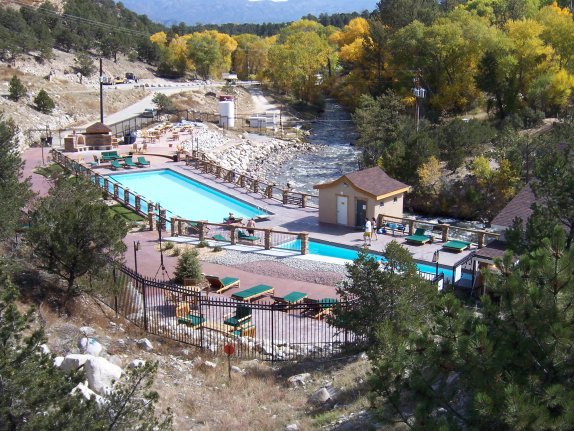
Yesterday was our 32nd wedding anniversary, so Carol and I took the puppies up to Woodmen Kennel on Wednesday and then blasted over Ute Pass to one of our favorite places: Mt. Princeton Hot Springs Resort. It's a little south of Buena Vista, Colorado, and only 110 miles from our front door. I reported on it briefly back in 2004, but the resort has changed hands in the past four years and the new owners are putting a lot of work and money into it. Brand new log cabins are going up on both sides of Chalk Creek, and there's a pavilion for weddings and other events. All that being the case, it's no longer the cheap date it was in 2004, but I definitely feel it's still worth the price. (~$120/night in the off season, including October.)
The gimmick is that by the side of the creek, water comes bubbling up from parts unknown at 133° F. By judiciously mixing the hot springs water with filtered creek water (which is Rocky Mountain snowmelt and generally in the mid-high 40s) they keep two huge pools steaming away at human-tolerable temps. The large pool (at left in the photo above) is a trifling 95°. The small pool is kept at 104° and is basically a 35' by 15' hot tub. If that's not hot enough for ya, there's a steam room in the middle. The resort's most unique gimmick is the creek pools: Because the water comes up from the ground on one bank of the creek, the resort has artfully arranged boulders on the creekbed so that the hot water mixes dynamically with water from the creek, keeping the temps generally in the 102° vicinity. And they're adjustable: If you want a cooler pool, you shove a boulder a little to let more of the creek in. If you want a hotter pool, you put small stones and creekbed sand in the cracks to keep more of the creek water out. Part of the fun is that the seep rate changes from second to second, so now and then you get a burst of hot water or ice water and there's no way to know what's coming. The brave are regularly observed to hop from the hot pools right into Chalk Creek. They always seem to sound European when they yelp. You'd think that they don't have cold rivers in Germany or something.
The resort is open year-round, irrespective of temperature. (They do close when snow makes the county road impassable.) This includes the creek pools. We want to go back in January to see how much steam comes off the 104° pool, and whether the Europeans are still hopping into the creek.
The resort uses the hot water for everything. They have to; every well on the property brings up hot water, though not all of it is at 133°. The rooms are heated with hot springs water. There are little radiator/fan things in the walls and if you want heat, you turn on the fan. If you don't want heat you get some anyway; there are pipes everywhere full of 133° water. The solution: Open the windows. The toilets flush with hot springs water. Think about it. (And don't flush while sitting down…) The faucets run hot springs water from both the hot and cold spigots, but the water going to the cold spigot runs through pipes somewhere that bleed some of the heat off, probably into the creek. The downside there is that the longer you run the cold water, the hotter it gets. Showers are of necessity quick.
The food is good, and the restaurant plays some satellite channel that specializes in top 40 songs from the 80s, everything from Roseann Cash to Dire Straits. Lots of Dire Straits. Out by the hot pools, they play jazz banjo improv, or else whatever the crew on duty happens to like. It was tough to predict, but after a couple of days, I realized that I will take jazz banjo over jazz sax six throws out of four.
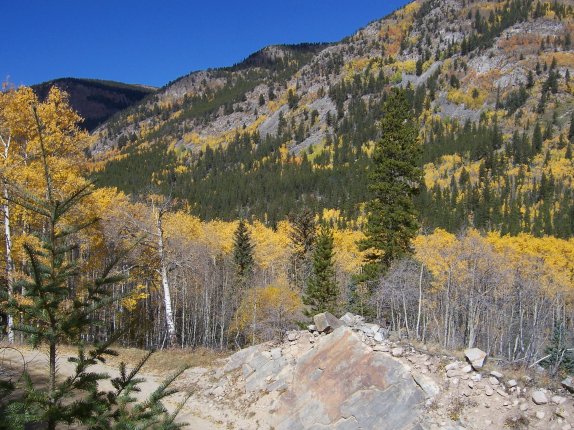
Yesterday morning we took the road west, up into the mountains, to see the fall colors. We chose wisely: The colors were at their peak, and were breathtaking. You could trace the paths that water takes flowing down the mountains by the bands of yellow aspen groves. After the first hour or two, I was very glad I have a 2GB SD card in my camera.
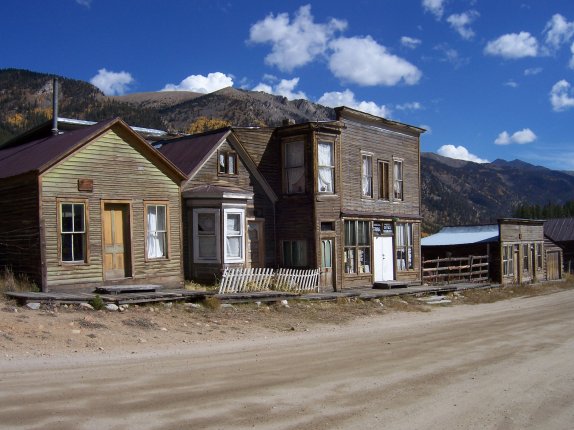
At the end of the “good” dirt road pavement was the famous Colorado sort-of-a-ghost-town, St. Elmo. The opening of the central Colorado mineral district in the early 1880s made St. Elmo happen, and the Denver, South Park, and Pacific narrow-gauge railroad kept the supplies flowing in and the ore flowing out for almost forty years. St. Elmo is not quite dead; people still live in some of the ancient buildings, which are painstakingly kept looking ramshackle because it's what people expect, even though the old photographs make the town look far better, and almost sprightly. Land there is mind-bogglingly expensive, and encumbered by deed restrictions that require that your buildings look “historically accurate,” which as best I can tell means looking like they're about to fall over. Maybe living at 10,000 feet will do that to you.
The old DSP&P right of way is still there and can be traced, and parts of it are now a hiking trail. I tried to climb a 100-foot embankment up to the trackbed from one of the small lakes that the Forest Service maintains along Chalk Creek, but 10,000 feet will do other things to you as well, especially when you're 56. Note that it didn't stop me; it just made me angry, and I will return and get up to the alignment at some point in the future.
In summary: Our trip was a complete success. Carol and I allowed ourselves the privilege of staying in bed and cuddling until 8:00AM—which is easier when Aero hasn't been throwing himself bodily against the walls of his kennel to get our attention since 6:15. We took care to remember not only why we fell in love but why we stayed in love all these years: We continue to look at the world like a couple of wide-eyed kids, practicing the art of being delighted. Taking delight in one another makes it easier to take delight in the world, and vise versa. (Being jaded is for statues.) 32 years? Heh. We're just getting into second gear!