Jeff Duntemann's Contrapositive Diary Rotating Header Image

The Turtle Wax Turtle

Somewhere in Chicago (Pete Albrecht and I are still trying to figure out precisely where) there was once a very Gothic-looking building with a giant turtle on top of it. It was the Turtle Wax turtle, of course, and it existed when I was quite young. Any time we'd be in the car passing by it, my folks would very carefully point it out. That would have been 1958-1962 or so. Pete thinks the building is the Wendell Bank Building at the intersection of Madison, Ashland, and Ogden, and it certainly looks right, though Pete remembers the sign being somewhere on Cicero and not Ashland. I confess that I have no idea, but that intersection would have been on the way to visit my grandfather and Uncle Louie, so it's a plausble hypothesis.

The search for the abode of the Really Big Turtle did turn up an interesting little video on the main Turtle Wax history page about Ben Hirsch and the genesis of Turtle Wax. Hirsch invented Plastone Car Polish, which became Turtle Wax after Hirsch stopped by Turtle Creek near Beloit and had the brainstorm that his car polish created a “hard shell finish.” Hirsch also invented the chocolate-covered banana on a stick and a few other things, though I suspect he made most of his money on Turtle Wax. The video shows some stills of the Big Turtle being erected and is worth a look, especially since it shows the monumental size of the statue. The video also includes an animated ad from the 1950s that's worth the cost of admission. The turtle sounds like Jimmy Durante.

I'm a little surprised that something that big and that iconically Chicago has been so little recorded online. It may be that it existed for only a few years, and it may have been moved to another location at some pont. We're looking for better information and I'll post any updates here as they happen.

All Dogs Go to Heaven

Sam Paris sent me an image that's been bouncing around the Net for some time now, and I roared. It's funny on the face of it, whether you know anything about religion or not—but if you've struggled like I have with the difficulties of understanding the several competing concepts of God, salvation, and the life to come, it was, well, ineffably hilarious.

I understand that it's not real, and in fact was created with Church Sign Generator. I don't know where it came from so I can't credit it, but read it all the way down. Yee-hah!

Where the topic comes up for discussion, I've heard many people say that the descriptions fed to us in childhood of Hell were vivid and very detailed—but Heaven was always vague, colorless, and ultimately boring. I keep flashing on the classic Gahan Wilson cartoon of some guy with wings and a halo sitting alone on a cloud, thinking to himself: “I sure wish I'd brought a magazine.”

Although the Catholic Powers go out of their way to deny it, buried deep in Catholic culture and tradition is a very radical kind of universalism. God did not create the physical universe as a temporary nuisance to be endured and then left with no regrets. The physical universe is in fact a crude, low-res reflection of higher realities that we simply cannot apprehend in this life. One metaphor might be Olaf Stapledon's cosmology from Star Maker, in which the Star Maker crafts a steady succession of increasingly mature creations, each creation “better” in a metaphysical sense than the one before. Another metaphor might be one I heard in college 35 years ago: That our physical creation is a faint echo of a higher world, which in turn is a slightly clearer and louder echo of an even higher world, and so on far beyond our ability to grasp. At each level there will be challenges, struggle, and probably suffering appropriate to our levels of spiritual development. Creation was in fact a far, far bigger Bang than we think.

So do dogs go to heaven? Hardly. They are already there. And when we leave this world and continue our long walk back toward the Creator, they will be right beside us.

Odd Lots

  • Small, short-lived sunspots are starting to turn up on a fairly regular basis. (I monitor spaceweather.com daily.) Their polarity suggests that they belong to the long-delayed Cycle 24, but they are so small as to be almost invisible without a powerful solar telescope, and many vanish within 24 hours of their initial detection. So we could still be facing something like a Maunder Minimum, with small and short-lived spots keeping the count up even with generally minimal solar activity. The coming year will be especially interesting in solar astronomy.
  • I ran across a fascinating couple of homebrew radio projects, and the tube design is especially intriguing. If you understand tubes even a little bit, read the article (PDF) on the low-voltage 3GK5 “Hellenedyne” one-tube reflex AM receiver. This is like nothing I've never seen before, and it's making me itch to throw one together just to see what this peculiar tube can do.
  • This is humor for deep, deep railroad geeks only, but wow: Parodies of classic locomotive designs, some of them realized as HO scale models. Ok, you may not think these are funny without knowing a little bit about railroad history, but hey, there's just something inherently silly about a locomotive painted with the legend “Wrong Island.” Thanks to Pete Albrecht for the link.
  • Also from Pete: Suppose that Tolkien's Hobbits, out from under their terror of the Dark Lord, had a thousand years or so (Hobbits don't hurry) to develop a reasonable technological civilization. Their astronomical observatories might well look like this, which is in fact a working observatory in Potsdam, Germany, named for Albert Einstein (I can picture Buildo Baggins, a distant descendent of the Sackville Bagginses, analyzing variable star luminosity curves at those desks, between bites of bread spread with entirely too much butter…)
  • Interestingly, the ebook edition of my Souls in Silicon collection is outselling the print edition 3 to 1. Even more interestingly, I make 23c more per copy on the ebook edition, priced at $3.99 vs. $11.99 for the print edition. This is an extremely useful dataset, and I'm tempted to drop the price on Cold Hands to $2.99 when I release it in December, just to see how it does.

Three Days in Hot Water, with Color

Yesterday was our 32nd wedding anniversary, so Carol and I took the puppies up to Woodmen Kennel on Wednesday and then blasted over Ute Pass to one of our favorite places: Mt. Princeton Hot Springs Resort. It's a little south of Buena Vista, Colorado, and only 110 miles from our front door. I reported on it briefly back in 2004, but the resort has changed hands in the past four years and the new owners are putting a lot of work and money into it. Brand new log cabins are going up on both sides of Chalk Creek, and there's a pavilion for weddings and other events. All that being the case, it's no longer the cheap date it was in 2004, but I definitely feel it's still worth the price. (~$120/night in the off season, including October.)

The gimmick is that by the side of the creek, water comes bubbling up from parts unknown at 133° F. By judiciously mixing the hot springs water with filtered creek water (which is Rocky Mountain snowmelt and generally in the mid-high 40s) they keep two huge pools steaming away at human-tolerable temps. The large pool (at left in the photo above) is a trifling 95°. The small pool is kept at 104° and is basically a 35' by 15' hot tub. If that's not hot enough for ya, there's a steam room in the middle. The resort's most unique gimmick is the creek pools: Because the water comes up from the ground on one bank of the creek, the resort has artfully arranged boulders on the creekbed so that the hot water mixes dynamically with water from the creek, keeping the temps generally in the 102° vicinity. And they're adjustable: If you want a cooler pool, you shove a boulder a little to let more of the creek in. If you want a hotter pool, you put small stones and creekbed sand in the cracks to keep more of the creek water out. Part of the fun is that the seep rate changes from second to second, so now and then you get a burst of hot water or ice water and there's no way to know what's coming. The brave are regularly observed to hop from the hot pools right into Chalk Creek. They always seem to sound European when they yelp. You'd think that they don't have cold rivers in Germany or something.

The resort is open year-round, irrespective of temperature. (They do close when snow makes the county road impassable.) This includes the creek pools. We want to go back in January to see how much steam comes off the 104° pool, and whether the Europeans are still hopping into the creek.

The resort uses the hot water for everything. They have to; every well on the property brings up hot water, though not all of it is at 133°. The rooms are heated with hot springs water. There are little radiator/fan things in the walls and if you want heat, you turn on the fan. If you don't want heat you get some anyway; there are pipes everywhere full of 133° water. The solution: Open the windows. The toilets flush with hot springs water. Think about it. (And don't flush while sitting down…) The faucets run hot springs water from both the hot and cold spigots, but the water going to the cold spigot runs through pipes somewhere that bleed some of the heat off, probably into the creek. The downside there is that the longer you run the cold water, the hotter it gets. Showers are of necessity quick.

The food is good, and the restaurant plays some satellite channel that specializes in top 40 songs from the 80s, everything from Roseann Cash to Dire Straits. Lots of Dire Straits. Out by the hot pools, they play jazz banjo improv, or else whatever the crew on duty happens to like. It was tough to predict, but after a couple of days, I realized that I will take jazz banjo over jazz sax six throws out of four.

Yesterday morning we took the road west, up into the mountains, to see the fall colors. We chose wisely: The colors were at their peak, and were breathtaking. You could trace the paths that water takes flowing down the mountains by the bands of yellow aspen groves. After the first hour or two, I was very glad I have a 2GB SD card in my camera.

At the end of the “good” dirt road pavement was the famous Colorado sort-of-a-ghost-town, St. Elmo. The opening of the central Colorado mineral district in the early 1880s made St. Elmo happen, and the Denver, South Park, and Pacific narrow-gauge railroad kept the supplies flowing in and the ore flowing out for almost forty years. St. Elmo is not quite dead; people still live in some of the ancient buildings, which are painstakingly kept looking ramshackle because it's what people expect, even though the old photographs make the town look far better, and almost sprightly. Land there is mind-bogglingly expensive, and encumbered by deed restrictions that require that your buildings look “historically accurate,” which as best I can tell means looking like they're about to fall over. Maybe living at 10,000 feet will do that to you.

The old DSP&P right of way is still there and can be traced, and parts of it are now a hiking trail. I tried to climb a 100-foot embankment up to the trackbed from one of the small lakes that the Forest Service maintains along Chalk Creek, but 10,000 feet will do other things to you as well, especially when you're 56. Note that it didn't stop me; it just made me angry, and I will return and get up to the alignment at some point in the future.

In summary: Our trip was a complete success. Carol and I allowed ourselves the privilege of staying in bed and cuddling until 8:00AM—which is easier when Aero hasn't been throwing himself bodily against the walls of his kennel to get our attention since 6:15. We took care to remember not only why we fell in love but why we stayed in love all these years: We continue to look at the world like a couple of wide-eyed kids, practicing the art of being delighted. Taking delight in one another makes it easier to take delight in the world, and vise versa. (Being jaded is for statues.) 32 years? Heh. We're just getting into second gear!

Odd Lots

  • A chemical found in red wine may slow aging in mammals. Reservatrol is a hot item these days, and whereas there probably isn't enough in wine to have measurable effects on health or longevity, Big Pharma firm GlaxoSmithKlein paid $720M for Sirtris, a biotech firm doing research on the reservatrol family of chemicals. Thanks to Frank Glover for the link.
  • Larry Steckler, who had worked for the Gernsback organization from 1957 until its bitter end in 2003, has published a 700-page biography of Hugo Gernsback. We've been waiting for a decent biography of our man Hugo for a long time, and I'll post my reaction here once I've read it.
  • Bruce Baker sent me a link to photos of a (more or less) scale model of the aircraft carrier Harry S. Truman built entirely in Lego. The story has been written up (in English) on the Make Blog, with more photos here. My big question with Lego (having grown up on Meccano, in which everything is bolted together with real bolts) is how such monumental Lego sculptures stay intact. Is it all friction? I've built small things with Lego, but models that come apart in your hands don't seem to me to be anything near as good as the (admittedly holey) things you make with Meccano/Erector and their ilk.
  • From Don Doerres comes a link to a software defined radio (SDR) on the Web, covering a portion of the 80, 20, and 40 meter ham bands. The “waterfall” visualization is fascinating, and something that “real” radios just can't do. We're good at matching patterns, and I was able to see when a new signal appeared anywhere on the covered band out of the corner of my eye. Contesters must love SDRs!
  • Michael Covington suggested that unnecessary animations are a far bigger distraction and degradation of the computing experience than windowing, and I have to agree. This is one reason I continue to use older software: Its moving parts don't move unless they have to.
  • Also from Michael comes a story from the UK about the fact that 2% of the 1£ coins in circulation are counterfeit. This boggles the mind: 1£ won't even buy lunch, and making enough coins to be worthwhile must take a lot of time and work, considering that you can and probably will do time if they catch you. (Does anybody remember Bernard Wolfe's wry short story “The Never-Ending Penny”?)

Setting the Ether on Fire

I finally finished my attic shortwave antenna a few days ago, after puzzling over how to do it for almost four years. It was both easier and harder than I thought. The project took up most of my spare time for a week, and required me to practice tossing a tethered tennis ball around up there between the two attic hatches.

I had to get the antenna up in the attic, above the walls of the house here, because the walls are stucco-coated chicken wire and thus form a very effective shield can. Even a 40' dipole in my workshop could pull in only some of the strong local AM broadcast stations. The new antenna works extremely well, and scanning the bands on Wednesday night with the Icom 736 brought in all the usual suspects from Europe at 9 MHz, along with an amateur station in Costa Rica at 7220 and another one that was (I think; copy on that one was poor) in Argentina. The quiet sun means that the bands above 14 MHz are basically dead, but assuming that we're not headed into the next ice age, they'll be back in a couple of years.

The wire was cut for 7200 KHz, and the measured SWR minimum was at 7130 (with another potentially useful one at 21400) so I got pretty close. Seeing if I could get a signal out was the next test. I tuned around on 40M to find a quiet spot, pressed push-to-talk, opened my mouth…

…and the fire alarm went off. I tore upstairs to find Carol in a panic and QBit barking furiously at the cold-air return where the siren lives. I didn't assume that the transmitter was at fault, but took a quick run around the house and garage to make sure nothing was burning, and by the time I reset the siren, the alarm system had already called the fire department. Nothing was burning, and with a red face I had to tell the firemen who came up in a truck (not a huge one, fortunately) that my transmitter had triggered a false alarm.

The garage smoke detector is perhaps 5' below the south leg of the dipole, and I may have to have the company that installed the alarm system run shielded cable to it. We think that the dipole was inducing sufficient current in the smoke detector cable to trigger the system, so the shielded cable may be enough. If the dipole is inducing currents in the smoke detector itself, the detector may have to go into a Faraday cage of some sort. The fact that the vulnerable detector is in the garage is fortunate. Out there a Faraday cage would be almost stylish; but maybe not so stylish on our livingroom ceiling.

So amateur radio station K7JPD will remain off the air for a little while longer. Damn. Hiram Percy Maxim didn't have this problem. Ubiquitous computing—and the wires that make it work—are a two-edged sword.

Scarcity Leaves Its Mark

Whether or not an unexamined life is worth living, examining what goes on inside your head is a lot of fun. I’ve become interested in psychology late in life (after treating it with contempt when I was a cocksure young rationalist) and identifying my biases and tracing them back down to their sources has become a minor hobby here.

My recent study of CSS reminded me of one of those biases: I hate windowing. I just hate it, and hate it so deeply I don’t even notice the hatred anymore. If you were to look over my shoulder as I work, you’d notice that I don’t use it. Whatever app I’m working in gets the whole screen, and when you can see the desktop at all, it means I’m in neutral and nothing useful is going on. I came to the insight after practicing fluid layouts in CSS. BTW, If you’re interested in learning how to do fluid layouts, I haven’t found anything better than Nate Koechly’s Web article “Intricate Fluid Layouts in Three Easy Steps.” Nate created the Yahoo UI Grids CSS system, which I may begin using once I learn enough CSS by building things from scratch. I like YUI because it supports fixed widths. Fluid layouts are not mandatory.

This is good, as I find fluid layouts peculiarly repellant. Things like this suggest a live frog nailed to a tree, squirming in agony. (Drag the corner of the window around and you may start to see what I mean.) Part of it is my long history with fixed page layouts in magazine and book work, and part of it is a desire to focus and not be distracted by things going on in other windows. The bulk of the bias, I think, proceeds from the same reason that the Greatest Generation were tireless savers and hated to waste anything: They grew up in conditions of scarcity. I ducked the Great Depression and WWII, but I followed personal computing from its rank beginnings, when displays were 16 X 64 character text screens or worse. I learned computers starving for screen real estate.

The IBM PC gave us 24 X 80 displays, but that was never enough. Text windowing systems like TopView seemed insane to me, and back in April 1989, when I was doing the “Structured Programming” column in DDJ, I wrote and published an “anti-windowing system” that treated the crippled 24 X 80 display as a scrollable window into a much larger character grid. Full-page text displays eventually arrived: The MDS Genius 80-character X 66-line monochrome portrait-mode text display (left) sat on my desk from 1985 through 1992, when Windows 3.1 finally made text screens irrelevant. (Lack of Windows drivers for the display soon forced MDS into liquidation.) It wasn’t until I bought a 21″ Samsung 213T display in 2005 and started running at 1600 X 1200 that I first recall thinking, “Maybe this is big enough.”

And only just barely. People who were born with a 1024 X 768 raster in their mouths may not be able to figure it, and I guess there’s really no way I can explain. It’s just me. Starve a man for screen space for thirty years, and he is unlikely to want to share what he has with more than one app at a time. Scarcity leaves its mark.

CSS Progress

I'm continuing my re-exploration of CSS in my spare moments, and it's worked out very well so far. If you're doing static pages that don't need Javascript or other fancy stuff, CSS can make very slick layouts with only a handful of rules. The problem of many people using old browsers that don't fully support CSS still exists (especially for IE) but to some extent it always will. CSS-challlenged IE6 still has 32% of the browser market, which means that at least 32% of people will not see your pages render correctly, and that seems like an awful lot to me. I thought I was alone in grumbling about this, but I'm not—and this guy does webstuff for a living.

Anyway. The browsers aren't there yet, but they do enough to support my modest goals. First of these is to get rid of table-based layouts in my Web articles. Tables are a kluge, but they were the best that the Web could do for its first ten years. Another goal is to create an “imprint style” defined in a single external style sheet. I've taken my several articles about kites and have been CSS-izing them to a common imprint style. These three articles work off the same style sheet:

(The Hi-Flier article is the biggest and messiest, and is still on the workbench.) The headers are custom-made images for the sake of the decorative title fonts. One of the Web's biggest defects is not having embeddable fonts. If you want to use fancy fonts, you have to render the font text in graphics and treat the rendered titles as images. I don't mind doing that at all; the page title is present in the META information, so the Semantic Web, wherever the hell it's hiding, will not be deprived of its due.

I'm still interviewing CSS editors. I've already gone through a bunch of them. The biggest disappointment was Amaya, an editor/validator that goes way back and was created by the W3C. Something that old (it's been around since 1996!) should be much better by now. Six of the toolbar icons are empty holes, and it crashes with the same unenlightening error on Win2K that Kompozer does. It did help me clean up my markup between crashes, but there are other ways to do that. Another major disappointment was TopStyle, an $80 commercial product with a downloadable trial version. The trial version is a good thing, because the only supported preview browser is IE. You can rig it to preview with Firefox, but there's a three-year-old message claiming that the Mozilla embedding technology is “experimental” and not supported, with warnings that border on those against crossing the streams. No way to preview in Opera or anything else. This is the kind of lazy-ass nonsense I will sometimes forgive on free products, but it's most of the way to 2009, and anything that costs money and claims a preview feature had better do IE, Firefox, and Opera, or it gets the hook. TopStyle got the hook.

In the meantime, I'm using Kompozer every day downstairs on my XP machine, and it hasn't crashed yet. It's got some thin spots—by default it creates internal style sheets, and you have to manually insert a link to an external sheet—but now that I've gotten to know it, my productivity is way up. Kompozer is a cleaned-up version of Nvu, and the French chap who wrote Nvu is working on a successor. (Having a little French helps here, though most of his posts are at least mostly in English.) Kompozer/Nvu's heart is definitely in the right place, and if I have to use it for awhile until M. Glazman releases its successor, I should at least be able to get some work done.

Other odds and ends associated with my efforts to transcend Webfossilhood:

  • I tried to upload WordPress to Sectorlink using a product called ZipDeploy. Apart from the arrogance of having a three hour trial period (!!!) the damned thing got partway through the longish upload and…vanished. It didn't show an error dialog. It didn't even beep. The app window simply disappeared, leaving the upload incomplete. There was nothing running in Task manager. It Died And Made No Sign. Hook!
  • Sectorlink being unhelpful in this regard (and I will not be renewing the contract for next year there) I went over to my Fused Network account and installed WordPress through their Installatron utility. It took 2 minutes and worked flawlessly. I've had difficulty installing Gallery 2 there, but it's looking like the problem is with Gallery and not Installatron.
  • Contra will be moving to WordPress sometime around the first of the year, depending on how quickly I learn it and how long it takes to sort out the hosting equation. There is a plug-in to do automatic cross-posts to LiveJournal, so I will be keeping my LiveJournal mirror. But this hand-edited table monster will (finally) be laid to rest. My WordPress install is browsable, but don't bookmark it, and don't expect it to be a mirror. It's just test posts. I have it on junkbox.com right now, but it will be on duntemann.com when it “goes live.”

And so to work.

Evaluating WordPress

I’ve been manually editing ContraPositive Diary in Dreamweaver since 2000, and prior to that (mon dieu!) in Notepad. The template is typical 2000-era table-bashing, and it has some quirks. I got the notion not long back that this nonsense has got to stop, and I have to sit down and think through what I’m going to be doing in terms of Web presence for the next few years, assuming that it’s not going to be what I’ve been doing for the last ten.

So what you’re looking at is an experiment. ContraPositive Diary is still alive and well at its usual home on duntemann.com and will be there for awhile yet. I’m playing with themes and plugins and CSS and a lot of other things, and I suspect that at some point I will switch over to WordPress. Soon. (Or maybe not soon.) But not yet.

Crossposted from contrapositive.junkbox.com

More on John T. Frye

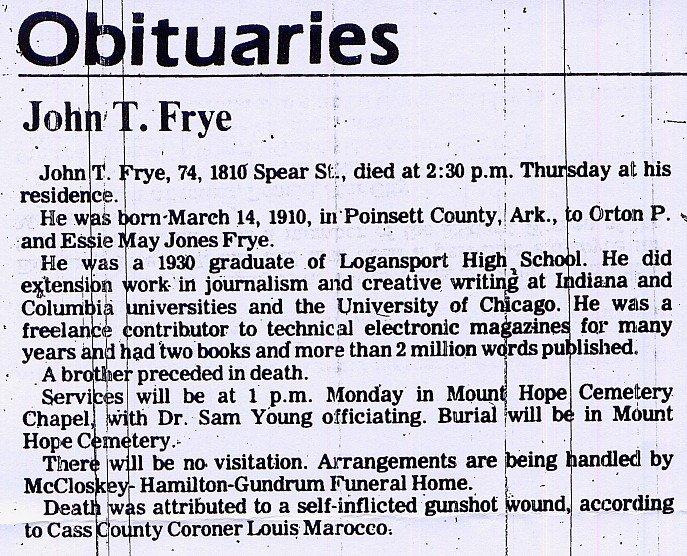
I just uploaded a new version of my Carl & Jerry index, including an expanded bio of John T. Frye. We know a lot more about him than we did a couple of months ago, and almost all of the new material came to me from Lisa Enfinger, whose parents were close friends of Frye’s for many years. I’ll summarize here:

  • John Frye was stricken by polio as an infant, and he could not walk at all, throughout his entire life.
  • That said, he was not immobile: He had hand controls installed on all of his cars, and traveled extensively throughout the United States. He owned a 1963 Olds Dynamic 88, but no word on whether he ever had a Buick. (Legend holds that he was a Buick man, but no one can tell me why that should be so.)
  • Remarkably enough, he never attended Purdue University, but instead studied at the University of Indiana, Columbia University, and the University of Chicago. Lisa did not know if he ever received a degree.
  • More remarkably, he never studied engineering, but preferred English, journalism, history, and psychology.
  • Her parents both attended Purdue in the 1940s while earning their degrees in chemistry, and John visited them there. He probably knew other people at Purdue, and it was not a long drive to Layafette from Logansport in any event.
  • He is credited with close to 600 short articles, including Carl & Jerry and Mac’s Service Shop. His first publication was supposedly in Hugo Gernsback’s Radio Craft in the early 1930s.
  • Her great uncle Gene Buntain was Frye’s close high school friend in Logansport, and the two of them discovered electronics and ham radio together. (Could Gene Buntain have been the inspiration for Carl?)
  • John Frye lived much or most of his life at 1810 Spear St. in Logansport, one block south of US 24. It was a little weird to dive down from orbit on Google Earth and be staring at the roof of Frye’s old house. One wonders what the man himself would have thought of it.

I dug through my smallish collection of really old radio magazines (including a few Radio Craft) and did not see him there, but if any of you guys can find any of his early articles, I would like citations.

Needless to say, I’m still looking for details on John Frye’s life, especially concerning where he learned radio and TV servicing and where he practiced it. Lisa said she never heard of him owning his own shop nor even working for a shop in town, so that would be a question worth answering.

Finally, I had written to Frye’s younger brother Bailey Frye late last year, but he was evidently too ill to respond, and I found today that he passed away at the end of April, at age 90.

Many thanks to Lisa Enfinger for taking the time to send me all the information, including the scan of a newspaper article from 1962 that I first lined to a couple of weeks ago, including a picture of Frye at that time, when he was 42.