- The dairy that delivered milk to our house when I was a kid was indeed Hawthorn Mellody Farms (as verified by the Sister of Eidetic Recall) which was unusual in several ways: They had an amusement park in Libertyville, Illinois, complete with a miniature train ride, a petting zoo, Western town, and pony rides, that was a famous destination in the 50s for suburban moms with station wagons full of Boomer kids. They were the first dairy to put pictures of missing children on milk cartons. And before they went bankrupt in 1992, they were one of the largest Black-owned businesses in the country.
- Also relevant to my entry of Febraury 24, 2009: Dunteman’s Dairy evidently existed before 1939. A page out of the 1937 Arlington Heights phone book from Digital Past shows an entry for Dunteman’s Dairy at 830 N. Dunton Avenue in Arlington Heights. The 1936 phone book shows a listing at the same address for “L. Dunteman,” so Lenard may have begun operating the dairy from his back yard (not an uncommon thing to do back then!) in that year. Prior to 1936 his listing shows yet a different address. I’ll have to see what’s at that address today the next time I’m in the area.
- Digital Past is a very good source if you’re doing genealogy research on Chicago’s northwest suburbs; awhile back I found the location and a photo of the headstone of Laura Brommelkamp Dunteman there, after looking in vain for some years. (She was the second wife of Henry Dunteman, founder of R. W. Dunteman Construction, which is still in operation in Chicago’s western burbs.)
- Well, grub is still plug-ugly, but it’s no longer difficult to configure. I’ve been using KGrubEditor for over a month now, and it makes the job a breeze. Highly recommended.
- Where’s my flying car? Well, it may be here: Yet another Skycar concept, but this time it’s more Mad Max than Flash Gordon. Put a big fan on the back of a go-kart, get up some speed, and then release the parawing. Off you go!
- Philip Jose Farmer has left us. Along with Heinlein, Clarke, and Keith Laumer, Farmer was one of the SF writers who inspired me to keep going and make something of myself in fiction. I still consider the Riverworld concept one of the most compelling ideas ever to surface in SF, even though the series wandered toward the end and would have been much better had it been three books (on the outside, four) instead of five.
- I was going to do a whole entry on this, but Cory Doctorow said everything I intended to say about whackjob Roy Blount Jr and the knucklehead Authors’ Guild, who want money from anyone who does text-to-speech. There’s nothing I can add, and as a longtime author who still makes money writing, I think I have a right to strong opinions about this. Let me quote Cory here, and cheer:
-
Time and again, the Author’s Guild has shown itself to be the epitome of a venal special interest group, the kind of grasping, foolish posturers that make the public cynically assume that the profession it represents is a racket, not a trade. This is, after all, the same gang of weirdos who opposed the used book trade going online.
Odd Lots
Dunteman’s Dairy, and Milk Caps in Winter
 When I was a pre-teen, we used to get milk delivered to the house every few days. I don’t recall fersure which dairy it was (Hawthorn Mellody Farms?) but the milk was in massive gallon returnable glass bottles with wire carry-handles, and a paper cap was machine-pressed over the lip to seal it. The caps themselves were circular sheets of blank white paper, but stapled to the center of each cap was a printed cardboard disk about an inch and a half in diameter, containing the name of the dairy. The cardboard disks are now collectibles, related in a vague way to the juice-bottle “pogs” that were stylish for half an hour or so in the mid-1990s.
Last week I got an email from someone asking if I knew anything about Dunteman’s Dairy. I did (a little) and when I went looking around for more info I found an eBay auction for one of their milk cap disks. The disk arrived yesterday, and you see it above. As I’ve explained here a time or two, my great-grandfather Frank W. Duntemann was the only boy of five in his family to keep the second “n” at the end of his name. Most Duntemans that you see these days are related to me, and all the Duntemanns, what few remain.
Dunteman’s Dairy was located at 420 E. Northwest Highway in Arlington Heights, Illinois. It was founded and run by Lenard Barney Dunteman (1906-1992) and his wife Grace Stippick Dunteman (1909-1978). As best I can tell, Lenard started the business in 1939, built a dairy plant from scratch, and ran it for almost twenty years. He bought raw milk from local dairy farmers (including some of his cousins) pasteurized and homogenized the milk, bottled it, and delivered it with his own trucks in Arlington Heights and adjacent Chicago suburbs. He was of my grandfather’s generation. Technically, Lenard and I would be third cousins, twice removed. His father Albert Dunteman was my great-grandfather Frank Duntemann’s younger brother, if that helps at all.
I don’t know a lot more than that, nor how broad their product line was. I know that they made and sold chocolate milk, but whether they sold butter or cream, I’m still trying to find out. Lenard had a mild heart attack in late 1958, and panicked. Fearing early death, he sold the equipment to another local dairy (I don’t know which one) to generate cash to support his wife, and retired. Ironically, Lenard lived to a genteel old age, but Grace died fourteen years before he did. The dairy building is still there and has been different things over the years. Parts of it have been razed, and what’s left has been given a new facade and is now a Shell station.
One final note about paper milk caps. In the worst of a bad Chicago winter, a bottle of milk left on an exposed front porch (like ours was) would begin to freeze after an hour or two on a particularly raw morning. I still find it odd that the bottles didn’t crack from the expanding milk, but something even odder did happen: A column of frozen milk would rise from the neck of the bottle, forcing the cap off. I remember seeing the cap a full two inches above the neck of the bottle on our porch once, circa 1959. This used to be a common sight (Stevan Dohanos did a Saturday Evening Post cover on it in 1944) but these days I doubt that more than a handful of my readers have ever had milk delivered to their homes. It’s just not done much anymore.
As for why the bottles didn’t crack, well, that still bothers me. I’m speculating that with whole milk, at least, the cream that collected at the top acted as a lubricant, allowing the ice to move freely upward, relieving pressure and keeping the bottle intact. If you’ve got a better theory, I’d love to hear it!
Odd Lots
- I’m 77,241 words into the revision, of which about 25,000 words are new. So I now have a little less than 100,000 words to go, and I’ll have a book. More has to be rewritten than I thought, but mercifully, not all of it. This is going to be almost my sole project for the next four months or so. Maybe I should get one of those writers’ progress bars for WordPress, if such exists.
- I finished the second ASCII chart, for the IBM-850 code page.
- The glyph for the German sharp-s (esset) character is not called “szlig” except within HTML pages, where it appears to be a name invented for the glyph by people who do not speak German, perhaps from “sz ligature.”
- Bright green Comet Lulin whistles past us today, at its closest a still-comfortable 38 million miles off, but it’s apparently a fine object in even a small telescope, and can be seen with the naked eye if you’re out past city lights. It’s very close to Saturn in Leo. Space Weather has a nice map showing where to look, and when.
- This may be the hoax of the decade.
- And while we’re talking digital TV, I’ve been wondering if those little USB TV receiver thingies are digital-ready–but not wondering hard enough to go research. (I watch almost no TV, but you knew that.)
- David Stafford and Jim Mischel informed me that there is an audiobook of someone reading my story “Drumlin Boiler” in what we think is Russian. (“Dramlinkskiy Kotel”) It’s a 50 MB MP3, so think twice about downloading it, but I would like some confirmation as to the language. Sure, it’s a pirate edition, but these days I’m happy someone is reading me, even if aloud.
- Bruce Baker sent me a link to an intriguing article by Rudy Rucker on self publishing. The problem: Only your friends will buy your book. The solution: Work hard at having a lot of friends.
Glites, Gliders, and North Pacific Products
When I was a freshman in high school, I remember picking up an odd paper kite at Walgreen’s. It was called a Glite, and was billed as a “gliding kite.” I was intrigued, and as it might have cost as much as 35c, I was willing to try it. The instructions indicated that even on a completely calm day, you could pull it aloft on a string, let the string go slack, and it would glide gracefully to the ground.
I never tried that; completely calm days were unusual where I grew up. However, I did try just tossing it horizontally, and it flew better as a glider than a lot of the small balsa wood gliders I’d played with over the years. Unlike the diamond bow kites I’d always flown, the Glite had a center of gravity a lot farther forward, giving it the balance of a glider rather than that of a conventional kite. Its two lead edges were relatively thick wooden dowels, as was its spine, making it a lot heavier than most kites as well.
It’s a shame it didn’t fly better as a kite. The one day I did try to fly it kite-style, there was a nasty wind, and my Glite looped helplessly in the air over the Edison schoolyard before ending up in the low branches of one of the kite-eating trees that stood in the parkway up and down the full length of the school property. I managed to get it down, but tore the sail badly in the process. It sat in my corner of the basement awaiting repapering, but I never got around to it and eventually threw it out.
I always wondered who made the Glite and how long the product had been on the market, though never badly enough to spend any time searching. Earlier today I spotted a paper Glite on eBay, and the seller kindly sent me the patent number printed on the sail. This led me to US Patent #3,276,730, which had been granted to Charles H. Cleveland of North Pacific Products of Bend, Oregon, in 1966. The irony is that the patent is titled “Tailless Kite,” when in fact the damned thing needed a tail pretty badly. Interestingly, the patent text does not mention the device’s gliding ability at all; Cleveland must have discovered that later on, or perhaps did not consider it a patentable aspect of the product.
Searching for other inventions patented by Charles H. Cleveland led me to US Patent #2739414, a balsa wood “knock-down toy glider” in which the wings were attached to the fuselage by a short length of plastic extrusion. I recognized it instantly as a species of glider abundant at Bud’s Hardware Store and other places when I was eleven-ish. You could fine-tune the balance of the glider by sliding the red plastic extrusion forward and back along the spine, and I remember that they flew very well, for something that probably cost a quarter. Cleveland liked things that flew; he also patented an oddly cubistic boomarang (which I never saw in a store) and a rubber-band catapault launched glider toy, which I did see once in a hobby shop, though never bought.
I did a little looking for North Pacific Products, Inc. and found no trace of the firm. A Portland, Oregon lumber products company is now using the name and does not mention toy manufacturing in its history. The SSDI lists a Charles Cleveland whose last residence was Bend, Oregon, and lived from 1917-1982, which would be about right. (His last patent was filed in 1980.) I may buy the Glite and would love to do an article about it; if you know anything else, please pass it along.
A Chart, If You Can Read It
The last couple of evenings I’ve been working at fulfilling a promise I reneged on ten years ago. Somewhere in the text of the second edition of Assembly Language Step By Step (which I was writing in the summer of 1999) I promised readers an ASCII chart as one of the appendices. I then plum forgot, and the book appeared in 2000 without that appendix. I still get emails from people asking me where they could find the chart, and have to reply in my best sheepish email voice that no chart exists anywhere in the book.
So this time I thought to put things right. I sat down in front of InDesign and figured out an ASCII chart format for the full 256-character extended set, and drew me an ASCII chart. For the encoding I used Code Page 437, which is what they now call the IBM PC ROM character set. Whether they could name it or not, CP437 was much beloved of DOS text-mode programmers, with all four card suits and more box-draw characters than anybody ever knew what to do with. The chart will fit comfortably (if snugly) on a single page in what we in publishing call “computer trim,” and I consider it a complete success, at least if you have good eyesight or a set of readers within easy reach.
Except…
As best I can tell, there is no encoding option available for Konsole (or any other Linux terminal emulator that I have) for Code Page 437. As close as I’ve come is IBM-850, which has fewer box-draw characters and more non-English alphabet glyphs. Of course, once you have a chart, it’s no big deal to find a new set of glyphs and sub them in, which is what I’ll be doing in coming days. In the meantime, if you have any use at all for a CP437 ASCII chart, here it is. I’ll post the one for IBM-850 when I finish it. Ten years late, I guess, but better late than never.
Debuggery
In parallel with editing and (increasingly) writing chapters, I’ve been interviewing tools to feature in later parts of the third edition of Assembly Language Step By Step. Kate has the gig for editor, but the debugger slot has been annoyingly open for a long time. Since the beginning of the year I’ve been interviewing debuggers and GUI debugger front-ends for gdb, which is more an engine than a debugger and may well be the single most painful piece of software I’ve ever had to use. (Don’t get me started on that. Whoops. Too late.)
It’s been frustration cubed. Here are some notes on the fray thus far:
- Nemiver does not work correctly with assembly language executables.
- Insight would be a good choice, but it is one of the ugliest things I’ve ever seen running on Linux, and I mean ugly in the sense of, well, ugly: Badly rendered Motif/Lesstif screens that seem scruffier than they should be, with hard-to-read tiny fonts. I know why they used that widget set (it’s very lightweight) but I also think that’s no longer anything like an issue in the Linux world.
- DDD is uglier than Insight, and doesn’t work as well.
- KDbg was my favorite for a long time, because it’s not ugly and fairly straightforward to use, but its help system is broke and I never figured out how to dump memory or display named data items from assembly. Like Nemiver, it was really created with C and C++ in mind. Like people tell me endlessly (and shut up, already!) “Nobody uses assembly anymore.” Heh.
As I race past 65,000 words and close in on the end of Chapter 6, I was forced yesterday to make an executive decision and call Insight the winner. Insight is interesting in a number of ways: It’s not a GUI front-end for gdb; it is gdb, and has knowledge of gdb’s deep internals in a way that a separate app simply can’t match. The GUI was written in Tcl/Tk, a language I learned and enjoyed almost fifteen years ago when I got Ousterhout’s book in for review at PC Techniques. One would think it would be no big deal to rewrite Insight for Gtk or Qt, but I don’t see the dust from any stampede.
So I got me an ugly debugger. That is (given my deadlines and the significant amount of money riding on the project) better than no debugger at all.
Looking for Mr. Beefheart
 Stop looking, actually. He’s right here. (And that’s Mr., not Captain, thanks.) Carol was at a dog show yesterday and I blasted out 4600 new words on Chapter 6, so it was not an especially romantic day, but that’s OK; we have built romance into the very fabric of our lives together, and in a sense we do a low-key, distributed Valentine’s Day 24/7. It’s not a giddy, infatuated romance–though we rediscover a little of that now and then—but rather the steady heat that comes of knowing one another unselfishly and deeply for a great many years. (For us, that would be closing in very quickly on 40.)
So Carol surprised me with a somewhat unusual Valentine’s Day present yesterday: A Colorado rib-eye steak cut in the shape of a heart. The steak came from Ranch Foods Direct, a Colorado Springs packing operation that buys local beef and buffalo and sells it both wholesale and at a couple of their own shops. We buy a lot of their meat, as it’s antibiotic and hormone-free, mostly grass-fed, and doesn’t travel very far to reach us. If you’re local, I do recommend them.
Knuckle-dragging, knob-headed Neanderthal that I am, I’ve been improving my health in recent months by eating less grain and more meat. The caveman diet has raised my general energy level (I don’t remember the last time I wrote 4600 words in one day!) and dropped my weight to 148, from 155 a year ago. I’d eat less sugar too, except that I haven’t eaten significant quantities of sugar in years. (I have dessert about three or four times a month, and then only after a big meal.)
Once Carol unveiled the steak, QBit couldn’t keep his eyes off it, and he followed me around the house as I looked for a suitable place for the inevitable photo opportunity. The weather should be good tomorrow. It may get up to 50, and be sunny, and we’re going to grill it out on the back deck. QBit and Aero will both get a little bit. Neanderthals had dogs, and still do. Neanderthals didn’t write computer books—and their dogs weighed a little more than fifteen pounds—but Tuesday was Darwin’s birthday. Here’s to evolution!
KDE Follies
I’ve been busy. And I’ve had headaches. This is mostly why you haven’t heard from me in a few days. I wondered for awhile if I was getting headaches because I was busy, but I’m coming around to a different point of view: I’m having headaches because I’ve been fooling with KDE.
I used to like KDE, until KDE 4 happened. Kubuntu 8.04 would not install correctly on two of the three machines I tried it on, and on the third it malfunctioned weirdly after a couple of days of very light use. I had almost no trouble with Kubuntu 7.10, apart from its failing to set up a network printer. That was KDE 3.5, which I liked. The press on KDE 4 was not good, and I figured I would let Kubuntu rest for a couple of cycles to see if the KDE 4 codebase would shake out a little.
I might have waited for 9.04 except that I couldn’t get the KDbg documentation to run under GNOME. I like KDbg a lot; it’s a beginner-friendly front end to the highly human-hostile gdb debugger engine. I’d like to cite it in my book, but there are a couple of things about it that I just can’t figure. Press F1, right? Well, when I do that, I get a mysterious error dialog:
Could not launch the KDE Help Center:
Could not find service ‘khelpcenter’.
I assumed at first that this is what happens when you have a KDE app running under GNOME, but the kate editor is also a KDE app, and its help document comes up without any trouble. The khelpcenter4 package is installed on the system. The obvious thing to try is to run KDbg under KDE, and see if things work any better.
Of course, to do that you have to have a running install of KDE.
I downloaded the latest Kubuntu ISO (in 13 minutes on BT!!), burned it to CD, and booted the live install on my SX270, the same machine on which Ubuntu 8.10 installed without a glitch. Kubuntu detected the monitor resolution, but…the display blacks out every six seconds for about three-fourths of a second. Otherwise (heh) it runs perfectly. The blackout is not a fade; the screen just turns black instantly. It made me a little nuts, but I suffered through this game of desktop peek-a-boo long enough to install KDbg. I pressed F1. Same dialog. KDE can’t seem to make its own help system work.
So KDE is on that certain list of mine right now. Even though it displays the assembly source for single-stepping, KDbg won’t display named initialized data in NASM executables, and the Memory window refuses to display anything, initialized or otherwise. Being able to inspect data in memory is mighty damned useful, and I’m starting to think that KDbg isn’t really set up to debug assembly language. Like almost everything else in the Linux world, it’s a C thing. Maybe there’s a magic command-line option that allows it to interpret stabs format debug data for assembly language, but there’s nothing much about it online. Clues welcome.
And Kate? The only thing it lacks is a shortcut for running make or launching a debugger, but that’s easy enough to do in the terminal window. It’s graspable enough for beginners, and that’s what I’m striving for here. Newcomers should not have to learn EMACS or gdb to make “Hello world” happen in assembly.
I don’t want to have to use gdb Insight (if there’s an uglier widget set than Lesstif’s I’ve yet to see it) but if I can’t get KDbg to browse data in memory, I may have to. And the decision has to be made soon. (I feel another headache coming on…)
Odd Lots
- German model train manufacturer Marklin has filed for bankruptcy, though there is still some hope that the 150-year-old firm will remain in business. Thanks to Pete Albrecht for the link.
- Scientific American has an interesting retrospective on the infamous nuclear-powered B-36 that actually flew back in the late 1950s, with a live, air-cooled fission reactor in its rear bomb bay. I’m less twitchy about nuclear than almost anyone I know, and that item still gives me pause. (I do think that the stock B-36 was the coolest military aircraft of the transition period between props and jets, and one of the coolest of all time, period.)
- From Rich Rostrom comes an aerial photo of the Fovant Badges, which are a group of military insignia cut into the Wiltshire chalk downs in southern England. They date back to WWI, and have been laboriously maintained since then–a job and a half, considering that some are over 200 feet wide.
- When I first heard Cher’s uber-irritating hit “Believe” years ago I wanted to know what sort of processing was going on with her audio. I didn’t want to know enough to search too deeply, but it recently turned up on Slashdot. The gadget is called Auto-Tune. And Cher can actually sing when she wants to; one wonders what it could do for no-voicers like Bob Dylan.
- I’ve never paid much attention to KDE’s Kate editor, but discovered today to my delight that it has syntax highlighting for NASM. I’d basically given up trying to find a lightweight Linux assembly language IDE to describe in my book, but half an hour of lightweight fooling around with it makes me think that Kate might be the one. Now all I have to do is become an expert in the next couple of weeks. Are there any books on it, print or e? I looked around and have found nothing so far.
- From the Words I Didn’t Know Until Yesterday Department: interpunct, which is a small dot used originally in Latin to unambiguously mark the spaces between words. It’s still used today to show you where the invisible characters are on your screen, and I recognized the concept immediately, but never knew what it was called.
- From ditto: A placket is a flap of cloth that hides a button on fancy clothes. I have a pair of pants with one, and again, never knew what it was called until very recently.
- Pete Albrecht pointed out a source of very nice cast aluminum house numbers in the Craftsman style–though at prices like these, I’m glad I have only a 3-digit address.
- From the Painting the Devil on the Wall Department: One of the nation’s leading promotors of monster truck shows was run over and killed by a monster truck at one of his own shows. (Again, thanks to Pete for the link.)
- From Ed Keefe comes a pointer to a stunt kite fitted out with a microcontroller, an accelerometer, and LEDs so that it could be flown at night and turn different colors depending on how fast it’s going and which way it’s pointing. I flew a kite at night in 1965 and only knew what it was doing by the crackle noise it made and how hard it pulled on the string. Technology advances…
The Yard’s All Out of 3 X 4s…
I’ve gotten far enough into the revision of Assembly language Step By Step that I need to have a Linux machine running up here in my office all the time. I often spend hours in Ubuntu on this dual-boot machine, but there are still some things I need to do in Windows, and booting in and out to bounce from one to the other is time wasted, and pointless when I have old PCs stacked like cordwood in the basement.
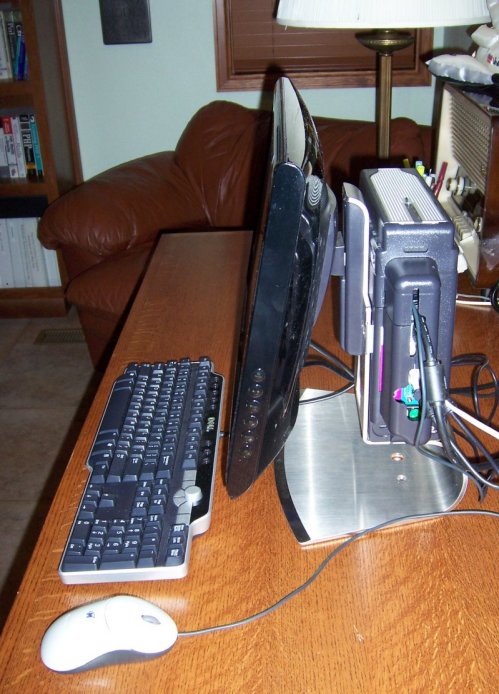
I have one of the very cool SX270 stainless-steel all-in-one brackets that combines a 10cm VESA monitor mount with a couple of tangs to hold an SX270 mini-PC behind the monitor. It makes for a very compact system, and in fact it was the integration of the SX270 and the monitor on the bracket that first brought the SX270 to my attention some years back, when I saw a couple of them at our optometrist’s office. So I took my spare SX270, parked it on the bracket, dug a Dell keyboard and a mouse out of the odd lots box, and realized that I did not have a VESA monitor to hang on it. So off we went to Best Buy, where I learned from the earnest young woman in the computer department that they had not sold 4:3 monitors for almost a year now. Every single one in the long line on display was 16:9.
I know why this is the case (home theater) and whereas it wouldn’t be my first choice, I’m willing to use that form factor, and really needed a monitor. I was apprehensive for a simple reason: The SX270 was made in 2003, and I don’t recall the machine supporting the 1600 X 900 resolution of the smaller 16:9 LCDs. I took a chance, figuring (or at least hoping) that I could rummage around online and come up with a newer driver for the Intel 82865G graphics chipset.
What I bought was a Samsung SyncMaster 2033SW. It’s VESA-compliant, and I bolted it to the stainless steel bracket without difficulty. It was on sale for $179. The machine itself cost me less than that; I think $150 on eBay some time last summer. 2.8 GHz, 1 GB RAM, with XP Pro–used and used hard, and ugly up close, but completely functional. I went up to Dell’s site to see if newer video drivers were available, but what they had was what I had. The closest that Windows could come to 1600 X 900 was 1280 X 768. The monitor centered the smaller raster in the middle of its screen, with the surrounding pixels dark. There was a “stretch” option that spread the raster out to the full extent of the screen, but it looked hideous.
Fortunately, Windows wasn’t the goal here. I booted the Ubuntu Intrepid installer CD in LiveCD mode to see what the OS would detect and how it would respond, considering that the machine dates back to 2003. Without a grunt of complaint, it detected the graphics hardware and loaded a 1600 X 900 driver. I tried a few things, pronounced it good, and told the OS to go install itself in earnest. Twenty minutes later, I was downloading NASM, Kdbg, the Bless Hex Editor, Nemiver, ddd, and a few other things through the Synaptic Package Manager. Not once did I have to face a command line. Everything Just Worked. The age of the machine (apparent from its collection of dents and inventory-tag stickum) didn’t seem to matter at all.
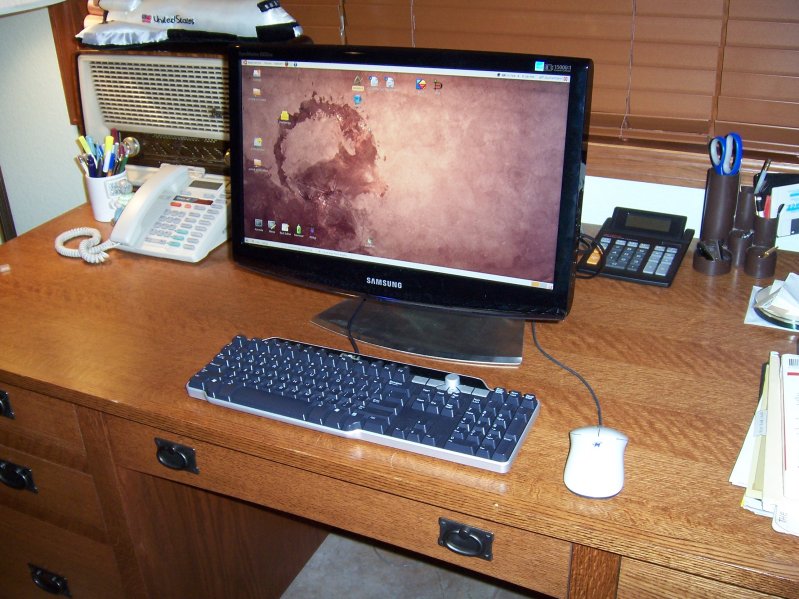
The display is gorgeous; it’s easily the brightest LCD I’ve ever seen. The whole gadget takes up about as little space as anything with a 20″ monitor possibly could. And after spending an afternoon with it, I realize that a long horizontal aspect can be handy: Editor on the right, Kdbg on the left, and just enough of a terminal peeking out under the editor to run make as needed.
I’ve been fooling with Linux intermittently for well over ten years, and the craziness of today’s events still boggles me: It installed much faster and way more easily than Windows generally does, and on old hardware to boot. This was not the case in 1999, let me tell you. If MS isn’t in trouble by now, it’s nobody’s fault but our own.