 My first job out of college was at Xerox, as a technical representative; i.e., a copier repairman. I repaired copiers in downtown Chicago for a little over two years, and then acted as a data debriefer for tech reps who repaired newly released copier models. I spoke with tech reps after they completed a service call, then typed the necessary data into a terminal for an APL-written mainframe system based at Xerox HQ in Rochester NY. I got to know the guy who wrote the system on the mainframe side. In loose moments he let me program things in APL, just for fun. This impressed him, and in 1979 he helped get me promoted to programmer in Rochester. I hadn’t heard much about Xerox’s Palo Alto Research Center (PARC) before we got to Rochester. In 1980 Xerox released its Star office data system, and we got a couple of them in our computer lab. I boggled at the graphical windowed user interface, and people told me that the Star was the child of a machine called the Alto, which had been created at PARC while I was still in college. A year or so before I quit Xerox to move into technical publishing, they delivered an Alto machine to our computer lab. I asked my boss what it was for, and he said he had no idea, as he had not ordered it. I was in maintenance mode and asked if I could play around with it. He said, Sure. I bought the three 1980 Addison Wesley books on Smalltalk, and without talking much about it, I used the Alto and taught myself Smalltalk.
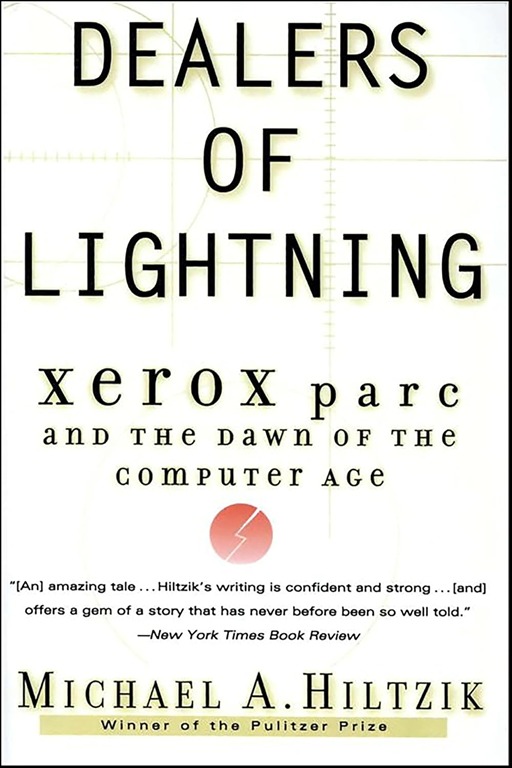
I said all that just to make clear that I knew a little about PARC and what it did back when PARC was young. Michael A. Hiltzik’s Dealers of Lightning fascinated me, as I had hands-on experience with the Alto and Smalltalk and wanted to know more about how they came to be. To me the book was riveting. Your mileage may vary…but overall, it’s a damn fine book and well worth reading.
Xerox was making outrageous amounts of money in the ‘60s and ‘70s from its patents on xerography. It bought a company called Scientific Data Systems in 1969, and rebranded its computer products as the Xerox 500 series. The SDS Chief Scientist suggested that Xerox create a research lab for computer technology, which triggered the creation of PARC. PARC opened its doors in mid-1970 under manager George Pake.
Alan Kay joined PARC that year, and was the source of several fundamental ideas that changed the shape of computing from multitudes of time-sharing mainframers on machines the size of a New York apartment to personal computing conducted by one person sitting in a chair in front of a single-user computer that fit under a table. The book describes the efforts of many scientists and programmers, but Alan Kay and Adele Goldberg were really the beating heart of PARC’s greatest achievements, which included object-oriented programming, the Smalltalk graphical programming environment, and, in truth, the very idea of personal computing through a graphical interface.
Kay’s first concept was the Dynabook, which was a bogglingly prescient look into the future at a computer the size of a laptop or a big tablet. It was never built in the early 1970s, obviously, but you can read about it in a great little book called Personal Dynamic Media, which I have on paper but you can download as a free ebook from archive.org. (A great many of Kay’s publications and interviews can also be seen at the Alan Kay Media Center.) The Alto machine was as close as 1973 technology could come to Kay’s Dynabook.
Dealers of Lightning covers the creation of the Alto in great detail, with less but still interesting text about the creation of the Xerox Star from the Alto prototype. Hiltzik focuses on the people who worked for PARC and Xerox executives, how they agreed and disagreed, and what became of their interaction. It’s a dense book about a huge game with a great many players, but the author helps reader understanding by including lists of the major players at Xerox and PARC, along with the names of PARC’s several internal departments. The book also contains a timeline of events from 1969 to 1984. These helped a great deal.
But what helped the most, oddly, was the book’s epilogue, subtitled, “Did Xerox Blow It?” In the epilogue Hiltzik outlines the dismissive conventional wisdom about how Xerox threw away its chance of being the inventor of personal computing—and reminds us that any large non-computer manufacturer would have refused to take so big a chance to create a market that did not yet exist. Yes, Xerox upper management made a lot of bad decisions. But those decisions are mostly seen as bad in retrospect. Apple ran with Xerox’s ideas because Apple was small and willing to bet the company on Xerox’s ideas. Xerox management was not willing to bet the company on technologies that did not exist or just barely existed.
I wanted to understand Xerox’s failure because I had worked there, and seen fascinating little bits of it. You may not see it as engrossing as I did. Understood. But take a chance. It’s a story about the origins of personal computing that almost nobody hears these days. If you’re a computer guy like me, you should be willing to hear that story as well as Michael Hiltzik tells it.