- The Nook Tablet is no longer rootable, thanks to a recent stealth update applied automatically when the device connects to the Internet. The big deal with the mod is that sideloaded apps can no longer be installed; all you get are what’s available from the B&N app store.
- Lose a few, win a few: Amazon no longer blocks rival ebook apps on its Kindle Fire almost-a-tablet.
- I always roll my eyes when people say things like <YEAR> will be the Year of the <WHATEVER>. However, I’m inclined to believe that Android may finally begin coming of age in 2012, and I’m hoping to score a 10″ ICS tablet once I find one with an external card slot and (ideally) USB charging.
- Xoom 2/Xyboard is off my list because it doesn’t have an external card slot. I also agree with the review (having a Verizon-issued Droid X2 now) that the Verizon app store is hideous.
- This may well be the smallest possible USB thumb drive. No, I don’t want one. I might inhale it.
- Joe Bryer, who sent me the coal samples I described yesterday, has posted some nice videos on YouTube about using coal for home heat.
- The chemical structure of coal (granting that it’s not a uniform material but a mix of many hydrocarbon compounds) looks something like this. (Thanks to Pete Albrecht for spotting this for me.)
- My very talented Taos Toolbox 2011 colleague Lisa Nohealani Morton had her name tattoed on her arm–in binary. I myself am no stranger to binary, but if you don’t believe me you can translate it using a binary-to-text translator.
- What if you’d been at my high school lunch table in the spring of 1970? This is what you would have seen. I boggle a little at my then-habit of drinking milk and lemonade at the same meal, but I’ve done (and worn) far weirder things in my life.
- Be careful what stuffed animals you pose with over at the photography studio, especially for your Christmas photo cards. Peace on Earth and all that…
- 42% of the 100% must think they’re part of the 1%. Or something. (Thanks to Michael Covington for the link.)
- Offered without comment: The continents can be rearranged to form a chicken.
science
Odd Lots
Coal That Does Conduct
We got 10″ of new snow last night, and it’s still coming down. Given that it’s going to be a winter blunderland out on the streets today, we decided to stay inside and get a few things done closer to home. One of these things was to spend a little time measuring the resistance of coal.
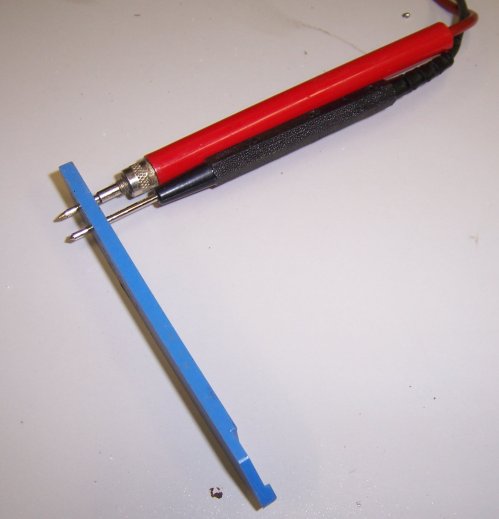
Reader Joe Bryer was good enough to send me eight pounds of coal samples, in two Ziploc bags. One bag was high-quality Pennsylvania anthracite. The other was bituminous, its origins unspecified. To take the measurements, I made a jig out of a piece of scrap plastic. I drilled two .0785 holes a quarter inch apart. The distance was arbitrary. (The size of the holes is that of standard probe tips.) The idea was simply to make all measurements with the same distance between the probes.
I measured several spots on five pieces of bituminous, and in all cases the resistance was higher than my DVM’s top reading of 20 megohms. The anthracite was a completely different story. The resistance varied from place to place on any given sample, and varied widely even on a single sample. The highest readings I got were in the vicinity of 180K ohms. The lowest was 12K. I wiped the samples with a dry rag prior to testing them.
This is promising. The 1/4″ spacing between the probes was not quite arbitrary. The carbon button microphone element in an old-style telephone is about 1/4″ in size. I have several of those in the drawer and all of them tested at between 5K ohms and 10K, depending on how you orient the element, and whether you tap it with a screwdriver. It is, after all, just a little container of small carbon grains. So I think it would be worthwhile sifting some sand-sized granules of anthracite and trying them in a mic element lashup.
Joe Bryer pointed out something I hadn’t known: Bituminous and softer coals like lignite and peat are sedimentary rocks, whereas anthracite is metamorphic rock. Pressure and heat can break down some of the long carbon chains and ring hydrocarbons of which coal is made and free up the carbon, which can then, in a dense enough fragment, conduct electricity. Hydrocarbons, even very dense ones, don’t conduct electricity and many are very good insulators. Graphite, which conducts electricity very well, might be considered the highest grade of coal, or at least the variety most affected by heat and pressure underground. (It isn’t burned as fuel because it’s not common compared to coal and very difficult to ignite.)
The next thing to test is carbon from barbecue briquettes, which I will have to beg from friends since I no longer burn charcoal for grilling. If I can find some of the drafting pencil leads I used in drafting class umpty years ago, I’m going to grind them up and test them as well. (My friend Joe Flamini W4BXG says that he’s done that himself.) In the meantime, I have a place to start, and will now set my mind to building a microphone lashup to test conductive particles in. More as I manage it.
Coal That Doesn’t Conduct
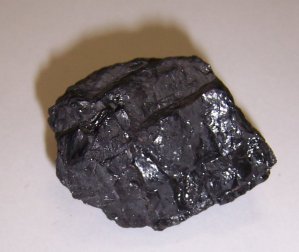 My friend George Ott surprised me with a lump of coal yesterday morning, after church over at St. Raphael’s. He even wrapped it and put a ribbon on it! I could barely stand the wait to get home and check its resistance. And (drum roll, please) the lump is…an insulator.
Or a damned reasonable facsimile. With my DVM set on its 20 megohm scale, the resistance didn’t read at all, even with the probes set pretty firmly in the coal about an eighth of an inch apart. I tested at eight or ten different points on the lump, since carbon is funny stuff generally and coal is not a uniform substance. The DVM reads a 10 megohm resistor right on the money, and failed to read a 22 megohm unit. I use that DVM a lot and certainly haven’t seen anything wrong with it. But no matter how close I set the probes, I got no reading at all.
I put the lump against my belt sander and ground a flat face, which was interesting in terms of the tarry smell that came off the lump. No difference. I whacked a corner off the lump with a coal chisel. No difference, even on the fresh and very shiny fracture face. With the clean and very sharp points of the probes no more than a sixteenth of an inch apart, the resistance was higher than 20 megs. Wow.
I’m not enough of a rockhound to know what sort of coal it is, and George didn’t know either. (He got it from a blacksmith who fires his forge with coal.) It looks like anthracite in that it’s quite shiny, but beyond that I just don’t know.
Another of my readers is sending me a sample of both anthracite and bituminous, and that may help. Some of the online sources I’ve read describe coal as a semiconductor, but I think by that they only mean a substance with significant resistance. I’ve seen nothing to indicate that some types of coal would be insulators across very small fractions of an inch.
However, among other projects I hope to get to this winter is a crystal detector lashup, steampunk style, on an oak base with a copper pipe cap to hold a mineral sample for testing as a cat-whisker detector. One doesn’t think of coal as a candidate, but it certainly won’t take much work to do the science!
I Want a Piece of Anthracite for Christmas…
Yes, I want a lump of coal for Christmas. Two actually: Santa, if you’re listening, see if you can get me four or five ounces of a good glossy anthracite, and a similar quantity of mid-grade bituminous. I’m not sure where else I’m likely to find it. (Ok, ok, eBay. Last resort…)
I haven’t been bad. I’ve been curious.
A question occurred to me the other day while I was hauling boxes around the lower level: Does coal conduct electricity? And if so, how well? I know that carbon does, but of course you have to specify which kind of carbon. Diamonds do not conduct electricity. Carol’s engagement ring is big enough for me to have put an ohmmeter across its large facet thirty-odd years ago. The carbon rods running down the centers of conventional carbon-zinc batteries conduct very well. Mechanical-pencil lead conducts electricity. Resistors, in fact, were basically painted lengths of pencil lead until relatively recently.
Coal, now. Hmmm. I would run downstairs and do the science right this minute, but I’m not sure I’ve held a piece of coal in my hand for forty years. Uncle Joe Labuda burned anthracite in a coal stove to heat his flat down Back of the Yards around 1960. I was fascinated by the lumps of coal in the bin behind his stove for their luster and even more by their smell, which was a less acrid form of the coal smoke that hovered over the neighborhood all winter, at least until people started installing natural gas space heaters.
Online research suggests that the resistance measured across the thickness of a one-centimeter cube of anthracite runs from the mid-hundreds to low thousands of ohms. That suggests that sand-grain sized particles of coal could be used to create a carbon button microphone. My friend Art Krumrey actually did this circa 1963, by beating on a carbon rod yanked out of a dead flashlight battery, and loading the grains between a soda bottle cap and half of one of the thin steel puck-shaped containers that large rolls of Scotch tape used to come in. He basically duplicated the circuitry of a primordial telephone connection, and we sent our voices over fifty feet of wire without any active devices at all, just a few dry cells in series with the cobbled-up carbon mic and a pair of dynamic headphones. It was boggling how loud the audio was, so loud that it overloaded the headset unless we spoke in practically a whisper.
This was how telephone systems worked before amplifier tubes were invented: The voice audio signal coming out of the carbon mic was already high-level, being a variable resistance in series with a high-current power source. In fact, electromechanical repeater amplifiers were created by mechanically coupling a dynamic earpiece to a carbon button mic. With decent batteries to drive the system, repeater chains like that could carry voice signals hundreds of miles without a vacuum tube in sight.
What I really want to know is whether a steampunk-era garage inventor could have created a usable carbon button mic using granules of coal, of if purer carbon would be required. If I can find a lump of coke that might work better, and turning coal to coke is not exactly alchemy. (I’m not sure I want to do it myself.) If the resistance of a lump of good anthracite were low enough, it could also function as the cathode of a carbon-zinc primary battery, which would be interesting all by itself. Water-cooled carbon mics the size of pie pans were used in series with high-speed alternators to generate voice-modulated RF before the advent of RF power tubes. It’s a delicious steampunkish concept, full of sparks and ozone and odd things turning too quickly for their own good.
Of course, I have a Drumlins World story concept that involves simple electromechanical wireless voice transmission systems. The sinister Bitspace Institute has a very secret radio communications network, and when a pair of spindly teenage boys independently invent spark radio, well, interesting things happen–especially when you throw a few drumlins into the mix.
Still taking notes, but even a few ounces of good coal could make for some interesting experiments, just as my steampunk Geiger counter did last year. Once the lower level is done I hope to lash something up to measure the effectiveness of different kinds of carbon granules in microphone service. Whether the story itself gets written or not, I expect to learn something, and that’s good enough for me.
Odd Lots
- You’re getting two Odd Lotses in a row for a reason. Stay tuned–I’ll try and explain tomorrow, if I don’t run out of Aleve.
- Bruce Eckel is returning his Kindle Fire because the damned thing will not render .mobi files. C’mon, Amazon. I mean, come on. (Thanks to Mike Bentley for the link.)
- Xoom 2, where are you? Whoops, it’s going to be called the Droid XYboard to distance itself from the Xoom brand, which was done in because Somebody Didn’t Want It To Have a Card Slot. (Don’t know who. Have suspicions.)
- Charlie Stross makes a good case that DRM on ebooks (as required by the Big Six) is a stick handed to Amazon with which to pummel the Big Six. Read the piece, follow the links (make sure you know what a “monopsony” is) and then read the comments.
- Schumann resonance waves can apparently be detected from space. This is surprising, as my earlier readings suggested that they only exist by virtue of a sort of immaterial waveguide formed by layers in the Earth’s atmosphere–the same waveguide effect that allows hams like me to bounce signals around the world.
- Femtotech? I postulated a “femtoscope” in my novel The Cunning Blood, but it was used to plot quantum pair creation and did not rely on exotic matter. I’m not sure such things are possible, or could be done in any environment where we could live or even work through proxies. But as with a lot of things (especially LENR) I would hugely enjoy being wrong.
- I torrented down the brand-new Linux Mint 12 Lisa the other day, and like its predecessor it will not detect the video hardware correctly on my 2009-era Core 2 Quad with NVidia 630i integrated graphics. Somewhat surprisingly, it will install on an older Dell GX620 USFF with (as best I can tell) no video problems. Not sure if I like GNOME 3, though. MATE, a GNOME 2 fork, has promise.
- I may have made this point once before, but hard steampunk authors should have the Lindsay Books catalog on hand, or at least have the site bookmarked. These are books explaining how to actually do steampunk technology, often in the form of reprints of original Victorian-era reference texts. Thermite, brass, steam engines, and loads of other goodies just as great-great grandpa learned them. (Thanks to Bruce Baker for the noodge.)
- One of my German friends told me that plagiarism in German doctoral theses is so widespread that it’s spawned a crowdsourced mechanism for detecting it. That’s the abbreviated English-language version; if you have a reasonable amount of German, go to the richer, fuller main page.
- Very spooky time-lapse video of a little-known physical phenomenon. (Thanks to Pete Albrecht for the link.)
- I originally thought this was a hoax. On the other hand, I have a Tim Bird and I love it. It’s hard to believe that such things actually work as well as they do.
- Sometimes you wear what you eat–or at least a reasonable facsimile.
Odd Lots
- The IBM PC turns 30 today. I had a dual-floppy 5150 and loved it. Hard to believe it came home almost thirty years ago.
- The number of retractions of dead-wrong and perhaps fraudulent scientific papers is surging, rising fifteen-fold in the last ten years. So what’s a citizen scientist to do? Probably not buy into just anything that might be in a peer-reviewed paper. (Maybe we need more peers. Or better ones.)
- Good example: There’s little or no evidence that salt causes hypertension, but that doesn’t stop certain scientists and many government functionaries from insisting that it does. (If salt did cause hypertension, I’d be…dead.)
- From the Words-I-Didn’t-Know-Until-I-Played-Scrabble-With-An-Expert Department: ort, which is a fancy but short word for leftover food scraps. As in, “Yesterday at 12:15 the junior-high lunchroom became an ort cloud…”
- The Perseid meteor shower peaks tonight just before dawn, but a nearly full moon will drown out many or most of the fainter traces. Hey, get up early and plop into a deck chair for a while. Assuming a clear sky, you’re almost guaranteed to see something. And there’s always next year. (Carol and I have been watching them as weather allows since 1969.)
- This is still extremely new, but it has promise: an AbiWord plug-in that exports epub files from within AbiWord. (I haven’t tested it yet.)
- Ditto for Open Office Writer. (Haven’t tested it either, but thanks to Sam’l Bassett for the link.)
- Are you the kind of reader who reads the ending in the bookstore before buying the book? (I used to be.) Apparently spoilers don’t spoil the fun of reading novels as much as most people assume.
- Who doesn’t like control panels? Here’s a wonderful album of panels from every sort of machine, from the Space Shuttle to the 1966 TV series Batmobile. Don’t miss Part 2. (Thanks to Ernie Marek for the links.)
- Wow. You used to be able to buy dynamite at the hardware store…at least if you were a farmer.
- Scott Adams thinks that boredom lies behind a lot of creativity. As we become less bored, we grow less creative. He may be right. But…how do we solve the Boredom Shortage? (Thanks to Pete Albrecht for the link.)
- I like butter. I like it a lot. But maybe not this much. (Thanks again to Pete Albrecht for the link.)
- Don’t just have your survivors give you a 21-gun salute. Be the 21-gun salute!
Odd Lots
- I guess I didn’t look hard enough last week: Pete Albrecht sent me a link to a site devoted to balloon molecules, using the same balloons that balloon artists twist into weiner dogs. The gallery contains lots of examples, from simple tetrahedra through Fullerenes and DNA, so don’t miss it!
- A neuroscientist calls BS on the Singularity. (Ok, the dialect of Singularitanism spoken in the vicinity of Ray Kurzweil.) What He Said.
- Using a laser sintering process (admittedly, on bigger parts than we’re used to seeing) some guys at the University of Southampton have created a 3-D printed UAV with a 6′ wingspan. 3-D printing sidesteps some of the difficulties of manufacturing certain shapes, including elliptical wings. (Thanks to Aaron Spriggs and half a dozen other people for the link.)
- Here’s a gallery of home-brew tube projects that’s one of the best I’ve seen. Take special note of the homebrew coil winder (design by Gingery) that made many of the designs possible. Here’s another link for the same writer.
- There is a NaNoWriMo alternate held in August. I think it really needs to be held in March (which I’ve considered the worst month of the year for decades) but nobody asked me.
- There was once a special phonograph record technology designed for use under car dashboards. It failed epically. I couldn’t stop vinyl records from skipping at home; one wonders what it would take to suppress skipping in a car on crappy Chicago streets. RCA created a different under-dash machine that played standard 45s, but by 1962 they’d all faded out with tailfins, waiting for the impending Age of 8-Track.
- Back in the day we sometimes Scotch-taped pennies on the tonearms of cheap record players to minimize skipping, and later wondered why the records started sounding crappy after awhile. (I think the term was “three-penny record.” I had more than my share.)
- Oh, dear. There may be an emerging film/fiction subsubgenre called “Fantastic Catholicism.”
- Here’s a nice short piece on some new research on airborne dust and its effect on atmospheric carbon levels. We’re finally getting a little hard data on the subject.
- “Wipe that grin off your face, Herr Luther.” (Thanks to Michael Covington for the link.)
Odd Lots
- A lot happened while I was down in Taos, and I’ll do my best to catch up a little here today. But as you’ve seen from my two entries about the workshop, it was tough to pay attention to anything there but the challenge at hand.
- More photos from the workshop: Christie Yant has established a single page linking to all four of her Flickr albums from Taos Toolbox 2011.
- Several people sent me invites to Google+, and I established an account several days ago. (I already had a Google account, so it was no big deal.) Google being insanely paranoid about how real your name is, look for me as…Jeff Duntemann.
- In the wake of Tuesday night’s epic natural gas leak here, I discovered that the ethyl mercaptan molecule resembles a balloon animal weiner dog with its hindquarters on upside down. Hey, I wonder if a balloon artist has ever done balloon hydrocarbons? (Google comes up empty.)
- Motorola is finally rolling out an Android upgrade that enables use of the Xoom’s SD slot. Guys, why was that so hard?
- Only a handful of people ever make it to 114 years old. And, weirdly, that’s when virtually all of the oldest of the oldest of the old actually die.
- Here’s a photo of the largest cannon ever built. No points for guessing who built it.
- And while you’re browsing Gizmodo’s Monster Machines category, don’t miss the largest Diesel engine in the world. Your flip-flops got paddled across the pond by something very like that.
- This SSD might well make that seven-year-old PC a little bouncier…but I still recommend maxing out RAM to 4 GB, cleaning the registry, and getting rid of crapware. I’m less convinced than some people that hard drive speeds are a serious bottleneck when your registry looks like an empty lot in a war zone.
- QBit, who on beach walks favors dead fish but will gladly settle for seaweed, has refused to answer the question: Why do dogs roll in stinky stuff?
- I doubt that this would ever work, irrespective of its cool halfway-to-dieselpunk looks. It does make me wonder what other cool stuff might have been drowned out in the racket coming from WWI. (Thanks to Gary Kato for the link.)
- And I know damned well that this wouldn’t work, but it goes all the way to full-bore, balls-out dieselpunk fantasy. (Thanks again to Gary Kato.)
- Perhaps you’ve seen the Dyson Fan on TV ads. Here’s how they work.
- The site is in German, and is well-known in Europe for high-end licorice. Pete Albrecht assures me that the name of the company really does translate as “Bearshit Pharmacy.” Wow.
Odd Lots
- Here’s another take on the EasyBits GO debacle, from a guy who used to work at Easybits. Even if it’s not a trojan, it’s still crapware, and careless crapware at that. The Microsoft connection is intriguing: MS will soon be reviewing the entire Skype ecosystem, and may decide to do some decontamination. I don’t think it will go well for EasyBits.
- Down in the trenches in the Carb Wars, people who yell, “A calorie is a calorie! It’s just the laws of thermodynamics!” don’t understand thermodynamics. I’ve known this for years. Here’s a good explanation. (Thanks to David Stafford for the link.)
- Mike Reith saw a pure white squirrel awhile back, up near Denver. I had never heard of non-albino white squirrels before, but they exist, and appear to be spreading due to evolutionary selection–by humans.
- Maybe it wasn’t us who extinctified the Pleistocene megafauna. (Or at least our paleolithic ancestors.) Maybe it was the Sun. Scary business. (Thanks to Jim Strickland for the link.)
- From the Words-I-Didn’t-Know-Until-Last-Week Department: prosopagnosia, the inability to recognizes faces or familiar objects. (Thanks to Bruce Baker for calling it to my attention.)
- From Pete Albrecht comes a link to a video of a train wreck caused by a tornado–with the wrinkle that the wreck is filmed from a security cam on one of the freight cars. Toward the end we see a derailed tanker striking sparks as it’s dragged against the rails. Made me wonder what would have happened had it been full of LP gas…
- Forgive the vulgarity and the pervasive comics/movies influence, but this is a point that needs to be made, and textual fiction is no exception. (Thanks to Frank Glover for the link.)
- I like sprouts. I haven’t eaten them for ten years. Here’s why. Alas, being organic doesn’t help. (Thanks once again to Pete.)
- Here’s a cogent (and funny) illustration of a great deal of what’s wrong with science these days. Hint: It’s not science. Most of the problem is the butthead festival we call the media. (The rest is the grant system.)
Odd Lots
- Here’s a nice graph of the smoothed sunspot number for the last four solar cycles (21-24.) Our current Cycle 24 is still young, but it stands fair to be the weakest solar cycle in 200 years. It may mean nothing, but 200 years ago we saw cycles like that frequently and were in the worst part of the Little Ice Age.
- Darrin Chandler pointed out Maqetta to me: an HTML5 WYSIWYG Web editor, free and open-source. And from IBM, yet. Haven’t tried it but hope to in coming days. Has anybody else played with it at any length? I use Kompozer for Web work right now, and it’s not evolving very quickly, let’s say.
- And what we may need more than Maqetta for Web pages is Maqetta for epub ebooks. I remain appalled at how much kafeutherin’ it still takes to do an epub with a cover image and even the simplest forms of paragraph differentiation. (Like no first indent to indicate a new scene in a story.) People continue to hand-code ebooks. This is idiocy to the seventeenth power.
- Sometimes you read a short, casual mention of something in a book or article, and the weirdness of it doesn’t really hit you. So stand ready for some pretty boggling astronomical weirdness: A 400-meter asteroid that moves in a horseshoe-shaped orbit. And guess who’s in the gap of the horseshoe?
- At our most recent nerd party, my new friend Aaron Spriggs mentioned Chisanbop, a method of finger arithmetic created by the Koreans and little known here in the US. This is very cool, and would be extremely handy on fictional planets (like my own Hell and the Drumlins world) where electronic computation either doesn’t work and hasn’t been invented.
- A brilliant new method of imaging underground structures like magma plumes shows that the Yellowstone supervolcano is bigger than we thought. The imaging is done by measuring electrical conductivity in the rock rather than the transmission of physical (seismic) vibration. The images give us no additional information on how close (or far) we may be to another eruption, but it may help us to interpret what little data we already have.
- Hoo-boy, here’s a problem I don’t think anyone anticipated in the wake of Japan’s recent catastrophic tsunami: Safes full of (soggy) money washed out of individual homes are now washing up on the seashore.