- Hurricane activity is at a 45-year low, and no major hurricane has achieved landfall on US soil in almost ten years. Tornadoes have been pretty scarce recently as well. Then again, it’s mid-April and snowing like hell outside right now. Two outa three ain’t bad.
- The Food Babe gets her you-know-what handed to her. This, after all, is the woman who said, “There is just no acceptable level of any chemical to ingest, ever.” Wow. I probably shouldn’t exist, then. (Thanks to Pete Albrecht for the link.)
- More evidence that salt isn’t the demon that government guidelines insist that it is. Remember, you can do the experiment on this one, as it applies to yourself: Give up salt for a month and record your blood pressure every day. Then go back on salt and record your blood pressure every day. If your BP doesn’t change significantly, you can pretty much assume that salt isn’t an issue.
- Red meat is not the enemy. And yes, the science is complicated. What science isn’t?
- Crickets are not superfood. Who knew?
- Carol and I have tried this Moscato and found it good.
- Someone pointed out that my Low-Voltage Tubes page on junkbox.com had gotten corrupted. Indeed it had–and I had unknowingly copied that corruption (which was present in my HTML source files)–onto all the backups I have here. So I pulled a trick I had thought about for a long time: I looked up the site on the Internet Archive’s Wayback Machine, and checked their images of junkbox.com until I found one with an intact copy of the article. I then just lifted the portion of the file that had gotten corrupt and dropped it into the newest copy of the corrupted file. Fixed.
- Amazon has a new contract with Harper-Collins that gives the publisher full agency; that is, the freedom to set its own prices. Amazon is posting a notice on the sales pages of full-agency titles telling the customer that the publisher has set the price, not Amazon.
- Here’s some actual data crunching of the Sad Puppies phenomenon, along with a good deal of sane and rational analysis. Stop hurling hate, and understand what’s going on. Hating isn’t helping your cause one bit.
- ESR thinks that the real problem dividing SFF right now is literary status envy. The piece goes back to last summer, which was before the whole industry went nuts over Sad Puppies. Worth reading, maybe twice.
- If you’re an SP3 supporter, you can get all kinds of Sad Puppies 3 merchandise at the logo artist’s Cafe Press studio shop.
Odd Lots
Carol and Dash Get Back to the Show Circuit

It’s been a tough three years for Carol. Her mom’s final year and passing, and then three foot surgeries that took literally a year to fully recover from; well, things like that would slow me down too. So it was with some celebration and a little apprehension that we took off for something we haven’t done in almost three years: a dog show.
We rolled into the Terry-All Kennel Club Dog Show up in Brighton, Colorado on Friday afternoon. Dog shows require a sort of “home base” where you can set up a grooming table and get the contestants in shape for the show ring. Grooming space can be either paid or unpaid. At the Adams County fairgrounds, the difference between paid and free grooming space is whether or not you have walls. Unpaid grooming space is in the cattle pens, which are just that: A roofed area divided into pens by pipe railings. Paid grooming space gets you walls, in an arena building used for showing and auctioning cattle.
What you don’t get either way is a floor. This is cattle country. You get good Colorado brown dirt, liberally mixed with grass and hay preprocessed by various large animals. Eat your lunch carefully: The Five-Second Rule does not apply.
Carol paid for grooming space in the arena building, and we were right by one of the building’s six doors. The light was good; power was available. Alas, we had a howling wind most of the weekend that was not named Mariah (maybe Manure-ah?) which blew in through the rear doors, picked up brown dust as it went, and deposited it upon all and sundry before exiting out the front doors. Breathing second-hand smoke in my youth was bad enough. Meditate for a moment on breathing second-hand cattle feed.
Oh, and we have blinding-white dogs. The challenge should be obvious.
Carol met that challenge in high style, granted that all of us came home crunching dust between our teeth. Dash never set foot in the dirt, nor did the rest of the Pack, all of whom were with us and three of whom were entered.
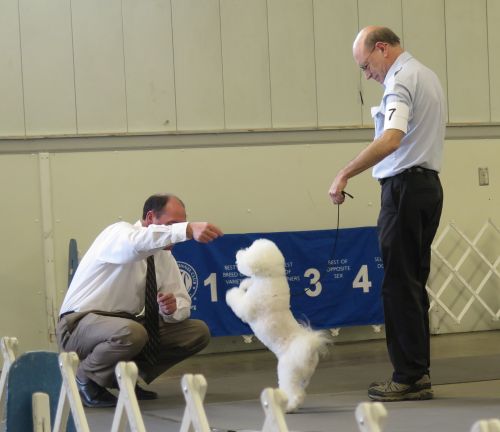
Friday night was an AKC-sanctioned B match for Bichons, which our club organized. (Many thanks to Tammy Singer for doing most of the legwork!) A “B match” is a sort of practice match for dog handlers, basically identical to a real AKC show ring (including an AKC registered judge) except that points are not awarded. In a B match, dogs older than 7 years may be entered in the Veterans class whether they’re neutered or not. QBit, now ten, and Jack, now eight, were both elegible. Carol got their coats in shape, and QBit took first in the class. Jack has a much better coat and looked quite sharp, but QBit (above) has the confident personality preferred by judges, which Jack simply lacks.
Saturday and Sunday were the real show, in which only Dash may compete. (He still has the family jewels, irrespective of regular threats from both Carol and myself.) This was a biggish show for Bichons, with 16 entered, though several did not show and at most I counted 13 Bichons at one time.
Some of them were spectacular, like Lorrie Carlton‘s Flynn, who pretty much swept the field on Saturday and went on to take first place in the Non-Sporting Group. It was a good weekend for Bichons: The breed won Best in Group for both Saturday and Sunday.

Where Dash beat all Bichon comers was in the Owner / Handler class, which means dogs presented in the ring (“handled”) by their registered owners. Dog showing is a competitive business, and there are a fair number of dogs shown by professional handlers who are paid to take dogs around the country on the show circuit to gather wins. Flynn is one of these. To keep professional handlers from sweeping all awards, there is a separate class for people (like us) who do their own handling. Dash won best in the Owner / Handler class on Sunday, which means Carol could show him against other Best of Breeds in the Non-Sporting Group also shown by their owners. After a little touch-up by the formidable Bichon groomer / handler Ellen Perry, Dash went around the ring and landed third place in the Non-Sporting Group. This was the biggest win Carol and I have ever nailed in showing our Bichons, and made the whole windy, dusty, exhausting outing worthwhile.
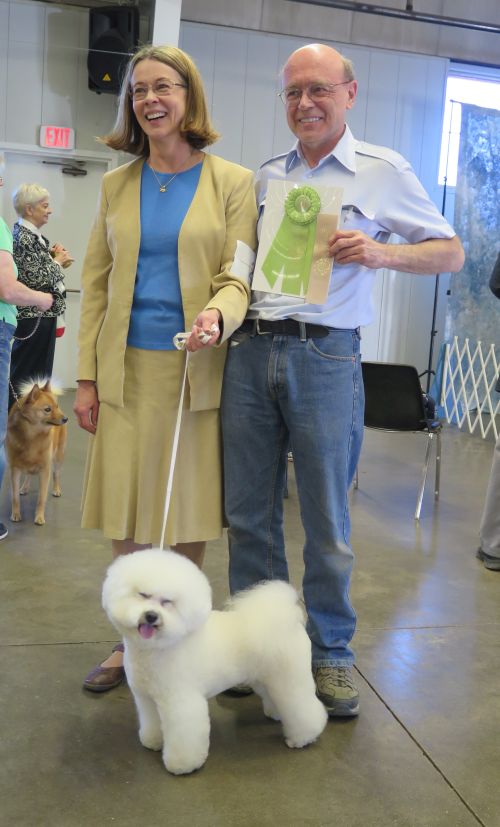
I was in my grubbies in the photo above (taken by Patrina Walters Odette) because I was not doing any handling on Sunday, and schlepping equipment around at this particular show is always a pretty dusty business.
Dust notwithstanding, it was great time and we had a chance to catch up with members of the club we don’t see very often. We also got to meet a couple of new puppy contenders worth watching in coming years. Our next show is in Longmont in mid-May, but we’re likely to leave most of the Pack with Jimi. There will be no B match, and QBit, Aero, and Jack will not be competing. So it will be a simpler project in many ways, as well as a cleaner one.
It took us all day to wash the dust out of everything…except the dogs. That’s another day entirely. Maybe two.
The Human Wave, Sad Puppies, and SFF Monoculture, Part 5
(This series began here.)
I held back Part 5 of this series because the Hugo nomination finalists were announced yesterday, and I wanted to see whether the Sad Puppies (and a separate but related slate, Rabid Puppies) would make their mark on the ballot. The answer is, egad: What a broom does.
But I’ll get back to that.
First I wanted to mention a little pushback on a different subtopic of the series: The Human Wave. A guy I’ve known (if vaguely) for a long time backchanelled me a short note, the gist of which was this: “So you want to destroy literary SF.”
This is a familiar tactic in many brainless headbumps I’ve seen down the years: When somebody proposes that something you oppose should be permitted, you strike back by accusing them of wanting everything except what they propose to be forbidden. This tactic probably has a name, and a place of honor in some online Gallery Of Stupid Argument Tricks. I mention it simply to point out the general level at which much discussion of SFF issues these days operates.
I told him to go back and read the series again, quoting the significant bits.
I’ll say in summary what I said here: The Human Wave is about allowing things, not forbidding things. Yes, what the Human Wave stands against is mostly a certain brand of pessimistic literary fussiness. The solution, however, is to broaden the field. Do litfic if you want. But don’t claim that litfic is the best or only thing worth writing. If the Human Wave movement pushes literary SF out of the spotlight, that’s a choice made by the readers, not me. My take: We need a much, much bigger spotlight.
Now, to the Hugo nominations. The full list from Locus is here. I’ve been a little out of touch with recent SFF (for reasons laid out earlier in this series) and am not familiar with most of them. I got a little discouraged last year when I picked up Redshirts, which turned out to be the biggest piece of crap I’d read out of all Hugo novel winners. (I have not read every single one, obviously, so bigger stinkers than that may be still be lurking somewhere in the past.)
The really, really big question on everyone’s minds today is whether the Puppies had any effect on the final ballot. Mike Glyer did an excellent summary on File 770, with more detailed analysis here. Two-digit takeaway: 71% of the finalists were on either Sad Puppies or Rabid Puppies, or both. Only 24 finalists were not on either slate. A record 2,122 valid nominations were submitted. John C. Wright picked up six slots, a new record for a single year. Some other notes:
- Brad Torgersen, coordinator of Sad Puppies 3, was very careful to keep everything legal and above-board. Even Patrick Nielsen-Hayden admitted that the Sad Puppies campaign had broken no rules.
- Sad Puppies concept creator Larry Correia withdrew his nomination for Best Novel, received for Monster Hunter Nemesis . He did not want anyone to be able to say that he proposed Sad Puppies just to win awards. He now has the moral high ground against any accusations of corruption that will invariably be thrown his way. Larry’s a class act, in spades.
- There will be a Sad Puppies 4, to be coordinated next year by Kate Paulk.
Heads are now exploding all over the Internet, which is the least surprising thing about the whole kerfuffle. Puppy haters are trying to figure out what changes might be made to the Hugo rules to make such a sweep impossible. The truth is that as long as you have supporting memberships who can vote, slatemakers will offer slates to their supporters. Eliminating supporting memberships would make Worldcon financially impossible. (I don’t see anybody complaining about the additional money that all those Puppy supporters added to Worldcon coffers.)
So: If you want to stop the Sad Puppies, you have to propose your own slates. (And have the followers to vote them, which is really the hard part.) Bored Beavers? Aggrieved Alligators? Mourning Meerkats? Go for it. The goal is to reduce monoculture, and broaden the spotlight. That’s ultimately what the Puppies thing is about. Let 2E20 slates bloom!
Boxes, Staging, and the Miraculous Irishman

I know. I’ve been gone almost three weeks, which for Contra is a long time. Where have I been? Well, c’mon, where do I usually go?
We had a serious and difficult mission this time. Carol and I co-own a condo in Chicago suburb Des Plaines with our older nephew Brian, and have since 2007. Brian needed a place to live, and Carol needed a place to stay while she was looking after her mom’s needs during Delores’ last years. Carol’s mom is now Home, and Brian is married and has his own place down in the city. So it was time to sell the condo. Long past time, in fact.
Having been mostly vacant for over a year, the place was dusty and cluttered. So for two weeks we sifted and sorted and dusted and scrubbed and re-polished the oak cabinets. Brian and Alexis took trunks full of stuff home, and Carol and I shipped five biggish boxes back here, loaded to bulging with clothes, kitchen gadgets, towels, plastic hangers, stuffed animals, books, odd computer parts, and much else. (The boxes arrived yesterday, and my initial reaction to the pile on the front porch was: What the hell is all this stuff?)
One subtask was to sell the bedroom set in the second bedroom. It was a nice, rugged item, bought in 1977 and used by Carol’s parents for a long time. Carol figured out Craigslist, and listed it. Then the weirdness began. Many people inquired about it, some of them clearly on the far slopes of the sanity bell curve. A few came to see it. Some thought we were giving it away. Sorry, folks. “$100” is not a computer backplane. Several more seemed willing to pay for it, but had no idea how to get it home and broadly hinted that we should deliver.
Time was running out. We tried to give it to the Salvation Army, but they were unable to get a truck out for it any time soon. Getting the place ready to sell meant rearranging furniture, but until the bedroom set was gone we couldn’t even begin. Not quite three days before we had to hop a plane home, Carol got a text from an Irish chap who said he loved the photos and would bring his pickup over to get it. When he arrived with a hand-cart, he handed me $100, scratched his chin, and then got it out the door, down the elevator, and into his Dodge pickup truck all by himself. He was chatty, and all the time that he was strongarming dressers while talking about growing up near Ulster and encouraging me to indeed visit County Mayo, from which my Irish forbears fled bad harvests in the 1880s, I was boggling at the main force he was exerting, he who was barely my height and 47 years old. It’s not like he looked like a linebacker. Then again, my father didn’t either, as certain North Side toughs learned to their sorrow in 1939.

With the bedroom set gone, Brian and I shifted some desks and things around to make the now-vacant second bedroom look like an office, while Carol and Ali staged the condo. “Staging” means making it look like a model home. Some of this involves removing personal items and photos of relatives, and the rest getting the towels to hang just so in the bathrooms. Carol set the table as elegantly as Corelle would allow. Ali directed Brian and me in shifting the livingroom furniture here and there to get a balanced look. Four hours before our flight back, we looked around and said, Damn, is this our condo?
The unit is now listed on MLS, and our Realtor lady is actively showing it.
We’ll miss the condo. It served us well during a difficult time in our lives. Freeing up our equity will making certain things possible, like a winter place in Scottsdale. We’ll be exceedingly thankful when it sells. (I am already thankful to my late, beloved, and very Irish godmother Aunt Kathleen for sending us a muscular Irishman just when we needed him the most.)
And now, boy, is there some work to do, work that (huzzah!) has nothing whatsoever to do with real estate. More on this tomorrow.
Odd Lots
- 2014 was a lousy year for adult fiction and nonfiction sales both. SF was down 7%; fantasy down 13%; computer books down 12%. To sell anything at all, you need to be chasing all those bookish kids who are supposedly all off somewhere playing computer games. Or something.
- A “fix-up” in the SFF universe is a novel constructed out of shorter works, with some edge-smoothing to make the whole thing hang together. Having seen the big list of SFF fix-ups on Wikipedia, I realize that I’ve read a fair number of them without ever realizing that they were in fact fix-ups. So I guess the techniques work. Should I perhaps begin The Everything Machine with a slightly modified “Drumlin Boiler”? I’m now seriously considering it. (Thanks to Frank Glover for the link.)
- Too much salt may kill you. So may too little. And it may not kill you at all, in any quantity. So why all the kvetching about salt?
- We may live in a much bigger galaxy than we thought–and a corrugated one, at that,
- A new class of drugs called orexin antagonists have begun to be marketed as sleeping pills, but may also confer resistance to Alzheimer’s Disease. New and still tentative studies suggest that orexin antagonists may also be used to reduce appetite. (PDF; Read the whole paper, or at least find the section on orexin.)
- The first 3-D printer for metal is about ready to mass-produce. It’s an odd system in that it uses metal clay, which must then be…yes indeed…baked. (Thanks to Pete Albrecht for the link.)
- Tom Naughton of Fat Head fame reviews Malcolm Kendrick’s book Doctoring Data, and if you’ve ever had a suspicion that medical studies are a stretch (or in some cases completely bogus…remember Ancel Keyes, the consummate medical fraudster?) it sounds like a great read.
- A guy snuck into several Ivy League universities and acted like a student for four years without being noticed. It’s unclear how much he learned, but the article makes the (to me, obvious) case that today an American college education has far less to do with education and almost everything to do with credentialing, and sorting Americans into populations of winners and losers.
- And he didn’t invent the concept. There was a TV sitcom in 1965 called Hank, about a good-natured campus food-truck guy with a secret life sneaking into classes, so he could someday have a better job than driving a food truck. I followed the series, and remember it fondly. Alas, Dick Kallman, the lead, was murdered in 1980.
- Now that I know they’re out there, I’m going to start watching for abandoned microwave towers. So is this primarily a California thing? Ever seen any east of Nevada?
The Human Wave, Sad Puppies, and SFF Monoculture, Part 4
To summarize this series so far:
1. There is a monoculture problem in the traditional science fiction and fantasy (SFF) print industry, and sales are shrinking. The number of publishers is stagnant or falling. Advances are dropping and contract terms have gotten insane. For contrast, the SFF media industry (typefied by its conventions like DragonCon and ComicCon) is exploding in popularity.
2. This monoculture problem has several components, but from a height, it’s a sort of “channel capture” effect: The SFF convention and awards infrastructure has embraced the notion that literary SFF–especially that focused on race/gender identity themes–is the “worthiest” sort of SFF and the sort that we all ought to read if we’re to be taken seriously as cultured beings.
3. People who used to read a great deal of SFF are rejecting this “message pie” fiction (by which I mean fiction that puts message and/or polemic first and story elements second) and are either re-reading older works, moving off to other genres, or out of recreational reading entirely.
4. Sarah Hoyt and several other writers have proposed a category called The Human Wave, which would stand in opposition to the current conventions of literary SFF, especially polemical literary SFF. The Human Wave emphasizes SFF as entertainment, celebration rather than denigration of the human spirit, plot, ideas, optimism, and sense of wonder. I endorse this without hesitation, and will have even more to say about it in future entries.
5. Basically, there are too few hands on the levers of power in the SFF universe. It’s time to start disconnecting those levers and dispersing that power. It’s time to inject some genuine diversity into SFF–not of authorship (we’re already there) but of theme and technique.
Part of that disconnection has been going on for some years: Independent and self-publishing, enabled by improving ebook technology and online stores like Kindle, are expanding their share of the SFF market. In defiance of conventional wisdom, many indie authors are making money, sometimes a lot of it. In fact, print publishers have begun seeing the indies as a sort of farm team, from which they call up the most popular players and offer them print contracts. About month ago, SFWA announced some rule changes allowing indie authors to become full members if they can prove that they’ve sold a certain amount of work for a certain amount of money.
So change is happening, and indie publishing is behind most of the change we’ve seen so far.
Which brings us at last to the matter of Sad Puppies. It’s an ancient question: whether to operate outside the current culture, or from the inside. Reforming anything from the inside is tough, because the Insider Alphas tend to arrange things so that change is difficult, as well as the tendency for reformers to simply be absorbed unless they arrive in overwhelming numbers.
Back in January 2013, Monster Hunter International author Larry Correia, in the context of a tongue-in-cheek rant about how he and other pulp-ish authors never get noticed by critics or awards committees, said this:
For as little as $60 you can become a voting member of WorldCon and nominate something awesome and filled with dragons, explosions, guns, heroism, actual good and evil, and a plot where stuff actually happens. And unlike Sarah McLachlan’s sad puppy commercial, your donation also gets you a whole big ton of free eBooks and all of the nominated works, worth more than the cost of joining.
For the next couple of months, Larry recommended a lot of works he felt should be considered for the Hugos, not excluding his own. He caught some predictable shit for that. It’s unclear how much the informal campaign changed the winners at LoneStarCon 3, but Larry got some people on the ballot who’d never been there before (like the formidable Toni Weisskkopf) and raised awareness of a lot of very good stories that would not otherwise have been on anybody’s radar. Every one of these stories that I hunted down would qualify as Human Wave SFF.
What Larry did is neither unique nor new. In fact, in the late 1970s and early 1980s I remember Mike Resnick sending MM paperbacks of his books to literally every name in the SFWA directory. He wasn’t constantly chanting, “Vote for my books!” but he made damned sure that anybody who was in a position to vote for him had one. I had no trouble with that, and although I never voted for him, I did read his books.
Fast forward a year. The Sad Puppies concept grew legs, got a first-shot logo (Pugs! Why does it always have to be pugs!) and became a serious and semi-organized thing rather than a wisecrack in somebody’s rant. According to Mike Glyer, Sad Puppies 2 placed seven of its twelve recommendations on the final Hugo ballot. To me, that’s not mere success…that’s beyond astonishing.
And another year, bringing us to the current day. Sad Puppies 3 now has a logo you can put on a patch (see above) created by Lee W. “Artraccoon” Madison. The slate is much larger, and its coordinator is now Brad R. Torgersen. Alas, I stumbled on all this right about the deadline for memberships qualified to nominate for the 2015 Hugos at Sasquan in Spokane, so don’t run off to try and get in on it. (I’m generally too late or too early for things, so I’m doubly not a wizard.) However, if before January 31 you were a member of LonCon 3 (last year) Sasquan (this year) or MidAmericon II (next year) you can recommend. Recommendations themselves are open until March 10.
This is a classic example of reform attempted from the inside. For all the foaming-at-the-mouth accusations of logrolling and ballot box stuffing, nothing about the Sad Puppies campaign violates the rules. What Larry and Brad are doing is in fact keeping a shrinking Worldcon alive by bringing in both money and new blood. An award with the prestige of the Hugos should not be decided by a few hundred people, but by tens of thousands of people. Otherwise it reflects neither quality nor popularity, but is rather a straw poll by an in-crowd heavily influenced by a handful of Insider Alphas.
Will it work? Depends on what you want from it. Seen as a publicity stunt (as many do) it’s already working, bigtime. Seen as genuine reform, well, I’m less sure, as much as I’d like to see that reform happen. Maybe it just needs a few more years to cook. Many things do. I certainly wish it all success. It’s already tipped my decision in favor of attending MidAmeriCon II in Kansas City in 2016.
However, if the goal is to popularize Human Wave SFF, there may be better ways. I’ll throw out some ideas when I continue this series. For the time being, I need to take a breather.
The Human Wave, Sad Puppies, and SFF Monoculture, Part 3
I was nostrils-deep writing Ten Gentle Opportunities and wasn’t paying attention when Sarah Hoyt quietly posted a bombshell: The Human Wave Manifesto. It was actually a manifesto in two parts, probably because I don’t think she intended it to be a manifesto at first. (Sabrina Chase had a part in it too.)
But boy, manifesto it is, bigtime.
I powerfully suggest that you read Sarah’s manifesto (perhaps twice) but I’ll summarize for those in a hurry:
The Human Wave is a resistance movement. It’s a reminder that SFF is about unlimited possibility; i.e., there are unexplored universes lying right outside our own navels. So first of all, it’s about throwing off a 30-year accumulation of Thou Shalt Nots and These Are Necessary Rules that the Insider Alphas of the SFF world have laid down. Back in the 60s we had whole posters printed with just two words: Question Authority. That’s what the Human Wave is about: questioning authority. The Insider Alphas are not authorities. They’re just writers and editors of a certain psychology that always makes a beeline for the levers of power. The Human Wave is under the floor right now, disconnecting all the levers. (If only we can keep them from hearing us giggle…)
Human Wave science fiction and fantasy (SFF) is fiction that deliberately subverts those supposed rules (fetishes, actually) and re-takes what was once commonplace in the SFF universe. The guiding principles of the Human Wave (as laid out by Sarah Hoyt) are in fact exhortations to freedom:
- Write fiction that entertains; nay, fiction that makes us gasp.
- Write fiction that celebrates rather than denigrates the human spirit.
- Write fiction in which characters are characters, fully realized individuals and not primarily defined as members of groups.
- Write fiction in which the message doesn’t overpower the rest of the story.
- Write fiction that isn’t eaten by Grey Goo; i.e., fuzzy characters wandering around landscapes of indeterminate importance doing nothing coherent, learning nothing, and ultimately having nothing to say.
- Write fiction that is upbeat; or if it must be downbeat, make sure it’s at least meaningful and that its insights are worth the downer.
- Write in a style that can be understood; i.e., don’t let style overwhelm or obscure substance.
- Write fiction that has internal logic and is faithful to that logic, especially your explorations of science and magic.
- Write fiction that isn’t boring, since ordinary life does not suffer a boredom shortage.
- Write what you write best and make no apologies; i.e., just shut up and write!
That’s the best synopsis I can provide. I’ve broadened the concept to include fantasy (the second “F” in SFF) but otherwise have tried to be faithful to Sarah’s intent. I will also add an eleventh commandment:
11. If you have that skill, write fiction that makes us laugh.
What I found heartening about the Human Wave is that it’s how I’ve always written, even if I take it farther than caution might suggest. I have a primal fear of not delivering enough value to my readers. That’s why I throw in dump trucks full of ideas, lots of explosions and gunfights, a little humor even in serious stories, and end with a mayhem-filled action climax. Yeah, I’m an old guy. I learned this stuff basically by reading the best of the pulps. There’s nothing shameful about the pulps, just as there was nothing shameful about 1958 De Sotos. Just as we can now make far better cars than 1958 De Sotos, we can write far better popular fiction than the Fifties pulps. We just have to ditch the shame.
I’ll also add this: Literature is good, and literary techniques can be dazzling in the right hands. I’ve read my share, and in fact have a degree in it, for what that’s worth. My two objections to literary SF are that not everyone has the skill to write it, and even when well-written, it doesn’t work as a steady diet. Let those who can write it, write it. Let’s just not insist it’s the whole picture, or even the worthiest part of the picture. Yes, literary is good. Choice is even better.
So. Where do we go from here? I’d certainly like to see a list of authors who embrace the Human Wave, as well as stories that embrace it, whether their authors ever heard of it or not. Such a list has not been attempted, to my knowledge. Although I’m not entirely sure what I’m going to do with it, I’ve already begun such a list. If you have authors or stories to nominate as part of the Human Wave, please send them along or share them in the comments.
Maybe it’s finally time to bring hardsf.com to life.
Now, although I consider this entry the heart of the matter, I’m not done yet. I’m a little nervous about the last topic in the title. Give me a few days to figure things out, and we’ll wrap this series up.
The Human Wave, Sad Puppies, and SFF Monoculture, Part 2
As I expected, I’m getting some pushback on the notion that SFF has a monoculture problem. So here’s the deal: If you like what’s on offer in SFF right now, there’s no problem…for you. I think it’s a problem, and I’ve begun to hear from other people who also think it’s a problem, along with reading a great many people online (whom I don’t know) saying it’s a problem, and for pretty much the same reasons.
If enough people think it’s a problem, then we really do have an objective problem. Lots of people who used to buy lots of SFF aren’t buying it anymore. Too much of that, and the genre goes into a kind of death spiral. Publishers consolidate, distribution shrinks (and shrinks faster than shrinkage of the retail book business generally) and fewer people find anything that appeals to them, so they drop out. The cycle then continues. We can argue about why this is happening, but it’s happening. I think it’s about monoculture. I’ll hear your explanation if you have one.
What I call social monoculture comes into play here. I encounter it when I go to cons, especially in the midwest: I see the same people I was seeing in the mid-1970s, when I discovered cons. We’re older, grayer, and (alas) more likely to be sick or dead. Young people are scarce. Fandom has no lock on this, by the way. Ham radio suffers from a similar monoculture, though it’s improving now, probably because Morse code has been out of the picture since 2007 and young people are coming to hamming through the Maker movement. ($35 HTs sure don’t hurt!)
SFF fandom has always tended toward cliquishness. Sam Moskowitz nailed it with his old but fascinating book The Immortal Storm, which documents all the fannish palace coups and nerdy attempts to draw lines between True Fans and Mundanes Who Sometimes Read SF, back in the Elder Days from the 1920s to WWII. Half of what I saw in fanzines in the 70s and 80s rehashed all that same material, and SFWA has been obsessed with who qualifies as a “real” SFF writer for decades, which is one reason why I no longer belong to SFWA. (There are others.) I never saw many attempts to welcome obvious newcomers. I have to grin to recall speaking briefly with a young woman at (I think) Windycon 1980, who complained that nobody would talk to her. I spotted her several more times that weekend, wandering around by herself, looking wide-eyed and lost. My guess is that she thought SF conventions were about SF. Well, um, not really…
The problem with social monoculture, especially one dominated by people at middle age or beyond, is that tastes converge on what a relative handful of social alphas deem acceptable. Without a steady stream of new people to challenge the influence of social alphas, uniformity rules, boundaries contract, tribalism emerges, nonconformists are marginalized, and the overall population of the culture collapses.
Industry monoculture may in fact be a consequence of social monoculture. (Certainly, the two feed on one another.) When social alphas work at publishing companies, they become gatekeepers, and their tastes become holes of very specific shapes through which all published work must pass.
Well, there’s a timer running on industry monoculture. Publishing is no longer capital-intensive, and as print book retailers drop off the edge, it’s become less and less distribution-constrained. (Just getting bookstores to shelve our books was a hideous problem in Coriolis’ early years. If we hadn’t had a magazine to do direct sales with, we might not have survived to the Internet era.) Publishing requires skills but not credentials, and those skills aren’t string theory. People I know personally are making money self-publishing, and some here and there are making a lot of money. Obviously, a writer has to produce material that readers want to buy. (Getting your work noticed by those readers is a separate challenge, one I’ll take up over time.) But once you step outside the conventional NYC-dominated world of print publishing, constraints imposed by social alpha gatekeepers pretty much vanish.
So: A spectre is haunting monoculture: the spectre of the Human Wave.
Stay tuned, kids.
The Human Wave, Sad Puppies, and SFF Monoculture, Part 1
A spectre is haunting fandom: the specter of monoculture.
I haven’t done much in SF for almost two years, having spent a great deal of time learning some new technology and then writing about it. (That saga is painful and may end badly, as I’ll explain when it does end, one way or another.) So I come back and begin preparing several things for publication on Amazon, including Firejammer, The Cunning Blood, Drumlin Circus, and a number of my longer stories. As I flip around the screamosphere seeing what’s up after my two-year absence, wow: A rumble has begat a manifesto that begat an attempt to break out of the worst rut the SFF world has ever seen. “Monoculture” is the polite word for a rut so deep that it threatens the viability of an industry. That’s what we’re up against in SFF, and that’s what I’m going to be discussing for a few entries here on Contra.
One warning: This issue makes people of certain psychologies slobberingly, incoherently, hatefully, murderously, roll-eyes-back-in-the-head angry. If that’s you, well, about face, forward march. You are not allowed to be angry here, and if anger is your hobby, you won’t find much to enjoy.
To begin: I read a lot of SFF. I’ve been reading it for over fifty years. Recently, instead of new fiction, I find myself increasingly reaching back to the 90s and prior for things I’ve read not just once or several, but often many times. I do try new fiction, but I rarely finish it. These are the primary reasons:
- It’s depressing. Depressed characters with depressing 10,000-word backstories wander around depressing worlds through depressing situations where nothing is learned, no one is redeemed, and in truth nothing of consequence ever actually happens. (Sarah Hoyt calls these “grey goo stories.”)
- It’s preachy. Good polemic is hard, and should be subversive, not in-your-face. Clever writers can preach via story without being too obvious about it, but sermons in story costumes are dull, off-putting, and in many cases excuses for scapegoating and tribal hatred.
- It’s slow, and talky. I don’t necessarily demand fistfights and explosions on every other page. Still, shut up, put those coffee cups down and do something!
- It lacks ideas. I may be peculiar in this, but to me a story without interesting ideas lacks an SFF soul.
- Humor is nowhere in sight. I like funny SFF. As best I can tell, it’s now extinct.
- From a height, it just isn’t fun. Fun is what we do this for. Fun is subjective, and hard to define, but damn, I know it when I read it.
When I begin reading a new work of SFF, I start a mental timer. If at some point the fun doesn’t start (and that point depends on my current mood and available time) I put the book down and go on to something else. Such books rarely get second chances. I gave Bowl of Heaven a second chance because it’s an idea story by authors with good records, but the fun took a long time to start and really didn’t go anywhere coherent. I haven’t given it away yet, so a third chance is possible, but as it’s the first volume in a saga, I may wait until the second volume actually appears.
I’ve been slowly drifting away from SFF for a number of years. Discussions with people I know suggest that I’m not alone.We’re all still reading as voraciously as ever, but the reading has gone over to other things, especially nonfiction. Nonfiction matters: I’ve noticed that I’ve become a better fiction writer since I’ve become an insatiable nonfiction reader. Fiction, especially SFF, is not 100% imagination. On the other hand, when you set aside a recent Hugo-award winning novel for being tedious and generally lame, well, that says something.
Note well (especially you hotheads) what I’m saying and not saying here: I’m saying that the SFF universe is losing readers because of a steadily narrowing focus on dark, dull, misanthropic, idea-free titles. I am pointedly not saying that such titles should not be published, nor read. What I want is a broad selection. What I am against is monoculture.
Having given it a great deal of thought, I see the monoculture issue in four parts:
- Political monoculture. I hate politics and loathe talking about it, so I’ll let others handle this one. It’s just an extension of the monkeyshit tribal wars that seem to dominate our culture right now.
- Social monoculture. This is tricky, and has to do with the fact that the SFF fan community is aging and grouchy, and young people are for the most part going elsewhere. For example, how many people go to Worldcon? How many to Dragoncon? From what I can see, the dragons have it twenty to one.
- Industry monoculture. SFF publishing has become a reflection of NYC publishing as smaller presses are engulfed and devoured by conglomerates or simply go under. It’s the same people and the same companies working in more or less the same place, with fewer and fewer gatekeepers who are mostly all alike. There’s a time limit on this one, as anybody who’s paying attention can tell. (Much more on this in future entries.)
- Technique monoculture. Critics and gatekeepers lean strongly toward literary techniques, and against techniques that emerged from the pulps, and the pulp descendents that many of us grew up on: adventure, action, and upbeat themes that express the triumph of the human spirit. Yes, characters are critically important. Characters are not the whole show.
Whew. That should be enough to get me in serious trouble for the rest of my next three lives. Heh. See if I care, as I go more deeply into these points in future entries.
All the Myriad Waze
Several weeks ago, Carol and I got stuck in traffic on I-25 on the south end of Denver. We were trying to get home to Colorado Springs, and traffic was at a standstill. We didn’t know where the problem was, nor how to get around it. So we took most of an hour to get a couple of miles. The next day I tracked down a fuzzy memory of a mobile app that maps traffic congestion using crowdsourced reports from app users. It only took a minute to find Waze. I installed it on my phone, and Carol and I have been playing with it ever since.
We don’t punch a clock anymore and have no commute, but whenever we have to go across town (which for Colorado Springs is about fifteen miles tops) we fire up Waze and look at the prospective route. It’s definitely saved us some stop-and-go time, especially on I-25, which is the only freeway we have here.
Waze is basically an interactive map on which reports from users are plotted in something very close to realtime. These include speed traps, wrecks, potholes, construction, and other miscellaneous hazards. The reports are generally accurate, right down to the potholes. When traffic is slow, Waze knows it, because GPS can calculate your speed. When two or more Waze users are going slow on a particular route, Waze paints the road in red and indicates what the speed currently is.
This is cleverness but not genius. Back in the wardriving era when GPS was first commonly available (back in 2000-2003 or so) I had this notion that a system could gather information about speed traps, if only there were a way to get reports to the central server from user cars. Then, wham! Smartphones happened. The rest is history.
No, the genius part of Waze is that its creators turned it into a sort of combination video game and social network. Waze users are plotted on Waze maps right along with the speed traps and potholes. It integrates with things like Foursquare. You get points by submitting reports and spotting errors on Waze maps. (You actually get points just by driving around with Waze running on your phone, which allows them to gauge speeds on the roads.) People with the most points get swords, shields, or crowns to wear on their little ghost-like Waze icons. Intriguingly, you can send messages to other Waze users, create teams of drivers, and other things that I haven’t quite figured out yet, including searches for cheap gas. Even doing as little driving as we do, in three weeks we managed to rack up over 900 points. There’s a stack rank of users for each state. (We’re down in the 100,000 range for Colorado.) Carol got some points for making roadkill out of a piece of hard candy that mysteriously appeared on the Waze map in front of us. If that sort of thing appealed to us, I suspect we would be addicts, like the people with over half a million points obviously are.
There are two fairly obvious downsides to the Waze system:
- To be useful, Waze requires that a certain critical mass of users be prowling around your town, reporting things. Here in the Springs, this rarely happens outside rush hours. I’m guessing that in smaller towns, Waze never really gets out of first gear. Like so much these days, it’s a YUH (young urban hipster) phenomenon.
- As if I even had to mention, it’s yet another driver distraction, probably in the same league with texting. That’s why we only use it when we’re both in the car, and Carol typically does the reporting and the sniffing ahead for congestion.
I’m starting to see articles about how cops hate it because of speed trap reporting, which suggests that, at least in large urban areas, it’s working as designed. I like it for the sake of the traffic reports, which I suspect will be even more useful the next time we’re in Denver, or lord knows Chicago. Problematic for one, useful (and sometimes fun) for two.
Cautiously recommended.