Jeff Duntemann's Contrapositive Diary Rotating Header Image

Delphi Turns 25

Today (or maybe tomorrow, depending on who you talk to) is the 25th anniversary of Borland’s introduction of the Delphi RAD environment for Object Pascal. Delphi changed my life as a programmer forever. It also changed my life as a book publisher for awhile. The Delphi Programming Explorer, a contrarian tutorial book I wrote with Jim Mischel and Don Taylor and published with Coriolis, was the company’s biggest seller in 1995. We did a number of other Delphi books, including a second edition of the Explorer for 32-bit Windows, Ray Konopka’s seminal Developing Custom Delphi 3 Components, and others, including Delphi 2 Multimedia Adventure Set, High Performance Delphi Programming, and the ill-fated and much-mocked Kick-Ass Delphi. We made money on those books. A lot of money, in fact, which helped us expand our book publishing program in the crucial years 1995-1998.

It took OOP to make Windows programming something other than miserable. I was interested in Windows programming from the outset, but didn’t even attempt it while it was a C monopoly that involved gigantic switch statements and horrendous resource files. With OOP, you don’t have to build that stuff. You inherit it, and build on it.

There is an asterisk to the above: Visual Basic had no OOP features in its early releases, and I did quite a bit of Windows BASIC work in it. Microsoft flew a team out to demo it at the PC Techniques offices in late 1990 or early 1991. A lot of Windows foolishness was exiled to its runtime P-code interpreter, and while a lot of people hate P-code, I was used to it from UCSD Pascal and its descendents. What actually threw me back in my chair during the Thunder demo (Thunder being VB’s codename) was the GUI builder. That was unlike anything I’d seen before. Microsoft bought the GUI builder from Tripod’s Alan Cooper, and it was a beautiful and almost entirely new thing. It was Visual Basic’s GUI builder that hammered home my conviction that visual software development was the future. Delphi based its GUI builder on OOP, to the extent that Delphi components were objects written within the VCL framework. I enjoyed VB, but it took Object Pascal within Delphi to make drag-and-drop Windows development object-oriented from top to bottom.

People who came to OOP for the first time with Delphi often think that Delphi was the first Borland compiler to support OOP. Not so: Turbo Pascal 5.5 introduced OOP for Pascal in 1989. Although I wasn’t working for Borland at the time, I was still in Scotts Valley writing documentation for them freelance. I wrote about two thirds of the Turbo Pascal OOP Guide, a slender book that introduced OOP ideas and Object Pascal specifics to Turbo Pascal 5.5 users. A little later I wrote a mortgage calculator product using BP7’s OOP features, especially a confounding but useful text-mode OOP framework called Turbo Vision. I licensed Mortgage Vision to a kioskware vendor, and in doing so anticipated today’s app market, where apps are low-cost but sold in large numbers. I cleared $17,000 on it, and heard from users as late as the mid-oughts. (Most were asking me when I was going to start selling a Windows version. I apologized but indicated I had gone on to other challenges.)

I mention all this history because, after 25 years, a lot of it has simply been forgotten. Granted, Delphi changed the shape of Windows development radically. It did not, however, come out of nowhere.

One of the wondrous things about Delphi development in the late 90s and early oughts (and to this day, as best I know) was the robust third-party market for Delphi VCL components. I used to wander around Torry’s Delphi Pages, marveling at what you could buy or simply download and plug into Delphi’s component palette. I have all of TurboPower’s Delphi VCL products and have made heavy use of them down the years. (They’re free now, in case you hadn’t heard. Some but not all have been ported to the Lazarus LCL framework.) I’ve also used Elevate’s DBISAM for simple database apps, and Raize Software’s DropMaster for drag-and-drop data transfers across the Windows desktop. Those are simply the ones I remember the best. There were many others.

I don’t use Delphi much anymore. I still have Delphi 7, and still use it now and then. The newer versions, no. It’s not because I don’t like the newer versions. It’s because what I do these days is teach “intro to programming” via books and seminars, and I can’t do that with a $1,000 product. Well, what about the Delphi Community Edition? I tried to install that in 2018. The binary installed fine. But the registration process is insanely complex, and failed for me three times for reasons I never understood. Sorry, but that kind of nonsense gets three strikes and it’s out. On the other hand, if I were actively developing software beyond teaching demos, I’d probably buy the current version of Delphi and go back to it. I’m willing to deal with a certain amount of registration kafeuthering, but I won’t put my students through it, especially when Lazarus and FreePascal can teach the essentials of programming just as well.

Nonetheless, Delphi kept me programming when I might otherwise have given it up for lack of time. It allowed me to focus on the heart of what I was doing, not on writing code for user interface elements and other mundane things that are mostly the same in all applications. Back when Delphi was still a beta product, Project Manager Gary Whizin called Delphi OOP programming “inheriting the wheel”. That’s where the magic is, and Delphi is strong magic indeed.


Daily Penny Report

  • 2 pennies at Safeway: 2019-D, brilliant uncirculated, 100% mint luster.
  • 1 penny at Safeway: 2000-D, extremely fine, 60% mint luster.
  • 1 penny at Safeway: 2001-D, fine, 5% mint luster, corrosion
  • 1 penny at McDonald’s’s: 2012-D, extremely fine, 85% mint luster

Remember, if I don’t post a penny report on a given day, that day I didn’t buy anything for cash and get pennies in change. And no, I won’t be doing this forever. I’ll stop when I get some stats on the age of pennies in common circulation.

Daily Penny Report

  • 1 penny at McDonald’s: 2019, brilliant uncirculated, 100% mint luster.
  • 1 penny at Fry’s: 2007-D, very good, dirty, no mint luster.
  • 1 penny at Fry’s: 2012-D, near-uncirculated, 85% mint luster
  • 1 penny at Fry’s: 1986, very fine, 10% mint luster
  • 1 penny at Fry’s: 1959-D, brilliant uncirculated, 100% mint luster

This last one was a bit of a surprise: a 61-year-old penny that looked like it had never been touched. Photo below, beside the 2012-D with just a few smudges.

Uncirc 1959-D - 500 Wide.jpg

I’m not sure where a penny would have hidden for 61 years except in a penny jar. And so the experiment continues…

Daily Penny Report

  • 1 penny at McDonald’s: 1985, fine, no mint luster.
  • 1 penny at McDonald’s: 2005-D, extremely fine, 50% mint luster.

Daily Penny Report

  • 1 penny at McDonald’s: 1978, very fine, 5% mint luster.
  • 1 penny at McDonald’s: 2000, near-uncirculated, 60% mint luster.
  • 1 penny at McDonald’s: 2002-D, extremely fine, 20% mint luster

Let me clarify how these reports work: I am posting a line item for every penny I receive in change on any given day, not a line item for each transaction. (Actually, if I get two pennies with the same date, I’ll report them in a single line item, as I did yesterday.) Today’s pennies came to me in one purchase at MickeyD’s. If you don’t see a Daily Penny Report, it means I didn’t buy anything that day that gave me pennies in change. Big stuff I typically charge, but I pay cash for little stuff so as not to clutter my charge statements.

Daily Penny Report Intro

I’m getting 25, 30, and 35-year-old pennies almost every day when I get change at all. So for awhile I’m going to post a short entry each day when I get pennies in change. I’ll give a year, a condition, and where it came from, for each penny I get. Maybe there’s no trend. Maybe I just notice the older pennies more. Except…I look at them all. The old ones outnumber the new ones. I’m doing this more to keep a log than to provide engaging reading. Is this a passing phenomenon, or is it real and long-term? I won’t be adding this intro each time. So you’ll see a lot of one- or two-line entries, even on days when I post something bigger. Let’s see what the numbers eventually say.


  • 1 penny at McDonald’s: 1985-D, near-uncirculated, 50% of mint luster
  • 2 pennies at Natural Grocer: 2019-D, brilliant uncirculated, 100% mint luster
  • 1 penny at Natural Grocer: 2016-D, uncirculated, smudgy, 90% mint luster

Odd Lots

  • Amazon is selling hand-made (in Latvia) steampunk thumb drives incorporating copper pipe caps and a Soviet-made pentode vacuum tube. LEDs light up the glass from the bottom of the tube when there’s power available at the USB connector. (Thanks to Bill Meyer for the pointer.)
  • Tonight would be a good night to see Mercury. It’s never easy because the planet never gets too far from the Sun in the sky, but with smartphone apps like Sky Map (on all Android phones by default) it’s certainly easier than it once was. Start by finding Venus in the west, immediately after the Sun goes below the horizon. (You can’t miss Venus.) Mercury lies roughly on a line between Venus and the Sun. There are no bright stars in that part of the sky, so if you see a star near that line, it’s not a star but ol’ Merc himself.
  • Speaking of the Sun… Here’s a solid overview of the history of solar science. It’s a long piece, and even if you choose not to read it, the photos and diagrams are worth the visit.
  • Betelgeuse continues to dim for unknown reasons. It’s fallen from 10th brightest star in the sky to 24th brightest. Orion is the first constellation I can clearly recall seeing, and these days, it just looks…off. This may mean it’s about to go supernova…for large values of “about.” (Hundreds or more likely thousands of years. Stars are never in a hurry.)
  • I’ve been following the coronavirus epidemic using a dashboard maintained by Johns Hopkins. Who knows how accurate it is, but one does get a feeling that China is currently in a world of hurt. I got the link from my friend Charlie Martin, and he’s got a good article about the issues involved.
  • This is a little weird, but it’s one more telltale that the technical publishing industry I loved for so long is no longer with us. I went searching for a book on installing, configuring, and customizing the MediaWiki software, and found…nothing. There’s plenty online, but I’m talking about book-length treatments. If you know of one let me know. My longstanding heuristic is that if it’s not on Amazon, it isn’t available.
  • How to turn a waterway into wine. At least it wasn’t a Zinfandel.
  • Ah, but this was a sweet, sweet hack: Some guy wandered around downtown Berlin pulling a little red wagon full of smartphones, all running Google Maps. Wherever he happened to be during his wander, Google Maps reported a traffic jam.
  • If politics bores you as much as it bores me, here’s a solid distraction from all the tiresome yelling and screaming: The economics of all-you-can-eat buffets. Eat quick: My instincts tell me that as a category buffets are not long for this world.
  • Finally, you’ve heard me say that there’s funny, there’s National Lampoon funny, and then there’s Babylon Bee funny. This may be one of the Bee’s best pieces yet–given this season’s nonstop nonsense.

Monthwander

1943D Lincoln Cent - 500 Wide.jpg

The old pennies continue to arrive in my hand, at both McDonald’s drive-through and the Fry’s supermarket across the parking lot. Just yesterday I got a 40-year-old penny in change from my $1.09 coffee, again with plenty of mint luster. And about a week ago, something wonderful ker-chunged out of the Fry’s autocashier machine, after I fed it a twenty for some groceries. It was a 77-year-old penny, and one-of-a-kind for US coins: It was struck in steel in 1943, because in 1943 American bronze was going elsewhere, primarily into shell casings.

Although it certainly looks its age, the penny was clearly not a parking-lot penny. It had some dirt and oxide on it but none of the pits and scratches that parking-lot service will impress on a coin. Even when I was a kid they were curiousities. Ever so rarely we’d get one in change, and when we did we put them in our penny jars. I don’t think I’ve seen one in the wild since 1965 or so.

Now, if you remember, take a look at the pennies you get in change. I’d be curious to see how widespread this phenomenon is.

And the next time we get one of those little glass bottles of heavy cream, I think I’m going to start a penny bottle, with nothing but 20+ year old pennies in it.

_…_ _…_

In my spam bin a few days ago I found an email pitch for…wait for it…a Monkees fan convention. I will readily admit that I was a big Monkees fan when I was 14. The band recorded some good material, with the caveat that not all of it was used in the TV show, like their wonderful cover of the Mann/Weil song “Shades of Gray.” But a Monkees convention? Their show went off the air 52 years ago. Half of the Monkees are (alas) dead. Who’s the demographic? Sixtysomething Boomers? The con is real. If it were in the Southwest I might even be talked into attending, just to see who else shows up. (It’s in Connecticut.) It’s funny how I remember the TV show as being hilarious. Carol and I watched a few episodes on Netflex a couple of years ago. It had its moments, but I would not describe it as anything better than whimsical. Of course our standards for humor have gone up. That’s what standards do.

_…_ _…_

Summer weather in Scottsdale ended pretty abruptly last fall, skipped autumn entirely, and went right to winter. Of course, for us that means daily highs in the 50s and 60s, and nightly lows in the 40s. This year, we were dipping into the 30s in November. Carol’s had to cover some of her plants with old towels and pillowcases to protect them from radiative freezing, and that was even before the winter solstice. It’s been a mighty chilly year in a lot of places, including some you don’t generally associate with cold weather, like Saudi Arabia. You will not see anything mentioned in the MSM. Of course it’s weather. But line up enough weather in a row, and you get something else, heh.

We don’t get three dog nights here. (That’s a big part of why we’re here.) But we’ve been having some two-dog nights lately, even though there are six dog beds in the great room alone:

Two Dog Night - 500 Wide.jpg

_…_ _…_

Once again, a reminder: Those links and (very) short bits I used to do here as “Odd Lots” I’m now doing on Twitter. I have 512 followers, and that’s more people than those who read Contra regularly. You can find me on Twitter at @JeffDuntemann. I’ll probably be doing more of these “wander” items here, plus longer form essays as they occur to me.

Green Grow the Russians, Oh!

A song got stuck in my head the other day, but I had forgotten the words. No, wait: I never entirely knew them to begin with. They made no sense, but that didn’t matter, as for the most part they were unintelligible. About all I could clearly recall at first was the line:

I’ll sing you five-oh; green grow the Russians, oh!

And with that, a whole dumpster of brain sludge emptied out into my forebrain. It is a tale (probably) worth telling.

Ok. In the summer of 1963, I went to Boy Scout Camp for the first time. I was 11. It was at Camp Owassipe, the big Scout reservation inland of Muskegon, Michigan. The camp at that point was 11,000 acres huge, and that first year we were at Camp West, one of several camp centers within Owassipe. Camp West was for tent camping (no cabins) and was a CCC project from the ’30s that had not been well-maintained and after thirty years was falling apart. But it was right on a lake and we loved it.

Part of the Camp West experience was eating three meals a day in a big log-lodge mess hall that must have held two hundred tweener boys. The food was hot dogs and hamburgers. We didn’t care; we were lower-middle-class upstarts and had no issues with hot dogs and hamburgers. I don’t remember there being any green vegetables, and I was good with that.

But one thing none of us had ever experienced before was singing songs after meals. There were several college-age junior scoutmasters at Camp West, and they led the digesting masses in several rousing pieces before sending us on our way. I remember only two of the songs, and only one clearly: Rise and Shine. One of the mess hall song leaders was a junior scoutmaster named Jory, so as you can imagine, most of us sang:

Rise and shine and give God your glory, Jory!

Being tweener boys, it was funny even after singing it seventeen hundred times. Fortunately for us, Jory was a good sort, a little overweight and very much the showman. For all we could tell, he was singing it too.

Now, the other song. Our Scout troop was based at our Catholic church, and what we sang at school were either Catholic hymns or odd little songs in songbooks published by the Sisters of Providence, which were more or less junior Catholic hymnals with some kid stuff tossed in for seasoning. (Gregorian chant wasn’t the sort of thing you sang at Scout camp.) I’m guessing that most of the other kids were Protestants, because they knew the songs and we didn’t. The song leaders assumed that we all knew the songs, and didn’t take time to teach them. We learned them by listening to the other kids. Except this time, the lyrics were nowhere near as clear–especially with half the boys horsing around and generating plenty of QRM. Ladies and Gentlemen, I give you the weirdest kid song ever. This has “Baby Shark” beat all cold: Meet Green Grow the Rushes, Oh!

It was a counting song, like “The Twelve Days of Christmas,” which gave us some clues, at least. It started out with a grammar puzzle:

I’ll sing you one, oh; green grow the rushes oh!

What is your one-oh?

One is one and all alone and evermore shall be it so.

First of all…rushes? This was pre-Vatican II, and although we were taught Bible stories, we did not read them from the Bible, even baby Moses in the rushes. (This was a Catholic peccadillo that ended with the Council.) The word “rushes” was not in our working vocabulary. We knew them as “cat tails.” However, the Russians loomed large in almost every part of life in that era. They were the emblematic Bad Guys of my grade school ’60s, who we were sure would first beat us to the Moon and then kill us all with nuclear missiles. So we insulted them at every opportunity. Swapping in “Russians” for “rushes” made no objective sense, but it made perfect sense to Cold War era tweener boys.

Alas, we couldn’t quite parse the clause “evermore shall be it so.” Sister Marie Bernard would have circled that in red and taken points off. So we sang “and evermore shall be a stone.” It was a good guess, and better still, we could diagram it if we had to.

Some of the others were obvious, like “Twelve for the Twelve Apostles.” Which made this a God song, just like “Rise and Shine.” Ditto “Ten for the Ten Commandments.” “Eleven for the Eleven Who Went to Heaven” was also obvious, in part because not much rhymes with “eleven” but “seven” and “heaven.” (The word “leaven” was not yet in our vocabulary books.) Were there only eleven people in Heaven? Kind of a lonely place. Our Mass books were crusty with saints, and we had to wonder where they all ended up.

After ten it got a little freaky. “Nine for the Nine Bright Shiners?” What were they? God’s baseball team? “Eight for the April Rainers?” I remember singing this as “April Rangers.” Maybe the April Rainers were God’s farm team. Farmers like rain, no?

“Seven for the Seven Stars in the Sky.” As with the saints in Heaven, this figure seemed a little short, especially since you could see every star there was in rural Michigan night skies in 1963. Maybe the songwriter lived in Chicago, where you might see seven, if you were lucky and had good eyes.

“Six for the Six Proud Walkers.” I believe I heard this one correctly, but that didn’t prevent us from singing “Six for the Six Loud Talkers.” Given that talking in class was a sort of secular mortal sin, we assumed these guys were not among the eleven in Heaven. Besides, Pride was a Capital Sin.

“Five for the symbols at your door.” Hmmm. I heard that word as “sinfuls” which while wholeheartedly Catholic seemed off somehow. Maybe it accounted for the semiregular visits by the Jehovah Witnesses, who much annoyed my very pious mother.

“Four for the Gospel makers.” I’m pretty sure everyone was singing “Gospel Writers,” which at least made sense numerically, and we were back to God territory. (Every writeup admits that some of the lines came in multiple versions.)

“Three, three, arrivals.” Huh? I swear, the first time we sang the song, this came to me as “Please clean the rifles.” “Three, three survivors” was what we ended up singing, lacking any strong clue as to who had survived, nor what trials they had undergone. Without being able to name them, I recalled the three guys who got thrown in a furnace by the Babylonians but survived because Jesus was in there with them, and you did not mess with Jesus.

“Two, two little white boys, dressed in all their green-oh.” I’m also pretty sure this is what everybody was singing, even though the definitive version is “lily-white boys.” Supposedly this is about the two main stars in Gemini, which on bad nights might well be the only stars you could see in Chicago. As for dressing a star in anything, well, you dress the star of your choice. I’ll watch–from a hundred million miles or so.

One, as mentioned earlier, was a stone. If it was all alone, it should have ducked down a Chicago alley, which in 1963 were gravel-paved and where most of our stones came from.

My following two years at Boy Scout Camp were at a much newer campground, which did not have a mess hall. They delivered hot food in giant thermos bottles from a jeep, and we ate at picnic tables. We sang some songs around the central campfire in the evenings, but beyond a somber item about Chief Owassipe none of them have stuck even a little.

Considering “Green Grow the Rushes, Oh”‘s cloudy origins and multitude of verse variations and interpretations, I can’t say we did it much violence. After all, see this, from the song’s entry on Wikipedia:

“The musicologist Cecil Sharp, influential in the folklore revival in England, noted in his 1916 One Hundred English Folksongs that the words are “so corrupt, indeed, that in some cases we can do little more than guess at their original meaning”.

We were from Chicago. Corruption there was so ubiquitous that most people didn’t even notice it. As for guessing, well, we guessed, and our guesses were as good as anybody’s. If it came back to me fifty-five years later, I’d say its evolution as an earworm was very robust. Plus, it propelled me to a long and motley career of writing silly lyrics to well-known songs.

As for the Russians, they were the wrong color, unless they were like bell peppers. You never can tell with Russians.

Christmas in the French Alps

IMG_0296-500 Wide.jpg

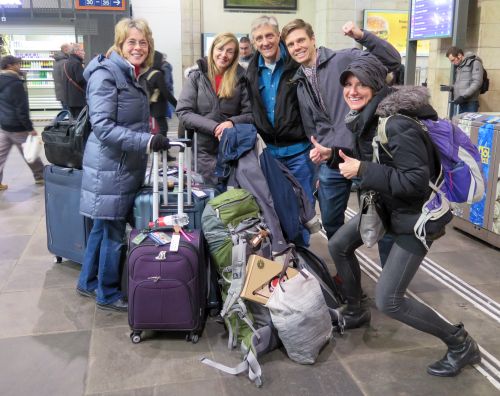
(Start the saga with yesterday’s entry, if you haven’t read it already.) Once the river cruise boat saw us down the gangplank, the six of us hopped a train in Basel, Switzerland and took off for Geneva: Carol and I, Kathy and Bob, and Alexis and Brian. One of my friends had told me before we left that the run between those two cities was flattish and not especially scenic.

Well. There’s Nebraska flattish, and then there’s Switzerland flattish. Nebraska wins hands down. The land we crossed was rugged, and there were always mountains in the distance in one direction or another. It was a gorgeous ride, and our first look at rural Switzerland. I found myself thinking, if this is the flat part of Switzerland, what must the mountainous parts be like?

We’ll check into that next trip. Matt met us in Geneva, and we stopped for a while at his house before piling into several cars and heading across the border into France. The drive took an hour, and it wasn’t long as the crow flies. Not being crows, we had to deal with endless doglegs on mountain roads. But late afternoon we found ourselves in Morzine, a ski town in the foothills of the French Alps. Morzine itself is at 1000 meters (3300 feet) above sea level, but that’s just the town. All the real action is uphill. From Morzine you can take a dozen ski lifts a good deal higher.

For our second week in Europe we teamed up with several people in Carol’s extended family and rented an entire (small) ski chalet in Morzine. Everybody except for the old folks (like us) were skiers–and a couple of the old folks were too. Me, well, at 67 I’ve never broken a bone, and don’t intend to start now. You ski. We’ll watch.

The chalet was comfortable, if chilly at times on the first floor. The common areas were bright and cozy, with a wood-burning fireplace and lots of chairs and sofas:

IMG_0305-500 Wide.jpg

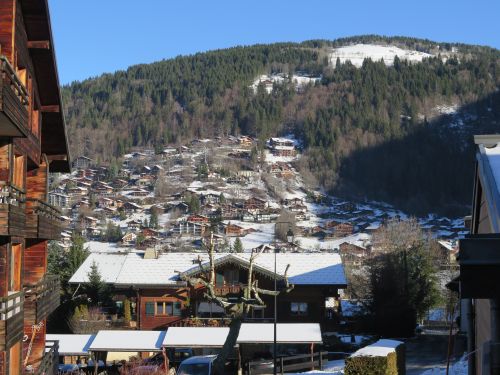
The dining room had huge windows overlooking the mountainsides. That is, when the weather was clear, we could see the mountainsides. Clear weather wasn’t the norm, so I took the shots when I could. This is the view from the dining room, on Christmas Day:

IMG_0313-500 Wide.jpg

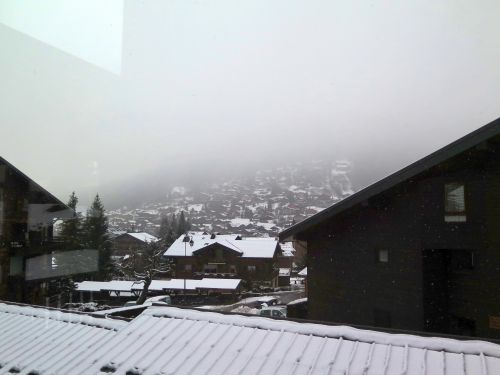
And this was the view (without any zoom) through a nearby window that was typical of most of the rest of the week:

The ginormous dining table could easily seat 16, but we were only twelve plus a toddler. And the food, good lord, it was like nothing else we’ve ever had. Chef Michael prepared breakfast and dinner, and left fruit and fresh bread on the table for those who would still be in the chalet at lunchtime. This is a standard ski chalet practice, rooted in the assumption that skiers would not be coming back to the chalet for lunch. Carol and I bought ham, turkey, and cheese down in the town center for sandwiches.

Below is Christmas Eve dinner. After the meal we watched National Lampoon’s Christmas Vacation, a long-time family favorite. Most of us had brought Christmas Vacation-themed T-shirts, and some of us even dressed like the characters, especialy Grandma Wilma, Brian, and Alexis. (Carol bought the two of us T-shirts at our local thrift store. Mine was an XXL, but that’s what was there.)

IMG_0332-500 Wide.jpg

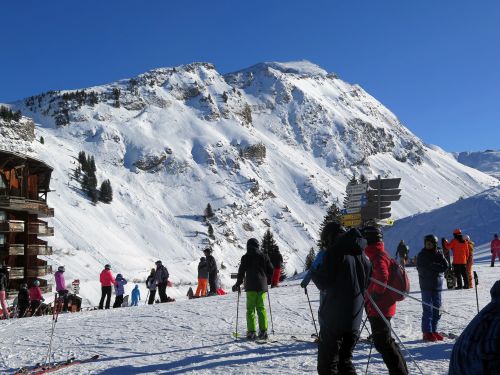
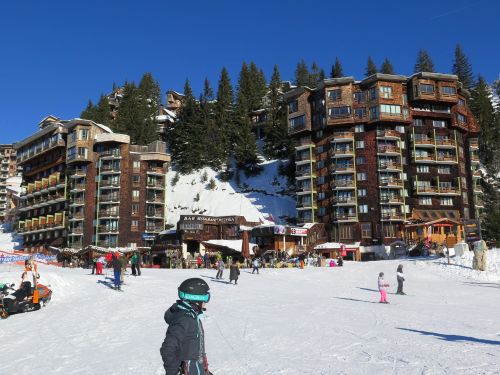
It snowed most days, if not a lot. (And Morzine knew how to deal with it.) Christmas Day, however, was crystal clear and brilliantly sunny. The whole bunch of us decided to take the big cable gondola up the mountain to Avioraz, a sort of satellite town that catered almost solely to skiers. Those who ski, skied. The rest of us wandered around looking in shop windows. The streets of Avioraz were (deliberately) under a foot or so of hard-packed show, and could be skied as easily as walked.

IMG_0320-500 Wide.jpg

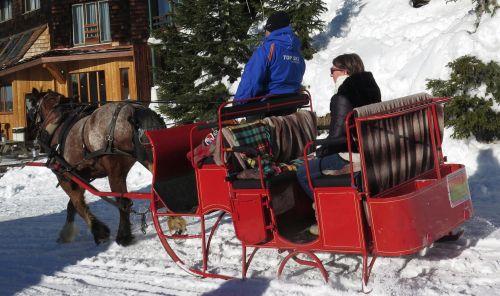
Avioraz, as you might expect, consists mostly of ski chalets, ski shops, restaurants, and bars. We had lunch outside in bright sun–mercifully, there was no wind to speak of, so it was almost warm. Not long after lunch, while Carol and I were walking around (most of the gang had gone even further up the mountain on the ski lifts) I heard bells. And what should come around the corner but…a one-horse open sleigh! Egad, I’d been singing that song ever since I was a toddler, but until Christmas Day 2019 I had never actually seen a “one-horse open sleigh.” Maybe I just don’t get out enough.

We did get out Christmas night, and went to church in Morzine. It was the first time I had ever heard Mass in French, though we had heard it in German when we last visited Europe in 2002.

Sagely predicting that at least some of the week would suffer lousy weather, Matt brought a 1,000-piece jigsaw puzzle of a Bob Ross mountains-and-trees painting. We dedicated a game table to it and got to work on the first day. We worked on it whenever there was nothing much else to do. I had never before attempted a puzzle that large (nor one with such vast expanses of blue) and didn’t contribute a great deal. Carol worked at it a lot, as did her sister Kathy. Brian’s wife Alexis had a near-magical touch with puzzles, and whatever time she spent on it greatly accelerated its assembly.

It took us until the middle of the last night we spent at the chalet, but at some point the last piece clicked into place and it was finished.

The skiers among us were gone a lot, but overall, we talked, laughed, drank good French wine, read, worked the puzzle, and entertained little Molly while her parents were out on the slopes. Molly’s parents, both her grandmothers, and her great-grandmother Wilma were all there, so Molly got plenty of attention. She’s starting to talk, and almost got the hang of “Uncle Jeff” during our week together.

Our trip home was long but uneventful: We flew from Geneva to London Heathrow, then from London to Dallas, where we had to retrieve our suitcases and go through customs. Carol got the two of us TSA’s Global Entry certification earlier last year, and so customs was trivial. We re-checked our bags and hopped a flight from Dallas to Phoenix.

At the airport we ordered up a Lyft ride. The driver told us that airport management was pushing ride-sharing services like Uber and Lyft out of the airport, and that he would no longer be serving passengers after a whole raft of new fees and requirements are imposed later in January. The fees are being challenged in court, so the whole thing could collapse if the ruling goes against the city. I like Lyft and will miss it for airport trips, but technology has its way of getting past government interference. It’ll be interesting to see what ways eventually emerge.

Overall it was a wonderful trip, both on the water and in the mountains. I got behind on a number of projects (not least being the final bits of my novel) but it was worth it. On the upside, we didn’t put up much in the line of decorations here in Phoenix, so there was less to put away on our return. Alas, one of the first things that happened was the noisy death of our built-in 1500-watt microwave oven. We ran down to Walmart and picked up a smaller 900-watt unit for…$65. That’ll do until the JennAir repairman can make it out here.

In the meantime, we’re enjoying our (slightly chilly) Phoenix winter, and gradually getting over eight hours’ worth of jetlag. Happy new year to everyone here, and don’t believe the doomsayers: This is by far the best time in human history to be alive!