Jeff Duntemann's Contrapositive Diary Rotating Header Image

Close Harmony

I’ve been low-energy for most of this past week, and haven’t made much progress on various projects. These things happen. I filled in some holes (of which there are many) in my memoirs, but mostly I’ve been prowling YouTube for new music. I hear occasional classical cuts on KBAQ that I’ve never heard before and buy them as singles on Amazon, usually for 99c or (at most) $1.25. So I have classical covered. I do like pop music. My collection is…big. But I’ve been gathering it since I was in high school, and I’ve heard it all a lot. I’ve caught myself being impatient when one track or another isn’t over yet. That’s a pretty clear sign that I need to freshen up the collection a little.

I’ve been looking on YouTube. A lot of people probably haven’t caught on to the fact that whatever music you like is probably in buried in that huge pile somewhere. Really, it’s not all cute puppy videos. I consider the Monkees’ cover of the Mann-Weil song “Shades of Gray” pretty obscure. It was never on a single, even as a B-side. But it’s there. The accompanying video is forgettable. In truth, I generally don’t watch the video portion of a song playing. The other day I was taking notes on The Molten Flesh and listening to a lot of different things. I put the browser down in the taskbar. It’s a lot like listening to the radio, and all it takes to “change the station” is to bring the browser back up into view and look for something else.

As long as I’ve listened to music, what has mattered to me are melody and harmony. Youtube does a pretty good job of suggesting tracks I might like after I play something. So I jump from one song and one artist to another. There are plenty of misses. The hits I add to a playlist. The best of the best I buy on Amazon and copy to the thumb drive that plugs into my stereo in the Durango.

One of the first things I found startled me for a number of a reasons. It’s the Podd Brothers’ NYC Virtual Choir and Orchestra, performing the old hymn “How Can I Keep from Singing.” There must be a hundred singers and musicians, all at home, each shown in a window in a matrix that scans around as the track plays. The harmony, wow, particularly toward the end when the orchestra goes quiet and the singers go full a capella. I was startled by the faces, which are the faces of ordinary people, which is to say, not movie stars or rock stars, of all ages and races. Any of them could have been my friend, and by the end of the song I caught myself wishing that all of them were. And that’s music, with a capital M!

Most of my old friends were present. I’ve been listening to Celtic Woman for a long time. Some of my colleagues dislike the big stage productions they prefer, but I’m not in it for the video. Their cover of “The Parting Glass” is wonderful. I’m not a huge fan of bagpipes, but in this case, well, it fits. Another solid piece they have is “Tir Na Nog,” which I had not heard before.

Perhaps the best discovery so far is Brigham Young University’s Noteworthy, an a capella group of college-age women, and they are good. Close harmony doesn’t get a whole lot better than this. Consider their cover of “When You Believe” from the animated film Prince of Egypt. It’s a powerful piece from anyone who performs it well, and this is hands-down the best I’ve ever heard. “Be Thou My Vision” is another favorite hymn here. Listen to harmony on this one, yikes.

The biggest single surprise so far is almost certainly the One Voice Children’s Choir. Getting what looks like most of forty or fifty kids to sing harmony is a feat that boggles the mind. And they are really, really good. Consider their cover of the Chainsmokers’ 2017 hit, “Something Just Like This” It’s a terrific song, and even better when the voices are this good. The first time I heard it I had a weird realization: This song could be a duet between Larry and Sheri, the stars of my novel Dreamhealer. Larry reads all the old books (which get him into quite a bit of trouble) whereas Sheri wants a good man at her side, and she could do without all the occultish dream arcana. (Sheri loves him and follows him anyway, all the way to the center of the Collective Unconscious, to face down the Architect of All Nightmares.) One Voice also does a cover of “When You Believe,” and it’s excellent. Ditto “J’Imagine.” Kid choirs seem to be a thing right now. Here’s one from Ukraine, singing “Something Just Like This.”

Maybe you’re not that into close harmony. No sweat. I don’t listen to rap. As best I can tell, it’s all here. Set aside an evening, pour yourself a drink, and poke around. Whatever might be bothering you, I’m pretty sure you’ll feel better. Worked for me.

Announcing the Publication of Odd Lots

Odd Lots Paperback Front Cover - 500 Wide.jpg

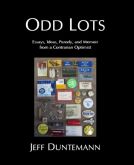
It is with considerable pleasure (and a great deal of relief) that I announce the availability of my newest book, Odd Lots. It’s available in both ebook ($2.99) and trade paperback ($12.99) format.

I announced the project here last October. It’s taken a lot of time to put together in part because I had to OCR so much of it, and I hate OCRing. The other time-consuming element was trying to decide what-all should be in it. The bulk of what I’ve written on programming is now obsolete, and what isn’t obsolete is in published books that are already available. But my DDJ columns? DOS programming? Modula 2? Extinct. I suffered over those decisions more than I should have. I gave myself a 250-page topstop for the paperback. It came in at 235 pages, so I could have thrown in another Contra entry or two. At some point I simply had to say, “It’s done.”

What’s in it? Five topical sections:

  1. Essays, idea pieces, and editorials from PC Techniques/Visual Developer.
  2. Entries from Contrpositive Diary
  3. Parody (most of which came from the magazine)
  4. Memoir
  5. None of the above.

Part 1 contains pieces from the magazine that I felt had lasting interest, like “The All-Volunteer Virtual Encyclopedia of Absolutely Everything,” a few essays about the wearable computers I called Jiminies, “Pay Them Forward,” and “Hail the Millennium!”

Part 2 contains entries from Contra, again items I felt had lasting interest. I threw in my oddball series “50 Days’ Meditation on Writing,” which I posted on Facebook on fifty consecutive days way back in 2014.

Part 3 contains humor and parody, some of which was originally published in the magazine, and some in fanzines that now go back almost fifty years.

Part 4 contains excerpts from my memoirs, along with the very first written item I ever sold for money, which ran in 73 Magazine in December 1974. Some of that appeared here on Contra. A great deal of it is published in Odd Lots for the first time.

Part 5, well, some things don’t categorize well. Whatever didn’t fit in the first four categories ended up here. A couple are funny, including one that might be considered a parody of myself. The others might be classified as “inspirational,” depending on what inspires you.

The cover photo, some might remember, came out of a 2015 Contra entry called “Samples from the Box of No Return.” I think it qualifies as a collection of odd lots, just not written ones. It’s a shame I couldn’t photograph everything in the box, which has a lot more stuff in it than shown here.

Again, I assembled the book because I regularly get emails from people asking where they could find one or another editorial or idea piece from the magazine or Contra. I posted a few on my site. I don’t have word processor files for most of them, and had to OCR them. It’s almost a private publication for my fans, some of whom have been reading me since I launched Turbo Technix at Borland in 1987. I freely admit that some of it sounds like bragging. Hey, I really did predict Wikipedia in 1994, using technology we had in the early ’90s. Keep in mind that I wrote a great deal of that early material with a grin on my face. It was blue-sky stuff, satire, and primarily entertainment. I’ve never been one overly given to seriousness. Please read it with that in mind.

And I once again thank all my long-time readers for giving me a reason and a forum for writing interesting and funny stuff, and for (finally!) having a place to put it.

It’s done. Whew. Go get it! And if you think Odd Lots was odd, heh–just wait until you see my next publishing project. (Stay tuned.)

Odd (COVID) Lots

  • Here’s an excellent summary of studies of SARS-CoV-2 mask effectiveness from Swiss Policy Research. It’s not an article so much as a list of research studies and papers from mostly European sources, all with links. A number of very clear graphs indicate how infections have mapped to mask mandates. The news is all bad for mask fetishists: Masks do not appear to have any significant effect on the spread of SARS-CoV-2. Be sure to watch the video, which supports my long-term contention that masks propel aerosol viruses via jets around their edges. Given how far air from those jets travels, I’d guess that being next to a person jetting around a mask is more dangerous than standing the same distance from somone not wearing a mask at all.
  • Here’s another solid item from Swiss Policy Research on COVID-19 treatment protocols. The US seems peculiarly reluctant to actively treat the disease with known protocols like zinc plus an ionophore or (for no reason I can discover) ivermectin. Yes, ivermectin does work. There is some recent research suggesting that HCQ + zinc will not work, but against that is a fair amount of research, some pioneered by Dr. Zev Zelenko in New York. Here’s the study to which Dr. Zelenko contributed.
  • If masks don’t work, what’s the best thing to do? Our doc suggested taking quercetin plus 50mg zinc gluconate every morning as a preventive. Quercetin is a strong ionophore that escorts zinc into cells where it can stop viral replication. Note that not all zinc is created equal. The bioavailability of zinc oxide is essentially zero. Stick with sulfate or gluconate. Quercetin is OTC; we use the NOW formulation that includes bromelain. Whether quercetin is as strong an ionophore as HCQ is something I’ve researched and found nothing useful. I find it interesting that quercetin is used in Erope to treat existing infections, and not merely as a preventive.
  • Nitay Arbel posted a link to a study suggesting that the Moderna vaccine’s protective effect is longer-lasting the the Pfizer vaccine’s. If you’re interested in pandemic science at all (as opposed to pandemic politics) bookmark his site and check it regularly.
  • Here’s a paper that discusses the differences between ivermectin and HCQ against COVID-19. The TLDR summary is that ivermectin acts against both early cases and more advanced cases, while HCQ+zinc work far better in early cases than advanced cases. HCQ alone doesn’t work at all. I’d suggest bookmarking the page because it contains a huge number of links to pertinent research of all kinds.
  • If you’ve never supplemented zinc before and are confused by all the options, this page will lay it all out. It’s a subtler business than I originally thought.

Daywander: The Penny with the Upside-Down Date

1961 upside down.jpg

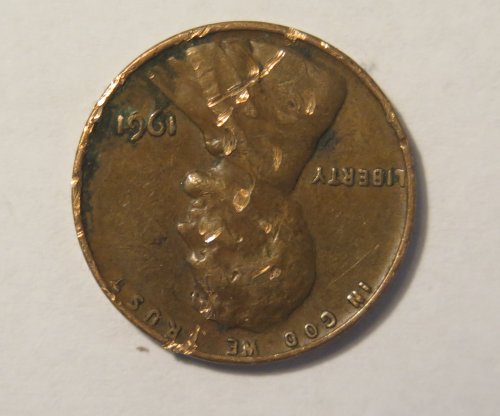
In 1961, when I was nine, our family went to the Illinois State Fair in Springfield. We took a tour of the town, saw Lincoln’s tomb, and had a lot of fun together. The fair was wonderful. My father ran into Larry Fine (1902-1975) of the Three Stooges at the beer tent and bought him a drink. When we reconvened toward the end of the day (my mother had carnival-ride duty) he had a gift for me: A 1961 penny with the rare upside-down date.

It wasn’t all that rare. In fact, I got one in change at the Mickey D drive-thru this morning. Now, the poor thing has clearly spent some time in a parking lot, but you can see from the photo that the date is indeed upside-down. Well, the nine-year-old I was in 1961 certainly thought so. It took me a week or so to figure out that he was not just pulling my leg, but yanking on it so hard it squeaked. And yes, when I figured it out I thought it was funny as hell.

Today was a weird day. Last night we got almost two inches of rain. Two inches. In Phoenix. In one night. Now, on average, Phoenix gets 8″ of rain a year. So last night represented 25% of our annual rainfall. Oh–they’re predicting another 2″ tonight.

I guess this is going to be a wet-ish year. Our ash trees may survive after all.

Now, has anyone else ever heard of “heat lightning”? When we were kids, we sometimes saw lightning flashing along the horizon (or at least above the nearby houses) on hot summer evenings, with no least whisper of thunder. Nobody explained why it was called “heat lightning.” Light travels farther than sound, and heat lightning is just lightning so far away that the thunder can’t keep up with the flash.

It must be important. Heat lightning has a Wikipedia page, and I don’t. However, the Wikipedia Gawds are threatening to delete the page if some acceptable peer-reviewed studies aren’t produced immediately to provide evidence that heat lightning is real and not a hoax. Don’t you dare suggest a Primary Source. Primary Sources make the Gawds drool on the floor and then start throwing chairs. The only way to escape them with your life is to run while screaming “I’m not notable!” at the top of your lungs until you’re past chair-throwing distance.

Heh. And you think I’m kidding.

Masks as Inadvertent Variolation

Yesterday’s post on the effectiveness of masks reminded me of something I had taken notes on over a year ago: masks as variolation. The insight wasn’t original to me, but alas, I don’t recall where I first saw it.

Variolation, if you’re not familiar with the term, is the process of generating immunity to a virus by exposing people to small amounts of the virus. It was invented for (and named after) smallpox (variola). The process, however, can be applied to other viruses. I wonder if wearing a so-so mask within a population carrying SARS-CoV-2 would allow the inhalation of enough virus to cause antibody generation via a mild or even asymptomatic infection, but not enough to cause a full-bore and possibly severe symptomatic case.

This isn’t where I saw it, but an article in the New England Journal of Medicine from late 2020 makes precisely this point. In my article on masks I was talking about the aggregate effectiveness of masks, which depends on how many viruses you inhale through the filtration medium–and how many viruses are squirted out through jets at the edges of your mask when you exhale. No mask is perfect. A lot of them are worthless, but quite a few are effective enough to reduce viral load by some percentage, which obviously varies by the type of mask and how it’s worn.

Which brings me to my pet peeve, which is pertinent here: The media never talks about COVID-19 deaths. They only talk about cases, which can include mild or asymptomatic infections–or, in truth, false positives on the fluky PCR test. What the media absolutely will not talk about is natural immunity, that is, immunity conferred by an actual infection with the pathogen. We know such infections happen. We have no idea how prevalent they are. My hunch is that many or most of these new cases are not cases as generally understood (a sick person!) but positive tests from people who have had an infection and threw it off, perhaps thinking it was a cold or without even knowing they’d had anything at all.

I’ve seen studies indicating that natural immunity is stronger and longer-lasting than vaccination immunity. This post on The Blaze mentions some of them. What this means is that the “exploding case count” the pornpushers are screaming about could well be a count of positive-test people who now have natural immunity and will probably never contract the disease again.

How could this be? Simple: The vaccine gives you a quantity of SARS-CoV-2 spike protein, which teaches your immune system to recognize the virus by its spikes. An actual COVID-19 infection teaches your immune system about the whole damned virus, spikes and everything else.

Obviously, nobody wants to catch the disease, since the panic industry has pushed what I call “mask-it or casket” porn, typically just-so stories of some guy who claims the vaccine is fake and then dies of COVID the next day. The vaccine is not fake; Carol and I got it as soon as we were eligible. (I do wonder whether we would test positive under PCR. It might be worth the cost of the tests to find out.) What I’m talking about is that huge unknown: how prevalent natural immunity is–and how we came to get it.

Masks don’t protect you completely (as the government seems to imply) but they protect you some–and maybe enough to generate that natural immunity without suffering from the disease itself. That’s variolation.

As several of my friends have found, even mentioning “natural immunity” on Twitter or Facebook will get you banned, most likely because natural immunity argues against all the panic, and argues in favor of our hitting a degree of herd immunity (also a ban-attractor) soon or even already. Remember: A case is a positive test, symptoms or no symptoms. It’s very rare to contract the disease again after you’ve had it and thrown it off. It’s much more common to contract it after vaccination. (We’re ready for that, though given the prevalence of comment harpies, I’ll share details only with people I trust, and then one-on-one.)

Now, this notion of masks as variolation is just speculation. I bring it up because it exposes a huge gap in the coverage of COVID-19 that we’re getting from conventional online sources, who are censoring all mention of natural immunity and its related topics. It’s also why I keep my own instance of WordPress on my own hosting service rather than an account on the WordPress site. I don’t talk about controversial topics very often, but when I do, I don’t want the conversation to be suppressed.

Masks Can’t Work–But Not for the Reasons You Think

I’ve been pondering this issue since last fall, waffling constantly about whether I should write about it at all. I was sure that any number of other people would make the point I’m about to make, but I haven’t seen it. Maybe it’s too simple. Maybe people are past caring. I don’t know.

Here’s my point: Consumer-grade masks can’t stop SARS-CoV-2. It’s impossible. But not for the reasons you might think.

First, some background. Surgical masks were originally developed to protect vulnerable patients from pathogens exhaled by doctors. They were not designed to protect healthcare workers from patients. Some people recognized this early on, in memes stating (rather too confidently) “My mask protects you. Your mask protects me.” In a perfect world, that might be true. Such a world does not and cannot exist.

The key word here is perfect.

In order to be effective, a mask must meet these requirements:

  1. It must be made of a material allowing the flow of air while seriously restricting the flow of droplets and aerosol virus particles. Such masks are uncommon. The only ones I know of are N95 masks, without exhalation ports. (Exhalation ports render an N95 mask pretty much worthless, as this study showed.) And I’d just as soon reserve N95 masks for front-line healthcare workers.
  2. A mask must fit close to perfectly. I don’t know how anybody expects one mask design to fit all the infinite varieties of human faces. Fit often requires that the mask straps be very tight, so tight as to be nasty uncomfortable. A couple of loose straps over your ears won’t do it, especially if your face is unusually long or wide.
  3. The mask must be worn perfectly. If adjusted for comfort, even a perfectly fitted mask will leak like a sieve and ceases to be effective.
  4. Touching the filtering medium of your mask is a no-no. If you’re in an area with aerosol virus particles floating around, those particles will accumulate on the outside of the mask. Touching them transfers them to your fingers, which can then easily transfer them to food or tissues.

The primary failure mode for masks is leakage. When the whole mask fetish first became a thing, we bought some masks and I did some experimenting. I put a mask on as best I could, dipped a finger in a glass of water, and held the wet finger around the edges of the mask while I breathed normally. I could easily sense jets of air at several places around the edge of the mask, no matter how I adjusted it. These jets did not pass through the mask material, and if the wearer is contagious, the aerosol virus particles will be sent in several directions with significant force. I was surprised, in fact, at how much force was behind the jets from even normal breathing.

Think about jets of air for a moment. Even a tiny amount of air will move quickly if forced through a small hole or gap. Those jets leaking around the edges of your mask will carry aerosol viruses a long way. Sure, droplets quickly fall to the ground within the standard distance of six feet. SARS-CoV-2 travels as both droplets and as aerosols. Droplets are big enough to be trapped by the mask’s filtration medium. Aerosols are so small that most go right through it, absent expensive materials like those used in N95 masks. Cloth masks depend on the nature of the cloth. Cheap surgical masks barely stop them at all. Woodworking masks are completely worthless. Hold that thought; I’ll come back to it.

I’ve found some interesting videos. In this first one, a woman takes a hit off her vapestick, puts her mask back down, and then exhales. She immediately blows two jets of smoke right into her eyes, and then starts choking. Bad idea. The takeaway is that smoke came out the edges of her mask in a hurry. Obviously the mask was not being worn correctly. Hold that thought too; I’ll come back to it.

Here’s another, better video, in which a man wearing several types of masks inhales from a vapestick and exhales while wearing the masks. (I can’t tell whether he’s wearing the masks correctly or not, though it looks correct to me.) Smoke or vapor (I’m not especially familiar with the technology) streams out from the edges of the mask on every side. The smoke or vapor is there there simply to help you visualize how leaky cheap masks are. Clearly, my mask doesn’t protect you, and your mask doesn’t protect me. (The video was originally posted on YouTube several times, and taken down every time. It’s now on BitChute. The Powers obviously don’t want you to see failure modes in enforced conventional wisdom.)

Even a high-quality mask will leak around the edges, especially if you have a nonstandard face. We needn’t mention gaiters, which have no mechanism for preventing significant jets through the gaps on either side of your nose.

Now, I told you all that to tell you all this: Suppose a high-quality, perfectly fitting mask worn perfectly traps a significant number of aerosol particles. Here’s the extra-large economy-sized question:

How do you guarantee that all mask wearers are wearing effective masks that fit well and are worn correctly?

We all know the answer: You don’t. Masking is a collective exercise. It’s gotta be almost everybody or it might as well be nobody. There is no enforcement mechanism that will render a mask-wearing public immune to SARS-CoV-2. I’m pretty sure there’s no enforcement mechanism that will keep a mask-wearing public from exhaling massive numbers of aerosol viruses. Post mask cops on streetcorners, checking mask types and adjusting them to fit correctly and well? Really? Most of the public doesn’t like masking and will do the minimum necessary to meet a mask mandate. I’m thinking a lot of them will wear their masks as loosely as possible, just for spite.

My conclusion is this:

Enforcing an effective mask mandate on the public is impossible.

I can already hear the crowd screaming at me: “The perfect is the enemy of the good!” Well, yes. In this case, the chain of contingencies leading to effectiveness is so long that anything less than perfect is just about no good at all.

“But if a mask stops even one virus…”

The fifty billion other viruses gleefully jetting away around the edges of your mask might want a word with you. Or maybe they’ll just laugh.


Note well: This is a controversial topic, and as with all such topics, I require heroic courtesy from all commenters. Screaming at me won’t convince me of anything; it just makes you look like a moron. I’d appreciate that if you take issue with something I’ve said, take issue with the point I actually made.

Aero’s 15th Birthday

Today is Aero’s 15th birthday. He was our first show dog, and became an AKC champion in 2010, under Carol Duntemann’s expert handling. The photos below are of Aero when we first got him in 2006, and from the 2009 Bichon Frise National Specialty show in St. Louis.

He’s still reasonably spry for a dog that old, though he doesn’t see very well and gets confused now and then. Given that he’s now 105 in dog years, I’m very happy he’s still with us and still running around.

We’ll be giving him his usual birthday “cake” of raw hamburger a little later today after supper. Everybody gets some–and sometimes I think it’s gone in nanoseconds. But however he wants to enjoy his birthday is fine by us. He’s been a terrific dog, loved the show ring, and brought us a great many ribbons. If he mostly sleeps in one of the (many) dog beds scattered around the house these days, that’s ok. He’s earned it.


100_0951 - 500 Wide.jpg


IMG_0275 - 500 Wide.jpg

Odd Lots

  • The major social networks are now suppressing any mention of research that supports the effectiveness of ivermectin and HCQ against SARS-CoV-2. I’ve given up, as it’s a bad use of my time to try to slip information past those insufferable busybodies. So I guess I have to be content with Contra here and MeWe, which so far hasn’t given anybody any grief about discussing COVID treatments and related issues. Feel free (in fact, I encourage you) to spread these links around any way you can.
  • There’s what looks like a very good free PDF guide to home treatment of COVID-19, from The Association of American Physicians and Surgeons. It aligns with the reading I’ve done of peer-reviewed research on the topic.
  • Another very good site for laypersons on COVID-19 treatment is The Front Line COVID Critial Care Alliance, a group of physicians who are trying to make sure people have someplace to go for information that isn’t vetted by a cadre of arrogant billionaires whose sum total of medical experience is putting bandaids on their owies.
  • I read a book last week from an Arizona physician who gathered over 500 medical research papers on topics that bear on the COVID-19 issue. The Defeat of COVID is sometimes a bit of a slog, but the citations are solid gold. If you have more than a passing interest in the topic, I encourage you to get it. You’re sure not going to see any of this research linked on the social networks.
  • One thing you have to remember is that the panic-porn industry is talking solely about cases. A case is a positive test. Period. A case does not have to be symptomatic. They aren’t talking about deaths because deaths don’t seem to be rising. Certainly deaths in Arizona are not. (Click through to the graph and it’ll be obvious.)
  • The CDC is withdrawing its support from the PCR test, which can be “cranked up” to absurd sensitivity. Here’s a direct quote from an article in the British Medical Journal: “Another problem with relying on PCR testing alone to define a COVID-19 case is that, owing to the sensitivity of the test, it can pick up a single strand of viral RNA-but this doesn’t necessarily equate to someone being infected or infectious.”
  • There are a fair number of studies of ivermectin as treatment for COVID-19. Here’s one from Antiviral Research, a journal published by Elsevier.
  • Ditto HCQ. Here’s one from the International Journal of Antimicrobial Agents, with this money quote: “Risk stratification-based treatment of COVID-19 outpatients as early as possible after symptom onset using triple therapy, including the combination of zinc with low-dose hydroxychloroquine, was associated with significantly fewer hospitalisations.”
  • To close out this COVID-19 issue of Odd Lots, a blatantly obvious bot-distributed hoax campaign on Twitter was not flagged by their supposed fact-checkers. I just did a Twitter search on “I just left the ER. We” and got quite a few laughs out of people making fun of the hoax, and (by implication) Twitter itself. Really, go look. It’s hilarious.
  • Had to fetch down a sample of the merriment:
    “I just left the ER . We are officially back to getting crushed by vegetables. Arugula is running rampant and it’s MUCH more transmissible than the original lettuce. 99% of our ICU admits did NOT eat a steak. Virtually ALL of them wish they had.”

  • (Many thanks to Bill Meyer for some of these links.)

Birthdays and Horizons

69 today. That’s a good number, as it’s the same upside-down as rightside-up. The last one of those I passed through was 11, so it’s been awhile. (Ok, sure 1 and maybe 8, depending on the font.) Quick aside: 1961 also looked the same both ways, at least on pennies.

69 is the last year before one of what I call horizons rises to meet me: As a younger man, I thought of 70 as the horizon between ordinary people and…old people. So next year I’ll be a genuine, card-carrying Old Guy. Does this bother me?

Not on your life. Or mine.

Life is all about horizons. When I was in kindergarten, first grade was a horizon. When I was in grade school, high school and college were horizons. Marriage was a horizon, understanding it poorly as I did when I was six or seven. I remember wondering if you had to have a job before you could get married. I imagined living with a girl, and it was a…peculiar imagining, at 9 or 10. In truth, I could more easily imagine going to the Moon. I considered that a horizon as well; in fact, when I was a senior in high school, my lunch table vowed to meet on the Moon on New Year’s Eve 1999. It seemed so far away, in time as in space. We’d come so far so fast–how could it not happen?

Not every horizon comes when it’s called.

College, mon dieu. That horizon hit me in the face and damned near broke my nose. I got past it. I graduated, and got a job. That was a horizon. Leaving home was a horizon, one I avoided for far too long. I proposed to my best friend–one horizon–followed quickly by our wedding–another horizon.

Ordinary life can be deceptive. If you squint a little, you can avoid seeing any horizons. You get up, go to work, come home, have dinner, write/tinker/work 20 meters, then go to bed, confident that the same thing will happen tomorrow. Nonetheless, the horizons are there. My father’s death was a horizon, one I could see coming a long way off, and it shook me to the core. Scarcely a year later, one of my friends died. He was a fireman, and a wall fell on him while he was making sure everyone had gotten out alive. Seeing friends die is a horizon that few of us see coming, especially when we’re still in our twenties. It was scant comfort to remind myself that Bill Nixon was a hero. He was only the first. There have been many since then.

Starting my own company was a old dream of mine, and in 1989 it jumped up and said “Hi!” Horizons can be like that. Losing that company 12 years later was another horizon, one that almost ate me alive. Having my first book published was an even older horizon. I remember a dream in which I was holding my first book, without knowing what book it was. Sometimes horizons don’t tell you much about themselves until they’re already in your rear-view mirror.

Retirement was a very old horizon; I remember thinking as a teen that 2017–when I would turn 65–was an eternity away. Flying cars! Mars base! Heh. Today, well, 2017 seems almost quaint.

Horizons are firsts and onlies. You do them once and they change you, and then, sooner or later another one comes around the corner at a gallop.

Be ready.

The Ionophore Experiment

A year and some months ago, when the whole COVID-19 thing was just getting out of second gear, one of the doctors I see recommended that Carol and I take zinc and the OTC supplement quercetin every day. The explanation was simple: Quercetin is a zinc ionophore. Ionophores are chemicals able to transport certain ions through cell membranes through which those ions would not ordinarily pass. Zinc is known to attack viruses of all sorts, especially cold and flu viruses. Quercetin attaches to zinc ions and escorts them through cell membranes, into the cells where viruses replicate. Zinc stops virus replication cold.

This sounded familiar, and it was. About that time I had begun hearing of the work of Dr. Zev Zelenko, a New York physician who had begun treating early COVID-19 patients with a drug cocktail consisting of hydroxychloroquine (HCQ), Zinc, and an antibiotic. Dr. Zelenko has a wonderful metaphor describing the cocktail’s operation: Zinc is the bullet. HCQ is the gun. Sure, it’s a little more complex than that, but despite metric megatonnes of anti-HCQ bullshit in the media, the cocktail works.

I’ve seen quercetin described as a zinc ionophore in many places. HCQ is also a known zinc ionophore. It’s a prescription drug that must be taken under medical supervision to avoid certain side effects. However, people I know personally are taking it every day and have for years for autoiummune disorders. I’m not sure how you measure the effectiveness of one zinc ionophore vs. another, so it’s unclear how “strong” an ionophore has to be. Everything I’ve read suggests that quercetin is strong enough to kill viruses wholesale by escorting zinc into cells.

Quercetin has, at best, mild side effects. It’s found in many foods, including kale. Alas, I won’t eat kale, so I take it as an extract in a gelcap. Carol and I followed the physician’s advice, and we’ve been taking 800 mg of quercetin once daily in a formula that includes bromelain. We also take 50 mg zinc daily in the form of zinc gluconate. I’ve talked about this before here on Contra, though it may have been a whole year ago or more. I bring it up again because Carol and I have noticed something unrelated to COVID-19: Neither of us has gotten a cold since we began taking quercetin plus zinc.

And that, my friends, is worth something. My long-time readers have heard me bitch about catching colds and feeling miserable down the years. I get one or sometimes two bad colds a year, and a scattering of sniffles that last for a few days and vanish. We get flu shots, but we still got the flu really bad back at the end of 2017. So the experiment is this: Even though we’re fully vaccinated, we’re going to keep taking quercetin plus zinc, and see how long it is before either of us catches a cold or flu. (We’ll still get our flu shots. I’m a strong believer in vaccination.)

Now, a lot of the country is still hiding out, though here in Arizona mask mandates are mostly a thing of the past. So it’s possible that we ducked colds for the past fourteen months by simply not rubbing shoulders with people much. Those days are past. We shop at big stores like Safeway and Target and Costco even when they’re crowded and nobody has masks. In other words, we’re more or less back to normal life. And my experience of “normal life” prior to COVID was (at least) one cold a year.

Carol and I aren’t worried about COVID anymore. Is it possible that we don’t have to worry about catching colds either? I’m turning 69 in a week. I’ll recap in another year. There’s still no cure for the common cold, but if two OTC supplements can stop colds before they start, man, I call that a revolution–and one helluva birthday present!