Jeff Duntemann's Contrapositive Diary Rotating Header Image

Progress Report and Excerpt: The Molten Flesh

I’m now about 40,000 words into The Molten Flesh, which is nominally the sequel to The Cunning Blood. It’s a sequel in the broader sense of a story told in the same universe but not focusing on the same characters or planets. The single exception is Sophia Gorganis, who has a cameo in a flashback set a few years earlier than the action of The Cunning Blood. The focus is now on a different nanotech society and device: Protea, a synchronistic combination of the human body and a nanomachine that is present in every part of the body, up to and including the brain. The same general nano/human typography conventions apply: Subvocal human speech to the nanomachine is enclosed in vertical bars. The speech of the nanomachine to its operator is in italics. Those conversations are private; onlookers cannot hear either side.


From The Molten Flesh, Chapter 13

Copyright 2021 by Jeff Duntemann. All Rights Reserved.

Halifax fired its main engines as soon as its shuttle repair bay doors closed behind Hubbardton and sealed. Like everything else about Halifax, the shuttle bay seemed out-of-scale. At least three fourth-generation shuttles could line up side-by-side for repair or storage. Ron eyeballed that in a pinch, it could stuff away five second-gen shuttles.

The lock pumps had the repair bay pressurized in less than ten minutes. Cory Ellis went down the ladder from the shuttle’s lock. Ron jumped. It was hard for the big ship to be in a hurry. Acceleration was only half a gee. The air in the bay still held the flinty scent of bare metal and fresh plastic. “New starship smell,” Ron said, chuckling.

No sooner had the pressure all-clear horn sounded than five crew entered the repair bay at a run. Three men and two women, all young-Ron pegged them at under thirty, a couple of them way under thirty. A reasonable security detail, he supposed.

Ron blinked. The tall blond woman had the captain’s golden galaxy over her heart. The shorter, dark-haired woman had the drivemaster’s braided golden ring. |Something funny is going on here.|

The captain is Bronya Azarova, born in Kraznoyarsk. 27 years old. The drivemaster is Sally Ann Gildea, from Cincinnati. 25. Both are Star Academy graduates. I cannot identify the men with any certainty.

|Neither was in the top ten of her class, or I’d have heard the names. You’d think they’d send someone a little more seasoned to run a starship the size of a small town in Nebraska.|

There’s not much running to be done. The whole point of the fourth generation was to allow AIs to do nearly all of the decision-making. No more human error. Safe.

|I guess Star Academy was one way for a girl to get her ass out of Siberia.|

Ron was bemused but pleased. A more seasoned captain like Sophia Gorganis could have caused a lot more trouble. He walked behind Cory as they approached the detail. When Cory got a few meters from Bronya, the rest of the detail stepped back. Bronya stood her ground.

“Mr. Ellis, what do you think you are doing?” Her accent was pure, her face a blond-framed sneer that suggested contempt painted over terror.

“I’m saving my life and yours.”

Chush sobachya. Give me the keys to the drive.”

Cory tilted his head toward Ron. Ron dug in a pocket and held up the keys like a hand of cards.

Bronya reached into a hip pocket, and pulled out a 9mm sidearm. She stepped around Cory and with both hands aimed it square at Ron’s sternum.

|Mush matrix, full torso. Fast!|

It’s mostly still there. Give me two minutes. Keep her talking.

Cory ducked to Ron’s left. “Bronya! Stand down! What did Star Academy teach you about firearms in a spacecraft!”

She didn’t move. “Ron Uhlein taught me starships are tougher than that. Keys, Mr. Uhlein.”

Ron tucked the keys back into a pocket. The heat of Goop’s rearranging his body was bringing sweat to his forehead. Not ideal, but unavoidable. Keeping her talking might be hampered by his not knowing Russian-but he would try. “I like your style, kid. Come work for me and give 1Earth a spanking. You know damned well what they’ll do to you when you go home without Halifax.” He pointed at her left breast. “You earned that galaxy. I suspect I helped you earn it. I’ll let you keep it. I’ll send you to star systems nobody else has ever been to.”

The pistol quavered in her hands. “Give…me…the…keys.”

“How about revenge? The Canadians stomped your nation and killed several million of your people. They stomped my nation too-and now they’re so scared of us they don’t travel outside the cities. I’ll bet it’s the same in Russia. Let’s you and me put together a new alliance: Rural Russia and rural USA, against 1Earth.”

Bronya licked her lips. “You are a thief and a traitor.”

“I’m a free man.” He took a step forward. “Are you a free woman?”

“I am a citizen of Earth.”

“A planet that’s mostly turned its back on star travel. However it was you got lucky enough to take this monstrosity out of Earth orbit, you’ll never be that lucky again. I’m your last chance to use your galaxy, kid.”

Long seconds passed. Bronya’s face showed torment. Ron kept his hands in his pockets. Close-range slugs would do less damage to a mush matrix in his chest than to his arms and legs.

Then, from Hubbardton, behind them. “Bluster! Fake!”

Ron cursed. He had ordered Alyssa to stay on the shuttle. The girl walked directly toward Bronya, yelling, “Orphan! Forgotten! Lonely! Bitter!”

Bronya is indeed an orphan, and has been since she was fourteen. The matrix is now in place.

Bronya swung the pistol toward Alyssa. No way! Ron jumped. The half-gee fake gravity threw off his aim. He stumbled, his shoulder lowered and aimed at her ribcage. The woman had reflexes; she dodged, spun back and pumped two rounds into his chest before he connected. The kinetic energy of the slugs slowed Ron a little but caused him no pain beyond a strong thumping where the mush matrix absorbed the rounds’ energy. She tried to side-step but not quickly enough. Ron caught her free arm and kicked Bronya’s legs out from under her. She hit the floor ass-first and fired again. The slug went ching! against the metal deck.

“Drop it!” Ron yelled. Bronya, grimacing, tried to swing the pistol back toward Ron. He grabbed her wrist and squeezed hard. “I said drop it!”

She reeked of sweat. “I know what you do! You are a monster!”

“I do what I have to do.” |Pain #4. Thirty seconds’ worth. Go.|

Goop squeezed the neurostimulant into Bronya’s arm. The woman inhaled a ragged breath, and screamed. The pistol hit the steel deck. Ron shoved himself to his feet. Bronya thrashed on the deck, holding one arm in her opposite hand, whimpering between full-throated screams.

The three men from the detail fled the repair bay. Sally Ann stepped backwards several meters, but continued watching. After thirty seconds had passed, Bronya let herself fall flat on her back, breathing quickly, tears smeared across her face. Ron looked her in the eye as he picked up the pistol and tucked it into another pocket. He cupped a hand below his ribs. Goop expelled the spent slugs. Ron reached out his hand and let them fall half-gee gently on Bronya’s chest. “Captain Azarov, I believe you dropped these. Oh…and I withdraw my offer.”

Hallowander

Halloween. Wow. It seemed like the Fourth of July was just a few weeks ago. Then Carol and I walked into Wal-Mart. We live on a street with only a few kids, and if memory serves we ended up eating most of last year’s candy ourselves. So we bought a couple of bags of stuff we wouldn’t mind finishing, if it comes to that.

And it will.

At Wal-Mart (and probably almost everywhere else in the retail universe) Halloween was already over, and shoved to one side of the Seasonal aisle. Many of the candy SKUs were gone, including every species of M&Ms but…popcorn. Huh? Popcorn flavored M&Ms? I’d like to say I’ve seen stranger things, but I’m not sure I can. (Ok, sure: Peanut butter-flavored whiskey is a contender, as is coffee-flavored Coke.) At least we got it cheap. And the rest of the Seasonal aisle–along with much of the rest of the store–was already full-bore Christmas. No surprise.

And still tiny radishes. That’s the only kind of radishes you can get at Wal-Mart. Back in September you could still get full-sized radishes at Fry’s and Safeway. Now everybody is selling miniature radishes. I like slicing radishes and covering the tops of our salads with them. Microradishes cut a little easier than big radishes, but you have to cut a whole lot more of them.

Oh–and Total Wine now sells a red blend infused with…habanero. Maybe there’s a habanero surplus because everybody with asbestos esophagi are demanding ghost peppers in everything. So the winemakers could be getting them cheap. (An aside: Witching Hour wines are decent, for cheap red blends. Why not get a bottle for your Halloween festivities? There are several SKUs. Just read the labels before you drop them in your shopping cart, ok?)

Maybe there’s a habanero surplus. I really don’t care, as long as they don’t start loading it into iced coffee. But I will tell you something else: There is a severe onion-ring shortage. Two fast-food restaurants that we haunt now and then haven’t been able to get onion rings for literally weeks. For Corleone’s, it’s been longer than that. A little sniffing around online tells me that the world’s #1 exporter of onions is…China. So the nation’s onion rings are likely as not sitting in that immense barge-clot that’s jamming up California ports, especially off Los Angeles.

There’s hope on that front. As usual, the problem devolves to idiotic regulation by government seat-warmers who’ll gladly collapse the world’s economy because a handful of whiners in LA complains that they can see containers stacked more than two high at the ports. If they’re on a ladder. And holding binoculars. Here’s a long-form explanation of how that was discovered and how it was (maybe, or might be) solved. Let us pray. I miss onion rings.

My old friend Mike Bentley posted a link to a stack rank of books about…drumroll please…the PowerPC CPU. My PowerPC book came in at #7. Mike’s was at #24. All those books were long ago and far away. Once Apple switched to Intel CPUs, the PowerPC went gently into that good night. That’s too bad; it was a solid architecture and deserved better. In case you’re interested in PowerPC books, you can get mine on Amazon. It’s a shame the mass-market paperback is now going for $877.95. I guess you’d better order the trade paperback, which sells for $4.75. A footnote: There never was a mass-market paperback edition. Maybe it’s a ghost. (More likely a daemon, heh.)

Carol has a recipe for beer bread that she wants to try, and we’re going to make it pumpkin-spice beer bread. How? By using pumpkin-spice beer. I bought a 12 oz can of Sleepy Dog Gourdgeous Pumpkin Spice Ale yesterday. You likely won’t see it in stores because it’s a local product, produced in Tempe, a suburb of Phoenix. Not sure how well it will work. I’ll let you know.

A quick aside: I’m still getting old coins in change at McDonald’s and other stores when I pay cash. The nation’s penny jars are still emptying into our outstretched hands. The other day I scored a 1969-S and a 1975-D in one transaction.

Speaking of stack-ranks, Google has a search-trends stack rank of Halloween costumes. We don’t see a lot of kids in costumes anymore, and it’s been a very long time since I wore one myself. I’m thinking a lot of these popular outfits are popular with adults. #1 is Witch. (My psychic powers predicted that one.) It’s an interesting list, and starts getting peculiar fairly quickly. #10 is Chucky, the serial murderer doll from the Chilld’s Play flicks. #18 is the 1980s. Ok, I could see the 1970s as a costume. (Maybe I wore a costume more recently than I thought.) But the ’80s? What is it? A pinstriped suit with matching vest? It surprised me that Princess was down to #30. Disney may have saturated its market. I had to look up “The Purge,” which took #38. And #49: The 1990s? I got nuthin’. (The site does not provide examples, just stats.) Oh–#59 was the 1970s. Dressing a kid up like the 1970s might be considered child abuse in some jurisdictions. And that’s as far as I went.

KBAQ, our local classical music station, is going to be playing Halloween-appropriate classical compositions all day long and into the evening, including a lot you may not have heard of. You can stream it here no matter where you live. If you like classical music, it may surprise you how many compositions are about ghosts, devils, death, and wizardry/witchery–or at very least sound like they should be. (One example is the waltz from Aram Khachaturian’s Masquerade.)

In closing, on this long afternoon of the creepiest night of the year, I present a recent translation of an ancient Halloween prayer that most of you have heard many times:

“From goosies and goalies and long-legged besties
And things that grow hemp in the night,
Good Lord, deliver us!”

Odd Lots

  • Sandia Labs has invented a way to extract metals from coal ash, including rare-earth metals used in batteries and electronics. Furthermore, they do this using food-grade citric acid, which is relatively benign from an environmental standpoint. The treatment makes the coal ash residue much less toxic, and thus easier to dispose of.
  • It took a few seconds to decide if this listicle item was in fact satire, but it seems to be factually accurate, to the extent that facts are presented. Behold a stack rank of The Most Miserable Cities in America. Arizona has both ends covered: Bullhead City is the most miserable city in the state, but Scottsdale is said to be the happiest city, and Phoenix the city with the greatest job security. The Phoenix suburb of Gilbert has the lowest poverty rate, not just in Arizona but in the whole country.
  • A lot of misery is caused by debt. Here’s another stack rank of our 50 states (it’s a long piece; scroll down to find the full table) this time by debt per capita. Arizona is #42, which I consider pretty good. Wyoming is #50. My home state of Illinois is #4. and, as usual, the king in this wretched wreck of a castle is…skip the drumroll, please–New York.
  • Mary Pat Campbell operates a fascinating site called Actuarial News, which aggregates articles about economics, risk and statistics in many areas, including COVID. She’s an excellent aggregator, in that her capsule summaries save time for me by letting me decide quickly whether a piece is worth reading in full. Highly recommended.
  • Arizona has administered 8,197,928 doses of COVID vaccine as of today. 59% of the population is fully vaccinated, while 69.5% of eligible persons are fully vaccinated, including 88% of the over-65 cohort. Unfortunately, the state does not track breakthrough infections, which are a topic of great interest to me right now.
  • Every new Windows 10 machine I’ve bought in the last couple of years has pestered me to “get even more out of Windows” at boot time. You can’t kill the screen except to delay it by 3 days. Here’s how to kill it so it never comes up again. I’ve done this on three machines so far and it’s worked every time.
  • Antarctica just had its coldest winter on record . Average temp there went down to -61.1C, the coldest ever recorded. Russia’s Vostok station went down to -79C, (-110F) just one degree from the coldest temp ever recorded on Earth. Brrrr! As for fear of the Antarctic ice melting and killing us all, well…don’t sweat it.
  • From the No Shit, Sherlock department comes a revelation that full-fat dairy products do not increase heart disease risk. I’ve been following the high-fat/low-fat issue for 20 years, and this is not new knowledge. Of course, the knucklehead interviewed at the end said that non-tropical vegetable oils are even healthier than dairy fat. To the contrary.
  • A study performed by a Native American health service found that treating COVID-19 patients with monoclonal antibodies was very effective: Only 17% of infected patients treated in the study were later admitted to a hospital, and only 3% died.
  • Here’s another drug to watch for early-intervention COVID-19 treatment: fluvoxamine (Luvox) which is a well-understood SSRI antidepressant that also has anti-inflammatory properties. See this paper published in the journal Open Forum Infectious Diseases.
  • Merck has a new antiviral in testing with “phenomenal” success against SARS-COV-2 . It will cost $70/pill. Why is there a furious war being waged against ivermectin? It’s a well-understood and safe generic that costs $2/pill. Meanwhile, much of the health industry, including hospitals, clinics, pharmacists, and even doctors (who should know better) are standing around watching people die, even as evidence is piling up that ivermectin is effective against early COVID-19. Merck’s new drug may be a gamechanger, but the game is crooked as hell.

  • Since we’re talking about diseases, I’ll throw this in: Certainty is a disease. An interesting piece from Inc explains how certainty is a key element of the Dunning-Kruger effect. My own views go like this: Certainty and competence are inversely related. The more certain you are, the less competent you’re likely to be. Many years observing humanity suggests to me that the more you scream about how right you are, the more likely you are to be wrong.

Excerpt: Complete Sentences

5

Three flashlight beams lit the campground road. With Charlene to his right and Marianne to his left, Eric led the way to where the road swung toward the lake and the sand came right up to the crumbling edges of the asphalt. A slow breeze like a soft warm breath came off the lake, heavy with the scent of summer, and gentle water sounds joined with the August cricket song. Charlene’s left hand gripped Eric’s right arm just below the end of his T-shirt sleeve. Her touch was still magical, perhaps moreso because she was putting her weight on his arm whenever she took a step. She could walk because he was there to help. He tried to drive the thought out of his head, but with each tightening of Charlene’s hand on his bare arm, the intoxicating thought returned: She needs me!

The trio walked out onto the beach until they had gone midway across the sand, within several yards of the water. Eric scanned the horizon. “This should be good, right here.”

Charlene squeezed his arm one last time, and pulled herself against him. She tipped her head until her temple touched his shoulder. “Thank you,” she whispered.

“Whatever I can do to help,” he whispered in reply. He looked up again as she drew away. “Turn off your flashlights.” The three lights flicked out, leaving them in darkness.

No one moved nor spoke as their flashlight-dazzled eyes gradually adapted. Above them, in an order Eric had witnessed under many dark Wisconsin skies since he’d been a small boy, the stars were coming out. First, the brightest of the brilliant: Antares, Spica, Vega, Deneb, Altair, all torches of the night. And one more, in their league but not of their kind: Saturn, a steadfast untwinkling pale yellow in the southeast. As his eyes grew more accustomed to the dark, the second-string stars appeared. Eric could name some but not all, and they were everywhere, the framing members of the constellations, not torches but-he grinned-two by fours. Soon after emerged the multitudes of lesser magnitudes, down to the limits of his eyes to discern. Finally, meandering down the sky toward Sagittarius in the south, a river of pale stardust, the Milky Way.

“Wow!” Marianne said to his left. “I’m lost already!”

Charlene tsked. “Nobody’s lost with Eric around.”

“Especially you,” Marianne muttered.

It was a girl thing; Eric guessed that he wouldn’t understand. He shrugged, and knelt beside Marianne. “We’ll start right here. Turn toward the north.” He gripped Marianne’s hand and pulled her around until she was facing the same way he was. He noted that there was no magic in Marianne’s hand, as there was in Charlene’s. “Right over the trees in the north. Look hard. You’ll see the Big Dipper.”

He felt her hand tense. “Yes! It’s there! I see it! It’s really big!”

“Yup. That’s why it’s not called The Medium-Sized Dipper. Now look at the bowl of the Dipper. Find the two stars at its left side.”

“I see them.”

“Now draw a straight line between those two stars, and extend it upward until the line hits another star.”

Marianne remained silent for a few seconds. If she had never looked up at a sky as crisp and clear as this, she might have trouble separating the Dipper’s canonical stars from the clutter of fainter lights everywhere around them. So he was patient. She was only nine.

Charlene placed her hand on his shoulder and squeezed twice. Eric suspected she was thanking him for catering to her bratty little sister. Again, he felt Marianne’s hand tense as her eyes learned the skill of separating the brighter lights from the fainter.

“Yes! It’s there! What star is that?”

“Polaris. The pole star. The whole sky revolves around it.”

“Wow! And that’s really because we’re rotating, right?”

“Right. And Polaris is the end of the handle of the Little Dipper. It’s harder to see because its stars are fainter. It’s about the same shape as the Big Dipper, but smaller and aimed the opposite way.” Eric lifted lifted Marianne’s hand until it pointed to one side of Polaris. “See it?”

Eric could almost feel the epiphany that came upon Marianne. “I do! Wow! The Little Dipper! How do you knowall this stuff?”

Eric released her hand and stood. “I read books. Lots of them.”


In one rapid-fire lesson, Eric took Charlene and Marianne through the hallmarks of the late summer sky: Scorpius, the teapot of Sagittarius, the Summer Triangle, Delphinus, the Great Square of Pegasus, and all the bright stars from horizon to horizon. Halfway through the tour, he felt Charlene’s soft, small fingers wriggle their way between his. He lost his train of thought, and caught himself wondering where Achernar was. No, wait-that wouldn’t be visible this early until October. Only one thing was clear in his mind:

A beautiful girl was holding his hand.

“Please show me Lyra,” Charlene asked. Eric’s heart was pounding. “In the book I read, it actually looked like a harp.”

Lyra was almost at the zenith. Eric craned his neck back until he felt it pop. “Straight up. A very bright white star with a touch of blue. That’s Vega, Alpha Lyrae. You can’t miss it.”

“Yes! It was so bright and beautiful in that book. I wanted a T-shirt with ‘Lyra’ on it, printed in gold ink on black above the constellation. I wanted it to be my symbol.”

Eric pointed at Vega. “Lyra is a parallelogram, with Vega above and to the right of it. Four stars. It would be easier to see if it wasn’t straight up.”

“That’s easy to fix,” Charlene said, and sat on the sand. She stretched her legs out toward the water, and lay down. “I see it! Perfectly! It’s better even than the book!”

“No picture of the stars ever does them justice.” Eric pointed again, almost to the zenith. “To the right of Lyra is Hercules. It looks like a keystone.”

Charlene grabbed Eric’s ankle. “Don’t look straight up like that. You’ll hurt your neck. Lie down like me.” She turned to her sister. “Marianne, you too.”

“I dunno about this,” Marianne grumbled, but complied.

Eric hesitated, looking back toward the trees that separated the beach from the tent sites. He had done plenty of observing flat on his back. It was certainly a more comfortable position for looking at the zenith. But he’d never done it with a girl-or anyone else-beside him.

Once Marianne was stretched out on the sand, he sat down between the two girls, took one more nervous glance toward the road and the trees, and lay down himself.

The lecture began again. He explained how you could follow the curve of the Big Dipper’s handle and “arc to Arcturus” and later, following the same general curve, continue to Spica. He showed them the close pair of stars called the “cat’s eyes” at the stinger end of Scorpius. Wistfully, he told them that if he had his telescope finished, he could show them the rings of Saturn.

Eric heard Charlene wriggling toward him on the crunchy sand. Her hand gripped his right arm. The next thing he knew, her head was on his shoulder, her body pressed against his side. He had the intuition that she was paying but a fraction of the rapt attention that she had shown only minutes before. His tour of the sky stopped abruptly.

A slow, silent minute ticked past. Eric oscillated between elation and dread.

Dread won, in the form of Marianne’s agitated voice. “Hey, Shar, what are you doing over there? If mom sees us lying down like this, she’ll be mad.”

“Your mom is always mad.”

“You’re lying down and hugging a boy!”

Charlene looked over Eric’s recumbent body at her sister “I’m hugging my friend.”

“He’s a boy. It’s not like hugging mom.”

Charlene’s voice grew sharp. “Your mom hugs you. She’s never hugged me. Ever. And your dad never hugs anybody. Who am I supposed to hug?”

The last thing Eric needed was for the girls to get in a screaming match across his ribcage. The pale green luminous hands of his watch showed 9:41. He had promised Mr. and Mrs. Sawyer to get their daughters back to the site before ten. This was as good an excuse as any.

“Um, we have to go home now. It’s quarter to ten.”

Eric helped Charlene to her feet, with Marianne standing nearby, her arms crossed. Charlene rubbed her eyes and cheeks against the sleeves of her T-shirt. Once their three flashlights were lit, they walked back to the tents without another word. Charlene’s limp was still obvious, but she did not take Eric’s arm. And one faint smile was her only reaction when he finally said ‘G’night”.

Announcing Complete Sentences

cs_3-500 wide..jpg

And now for something completely, totally, top-to-bottom (for me at least) different: I present Complete Sentences, a short novel about two very articulate high-IQ 12-year-olds. Not in space. Not in the future. Not on some other planet nor in some unlikely fantasy world. No hyperdrives. No monsters. No magic. Nossir. On Earth, our Earth, our timeline, in Wisconsin. In 1966.

I’m not even sure the term is still used, but when I was first making my name in SF, we called such fiction “mainstream.” In other words, a story about ordinary people in the here and (approximately) now, with no fantastic elements at all. Yes, I wrote mainstream fiction. I’ve done this only one other time in my increasingly long life, back when I was in college in 1972. I wrote a short story about two guys my age who were sweating bullets about the draft lottery during the thick of the Vietnam meatgrinder. My Modern American Literature prof loved it and told me I should try selling it. The story is grim. One guy pulls #244. He’s free. The other one pulls #6. He runs. Mainstream literature is full of stuff like that, which is why I now mostly avoid mainstream literature.

So what’s it about? Let me borrow the descriptive text I uploaded to Amazon with the book:

It’s late summer 1966. Family camping is the rage. Boomer kids are everywhere. Star Trek is brand-new. Smartphones and social media haven’t even been dreamt of yet. So summer crushes happen the old-fashioned way: young face to young face.

While scoping out sites for stargazing at Castle Rock Lake, 12-year-old Eric meets a girl from the next campsite over. Charlene and Eric are both gifted, highly articulate kids: Eric in math and science, Charlene in art and composition. He shows her the constellations in the ink-black Wisconsin night sky; she sketches him and writes him poems. An attraction neither has ever felt before soon blossoms between them. Eric’s sensible parents caution him that 12 is too young to fall in love, while Charlene’s parents barely speak to each other, let alone her. She aches for the love she sees in Eric’s family, and takes strength from the attention and kindness that Eric offers her.

For Charlene has a secret, one that cuts to the heart of who and what she is. When the conflict in her family threatens to end the campout early, she must explain that secret to Eric, and begs him to accept the vision she has of her own future. Facing the possibility that they may never see each other again, Eric and Charlene struggle to put words to the feelings that have arisen between them. They discover the answer in the language they both speak, and had spoken together all along: Complete sentences.

I’ll post a sample chapter tomorrow.

In the meantime, you all might reasonably ask, Why? For the same reason I wrote whacko humorous fantasy like Ten Gentle Opportunities and Dreamhealer: To prove that I could. Before I wrote Complete Sentences, I didn’t know that I could write mainstream fiction. Now I know. Before Kindle made self-publishing possible, I had to write what publishers wanted. I first tasted the forbidden fruit 25+ years ago, when Coriolis established a book publishing operation and I was the one who decided what to publish. Could I have sold The Delphi Programming Explorer to Wiley or Macmillan? That was a gonzo book. It was also the Coriolis book that sold the most copies and pulled in the most revenue for all of 1995. I (maybe barely) sold Assembly Language Step By Step (under its original title Assembly Language from Square One) to the late Scott, Foresman in 1990. That was just as gonzo, if not moreso. (My four-fingered Martians are standing up and cheering.) A guy once sent me an email telling me that that book saved him from flunking out of his computer science program. Yeah, that book is nuts. But I have independent evidence that it works, in the form of hundreds of fan letters. Not to mention the fact that it’s been in print now for 31 years.

These days I write what I do largely to push back personal boundaries–and sometimes try things I’ve been wanting to try for literally decades. I always wanted to write a love story where the nerd gets the girl in the end. It took awhile. Then there was Dreamhealer. I don’t call it a love story. But it contains one–in fact, two.

In writing Complete Sentences, I drew on bits and pieces of my own history. (Just bits and pieces. It is pointedly not autobiographical.) When I was 12, I found myself longing for female company. Not love, nor, lord help us, sex. I didn’t know why, exactly, but alluvasudden I wanted girls to be my friends. I remember that feeling clearly. I didn’t know what to call it, and for the most part it was an annoyance, at least for the next couple of years. I now know what to call it.

Complete Sentences is not a love story, not in the usual sense of the word.

Or…maybe it is.

You tell me.


Watch This Space…

(Something interesting coming soon to a Contra post near you…)


By the time Eric reached the road, his mother was already headed back to their campsite. He had to trot to catch up.

“She’s an interesting girl,” Marcia Lund said, when Eric drew alongside her.

“I think so too. But how did you…”

“No, I mean interesting.”

Eric’s mother had used that word with that emphasis before, sometimes of things she didn’t entirely approve of. “Mom, c’mon.”

Marcia laughed. “She came up to me and introduced herself. Dad came over and she introduced herself again. She said she wanted to meet you. I said you were down at the beach. Then your father invited her to have lunch with us.”

Eric grimaced. “Just like dad.” He took an uneasy breath. “Um…will she?”

“If her parents don’t object. And why would they?” Marcia grabbed her son’s forearm and squeezed it.

Eric waved her hand away. “Ok, ok. Now, what makes her, um, interesting?”

“Everything she said, she said in complete sentences. You could learn a few things from her.”

Eric groaned. “You’re an English teacher even on summer vacation.”

“I get paid year-round. And my kids will not be illiterate.”

They left the road and rounded the family’s big blue tent.

Charlene was already sitting at the campsite picnic table across from Eric’s younger sister Lisa, with a bright orange Melmac plate in front of her and a very big grin on her face.

Review: The CopperFlo Pool Ionizer

CopperFlo Pool Ionizer - 500 Wide.jpg

Everybody with a swimming pool knows that the price of the canonical 3″ chlorine tablets went through the roof over the past year. We can’t blame it on teh viris this time–an explosion and damage at the Louisiana plant that makes most of the tabs was the culprit. Supply is no longer a problem, but the price is still a lot higher than it was a year or two ago.

Enter the solar-powered pool ionizer. I had never heard of pool ionizers until a couple of weeks ago, while I was severely low-energy and just caroming around the Web looking for anything interesting. What I discovered was a whole new way to sanitize your pool. How they work is pretty simple: A small solar array provides a voltage across two metallic elements, a copper rod surrounded by a steel helix that has a silver coating. The voltage creates metallic cations. The cations kill bacteria and algae on contact.

The device is about a foot in diameter. The drawing below shows what’s inside:

CopperFlo-Solar-Pool-Ionizer-1.jpg

In truth, there’s not a lot of there there. The one I bought was from NoMoreGreen Technologies and is called CopperFlo. It was $179.98 on Amazon. It comes with a bottle of test strips to measure the ion concentration in the pool water, plus a little brush to scrape calcium scale off the copper electrode once in a while. No batteries, no moving parts.

I set it down on the surface of the pool, where it just drifts around. Any reasonable light on the solar array will generate some ions, and full Arizona sun will generate a lot of ions, hence the test strips. I let the chlorine tablets shrink down until there was only one tablet in one floater. The pool did not turn green. I’ve dealt with green pools a time or two, and I know that keeping the chlorine levels up is crucial. To me, seeing a sparkly clean pool with only one tab in a floater is borderline miraculous, especially when it’s still an Arizona summer and the water is between 86 and 88 degrees F. Supposedly you only need one sixth of the chlorine tabs to keep the water clean as you would absent the ionizer.

Besides the fact that in one summer it will save me enough in chlorine tablets to pay for itself, it’s a cool concept. It’s only been in the pool for twelve days. It’ll be interesting to see how it performs long-haul.

Odd Lots

  • Research shows that ivermectin works. Here’s a paper published this past July in The American Journal of Therapeutics. I’ve read in a number of places that ivermectin is one of the safest drugs known. No, the FDA hasn’t approved its use against COVID-19. The Pfizer vaccine wasn’t FDA approved either until a few days ago. I can’t help but think that people are dying needlessly because of all the government screaming and yelling about people taking horse medicine, when taking horse medicine is a vanishingly small phenom. If ivermectin has no serious side effects, why not let doctors try it? What’s the downside?
  • Here’s a 30-page review of evidence demonstrating the effectiveness of ivermectin in treating COVID-19. Again, if it’s a safe drug that’s been on the market and widely studied for 30+ years, why not let people try it?
  • It’s become harder and harder to find evidence of the effectiveness of hydroxychloroquine (HCQ) in combination with zinc. I’ve looked. The early clinical experience emphasized that the two work together or not at all. I find it weird that nearly all the studies I’ve seen test HCQ either alone or with azithromycin–but not zinc. Clinical evidence shows that the combo doesn’t work well on late and severe cases, but rather when symptoms first appear. Still, if ivermectin works as well as recent studies show, HCQ’s moment may have come and gone.
  • I may have backed the wrong horse. Recent research seems to show that the Moderna vaccine generates twice the antibodies as the Pfizer vaccine does. Now let’s see some research on the rates of breakthrough infections versus vaccine type.
  • Here are some recent stats on the prevalence of breakthrough infections. The real eye-opener would be to know which vaccine is best at preventing breakthrough infections. That said, the chances of breakthrough infections occurring is very low. If you don’t read the paper, at least skim down to find the odds chart. Cancer risk is 1 in 7. Breakthrough infection risk is 1 in 137,698. I like those odds.
  • Ugggh. Enough virus crap. Let’s talk about something else. My pre-2000 pandemic penny jar (a thick glass bottle that once held cream from Straus Family Creamery) continues to fill. Last week I got a 1950-D wheat penny. A few days ago I got something a little odd: A 2 Euro cent coin from Ireland, dated 2002. It’s almost precisely the same size as a US penny, and if I didn’t look closely at coins I might have missed the fact that it was 19 years and an ocean away from home. Getting pennies from the 1980s is an almost everyday thing now. The penny jars are clearly still out there and still emptying into the McDonald’s till.
  • We lived near Santa Cruz for three and a half years and never visited its famous Mystery Spot. It turns out that mystery spots, roads, hills, and holes are all over the place. Here’s another interesting compendium. Yes, it’s bullshit. Yet I get the impression that it’s often very clever bullshit, and I wouldn’t mind getting a look at one or two.

Close Harmony

I’ve been low-energy for most of this past week, and haven’t made much progress on various projects. These things happen. I filled in some holes (of which there are many) in my memoirs, but mostly I’ve been prowling YouTube for new music. I hear occasional classical cuts on KBAQ that I’ve never heard before and buy them as singles on Amazon, usually for 99c or (at most) $1.25. So I have classical covered. I do like pop music. My collection is…big. But I’ve been gathering it since I was in high school, and I’ve heard it all a lot. I’ve caught myself being impatient when one track or another isn’t over yet. That’s a pretty clear sign that I need to freshen up the collection a little.

I’ve been looking on YouTube. A lot of people probably haven’t caught on to the fact that whatever music you like is probably in buried in that huge pile somewhere. Really, it’s not all cute puppy videos. I consider the Monkees’ cover of the Mann-Weil song “Shades of Gray” pretty obscure. It was never on a single, even as a B-side. But it’s there. The accompanying video is forgettable. In truth, I generally don’t watch the video portion of a song playing. The other day I was taking notes on The Molten Flesh and listening to a lot of different things. I put the browser down in the taskbar. It’s a lot like listening to the radio, and all it takes to “change the station” is to bring the browser back up into view and look for something else.

As long as I’ve listened to music, what has mattered to me are melody and harmony. Youtube does a pretty good job of suggesting tracks I might like after I play something. So I jump from one song and one artist to another. There are plenty of misses. The hits I add to a playlist. The best of the best I buy on Amazon and copy to the thumb drive that plugs into my stereo in the Durango.

One of the first things I found startled me for a number of a reasons. It’s the Podd Brothers’ NYC Virtual Choir and Orchestra, performing the old hymn “How Can I Keep from Singing.” There must be a hundred singers and musicians, all at home, each shown in a window in a matrix that scans around as the track plays. The harmony, wow, particularly toward the end when the orchestra goes quiet and the singers go full a capella. I was startled by the faces, which are the faces of ordinary people, which is to say, not movie stars or rock stars, of all ages and races. Any of them could have been my friend, and by the end of the song I caught myself wishing that all of them were. And that’s music, with a capital M!

Most of my old friends were present. I’ve been listening to Celtic Woman for a long time. Some of my colleagues dislike the big stage productions they prefer, but I’m not in it for the video. Their cover of “The Parting Glass” is wonderful. I’m not a huge fan of bagpipes, but in this case, well, it fits. Another solid piece they have is “Tir Na Nog,” which I had not heard before.

Perhaps the best discovery so far is Brigham Young University’s Noteworthy, an a capella group of college-age women, and they are good. Close harmony doesn’t get a whole lot better than this. Consider their cover of “When You Believe” from the animated film Prince of Egypt. It’s a powerful piece from anyone who performs it well, and this is hands-down the best I’ve ever heard. “Be Thou My Vision” is another favorite hymn here. Listen to harmony on this one, yikes.

The biggest single surprise so far is almost certainly the One Voice Children’s Choir. Getting what looks like most of forty or fifty kids to sing harmony is a feat that boggles the mind. And they are really, really good. Consider their cover of the Chainsmokers’ 2017 hit, “Something Just Like This” It’s a terrific song, and even better when the voices are this good. The first time I heard it I had a weird realization: This song could be a duet between Larry and Sheri, the stars of my novel Dreamhealer. Larry reads all the old books (which get him into quite a bit of trouble) whereas Sheri wants a good man at her side, and she could do without all the occultish dream arcana. (Sheri loves him and follows him anyway, all the way to the center of the Collective Unconscious, to face down the Architect of All Nightmares.) One Voice also does a cover of “When You Believe,” and it’s excellent. Ditto “J’Imagine.” Kid choirs seem to be a thing right now. Here’s one from Ukraine, singing “Something Just Like This.”

Maybe you’re not that into close harmony. No sweat. I don’t listen to rap. As best I can tell, it’s all here. Set aside an evening, pour yourself a drink, and poke around. Whatever might be bothering you, I’m pretty sure you’ll feel better. Worked for me.

Announcing the Publication of Odd Lots

Odd Lots Paperback Front Cover - 500 Wide.jpg

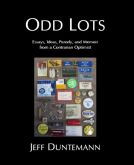
It is with considerable pleasure (and a great deal of relief) that I announce the availability of my newest book, Odd Lots. It’s available in both ebook ($2.99) and trade paperback ($12.99) format.

I announced the project here last October. It’s taken a lot of time to put together in part because I had to OCR so much of it, and I hate OCRing. The other time-consuming element was trying to decide what-all should be in it. The bulk of what I’ve written on programming is now obsolete, and what isn’t obsolete is in published books that are already available. But my DDJ columns? DOS programming? Modula 2? Extinct. I suffered over those decisions more than I should have. I gave myself a 250-page topstop for the paperback. It came in at 235 pages, so I could have thrown in another Contra entry or two. At some point I simply had to say, “It’s done.”

What’s in it? Five topical sections:

  1. Essays, idea pieces, and editorials from PC Techniques/Visual Developer.
  2. Entries from Contrpositive Diary
  3. Parody (most of which came from the magazine)
  4. Memoir
  5. None of the above.

Part 1 contains pieces from the magazine that I felt had lasting interest, like “The All-Volunteer Virtual Encyclopedia of Absolutely Everything,” a few essays about the wearable computers I called Jiminies, “Pay Them Forward,” and “Hail the Millennium!”

Part 2 contains entries from Contra, again items I felt had lasting interest. I threw in my oddball series “50 Days’ Meditation on Writing,” which I posted on Facebook on fifty consecutive days way back in 2014.

Part 3 contains humor and parody, some of which was originally published in the magazine, and some in fanzines that now go back almost fifty years.

Part 4 contains excerpts from my memoirs, along with the very first written item I ever sold for money, which ran in 73 Magazine in December 1974. Some of that appeared here on Contra. A great deal of it is published in Odd Lots for the first time.

Part 5, well, some things don’t categorize well. Whatever didn’t fit in the first four categories ended up here. A couple are funny, including one that might be considered a parody of myself. The others might be classified as “inspirational,” depending on what inspires you.

The cover photo, some might remember, came out of a 2015 Contra entry called “Samples from the Box of No Return.” I think it qualifies as a collection of odd lots, just not written ones. It’s a shame I couldn’t photograph everything in the box, which has a lot more stuff in it than shown here.

Again, I assembled the book because I regularly get emails from people asking where they could find one or another editorial or idea piece from the magazine or Contra. I posted a few on my site. I don’t have word processor files for most of them, and had to OCR them. It’s almost a private publication for my fans, some of whom have been reading me since I launched Turbo Technix at Borland in 1987. I freely admit that some of it sounds like bragging. Hey, I really did predict Wikipedia in 1994, using technology we had in the early ’90s. Keep in mind that I wrote a great deal of that early material with a grin on my face. It was blue-sky stuff, satire, and primarily entertainment. I’ve never been one overly given to seriousness. Please read it with that in mind.

And I once again thank all my long-time readers for giving me a reason and a forum for writing interesting and funny stuff, and for (finally!) having a place to put it.

It’s done. Whew. Go get it! And if you think Odd Lots was odd, heh–just wait until you see my next publishing project. (Stay tuned.)