Jeff Duntemann's Contrapositive Diary Rotating Header Image

writing

Anomaly Con 2011 Wrapup

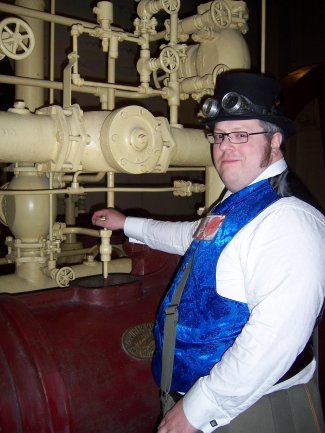
JimBySteamEngine.jpgI got back from Anomaly Con 2011 last night, and realized by 9 PM that it had worn me out. I used to do weekends of nonstop socializing and concept-absorbing without blinking, but those days are gone, and I just don’t have the stamina anymore. My collaborator Jim Strickland (left) did much better than I, but I’m guessing we both slept pretty well last night. I certainly did.

Not that I didn’t learn a lot, nor enjoy it. To the contrary: It was a great time, and I suspect I made a few new friends, even if I didn’t raise my profile as a writer very much. One of the things I learned is that the steampunk phenomenon is less about books than about culture, and it’s held together much more via social networking than I would have predicted. The sessions on clothes and characters and even absinthe were SRO. The sessions focused on writing were less so, though anything involving Sarah Hoyt was reasonably well-attended.

I haven’t read her yet and intuit that her work isn’t exactly my thing, but Sarah in person is insightful, funny, and completely on top of the writing game. Furthermore, she’s willing to dump on all of the writerly rulebookisms now doing the rounds at workshops, like never use any said-bookisms, avoid adverbs, and so on. Though she didn’t say it straight out, the summary is simple and would-be writers need to drink deeply of it: You can’t write well by rules alone. Black-and-white thou-shalt-nots of this sort are particularly misleading, and are perpetuated by people who make their living trying to teach people without a good ear for the language how to write. Backwards, backwards: Get your ear first, then apply the rules when your ear detects a rough spot.

One great surprise for me was Pandora Celtica, a (mostly) a capella group of five who do Irish folk songs and their own Celtic-themed compositions in marvelous close harmony. It was accidental: I was on my way to the men’s room when I passed the group’s vendor table, just as they were striking up an impromptu number. I bought two of their CDs on the spot, and was not disappointed.

A couple of my conversations suggest that a rift is developing in the steampunk world: Those who would like to see steampunk remain true to its roots, in fiction faithful to the science, technology, and culture of its time, versus those who feel no hesitation in pulling steampunk ever more toward deep retro urban fantasy. I need to read more on both sides before I can have strong opinions here, but something of this sort was happening in the 1960s, when the New Wave was taking on traditional hard SF and enough bricks were thrown in both directions to build several thousand brick moons. The New Wave eventually drowned in its own self-indulgence, but in fairness, it freed both fantasy and hard SF to explore sexual themes in ways simply unthinkable prior to 1960. The term “steampunk” may have to be broadened to include any fantastic literature in a Victorian setting–which will clear the way for others to create “hard steampunk” as a distinct subsubgenre.

The Tivoli Building at the Auraria Campus is not brightly lit, and many convention events were held in cavernous spaces where my pocket camera couldn’t grab enough light to image well. So (having reviewed everything in the camera this morning) I don’t have much in the line of photos to show you, and nothing at all of me. Jim may have some better shots (he had his DSLR with him) and if so I’ll post what I can in coming days.

Odd Lots

  • A 20-year study does suggest that personality affects longevity, though interpreting the results sounds tricky. The question arises whether personality can be changed, and if not, well, longevity is (as I’ve long suspected) almost entirely in the genes. (Thanks to Frank Glover for the link.)
  • I had never heard of Kindle novelist Amanda Hocking until a week or two ago, but she’s obviously doing something right. What I think she may be doing right is accruing fans, as Kevin Kelly suggested back in 2008. Get to 1000 fans, and you can make a living. (She clearly has more than 1000 fans.)
  • A Wi-Fi only Xoom will go on sale at the end of March at a $599 price point. I’m still waiting for them to make the SD card slot work, but it’s nice to see some flexibility in other areas.
  • A 128GB SDXC card was inevitable (and still expensive–though check back in an hour or so) but I wonder what devices can actually use it. Most of the “barrier” issues are with Windows; Linux does not differentiate between SDHC and SDXC cards as long as they have compatible filesystems.
  • It’s not blogs that have debased American politics. It’s email–email sent to you by your aunt, who tells you to forward it to everyone in your address book. We laugh, but new research suggests that the strategy works.
  • Digging around in the shop the other night I found an envelope of crystal pairs for my old Standard 2M HT, which I bought in 1976. That was a great radio, built like a brick, and I’m looking to get another one. I’m watching eBay, but if you have one in the pile somewhere you might part with, I’m interested.
  • OMG! There are still potato chips fried in lard! Glorioski!
  • We’re finally starting to admit it: Fruit will make you fat. I ration fruit to three or four servings a week. Fruit is candy and almost entirely sugar, much of it fructose, which basically goes straight to your gut.
  • And while we’re talking food, consider: If a dozen eggs cost about $2 where you live (as they do here, sometimes cheaper) that means that two eggs plus a little butter to fry them in will set you back about 35 cents. That’s cheap calories, and good ones.
  • While listening to the 1968 Association song “Six Man Band” the other day, a line in the lyrics caught my attention: “We’ve got the seventeen jewels that dictate the rules…” How many people under the age of 25 or so have any idea what this refers to?

Space Westerns vs. SF Westerns vs. Weird Westerns

Back in 2002, when “Drumlin Boiler” appeared in IASFM, somebody in the comments on the IASFM Web site grumbled that the story was “a glorified western.” I hadn’t thought of it in those terms, but even though I’m sure the comment was intended to be dismissive, it was true: “Drumlin Boiler” was a story set on the frontier in a society roughly equivalent to 1870s America. The frontier was on another planet, and there were all these alien gadgets lying around causing trouble, but people were riding horses and packing six-guns.

Ever since then, I’ve used the term “space western” to describe the genre of the first several Drumlins stories. (Drumlin Circus is different for a number of reasons, but I’ll get to that in future entries.) The term was floating around in obscurity for years in the SF culture, but then Firefly happened, and abruptly what my Clarion ’73 compatriots once razzed as “cowboys on Mars” became legitimate and even hit the bigtime.

I learned not long ago that there’s a mirror image of the space western: the science fiction western. I hadn’t known that the literary classification knives were cutting that fine, but they are. Space westerns transplant themes and cultural elements of the American west onto other planets. Science fiction westerns transplant SF themes into the actual American West of an earlier time. Think of the difference as “cowboys on Mars” vs. “Martians in Texas.” (For a great example of the latter, see Howard Waldrop’s wry “Night of the Cooters.” I’m guessing, not having seen it nor read the graphic novel, that Cowboys and Aliens is much the same.)

And as if that weren’t enough, there are also weird westerns: supernatural themes transplanted onto the American West. This surprises some but doesn’t surprise me. The era of the American West was also the apex of Spiritualism, which originated near Rochester, New York in 1848 but by 1880 was everywhere in the country, including the western territories. The weird western subgenre goes way back: The mere handful of classic horror comics that I read in my cousin Ron’s basement in the late 1950s always had a few cowboy settings. These days, you can find things like Six-Guns Straight From Hell, which appears to include such genre cross-products as werewolf sheriffs, vampire bank-robbers, and “new-fangled electric zombies.” Many of the stories were first published in Science Fiction Trails, an annual anthology edited by David B. Riley. SFT goes broader and covers all three categories, sometimes with a steampunk flavor, as in Jim Strickland’s story “Brass and Steel” in the recent #6. “Brass and Steel” might well be said to include “new-fangled electric zombies,” a concept Jim pursues with a lot more rigor than the author of your average sparkly vampire yarn, ten-gallon hats or no.

I went a little cold on SF for quite awhile (I’m guessing almost 15 years) because it began to take itself a little too seriously and thereby ceased to be fun. Fun is what we do this for, after all, and sending things a little bit over-the-top is the very best way to puncture the stuffies and get the fun back front-and-center. The first three Drumlins stories were space westerns. Drumlin Circus is a steampunk western, with just a hint of weird, if a postulated sensitivity of quantum computers to human mental states counts as weird. (I stop well short of vampires.) Hell, I can wear lots of hats; hats are among the things I do best. Ask Carol. Or just look in my closet.

Taking a Breath

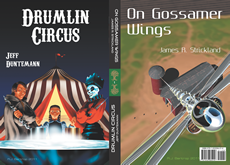
This has been a helluva month. To finish Drumlin Circus I wrote 26,000 words in two weeks, and then by six days later had polished it, laid it out, proofed it, and combined it with a second short novel (by the formidable Jim Strickland) to make something book-sized, with a twist. (More on the twist in a later entry.) We’re now waiting for the cover art, and so for a day or two I’ve had a chance to pick up my office, read a little, run the dogs around, and ruminate on what I’d learned.

coincellgrab.jpgOh, and I bought a TV for downstairs. A TV. 55″ wide and 1.37″ thick (!!) by my digital calipers. Sure, I’d like a flying car. But this again reminds me that we really do live in the future.

The do-it list was getting long. I’ve needed to replace a couple of coin cells in the Dell USFFs we have here and at church for some time. In most PCs this isn’t difficult, but Dell put the coin cell holder in a bad spot, especially in the SX270. Pulling out the old cell, no sweat–that’s what God made needle-nose pliers for. Reinserting a new cell would be easier too, except that the pliers would short out the cell. So I put a short length of shrink tubing over one of the two jaws and held it over a match for a bit. Shazam! The cells survived the operation, and I broke no fingernails trying to coerce them in either direction. It’s a trick worth remembering if you can’t use your fingers to get coin cells into place behind that plumber’s nightmare of a heat sink you’ve got.

One of the things I had to do to write Drumlin Circus was adopt an older style for the first-person narrator, who is an educated city guy in an 1890s sort of culture, albeit one not on Earth. This isn’t normal diction for me and I had to train myself to do it, first by reading largish chunks of The Time Machine and Food of the Gods, and then by going back to Gene Wolfe’s boggling 5-volume New Sun saga, which I hadn’t been through in ten or fifteen years. Again, the complexity of the tale boggled me a little (as did more than a few of the words he repurposes but never invents) but this time I was ready: I had ordered Michael Andre-Driussi’s Lexicon Urthus and kept it at my elbow. It’s a 420-page index of terms, concepts, and proper names from the series, with not only their meanings in the story but also their derivation from myth, religion, and other languages. If you intend to read the Urth cycle closely, you’re gonna need this. Highly recommended.

Over the next few days here I’ll try to cover a few more noteworthy things associated with Drumlin Circus. Mostly I want to reassure you all that I’m back and looking forward to writing here a little more regularly than I’ve been.

The Long, Long Circus

Whew. Drumlin Circus is done. Or at least complete and intact, if not finished. (Stories are a little like software to me: They’re never finished, not in a truly final sense of the word.) I had dared myself to get it all down by last night, and come four PM I found myself staring at the screen, thinking that I needed a short “resonance” scene to wrap it all up but couldn’t figure out what it might be. (Such scenes are not part of the outline.)

So I sat down this morning and started reading the whole thing through from the beginning. By the time I got through it about 11:00, I knew what I wanted, and fifteen minutes later the words were on the page.

The story came out a lot longer than I planned. 33% longer, in fact: I planned for 35,000 words and my subconscious handed me 53,000. The same thing happened to me in 1998 and 1999: I had intended The Cunning Blood to come in at 90,000 words, and by publication in 2005 was 145,000 words long. Several people have told me that that was a major reason none of the big houses would publish it.

Getting the flu in January slowed me down radically. To make our deadline of introducing it at AnomalyCon at the end of March, I set the completion deadline for March 2. That was a tough one, and in fact, I wrote 25,000 words in the last fourteen days alone. I don’t think I’ve ever written that much fiction in that little time, at least since I was in high school and did little else.

How did it turn out? Reasonably well. It was an experiment on a number of fronts. I’ve never written anything in that length class before. I have a completed but unpublished novella that came in at 27,000 words, and nothing else much past 12,000. It was also a conscious effort to bend the work in a steampunk direction. How that worked I’m not sure yet, though sooner or later people will probably tell me. I wedged in almost every steampunk trope there is, even if briefly: airships, goggles, steam locomotives, strong women dressed provocatively, long-barrelled pistols, and as much brass as I could mention on a planet more or less flooded with intelligent nanocolonies of alien metal. I even tipped the hat to zombies, if only in a metaphor. (Calm down. There are no actual zombies in the story. None.)

I read some Verne and Wells before getting down to business, so that my first-person viewpoint character would sound like an educated city man from 1890, and not like the cowboys and farmers who have dominated the drumlins canon so far. Again, I’m not sure yet how well that worked out. We’ll see.

The story needs some cleaning up, some continuity checking, and as much peer review as I can gather in the next couple of days. Cover art is in progress, and if all the streams collide into the same river, we’ll see Drumlin Circus in book form on or before March 27.

Drumlin Pressure Cooker

I guess it’s time to at least let you all know that I’m alive, but I’m in death-march mode on Drumlin Circus. In ten minutes I’ll begin writing the action-packed climax, with repeating pistols, flamethrowers, a small hydrogen airship, a self-modifying steam calliope, and the Big Ball of Cesium. Oh, and a few deinotheria, a couple of woolly mammoths, a dire wolf, and all the expected smilodons. And did I mention a coven of witches who don’t believe in magic because they have something better?

This is a collaboration with Jim Strickland, and we intend to have it finished, laid out, and printed by Lulu before AnomalyCon on the 27th. Cover art is on the way, though not having it won’t stop us. (The dog-ear on the cover will say, “Uncorrected Proof” because that’s the standard excuse for slightly overaggressive deadlines. If I hadn’t had the flu for three weeks the damned thing would be done already.)

I’ve written over 8,000 words in the last four days. I have 38,000 words down, and expect the climax to take another 5,000. The story must be finished by 4 PM Wednesday. I expect to make the deadline with difficulty; hell, do you think writing adventures in Victorian diction is easy?

More when I can take a breath.

Accidental Steampunk

5,000 words in two days. Wow. I haven’t done fiction at a rate like that since I was wrapping up The Cunning Blood in early 1999. It’s the main reason you haven’t seen me here much recently: I have a hard deadline for a story (this is uncommon; deadlines are for things like computer books and articles) and if I don’t produce at this rate for a little while longer, Drumlin Circus won’t be finished and laid out in time for AnomalyCon in Denver at the end of March. I have 27,200 words down now, out of a target 37,000 – 40,000. That’s heading out of novella territory into the strange turf of short novels, where I’ve never worked before.

But that’s the idea. Ruts are horizons pulled in too close, and I’m trying to push ’em back as much as I can, in as many ways as I can. Those who are familiar with my drumlins stories have gotten comfortable with a sort of Weird Western ambiance, and perhaps a hint of Cowboys & Aliens, except that the aliens are gone to parts unknown, having left all their incomprehensible machinery behind. (I was actually inspired more by Fred Pohl’s Gateway novels, at least in terms of the alien machinery.) So far I’ve focused on the rural and frontier areas of the drumlins planet, but much of Drumlin Circus takes place in the planet’s largest city. There were cowboys aplenty in 1890s Colorado, but out east in 1890s Chicago or 1890s New York, society was radically different.

The Drumlins Saga as a whole is about human castaways on an Earthlike planet who slowly re-create Earth technology and civilization, hoping eventually to repair their starship and return home. They “pass through” stages of technology roughly corresponding to advances in Earth history, and at the time of Drumlin Circus they’re basically gotten to 1890, with steam power and the beginnings of electricity. (The first three Drumlins Saga stories are collected with others in this book. More are planned.)

However, there’s a wildcard: alien machines scattered all over the planet, analogous to 3-D printers with a back-end database of manufacturable parts. Enter a 256-bit binary code, and…something…comes out. Some of these somethings are familiar and useful, some can be repurposed, and some, well, they’re just weird–and maybe dangerous. (Furthermore, there’s a lot of somethings. Do the math.)

So it’s 1890 with a twist.

Drumlin Circus itself recounts a sort of low-level war between a traveling circus and a cultlike research organization called the Bitspace Institute, which is very much a steampunk bad-guys version of the Ralpha Dogs from TCB. The steampunk part wasn’t deliberate, and when I was first defining the Drumlins Saga back in the early 2000’s, I hadn’t read any of the steampunk canon yet. But it’s tough to set a story in an 1890s technological milieu these days and not be accused of steampunking, so at some point I gave up and said, Awright awready. I’m a steampunker. (I’ve even had a top hat since 1999, and you’ve seen this. And this.) I’ll deal with it.

(More tomorrow.)

Memory and the Need to Explain

I’ve been writing my memoirs for a couple of years now, little bits here and little bits there as time allows. I don’t intend to publish them, though I may give them to people who request them. But having researched and meditated on the fluky nature of human memory, I want to record what I remember now, against the strong possibility that the remembering will not get any better.

One of my friends (who knows about my memoir-ing because she’s in my memoirs) asked me if it was a painful process. That’s a good question that I hadn’t considered; after all, I was trying to remember and record as much as I could, the bad along with the good. So was writing about the occasional tragedy in my life painful? Remarkably, no. In fact, the more I write about my life, the better I feel about it. I’ve always attributed this to the value of emotional release (especially of suppressed emotion) as documented by James W. Pennebaker in his book, Opening Up. But earlier today, while reading Daniel Gilbert’s Stumbling on Happiness, I came across another possibility: That explaining personal tragedy, even in a purely intellectual way, feels good and is healing in and of itself. There is, however, a bit of intriguing weirdness in it: It appears to work even if your explanation is bogus.

The human mind seems to like a coherent narrative, and when coherence is in short supply will manufacture as much as it needs. This may be one reason that we discover faulty memories of our past, as I’ve documented here: We value continuity over accuracy, and abhor blank spots. So when we’re telling a remembered narrative and come across something we don’t remember or don’t understand, it’s very tempting to guess and then build the guess into the narrative. (This can be and I think often is an unconscious process.)

I noticed this process at work some months back, when I was writing an account of my early relationships. Girlfriends #2 and #3 very clearly and explicitly rejected me because of my eccentricity. (I married Girlfriend #4.) Weirdly, what happened with Girlfriend #1 I simply don’t recall. I remember when the end came (August 1968) and I remember being miserable about it. I just don’t have the slightest idea what the issue was.

When I wrote about it, my first draft was the honest one: “I no longer remember why Judy and I broke up.” I didn’t like admitting that, but further thought brought no new memories to light. I do remember arguing with her and being a jerk about it. I just don’t remember what we were arguing about.

So for my second draft, I added speculation: “I no longer remember precisely why Judy and I broke up, but considering my later experiences with girls, I’m pretty sure my eccentricity had begun to wear on her after ten months of being inseparable.” That sounded a lot better to me, even though there’s not a lick of memory to back it up.

It is, however, a much better story. It ties in with my later experience and clearer memories. It just isn’t true. (I will admit that it’s a reasonably good guess.) Alas, I think that if I told the story often enough, the fact that this was simply a guess would get lost, and the guess would melt into my personal history and absorb credibility from everything else I’ve written. I wonder now how much of this has already happened.

Bottom line: Our memories may not decay naturally. We may unconsciously corrupt them by trying to knit them together into a coherent narrative, inventing or reshaping facts where facts either don’t fit well or don’t exist. That done, we convince ourselves that our guesses are true, at least until we encounter independent evidence that they’re not.

I don’t think it’s an honesty issue. If it were, you’d think it would feel better to just admit ignorance than tell a tall tale, especially when the tall tale puts the teller in a bad light. To the contrary, I think that devising narratives is a basic human need, and even when we don’t have to, some of us do it anyway, simply because it feels good. (This is how novels happen.)

Memoirists: Admit your ignorance. Label guesses honestly. The better a story your memoirs tell, the less likely it is that they really happened. (I’ll do my best to take my own advice here. Corrections gracefully accepted.)

Odd Lots

  • Maxwell’s Demon as Web comic. (Thanks to GMcDavid for the pointer.)
  • Here’s a tutorial on adding a MicroSDHC card to the Nook ebook reader. Looks like a mechanically touchy business (be careful!) and nothing substantive is said about sideloading content on the inserted card. Sideloading of content is something I’m less and less willing to compromise on, as I do not want a censor between my slate and material that I want to read.
  • I’m due-ing diligence on the very impressive, Android-powered Nook Color, but the frontrunner in the Great Jeff Slate Project continues to be the Galaxy Tab, especially since Samsung is offering this keyboard dock. That said, Nook Color is the right idea for ebook freaks: Approach a general-purpose slate from the ebook side, starting with a killer ebook store and working toward everything else. (Supposedly, V2.2 and access to the Android app store is coming soon.) My view: Dedicated e-readers like Sony’s and even Kindle will eventually give way to more general-purpose slates of similar size, though slates may “lean” toward one enthusiasm (like ebooks) or another.
  • Back in 1983 and 1984, I did about 10,000 words on a since-abandoned novel that included a species of road surface that charged your car’s batteries as the car moves over the road. A pickup called the “board” (after surfboard) was suspended beneath a vehicle and hovered over the road surface via maglev to generate current like a linear alternator. I was pleased to see that Wired posted a news item on some guys in New Zealand who are developing almost precisely that. Not sure how well the math works out (especially with respect to infrastructure costs) but it’s a cool idea. I added another small touch: Ohmic losses in the “voltway” surface kept it snow-free in winter.
  • Pope John Paul II was an idealist. Pope Benedict XVI is a pragmatist. My SF prediction: As he grows older and sees the problems besetting the Church getting no better and possibly worse, he will begin considering other reforms that his uncompromising predecessor would have considered impossible. Hey, Bennie! How ’bout Vatican 3!
  • People who have lots of moles have longer telomeres. Or at least look younger than they are. Carol and I are both so blessed, mole-wise, but I think it worked better on her than on me.
  • If you spend a lot of time in the car but off the Interstates, take a spin through RoadsideAmerica, a bemused compendium of eccentric stuff you can see on road trips. I liked the entry on smiley-faced water towers, since we pass one in Adair, Iowa every time we blast back and forth to Chicago. And Adair is far from the only one.
  • From the above site: When we left Arizona seven years ago, some people nodded and said, Cool! Colorado isn’t as crazy as Arizona. Well…I’m not sure that’s true.

The Zombie Bandwagon

On this fine Halloween Sunday morning, I have to ask: W(h)ither zombies? I’ve read about why pirates like parrots, but the undying love steampunkers hold for death-in-self-denial has always puzzled me. I guess it’s part of the punk rather than the steam, and I’ve always been better at steam than punk. A recent blog post by Charles Stross has created enough noise in the blogosphere to wake the dead: Charlie is annoyed at the fact that steampunk has become a bandwagon, and he doesn’t do bandwagons. (My overall reaction to the post is that Charlie protesteth too much, and by the end sounds like he’s annoyed because he didn’t jump on the bandwagon when it rolled past his house.)

One place where Charlie and I agree: zombies. They’ve been done to, well, you know. He’s locked horns with Cherie Priest, a gung-ho Seattle steampunk writer who’s had a lot to do with populating the steampunk universe with shambling horrors, which she very aptly calls “rotters.”

The problem may be that steampunk as a subgenre is shattering, and parts of it are slithering across the floor and merging with paranormal costume fantasy. (I’ll know when I grab and read one of Cherie’s books.) Perhaps it’s time to claim a subsubgenre as “hard steampunk,” where we get to keep the pipe fittings but bury the dead. I could do that. I may already have. (See “Drumlin Boiler,” which I’d rather see considered steampunk than weird western.)

Zombies are not a new thing. I was given a zombie story called “Impulse” to read aloud at a Boy Scout summer camp campfire gathering in 1964, and it was decent. (I wish I could find it again, but I don’t remember the author. I think it goes back to the Fifties.) Unless I misrecall–and that was 46 years ago–it was about some sort of telepathic alien goo that tries to use a dead body as a disguise and finds it doesn’t work well. Surprise! I saw plenty of zombie movies as a much younger man, and have read more than my share of zombie fiction. (The best? George R.R. Martin’s “Override.”) To my hard SF mind it’s a difficult business. Biological systems are more resilient than mechanical ones, but after all, we call them “dead” when they don’t work anymore. If they get up and start working again, I find it hard to still think of them as dead.

In truth, what I mostly think of them as these days is funny. I have a whimsical novel called Ten Gentle Opportunities on ice right now that turns De Camp’s Harold Shea concept on its ear, and posits a sort of magic hacker from a universe where magic works as a consistent alternate physics (with spells a sort of immaterial software) who jumps universes to escape from an enraged magician and lands here on Earth. To escape pursuit while still in his own magical world, he makes his way into a zombie trap, where the zombies check in but can’t check out. Alas, physics is a bitch, whether magical or not.

Getting the dead to stay dead was an increasingly serious problem. Formerly living material was powerfully endomagical: Once the Great Magic of life drained out of it, a corpse would soak up any uncommitted Third Eye magic in its immediate surroundings, and if enough were available would get up and start shambling around again, breaking things and getting into fights.

For most of history, magic had been rare and valuable, and the few magicians in the world tended to be well-bred and tidy. Unnecessary or broken spells were always frotted back to the primordial chaos from which they had been drawn. Alas, as the archipelago grew crowded, younger magicians lacking an inheritance increasingly turned to drink and careless spellmaking to obtain what they wanted. Few landless magicians studied hard enough to advance to Adamant Class. The spells blikked up by drunken Ruby-classers were complicated and fragile, and rapidly broke down into increasingly tiny fragments that nonetheless had to be individually frotted to be rid of them. No one would bother, especially the Amethyst and Adamant classes, who thought of spellfrotting as something one did only to one’s own magic. So little by little, invisible grains of useless magic blew around the world on the very winds, ready to be absorbed by a corpse’s hungry substance.

Most folk lacking the Third Eye grumbled that Global Enlivening was a conspiracy by magicians, who were the only ones who could unbreakably bind a corpse to its own etheric shell such that both would comfortably and permanently disintegrate. Within Styppkk’s own lifetime, mean-time-to-shamble had fallen from a comfortable fortnight to only three days, and if a magician could not be found (and paid) to conduct a proper funeral and shellstaking by then, one’s deceased relatives would wander off, though walls as easily as through doors.

The problem had grown acute enough two centuries earlier that the world’s Adamant magicians had collaborated on the creation of the great lychfields, which were zombie traps: The bait was earth magic, which though powerful was not absorbed by dead flesh. The simple spell at the heart of every lychfield made earth magic smell like Third Eye magic, attracting zombies that were already ambulant. Once inside, they could not get out, and eventually exhausted the ambient magic they had absorbed and crumbled to bones and dust.

Styppkk had read it all in Wiccapedia, and as he got to his feet he felt around in his many pockets for the requisite spells. He knew how to command zombies and had done it a time or two, usually as a way of getting cheap if not especially skilled labor. This time what he wanted was a diversion. In only seconds, the shambling horrors in the lychfield would smell the magic he had in his pockets, and would turn in his direction. Then the real fun would begin.

Seconds passed, then minutes. Nothing. Styppkk looked around in the gloom. He saw no movement. There was no sound but the unnerving trickle of water down the granite walls enclosing the lychfield. He took a step forward, and crunched on ancient bones–then tripped over a motionless body that shuddered only slightly at the indignity.

Something was wrong, and Styppkk knew that in relatively short order, Jrikkjroggmugg would be over the wall and on his case again. He fished a clamshell phial from an inside pocket, snapped it open, and dipped his left pinkie in the dust it contained. Seconds later, his pinkie burst into brilliant but cold flame, and Styppkk could now see clearly to the far wall of the lychfield. There were plenty of zombies, but none were moving. In many places, they were stacked like cordwood or leaning against one another like tottering monoliths in a henge. Styppkk counted hundreds by eye.

On a hunch, Styppkk flipped down his helmet’s crystal daggers again, so to see how strongly the magically animated zombies were glowing. Nothing was glowing very strongly…but every zombie in sight was glowing identically. Of course! Like water, uncommitted Third Eye magic sought its own level, and newly-arrived zombies confined in close proximity to older zombies lost some of their magic to the lychfield’s older denizens, until at some point there was so little magic to go around that nothing was even twitching, much less shambling.

Styppkk fixes that, of course, and I get to make fun of the zombie fad on a large scale, while putting forth my own vision of magic-as-alternate-physics. (Want me to finish it? Then find me an agent. I’m not having much luck on my own.)

That’s my take on zombies. They’re kind of like reuben sandwiches or Drambuie: Not my thing on the consumption side, but as a bartender or deli owner I’d serve them up without a twitch to paying customers. (Hey, I sold lots of C++ books from Coriolis, right?) As for bandwagons, well, let’s consider that bandwagons don’t roll without customer demand to pull them. Sorry, Charlie. Zombies taste good, whether or not they’re in good taste. People are buying Cherie Priest’s books and those of many others who are plowing that same field, which means that zombies are now firmly planted in the fantasy landscape. I’m a starships guy by birth and I’ve been waiting for the elves’n’gnomes’n’dragons thing to die out for fifteen years or so, but by this time, them having taken over 80% of the SFF shelf space at Border’s, I’d say it ain’t gonna happen.

Which doesn’t mean I’m going to start writing zombie stories, apart from (perhaps) Ten Gentle Opportunities, which treats zombies only in passing. I will only raise for my fellow writers the possibility that unless you’re big enough to have your own wagon (as Charlie Stross certainly is) it probably makes sense to grab the first one past that you know you can ride–and if the other passengers’ arms come off as they pull you aboard, so be it.