Jeff Duntemann's Contrapositive Diary Rotating Header Image

writing

Daywander

As I circle the concluding chapters of Ten Gentle Opportunies like a ravening vulture (do vultures raven? If so, what do ravens do?) I discovered this morning while reading email with an iced coffee in hand that Phil Foglio posted a rave of my novel The Cunning Blood, both on the Girl Genius Facebook page and his LiveJournal. (Thanks abundant to Alice Bentley for the tipoff.) Nothing motivates this particular vulture to abandon patience and kill something like a review of what has been (and still is–barely) my only completed full-length novel.

Now I have to kill this thing before it kills me.

(Note that there are other reasons for my slowdown the last couple of weeks, reasons that kept me from attending MileHiCon this weekend. Carol had to take a flight to Chicago on very short notice; more as things become clearer.)

Need. More. Coffee. I’m trying something peculiar here: The new-ish International Delights iced-coffee-in-a-milk-carton product. It’s outside the envelope for me because it’s got sugar in it, so I really bought it as a dessert. The mocha flavor is disappointing. It tastes almost exactly like the chocolate milk I used to drink at the Lane Tech lunchroom. Good if you like that sort of thing, but I want a brew that reminds me less of the clueless nerd I was in high school.

I also need to research the named ingredient “corn syrup.” Is that a new euphemism for HFCS? I know the corn industry is squirming so hard the worms in the gully are worried, but from earlier research I know that corn syrup is mostly glucose/destrose, which while still sugar isn’t as malevolent as HFCS seems to be.

Flying back from Hawaii I attempted to watch a rip of an episode from the original Outer Limits series on my Transformer Prime, and discovered something interesting: The throughput from the MicroSD card slot is insufficient to render the video on the Transformer’s display. It’s not exactly pixellation, but more like the sort of herringbone interference my ham radio signal used to put on broadcast TV. Regardless, it made watching the video impossible. Then, when I simply copied the .avi file to internal storage, it played perfectly. I know from previous experience that mp3 files play fine from MicroSD, and ebooks are not an problem at all.

Separate but still important issue: The Transformer Prime did not have the audio signal to drown out jet engine noise on our long flight. So even once I copied the episode to internal storage, I couldn’t make out the dialog half the time. That was the only video I brought, so more research is necessary. Video rips are peculiar things, and I certainly need better headphones.

I’ve broken a lot of light bulbs in my sixty years, but this recent casualty from the lamp over the stove was remarkable:

Broken Lightbulb.jpg

Secret? The touch of a rag wet with cold water. Yes, the bulb was off , but had been on all morning until five seconds previous. Duhhh. Light bulbs are not made of Pyrex.
Odd Lots

Odd Lots

The Memoirs Mindhack.

I have to take a break for a day or two. My subconscious is telling me it’s tired, in the usual way: It pouts and refuses to produce. Fatigue can cause similar symptoms, which is why I go to bed so early that my friends laugh at me. But I’ve been quite well-rested in the last week or ten days, and yet getting started has sometimes been a struggle.

Writer’s block is serious business. So I decided to hack myself.

Half of the struggle against writer’s block is just getting yourself to write something. What you’re writing is less important than engaging the gears and backing off on the clutch. This is not news to me or anyone; I heard it from Ted Sturgeon himself, at the Clarion workshop in 1973. His suggestion went so far as to suggest typing a story out of the newspaper, just to be typing something. I’ve tried this a time or two, and it’s not especially effective. (I’ve sometimes wondered if what Ted Sturgeon called “writer’s block” was actually clinical depression.) During my recent months with Ten Gentle Opportunities, I’ve tried another mindhack against writer’s block, with terrific success: Work on your memoirs.

Most people don’t understand what this means. A lot of badly written books about annoying people (culminating in that consummate literary fraud, A Million Little Pieces) have turned the public off entirely to the idea of memoirs. Make no mistake: Memoirs don’t have to be published to be useful. They don’t even have to be finished. (I suspect my own may never be.) I’m writing my memoirs as an exercise in remembering, to get the facts and impressions about my life down in written form before the memories decay, as memories clearly do. I don’t expect to publish them, though I may allow friends to read them. In a sense, I’m backing myself up to disk.

What I’ve discovered, almost by accident, is this: After typing a few hundred words of my own story, my subconscious wakes up and stops pouting. I then open Ten Gentle Opportunities and I’m off at a trot. It works almost every time. It works better than absolutely everything else I’ve ever tried, and having been writing for almost fifty years, I’ve tried a lot.

Why?

I have some theories:

  • We all like talking about ourselves. The material is always interesting and thus the writing is a lot more fun. If there’s no one around to annoy, there’s no harm in it.
  • There’s less work involved. We already know the story and don’t have to make up a plot. The universe is familiar, and to a great extent documented online. I was able to find a certain Chicago-area manhole cover on Google Street View after thinking I may have imagined it. (Don’t ask.)
  • Our life story is, after all, a story. Things happen. Characters suffer, learn, and grow. Funny situations rise above the disorder. Remarkable people bump into us, and we’re never the same. (“Hi. I’m Grace Hopper. Have a nanosecond.”) Change happens, and change is a helluva teacher. Telling our own story engages the same gears as telling stories we make up. And the challenge, after all, may be no more than getting into first gear.

Someone in my inner circle asked me if the writing had been painful. That’s a hard question. Writing can be painful, and some kinds of writing must be painful, if the idea is to allow a reader to empathize with someone’s pain. Writing about being dumped by three girlfriends (maybe four, depending on how you define “girlfriend”) was in fact surprisingly healing. I thought about the events from their perspectives, and in one case realized that a girl had taught me something crucial that I refused to face for almost 45 years. Wherever she is (and she may not even be alive) I leaned back in my chair, told her she was forgiven, and wished her nothing but the best.

On the other hand, I have not yet begun telling the story of my father’s hideous illness and death. Once I head into that, all bets are off.

So if you’re a writer and you get stuck, take a walk around the block. In this business, the blood’s gotta pump. If when you get back you still can’t get the engine to turn over on that YA paranormal sparkly robots vs. zombies epic, open a new document, pick a scene in your own plot, and tell the story.

Zoom! Off you go.

Just don’t forget to click back to the robots.

My Hair Is ( Finally) On Fire

I’m certainly behind schedule. I’m modestly over (word) budget. I’m still wracked by doubts as to whether the whole loony concept makes sense. But today I experienced a breakthrough, and finally, as Jim Strickland so wonderfully puts it, began writing like “your hair is on fire.” My final, trademark Jeff Duntemann mayhem-filled action climax is well underway. I hope to finish it (and thus the book) in less than a week. To do that, my hair will have to be on fire and remain on fire for a little while longer.

I’ve done this before. I’ve actually done it a lot, which may, at least in part, explain my hairline. In my system of measurement, one “Writing Like Your Hair Is On Fire” unit is equal to 2,000 words captured in one 24-hour period. In my history as a fiction writer, I’ve achieved as many as 2.7 WLYHIOFs. In nonfiction I’ve managed 4.5–and that was back when my hair was vanishing at 40% the speed of light. No wonder.

Ten Gentle Opportunities has been an excruciating project for a number of reasons. It’s humor, and humor is hard. More than that, it’s a love story. It’s actually either two or two and a half love stories, depending on which Love Story standard unit you use. I’ve never written a love story. Now I’m writing two and a half of them, all at once. For the love stories to make sense, I also have to include an AI sex scene. It’s actually an AI menage a trois…but before anybody gets bent out of shape, I need to add that the AIs remain fully clothed throughout (Simple Simon is incapable of removing his clothes) and no naughty bits are mentioned whatsoever. Among humans, sex (as my mother so often insisted) may well be chemistry. Among the AIs of the Tooniverse, it’s undocumented kernel call 105.

For the past ten days I’ve been gnawing on the love story problem, writing a few hundred words, then yanking them out and writing another (different) few hundred words when the first batch didn’t look right. Humorous or not, I’m trying very hard to create characters with some depth to them, which means that character and relationship arcs are important. In this kind of writing, you can’t just reach for the starships anytime you get bored with the people. (I’m famous for that.) I have a plan, and I’m stickin’ to it. If it means blowing my self-imposed deadline, so be it.

As for the hair, hey: There is life after hair. I’m living proof.

Worldcon Wrapup

2001lostsciencecover.jpgIt was a relief to step off the plane in Colorado Springs and grab a chestful of thin, dry air. I’ve lived in dry climates since early 1987, and I’ve lost my taste for late-summer Chicago mugginess. The toughest part of Chicon 7, which concluded on Monday, was going back and forth across the Chicago River between the Hyatt and the Sheraton and wondering if I were walking above the river or wading through it. The con went very well, considering my aversion to crowds. I got to see a lot of people I don’t see very much, granted that I missed a few. I heard some readings and workshopped a couple of stories with my friends from the 2011 Taos Toolbox workshop. And the Hugos, which I haven’t seen in person since (I think) 1986. John Scalzi was easily the best Hugos toastmaster I’ve seen since I began attending worldcons in 1974. He was funny, he was terse, he was great at improv, and he held the awards for the winners as they spoke their thank-yous into the mic. (There was nowhere else to put them.) He’s losing his hair and doesn’t shave his head–he certainly gets private points from me for that.

I was not aware of it at the time, obviously, but a misguided attempt at automated copyright protection killed the stream that Chicon was sending out to people who couldn’t be at the con. This was idiotic on so many levels–the video clips being “protected” had been given to the con by the studios specifically to be shown at the awards–and reminds us that robots should not be enforcers. Never.

The very idea of copyright, on which artists in many areas depend, is being weakened in the public mind by crap like this. If something eventually kills copyright, it won’t be the pirates.

I had a marvelous interview with the fiction editor at a major press, at which he agreed to read the manuscript for Ten Gentle Opportunities. Better than that, he took notes on my experience and my background (I brought both The Cunning Blood and one of my computer books) and suggested that what he might like even more from me than a humorous fantasy mashup was a good ripping hard SF action adventure.

I wondered for a moment: Gosh, could I do that? (Only a moment. A short moment. Ok, no moment at all.) I had intended to pursue my first Drumlins novel The Everything Machine after TGO was on its way. Now, I’m not so sure. The Molten Flesh is less far along, but it may get promoted to the top of the queue. We’ll see.

I did spend a fair bit of time with my sister and her girls down in the dealers room. (She and Bill publish and sell filk CDs as Dodeka Records.) As usual, I did a little shopping, emphasis on little. (We didn’t drive, so whatever I bought had to be packed home on what I call a “sewer-pipe jet.”) But I found something wonderful, as Dave Bowman notably said in 2010.

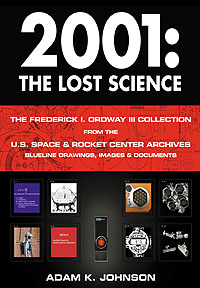
Across the aisle from Dodeka Records was Apogee Prime, a publisher specializing in aerospace books in several categories. They had a new book that, at 12″ X 14.5″, was mighty big for my creaky old suitcase, but I bought it anyway: 2001: The Lost Science. What we’ve got here are original photos, sketches, and literal blueprints of the technologies presented by Stanley Kubrick in 2001: A Space Odyssey. Much of the material was thought to be lost, and when the sequel 2010 was filmed in the early 1980s, a lot of it had to be re-created from scratch, often by having artists watch the original movie fifty times with sketchpads in their laps.

The book draws on the personal collection of Frederick I. Ordway III, who is a real rocket scientist and former colleague of Werner Von Braun, and worked on the Explorer 1 project. Kubrick hired Ordway to help him predict, as reasonably and realistically as possible, what space science would be like in the year 2001. This book is a good overview of his predictions, at least those that made it into the 1968 film. Satellites, space stations, nuclear propulsion systems–these were the aches that a certain class of nerdy 16-year-olds were feeling in 1968. For a good many reasons, only some of which I’ve discussed here, 2001 has long been and will likely remain my favorite film of all time. I remember those aches, and wear them proudly, as they are the aches of boys who dare to dream.

This is a coffee table book, but one that you may actually read cover-to-cover. (I’m not quite done but will be soon. There have been times when I’ve had to take a deep breath and set it down.) Softcover. $49. Very highly recommended.

Peace Through Superior Flier-Power

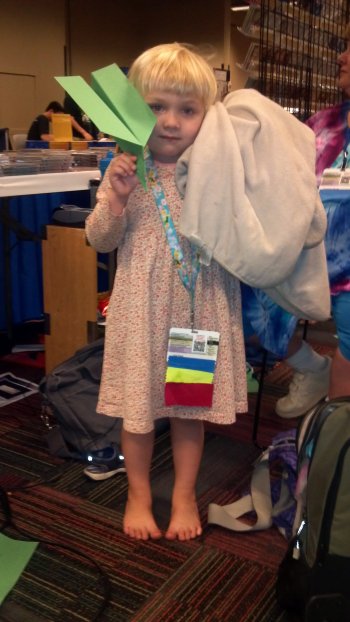
Julie At Chicon-350 wide.jpgWorldcon, Day 3. I spent a goodly chunk of today helping Gretchen and Bill at their tables down in the dealer room. Part of this involved distracting Julie (my younger niece, age 4) who was bored and making Gretchen a little nuts. Her sister Katie is old enough to go to the kid programming room by herself; Julie still needs an adult escort, and will accept no substitutes for Mommy. Mommy, alas, had a table to run.

We did our best. I showed Julie how to make a paper airplane from a sheet of green construction paper and two paperclips that had been hanging out in the bottom of my briefcase. We got us a decent airplane together, and I tried hard to persuade her that aviation is more finesse than brute strength. She had a tendency to want to wind up and throw the plane with all her might; after a few demos she seemed to pick up on the fact that a little thrust in a straight line will work better than a roundhouse discus hurl. The plane flew, Julie was delighted, and Mommy got some much-needed peace.

All in the greater cause of growing up. My older cousin Diane taught me to make paper airplanes as well as other things, like pumping a swing. I was older than four, too. My catalog of Uncle Jeff Tricks is both deep and broad, but most require a little more physical maturity than either Katie or Julie have just yet.

I did notice with considerable pleasure that Katie was building things out of mainstream Lego (not MegaBlox) in the kid programming room. There is a Lego hoard in a corner of my workshop, awaiting the proper time. That time is coming soon.

Again, much of a good con is conversation, and I had quite a bit of that. I even spoke briefly with Harry Turtledove at his signing for Every Inch a King. I stood in awe of Steve Jackson’s creation called “Steampunk Chaos,” which is a sort of huge Rube Goldberg marble-track thingamajigger with a steampunk flavor that Steve has been assembling now for several years. He evidently builds a core machine and then invites bystanders to dig into his boxes full of loose parts and extend it. Most of the extenders were young teen boys, and by all accounts they were having a marvelous time. I took photos but none really captures the geeky bronze (painted) awesomeness of it all.

The crowds at Worldcon this year seem a little thin, both to me and to others that I spoke to this afternoon. Rumor has it that the organizer of DragonCon explicitly pledged to drive the SF Worldcon into the sea by siphoning off younger congoers, and he may well be succeeding. The response, of course, would be to hold Worldcon a little earlier, prompting at least some people to attend Worldcon first and exhaust their resources before DragonCon. That may or may not work, but the graying of Worldcon was painfully obvious, and it would be well worth a try.

More visiting tomorrow, maybe a little more shopping, and a long-awaited chance to pitch Ten Gentle Opportunities to a major publisher. Stay tuned.

Dispatch from Gormenghast-on-the-River

Worldcon, Day 2. I’ve been in this hotel before. I’ve wandered through its subterranean halls, furiously poking bits into my wetware geolocation memory register, without much useful success. I feel like a cat looking for his litterbox in Gormenghast…along with a thousand other cats. It’s the most chaotic Worldcon venue I’ve ever experienced. It’s about as orthagonal as the Intel x86 architecture. It’s as…

Ok, ok, I’ll stop bitching. Much looking at maps allowed me to get to a lot of places and get a fair bit done. 10 out of 13 students from my 2011 Taos Toolbox workshop are at the convention (as are instructors Walter Jon Williams and Nancy Kress) and we actually held a brief critique session at Carole Moleti’s kaffeeklatsch noonish. I sat in a couple of readings and spoke at length with a great many people I don’t see very often. Over lunch I tried to get the K9 email client for Android running on my Transformer Prime, without complete success. I would try again but I had free Wi-Fi at The Corner Bakery. Here in my room at the Sheraton, it would be another $13.95 for a day, on top of the $13.95 I’m already paying for my laptop’s connection.

The discussion topic of the house seems to be, “W(h)ither zombies?” Are they past their expiration date? Is there any more meat to be chewed on that bone? Is the corpse still twitching?

Consensus seems to be, Yes–but ya gotta have a twist. I had a moment to think about twists this afternoon, and if I wanted to do a zombie novel I think I have a good one. I won’t bore you with it right now, but I’ll offer a clue: It’s a straightforward extension of something I’ve written about before in an SF story.

David Brin asked me what time it was. I answered, “4:22.”

In loose moments I’m reading The Quantum Dot by Richard Turton. Nice item, a little dry, but the best summary I’ve seen so far.

A filk popped into my head this morning. I’ll quote the refrain. If you know music at all you’ll get the joke:

Seven ugly shelves, made out of wood;
Tall and thin they were.
Into the writer’s house they went;
His paperbacks to bear.

There’s more, but I need to work on the rhyme.

And I’m about out of time this evening. Supper looms. Not sure where it looms, but it’s making loom noises. Or maybe that’s my stomach. I’ll find out shortly.

Worn Out in the Big City

Just got downtown here in Chicago for the World Science Fiction Convention, Chicon 7. I have a nice room on an upper floor of a good hotel, and pointedly not at the Hyatt, the main convention location. That was deliberate. I like peace and quiet, especially when I try to sleep, and I’ve been to enough Worldcons to know that I’m peculiar in that regard.

Ok, sure, I’m peculiar in a lot of other regards too. But for the next couple of days, that’s the big one.

Crowds have always made me uneasy. This was true even 35-odd years ago when I worked downtown just a few blocks south of here. I was in and out of office buildings all day, fixing Xerox machines, so I was down there on the sidewalks flowing with the trudging masses more than most people do on any given day. After that there was the ride home on the El, packed like bits in a Zip file. I didn’t find it exhilarating. I found it exhausting. I never knew just how exhausting until I bought a very Cleaver-ish white house in a tidy, quiet Rochester NY picket-fence suburb. Carol and I could sit on our patio on temperate days and have supper without hearing anything but birds, lawnmowers, and the occasional truck on Monroe Avenue. Our biggest challenge was keeping Mr. Byte from raiding the strawberry patch when we weren’t looking.

As my friends know, I am not shy and retiring in the least. I’ve given many speeches and seminars to large-ish audiences, including one that must have been close to a thousand people. I even did standup comedy once, though I did have some help and a very workable crowd.

I’ve never been stepped on at a soccer riot, nor squeezed in front of a stage at a rock concert. I can only conclude that a preference for quiet living is genetic. I wonder if it’s maybe yet another survival-selected holdover from my cave-dwelling ancestors, who knew in their guts that when too many Neanderthals hung out in the same place, skulls got bashed and the hunting got thin.

So in a few minutes I’ll throw this thing in the room safe and thread my way down into the pandemonium that is a Worldcon. I have people to see that I don’t see very often, books to buy (and sign; I’ll be at the ISFiC Press table at some point) and a meeting with an editor who has expressed interest in Ten Gentle Opportunities. As always it will be a cortisol thrill-ride, and tonight I will gladly vanish back up here and leave the all-night partying to those better adapted than I.

More as it happens.

Harry Harrison, Gentleman Atheist, RIP

65,000 words. This is still hard. But I am damned well going to make it work.

One reason I will make it work is a man who left this world today for other worlds, not that he was any stranger to other worlds. Harry Harrison is one of those guys who isn’t appreciated as much as he deserves, for reasons that escape me. Most people know of him for Slippery Jim Di Griz and little else. We forget that his story Make Room! Make Room! inspired Soylent Green. Almost nobody knows that he wrote the Flash Gordon newspaper comic strip in the 50s and 60s. (I didn’t know it until I read his obituary.) And I’m amazed that more people haven’t read what I consider just about his best work, The Daleth Effect. And what I do consider his best work may not be everybody’s choice, but too bad: The Technicolor Time Machine beats all.

When I was fresh out of the Clarion SF workshop in 1973, I cleaned up a Clarion story of mine and sent it to him. He bought it for $195, and when it appeared in his anthology Nova 4 the next year, I was (finally!) a published SF writer.

The story was “Our Lady of the Endless Sky,” now in my collection Cold Hands and Other Stories. It’s about a slightly clueless Roman Catholic priest who manages to be sent as the Catholic chaplain to a church constructed on the Moon. When an industrial accident destroys one of the lunar base’s hydroponic gardens, a new garden is built under the transparent dome of the church. Father Bernberger is heartbroken. He’s lost his church…or has he?

It was a decent story for something written by a 21-year-old kid who was “young for his age.” But far more remarkable than that was the fact that Harry Harrison bought it at all. You see, Harry was an atheist, and said so as often as it took for people to get the message. So why would he buy a story about religion?

The one time I met him, at the SFWA reception at one of the late 70s Worldcons, I thanked him for buying the story, and asked him exactly that. (All the SMOFs had told me about him being hostile to religion.) He laughed and said, “It wasn’t about religion. It was about a man who had faith.”

He told me to keep writing. I did.

Now, I’ve taken a lot of kidding and scolding and eye-rolling down the years for being such a naif as to go to church every Sunday and even (egad) pray. I’ve seen a lot of desperately mean-spirited condemnation not only of religious nutters (as though there have never been atheist nutters) but also of the quietly religious people who tend the sick and feed the poor without making any attempt to convert them, nor saying anything more about it.

None of that from Harry Harrison, at least not that I’ve ever seen. He was a gentleman atheist who gave me a push by publishing my story about a church and a priest, even though it went against the grain of his personal philosophy. He shook my hand and told me to keep going. He wrote good, engaging yarns that made me gasp and made me laugh, yarns that I freely admit to imitating. He is one reason (though not the sole reason) that I will not condemn atheism as my species of Catholicism is sometimes condemned.

Godspeed, good friend, however you may understand the wish.