Jeff Duntemann's Contrapositive Diary Rotating Header Image

Fantasy? Or Science Fiction?

“Hilary? Hey, John McCain here. How's it going? Yes. Understood. I read the news. Look, I'll get to the point: Do you still want to be President? I think I can help get you there. It's unorthodox, but hear me out.

“Your party is in trouble. Once the media decided to anoint Obama as our next President, they turned on you, and split the Democrats wide-open. My numbers people tell me that about a quarter of your supporters would rather vote Republican than vote for Obama. They may not actually do that; they may just stay home. But if Barack thinks he's just going to walk off with the election, he's greener than he looks.

“My party, on the other hand, is just about dead. The corpse is still twitching, but the neocons killed it a long time ago. The Democrats are split two ways. The Republicans are split ten ways. Ok, I won't lay it all out; I respect your research staff. This is not new news. Over here we're all having a bitch of a time trying to decide what the party stands for, and the party leaders don't even like me. They're keeping their mouths shut; they don't want to do what your party's doing to itself. They wanted Rudy Giuliani, and they expected me to lose gracefully and go away. I lose gracefully—when I lose. But they're gritting their teeth when they say they support me. Behind the scenes they've said a lot of the same things about me that your party bosses are saying about you. I'll admit to you privately that I'm pretty angry about that.

“But set that side for now. We both have this other problem: There are a lot of people who are disgusted with the whole business. It's not fair to say that they're in the middle, between you and me, between Republicans and Democrats. They're outside the graph. They're tired of the posturing and the tribalism and the personality cults. They know the country's in trouble, and they want it fixed. They're tired of the War, they're afraid for their jobs, they're afraid of getting cancer and losing everything they own before dying in agony. Global warming isn't on their radar. Neither is gay marriage. Those are fringe issues. It's about the economy. It's always about the economy. Bill had that dead right.

“There's a window here: Remake the Republican Party out of the rubble, put some solutions on the table, and try to find a way out of the mess we've gotten ourselves into. That's what I'm going to try to do. I'm going to piss a lot of my party people off, but I'm going to tell them to hit the road. I'm going to turn the whole thing inside out. I'm going to let the tax cuts expire. I'm going to propose another approach to universal health care. It may take a couple of years, but I intend to end the War.

“No, I don't blame you. I don't expect anybody to believe me, which is why I'm not telling anybody. But that's what I'm going to do. Look: I'm 71. I'm in decent health but I get tired sometimes. I have this one last chance to do something completely audacious, which is to break the gridlock and get this country back on track. Otherwise, I keep the status quo and go quietly into that good night, probably before the end of my second term. I do not intend to be another William Henry Harrison.

“I admire your guts and your persistence. I respect your positions, even the ones I don't hold. I think I can win this November. But with you as my VP, I don't think we can lose.

“Hilary? Hilary? You there? Yes, I'm serious. And I'll make you this promise: Run with me in 2008, and I will choose not to run in 2012. We don't have to say anything now. I'll be 75, and that's too old to do it again. The public will accept that.

“Hold on. You do not have to actually be a Republican. You simply have to pretend to be one for a year or two, until we completely re-create the Republican party somewhere in the center. My research indicates that many more Americans want consensus than ideological polarization. We may have to upset a few noisy people at the extremes who like to think that they're more important than they are. I'll cover the right if you'll cover the left. But I promise you, when we're through with it, it will be an utterly different party.

“Barack's young, and his people worship him. He'll try again in 2012. Still, I don't think there's a slate in the universe that could win against Clinton/Rice.

“Are you in? You don't have to tell me right this…

“Wow. Good. So let's do it. You've waited long enough. I've waited too long. It's time. It's just damned time.”

Odd Lots

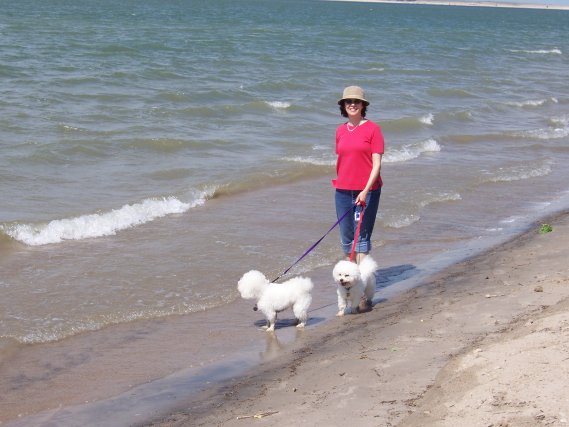
  • Carol and I were at the Longmont Dog Show over the weekend, and Aero got another two blue ribbons, though that was in the Open Dog category and didn't yield him any points. I actually “handled” (took around the show ring) another dog owned by Aero's breeder Jimi Henton. Showing Jackie (Jimi's Hit the Jackpot) was fun, especially since Jackie is the biggest, heaviest, strongest bichon any of us has ever seen (23 pounds, all of it muscle!) and there's nothing the least bit fussy about him.
  • The Make blog aggregated an item on making your own railcarts and railbkes. I've often thought that this might be fun (it's certainly nothing new) but the snag is that when railroads abandon a run of track, they typically tear up the rails for scrap almost immediately. The mere presence of iron suggests that trains come through, if only occasionally, and that would make me nervous. I have been looking for but have not yet found an index of track sections where trains are known not to run.
  • In the certifiable Brain Sludge category of Web content falls Topher's Breakfast Cereal Character Guide, which lists (and in most cases shows images of) all the characters hawking cereal on boxes and commercials that you've ever heard of, and I suspect more than a few that you haven't. The list also includes purely fictional cereals like Calvin's Chocolate Frosted Sugar Bombs, and Admiral Crunch and Archduke Chocula from Futureama. Early versions of the Rice Crispies Elves are interesting—and I never knew that Tony the Tiger had a spouse. All here.
  • Speaking of cereal, this article confirms my grocery-store math: House brands cost as much as 40% less than largely indistinguishable name brands. If you're spending more for gas, at least spend less on Rice Chex. The only type of cereal where house brands taste distinctly different to me are oat toruses, or whateverthehell you call them in the generic—Cheerios clones. The house brands are not necessary bad (in fact, the Trader Joe's house brand oat toruses are distinctly better) but it's odd that all the chex and the flakes can't be told apart but Cheerios brooks no imitation. By the way, most house brand cereals are made by Ralston Foods. Here's their list. Of interest to geometers are Crispy Hexagons. What, no Crispy Dodecahedrons?
  • And to round out the discussion of nostaligic carbs, I regret to inform all who may care that Dressel's Cakes are really and truly gone forever. Their distinctive frozen whipped-cream chocolate cake was a Chicago standard for 75 years, coming from their plant at 66th and Ashland Avenues, but the firm was bought by a French company a few years ago and dismantled for reasons unclear. (I'm glad I can still get Green River!)
  • Mike Reith sent a pointer to goosh, a purely textual interface to Google that works a lot like the Unix shell. Could this be useful to the vision-impaired?
  • There are no visible sunspots right now, and according to several items I've read, there have been none for some weeks, and very few for months, all the way back into the middle of last year. Ham radio guys (like me) track sunspot activity closely because it affects shortwave radio propagation. Here's a sample. It's probably too early to worry, but long-term sunspot minima have been very bad juju in the past.

Odd Lots

  • Wired aggregated this item about a convertible bus/railcar that somehow suggests a modern take on the legendary Rio Grande Southern Galloping Goose lashups. I like the concept a great deal, especially for rapid transit in places where there are rails but not enough population density to create a dedicated passenger rail system. The technology is hardly original with Japan; I see Union Pacific maintenance pickup trucks riding the rails all up and down the old Northwestern corridor outside of Chicago every time I'm in town. The trucks straddle the tracks at a grade crossing, drop their flanged steel wheels, and then apply traction from the truck's rear rubber tires. I don't see why a passenger bus of some sort couldn't do the same thing.
  • I don't recall when someone asked me this (or, in truth, who it was) but the decorative font used on the cover of the Degunking books for the main titles is the Chicken King font from Font Diner. The similar decorative font used in the main chapter titles is Fontdinerdotcom Loungy. Font Diner is a type foundry that specializes in retro fonts, and they have a bunch of them, generally sold in 10-font packs for $28.
  • My uncle ran a dairy farm in Wisconsin until 1975 or so, and in addition to milk, his herd produced a mid-boggling (to me, at least) quantity of cow manure. Finally we have a small-scale mechanism for harvesting the methane produced by decaying manure. The consolidation of small dairy farms like my uncle's into monster corporate milk producers makes something like this not only economical but pretty compelling.
  • What the open source world needs is a sort of integrated bootloader system as good as or better than Apple's BootCamp. I've been hearing about GRUB2 for a long time, but it doesn't seem any farther along than it was a year ago. Coreboot/FILO is another interesting idea, but as I read it would require close cooperation of PC hardware manufacturers—which would be a good thing, fersure, if it would happen. (That may be the big trick.) I'm considering the commercial Bootit NG for my next machine, but in the open source world I don't see a lot happening. If I'm missing something, do let me know.

Kubuntu on Painkillers

A quick update on my mouth rehab, though it borders on TMI: About two weeks ago I had 30 new crowns installed, after fussing with a mouthful of temps for most of a month, one of which had a bad habit of coming loose while I was doing something innocuous, like chewing a chicken leg. That operation was not bad, though my gums got a little beat up from the sterilizing agent and dental pick work to remove excess adhesive. So now I have 30 brilliant white porcelain crowns, and if all you look at are my teeth, well, I look like a TV anchorman.

But that leaves two to go. One of them was so badly damaged by six years under my previous horseshoe of connected crowns that it had to come out. The other is a healthy tooth but needed crown lengthening and a post in the middle of it, because it had gotten whittled down so far in 2001. Alas, a post requires a root canal, because the post has to go somewhere. Yesterday I went back and had the lower molar pulled, and crown lengthening (warning: NSFS) done on its opposing number in my upper jaw. That involved some bone scraping, which was one of the ugliest sounds I've ever heard, given that I could feel it in my…bones.

Everything becomes quiet for about six months now. My empty socket has to heal and fill in with bone, after which the surgeon will install an implant post to hold a porcelain molar. At about the same time, I'll have a root canal done on the upper and a post installed in the middle of that tooth to hold the opposing porcelain molar. And then—egad, I hope!—the whole thing will be finished.

On the other hand, I thought I was finished in 2001. Silly boy.

So I'm back on painkillers, though I don't need as many this time as when I had my gums reworked along the entire perimeter of my lower jaw back in January. And last night I did an interesting experiment: I installed Hardy Heron not once but twice, all while in a codeine fog.

Results: It went flawlessly. Linux has clearly arrived. A week or so back I downloaded and burned the ISOs for both Ubuntu and Kubuntu 8.04, the Kubuntu distro with KDE 4. I like KDE more than Gnome, because it reminds me more of Windows, and I've been looking forward to seeing V4 for several months. Both Ubuntu and Kubuntu installed without incident, each in its own 30 GB partition on my lab SX270 3.2 GHz box. I did not have the display glitches I had back in October, (even though the hardware has not changed at all) and both distros saw my network immediately.

I installed a bunch of things with the Adept installer, including some games, Boa Constructor (a vaguely Delphi-ish RAD environment for Python) and some office apps. No problems there, and Boa Constructor is worth a little experimenting and some description as time allows. My only complaint so far is a minor one: GRUB is ugly, and needlessly so. Suse and Fedora (I think) already have a graphical GRUB OS selection screen. Given the importance Ubuntu places on nontechnical users, I think it would be worthwhile to budget a little work for creating one and including it in the default distros.

The reasons are not entirely esthetic. Nontechnical people almost never see text screens anymore (except for a vanishingly quick appearance while BIOS POST does its thing) and when they do, it almost always means that something is wrong. Leaving a general good impression of desktop Linux is vital right now, as from what I can see, the OS itself is ready.

A quick skim of the Ubuntu forums online indicates that it's possible to install a graphical GRUB display in Ubuntu, and I'm going to give it a shot today or tomorrow, when the codeine is no longer necessary and I can run my brain on all cylinders. In the meantime, if any of you have any experiences (good or bad) with graphical GRUB displays, I'd appreciate hearing them.

The Canon G9 Camera

Our neighbors Lena Olson and David Kuchinski came by for dinner last night, and Lena brought her Canon G9 digital camera. I've been looking for the successor to my well-used Kodak V530, and the G9 is an extremely impressive item. I was thinking that to get all of what I wanted, I would have to stay small and also go big, all the way up to a Digital Rebel SLR or something like it. The G9 falls somewher in the middle, and is about the same size and heft as the compact 35mm film cameras that Carol and used in the 80s and 90s.

I have some complaints about the V530, but it slips easily into my pocket and is all-metal on the outside, which is good if it's sharing the pocket with my keys and my usual quarter-pound of loose change. The V30 is great if you're going walking and want to catch the elusive Colorado wild turkeys that I seem to see only when I don't have a camera in my pocket. (Local bears are not as shy.) However, I do need something with more control over exposure, a somewhat better flash, more battery life, and (especially) better macro capability.

One of the things I want to do is take better pictures of smallish, small, and very small objects. Not microscopic objects—just things down, perhaps, to the size of a quarter. The V530 can focus on things that small, but its depth of field isn't good, its auto focus feature sometimes focuses on the wrong part of the artifact, and exposure control is poor for anything at macro range.

Lena is an award-winning sculptor, and artistic in ways I can never hope to be. I trust her judgment about artist tools generally, including cameras. She thinks the G9 is the best camera she's ever tried—and after I explained what I was looking for, she declared it just the thing and left it with me for a couple of days to see for myself. I took a few test shots with it this morning out on the back deck (where the diffused light of a mildly cloudy day was especially good) and am much impressed.

This was taken without knowing anything at all about what can be done with the camera's special options, and at least for Lulu projects, I consider it publication-quality. I want to see about increasing the depth of field while reducing shadows, but what I got was probably good enough.

The photos I show here (both taken this morning) don't really put across how much detail is present in the digital files, which in their native mode are 3000 X 4000 pixels in size. You can zoom in until you fill the screen with an octal tube socket, which (for tube geeks like me, at least) was mighty surreal.

It's not significantly more expensive than the V530 was a couple of years ago (about $400 online) and looks like it will do the job. We'll see.

As an aside, I'm going in tomorrow morning to get a tooth pulled and the socket bone-grafted. The surgeon is also going to trim the gumline around the opposite molar. I'm likely to be under a fog all day tomorrow (and perhaps part of Wednesday) and may not post for a few days. Man, this dental project is getting old.

Odd Lots

  • Someone's invented a glass jar with a screw-on lid on both ends. Makes sense: By the time you reach the bottom of the peanut butter, most of the oil is gone and what's left is as hard as a rock. Or, alternate lids and gradually work your way toward the middle. If you keep alternating which end is up, the oil won't be as likely to collect on either end and the peanut butter may stay softer until it's all gone.
  • Bruce Baker directs us to a Webring of homebrew CPUs. No VLSI. No LSI. Maybe TTL chips. Or discrete transistors. Or relays. I wire-wrapped a COSMAC machine with 2K of RAM back in 1977, and I thought it was a job. Wow.
  • As an individual with a “special relationship” to calculus (and a special fondness for filk) I damned near bust a gut watching this. The Slashdot commenters (who are interesting all by themselves) need to get a life, or at very least a sense of humor. Most of them weren't even alive when Disco was first-run, and so I suspect the comedy shoots right by them.
  • Epson has been demonstrating a proof-of-concept model of an A4-sized e-ink display with a mind-boggling resolution of 3104 X 4128 pixels, in monochrome. 385 DPI is more than enough for monochrome graphics (though gray-level depth is not stated) and within a few years, a full-sized letter/A4 ebook reader will not only be possible but inevitable.
  • From Jan Westerlink comes a pointer to a wonderful gallery of home-made kites, including one I especially like, especially in light of yesterday's entry: A 4-cell tetrahedral made by rubber-banding 24 bamboo shish-kebob skewers together. Scroll down to pictures 24 and 25. Beautifully done, if a little prickly: If that thing dives toward you, duck!

The D-Stix Kite Flies Again!

As we concluded our first date back on July 31, 1969, I somewhat apprehensively asked Carol if she would go out flying a kite with me on the following Saturday. I was building a tetrahedral kite out of my D-Stix set, and although my intuition was that this was not the way to impress girls, I gave it a shot, and she accepted. And so it was that we piled into my mom's '65 Biscayne and took my D-Stix tetra out to the huge Forest Preserve field at Irving Park Road and Cumberland.

The kite didn't fly well, if I recall correctly (and in truth, most of what I remember about that Saturday afternoon was Carol) but we both had a great time. An hour or so in, the kite smashed into the ground and broke a couple of sticks, but I salvaged the yellow connector pieces—and when I recently pulled down the butter dish that the D-Stix connectors had been in since who knew when, begorrah, they were still in there, including one with some kite string still tied through the hole.

It was a natural. I took the same damned D-Stix pieces, bought some 1/8″ dowels, and I made us another tetrahedral kite. At some point I will create a Web page describing its construction in detail, but I'll just insert a few photos here. A typical joint is at right. The yellow connector originally had eight “ears,” but I snipped two off with a dykes to make the requisite six. (The four outer vertices were six-bangers from which I snipped three.) The paper was ordinary Hobby Lobby artsencrafts tissue, which I glued with Elmer's glue. Mucilage would be better—or at least more historically accurate—but they don't sell that at Hobby Lobby anymore.

Building the kite didn't take much doing. I assembled the D-Stix frame, cut out some conjoined equilateral triangles of tissue, and glued the tissue to the frame. There were a couple of tricky glue joints, but nothing that a protruding corner of a chunk of plywood didn't finesse. All in all, it took maybe an hour.

And it flew. Sorta. Carol and I got it into the air down at the park along Highway 115, but the wind was strong and erratic and I had to hang some tail on it to keep it aimed skyward. It had a tendency to lean left, and after a few minutes of tearing around the great blue sky like a puppy suddenly released from its kennel, it did The Dive, and mashed itself against the grass just like its previous incarnation had, almost 39 years earlier. Two sticks popped out of their sockets, and the tissue ripped in two places, but it's nothing a clever geek can't fix.

It was beautiful. (And weird.) Just like Carol (and me.) We laughed, and laid back in the grass, and reflected that life can be good on a brisk Saturday, with a kite and some string and a willingness to let all the rest of it just blow away for awhile.

The Risks of Quirky English

As I've mentioned here a time or two, I've been gradually recasting my 1993 book Borland Pascal 7 From Square One for the current release of FreePascal. It's turned out to be a larger project than I had expected for a number of reasons, some of them humbling (I was not as good a writer in 1984 as I am today) and some completely unexpected. The one that came out of left field stems from the fact that Pascal isn't used in the US that much anymore. Most of the audience for the new book is in Continental Europe, and while most of them understand English, they understand correct, formal, university-taught English.

Not slangy, quirky, down-home, Jeff Duntemann feet-up-on-the-cracker-barrel English.

This became clear some time back when I posted the first few chapters for FreePascal users to look at. I got a few emails with detailed critique (for which I am extremely grateful) and there was a certain amount of puzzlement about some of the language. A few of the things that puzzled my European friends were not a surprise:

  • QBit stretches and climbs on my chest, wagging furiously as though to say, “Hey, guy, tempus is fugiting. Shake it!”
  • Ya gotta have a plan.
  • …and write the plan in German, to boot.
  • …cats are pets, not hors d'oerves on the hoof.

But some were. The expression “to run errands” is not universally understood there. Nor is the word “shack.” (I changed it to “shed.”) I want very much for the book to be accessible to those who are using Pascal the most, and that's a new kind of challenge for me: Writing plain English without resorting to clever coinages and Americanisms.

Alas, I'm not always aware of it when I'm using Americanisms. (I should find a book for English-speakers traveling here, just as there are books on British English for those of us who visit the UK.) There are other problems: Europeans are not intuitive with Fahrenheit temperatures, any more than we're intuitive with Celsius here. I mentioned in the book that it hit 123° in Scottsdale once in the summer of 1996, and although my European friends know that that's hot, when I translate it to Celsius—50°—they gasp. We were gasping too—Keith and I had to shut the Coriolis offices down because the air conditioners were losing the race. Solution: Put temps in Celsius. Americans know damned well how hot it is in Scottsdale. (As I left in 2002, it seemed like most of them had already moved there.)

It's a two-edged sword. I like writing the way I talk, and for those who haven't met me, well, I talk the way I write. It's easy. On the other hand, having worked my way through the first hundred-odd pages of the new book, straightening out my language quirks, I find that it now reads very well. It doesn't sound quite as much like me, but that's OK. The idea is to keep Pascal alive, wherever and however it is to be done. Writing for the world—and not strictly for us American barbarians—is a useful skill and good discipline. If I stick with Pascal and Delphi, which I have every intention of doing, you're likely to see more of it in the future.

Odd Lots

  • Most people know that the New Age Millerites believe that the world is going to end on December 21, 2012; if that's news to you, here's a nice overview of this deliciously deranged topic, courtesy Frank Glover.
  • Several people online, in an almost offhand fashion, have indicated that Vista's knucklehead UAC feature is training people to click “Allow” automatically, no matter what it's asking about. That may be the single greatest design error in Vista, and could over time render Vista as insecure as anything that came before it, and certainly less secure than just working in an LUA under XP.
  • A reader has asked me to post an entry on all magazines to which I have subscribed and re-upped at least once, but no longer subscribe to. That would be an interesting collection, and a long entry, but I'll try and get to it soon. One of that group that I might still read if I had enough time is First Things.
  • I had a tin toy robot when I was six or seven, and it seems like most of my friends had one or two. So it was a Boomer kid-culture phenomenon, and one I don't see much about these days. Here's a photo gallery from Wired with some nice shots. Most of my early childhood nightmares were about robots and mummies, which suggests that my two subconscious fears (at least according to one amateur Jungian friend of mine from twenty-odd years ago) were of death and berserk machinery. I'm not so sure; that was what most of the cheap horror/sf flicks I saw on Channel 7 were about at that time.
  • Another interesting article/discussion on the Fermi Paradox. Me? I think we really are alone. I don't know why just yet. If I had to guess, I'd say that it's because imagination as a mental mechanism is rare. But I've been thinking about this for thirty years and keep coming back to that conclusion.
  • Lordy, I remember these from catalogs back in the early 60s. Why do they suggest a filk: Looking Through the Eyes of Badminton! (Thanks to Bishop Sam'l Bassett for the pointer.)

Magazine Meanderings

We brought home two weeks' worth of mail this afternoon, and in the pile were the latest issues of all the print magazines I currently subscribe to: QST, Nuts & Volts, The Atlantic, and Wired. Every month I read them—or major portionsof them—and every month I fret for the future of the magazine business, in which I played with great success for fifteen years (1985-2000.)

QST isn't doing too badly. It looks pretty much the way it looked twenty years ago, and it fulfills its editorial mission better than any magazine I've seen in recent times. The amateur radio demographic isn't doing well, as our average age is now up in the high 50s somewhere, but the editorial people know their readers, the ad people know their advertisers, and somehow they make it work. I just wish they'd publish a review—or simply an announcement!—of my Carl & Jerry reprints.

And I continue to be amazed at how well Nuts and Volts has grasped what Tim O'Reilly has brilliantly nailed as the Maker Psychology: People who build stuff because they love to build stuff, whether it actually turns out to be useful or not. It's the last real big-time magazine about electronics, and I bought a lifetime subscription in 1980 for $5! I just wish they'd publish a review—or simply an announcement!—of my Carl & Jerry reprints. (Is there an echo in here?)

I'm not as sanguine about The Atlantic, and haven't been for five or six years now. Still, every time my sub runs out, I re-up, having been wowed by an article or two right in the nick of time. They used to publish thought-provoking articles about things I hadn't heard about before, or didn't understand, or both. A couple of issues ago, they published a cover story about…Britney Spears! The readership apparently sent away (from one of those wonderfully eccentric little 1/12 page ads in the back of the mag, doubtless) for authentic Transylvanian torches and pitchforks and began marching on the mag's offices on New Hampshire Avenue in DC. Me, I'll be contrarian here and say that Britney didn't bother me too much. Maybe she was an experiment. Maybe the editorial staff wanted to prove to their bean counters that slutty, washed-up pop singers are not the keys to the kingdom; if so, they succeeded in spades. No, my big gripe with The Atlantic is that they became obsessed with political personalities a few years back, and now it's Obama or one damned Clinton or another on the cover almost all the time. I wouldn't mind articles about political ideas so much, but no—it's all about how desperate Hilary is getting, and how Obama will learn how to walk on water by his inauguration next January. (Hint: Pray for a winter cold enough to freeze the Potomac.) I was ready to let it lapse back in January, and then they published Lori Gottlieb's brilliantly ascerbic little spitting-into-the-evolutionary-wind commentary called “Marry Him!” I re-upped. And this month, mirabile dictu! Their cover story is a reasonable layman's overview of threats to the Earth from asteroids and comets. There's the inescapable praise-for-Obama piece and a peculiar backhanded tribute to G. W. Bush, both of which I could have done without, but there was also an anguished piece by an adjunct professor teaching English to night school students telling us that not everyone has what it takes to get a college degree. We'll see who wins come next January when I have to write another check, but my editor's intuition detects a back-office struggle between editors who think we like to read about ideas and editors who think we like to read about, um, our national mental illness. Hey, guys, John-John Kennedy himself couldn't make it work. Whatthehell makes you think you can?

And then there's Wired. Like the trademark alternating color bars on their spine, I subscribe and lapse, subscribe, and lapse. The colors and the page layouts still give me headaches, but to ensure that I'm still young old (rather than old old) I have to keep in touch. And they have their moments: The current issue's cover text is absolutely, unreservedly brilliant: “Attention Environmentalists: Keep your SUV. Forget organics. Go nuclear. Screw the spotted owl.” I wanted to cheer. And then I went right for the cover story, to receive the worst impression that they had gotten the idea for the cover but then chickened out when trying to create the article. A few hundred disjointed words without much in the line of facts qualifies as a rant but hardly an idea piece, and the tiny nuggets of information they tossed in simply made me nuts to find the rest of the story somewhere. In the meantime, what the current issue tells me is that in some quarters, at least, our national mental illness is not politics but ADD. There's almost nothing in the whole issue that's more than a few hundred words long. Wired has for some time been approaching what I might call “magazine theater”: Giving the reader the impression that they're reading a magazine. It's currently paid for, but I think the bar on my spine is about to change colors again.

Still, consider the fate of Sky and Telescope, which I dropped in February after subscribing for over twenty years, because I just wasn't reading it. I took Harper's for a year back in the late 80s. Now I riffle through it in airport newsstands to make sure I'm not missing something. (I'm not.) And don't get me started on Scientific American

I love magazines. I guess I'm just fussy. But you knew that.