- Here is the entire sky projected on a plane, and zoomable. (LINK REMOVED–SEE COMMENTS.) That doesn’t do it anything like justice. Cruise the image a little and gasp. (Give the site time to refresh; it’s newly slashdotted.) Read the rest of the page too–it’s fascinating, and full of great photos. Chile looks a great deal like Mars in some places.
- There is apparently a correlation between sleep loss and amyloid tangles in the brain, which are a key element in Alzheimer’s Disease. Causation is still a little unclear, but I find it significant that in our era of Anything But Sleep, the incidence of various dementias is exploding. Be in bed by 10:00PM and keep your brain. Now there’s a deal I can live with.
- Wired has an interesting retrospective on tablet computing, which I found worthwhile mostly for the mention of a steampunk-era electromechanical handwriting encode-and-transfer device, which ferdam sounds like what Sherlock Holmes would use to IM Watson.
- Here’s another worthwhile perspective on the Google Books Settlement.
- A chap who calls himself the Jolly Pirate wrote to tell me that the Pirate Party is alive and well in the US (I was under the impression that it was a European thing) and some interesting links may be found on its site, many of which have nothing to do with piracy. Now, would an American instance of the Pirate Party lean left or right? (Or would it be port and starboard?) I’ll be damned if I can decide…
- It’s been a bad season for big-time wine critics, who can’t seem to find a business model and keep getting busted in conflict-of-interest scandals. The Internet allows the crowdsourcing of critique of all sorts of things–why should wine be any different?
- Pertinent to the above: What we need is the wine implementation of the “People who liked this also liked…” mechanism I see (and use) in the book world. I very much like Campus Oaks Old Vine Zinfandel, though the 2007 vintage now in stores is a pale shadow of 2005. What would be a wine similar to that? (If you know of such a system for wine, please share.)
- There are candy Legos.
- The charger for my Kodak pocket camera is a thin little slab with two 110V power plug pins that swivel out to plug into the wall, and then swivel back into hiding when they’re not needed. Why can’t they build that mechanism right into the back of an ebook reader? (I was without my Sony Reader for a couple of months after I lost the charger.)
- After an unexplained absence of several weeks, Fort Carson’s cannon is back. (See my entry for September 15, 2009.) Maybe the cannon was broke and they had to send it back to the factory for repairs…
Odd Lots
Holy Faces

I’ve been doing a 50th anniversary commemoration book for our Episcopal parish, and as part of the project I’ve been photographing the Stations of the Cross on the church walls. I’m strictly a hobby photographer, and admit a little sheepishly that I haven’t gone through my camera’s manual yet, page by page. So I found it a little startling when I aimed my new Canon G10 at the first station, and the camera identified Jesus’ face. The Canon G10 identifies faces for a couple of reasons, from eliminating redeye to starting the timer when an additional face (presumably the photographer’s) enters the field of view. It puts brackets around them when it identifies them.
The station depictions at our church are not photorealistic. They are done in the distinctive Mexican primitive style, by the well-known Mexican-American artist Mario Larrinaga, who (among many other things) was a matte artist for the original 1933 film King Kong. The stations are painted icons, deliberately lacking any suggestion of a third dimension (so that they cannot be mistaken for the biblically prohibited “graven images”) and as such they resemble cartoons more than portraits.
It got me thinking about how cameras identify faces. As I worked my way around the church, a pattern began to emerge. For the image above (Station #6, depicting Jesus, Mary, and Veronica) the camera tagged Jesus’ face twice–once in person and once on Veronica’s veil–but did not consistently identify the face of the Blessed Mother. Veronica did better, but not nearly as well as Jesus. The brackets flickered and did not stay on consistently.
When I got home, I tried a few other things. I brought up Google Images and aimed the camera at screen images of the Mona Lisa, various Rembrandt portraits, and a few other things. The camera got most of them. I then pulled out a couple of Lynda Barry’s books, spread them open with bookweights, and tried to get the G10 to recognize Marlys and Maybonne. No deal, but some of their friends were picked up.
These seem to be the criteria:
- Faces need eyeballs. Marlys always has her Far Side glasses on. No eyeballs.
- Big eyes are better than small eyes, all else being equal. This seems to be Mary’s problem in the station image above.
- Faces need to be mostly human-shaped. Funny animals don’t cut it. But then again, neither did any of the characters in PVP. Tycho and Gabe were similarly snubbed. (It was odd to think of Marlys’ brother Freddie as being more “realistic” than Gabe.)
- Faces need to be looking more or less straight at the camera.
This last criterion seemed to be the most significant. Profiles were never recognized, and three-quarter views only about half the time. The closer a face was to dead-on, the better the camera recognized it.
So. Got redeye problems? What Would Jesus Do? Get a G10. And look straight at the camera.
SX270 Windows XP Widescreen Driver Fail
I’ve been using a Samsung 2033sw 20″ widescreen monitor on a Dell Optiplex SX270 machine since February, running Ubuntu 8.10 and later 9.04. I bought another SX270 machine for our church with the intention of putting a Samsung 2033sw on it, and discovered this afternoon that Ubuntu can do something Windows can’t: coax the SX270’s Intel Extreme Graphics 2 subsystem into 1600 X 900 mode.
A 1600 X 900 mode does not appear to exist under Windows, even with the latest version of the Intel 865G graphics drivers. Windows identifies the Samsung monitor and knows that its native mode is 1600 X 900, but it can’t match the monitor. And so Windows uses a different mode and looks smeary, as LCDs do if you don’t hand them pixels at their native resolution.
At this point I’m stuck, and will have to fall back to an older 17″ 4:3 monitor. These are readily available and fairly cheap on eBay, but I already have a brand-new Samsung 2033sw over at the church, and now have nothing to hook it to.
I guess it’s always been true that Linux works better on older PCs than the current version of Windows does, but I’ve never had my nose rubbed in this fact more thoroughly than I did today. I’m open to suggestions, but anything that involves a lot of work and time will be politely declined. For another $50 I can get a used Dell 17″ flat panel to hang on the SX270, and will consider the lesson well-learned.
Assembly Language Step By Step, Third Edition
 A few minutes ago, UPS left my author’s carton of Assembly Language Step By Step, Third Edition on the front porch. So after ten months of work (and another month of anxious waiting around), it’s really and truly real.
100% Linux. Certified DOS-free. It turned out pretty well, all things considered. And having (finally) held it in my own hands, I think I won’t ask anything more from today.
Odd Lots
- Maybe I thought of it first. I don’t care. This guy did a great job. What He Said.
- I was wrong about the Alice programming environment: There is in fact a version for Linux, though the developers admit it’s a little buggy and largely “proof-of-concept.” (Thanks to xuwande on LiveJournal for the tip.) To me, Alice looks a lot like the primordial Alto-based Smalltalk environment described in the seminal 1977 Xerox publication, Personal Dynamic Media, and I’ll install and explore the product (probably under Windows) as time allows.
- And even though this is mostly a research project (with no promises or even strong hints that it will ever become a product) the Microsoft Courier looks mighty good to me from an ebook reader standpoint. The interface is a little busy for my tastes, but we’ll see how it goes. Maybe it would be a waste of the device to use it for nothing but reading ebooks, but I consider it my prerogative to waste whatever part of a device I don’t consider useful.
- Maybe it’s not just me. As much as I like the Kodak EasyShare pocket cameras (Carol and I each have one) the EasyShare software is hideous and has given me nothing but trouble. This seems to be a trend. Can you imagine a new Mac app from a major vendor that still needs PowerPC emulation? Egad.
- I guess it’s better for a church to be full of books than empty of prople, and these guys did not do a bad job.
- Suddenly we have not one but two large sunspots visible at once, a situation not seen for over a year. Alas, I spun the dials earlier this morning, and 15 meters isn’t any livelier than it usually is here, which is to say, dead.
- The Google Books Settlement may well be dead on legal grounds, something that doesn’t surprise me at all. What Google needs to do now is just publish an open invitation: “Anybody who holds rights to a printed work and wants the work to be posted on Google Books under the terms below, fill out this form. We’ll handle the scanning.” I’d be first in line in what I’m pretty sure would be a stampede that would sooner or later bring in all the the stubbornest skeptics. The key: I’m willing to admit that my out-of-print works aren’t worth much. 1% of a loaf is still better than no loaf at all.
- ADDED 9/24/2009: Here’s a guy saying something that isn’t often said: Google Books is a fantastic research tool, and far from being evil, the Google Books settlement was just the first (now aborted) effort at something that simply has to be done.
Tell Me What “Junk Food” Is
Much opprobrium has been heaped on junk food in recent years. I’m willing to listen–but if we’re going to eliminate it from our diets, we first have to know what it is.
So…give me a definition.
The definition must be precise; that is, terms like “empty calories” or “having no nutritional value” are subjective judgments and thus not useful. Specify ingredients, and proportions (as percentages) if necessary. Furthermore, the definition must be about the food itself. Where it’s prepared or served is a separate issue and cannot be part of the definition. If an ingredient is junk, it’s junk whether it’s served at Mickey D’s or at Olive Garden or at the $75-a-plate fancy dinner joint of your choice. (Or at home.)
Methods of preparation may be cited, but again, such citations have to apply across the board, no matter who does it or where. Expensive junk is still junk.
Finally, “the term is meaningless” is a legitimate answer. However, if that’s the case, let’s make it meaningful, by creating a clear definition.
Let’s hear from you.
Odd Lots
- When I was a (much) younger man, I wanted a ’59 Chevy. Having seen this, I guess it’s just as well that I didn’t get one. (Thanks to Todd Johnson for the link.)
- Micropayments may not allow small creators (like me) to make money. They may not allow big huge monstrous media outlets make money either. They may not allow anybody to make much money at all. Bummer. I did have hopes…
- Oh, and the Long Tail may not be as long as we thought. Double bummer.
- Has anyone reading this ever played with the Alice language/GUI system for teaching programming? (Alas, no Linux version. Triple bummer. ) Any opinions? I have nieces who are growing up so fast…
- From Pete Albrecht comes word that Chicago’s Kiddieland is closing. My father took me there in 1955 while my mom was working. We had pizza and I went on all kinds of rides. That night I puked my guts out, and my mom thought I was coming down with polio. (They don’t call it the Scrambler for nothing.)
- Here’s another thing I thought I might have imagined: World Of Giants , a b/w TV show from 1959 that went into syndication and used to run just before the 4:00 PM monster movie on Channel 7 in Chicago, circa 1965. At least two people must have watched this, and the other one must have been Irwin Allen. (And the guy who created the show must have read Richard Matheson.)
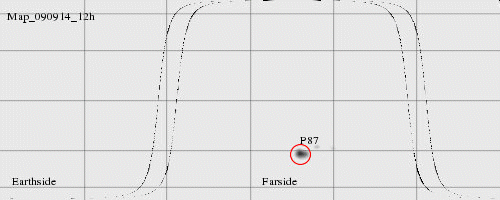
- Although the sun’s face has been devoid of sunspots for 18 days running (and 212 days this year) there is a major sunspot on the other side of the Sun, which may rotate into view sometime tonight. I boggle a little to think that we can image a sunspot on the far side of the Sun. How this is done is interesting, and has little or nothing to do with light. Flying cars or no, we are living in the future!
- From the Not Too Clear on the Concept Dept: I just nuked a spam message pitching “herbal testosterone.” Right.
Rant: The Case for Killing Newsweek
 I am aghast. Yesterday afternoon I was at Barnes & Noble, and at the checkout stand I saw what must be the most appalling magazine cover ever to appear on a mainstream US magazine. It wasn’t on Hustler or Soldier of Fortune. It was on the latest Newsweek.
I don’t dabble in politics much here, and I haven’t had much to say about the health care debate that others haven’t said many times, and probably better than I would. But I want to make my position clear: If health insurance reform collapses, it won’t be due to any vast, right-wing conspiracy, not with ol’ Newsweek leading the charge. Salon ran this piece back in August. Same gist. Similar stupid title.
There is a meme abroad, and while I don’t know if it has a name, I call it “Lammism.” The gist of the meme is that the elderly are an expensive extravagance, and money spent on them would be far better spent on younger people. This is not a new thing. I gave the meme its name in honor of former Democratic Colorado governor Richard Lamm, who famously said in 1984 that the ill elderly “have a duty to die…and let our kids build a reasonable life.” I guess it’s us or them, Dick, right?
It doesn’t matter that the Newsweek article is far more nuanced than its moronic title suggests. It doesn’t matter if “society needs to have this conversation with itself.” All that matters is that we are scaring the living crap out of our elderly, and if the elderly don’t sign on to health insurance reform, we don’t have a bill. Furthermore, if we dismiss their fears out of hand and pass a bill anyway, there could well be another party in control of Congress after the next election.
The elderly are not simply being paranoid. They know that Medicare is a very sweet deal, especially compared to the insurance situation of a great many younger people. They know that the government spends a huge amount of money on their care and sustenance. Given articles like those I mention above, they can be forgiven for fearing that when the government goes looking for health care cost savings and “waste,” that they will be first in line for close examination. They know that without fairly constant and often expensive medical intervention (paid for through Medicare) many of them would be disabled, dependent and suffering, and a great many more would simply be dead. Small wonder that they’re willing to believe the fearmongering lies of death panels that do not exist.
(The elderly might wave the magazine and reply: Yet.)
In Newsweek, we have a classic example of a print publication floundering to survive, and willing to risk it all on a misleading and alarmist cover line that bears little connection to the cover story. The plug on the cover of the latest issue isn’t connected to Granny. It’s connected to Newsweek.
Please join me while I pull it.
Google Feeds the Bookstore Bookburners
This morning’s Wired blog announced the reality of something I’ve been watching for and expecting for a long, long time: Bookstores have begun installing a significant and vapor-free mechanism (starring the long-but-no-longer vaporous Espresso Book Machine) to print books on demand. The books in question (for the time being) are out-of-copyright works scanned by Google into its Google Books system.
This is a fine thing, even though it probably spells the end of the road for book preservation efforts like my own re-creation of The New Reformation and The Pope and the Council the hard way: Scanning and OCR extraction of text followed by conventional layout. Google books are facsimile editions, complete with library stamps, marginal notations, flaws in hundred-and fifty-year-old paper, and the occasional squashed silverfish. I’d prefer new editions, but I’ll settle for facsimiles, and certain scholars would prefer to see a facsimile to make sure that nothing of the original author’s work has been left out or changed.
So no carping here, except to demand of Google: Keep going. You’ve got the means and the manpower, so expand the system to allow the ordering of any book–not simply the public domain ancients–for which a printable PDF image can be mounted on one of your servers. If this happens, there would be three big benefits:
- Bookstores would have a new reason for people to come in the door: To browse the bookburner kiosks for interesting stuff (old and new both) that just isn’t popular enough to stock on physical shelves. We need bookstores, and this is the best recent innovation to surface that may help us keep them alive.
- New (not ancient) titles without sufficient market to warrant physical book distribution (like my SF) would have a chance to get some bookstore presence, especially if hands-on bookburner systems create new sizzle for B&M bookstores.
- Publishers who won’t release electronic editions of low-volume books for fear of file sharing may be willing to trust a PDF to Google to sell in print form.
It’s still unclear whether anything covered by the Google Books settlement with the Authors’ Guild will become available through the system anytime soon, but in truth, if it doesn’t, I’m not sure authors of our-of-print works will see any financial benefit from the settlement. Ebooks remain a geek enthusiasm. The volume is still in paper copies, and systems like this remove the wasteful overprinting and returns privileges that make conventional book publishing such a financially risky proposition.
Much to love here, and no evil that I can see. Let’s watch, and hope for the best.
Review: Banting’s A Letter On Corpulence
“Do you like Banting?”
“I don’t know. I’ve never banted.”
Unlike the oft-quoted line about our man Rudyard, this isn’t really a joke. I have banted, I’m still banting, and I do like it. However, I didn’t know it had a name until a couple of months ago, when I read William Banting’s A Letter on Corpulence, Addressed to the Public, and began to research the booklet’s background.
Dr. Atkins, shove over. Mr. Banting was here first.
In London in the early 1860s, an overweight undertaker was talking to doctors about his obesity. He had watched himself put on weight over the previous thirty years until, at age 65, he weighed 202 pounds, and stood only five foot five inches. He was having trouble getting up and down stairs and doing simple things like tying his shoes. He was annoyed. He had tried everything local physicians suggested, including buying a boat to row on the Thames and walking briskly every day, and taking various medicines that we would today consider worthless nostrums. Nothing worked. Then he came upon Dr. William Harvey, who made a suggestion that seemed too simple to be useful: give up beer, sugar, and “farinaceous” (starchy) foods.
Banting did so, beginning in September, 1862. And fortunately for us, he was of a scientific turn of mind, and wrote down both what he ate daily, and what he weighed every three weeks, for the following year. And in that year he dropped 46 pounds, eating mostly meat and non-starchy vegetables, plus a piece of dry toast or rusk (zweiback) for tea. And he lost the weight even eating four meals a day and drinking an amount of alcohol that would leave me unconscious on the floor.
After losing about a pound a week for that year, he felt better than he had in two decades, could navigate stairs without hyperventilating, and do whatever he needed to do in terms of ordinary activities. He felt that his eyesight and hearing had improved. He was, in short, a happy guy. And having achieved his goal of losing significant weight, he did a remarkable thing: He wrote up his experience as a pamphlet addressed to the public (what today we’d call an “open letter”), printed it at his own expense, and then handed it out to anyone who was interested.
It was popular enough to warrant two sizeable addenda across several printings, but even with those included the whole thing is only 25 pages long, and available as a free facsimile scan from Google Books. You can read it in fifteen minutes, though people who are not used to Victorian diction may find the text a bit of a slog. The pamphlet became popular and was much discussed in the London area at that time, enough so that “to bant” became a new verb, and meant to adopt Banting’s diet as a means of losing weight.
The Google Books edition include two longish contemporary commentaries, one from Blackwood’s Magazine, the other from Harper’s Weekly. Both are snarky wanders intent on demeaning Banting’s experience, and neither confronts the truth face-on: Banting did an experiment, recorded his results, and made them public without any attempt to profit from them. (In fact, he gave 50 pounds to a local charity hospital in thanks.) Instead, Blackwood’s tries to convince its readers that Banting was not all that fat to begin with, and besides, fat people tend to be affable and law-abiding citizens, so it’s good to be fat! There’s not a lot to be taken away from the two reviews except the sense that things don’t change much; many of the same groundless arguments are thrown today at low-carb diets, simply because “everybody knows” that eating fat makes you fat and the best course is a “balanced diet,” which, as always, means “a diet that I favor.”
William Banting is important because his experience predates the modern carb wars by close to a century. He wasn’t trying to debunk Ancel Keys’ fraudulent research or establish a diet-book empire. He was just writing down something that had worked for him, and he cautiously suggested that, under advice from their own physicians, overweight people might try the same method. It may not work for everyone, but (in contradiction to the ridiculous critique in Blackwood’s) that does not mean it will not work for anyone.
Highly recommended, especially since you can read it over your eggs and bacon at tomorrow’s breakfast. (I read it on my X41.)