Jeff Duntemann's Contrapositive Diary Rotating Header Image

Some Good Juju and Some Bad Juju

Bad juju first: When I woke up this morning it was 0, and we had six inches of new snow on the ground. Carol had a physical scheduled for 10:00, so we were out the door extra early, slithering (even in 4WD) in a winter wonderland. We got there and back intact, but it was snowing again when we pulled into the driveway, and the Weather Channel radar indicates that it may be snowing for some time. Given that six inches is close to the limit my little snow blower can handle at one gulp, I decided to get rid of what was there to make way for what was clearly coming. Not too difficult, and I was mostly done when I slipped on a patch of black ice on the driveway and went down hard on my right arm. Here’s hoping an Aleve will minimize the swelling, but I’m expecting some exquisite bruises on that arm, albeit bruises no one will see except Carol given that long-sleeved shirts are the order of the season. Winter began here in early October, and may we be so bold as to demand that it be gone by February?

Probably not; that promising sunspot that popped up for a few days on the far side of the Sun is now gone, and our hundred-year solar minimum continues with no end in sight.

The good juju comes to us mostly from the Engadget blog. A very perceptive post from Niley Patel on Saturday exposes Michael Arrington’s wrath over the Crunchpad coup that supposedly killed the tablet stone dead a week ago. And today several people wrote to tell me that what had been the Crunchpad is now the Joo Joo Tablet, and Arrington’s erstwhile hardware partners Fusion Garage intend to go it on their own. More details over on Gizmodo.

Saturday’s post suggests that Arrington was careless about defining contractual relationships between his firm and Fusion Garage, which is peculiar, considering that Michael Arrington was a lawyer long before he was a blogger or a tech enterpreneur. He registered the trademark for “Crunchpad” only at the end of November, after calling it by that name for well over a year. And now, wowzers, Fusion Garage claims that he never had much to do with the technical development of the device to begin with.

Arrington is threatening wholesale litigation, and the whole thing is starting to smell like greasepaint to me. But think: What better way to launch an unlikely dark horse in the tech world than to foment a media circus? Everybody loves a fight. I see a possible business plan that puts the Underpants Gnomes to shame:

  • Phase 1: Talk for a year or two about a fantastical device and see if anybody notices.
  • Phase 2: If nobody notices by the time the device is ready to sell, pretend to have a riproaring legal fight over who has rights to what.
  • Phase 3: Harvest endless millions of dollars’ worth of free PR while taking pre-orders.
  • Phase 4: Have a group-hug videocast to settle conflicts that never really existed.
  • Phase 5: Profit!

The problems could be real, too, obviously. But there’s something funny going on somewhere, and whereas I won’t order one until I see that it can be configured as an ebook reader (and ideally let somebody else try it first) I still have high hopes. Let’s watch.

Update 12/8/2009: Engadget has a little more detail, and a hands-on video.

Odd Lots

  • We broke a new cold record for December 3 last night, when it went down to -3 here. (The previous record was +3, so that’s a significant margin.) Cheyenne Mountain is covered with snow, and it’s a wonderful wintry-Christmasy scene out my office windows, though I have to get out there and clear the walks when the temps eventually get up into double digits.
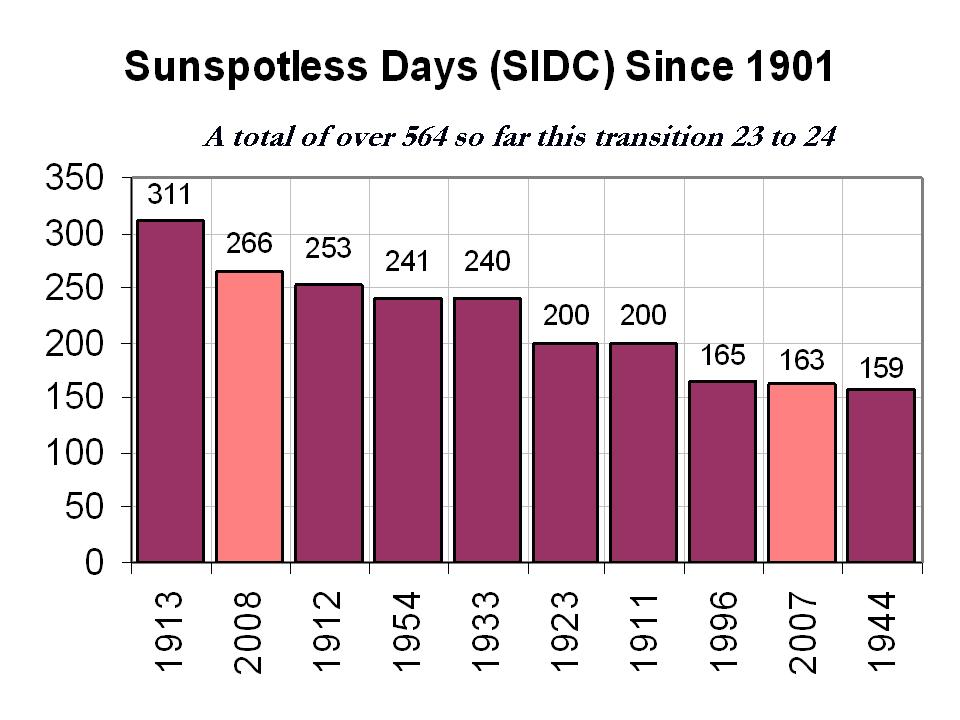
  • My prediction: We will not quite break 2008’s record for sunspotless days this year. Why so sure? Well, we’re already at 255 days (and just passed 1912’s count of 253) but a sunspot appears to be forming on the back of the Sun, and it will rotate around the far side and come into view in about a week. If it’s a big enough spot, it may be visible for the rest of December. So add 7 to our current 255 and you get 262, which is in cigar territory for 2008’s 266 sunspotless days, but not quite lit. Of course, if the spot lives and dies over the next week or so (which I’ve seen happen for smallish spots) we may still beat 2008. Either way, we’re in the thick of the deepest solar minimum in 150 years.
  • I just ordered a Dell Inspiron Mini 10 netbook, after spending some quality time with Julian Bucknall‘s slightly older and smaller Dell netbook at the Meetup-less Delphi Meetup last night. The keyboard is surprisingly usable, and I don’t expect to be writing any 180,000-word computer books on it. I was looking for compactness, not cheapness (there’s a larger toy budget this year, much thanks to Assembly Language Step By Step and other things) and so I loaded up with a GPS receiver, higher-res display, faster CPU, and (obviously) a bigger battery. All that, and it still runs XP. Windows 7 was an option, but why burden a pocket machine any more than it’s already burdened by just being a pocket machine?
  • Intel has unveiled a novel 48-core x86 processor, arranged as 24 dual-core CPUs communicating through a mesh network with up to 256GB/s bandwidth. Cores no longer need hardware cache coherence machinery, which cuts the complexity and power consumption of the (huge: 567 mm2!) part. I’m still wondering howinhell we’re gonna program these things.
  • Does anybody my age or older remember the TV series Men Into Space? It ran for one season in 1959-1960, and was created by Ziv TV, the firm that also did Science Fiction Theater, Sea Hunt, and Highway Patrol. Remarkably, I don’t remember it at all, even though Broderick Crawford’s iconic “10-4!” is crystal clear in my head. There was supposedly some Bonestell backdrop art in the show, and a solid attempt at factual accuracy, within the limits of weekly TV production of the time. Thanks to Roy Harvey for the link.
  • People who are familiar with my novel The Cunning Blood should take a look at these 3-D renderings of the Mandelbulb. This is almost precisely what I had in mind when imagining Magic Mikey’s views of chaos signatures using the Femtoscope. (Chapter 12, p.196ff.)
  • In a dance-around-it sort of way, Slate admits that there’s no compelling reason to use Office 2010…or 2007…or any version past the one that meets all your needs. Duhh.
  • From Neil Rest comes a pointer to a puppet show dramatizing the Bohr-Einstein debates over spooky-action-at-a-distance. Einstein is played by a stuffed bichon. (What else? You’d cast a Chihuahua?) BTW, this is for real; it’s not a parody but an actual physics lesson.
  • Borders is closing about 200 of its Waldenbooks mall stores in January. Here’s a PDF list of stores to be closed. I’ll admit that I haven’t bought anything at a Waldenbooks store for many years, simply because they don’t have the selection of the “big” Borders stores. (I also don’t go to shopping malls that often.) This may be good news, if it means that fewer of the big stores will have to go down too.

Review: Planet 51

Planet51.jpgThere’s concept, and there’s execution. You need both to make a truly terrific work of fiction, whether on film or in text. I had high expectations for Planet 51, and the concept did not disappoint me: A loopy twist on the classic alien monster movies of the 1950s…except that this time, we’re the aliens, landing on a planet full of…1950s aliens.
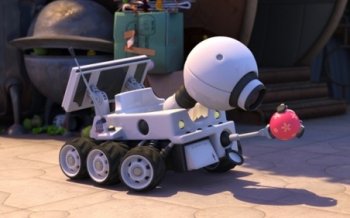
Or, let’s say, 1950s aliens living in an alien analog of 1950s small-town America. As with the 2005 animated film Robots, there’s an alien analog to just about everything Earthish: Malt shops, bowling alleys, poodle skirts, backyard barbecues, and hovering alien ’59 Caddies. There are 50’s alien monster movies, and 50s paranoia, here directed against…aliens. Somewhere off in the desert is a mythic alien Secret Base a la Men In Black, where dozens of captured robotic space probes from Earth are kept under glass domes. Into the thick of all this lands a souped-up Lunar Excursion Module containing an oafish, self-involved square-jawed astronaut, who is surprised that Planet 51 is inhabited, and is as terrified of its innocuous green noseless inhabitants as they are of him. His arrival triggers the awakening of a 6-wheeled robotic rover named Rover, which handily dismantles the dome under which he’s been stored, and then goes looking for his master, NASA Capt. Chuck Baker.

Is that a great concept or what? Alas, for all the great ideas and great artwork, somehow it doesn’t completely gel. Much could be done with an astronaut who realizes (as Chuck Baker eventually does) that he’s simply baggage strapped into a completely automated spacecraft, and that it’s not about him. Too bad that nothing is; Baker is drawn as an idiot, but somehow isn’t even true to that time-honored Hollywood template. Is he an astronaut, a lounge lizard, or a motivational speaker? (I got the impression that the scriptwriters couldn’t quite agree on who or what he was.) The alien characters are fun because they’re just barefoot green 50s suburbanites (the women all have built-in high heels) doing 50s things, and even listening to 50s music. It’s a stretch, but this is a cartoon movie, and for the most part the alien side of things works. Teen alien Lem debates with his comic-store geek friend Skiff about the existence of, well, aliens. (I.e., humans.) Skiff is sure that we’re out here; Lem can’t take any of it seriously, at least until he has to hide Capt. Baker in his bedroom. Lem pines over alien girl Neera, whose growing sensitivity to social issues prompts her to hang out with a group of protesters led by a long-haired, guitar toting alien hippie jerk named Glar. (Bzzzzzt! Hippies had not yet evolved in 1959, and the friction between the two cultures suggest something more like 1965 than 1959.) Once knowledge of Baker’s landing escapes the boundaries of sleepy alien town Glipforg, the alien army converges on the town, under cool, sunglassed Patton-archetyped General Grawl, and acts pretty much like the US Army acts in all those 50s alien monster movies.

rover1.jpgThe film is carried largely by the brilliant little robot Rover, who acts like a very bright dog with a power screwdriver, and gets most of the good sight gags and physical humor, including a surreal riff on “Singin’ in the Rain,” as it rains…rocks. (Rover’s job is to pick up rocks, like any good interplanetary probe. Alien rain is thus a species of nirvana for him.)

There are some good laughs here, though not as many as I wanted. The mandatory cultural references come thick and fast, some of them so subtle that if you blink you’ll miss them. The big negative is that Baker’s character is almost entirely wasted, even as a comedic figure. I also think some of the potty humor was over the line, or at least it would have been when I was a 12-year-old.

But hey, it was good (if not completely clean) fun. I have a special fondness for Rover, because he was pretty much how I imagined a character in one of my published stories: a clever and lonely Mars probe also named Rover. (See “Bathtub Mary” in my collection Souls in Silicon.) Burger King actually has a Planet 51 tie-in going on right now, and if I could force myself to eat at Burger King I could get a Rover toy for my bookshelf. (I’ve done worse for less, so we’ll see…)

Cautiously recommended.

Daywander

(Playing around with blogging styles here.) We got back from our Thanksgiving trip to Chicago yesterday afternoon, just before the deep freeze closed in again. Low tonight 10; high tomorrow 15; low tomorrow night 4. This is the coldest damned autumn we’ve had since we moved here, as well as the snowiest. Still, I’ll take this climate over Chicago’s three-month gloomfest any day.

I stuck my nose in the attic earlier this afternoon, scoping out what it might take to finish the job of shielding the leads from my garage smoke detector from my new-and-never-used wire dipole. What it will take is gloves and a winter coat, and wistful regret over not doing this in the fall. Wait a sec–this is the fall. And it’s not like I have any sunspots to coerce my signals into a path long enough to be useful.

My venerable 2005-era Kodak EasyShare V530 pocket camera is malfunctioning consistently and is probably scrap. I’ve said this before and it unexpectedly and inexplicably came back to life, but it’s been sitting dead in its little cradle for a month now, and I’m trying to decide what may take its place. I have the superb Canon G10 for technical photography, at which I’ve gotten tolerably good, but I still need an unfussy camera that will fit in a pocket, not need a case, and take a certain amount of rattling around with keys and small change (or big change) without damage.

In truth, what I’m really looking around for in a pocket camera is the champ at minimizing shutter lag. When I press the button I want the picture now–or as close to now as the technology permits. (I know DSLRs are good at this, but I want something small.) All of my previous digital cameras have required an ungodly amount of time to calculate what they’re going to do with the pixels that they’re about to capture, and this has meant a lot of missed shots of cute nieces and rowdy bichons playing dog soccer with Katie Beth’s beach ball. Sony seems to lead in most of the stack ranks on the shutter lag front, so I’m thinking about the Sony DSC-WX1.

Elsewhere in the Dying Hardware Department is my poor HP Laserjet 2100M printer, which I’ve had since, well, damn, I don’t remember, but probably 1998. I have pumped an immense amount of paper through that little cube, and replaced its worn-slick feed rolls in March of 2006, expecting them to work for another six or seven years. No luck. Paper feed has gotten erratic once more, and I’m not sure I want to go through the gnarly process of changing the feed rolls yet again. (That said, I have another repair kit on the shelf, so I probably will. I was the Lord High Feed Roll Executioner thirty-five years ago when I worked the LaSalle St. copier territory for Xerox, and such hard-won skills are a shame to waste.) So this might in fact be a good time to pop for my first color laser printer. I’m still shopping, but the HP CP1518 is the current front-runner. I know that the color laser cartridge market is a racket, but there have been times this year when I would really have liked color output for proofing book pages and covers. I guess if I do change out the rolls on the 2100 yet again I could park it downstairs for volume runs and keep the color unit up here. We’ll see, and soon–I need the tax deduction this year, courtesy my assembly language book.

Dash is sliding into puppy puberty: I caught him marking the baseboards in the front hall where QBit often sleeps. I rolled him on his back and tried my best to sound furious. He wagged his tail. A disciplinarian I’m not. I sense (nay, smell) interesting times ahead.

So Much for the Arrington Crunchpad

Damn. Like, well, damn. Michael Arrington just announced that, probably no more than a week or two before shipping boxed product, the Crunchpad is dead. I rarely post two entries on the same day, but I happened on this just a few minutes ago, and it’s important enough not to hold until tomorrow. The problem seems to have come out of nowhere and is shaped something like this: The CEO of Fusion Garage, the firm tasked with manufacturing the Crunchpad device, just popped up in Arrington’s inbox and basically said, We don’t need you anymore and will be making and selling the device ourselves. WTF? And WDHTHIA? Barlennan?

What happened probably happens a lot in certain tech partnerships between small and roughly equal entities: One who thought they held more of the cards wanted a bigger cut of the take than the original agreement gave them. And because both Arrington’s group and Fusion Garage have joint ownership of the various pieces of IP involved, neither can just move ahead and release the product on their own. (Why Fusion Garage doesn’t recognize this is obscure.) Unless this is an extremely clever way to simply kill the project without admitting technical failure (a possibility, but not something I’d expect out of Michael Arrington) the project may be dead on legal grounds.

Or maybe it really was the problematic 12″ capacitive touchscreen that has given these guys pure hell from the outset. Doesn’t matter. I had high hopes for the gadget, which (screw the Web!) would have been a spectacular ebook reader. I dislike the physically small, low-res e-ink readers we now have, because they don’t display technical art well, nor color at all. Comics people have the same gripes, albeit for a different kind of art. There’s no physical law saying that all ebook readers must be the same color-and-resolution-limited, coat-pocketable thing. Books are different.

Again, if the fail was really technical, and all this huggermugger a smokescreen, we won’t see anything out of the ashes. But I do hope that if we’re just seeing tantrums here, something can be worked out.

(Still, is it just me…or did Arrington fold perhaps a little too quickly?)

More here later if I can find it.

Odd Lots

  • Here’s a great graphic strongly suggesting that the much-denied Medieval Warm Period really existed, and was indeed a global phenomenon. (For further evidence, read The Little Ice Age, which predates the worst of the current Global Warming hatefest and thus may be considered reasonably reliable.)
  • I had not heard this before: The imminent Nook ebook reader from Barnes & Noble will have a Wi-Fi connection, allowing owners to browse free ebook previews that are only accessible through store hotspots. This gives people a reason to come into physical stores, Nooks in hand, spend time, drink coffee, browse the print collection, and leave with a bag full of print titles that aren’t available as ebooks. Assuming it’s true, as a marketing gimmick, it’s brilliant.
  • The Nook has a slot for a Micro-SD card with a capacity of up to 16 GB. Assuming a typical text-mostly ebook file to be 500K in size (which is very generous; most fiction titles I’ve seen are about half that, or less) a Nook is capable of storing about 30,000 books. If you read a complete book every single day, that will last you for…82 years.
  • I’ve already seen the Nook e-reader referred to as the “Nookie reader.” Which it will be, trust me.
  • People are quibbling in the comments that it’s not a self-propelled model train, but screw it: This guy made a Z-scale model of an N-scale model train layout, working effectively at a scale of 1:35,200. He gets serious points for, well, something, and the video is very cool.
  • And at the other end of the scale, here’s the world’s largest model train layout. (Thanks to Pete Albrecht for the link.) Makes me want to go back and work on The Million-Mile Main Street, positing a 1:1 scale model train layout that covers an entire planet, where the trains (each a sort of AI hive mind) run things, and the people are hired actors.
  • Researchers at Purdue have demonstrated ALICE, a new species of rocket fuel consisting of aluminum nanoparticles and…water. Larger aluminum particles have been used in rocket fuel before (they’re part of the formula in the Shuttle’s strap-on boosters) but the smaller the particles, the more efficiently they burn. As aluminum is common just about everywhere, if you can corner enough solar radiation to smelt the aluminum and dig up some water (guess where, Alice!) you can go places.
  • Pete Albrecht sent me a link to SeatGuru, which provides detailed floor plans for all major aircraft on all major airlines, including where the power ports and extra legroom are. If you fly a lot, it might be worth a close look. Here’s a good example of a specific aircraft.
  • This insane vampire business has evidently begun to affect the cosmetics business; the Daily Mail reports that pale foundation and powder are pushing their tanner competitors right off the market.
  • I stumbled upon the above item after stumbling upon this, which may be the most inexplicable Web site I’ve seen in the last several years. They pay people to put that together? And what kind of organism from what planet reads it?
  • Word must have gotten out that I’m a liturgical conservative. I therefore find this funny, in a slightly painful kind of way. (Thanks to Bruce Baker for the link.)

Think Before You Click!

I have a stray hour this morning, and I’d like to work in some notes on a few deceptive online mechanisms of various species that came to my attention all at pretty much the same time.

The first of these is Fanbox, which is a spinoff from a site called sms.ac a few years ago. I’m getting emails daily that claim to be from Facebook friends telling me that “Rodney Hornswoggle thinks you will really like this YouTube video. [Click here to] Check it out.” Even though I do know Rodney and he is on my friends list, a pitch like that smells to high heaven, and I’m not dumb enough to click on it. I researched it online and got a faceful. The emails were sent by something called Fanbox. Fanbox is a Facebook service that does various things, but, almost incredibly, it works by asking people for their email account and password, so that it can begin spamming everybody in the hapless users’ address books.

I boggle at the notion, but in fact this is not a new phenomenon. Fanbox’s corporate parent sms.ac has done this sort of thing for years, to the huge annoyance of a great many people. As with other things of this sort, the full story is complex. Google on “sms.ac scam” or “fanbox scam” and you’ll begin to get the idea. The takeaway here is obvious: Don’t give your email account password to Facebook apps. Or anybody else, for that matter. Geez.

Next is Video Professor, which is (again) not a new idea: Selling tutorial DVDs via “negative-response billing.” This is illegal in Canada but not the US, and hearkens back to the “book of the month” clubs or “record of the month” clubs in years past, in which you agree to accept (and pay for) an item every month until such time as you cancel the membership. At least with those ancient systems you had some reasonable idea of what it would cost you. Details of how much you end up paying Video Professor for a number of tutorial DVDs ($290!) are obscure, and present only in some very, very small print. TechCrunch’s Michael Arrington wrote about it in the Washington Post , after which Video Professor tried to intimidate both Arrington and the Post with legal threats. It didn’t work, and the effort spawned a great deal of negative publicity for Video Professor. However, they’re still out there, selling DVDs using what I consider an extremely deceptive pitch. Stay well back.

Finally, while we’re talking stuff-hidden-way-down-in-the-fine-print, there are “online loyalty programs.” (More here.) The scam works like this: An online retailer takes your credit card information during an order, but just before the order is completed, you’re invited to join a loyalty program to receive coupons or discounts or something. The program costs $9-$12 per month, but (as always) that’s way down there in the fine print, which authorizes the online retailer to give your credit card information to the loyalty program operator, who then bills your card and kicks backs funds to the online retailer that originated the lead. As with rebates, most of the coupons and other “rewards” are never redeemed, so it’s basically a free monthly slurp out of a great many credit card accounts. Online merchants who use such systems should be avoided. Here are a few mentioned in the article: Priceline (you’re old, Jim!), Orbitz (how d’ya think they could afford that hovercraft?), Buy.com, Fandango, 1-800-FLOWERS, Continental Airlines, and many others. (I printed out the full list included in the article as a guide to my personal boycott of anybody offering such programs.) And wow! Our old friend, Classmates.com, pocketed $70M through its partnerships with the loyalty progam operators.

Don’t be a victim. Think before you click. Read it all, especially on second or third-tier sites that you haven’t dealt with many times before. Check every line on your monthly credit card statements. Google for the name of the site and “scam” and see what others have said. Paranoia isn’t always a mental illness these days, especially online.

Thanksgiving Break

I’m by no means finished with my current thread on how necessary Windows is, but the Thanksgiving holiday weekend intervened, and Carol and I flew to Chicago earlier this week to spend time with family. I hadn’t seen our nieces Katie Beth and Julie since the beginning of August, and kids change quickly at this point in their lives. Julie is now making short but full sentences (at 18 months) and Katie, now 3, is chattering away as she discusses some pretty interesting issues. For example, last night at Gretchen’s house, Katie looked at me and asked her mother, “What is Uncle Jeff?” (A few of my early girlfriends probably wondered the same thing.) Gretchen tried to explain that Uncle Jeff is her brother, but Katie does not have a brother and may not quite grasp the concept yet.

No sweat on that one; she’ll get there. Carol and I visited with her mom on Wednesday, did some shopping, and helped her sister Kathy prepare the Thanksgiving feast. It was drippy from the moment we got off the plane on Tuesday, and the drips continued through the day Thursday, when the family finally gathered at three. The feast included all the traditional fare: Turkey, ham, stuffing, green beans, mashed potatoes, sweet potatoes, rolls, both ceasar and Hawaiian salad, three kinds of home-made pies (with ice cream, as an option) and probably a few things that I missed, most likely green vegetables. As has become the tradition, I acted as sommelier, and brought both dry and sweet wines for the table. The dry red was Cosentino Winery’s Cigarzin 2004, a superb, fruit-forward Zinfandel without much oak but with explosive fruit flavors. Not subtle–but then, neither am I. On the sweet side I chose Bartenura’s Malvasia, an unusual sweet blush with just a little fizz. We also had a German Riesling Auslese from St. Christopher, with a bottle of White Heron in the fridge in case we needed it. As feasts go it was outstanding; much credit going to Kathy, her husband Bob, and Bob’s mother Betty for somehow making all the food appear at an appropriate time at the appropriate temperature.

I stayed out of the stores yesterday for obvious reasons, even though I’m shopping for a new subnotebook or (gasp) netbook. Instead I spent time at Gretchen’s making an old family recipe handed down from our Irish grandmother Sade. It’s called gumgash, which is essentially hamburger mixed with chopped onions, mushrooms, diced tomatoes, and shell macaroni. I dumped a little Campus Oaks Old Vine Zinfandel 2006 into the mix, which isn’t historical but adds significant flavor if you can let the whole thing simmer for 20 minutes. After we all feasted on gumgash, the girls demanded to hear their Phineas and Ferb music CD. This is a spinoff from a cartoon show on the Disney channel, about two 10-year-old nerds who invent things and drive their 15-year-old sister to distraction. The show is the girls’ current favorite (having recently upended the Madagascar Penguins; could there be stirrings of Linux culture here?) and I danced with both of them to a few of the brief but well-written cuts (some of which were hilarious) on the album. There aren’t many effective ways to dance with an 18-month-old, so I sat taylor-style on the kitchen floor and held Julie’s hands while we both swayed back and forth to the pounding rhythms of “I’m Lindana and I Wanna Have Fun!” which, while only 51 seconds long, is insanely catching, and echoed endlessly around in the back of my skull until I finally dozed off at 11 last night.

So here I am, taking a breather on Saturday afternoon before getting busy again. We’ll be home in a couple of days, when I’ll continue the current series, and then segue into some observations about writing fiction. I like lumps in my Thanksgiving mashed potatoes, and I like lumps in my exposition. The important part is what the lumps are made of. If they’re tasty enough, nobody will care…but I’ll get back to that.

How Necessary Is Windows? Part 5: Crossover

There have been several attempts down the years to make Windows unnecessary. The most audacious is doubtless ReactOS, which cuts to the heart of things and wants to be a complete Windows XP-compatible OS. Needless to say, this is no small project and will take a long time to complete; right now, I’d call it somewhere between completely useless and intriguingly experimental. (It runs Skype, at least.) I’m also concerned that if they ever do get it anywhere near useful completion, Microsoft will stomp on it hard.

That’s certainly the high road. But how necessary is it to clone the whole damned OS? A Windows app, after all, is just a block of x86 machine code that makes calls into one or more APIs. If you can clone the APIs in an acceptably clean-room manner, you don’t need to duplicate the entire architecture, kernel and all.

And that brings us to one of the oldest and oddest ongoing projects in open-source computing: Wine, begun in 1993 by Bob Amstadt and Eric Youngdale. Wine provides a compatibility layer consisting of clean-room DLLs implementing the Win32 APIs, plus whatever magic is necessary to make the deeper host OS machinery look like Windows to the app. This is easier than implementing a whole OS, with the further advantage that if done properly, Wine can act as a Windows compatibility layer over several Unix-like OSes, rather than only Linux. Currently, Wine can operate over Linux, Mac OS X, FreeBSD Unix, and x86 Solaris.

After 16 years of dogged work, Wine actually works pretty well. Part of its success is due to a remarkable cooperation between the Wine project and a commercial software house in St. Paul named Codeweavers. Codeweavers sells a $40 deployment/management utility for Wine called Crossover, which basically makes Wine noob-friendly. (Naked Wine is pretty stark.) Codeweavers also tweaks Wine itself to improve app compatibility, and contributes those tweaks back to the Wine project under LGPL. Some financial support is also provided to the otherwise volunteer-based Wine project. Wine’s founder, Alexandre Julliard, is an employee of Codeweavers, where he works full-time on Wine development.

Codeweavers focuses mostly on big-market apps like Microsoft Office, and doesn’t officially support apps beyond a relatively short list of “gold” software. However, I’ve found that a great many Windows apps install and run just fine under Crossover whether they’re on the list or not. InDesign 2.0 is listed on the site as “known not to work” but apart from a minor display glitch, it seems to work as always. (I haven’t tested it deeply so far.) Most Microsoft apps work beautifully (especially older ones) and I’ve been using Office 2000 and Visio 2000 under it without incident since last fall.

Wine implements a sort of runtime environment emulation for Windows called a “bottle.” More than one bottle may be created on a single host OS, and each bottle has its own emulated C: drive and Registry. By giving each Windows app its own bottle under Wine, apps are prevented from interfering with one another in the dreaded “DLL Hell” effect. Because it’s not a VM, the performance hit for running Wine/Crossover is very small, and most important, you do not need to have a legal copy of Windows running in the VM. On the other hand, a bottle looks enough like Windows to be infectable by Windows malware, though one bottle probably can’t infect other bottles on a Linux system, or the underlying system itself. (From what I’ve heard, the low-level system tricks played by many malware packages keep them from running or at least running completely.) There are known conflicts between WGA and Wine, so don’t install WGA if you can avoid it.

Bottom line: If Wine supports all the Windows apps you absolutely must use, you do not need Windows at all. I haven’t tested all the Windows packages that I use here (next up is MapPoint 2004) but for Office and Visio 2000 it’s been nothing short of magical, and I’m guessing InDesign will come along eventually. In a mature software market, time works in our favor: One by one, existing apps will be installable under Wine, and each time that happens, Windows slips a little bit deeper beneath the waters of irrelevance.

Next up: For the hard cases, there’s always virtualization.

Harry L. Helms 1952-2009

I got word the other day that Harry L. Helms W5HLH had died this past Sunday. Harry was a friend for over 20 years, and we met regularly at trade shows including the Borland conferences and ABA/BEA, just to touch base and trade ideas. He and I had a lot in common: We were both longtime hams, we both liked classic radio gear, shortwave listening, and publishing. (We were also within a few weeks of the same age.) He was the co-founder of HighText Publishing in Solana Beach, California, and the author of a lot of books worth reading, including Shortwave Listening Guidebook (1993), How to Tune the Secret Shortwave Spectrum (1981), Top Secret Tourism (2007) and Inside the Shadow Government (2003), which may be the scariest book I’ve ever read. He published Andrew Yoder’s Pirate Radio (1996) which is best-of-breed on the history of that insane little cross-current in the mostly placid waters of the radio broadcasting industry.

His passing was nothing out of the blue: He had blogged about his struggle with cancer for several years, and displayed a species of courage in the face of imminent death that I hope I can summon when my own time comes. His last months were spent in his home town in South Carolina, with his wife and family, and his dogs and cats all around him, and if we all have to make that final leap into the unknown, I’d be hard-pressed to think of a better way to do it.

Harry had a healthy scientific mind, and while not religious, he told me he was open to the possibility that death is not the end of all things. He enjoyed uncovering the hidden and the secretive and the overlooked (see Top Secret Tourism for a travel guide to all the places the government would just as soon nobody knew about) and I have an intuition that he was looking forward to seeing “what was out there.” In one of our last exchanges some months ago, I made an outrageous suggestion, about which I won’t say more unless something remarkable happens.

We’ve got his books, and for the time being, that’s remarkable enough for me. W5HLH DE K7JPD / TNKS GUD LK ES 73 SK.