Jeff Duntemann's Contrapositive Diary Rotating Header Image

Daywander

Not having much luck making Workstation 6 function, and two conversations and numerous emails with VMWare’s tech support people hasn’t helped. I install the product, I enter the serial number as requested, and get this error message. Has anybody else ever seen this? Or can anybody even explain it? I emailed the screenshot to VMWare, and that’s about the time they clammed up.

I hate to abandon Workstation entirely. VMWare’s snapshot system is far superior to that of VirtualBox, and I use it a lot. I’ll miss it. Boy.

And while I’m asking peculiar things, let me ask the multitudes here how you pronounce “iodine.” I have always said eye-oh-dyne, but Bob Thompson, who knows more than a little about chemistry (and certainly more than I) pronounces it eye-oh-deen. This lines up with the rest of the halogens; we don’t, after all, say “broh-myne.” So? Which is it?

I edited another half a chapter of FreePascal From Square One yesterday morning, and in laying out the edited material got up to page 136. The book I’m adapting it from is 800 pages long, but don’t look for anything that size. To be workable on Lulu, the book is going to have to stop at or before page 400. A lot of the material in Borland Pascal 7 From Square One just doesn’t apply anymore…who’s called the Borland Graphics Interface lately, or done text output by poking word values into the video display buffer? The BGI chapter was 100 pages all by itself, and when I slice out that and other things like overlays and DOS/BIOS calls, I’m really pulling 400 pages out of no more than 600 pages of useful material, maybe less. Should be done by June. I hope.

The issue of whether Amazon imposes DRM on Kindle publishers is complicated, and I’ll back away some from my statement to that effect on Monday, and will hold off until I try to get one of my own titles into the system. This article suggests that recent policy changes have made DRM optional. Having to face the DRM issue square-on has kept me putting off publishing on the Kindle for some time. As a very small publisher I’ve made this promise to my readers: No DRM of any kind, on anything, ever. I’m willing to forgo Kindle sales if the DRM decision is not my own, but from what I’m reading now, I think that won’t be the case.

As for Amazon caving, well, that’s more complex too. I see that Nancy Kress’s new book Steal Across the Sky is listed on the Amazon Web store, and her publisher, Tor, is one of Macmillan’s imprints. However, you can’t order it from Amazon at this time. (Third-party affiliates are offering it, but Amazon itself is not. Note the double dashes under “Amazon Price.”) Ditto Nancy’s Beggars and Choosers, another Tor book. Yesterday morning’s Wall Street Journal had a story explicitly stating that Amazon had conceded the price issue to Macmillan. But Amazon isn’t selling the books yet, so clearly the struggle goes on.

Off to church, to install an SX270 in place of a doddering old E-Machines box that is four times the size and probably a third the capability.

Ebooks: Wholesale/Retail vs. Commission

I’m guessing that by now, most of you have heard of Amazon’s little dustup with Macmillan, one of the world’s largest book publishers. As long as Kindle was the only significant online retailer for ebooks, Macmillan accepted Amazon’s sales terms, which set a ceiling of $9.99 on most ebook prices, at Amazon’s option. But the instant Apple popped up as a second significant ebook retailer, Macmillan cut a better deal with Apple, and demanded that Amazon match Apple’s terms, which include a higher price ceiling. Amazon responded by refusing to sell Macmillan’s titles.

Amazon caved yesterday, and agreed to reinstate Macmillan’s books at Macmillan’s higher prices. People posting in the comments sections of some news sites seem puzzled that a more competitive market would raise prices for consumers, but that’s just the way truly free markets work. Until Apple showed up with their iPad, Amazon had a monopsony relationship with ebook publishers, rather like WalMart has (still) a monopsony relationship with a multitude of small-to-middling goods manufacturers and wholesalers. In a competitive retail market, neither monopoly (one seller, many buyers) nor monopsony (one buyer, many sellers) dominate. There are lots of buyers and lots of sellers, and we quickly find out what the “real” price of a product is, as manufacturers and retailers jockey for the greatest market share among consumers.

That’s not, however, what I find interesting about the recent conflict. Look closer, and you’ll see two fundamentally different approaches to selling a product to consumers: Amazon is selling on the conventional wholesale/retail model, and Apple is selling on an agency model. Amazon wants to buy ebooks from publishers at a wholesale price and make money on the margin between that wholesale price and a retail price that it controls. This allows it to create occasional “loss leaders” to generate traffic, as conventional goods retailers have done as long as anyone remembers. Apple, by contrast, wants to sell ebooks at prices set by their publishers, and take a percentage of every sale.

Publishers like the agency model since it gives them more control over pricing, and does not train the public to expect all ebook prices to be $10 or less. How much better the agency model is for publishers and authors is unclear, and depends in part on how fungible you think books are, which is a very weird business that I’m still thinking about. It may also depend on how many players can participate on the publisher side. A B&M bookstore can only contain and manage so many physical books, and publishers play lots of dicey scarcity games to get more shelf space than their competitors. (“Stock our whole frontlist and we’ll give you an extra 2 points’ margin…”) An online ebook store’s capacity is essentially unlimited, and any number of publishers can play. If there are a million publishers and 999,900 of them sell products at lower prices than you do, your control of pricing is less than it was in the era when it was tough to get your books into stores and a relatively few large publishers dominated the market.

Nor does it end there. If you look even closer, Apple’s model starts to look familiar in another sense: It starts to look like a publisher paying authors a royalty. The royalty rate is insanely high by historical standards (70% or thereabouts) but there are no atoms to push and protect. Without atoms getting in the way, being a publisher becomes an entirely different challenge, and the difference between conventional publishing and self-publishing implodes to the process of contracting for services you need with people who have the skills you don’t have. As experience in that process becomes more common, being Macmillan gradually becomes less and less important. I wonder whether Macmillan understands that.

Most of all we need to remember: The ebook business is still in its infancy. Everything remains in play. The readers can only get better. People are doing weird things that seem to work, like giving away your older ebooks to develop a market for your newer ebooks. Lots more ideas will be tried, new technologies will appear, and older technologies will change and improve. Maybe Amazon’s crazy action against Macmillan had to happen, just to show everybody that such things won’t work. (Sure, it was obvious…in hindsight.)

Me, I’m with Apple…for now. Why? Because Apple’s business model smells more like a free market than Amazon’s–and more like a game I can compete in. That could change, and much of that decision will hinge on the nature of Apple’s ebook DRM. (We don’t know all the details yet.) Kindle’s DRM is mandatory–whether I as a publisher want it or not. In a sense, its purpose is not to protect the publishers or the authors from piracy so much as to protect Amazon from a freer market, in which consumers can move their books from device to device at will. Apple could adopt that same strategy, leaving us with two paranoid and incompatible ebook retailers and readers. Hey, that’s nothing that another five or six major ebook retailers couldn’t fix, and they’ll happen. Give ’em time.

VMWare Player and the Thoughtpolice Images

Quick non-rant update to yesterday’s rant: It’s Sunday night and I didn’t expect to hear from VMWare support today, so I did a little thinking and came up with a crazy idea: What if somebody else has already created VMWare images of popular Linux distros and just put them out there?

Heh. Somebody did. And even though I can’t install Linux (or anything else) in a brand-new VM, I googled around and found a page offering a whole bunch of Linux-in-a-VM images, all freely downloadable. They’re big (most of them over a gigabyte) but there are torrents for them and they came down fast. I downloaded Fedora Core 12 and OpenSuSE 11.2. What I didn’t mention yesterday is that when you install VMWare Workstation, you also install the standalone VMWare Player, which is a stripped-down run-only version of Workstation. The version of Player that installed with Workstation was not bound by the Workstation license, and worked.

The Fedora Core 12 image loaded and ran flawlessly. The OpenSuSE image did not load at all. I don’t think it was a damaged zip file; the message put up by Player indicated that “opensuse is not supported.” Smelled like an “old software” problem to me. My copy of Workstation dates back to 2007 and installs Player V2, so I downloaded the most recent version of Player (3.0) and installed it. This time the OpenSuse image loaded right up, albeit in KDE 4. (That’s OK; I need to spend some time exploring KDE 4.) Lesson: In the VM world, the latest is probably the greatest…or at least worth having.

I installed Lazarus in the Fedora image, and if you’re logged in as root, it really is as simple as:

yum install lazarus

(Use su -c 'yum install lazarus' if you’re not in root.) Took about 25 minutes. I haven’t run a lot of tests on the new install, but the source is there and everything looks functional.

Several people wrote to recommend the alien utility for converting rpm packages to debs. I’m going to try that, and (assuming the generated deb works) I’ll just host the deb on my upcoming FreePascal page so people can download it. (Why don’t I think it will be quite as easy as that?)

Another crazy idea: Once I get my Workstation 6 running, create a VM of Ubuntu with Lazarus installed, however it is to be done. At that point, who needs to install anything? I’ll just tell people to download the VM and run it in Player. I can set up the VM to save state with Lazarus running and the book itself open in Okular, with all the example programs in appropriate directories, ready to load and poke at.

I’m still annoyed at VMWare, but at least they’re not holding up my research any longer.

Rant: That Old Linux Package Format Blues

I described my FreePascal from Square One book project in detail a couple of weeks ago, and I work on it as time allows. There have been some hangups; in fact, I sometimes wonder if I’m not Cing evil spirits at work hereabouts, frustrating my efforts to popularize Pascal.

A lot of this has to do with Linux software package formats. I’m trying to write a chapter in a beginners’ book describing how to install the FreePascal/Lazarus compiler/IDE combo. For Windows it’s easy: Download the executable installer, run it, and answer the wizard’s questions. I ran into a stone will with Ubuntu: There is a deb package for Lazarus (which includes the FreePascal compiler binaries) but it’s ancient, and much worse, it does not install the compiler source code, which Lazarus needs. Now, why an IDE needs the source code for its compiler is obscure, but that’s how they wrote it, and when you run Lazarus in the absence of FreePascal’s source code, it complains, and warns that some (unspecified) subset of its features may not work.

The rpm package, on the other hand, is current and complete. In the installation chapter I’d like to describe installation in detail for Windows and the three most popular Linux distros: Ubuntu, Fedora Core, and OpenSuSE. Fedora and OpenSuSE use RPMs. No problem there. Installing Lazarus under Fedora may in fact be as simple as opening a console and typing “yum install lazarus.” (I haven’t tried that yet; more on why a little later.) YaST has OpenSuSE covered. But with the Linux market leader, I’m hosed.

Yes, I know, there are solutions: Get the tarballs from the Web site, build the whole damned thing from source, convert from rpm to deb with Alien, etc. etc. etc. I can do that stuff. But this isn’t about or for me. It’s for people who are just starting in on programming and may be just trying out Linux. I don’t want to explain how to frakking rebuild the whole damned 200 MB monstrosity from source code. (Wasn’t CP/M Turbo Pascal happy to take up 24 KB? Does anybody even remember that old letter “K”?) All that is beside the point. The real question is this: Why can’t the FreePascal/Lazarus guys keep a workable deb package together? I know enough about Debian package management to be sure that it’s possible. (I don’t knows enough, alas, to do it myself.) It isn’t being done. And nobody seems to want to talk about why.

Not having a complete install for Ubuntu made me uneasy about running tests in Lazarus under Ubuntu, so I realized I would have to get instances of Fedora Core and OpenSuSE together. How hard could that be? Well…

  • I created a new VM in Workstation 5 for Fedora Core 12. The install failed partway through, with the VM locked up. “He dies and gives no sign.”
  • Ditto a VM for OpenSuSE. Ditto. The YaST installer could not detect the virtual hard drive created for the VM, so we didn’t even get as far as installation.
  • I reformatted an old Kubuntu partition on a machine downstairs and attempted to install Fedora on it. Different fail, but fail nonetheless. The DVD vetted itself with a clear bill of health, but I may download it again anyway.

I managed to get OpenSuSE to install on that same partition, so I finally have a complete and trustworthy Linux installation of Lazarus. And I will say that I really like OpenSuSE. (This is the first time I’ve ever laid hands on it.) The OpenSuSE Build Service is a thing of beauty.

The double VM fail is a puzzler. And that led to me wonder if newer distros just don’t play well with 2004-era Workstation 5. So I finally took my still-sealed retail copy of Workstation 6 off the shelf, installed it, registered it…and VMware doesn’t seem to know how to license it. I’m sure they don’t do much business in boxed product, but that’s no excuse. Email tech support with their Indian support people has a 24-hour turnaround, and the last time I got a response, the guy sent me the serial number for my copy of Workstation 5 and told me to use that, as it was already licensed. Gakkh. So they have my $180, and I have a copy of Workstation 6 that won’t run. We’re three days into this adventure, and I’m sure nothing will get resolved until Monday. If then.

You wonder why I hate activation systems so violently.

And people wonder why tech books take so long to write.

Screw it. It’s the weekend. I’m going to find the nearest bag of potato chips and eat the whole damned thing.

Odd Lots

  • The iPad’s ebook store is evidently US-only, less likely because of copyright laws themselves (as many are claiming) than because a lot of books are licensed to publishers by country, and if an author did not contract a book for distribution in Asia (for example) it can’t legally be sold in Asia. Some authors think this will allow them to contract separately by country or language and make more money…when in fact it only means that people outside the US will have yet another reason to steal the damned book. The only way to reduce content piracy is this: Sell it cheap, sell it easy, sell it everywhere. Anything else is wishful thinking.
  • Here’s a great short piece by nanotech guru Eric Drexler on why tokamaks won’t ever be widely used in commercial power generation. My favorite line in the whole thing: “…[the Sun] puts out less power per unit mass than a good compost pile.” Fortunately for us, the Sun is a little bigger than a compost pile. (Thanks to Frank Glover for the link.)
  • When I finally worked up the courage to go to the Meetup Web page for the Paranormal Erotic Romance Book Club of Colorado Springs, I discovered that one of the topics they list for the group is “New in Town.” I belonged to the New In Town Meetup for awhile in 2003, and I’m guessing that that’s why I got the email mentioned in yesterday’s entry. Lesson: Never ascribe to vampires what can be explained by simple spamming.
  • And while we’re talking weird emails, I got one the other day thanking me for using Minitab statistical software…which I had never heard of until I opened the message.
  • If you ever had the urge to click on a cloud formation, this is the kite for you. (Thanks to Michael Covington for the link.)

“A Meetup Group That Matches Your Interests…”

Today is Delphi Meetup day, and, peculiarly, I got an email from Meetup.com a few minutes ago. It was peculiar because although we still call it Delphi Meetup, we dropped Meetup.com like a hot rock years back after it started charging $100+ per year to coordinate a monthly meeting. (Like that takes anything even close to $100 worth of cycles or storage or bandwidth.) Meetup.com keeps trying gamely to get me to come back by promising me interesting groups to join…just as soon as somebody ponies up that hundred bucks. Wi-Fi and New In Town were the ones I used to belong to circa 2003, when I was working on my Wi-Fi book and we were still new in town. I guess they gave up, as I haven’t heard from them in most of a year.

Until today, when I got an email with the breathlessly overcapitalized subject line: “A New Meetup Group That Matches Your Interests Has Started!” Hmm. Wi-Fi? Ebooks? Ham radio? Kites? Contrarianism?

No. Only inside the message do they reveal the group’s name: “Paranormal Erotic Romance Book Club of Colorado Springs.”

Wow. I never even knew that there were paranormal erotic romance books. Lesbian pirate novels, sure–a woman who used to work for me brokered foreign rights in that genre for awhile. So I guess anything’s possible…but I have to wonder how they fingered me as a potential member. Was it a mistake, or simple desperation?

In truth, I’m quite sure I don’t want to know.

Daywander

(“Daywander” is a new category I’m trying out. The idea is something less crisp than Odd Lots but still a collection of different things I thought about or did during the day. It may not work out, and if it doesn’t I won’t miss it overmuch.)

So. We have an iPad. It’s not like it was a surprise, and in broad strokes it was pretty much what everybody thought it would be. I’m very glad that Apple anointed the ePub format for ebooks…the last thing anybody needs is a new proprietary text container. Now we need to know if the Jobs Gang can face down Big Books over prices and DRM. News items I’ve seen recently indicate that books from the iPad store will be allowed to cost more than books on the Kindle, and I’m good with that. I routinely pass on supposed “bestsellers” because they don’t smell like they’re worth $25 to me. The market can decide…and the publishers need to learn that lesson. The bigger question is how much access small publishers will have to the Apple store. One of my goals for 2010 is to get some of my titles onto the Kindle to see how they do. Anybody can be on the Kindle, and the price of goods can be $0.00. I haven’t seen an indication…yet…whether free books will be available in the Apple store, or whether other stores will be accessible, or how difficult it will be for one-person publishers to get in on the action.

And for that matter, is there an SD card socket, so I can drop in the ebooks I already have?

As an ebook reader it looks socko; finally, color and enough resolution to display technical books with figures and detailed art. How well you’ll be able to read the screen outside is another big question that ebook freaks will obsess about. Not me…when I’m outside I’m enjoying the outside for being the outside.(Books to me are an inside thing.) The iPad display isn’t e-ink…but it could be. Why not two displays? Frontside for inside, backside for outside. Apple could do that blindfolded. The thing already costs $500 minimum. Another $75 for a second display wouldn’t kill it.

Hardware, mon dieu. I tried and failed to tweak the Intel driver for the SX280 this afternoon, as suggested by my sister’s friend Chris Meredith on my LiveJournal mirror, and described in this eye-crossing article. Bits don’t scare me, and I follow directions well, but the machine failed to present the tweaked 1600X900 resolution as an option. Hardware can be stubborn sometimes.

Getting away from hardware for the nonce, it’s been revealed that the late Pope John Paul II beat himself with a belt and slept naked on the floor to move himself toward spiritual perfection. The Jesuits were big on this, and did this well into the 1950s: Each Jebbie had a little whip called “the discipline,” and was to use it on himself every night, presumably for the same reason. (Garry Wills wrote about this in his excellent book, Why I Am a Catholic.) What has never been clear to me is why hurting yourself has anything to do with spiritual perfection. (This is especially puzzling given JPII’s ecstatic writings about the holiness of the human body…so holy that we apparently must beat it up, mortify it, make it bleed. I guess.) Sorry. Don’t buy it. What “mortification of the flesh” really is is a powerful temptation to pride: People who hurt themselves and deny themselves can never quite hide the smugness that seems to come with the territory. My take? Real saints help others. Hurting yourself does not help others. Get real.

And in other news from the God side of things, this past Sunday’s Old Testament reading contained orders from the Hebrew Scribe Ezra, in the Book of Nehemiah, Chapter 8: “Eat fat, and drink sweet wine…” Hey, Ez! Got it covered!

The SX280 Comes Out of Depreciation

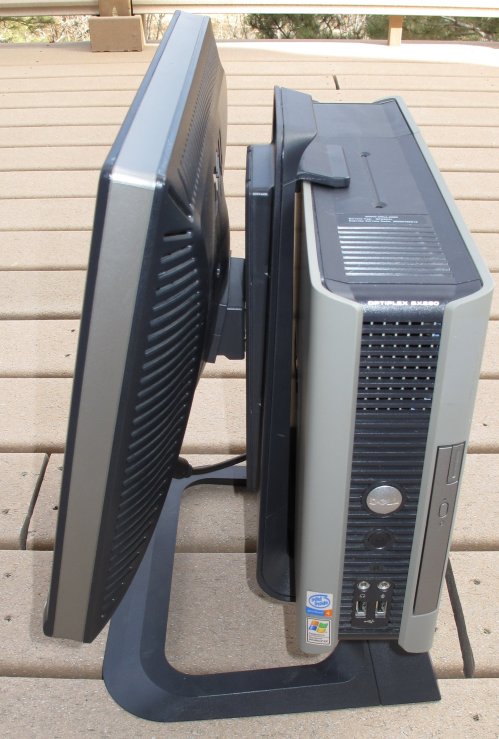
SX280onHC317Deck500Wide.jpg

I’ve changed my mind again; take note, and remember that it’s good practice. I recommended the Dell SX270 here over the SX280 last fall. Having had some time to spend with a couple of SX280s, I’m thinking that the SX270’s day may be past.

I’ve been configuring and using Dell’s SX270 Ultra Small Form Factor (USFF) machines for several years now, and mostly I love them. They’re rugged, tiny, quiet, reliable, and come with a BIOS-locked version of XP Professional that does not need activation. (The disc can’t be installed on anything but a Dell SX270, and because every last SX270 out the door had a paid-for Windows instance on it, Microsoft figures they won’t lose anything by giving over WPA, and they’re right.) The SX270s were made and sold between 2003 and 2005, and given that they were almost entirely corporate fleet machines, five years later they’ve mostly been written off by their corporate owners and dumped on the resale market. That’s why they’re so cheap; a quick check of completed auctions on eBay right now shows dozens of units selling for between $60 and $100, and a few full systems (including flat panel monitor, keyboard, mouse, and the combo system unit/monitor stand) for between $100 and $150.

There are a nonetheless few downsides to the SX270:

  • They’re limited to 2 GB RAM. This can be an issue, depending on what you’re doing with them.
  • They use 2.5″ laptop IDE hard drives, which are more expensive (and less capacious) than the conventional 3.5″ drives most larger PCs contain.
  • Their integrated graphics systems are not meant for animated video games, and the slower machines (slower than 3 GHz) do not render video very well.

In 2005, Dell replaced the SX270 with the SX280 USFF, which is about 15% larger but still mighty small. The SX280 is a better machine in a number of ways:

  • It can take up to 4 GB RAM, though you have to be careful what you put in it. (More on this in a moment.)
  • It uses ordinary 3.5″ SATA drives, which means you can pack 1.5 TB into the little box for about $120.
  • The integrated graphics chipset is faster and more versatile–if still not quite versatile enough.
  • It opens up and field-strips a lot more easily than the SX270.

Until very recently, SX280s were fairly scarce and went for $250-$350 used. But a few months ago I noticed that SX280 prices were imploding, and they’re now as cheap (and in many cases cheaper) than the SX270, sometimes as cheap as $50. In fact, a week or so ago, a full 2.8 GHz system like the one shown above (which I will be installing in our parish office shortly) sold for $103, including the Dell HC317 17″ monitor on stand, mouse, and keyboard.

The SX280 is a little fussy about the sort of DDR2 DIMMs you put in it. Crucial has a nice lookup service for Dell (and many other) computers, and I ordered 2 2GB DIMMs from them. Go here and look for the Crucial Memory Advisor. If you buy the ones specified for your model, they’re guaranteed to work, and mine did.

Seeing SX280s cheaper than 270s is a little odd. It may be that the supply of workable SX270s is drying up; after all, they went out of production five years ago. Doesn’t matter; the SX280 is a better machine, and if you mount it on an HC317 stand behind the 17″ monitor, it’s no larger than the similar 17″ piggyback system incorporating an SX270. The HC317 stand is VESA compatible, so if you have a larger VESA monitor it’ll bolt right on.

The big downside, as I’ve alluded to before, is that neither the SX270 nor SX280 will display a native 16 X 9 raster under Windows. I’ve tried to coerce the Intel chipset to do 16 X 9 to no avail–which is infuriating, since Ubuntu detects my widescreen monitor and somehow drives the Intel GMA 900 controller at 1600 X 900 automatically, with no input from me.

Anyway. If you’re looking for a small and quiet officework machine for cheap, the SX280 just got cheap. Highly recommended.

Odd Lots

  • Here’s a nice detailed article about how Linux treats hard disks and how Linux partitioning works.
  • We now have two major sunspots on the visible face of the Sun. I don’t remember the last time I saw that. (Most of the specks we’ve been giving sunspot numbers to in the last couple of years don’t count, in my book.)
  • The New York Times has finally shone their light on an ebook marketing technique that Baen Books pioneered years ago. (Thanks to Pete Albrecht for the link.)
  • Version 4.0 of the FastStone Image Viewer is out, and well-worth having. It’s the best image browser I’ve ever used, and if you have to sort an SD card full of digital photos and cull marginal shots quickly, there’s nothing like it. Make sure you get the portable version; it lacks nothing and doesn’t make any changes to your system. Freeware. Highly recommended.
  • Rich Rostrom sent a pointer to a fascinating article on Moscow’s stray dogs. They’re going feral, but it’s a peculiar sort of urban feral that considers humans and all their gadgetry to be just another part of the landscape. They’ve learned how to ride the subway, for pete’s sake!
  • I’d read in a number of places that faces judged as beautiful are generally “average” faces, without a lot of distinguishing characteristics. Because I could never quite get a grip on what an “average” face would be, I always took the notion with a grain of salt. But this site, assuming it really is creating a “facial average” from a gallery of headshots, suggests that there’s something to it. Start with two faces, then add faces one by one, and see if the average face doesn’t become more beautiful (and distinctly ambisexual) as you go. It did for me.
  • Here’s a short interview with Bob Silverberg, describing his writing life during the Golden Age of Pulps. A million words a year…
  • Cracking ice in the surface of a frozen lake sounds like a blaster battle.
  • From the That-Certainly-Has-To-Count-For-Something Department: Behold the world’s largest disco ball.

Kompozer Explained, in Recto-Verso

While checking to see if Kaz (Fabien Cazenave) has released Kompozer v0.8 (not yet!) I ran across a very nice free user guide to Kompozer written by Charles Cooke and released under Creative Commons. I’ve been using Kompozer for a couple of years now for all my new Web content, and although definitely unfinished, what’s there works very well. I figured it out by beating my head against it, but Cooke’s manual will obviate a lot of the beating if you’re coming to it for the first time. (The document is available in both English and German.)

And in downloading the PDF, I ran across a term I hadn’t seen in quite awhile: recto-verso. Most people use the term “mirror margins” these days, and that’s pretty much what it means: You lay out a book so that the wide margin is alternatively left and right on the printed sheet. Page 1 has the wide margin on the left, page 2 has the wide margin on the right, page 3 on the left, and so on. What this allows you to do is print the book on both sides of the sheet, so that the wide margins all end up on the left and form the “gutter” through which you punch the book for binding.

If you lay the book out in 2-page spreads, how this works is obvious, and most desktop-publishing templates for duplexed material take it into account. If you’re laying it out as single pages in something like MS Word, you have to specify “Mirror Margins” in the File | Page Setup menu and give yourself some space in the Gutter field. Cooke’s book is also available with wide margins on the left of every page, for printing on one side of the sheet only. The two versions are separate PDFs available from the same Web page; make sure you download the correct one.

One interesting thing about Cooke’s guides is that the PDFs are in color, with color highlighting, pale blue tips boxes, full-color screen shots, and colored arrows on screen shots to point out UI features. I guess it makes sense; almost everyone I know has a color laser by now, and I bought my first only about a month ago. I duplexed the recto-verso PDF, and made myself a duo-tang manual. I have quibbles with the layout, in that he packs way too much material on each page…but then again, with the cost of color laser and inkjet ink, printing only 61 pages is a lot cheaper than printing 150.

This was the first significant duplexed color job I’ve run on my new HP Color LaserJet CP1518ni. My one gripe is that there’s no fold-down single-sheet/duplexing tray in the front of the printer, as there is on the LJ2100 line. You can feed single sheets through a slot in the front of the printer, but for duplexing a stack, you have to pull the main paper tray and place the stack in the tray after you run the first side.

I guess that’s a nuisance, but the quality of the printing is very good, and in as dense a layout as Cooke hands us, the use of color does help a little.

Recommended.