- Maxwell’s Demon as Web comic. (Thanks to GMcDavid for the pointer.)
- Here’s a tutorial on adding a MicroSDHC card to the Nook ebook reader. Looks like a mechanically touchy business (be careful!) and nothing substantive is said about sideloading content on the inserted card. Sideloading of content is something I’m less and less willing to compromise on, as I do not want a censor between my slate and material that I want to read.
- I’m due-ing diligence on the very impressive, Android-powered Nook Color, but the frontrunner in the Great Jeff Slate Project continues to be the Galaxy Tab, especially since Samsung is offering this keyboard dock. That said, Nook Color is the right idea for ebook freaks: Approach a general-purpose slate from the ebook side, starting with a killer ebook store and working toward everything else. (Supposedly, V2.2 and access to the Android app store is coming soon.) My view: Dedicated e-readers like Sony’s and even Kindle will eventually give way to more general-purpose slates of similar size, though slates may “lean” toward one enthusiasm (like ebooks) or another.
- Back in 1983 and 1984, I did about 10,000 words on a since-abandoned novel that included a species of road surface that charged your car’s batteries as the car moves over the road. A pickup called the “board” (after surfboard) was suspended beneath a vehicle and hovered over the road surface via maglev to generate current like a linear alternator. I was pleased to see that Wired posted a news item on some guys in New Zealand who are developing almost precisely that. Not sure how well the math works out (especially with respect to infrastructure costs) but it’s a cool idea. I added another small touch: Ohmic losses in the “voltway” surface kept it snow-free in winter.
- Pope John Paul II was an idealist. Pope Benedict XVI is a pragmatist. My SF prediction: As he grows older and sees the problems besetting the Church getting no better and possibly worse, he will begin considering other reforms that his uncompromising predecessor would have considered impossible. Hey, Bennie! How ’bout Vatican 3!
- People who have lots of moles have longer telomeres. Or at least look younger than they are. Carol and I are both so blessed, mole-wise, but I think it worked better on her than on me.
- If you spend a lot of time in the car but off the Interstates, take a spin through RoadsideAmerica, a bemused compendium of eccentric stuff you can see on road trips. I liked the entry on smiley-faced water towers, since we pass one in Adair, Iowa every time we blast back and forth to Chicago. And Adair is far from the only one.
- From the above site: When we left Arizona seven years ago, some people nodded and said, Cool! Colorado isn’t as crazy as Arizona. Well…I’m not sure that’s true.
ebooks
Odd Lots
EBooks, Foreign Rights, and Reluctant Pirates
Alana Joli Abbott reminded me that I hadn’t read Rose Fox in awhile, so I spent an hour yesterday catching up at the Publishers Weekly Genreville blog. Highly recommended. This post from last week was important because people higher in the publishing food chain than I have begun to admit that the foreign rights business model is already doing and could do hugely more damage to the ebook business.
An awful lot of people think that the Internet, being global, is truly a global marketplace. The sad truth is that if you’re in Australia, you may not be able to buy an ebook offered from England, or the US, or along many other vectors that cross a border. People in France often cannot buy English translations of French works, and in fact the world is carved up into regional and language ghettos that ebooks cannot legally leave. I’m not making this up, nor exaggerating: See Lost Book Sales for more examples than you could want.
The problem is an ancient carryover from the print book business, where publication rights to a book are brokered by language and often by nation. This used to be necessary to get international distribution at all, since gladhanding and then coddling multiple retailers on the other side of the planet is an expensive business that most publishers (especially small ones) simply can’t do. Applying the international rights/publishing/distribution model to ebooks is idiotic, since any IP address can connect with any other IP address and there is no physical inventory to manage, move, or return.
It’s easy to blame authors (which publishers are glad to do) for shouting “Mine! Mine! Mine! Mine!” about international rights, amidst fever dreams of making a fortune brokering Urdu translations of their books to the Pakistani equivalent of Macmillan–assuming that there is a Pakistani equivalent of Macmillan. In truth, midlist foreign rights sales don’t make a huge amount of money for publishers, and very little money at all for authors. (I’ve been both an author and a publisher and have worked both sides of that street.) It’s probably something like a 97/3 rule: A tiny handful of authors and books make a fortune on foreign rights, and everybody else gets peanuts, or just empty (contractual) shells.
Authors don’t help by vastly overestimating the commercial potential of their work, but the reality is this: Foreign rights sales are an easy and reliable (if minor) revenue stream for publishers, and the publishers will not give them up without a fight. There’s a lot of rentseeking involved and a lot of ego on the line. National governments generally support foreign rights agreements because local activity generates local tax revenue, whereas an EPub file flying over a national border generates nothing.
And so we have the absurdity of purchasers, money in hand, pleading in vain with retailers to sell them the product. The publishing industry is in deep denial about what comes next: The spurned buyers run over to RapidShare or Usenet and simply download the product for free. Online content is basically sold on the honor system, and if the author/publisher/retailer side of things doesn’t appear to be serious about being a business, why should readers be serious about being paying customers? I’ve often wondered whether a thwarted purchaser who figures out how to download ebooks from Usenet (it’s not trivial) will ever rejoin the legal marketplace at all.
The solution is simple, if not easy: One ebook, one world, one market. How we get there is unclear. Authors may need to get tough with publishers in peculiar and counterintuitive ways: “Take these global rights or I’ll throw them at you!”
Or maybe authors just need to take over the publishing industry. No, this doesn’t mean self-publishing. (If only it were that easy.)
More as time allows.
Odd Lots
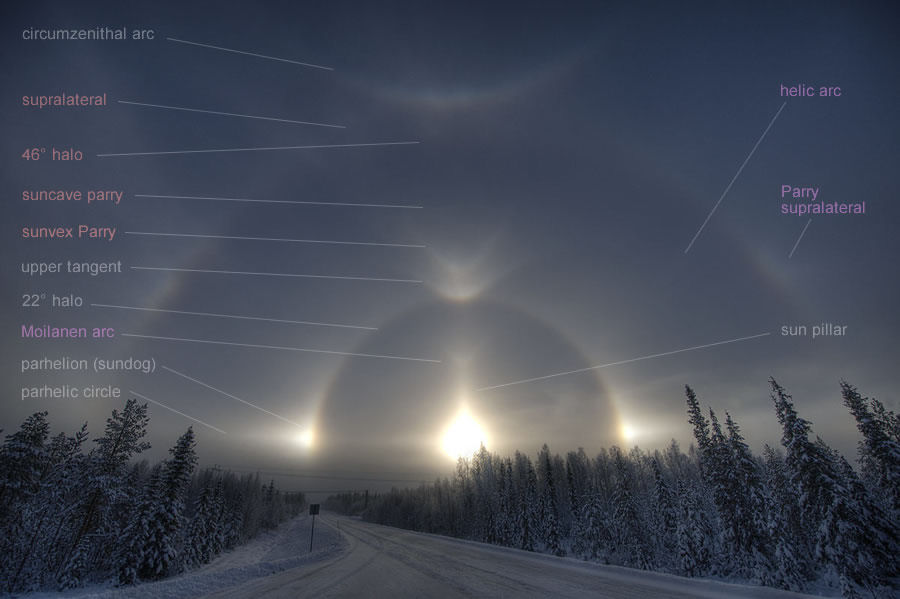
- Finland has some of the coolest sky phenomena on Earth.
- Sterile neutrinos? I think particle physics has gotten away from me. At least they didn’t discover it on the bridge of the Enterprise, with the Klingons closing in, right before the last commercial. (Thanks to Frank Glover for the link.)
- Are hipsters gone yet? Does their Weltanschauung capture the Zeitgeist? Or is it only a façade hiding the real bête noir? Will we miss them? Are you sick of dumb-ass questions yet? (Thanks to Pete Albrecht for the link.)
- And just when you think politics (even in my own relatively sane state of Colorado) can’t get any weirder, well…
- Several people sent me links to reports of an Irish chap who’s spotted a passerby in a 1928 Charlie Chaplin film talking on a cellphone. Gomog’s Razor (i.e., when all possibilities are equally unlikely, the craziest one is true) suggests time travel, but the little old lady in question may also be holding a compact mechanical trumpet hearing aid. Or maybe her ear is just cold. I’ll bank on time travel, and I know what she’s muttering into her Thiotimoline Smartphone: “Look, you idiots, I said send me to the year 2819, not the year 1928!”
- Samsung’s upcoming Galaxy Tab is getting a lot of press these days, but note that this review does not mention ebooks. At all. Wow.
- The Pontiac marque officially died this past Sunday. My grandfather Harry Duntemann always bought Pontiacs. His ’53 had an amber-colored glass Indian as a hood ornament, and my mother owned his loaded ’57 Chieftan from 1961-1967. It was a cool car with a very big engine, and given that my mom was used to driving tiny little Nash Ramblers from the mid-1950s, it was easy for her her to daydream and suddenly realize she was doing 80. I’ll miss Pontiacs. And my next car will almost certainly be a Ford, for reasons I don’t need to explain.
- Sportscasting can be hazardous to your hairdo.
- What if we stopped trying to immunize people against malaria and tried to immunize mosquitoes instead? Takes only one gone link to break a chain.
- “UCLA Seeks to Avoid Turnovers.” Me, I’m leery of cheese Danish.
- Dude, where’s my external tank? (Thanks again to Pete for this and the above link.)
- This is not a hoax. Really, it isn’t. I checked.
The Pulps Reconsidered, Part 4
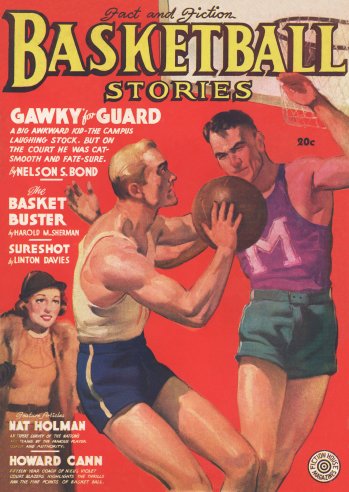 The essential difference between literary (as we define it today) and non-literary fiction didn’t crystallize for me until first-person shooters happened. I’m not one for games in general, but an hour or two playing early shooter games like Doom and Quake back in the 90s was an epiphany: This is a species of fiction. The following years proved me right. Most ambitious action games have at least a backstory of some kind, and some modern MMORPG systems have whole paperback novels distilled from them. (See Tony Gonzales’ EVE: The Empyrean Age, based on EVE Online.)
Of course it’s not literature. Did anybody say it was?
What it is is something else, something important: immersive. You get into a good game, and you’re there. I can do the same thing with a decent SF novel, but the phenomenon is in no way limited to SF. I’m guessing that Farmville or almost any reasonably detailed simulation works the same way.
Immersivity is the continental divide between literary fiction and pulp fiction. Like anything else in the human sphere it’s a spectrum, placing World of Warcraft on one end and Finnegan’s Wake on the other, with everything else falling somewhere in the middle. The term measures the degree to which you can lose yourself in a work, where “lose yourself” means “forget that you’re reading/playing and enter into experiential flow.”
Don’t apply a value scale to immersivity. It’s only one dimension of many to be found in fiction, and my point here isn’t to dump on Finnegan’s Wake. Literature is intended to evoke a response in the reader, but that response is not necessarily immersion. (It can be, particularly with classics like Huckleberry Finn that are new enough to be culturally familiar to us–dare you to read Chaucer without footnotes!–and yet not so new as to be afraid of Virginia Woolf.)
Pulling the reader in and carrying him/her along requires a smooth, linear narrative style, a vivid setting, and enough going on to maintain the reader’s interest after a long day working a crappy job. Pulp characters are often types, but that’s not necessarily due to a lack of skill on the writer’s part. A carefully chosen and well-written type allows room for a reader to imagine being that character, which is important in immersive fiction. As much as I enjoyed Gene Wolfe’s massive Book of the New Sun (and I’ve read it three times since its publication) I had a very hard time imagining myself as Severian. I empathize with him and certainly enjoyed watching him against the dazzling surreality of Urth (though I had to read numerous sections several times to be sure I knew what was going on) but being him? No chance. Keith Laumer’s Retief, on the other hand, no problem. Louis Wu? Same deal.
And for the umptieth time: (I can hear the knives being sharpened) This is not to denigrate literary fiction, of which I’ve read a lot and still do. My point is that immersive fiction is a valid entertainment medium, requiring different mechanisms and different skills than literary fiction. Let’s not dump on things for simply being easy to read. Easy is good if easy is what you want–and (on the author side) if easy is what people are willing to pay for.
Which should not suggest that easy to read is necessarily easy to do. The immersive magic of the pulps is obscured by the fact that a lot of it was just badly done, and could not have been otherwise, given that some pulp titles paid a quarter cent a word and published eighty thousand words twice a month. We can do much better these days, at least on the quality side. A brilliant potboiler is eminently possible–if we as readers give authors some sense that it’s ok to take up the challenge, and that they’ll be paid for their efforts when they succeed.
More in this series as time allows.
The Pulps Reconsidered, Part 3
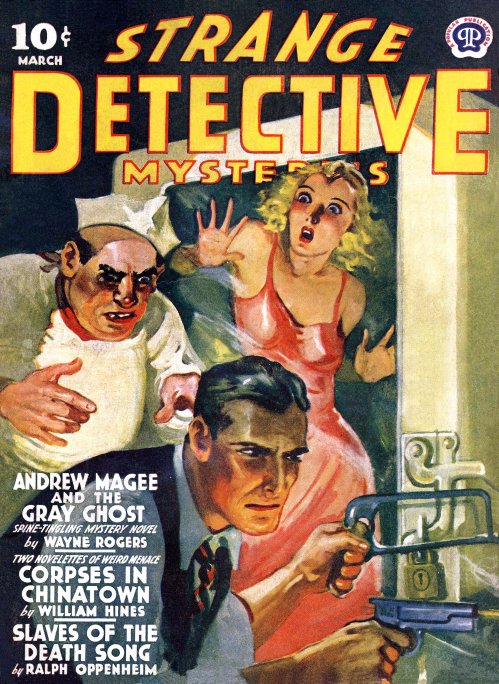
Bet you thought I forgot about this series, huh? Not so: I needed a little time to take a broader look at the field. (Click here for Part 1 and Part 2.) Someone told me that a lot of 1930s/40s/50s pulps were being scanned and posted on Usenet at alt.binaries.pictures.vintage.magazines, so I went up there and pulled down a representative sample. And I’m not talking SF anymore; what I grabbed were things like Air Wonder Stories, Mammoth Western, Strange Detective Mysteries, Adventure, and Spicy Stories.
It’s been wonderful fun. In fact, it’s a lot like watching campy old b/w TV shows, only better, because I can decide how everybody and everything looks. I don’t have to be appalled (or giggle) at the cheap crappy special effects. I just willingly enter a world in which nobody rolls their eyes at a homicidal supermarket butcher about to strangle a square-jawed hero armed with a pistol in one hand and a hacksaw in the other. (See above. No, I didn’t read that story. I still wonder what the hacksaw was about.)
I’m not the first to suggest that the pulps vanished largely because TV took over their niche. The pulps were Saturday-morning movie serials that you could enjoy any time you wanted, and once TV started showing Commando Cody, Bomba the Jungle Boy, Flash Gordon, and made-for-TV adventures like The Texas Rangers, Sky King and Highway Patrol, much of the money went out of pulp publishing. The financial pressure was eventually fatal, but over the short term, as the pulps dwindled, their quality went up. And it wasn’t just that we knew more about science and technology and hence could write better SF. The SF of the Thirties was awful because the readership didn’t care. The pulps had a monopoly on cheap entertainment and people bought it because it was all there was, and reading it was better than staring at the wall.
Print entertainment evolved out of the pulps and into other print markets, particularly glossy mags. The railroad pulps died, but glossy, ad-supported magazines like Trains and Railroad picked up the readership, which after WWII had more money to spend on locomotive picture books and model railroading. Tacky text-porn mags like Spicy Stories (which had racy drawings and a handful of “artful” b/w nude photos) gave way to Playboy and its cheaper imitators as social strictures against visual porn weakened in the 50s. In the late 50s, pulp SF improved hugely, and bootstrapped itself into the new world of mass-market paperbacks by selling reprint anthologies of the best work to come out of the pulp era. (We can be fooled into thinking 30s and 40s pulp SF was better than it was because what we read of it was hand-picked for quality decades after its publication. Read a couple of original SF pulps circa 1935 and you’ll see what I mean.) Crime pulps went both up and down, to comics on the low end (much of “crime” fiction from the Depression was actually horror) and to book-length mysteries on the high end. The romance pulps like My Romance split similarly into gossip mags and mass-market romance novels.
Fewer people may be reading these days, but those who gave it up probably never liked reading that much to begin with. Again, reading was better than staring at the wall, but TV, when it arrived, was easier, especially for people with marginal education. The audience that remained was pickier, and many had been formally exposed at the college level to classic literature, which became the standard by which all fiction was measured.
And that may be a mistake. (I’ll come back to this point in a future entry.)
Leaving the quality of the writing itself as a separate issue, after a good long look around I’d say that the lessons of the pulps are these:
- The pulps were about specific cultures. They were tightly linked to a time and a place and a generally understood cultural subtext. This was even true of early pulp SF, much of which might be characterized as “Depression-era Chicago on Mars.”
- Characters were intended as costumes to be worn by readers, not fully realized individuals to be admired on their own merits as independent men and women. A lot of people don’t understand this, and many still won’t admit it. Make characters too vividly fluky and original, and readers will have a hard time identifying with them.
- As a corollary to the above: Concepts, settings, and action were as important as characters, and much more vivid. Again, it’s the difference between imagining yourself driving a fast car and imagining someone else driving it.
- The pulps were fun. They understood and accepted their role as immersive entertainment. They were not equipped to be literature and didn’t try to be literature.
With all that in mind, the big questions become: Is there unmet demand today for good-quality immersive (non-literary) fiction? How much of this legacy can we retrieve in 2010 and do well?
More next time.
Daywander
We’re at a dog show in rural Greeley, Colorado, a little north of Denver–and right smack dab next to a huge cattle feedlot. Now, I’m a caveman and a realist–manure is the price we pay for beef–but that stuff sure do stack up and make its presence known. We kennelled QBit and Aero to simplify show logistics, but it’s funny not having Aero with us at a show. He’s a champ now, and the spotlight has shifted to Dash, who at 15 months already has 11 points (of the required 15) and one major win (of the required 2) toward his own championship. Aero was always a shy dog, and fearful at the outset. This cost him points early on, but Dash has never had any such problems, and it’s (remotely) possible that he could score a big enough win this weekend to make him a champion while still technically a puppy. (He won’t reach his majority until 18 months.) Master groomer Jimi Henton will be helping Carol make him and Jack look their best, and we have high hopes.
I just finished a dozen Lucerne eggs and I’m still alive to write about it, so the big contaminated egg thing may not be as horrible as some are making it out to be. But half a billion eggs, sheesh–and that from one company. Am I going to give up eggs? Hardly. My sole gripe is that Lucerne’s are the only eggs I can find locally in Medium, and I’ve titrated myself to a pair of Medium eggs scrambled for breakfast as what best carries me until lunchtime without any energy lapses. So I may have to fall back to a single Extra Large until I can scare up a different brand of Medium eggs. And while eggs are on the table here, does anybody see size Small or Peewee eggs sold at retail? (As best I know, these are generally sold to food producers for cakes and such.)
I bought and have been tormenting a new-ish WYSIWYG EPub editor product called Jutoh, from the guy who gave us the free ECub editor. It’s available for Windows, Linux, and Mac, and I’m testing it under Windows and Ubuntu. My first impressions are generally good, though the product still has a couple of thin spots, foremost of which is an inability to import .DOC files. More on it once I have a chance to get a couple of projects through it.
It may sound odd, but I’m pleased that Jutoh is not free software. It’s only $22, which is trivial–I’ve spent more than that just having an indifferent lunch with Carol at Village Inn. I don’t want to see the category of inexpensive commercial software die out. For a long time it seemed that software was going to cost either zero or a thousand dollars, which would mean that few solo software geeks would attempt to field an innovative utility that would not sell for hundreds but might sell for tens. I bought Atlantis some time back for $45 and love it–it generates the best EPubs of anything I’ve tried so far. (Jutoh is still in the running, but the race has barely begun.) Free software can be superb but all too often evolves slowly, if at all. Zoundry Raven, on which I write this, hasn’t been updated since 2008…though I must balance this by citing the free ebook manager Calibre, which is updated every couple of weeks.
We have lost the Star Hustler. Jack Horkheimer has gone off to see what the stars look like from the other side, and as little as I saw of him (I’ve not watched much TV in the last 40 years) I will say that he did a spectacular job making observational astronomy compelling to ordinary people, especially young people–and as goofy as he seemed sometimes, he never made me want to kick his teeth in, as all too often happens with Bill Nye. Science should not be full of itself (nor, alas, full of something else, as is the case far too often) and Jack was not. Keep looking up…maybe you’ll spot the light of the Big Bang glinting off the top of his head.
Odd Lots
- Everyone’s talking about a recent Copyright Office ruling that jailbreaking of smartphones is no longer illegal, but few have mentioned that several other significant exceptions to the DMCA’s anticircumvention provisions have been issued in the same ruling. Most interesting to me are limitations on ebook DRM where they prevent audio interpretation of texts from working.
- Could Popular Electronics be returning? Let us pray. (And thanks to Don Lancaster for the link.)
- Carol and I have begun avoiding movies in 3D. They give her headaches and they make me seasick. I thought it was just us being weird, but there’s some evidence that 3D isn’t the crowdpleaser that everybody (especially in Hollywood) thinks it is. Here’s some explanation.
- And even the 2D movies we’ve seen recently seem excessively loud. We may not be imagining things.
- A new dual-core Android-based tablet by an otherwise unknown German firm is really calling to me. We may not see this one here for awhile (if ever) but if it’s evidence of an evolutionary explosion in Android tablets, I’m good with that. Ours will arrive eventually.
- I’ve always been taken aback by the near-psychotic venom with which certain people treat an informal, likeable little font called Comic Sans. Scan the Internet and you’ll get a sense for what I mean. From ten steps back it looks like a tribal identity thing: You must slander Comic Sans to prove that you’re a member of the tribe, especially if you’re insecure about your membership. Secure people just keep their mouths shut and use something else.
- The little red guy running with a hatchet (see my entry for June 27, 2010) appears to be the logo of Psychopathic Records, not the Insane Clown Posse band itself, granting that the label was founded by the Insane Clowns and is probably owned by them. (Thanks to Ricky C on LiveJournal for the tipoff.)
- I solved another band logo question with the help of Google’s new output format for their Images search. Carol and I saw a band logo that resembled a bright red ballet dancer, apparently headless. I typed “red dancer band logo” into Images and there it was, an emblem of the Dave Matthews Band. I’m starting to like the new Google Images search output because it allows me to scan more images at once, rather than page repeatedly through a more limited matrix. This isn’t always useful, but I’m guessing it’s useful more often than not.
- Bicyclists in NYC seem to be preparing early for the coming Ice Age.
Odd Lots
- The $35 Atlantis word processor (see my entry for June 18, 2010) installs effortlessly under Wine and runs without a glitch under Linux. (It has a Platinum compatibility rating, and they don’t get any better than that.) If you’re doing or considering ebook development under Linux, it generates a very good EPub file, and is quite fast and extremely low-profile. (1.5 MB!)
- Doesn’t Popular Science tell us this (and just as emphatically) every three or four years? I’ll believe it when I actually see zepps flying over my house.
- From Bob Fegert comes word that Ray Kurzweil hopes to shake up the ebook business with his still-unreleased Blio reader. I’ve known of Blio for some time; what’s new is the partnership with Toshiba to create a Blio ebook store supporting PDF, XPS, and EPub books. However, what may make Ray the new kingmaker in the ebook world is a recent Federal requirement that universities make their e-readers accessible to the blind. Blio will do that very well (as you might expect, given Kurzweil’s history) and the reader is capable of rendering textbooks to an extent that most other ebook software/hardware combos simply can’t. Much to watch here.
- Having just spent a great deal of money changing out my glasses to a new prescription, I think this Android eye-test app is clearly and crisply brilliant.
- From the Words-I-Didn’t-Know-Until-Yesterday Department: Cyberlocker, a cloud-based file-hosting site. The term is generally used of sites like Rapidshare, which are coming to be seen by Big Content as the greatest single offenders in the file-sharing wars.
- Just as Shrek is selling Vidalia onions, I heard from a reader that Wallace & Gromit not only put the Wensleydale cheeses on the map, but with the power of cartoon branding brought the cheeses’ producer back from the brink of bankruptcy.
- Rich Dailey N8UX writes to tell us that the original Idle-Tyme rolling ball clock is back in production again, after 25 years. I saw one in a store window I don’t know how many years ago and giggled a little at the product’s inherent audacity, but it had a following, and I bought a plastic knockoff in the late 70s. The clock broke, but I still have the balls in a drawer somewhere. Read the history page; the inventor (like a lot of inventors) was a very interesting man.
Review: The Calibre Ebook Management System
I tried Calibre when it first came out a little over two years ago (v0.4.83) and was reasonably impressed. It did everything it said it did, reliably and without much fuss. Alas, I didn’t test most of its features back then, especially its file conversion modules. I’ve done a lot more in the past week, and overall I’m pleased.
The current version is 0.7.6, and author Kovid Goyal posts updated releases frequently, as often every couple of weeks. That’s amazing for a GPLed app, but Calibre itself is amazing in its way. If you install no other ebook reader or manager, get Calibre. It’s a Python app, and can be downloaded for Windows, Linux, or Mac.
There are three general aspects to Calibre:
- It’s a sort of jukebox for ebooks: a simple database manager that allows you to browse your ebook collection, search for individual titles, and edit metadata by individual title or in bulk. It can send books to any of a growing list of hardware readers.
- It’s a collection of import/export modules behind a GUI, allowing you to take an unencumbered ebook in one of a long list of formats, and export it to a different format out of that same long list.
- It’s an ebook viewer that can render ebooks for reading in most popular formats. When a format isn’t supported, Calibre attempts to launch the associated app to render the book.
All three aspects work well, though I ran into some problems with format conversion. I tested Calibre by importing basically every ebook I have on disk, which at this point isn’t all that many. I still don’t have a portable reader device that I like, and I don’t read a lot on my PC display. So I went and got a bunch of things from Project Gutenberg (including all the pre-1923 Tom Swift Senior books) plus some religion journals and other PD oddments from Google Books, and ended up with about 150 titles.
Calibre copies imported ebooks from their original locations to a separate directory, and it operates only on those copies, leaving the originals alone. (This means that the space your library takes on disk will basically double, though I doubt that this is an issue in an era of 2 TB hard drives.) It controls the filename of each file, and imposes a filename by running a regular expression against the title and author name in its database. Change a book’s title in the database, and the filename changes in sync. Delete a book, and only the imported copy in the Calibre directory goes away. Your originals are not touched.
Once you import the ebooks you own, plan on spending some time editing the metadata. Calibre uses a regular expression to extract an author and title string from each file, and although you can change the regular expression if you want, there’s no broadly accepted standard for ebook filenames, and you’ll find that many of your books have the author name in the title field or vise versa irrespective of the expression Calibre uses. You can specify a series name and number for books in series; e.g., Tom Swift, Sr., Volume 12. There are additional fields for publisher, ISBN, pub date, and comments, and if a cover image is present in a book, a thumbnail will be displayed. There is a tagging system with a tag manager.
Sorting out the metadata was a fair bit of manual labor, even for only 150 books. You can do updates on several books at once; for example, I highlighted all the Tom Swift books and set the Author field to Victor Appleton in one operation. If you have many hundreds or perhaps thousands of ebooks (and I know people who do) good luck; you’ll need it. There is autocomplete on fields and that helps, but there’s an irreduceable amount of keystroking that has to happen to get the most from the database browser.
The ebook viewer is as good as I’ve tested so far. It renders almost every ebook format I’ve ever heard of, including the comic book formats and PDF. (You can configure it to launch an external app to handle a specific format if you choose; for example, I open CBZ and CBR files with Comical.) For EPub and MOBI files, at least, the reader automatically maintains a bookmark to the last opened location in the book, and when you reopen a book, the cursor goes right to that bookmark. (This is not true for LIT, PDB, , and LRF books.)
About the conversion modules I have mixed feelings, and the problems are probably not all with Calibre. I converted my EPub version of the Beyschlag Old Catholic history to LRF, MOBI, and PDB. Results were so-so. One problem with the LRF export was that the font size was inconsistent: Parts of the text were rendered in larger type than others, and I can’t tell (yet) if that’s an issue with Calibre’s LRF viewer module or with the conversion process from EPub to LRF. The conversion to PDB stripped out all the formatting, including italics, and that does appear to be a problem with Calibre. MOBI kept the italics but didn’t center the author lines. Calibre seems happiest dealing with EPubs, and conversion from other formats to EPub works better.
Note that Calibre doesn’t deal with DRM-encumbered files at all. That’s fine with me, as I won’t buy DRM, but you need to keep it in mind if you’re looking to read DRMed books on your PC; Calibre is not the item for that.
I also installed Calibre under Linux, and I moved my entire Calibre database over to the Linux machine by simply copying the Calibre books directory to a thumb drive, and then copying the directory from the thumb drive to a folder in my home directory and telling Calibre to use it. As best I could tell, there were no functional or performance differences between the Windows and Linux versions.
There isn’t a lot of downside to Calibre. Opening and rendering an ebook on the internal reader can be slow if it’s one of the more sophisticated formats. (Txt and .rtf files open very quickly.) The viewer doesn’t downsample cover images very well when displayed at less than their native resolution, though that’s a quibble. (Reduce the display size on my Old Catholic history epub and you’ll see what I mean.) Adding bookmarks seems to take more time than it should, especially on longer books. The program crashed once when I had a lot of windows open. (These included Thunderbird 3, which seems to be causing a lot of weirdness recently.)
Calibre doesn’t help you create ebooks; that’s not what it’s for. And some issues with the conversion modules are going to keep me looking for reliable ways to make MOBIs, LRFs, and PDBs out of my EPubs. However, in terms of an ebook manager, it’s just short of stellar. The viewer modules work reasonably well, particularly with files created “natively”–that is, not converted from one format to another.
Basically, the ebook business is still mighty young, and I’m not surprised at how random things still are. Among ebook-related software products, Calibre is the least random of anything I’ve yet tested, and at this crazy stage of the game, that’s high praise.
Highly recommended.
Daywander
 It’s fawn season again, and yesterday we saw a mother deer leading a fawn that was no bigger than Jackie, if perhaps a little taller. Figure that: A deer the size of a bichon. The poor thing can’t be more than a day or two old, and it’s wobbling unsteadily around the First Curve on Stanwell St., where teenagers roar by in their parents’ elephantine Escalades and probably wouldn’t even notice if they had small animals wedged in their grilles. (We’re mostly thankful that they don’t miss the curve and plow through my office window.) Last night about 8 or so, mom had gone off somewhere, and junior was simply lying on our neighbor’s mulch, about six feet from the pavement. It wasn’t as obvious as it could be, but there are much better hiding places in the area. I guess we can think of it as evolution in action.

Our nephew Brian was out for a few days last week, and we all went down to the Garden of the Gods for a vigorous walk around the rock formations. I took a photo of Brian and Carol and something very weird happened: A dazzle from one of Carol’s rings just happened to hit the camera the moment the shutter snapped. Green Lantern must have that problem a lot, but this is the first time I’ve seen it from Carol.
My low-key inverted-vee antenna should be up and running off the back deck by Field Day, and will be 32 feet on each leg. That will get me the 20 meter band and up, and given that I’m feeding it with a short run (~10′) of open wire line through an MFJ Versa Tuner 2, I may get 40 as well. I’ll certainly try.
I’m still testing EPub readers. This morning, at Jim Strickland’s noodging, I installed the Barnes & Noble Desktop Reader. Not a bad item, but as with all the readers I’ve tested so far, doesn’t quite get it right. The presentation on my test files has been pretty good so far, but this time the software does use the title tag, and thus puts up only half of the Beyschlag ebook’s title. Also, it puts my test books up in two-column format, and I still haven’t figured out how to control the column settings. Neither of my two test books with cover images show their covers as thumbnails in the library pane. To its credit, the reader renders PDF documents pretty well, though of course there’s no metadata and thus no display of title or author.
Most annoying is the User Guide button, which brings up a longwinded sales pitch but no user guide. I assume you have to sign up for a B&N account to get the user guide, and I will at some point, but probably not today. I do understand that the product is designed to work tightly with B&N’s online bookstore and won’t slam them too hard for that integration, but basic “here’s how to do it” information should be there long before the sales pitches begin.
Nobody’s perfect, but the winner so far is FBReader, even though it inexplicably displays my copyright notices in ancient Greek. We’ll get there. Just not as soon as I’d like.