
I got my Novice ham license in May 1973, my General a year or so later, and my Advanced a few months after that. Now that Morse Code is no longer a requirement, I’ll go for the Extra one of these months/years. I never much liked Morse Code, even though I used it tolerably well as a Novice. This is interesting; my father was a radio operator in WWII, and he worked Morse and occasionally AM into a big hulking Hallicrafters BC-610. He taught Morse to me, and to the boy scouts in Troop 926 back in Chicago in the early-mid 1960s.
After I got my General I wanted a handheld FM transceiver for the 2 meter band. Note that we never called them “walkie talkies” in ham circles. They were “handhelds” “handie talkies” or more often simply “HTs.” So I bought a Standard handheld, and later added a keypad to it so I could control my robot Cosmo with touchtones. The Standard was built like a tank and served me well for quite a few years after I bought it in (IIRC) 1975. It wasn’t cheap in its era; I’m recalling something like $300. I bought an Icom 02-AT at the Dayton Hamvention in 1986, and gave the Standard to my late and much-missed friend George Ewing WA8WTE. The 02-AT served me well until the early oughts, when it just died. At the next Scottsdale Hamfest (alas, RIP) I bought another old (and cheap) Standard, but it only had crystals for repeaters, nothing local, and no pair for simplex. So it sat in a box, and in truth, I no longer remember if I even still have it, or if not, where it went.
Some time about 1998 or so, I first heard of the Family Radio Service (FRS) which the FCC established in 1996. FRS radios were cheap, small, popular, and did not require licenses. I bought one, a Tekk TF-460, which put out half a watt on one channel. I remember going up on the roof deck here in Arizona on Christmas Day 1998, and listened to the local kids playing around with their stocking-stuffer HTs. The FRS is a slightly shrunken version of the General Mobile Radio Service, which has been around for a much longer time. The services share the same channel assignments, and GMRS users may talk to FRS users. FRS radios may now put out two watts on 15 channels, the rest being limited to half a watt.
Which brings us up to 2015. I didn’t do a lot of VHF/UHF hamming in Colorado, and what I did was on a 2M/440Mhz mobile unit I got for cheap from a friend whose ham radio father had died. Then I heard about the Baofeng handhelds being sold on Amazon. I bought a UV-82L, which puts out 5 watts FM. It has 128 slots for channels, of which I set several on the ham bands and several on the FRS/GMRS frequencies. (I applied for and got a GMRS license, WRKT221, in 2021, for $35.) I wouldn’t bother doing an entry on it here but for one thing: The UV-82L cost me $37.99 in 2015. Today, you can get a similar but better radio, the UV-82HP on Amazon for…$19.99. It puts out 8W and has storage for 200 channels.
A few months later in 2015 I bought another Baofeng HT, the 5W BF-888s. It cost me $15.86. It has 16 channels and only works on UHF, in the ~440-470MHz area. It covers FRS and GMRS and the 440MHz ham band, though it comes preset to 16 of the FRS channels. I set several channels for 440MHz ham band. FRS and GMRS now mostly work on the same frequencies, so the unit works on GMRS as well.
Alas, you can’t get one anymore. Sorry; I meant you can’t buy them one at a time. Baofeng sells them in matched sets, the smallest of which is 2 units. (I’ve seen packs of 3, 4, 6, and 20, all on Amazon.) The sets include a charger for each radio plus a plug-in speaker/mic for each. The cost for the set of two is…$18.54. That’s 9 bucks per radio, less if you subtract out the charger and speaker/mic. You can’t always buy two hamburgers for that little.
All modern Baofeng radios use lithium-ion batteries. NiCads are history.
Setting up channels on Baofeng radios is done with a free Windows app called CHIRP, which can download a radio’s current channel settings, edit them, and them upload them back to the radio. This requires a USB-to-radio cable, which costs damn near as much as one of the BF-888s units.
There was (or maybe is) some friction between Baofeng and the FCC, since its radios are not type accepted for FRS or GMRS. That was the case in 2015, and I don’t see any indication that the problem has been solved.
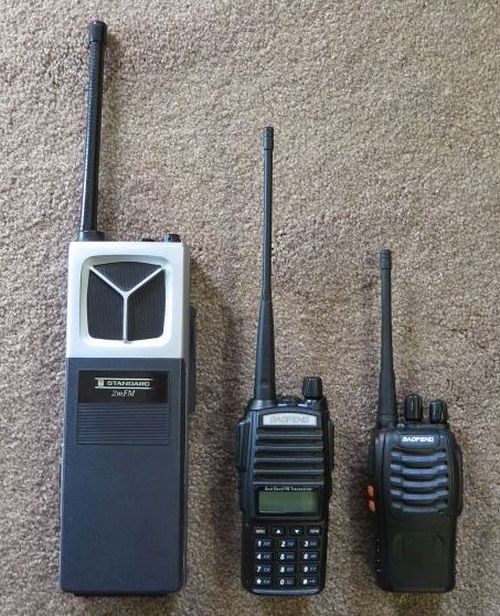
In summary, handheld radio history is moving in this direction: Handhelds are getting cheaper, smaller, and more powerful. Note the photo below, which shows the 1970s Standard crystal-controlled 5-channel HT, the UV-82L, and the BF-888s.
I bring this up simply because it’s now cheap to get into ham radio, and Morse code is no longer required. With FRS and GMRS you can get most of the same utility in a handheld without even having an amateur radio license. (FRS does not allow repeaters.)
And if you’re not interested in hamming, radios like these are good for camping, hiking, conventions and other events, etc.
I’d be curious to know if anyone else has used inexpensive handheld radios like these (Baofeng is by no means the only manufacturer) and how well they’ve worked out for you.









I admire folks who have skill at Morse code. I was able to memorize the code in my earlier days but not use it with any proficiency. Hence, I was not able to get my Ham license until decades later. Partially, in my defense, there were no software apps to help with practice. With regards to handhelds, I over-spent on an ICOM IC-T90A sometime around 2010 (at about the same time I got my license) but only used the 2m band; I wished I had just bought a 2m only radio.
I got a Quansheng UV-K5 about 2-years ago, that allowed me to flash it with an opensource firmware, for about $35 CAD (came with handheld microphone, separate earpiece/plug, charging dock and other cables)
https://github.com/qshosfw/
A Baofeng UV-5r was my first radio when I got relicensed ten years ago. It’s a steady performer and cheap enough that i won’t cry too hard if I lose it.
Some Baofeng units have had trouble with transmit purity. At Dayton the ARRL often has a tech with a spectrum analyzer doing free checking for spurs and harmonics that are over the limit.
A year ago I got a Radtel RT-590, another Chinese radio, that’s a clone of the Quansheng UV-k5. Since I got it, my Baofang has pretty much stayed in the drawer. There is an excellent free custom firmware for the Radtel/Quansheng on Github called Egzumer which, among other things, can show a spectrum of the current band.
I have been a ham since I was about 14 as a Novice and General before I got to 16, but many years latter, my wife who was very tolerant and even supportive of my hobby, but had no interest becoming a ham. This was before cell phones became part of almost everyone’s anatomy. We had a problem of being able to find each other when out shopping at larger centers or even in some large big box stores so I bought two FRS hand held radios and labeled hers as HUBBY FINDER 2000 and mine WIFE LOCATOR 2000. We used those extensively back in those days, and when her Father passed suddenly in Florida just a few years latter leaving her mother alone we used them on the trip, in convoy, from Atlanta to Orlando with one being in the pickup truck with me and my wife and the other in the SUV with her sister and brother. They were priceless for that use alone.