- From the Words-I-Didn’t-Know-Until-Yesterday Department: Fixie, a fixed-gear bicycle; i.e., a bike in which the pedals always move with the rear wheel and coasting is impossible. Fixies are currently the rage among hipsters in stylish cities. It sounds deranged to me, but I lack the hipster gene and value my knees, so what do I know?
- From Aki Peltonen comes a link to probably the best volcano blog I’ve ever seen. Great photos, interesting analysis, and reasonably courteous comments. (Boy, you don’t see that everywhere!)
- While we’re talking volcanoes, how are the sunsets in the UK? Denmark? Any personal reports from readers here?
- Many have sent me a link to the Panoramic Wi-Fi Camera, a fascinating gadget that consists of 20 cantennas arranged in a vertical line on a frame that spins 360 degrees horizontally. Spin the device, and a netbook builds a panoramic image of the 2.4 GHz field in the immediate vicinity. Watch the videos. Fascinating on its own merits, and pay attention to what happens when somebody throws a cup of coffee into a nearby microwave oven: The oven blinds the camera to everything else. For all the tooth-gnashing we hear over cellphone radiation, microwave oven RF leakage never seems to get a whisper.
- This should surprise no one: Google’s Street View carcams have also been wardriving. There’s less to this than meets the eye (there was a project, now defunct, doing this in 2002) but it’s yet another reason I don’t power-up my Wi-Fi access point unless I need it for some reason. (My house has Cat5E in the walls, and I use PowerLine bricks for high-speed Net access in odd corners.)
- Dave Schmarder N2DS has given his homebrew radio site a major upgrade and its own domain, so even if you saw it a few years ago, do take another look. Gorgeous work.
- We blew through the range of SDHC Flash memory cards in record time: 32 GB cards are now in the supportable $60-$80 range…and 32GB is as big as they get. We did this in four years. Admittedly, SDHC was a cheap’n’easy hack, but hell, what kind of damfool memory standard only increases capacity by 16X? (Even SDXC, which takes us to 2 TB, should have gone much farther.) My guess: Standards authors don’t want to be wrong about future advances in hardware, and certainly don’t want to be a drag on future innovations by being too explicit about how hardware is supposed to work ten or twelve years on. I can see both sides. That doesn’t make it any less annoying.
- From Michael Covington comes a pointer to a 1952 riff on beer and ham radio, and a glimpse of what cash-poor radio guys dreamed of the year I was born. I’ve never met anybody who ever had such a rack (the radios, the radios!) but beer was and remains very big in radio shacks to this day. K1NSS is the cartoonist behind the Dash books, about a dog who does ham radio. (I found him last year while researching names for our current puppy…)
Odd Lots
A Kingly Gift
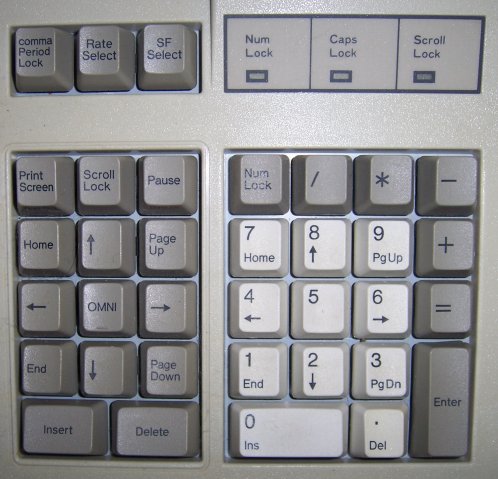
Last night, my brother-in-law Bill Roper presented me with a truly kingly gift: An unused Northgate Ultra keyboard, which he bought many years ago but never attached to any machine. I’ve been using Northgate Omnikey 102 keyboards almost without interruption since 1991 or so, and whenever we upgraded an early system at Coriolis to something that came with its own keyboard, I snatched the old Northgate and took it home with me. Several have died since then, though they may be repairable and still live in a box in my shop closet.
As I’ve reported here on a couple of occasions, I bought an Avant Stellar (an OmniKey clone) a couple of years ago, only to find that the decal keycap legends have begun wearing off on the most popular keys. “Double shot” key caps (one shot of plastic into the mold for the cap, a second for the legend) are mostly extinct, which is yet another reason I value the keyboards that I still have.
This one will take up its position as King of Duntemann Keyboard Country when I get it back home and attach it to the primary system in my office. It will go home by UPS (in a box surrounded by boxes of Trader Joe’s Joe’s O’s cereal) so to minimize the risk of getting dog piddle or McDonald’s iced coffee on it while we trek back to Colorado Springs.
There is a little exploring to be done. As shown above, the numeric keypad is significantly different from the Omnikey 102s that I’ve been using all these years. There are five keys I’ve never seen before:
- comma Period Lock
- Rate Select
- SF Select
- Pause
- OMNI
Bill did not have the booklet that came with the keyboard and I have no idea yet what any of these do, although the SF Select key is intriguing. (And sure, an OmniKey should have an OMNI key, right?) The rest of the keyboard is basically an OmniKey 102 with the second set of function keys across the top, just below the thumb-drive groove.
All in all, a truly kingly gift. I’ve never had an Ultra before. Now I do–and it’s NOS. Bill, you are a prince!
Odd Lots

- Pete Albrecht sent the above image, and challenged me to characterize it. What would you call it? (Answer at the end of this entry.)
- The people who created the indie WWII film The Downfall have had enough, and persuaded YouTube to pull hundreds of parodies of the well-known scene in which Hitler freaks out when he learns that the Soviets are closing in on Berlin and the war is lost. The film is in German, with English subtitles. People were swapping in their own subtitles, and whereas the first one (or maybe two) were funny in a painful way, after I watched three or four I had had enough myself. On the flipside, it was a fortune in free publicity for a film I’d never even heard of before people started sending me links to various parodies.
- Another Web site (following the example of Ars Technica) started banning people for even mentioning AdBlock on their forums. They retreated, defending their position all the way. The problem here is that ads can be malware injectors, and unless Web sites can guarantee clean ads (which isn’t easy, given how current ad systems work) I’m with the blockers here.
- Assuming that this is legit, it may be our best hope yet for fighting cancer after metastasis.
- Ditto a new broad-spectrum mechanism for knocking out viruses. (Thanks to Frank Glover for the link.)
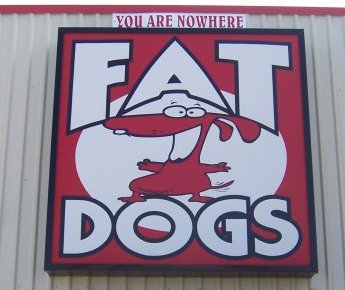
- For people who hadn’t read my earlier entries about it, Fat Dogs (see the photo of their sign in my April 19th entry) is a small chain of gas stations/convenience stores in western Nebraska. They’re so small they don’t have a Web site. That doesn’t mean they don’t have a great sign and motto. (“You Are Nowhere.”)
- Book publisher Penguin Australia published a pasta cookbook, one recipe of which calls for “finely ground black people” instead of “finely ground black pepper.” Although Penguin hasn’t copped to it yet, this reeks of an instance in which a mispelled form of “pepper” generated the suggestion “people” in the spell checker, and some underpaid knucklehead editorial staffer clicked on “accept all.” I gave that lecture to a couple of my staffers ten years ago. You’d think the publishing world at large would have internalized the danger by now.
- NASA’s Solar Dynamics Observatory satellite goes live today, promising the best solar images we’ve ever obtained.
- Give up? (See first item in this entry.) It’s a…bichon frieze.
Small Town Life, With Bombers
 Hey! We’re here again! Where’s here? Heh. Guess.
It was a boring trip, and when I’m driving, boring is good. It was so boring, in fact (64 degress, clear skies, no wind to speak of) that I just kept on going and did 480 miles the first day, taking us all the way through Fat Dogs country and out the other side. My driving maniac friends may grin to think of 480 as a lot of miles, but with four dogs’ worth of potty breaks (and a few for us) it got to be a drag by 6 PM. And so we stopped for the night at Grand Island, Nebraska.
Just before dawn, a front carrying rain and cold air caught up with us, and we played tag with it the rest of Day 2. Getting out in front of it was easy, and while we were out in front we stopped for most of an hour to walk the dogs and look around in Ashland, Nebraska, population 2,200. The Midwest Homebrewers and QRP Group meets there, in part because it’s about halfway between Lincoln and Omaha. That’s also the reason I wanted to take a look: Carol and I have thought of renting a small house for a month or so as a pied a terre and exploration base in interesting places like eastern Nebraska. Being less than an hour from both Lincoln and Omaha, Ashland would be almost ideal.
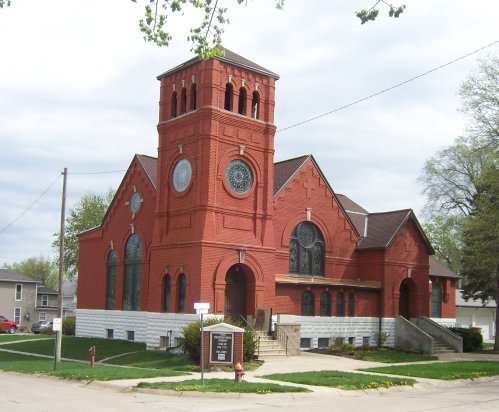
And it’s a great town, maybe just a hair smaller than what I consider the ideal size for human communities. Tidy older homes along streets lined with big trees, a cobbled Main Street, riverside park with walking trails, ham radio club, an aerospace museum full of classic bombers (plus an Atlas missile), broadband–what else could a man need? (And if I do need a megalopolis for some reason, Omaha is just a short trot out I-80.) Remember: Boredom is a choice.
We met my friend Darwin Piatt W9HZC for lunch in downtown Omaha at the Old Market, where I signed his copy of The Cunning Blood and we BSed about homebrewing and much else before the front caught up with us and it started to drizzle again. Then it was back on the road, where we eventually got out in front of the rain and made it to Iowa City before packing it in. Day 3 is always short, and we rolled into Crystal Lake about 3 PM.
We’ll be spiffing up the dogs for the Bichon Nationals the end of next week, but in the meantime I have a few days to gather my thoughts, take notes, visit with my sister and her girls, and maybe write a little. It’s been a long, cold, ugly winter (and let us pray that the current volcanic tantrum in Iceland doesn’t dump us into yet another Little Ice Age) so I’m greeting spring with an enthusiasm I don’t think I’ve felt for twenty years or more. For the moment, life is good, and I’m savoring it.
Kodak’s V530: The $40 Pocket Battleship
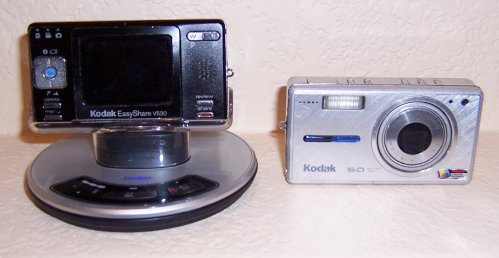
The camera gremlins have been active here this year: Both of mine were stolen at a dog show in February, and Carol misplaced hers last week. Fortunately, I bought a used Kodak V530 on eBay to replace my 5-year-old and now defunct V530, so we were able to take pictures at Aero’s pivotal dog show this past weekend. And of course, with the dog show past, Carol’s camera turned up again this morning. (I think it’s taking lessons from Aunt Kathleen’s Lucky Dollar.)
The “new” V530 is black, which wouldn’t have been my first choice. Anodized aluminum shows nicks and scrapes much better than plain aluminum. My poor busted V530 rode around in my pockets with my car keys on plenty of back-country hikes, to the point where much of the printing on the body is worn away past legibility. Still, it looks amazingly good, and if it still worked I’d still be using it.
The V530 has a feature important to me: A dock charger. The charger wall wart plugs into this little flying-saucer thingie with a plastic insert unique to the V530 body (other inserts are available for other cameras) and when I come back from a hike, I just drop the camera into the dock and it’s charged again within the hour. I know, people who take more than forty or fifty shots in a session will need to carry a spare charged battery, but I’m just not that avid. I have (or will soon have again) a much more capable camera for deliberate photography. Pocket cameras have a different mission in my universe: The V530 rides with me in case I need to take a photo–say, if I spot a bear rifling a trash can or a flock of wild turkeys up on the mountain slopes. Rather than pack a full camera bag when I’m not sure I will encounter anything remarkable, I just toss the V530 in my pocket with my keys so it’ll be there if I need it.
The used V530 cost me forty bucks plus shipping. Not too damned bad for a fully-functional camera in better shape than the one I’d been using. It was dusty (especially the dock) and a little greasy where fingers had been gripping it, but a few alcohol wipes took care of that. I’m seriously considering buying a “shelf spare” if another comes up on eBay, just in case the gremlins descend again in the future. It’s easily the best digital I’ve ever had, and for “opportunistic photography” I’m quite sure it’s as good as you’ll find.
Hail the New Champion!

Well, I’m dog tired and don’t have a lot of time tonight (and I hurt my back packing the car for the trip home) but the short form is this: Aero nailed it. He won Winners Dog the second day of the Terry-All Kennel Club dog show outside Denver, and because one of the other male bichons entered on Saturday but not Sunday, there were only two points to be had.
However, two points were all that he needed.
So now Aero is Ch. Jimi’s Admiral Nelson. We stopped at McDonalds and bought a cup of frozen custard to celebrate, and everybody got some, though Aero the Conquering Hero got more than his packmates. Furthermore, he got to ride the whole 90 miles home in Carol’s lap, a rare privilege shared only occasionally by QBit.
Before the gang packed up and went home, we took a group photo down in the cow pens. Left to right: Carol (with Aero’s winning ribbons), Aero, Lindsay Van Keuren, her 9-month puppy Beanie, Grace Van Keuren, Mona Lisa, and Mona’s owner Mary Provost.
What’s next? Aero’s becoming a champion this weekend (which was hoped for but hardly assumed) may change our strategy at the 2010 Bichon Nationals in Indianapolis. Carol needs to consult the bichon experts a little, but one thing is certain: It’s time to get Dash into more show classes and teach him some discipline. He likes everybody, and in fact he liked the judge in the 6-12 Month Puppy Dog class so much that he put his front feet up on the judge’s chest and tried to lick his nose. He will technically be a puppy for seven more months (even though he’s already full-grown and reproductively mature) but once you’re competing in Open Dog, licking the judge won’t score you any points.
Overall, it was a fine, fine (if exhausting) weekend. And on that note, I think I’m going to take another dose of Tylenol and go to bed.
Bichon Freeze
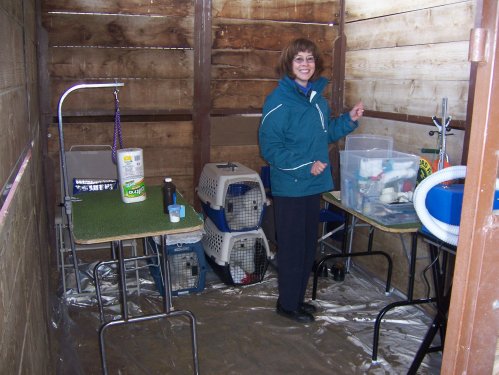 We’re at the Terry-All Kennel Club dog show at the Adams County Fairgrounds, just outside Thornton, Colorado, a suburb of Denver. And we’re back in the cattle pens, just as we were at the big Denver dog show in February. The difference, of course, is that the cattle pens at Denver’s National Western Complex are inside.
When we rolled into the fairgrounds at 8:30 this morning, the 4Runner’s thermometer read 36 degrees. We brought light jackets only (the dogs have their fur coats) which was, well, a mistake. We are working in a grubby 9′ X 12′ cattle pen with an uneven dirt-and-manure floor, rolling steel-tube doors, and gappy wooden plank walls going up a hair over seven feet. Past that there’s nothing but a freestanding tin roof another eight feet higher, complete with flocks of small birds roosting on the girders and dirty light fixtures that we (fortunately) do not need.
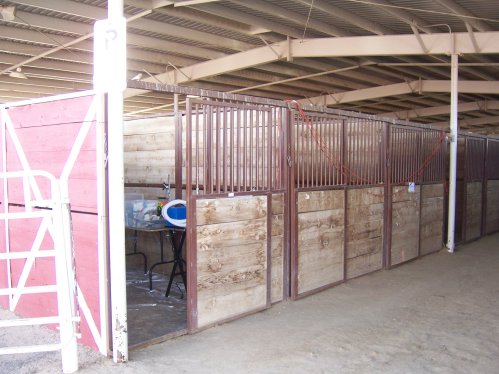
(The photo above was taken standing outside the red-painted barn entirely, looking in at our stall.) It was a cold, cold morning. Fortunately, we have a hair dryer, and every so often while blow-drying the no-rinse shampoo we have to use to get the day’s dirt off of the Pack, we stuck the snout of the hair dryer into our jackets for a second or two. A chill wind blowing freely through the stall didn’t help.
We now understand why Jesus was born between an ox and a ass. It was that or hypothermia.
It took until lunchtime for the sun to warm up the surroundings comfortably, and by then we were done. The guys were clean, fluffed, and expertly trimmed, and Carol took the quarter mile to the show hall carrying Jack, with me close behind, Aero and Dash each under one arm. If they had walked, they’d have been brown long before the quarter mile was over. (Anyone who has ever been to a county fair or a rodeo anywhere on the Great Plains will understand.)
Two people showing three dogs is an interesting exercise in logistics. Carol handled Aero and Dash in the first round (they being in different classes) and I handled Jack. As usual, Jack would not keep his tail up, and Aero beat him handily. Dash was no angel: We’re not quite sure how but he squirmed out of his show lead and would have leapt off the judging table had Carol not grabbed a hind leg in time. He thus narrowly avoided disqualification, and being the only entry in the 9-12 month Puppy Dog class, won his class by default.
In the subsequent Winners Dog round, Aero was up against Dash and a beautiful older male puppy, who had earlier won the 12-18 Month Puppy Dog class. Aero won the round, and thus (having beaten three male bichons) got three points. And because for male bichons three points is considered major, Aero bagged his second major win, of the two required for championship. In the Best of Breed round, Aero was up against the Winner’s Bitch and a male special (a previous champion competing for higher honors) and the special got it, afterward going on to Best of Group for Nonsporting. The special did not place in Best of Group, so at that point the bichon action was over, and we packed our stuff and toodled back to the hotel.
Aero clearly knows he’s hot stuff, and has been lording it over Jack and Dash here in the room ever since. (QBit is taking it easy for the weekend back at Sunrise Kennels, as he does not compete.) All Aero lacks now are two more points. If he wins tomorrow as he won today, he’ll go home a newly minted champion.
The tension is palpable. Tune in again tomorrow!
The Dollar That Didn’t Like Hawaii
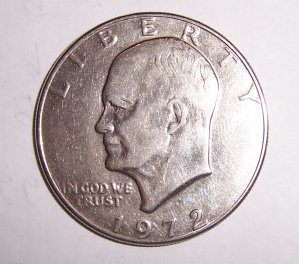 Life is full of little weirdnesses, and here’s yet another: Shortly before we left for Hawaii last month, my lucky dollar turned up missing. That’s the very one at left, though it’s shinier and more worn now than it was when I first mentioned it (and took the photo) in 2006. I’ve had the dollar in my pocket pretty much continuously since Aunt Kathleen died in mid-1999. She received it from my Uncle Louie at some point, and it came to me upon her death. Keeping the dollar in my pocket isn’t about luck, but about remembering both my godmother and a peculiar man who faithfully looked after his baby sister (my mother) after my dad died, and who believed in me when almost no one else did.
It’s hard to misplace something that big, but one day I just reached into my pocket for some small change and noticed that it wasn’t there. I then did a furious ten-minute tour of all the most likely spots: The sofa, the sectional, my reading chair, the 4Runner, behind the pants press. Nothing. Two days later we boarded the plane, and by then I pretty much assumed it had fallen out while I was sitting in a chair at Carol’s doctor’s office or somewhere else irretrievable, and was gone forever. I was bummed. (Hawaii helped ease the pain.)
Back at the end of March, only a few days after we got home from Hawaii, Carol and I had the carpet cleaners in for the first time since 2007. We spent an hour putting scooter disks under the legs of the smaller furniture pieces to get them out of the carpeted areas. Something caught my eye as I shoved Carol’s nightstand toward the bedroom door. There on the carpet, pretty much dead-centered in the space where the nightstand had been, was the dollar.
WTF? I tried to imagine a scenario in which the dollar would pass from my pants pocket to underneath Carol’s nightstand, without convincing success. Ever so rarely often I dump my pockets on the bed while I change pants, and somehow, the dollar must have migrated from the bed to the floor when I wasn’t looking, and rolled unerringly into shadow. You’d think I would notice. But I didn’t.
I put it back in my pocket. Carol and I both laughed, because we knew the rest of the story: Aunt Kathleen was not an adventurous person, not the least little bit. She’d had exactly three street addresses in her whole 78-year life, all within a few blocks of Chicago’s Devon Avenue. She’d been to California with her family when she was a 13-year-old girl. (Boris Karloff is signing her autograph book in this photo.) She took another trip with her parents in 1953, when she was 33, this time to…Hawaii. The trip must have been difficult, or for some other reason freaked her out, because as best we know, she never left the greater Chicago area again, ever.
As she said many times, she just didn’t like traveling. Or maybe Hawaii had made a bad impression. Hard to tell. But for all the talk you hear about the velocity of money, Aunt Kathleen’s dollar preferred to sit out our Hawaii trip and went to great lengths to do so. And once Hawaii was no longer a threat, it showed up again, promptly.
Crazy world, ain’t it?
CBZ Files as Image Archives
Last fall, I gathered a stack of Alma-Tadema‘s paintings from my pre-1923 images folder, wrapped them up into a ZIP file, and sent them to a friend who was looking for a copyright-free color cover for a novel. Some weeks ago, I learned that the CBZ (Comic Book Zip) file format is nothing more than a ZIP file with a different extension. I downloaded and installed a free CBZ reader called Comical. After changing the extension on the Alma-Tadema archive to .cbz, I double-clicked on it, and boom! There it was, beautifully presented and trivially easy to click through. And if you change the extension back to .zip, you can de-archive the images in the usual fashion using any ZIP-capable archiver. It’s all in the extension; no changes to the binary archive need to be made.
Not being a comics guy, I’d never heard of the CBZ format, though it’s been around since 2004. It’s basically an ebook reader protocol (since it is, after all, simply an ordinary ZIP archive) that opens a .zip file and displays the files in alpha order by filename. If the files are displayable as images, the reader displays them. If the files are not displayable as images, a well-behaved reader will ignore them. (Comical, one of the simplest free readers, sometimes crashes when it encounters a non-image binary.) If you need an indicia page, some readers will display text if it’s in an .nfo file. The .nfo will appear in a separate text window on opening the file, rather than in the page display area.
I’ve tested four free CBZ readers: ComicRack and Comical under Windows, and QComicBook and Comix under Linux. All but ComicRack are open-source. ComicRack is overkill in a lot of ways, though it works very well. (It requires the .NET framework, if that’s significant to you.) Comical is much simpler, and my only gripes are that it doesn’t display .nfo files, and it crashes when it finds certain kinds of non-displayable files in a .cbz archive. QComicBook is a Qt4/KDE app, and the one I find myself using under Linux. Comix (a Python app) works well but is not as capable as QComicBook. (Feature-wise, it’s on a par with Comical.) Others exist. Okular will open CBZ files without complaint, but it simply scrolls vertically through the images without attempting to show one per click.
Most of the comic book readers also read CBR and CBT files, which are RAR and TAR archives, respectively, and work almost exactly the same way. (I haven’t tested those formats.)
The CBZ system works best when all the images in the archive are the same dimensions and aspect ratios. I’m putting together some photo albums for showing the folks back home that are collections of digital photographs in one (big) .cbz file. The bigness is mostly unavoidable, since JPG files don’t compress very well. Still, it makes file management simpler
Here are some sample CBZ archives that I put together for testing: Alma-Tadema (14 MB). Hi-Flier Kite Catalog 1977 (6 MB). The “Elf” Space-Charge Receiver (1.7 MB).
Odd Lots
- A lot of Catholics (and doubtless a few others) would like to see some rabbit control on Easter.
- That said, Easter has done much better resisting commercialism than Christmas. Basically, the Christmas story is unreservedly delightful, whereas the Easter story is sobering. Happy beginnings are easier to come by and much more common than happy endings, as I’ve noted here before. The real message of Easter is solidarity with God, who is born, lives, suffers, and dies, like all of us–with the promise of a happy ending, even if the nature of that happy ending is obscure to us right here and right now.
- Early reports of Amazon giving in to demands from major publishers that they be able to set prices for their ebooks were evidently premature, but I’ve seen more reliable reports that the deal is now done, and that ebook prices will rise. This is not a bad thing: Publishers should compete on price, not retailers. And if Macmillan wants to charge $15 for an ebook, that provides some wiggle room for upstart and smaller publishers to get a place in the channel charging $10, or $8, or $5.
- Many photos have just gone up for EntConnect 2010.
- Ubuntu 10.10’s code name will be Maverick Meerkat. And hearing that reminded me that Lucid Lynx is just around the cornah. (The small photo of some meerkats devouring a Halloween pumpkin is worth the click!)
- I’ve been having some very odd problems creating good audio CDs with InfraRecorder Portable, and now recommend that you don’t use it. Some of the tracks just don’t “take,” but when I burn the very same MP3s to a blank disc from the same spindle using Gnome app Brasero, the disc is perfect.
- It’s far from complete but it’s a damned good start: A listing of electronics surplus houses by state. Sadly, they don’t list Apache Reclamation & Electronics, which suggests that Phoenix’s Mother of All Junkpiles has passed into history.
- From the Words-I-Didn’t-Know-Until-Yesterday Department: Mumblecore, a film genre characterized by improvised scripts, inexperienced actors, and lousy video equipment. (Sounds like my home movies.)