Jeff Duntemann's Contrapositive Diary Rotating Header Image

Review: The Ineo Toaster Dock

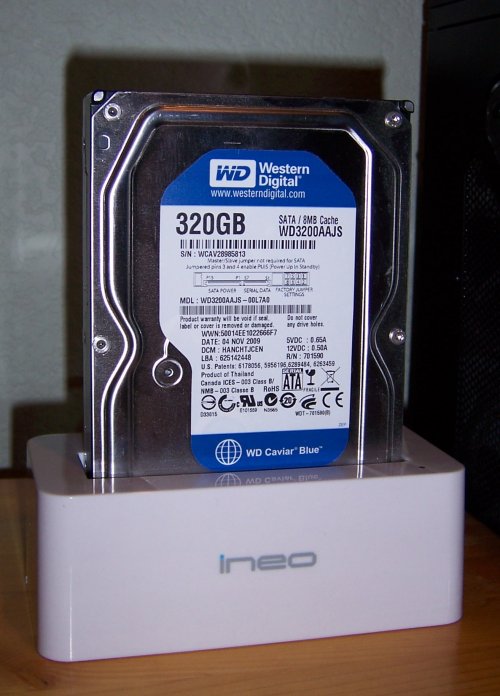
IneoDock500Wide.jpg

I have a 320 GB SATA drive that got corrupted when power dropped during a thunderstorm. I lost nothing in terms of data (I do backups well here) but now I have this naked drive in the drawer. I want to go through it and make sure there’s nothing worth taking from it that wasn’t in my backups, and then low-level reformat it and see if it could again be of use.

This is something that most of us do from time to time. I have a small pile of hard drives downstairs on my shelves, pulled from defunct machines before they went to the recycler. A couple of the older ones (1.6 GB anyone?) I treated with one-clunk degunking (in which that single clunk is applied out on one of the flatter boulders behind the house, with a five-pound sledge) but there are some that are still large enough to be useful.

Ordinarily I stick them inside a system to examine and reformat them, but most of the systems in the house are now USFF Dells, and don’t have an “inside” as we define insides. My current Antec desktop tower, as nice as it is in some ways, is miserable to open up. I used to use my old Antec and just left the covers off, but then the mobo died, making it junk. It would be damned fine to have an easy way to connect the occasional drive to a system to work with it, without having to fuss with Metric screws and cables and covers.

IneoDockTopView.jpgOne solution is shown above and (top view) at left: The Ineo I-NA317U+ “toaster” dock. It’s a USB 3.0 device (which works at reduced speed at a USB 2.0 port) with a spring-loaded hatch on the top. You drop a SATA hard drive into the hatch and shove it down until the drive data and power connectors mate with those in the dock. That’s it. The drive then appears as a USB storage device to Windows and Linux without any additional fuss or installing of drivers. The hatch has a notch in the connector corner sized to fit a 2.5″ laptop SATA drive. When you drop in a 2.5″ drive, the hatch doesn’t push down and away, but acts as a positioning guide. The SATA connectors are physically identical irrespective of the size of the drive, and located on the drive end plates so that the dimensions from the corner of the drives are the same on both 3.5″ and 2.5″ drives.

The dock requires a separate wall-wart power supply; there’s not enough power available from a typical USB connector to run both the drive and the dock. (USB 3.0 is more power hungry than 2.0, evidently.) The cable is also different from the conventional USB 2.0 model, and relatively short, at 3′. SATA drives are hot-swappable, and you don’t have to power-down the dock or the system to change drives in the dock. Just do the usual USB unmount, and you can then pull the drive up and out of the dock without damage.

The Ineo device worked flawlessly the first time. It’s SATA only, and I have begun looking for something similar for ordinary parallel ATA drives. I know that ATA drives aren’t hot swappable, so I may be forced to use an ordinary external USB enclosure and just not screw the top back on, but I can live with that. SATA is the future, and as I migrate away from ATA-equipped SX270 USFF machines to SATA-equipped SX280s the Ineo dock will become more and more generally useful.

About $50. (Mine came from Amazon.) Highly recommended.

Cold Hands and Other Stories

CHCoverPrototype.png

I’m sure I’d be a lot more famous if I weren’t so slow, but better late than never: I’m pleased to announce that Cold Hands and Other Stories is now available from Lulu.com in print form, with cover art by the estimable Richard Bartrop. Trade paperback, 230 pp. $11.99.

The body of my short fiction divides pretty much in halves: Stories focused on AI, and stories focused on everything else. I published all of my AI shorts in Souls in Silicon back in 2008. Cold Hands and Other Stories contains everything else, albeit with a new excerpt from my nanotech AI novel, The Cunning Blood. And “everything else” covers a lot of ground: spaceflight, aliens, religion, calculus, witchcraft, and steam locomotives, or at least steam locomotives hacked together from alien parts that probably weren’t intended to go into steam locomotives.

Most of the stories have appeared in print before, and one, “Cold Hands,” was on the final Hugo ballot in 1981. There are a few new ones, including one as new as late last week. Here’s the lineup:

  • “Cold Hands” (from IASFM, June 1980)
  • “Our Lady of the Endless Sky” (from Nova 4, 1974)
  • “Inevitability Sphere” (from IASFM, Sept./Oct. 1978)
  • “Whale Meat” (from Starwind Magazine, August 1977)
  • “Born Again, With Water” appears for the first time.
  • “Drumlin Boiler” (from IASFM, April 2002)
  • “Drumlin Wheel” appears for the first time.
  • “Roddie” appears for the first time.

Rounding it out is another excerpt from The Cunning Blood, different from the one I published in Souls in Silicon, and not available anywhere else but in the novel itself.

A big chunk of the book involves the Drumlins world, which I introduced in 2002 and intend to do a lot more with. Calling it steampunk isn’t quite fair, as it doesn’t take place in Victorian times and corsets are mentioned exactly once. Someone described “Drumlin Boiler” to me as “hillbilly steampunk” (steambilly?) and while that’s a surreal notion, it may be as close as you’ll come.

Yes, an ebook edition is planned, though given the sad, fragmented state of the ebook world right now, it’s going to take some time to kick the file down the tool chain into all the requisite formats. Fortunately, Lulu is a certified aggregator for iBooks, so once I have an EPub that passes the gnarly epubcheck test for standards compliance, I’m going to give it an ISBN and let Lulu list it on iBooks.

As always, blog mentions and reviews are much appreciated!

EPub and Word Processors

Well. Got your heart medicine handy? Jeff is considering a Mac. Well, not exactly. (Put down that nitroglycerine.) I’m strongly considering getting an iPad. And I’ll bet you didn’t know that I already have an iPod, thanks to Jim Strickland, who may in fact persuade me to get a Mac someday. I worry about some of Apple’s cultural issues (like not providing clear guidelines on what you can sell in their stores and what you can’t, and changing your &!$#*% mind about it every other week) but their engineering is extremely good. I spent some quality time with an iPad at a recent Enclave Meetup, and basically, I’m sold. Those guys pretty much nailed the ebook experience, or at very least came up with the best possible compromise between fixed-page and reflowable presentation that anyone might strike. And I want my books out there in the iBooks marketplace.

This means that I need to be able to create EPub files, and good ones. What boggles me is the scarcity of visual tools for that purpose. Among the mainline desktop publishing apps, only InDesign CS4 and CS5 can export finished EPub files, and some people think the feature itself isn’t finished yet. (I don’t have either version so I can’t do my own testing–and at $700 for the app, I don’t expect to get it.) Some odd comments I’ve seen online suggest that the Scribus developers don’t think that reflowable document export is a suitable task for a fixed-layout desktop pubber, and that they’re not going to do it. There are lots of converter programs for taking various types of files and turning them into EPubs. As best I can tell, most people code their EPubs up manually, as though they were writing a C++ program. Gakkh. But also as best I can tell, affordable WYSIWYG EPub editors begin and end with Sigil.

The format itself is not a skullcracker. You’ve got one or more XHTML files expressing content (plus image files, if present), one or more CSS files defining styles, and one or more XML files describing document structure and metadata, all placed in a container file that’s not much more than a .zip with a different extension. There’s an optional DRM layer in the spec, but it’s technology-agnostic and not much used. The spec is simple enough so that people write the damned things by hand. I can’t imagine that parsing and generating the XML/XHTML/CSS would strain any sort of editor.

My point here is that you don’t need a fixed-layout desktop publishing program like InDesign or Quark to create and maintain EPub ebooks. In a sense, EPub is a modern XML-based word processor file spec, and even a middling WYSIWYG word processor could be twisted a little bit to read, render, edit, and write EPub files that could be loaded right into iBooks without further processing.

Sigil comes close. I’m using it and I’m reasonably impressed, considering that the team is basically writing a brand-new word processor from scratch. What boggles me is that it’s the only WYSIWYG EPub editor in the universe. And as a word processor, well, it’s pretty spare.

There’s no reason for this. Existing word processing apps like OpenOffice Writer and AbiWord could easily be extended to import and export EPub files, or forked to create a ramcharged ebook development system using EPub as its primary file format. Fork or not, I’m convinced of this: All word processors will eventually become ebook editors. The ebook market is closing in on reality. We now have the file format we need. The software will follow.

But sheesh guys, how about picking up the pace a little!

The Pack at the Flatirons Kennel Club Show

FlatironsBichonsJune2010.jpg

We spent this past weekend at the Flatirons Kennel Club Dog Show up in Longmont, Colorado, about 100 miles north on I-25 past Denver. It was not a huge show for bichons, and there were only three entered, all males. We entered Jack and Dash, and our new friends Maggy and Steve Lamp entered their 19-month-old Tucker. QBit and Aero were with us, which complicated logistics considerably, but we got a little behind on their vaccination schedules and kennel rules are strict at good kennels. Aero is now a champion, and while he could be entered as a “special,” Carol felt she would be better off putting her effort into whipping Dash’s coat into shape.

She did. Alas, good coat or not, about the best we can say about Dash himself is that he didn’t try to jump up on the judges and lick their noses, as he did at the last Denver show. He has this thing about leashes, and shakes his head while walking to try and get free of them. He also pulls badly when he should be walking around the show ring at a stately prance. “Stately” isn’t in his vocabulary yet. (Aero seemed born to the manner.)

It was a hot day, with humidity shoveled into the barns by ginormous county fairgrounds swamp coolers, and we saw a lot of dog tongues. (Above, left to right: Jack, Carol, Dash, Maggy, and Tucker.) Tucker is a great little dog who is just starting out on the show circuit but still gave Dash a serious run for his money. Dash stayed true to his rowdy nature but evidently his coat carried the day, and when it was over, Dash scored Best in Breed both Saturday and Sunday. (At weekend dog shows, each day is usually a separate competition.)

This may have been due to the small field, and (more likely) the lack of past-champion specials and bitches at the show. Female bichons are a lot less rowdy than males (especially young males) and tend to show better generally. By winning, Dash thus earned four points and made it out of bichon competition entirely. For the first time ever, Carol got to field a dog in the group competition, where the best entrants from each breed in the non-sporting group compete against all the other best-of-breeds. Alas, we got whupped by the same Boston Terrier both days. (Don’t ask me why Boston Terriers aren’t in the Terrier group. Nobody said the dog show business makes sense, least of all Carol or me.)

Still, it was great good fun, and as aerobic as dog shows can get, I managed some quiet time in our hotel room to research ePub tools and get ideas. I’m fleshing out a new novella, Drumlin Circus, and took some good notes. Jim Strickland asked me last week what would happen if somebody drummed up the Big Ball of Plutonium–and I couldn’t answer. It doesn’t take much plutonium to go critical, and I admit I was a little shocked at just how little when Jim looked it up. So there’s plenty of conceptual work still to be done on the Thingmakers, and I’m glad Jim is noodging me to do it. He and I are considering an all-Drumlin Copperwood Double, with two 25,000-35,000 word novellas back to back, in tete-beche format.

The Colorado Springs show is next weekend, and after that it gets quiet for awhile on the dog show front. That’s ok; it’s summer and there’s a lot to do, like hanging an Elfa shelving system along the entire 20-foot rear wall of the garage. There’s software to test and Field Day to work and many words to be written. Snow season is (finally!) over. Time to put my winter coat away and get at it.

Rant: Eat Food. Not Too Much. And Sometimes Plants.

ExtraRich Milk Cap.jpgOh me, oh my, oh me, oh my…I’m just such a bad boy. Last year, I violated the Laws of Thermodynamics by eating more calories…and losing weight. Now, since we all know that every calorie is exactly like every other calorie (settled science!) and since we know that if you take in more calories than you burn, you gain weight, well, what other conclusion can I draw? The Laws of Thermodynamics are wrong! And by next week I’ll have this unbalanced wheel spinning away here! Somebody please wire NIST for me; my FAX machine is broken. They can send the Nobel Prize to my Stanwell St. address.

I’ve had to drill new holes in all my belts. I’m not kidding; you can still see the leather shreds on my 3/16″ bit.

Other weirdnesses are besetting me. My blood pressure is down. It wasn’t all that high to begin with (let’s call it high-normal; Carol doesn’t want me to post precise numbers) and now it’s normal-normal. My blood numbers are good, and haven’t changed a whole lot since I gave up habitual sugar in 1997, at which point they abruptly went from worrisomely high to…low-normal. So how did I do it? What’s the magic method?

Simple. Read this very carefully:

Eat food. Not too much. And sometimes plants.

Or, if you’d prefer the shorter, hipper, periods-for-emphasis version:

Eat. More. Animal. Fat.

I eat an egg fried in butter every morning, and I don’t skimp on the butter. I eat full-fat Greek-style yogurt with breakfast. I eat great mounds of several kinds of cheese. I have everybody-knows-are-hideous things like bratwurst for lunch and sometimes supper, especially in good weather when I can toss them on the grill. I eat steak, ground buffalo, pork roast, and chicken deep-fried in lard, when I can find it. (Alas, the poor lards have been hunted nearly to extinction by cruel activists bearing rapid-fire lawsuits and campaign dollars.)

And most recently, I’ve discovered extra-rich milk. It’s not easy to find, but it’s worth the search. Hereabouts, you can get it in half gallons or gallons at Farm Crest milk stores. Farm Crest milk comes from cows not treated with antibiotics or growth hormone, which is why I started drinking their lower-fat versions to begin with. And it is the whitest, creamiest, most delicious milk I’ve ever tasted. 4.5% milkfat, wow.

So why am I not dead? Am I some kind of alien fluke, or zombie? (If so, I’m coming for your brains, which are deliciously high in fat.) By all the objective measures that we have, I’m healthy and apparently getting healthier. (And most recently, I discovered during a routine eye exam that my vision is getting better. Not so much better as to obviate the need for glasses, but my prescription went down almost half a diopter. No clue why–even I won’t blame it on a low-carb regime–just tossing it on the table.)

That’s the more. Here’s the flipside: I eat a lot less pasta and rice than I used to, love it though I may. I have refined sugar only occasionally, and then only as dessert after a high-fat meal. And little by little, I’m trying to give up refined grains and starches, though that’s a much tougher climb. I do eat vegetables that don’t make me gag or bloat, admitting that it’s a short list. I eat fresh fruit only in moderation, since fruit is mostly sugar. I snack on peanuts or almonds, chased by a glass of extra-rich milk. Once it goes down, I’m not hungry anymore. (Bet I can stop eatin’ em!)

Like a lot of people, I went on the low-fat, high-carb diet recommended by our all-wise, benevolent Federal government in the 70s, and that’s when I started to put on weight. Middle age accelerated the process, and I’d probably be over 200 by now if I hadn’t figured it out.

So let me beat you shamelessly over the head with it, while reminding you that this is one of my clearly labeled and tightly self-rationed rants:

1. Government low-fat dietary guidelines are bullshit, all of them anchored in the bogus work of Right Man Dr. Ancel Keys, who may well be the most damaging fraud in the entire history of science. He had data for 22 countries. He picked the six countries that supported his hypothesis, that fat is bad for you. Then he attacked his critics until the government raised him to sainthood. Over the next thirty years, humanity gained the weight of a minor planet.

2. We know a great deal less about health and nutrition than we think we do, and as with all science, what we know gets old fast. For a quick catch-up, read Gary Taubes‘ book Good Calories, Bad Calories. Breaking news: Human biochemistry is complicated! Story at 11!

3. You may be the fluke, and thrive without effort on a low-fat diet. Maybe we’re all flukes–human beings are not identical. (I love the word “fluke”! I had it printed right on my VOM!) Makes no nevermind: You have the power to find out. You are the experiment. Do the science. I did.

Good luck. Butter is delicious.

Odd Lots

  • I’m not very good at one-liners. So, in my contrarian fashion, I will present an Odd Lots composed entirely of…two-liners.
  • Technical material (textbooks, manuals, computer books) rendered on an ebook reader? Now you’re talking.
  • As someone fond of both astronomy (especially telescopes) and Star Wars, I consider this a wonderful building hack.
  • Harrison Bergeron was evidently a Canadian kid soccer player. (Thanks to Bob Trembley for the link.)
  • What’s your favorite app for extracting text from PDFs? Any experience with ABBYY’s PDF Transformer?
  • And if you’re going the other way, slow but sure pays off: PDFCreator has finally reached version 1.0, after only seven years.
  • Sigil is the only WYSIWIYG editor for EPUB-format ebooks. Why? When will we start editing ebooks and stop coding them?
  • One of my cousins once had a sandbox in an enormous worn-out tractor tire. Now somebody’s recycled such a tire into a bike.

There’s a Nap for That

GirlsAndDash500Wide.jpg

I finally got an appointment with a local sleep specialist last week. I’ve never been a strong sleeper, and I’ve been having intermittent problems sleeping, some of them severe, since the collapse of Coriolis 2001-2002. There’s some (small) possibility that I have apnea, even though I sleep on my side and not on my back. I’m going to go in for a sleep study later this summer (when my allergies are better) and this was the initial consult.

The specialist went through all the usual sleep disturbance stuff with me, mostly things I’d read about many times in many places. One of the first things on his list he said briefly and emphatically: “No naps!”

Carol and I about cracked up.

For two reasons, actually. First of all, telling Jeff Duntemann not to take daytime naps is like telling Jeff Duntemann not to code in C++. No problem, Doc! I’m just not built that way. I can sleep during the day only when I’m sick, drugged, or both. (No comment on C++.)

The other reason goes back to our last couple of trips to Chicago. Our niece Julie, like her (slightly) older sister Katie Beth a strong-willed little girl, decided at some point earlier this year that She Will Not Take Naps. I teased her about it several times this past winter:

“Julie! How about taking a nap!”

“No!” She clutched her favorite blanket and made Angry Face at me.

“Just a little nap?”

“No nap!”

This went on for most of an evening in Gretchen’s family room, until I decided that I was in danger of jeopardizing my relationship with the person who would someday decide the fate of my legendary tube collection, and knocked it off.

But by our next trip, winter had faded to a glorious spring, and Carol and I did a lot of chasing around in Gretchen’s back yard with Katie, Julie, and the dogs. Carol has the Kid Gene and I do not; I have no intuitive grasp of what very small girls consider fun. I spin them around and roll down the hill with them, but I’m never entirely sure what they might enjoy. And the trying is nothing if not aerobic. So at one point, a little out of breath, I just lay down on the hillside, laid my hands over my chest, and stared serenely at the very blue sky. Julie, now 2, came up to me and looked at me quizzically.

“Julie, Uncle Jeff is taking a nap.”

Without a word or even much hesitation, Julie lay down on the grass beside me and laid her hands over her chest.

Lead by example, I always say.

Odd Lots

  • As I polish up this Odd Lots, I see that Sectorlink.com is down, which is significant to me since they host duntemann.com and copperwood.com. Have no idea what’s going on yet, nor how long the outage has existed. (I was over at one of Carol’s friends’ rebuilding some very ad-hoc tomato shelters in honor of George Ewing until an hour or so ago.) If some of my pages are inaccessible, it’s not about me; it’s the whole damned hosting service.
  • We lost Martin Gardner the other day, at 95. Amazing man, something like a technical Colin Wilson, who wrote the “Mathematical Games” column in Scientific American for 25 years, edited Humpty Dumpty’s Magazine for Little Children (which I read circa 1957-59) and cranked out books for most of his life. Every one I’ve read has been terrific, and I especially endorse Fads & Fallacies in the Name of Science (1957) and The Annotated Alice (1960.) I should look for a few more.
  • Art Linkletter too, who made it to 97. It was in Linkletter’s very funny book Kids Sure Rite Funny that I found the wonderful kid-quote: “Now that dinosaurs are safely dead, we can call them clumsy and stupid.” The book’s copyright was not renewed and it is now in the public domain; you can read it online or get free ebook copies in various formats here.
  • The problem with how to carry your iPad made it all the way to the Wall Street Journal, which devoted an A-head story to the issue. My correspondents (including a couple who have the iPad) think a belt holster is unrealistic. Best iCartage solution I’ve seen so far (including a photo endorsement from Woz himself) is the Scott eVest, with 22 hidden pockets, including one custom-designed for the iPad.
  • Then again, there’s some unexplored form factor territory between smartphones and iPads. I find the Dell Streak (formerly the Mini 5) intriguing for its size/shape alone. (Here’s an interesting perspective on display size from Engadget.) The 5-inch model that will launch later this year (and in the UK on June 4, I hear) is about the size of an old HP scientific pocket calculator, and in the fevered days of my youth alpha geeks carried those around in leather belt holsters. Even the rumored 7-inch version could be belt-holstered with some care; beyond that it gets dicey. (Dell supposedly has a 10-incher in development.)
  • After asking mobile developer David Beers about his thoughts on the Android OS, I discovered that Google will let you download an Android LiveCD so you can mess around with the OS on an ordinary Intel PC without having to lay out for an actual mobile device.
  • That unpronounceable volcano in Iceland, perhaps fearing that the world was starting to get bored with it, blew a volcanic smoke ring the other day. Many people, perhaps thinking that smoking may be hazardous to a volcano’s health, are cheering it on.
  • After several calm days here, the winds came up again yesterday morning. As Carol and I were driving back from Walgreen’s, we saw dust clouds crossing Broadmoor Bluffs in front of us on several occasions. It’s dry here, and construction sites generate a lot of brown dust, true. But then the winds calmed for a few seconds before starting up again, and when they did, we saw a large pine tree shake in the wind and let go a thick cloud of yellow dust. Pine pollen by the pound. No wonder I can barely breathe.

More George Ewing Stories

In the wake of George Ewing’s passing, my old friend Lee Hart sent me an email full of reminiscences. Some of these were familiar to me, but most of them were new. (Lee had been local to George for a lot of years and saw him far more often than I did.) So let me set them down here with minimal editing, as I’m currently in the center of the vortex trying to get things in sufficient order to do some serious writing in coming weeks.

Lee remembers (as I do I, in some cases) these WA8WTE tidbits:

  • Words like weaselrat, snoguloid, kremulator…
  • The toilet, on a raised dais in the center of the living room in his geodesic dome home (the “throne”).
  • Panning for coins and ICs in the sand floor of his dome after we tore it down in 1980.
  • How he kicked a skunk into the river because it was after his food.
  • His “motie” charger for his 2M handi-talkie: a series capacitor and bridge rectifier in a disorderly ball of duct tape.
  • His movie reviews, which made me wonder if I’d seen the same movie he did! (Ed: I have a couple, which I will scan and post in coming days.
  • Plowing his driveway with his picnic table.
  • His “tin Plymouth” that was so rusty it even holes in the roof. (Ed: This is the Barracuda he drive to Clarion. It was a…remarkable…thing.)
  • Making chili with peanuts because he was out of beans.
  • His “portable” computer, which was a military surplus shipping case. His Heath/Zenith H89, printer, a change of clothes for padding etc. all inside. He used the (empty) case as a seat, and screwed legs onto the cover as a table to use to hold the computer when everything was set up.
  • The car he sold to John LaPrairie for $200, with the proviso that John had to clean it out. (There was so much junk front and back that only a driver could fit inside). John found over $200 in loose change, wadded up bills, and refund checks in it.
  • Going to Soo, Ontario (Canada) in his rusty old pickup. The brakes failed rolling down the Canadian side of the bridge, so he rolled straight past customs at speed. Flashing lights, armed guards, etc. chased him down. When they found all that surplus junk in the back, they searched it for hours. They figured he was either an insane terrorist, or a harmless idiot. (“What’s with the bottom half of a chart recorder, eh?”)
  • George visited a friend he hadn’t seen for a while. The friend happened to mention that he was trying to fix his old Jeep, which had a bad carburetor. George starts rummaging through the pockets of his huge Army surplus coat, pulls out a carburetor and said, “Like this?”

I’ll add a couple of my own here: George (who was a very big if gentle man, and almost entirely muscle) visited us at our first house in Chicago shortly after we bought it in the spring of 1978. It was a 1913 bungalow, and paint had been used carelessly everywhere. The kitchen casement window wasn’t painted shut, but it would only go up a few inches without jamming. George saw me struggling with it, so when I stepped aside he grabbed both brass handles in his huge hands and heaved upward, hard. Ker-unch! Both handles came out of the wood and away in his grip.

A few years later, he drove his ’76 Monza hatchback out to our house in Rochester, NY and stayed for a couple of weeks to housebreak Chewy. We noticed that the Monza’s pot-metal door handles had been replaced with custom-shaped (in a vise, with files) galvanized iron angle stock. He had torn the real handles off within a year of buying the car, simply because he didn’t know how strong he was.

Damn. If George Ewing had been around in 10,000 BC with a jack and some 2 X 4s, Atlantis wouldn’t have sunk. And I don’t have a lot more friends like that to lose. Like, none.

Las Vegas Quarters

LasVegasQuarter500Wide.jpg

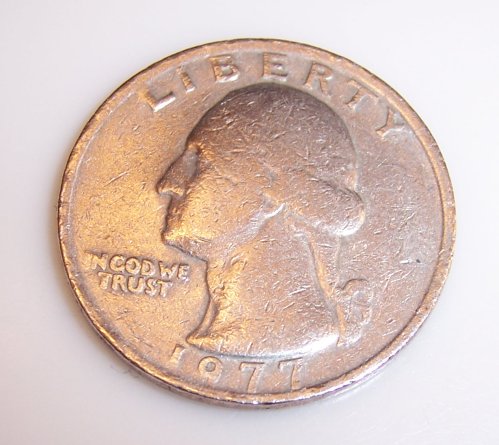
I got a Las Vegas quarter in change the other day. This is a term I use for certain coins (generally quarters but occasionally nickels) that (after spending decades ricocheting from one slot machine to another) have a distinctive beat-to-hell appearance that can’t be mistaken for anything else. Las Vegas quarters don’t wear smooth and shiny like quarters that people use to buy burgers at McDonald’s. They’re full of dents and nicks and more matte than polished. They also look like they were dug up in some Roman ruins in Gaul after a century or three of service.

Vegas fired its quarters back in the late 90s, when computerized slotless slot machines began replacing electromechanical slot machines with a vengeance. They’re now gradually filtering out into general circulation. This is the second I’ve seen this year, after never getting one outside the city itself prior to that.

I never entered a Las Vegas casino before my first trip to Comdex in 1985, and I remember that the metallic racket of quarters being spit into stainless-steel pans at the Continental Hotel and Casino was continuous and never stopped for even a second. The psychological effect was intentional and obvious: People weren’t just winning now and then. People were winning constantly. And the quarters paid the price.

By the time Carol and I took a short trip to Las Vegas a few years ago, the coin machines were gone. The racket of interacting metal objects had been replaced by a continuous cacophony of crude digital jingles, a sort of MIDI hell that I found a lot harder to take than the now-vanished quarter clatter.

I have a little dish of odd coins that I’ve gotten in change over the years (mostly foreign ones and American coins with weird damage) and my 1977 Vegas quarter will join them. Such quarters are tokens (literally) of a piece of technology that slipped away when nobody was looking, and a hundred years from now, I wonder if someone will pick up such a quarter and think, “My God, what happened to that poor thing!”