Jeff Duntemann's Contrapositive Diary Rotating Header Image

software

Annotating Reality

We’ve had evening clouds here for well over a week. Maybe ten days. I’ve lost count, but I may well have to kiss off seeing that supernova in M101. That’s a shame, because I’ve downloaded the Google Sky Map app to my new Android phone, and I want to try it out under the stars.

The app knows what time it is and where you are, and if you hold the phone up against the sky, it will show you what stars/planets/constellations lie in that part of the sky. Move the phone, and the star map moves to reflect the phone’s new position. How the phone knows which way it’s pointed is an interesting technical question that I still need to research, but let it pass: The phone basically annotates your view of the sky, and that’s not only useful, it suggests boggling possibilities. I’m guessing there are now apps that will identify a business if you point your phone at it, and possibly display a menu (the food kind) or a list of daily sales and special deals. With a rich enough database, a phone could display short history writeups of historical buildings, identify landforms for hikers, and things like that.

That mechanism is not an original insight with me; Vernor Vinge described almost exactly that (and much more) in his Hugo-winning 2006 novel Rainbows End . Most of my current boggle stems from not expecting so much of it to happen this soon. When I read the book back in 2006 I was thinking 2060. We are well on our way, and may be there by 2040. (Vinge himself said 2025, but me, well, I’m a severe pessimist on such questions. How long have we been waiting thirty years for commercial fusion power?)

In general terms, I call this idea “annotating reality.” In its fully realized form, it would be an app that will tell me in very specific terms (and in as much detail as I request) what I’m looking at. I do a certain amount of this now, but with the limitation that I have to know how to name what I’m looking at, and that’s hit-or-miss. I have an excellent visual vocabulary in certain areas (tools, electronic components, wheeled vehicles, aircraft) and almost none in others (clothes, shoes, sports paraphernalia, exotic animals.) I was 25 before I’d ever heard the term “lamé” (metallic-looking cloth) and had no idea what it was when I saw it mentioned in one novel or another. I had indeed seen lamé cloth and lamé women’s shoes, but I didn’t know the word. It’s more than the simple ignorance of youth. As much as Carol and I are involved in the dog show scene, I still see dog breeds here and there that I don’t recognize. (Is that a bergamasco or a Swedish vallhund?) Even my core competence has limits: I received a Snap-On A173 radiator hose tool in Uncle Louie’s estate, and if it hadn’t had Snap-On’s part number on it I doubt that I’d know what it was even today, because I don’t work on cars.

I want something that lives in my shirt pocket and works like Google Images in reverse: Show it the image and it gives you the text description, with links to longer descriptions, reviews, and shopping. This is a nasty computational challenge; much worse, I’m guessing, than query-by-humming. (I’ve been experimenting with Android’s SoundHound app recently. Nice work!) Dual-core smartphones won’t hack it, and we’ll need lots more bandwidth than even our best 4G networks can offer.

But we’re working on it. Facial recognition may be worst-case, so I have hopes that the same algorithms that can discriminate between almost-identical faces can easily tell a tubax from a soprillo. I can’t imagine that identifying the Insane Clown Posse band logo is all that hard–unless, of course, you don’t follow rap. (I don’t.) Bp. Sam’l Bassett did some clever googling and identified Li’l Orby for me, but as with the Insane Clowns logo, the problem isn’t so much drawing distinctions as building the database. Pace Sagan, there are billions and billions of things right down here in the workaday world. Giving them all names may be the ultimate exercise in crowdsourcing. But hey, if we can do Wikipedia in forward, we can do it in reverse. C’mon, let’s get started–it’s gotta be easier than fusion power!

UPDATE: Well, if I read Bruce Sterling more I’m sure I’d have known this, but Google’s already started, with Google Goggles. I downloaded the app to the Droid X2, and surezhell, it knew I was drinking a Coke Zero. The app said clearly that it doesn’t work on animals, but when I snapped QBit it returned photos of three white animals as “similar,” including a poodle, a kitten, and two bunnies. Close enough to warrant a cigar, at least in 2011. More as I play with it. (And thanks to the six or seven people who wrote to tell me!)
Amazon’s Print Replica

A few days ago, Mike Ward tipped me off to a new ebook format coming from Amazon: Print Replica. The new format is a lot like PDF, in that it presents a fixed page layout that cannot be reflowed, only panned and zoomed. A lot of people have been scratching their heads over it, but some things were almost immediately obvious to me:

  • Amazon will some time (reasonably) soon release their long-rumored high-res color tablet, capable of displaying fixed-format color page layouts at high quality.
  • Amazon wants a piece of the digital textbook market.
  • The whole point of the format is time-limited DRM.
  • And the whole point of time-limited DRM is to prevent any least possibility of a used ebook textbook market.

I’ve spent a couple of days sniffing around for details, though not much is out there yet. The format in question is .azw4, and you can buy some titles in the new format right now. However, .azw4 ebooks will only render on Kindle for Windows 1.7 and Kindle for Mac 1.7–and only in the US. It’s not only a great deal like PDF; it is PDF, inside a proprietary wrapper. For the moment, it seems that publishers submit a conventional print-image PDF to Amazon, and Amazon places it inside the wrapper.

I’m pretty sure that Print Replica is Amazon’s version of Nook Study, which I mentioned in my April 18, 2011 entry. Nook Study is also a DRM wrapper around a PDF. The DRM is draconian and mostly hated by everyone who’s ever tried it. I’ve never seen evidence that Nook Study is being adopted broadly, but if Amazon’s imitating it, that market must have begun to move.

If it is, it’s probably the only segment of the publishing market that is moving right now, where “moving” means “better than marginally profitable.” Textbooks are the cash cows of the publishing business, and because college education is a monopoly market for books, students shrug and pay well over $100 a copy, often more. There’s very little competition and almost no choice. The prof assigns the book and that’s that. The only shopping possible is for cheaper used copies.

The argument made for digital textbooks is that they are less bulky and can be cheaper than printed textbooks, but cheaper here means $80 as opposed to $120. The argument against is that the legal waters are still very murky on used ebook sales. The doctrine of first sale makes it legal to sell used print textbooks, though there are wrinkles involving importation. Current case law for software suggests that license agreements (even ones that can’t be examined before the sale) may prohibit resale of a physical boxed software product, like AutoCAD. It’s pretty clear that if ebooks are eventually considered software, first sale may no longer apply. To be certain, publishers want textbooks to vanish once each term is over, so that they cannot be resold irrespective of future legal decisions. Once most textbooks are ebooks, every sale is a new, cover-price sale, and if time-limited DRM is taken at face value, once the term is over, the book goes poof. (And whaddaya bet that that $80 e-text will be $85 next year, and $95 the year after that?)

I still have about a quarter of my college textbooks and still refer to them occasionally, most recently Listen, by Nadeau and Tesson (1972.) It’s hard to imagine not having any of the books I studied back then (granting that I only kept the better ones) but it’s sure starting to look like that’s the future. It’s also hard to think of a redder flag to wave in front of the nascent ebook piracy scene than an $80 price tag. As I’ve said many times, I’m glad I got my degree in the 70s, when a term cost $600 and you could keep your books forever.

The Last of the 5″ Floppies

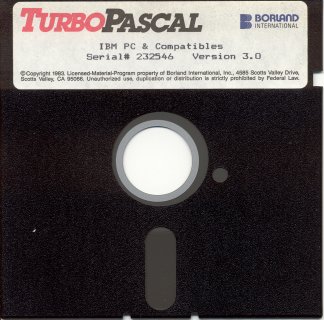
TP3Floppy325Wide.jpgThe AC works again, though now that it does, the hot spell has broken and we don’t really need it. (Love that 72 degree stuff!) However, Carol and I have some cleanup to do, as the air handler made a honking puddle on the furnace room floor downstairs, soaking the bottoms of a number of boxes. Some of those contained Christmas stuff, including my old Lionel trains. More intriguing, another, smaller, box contained a stash of 5 1/4″ floppies from the late 1980s and early 1990s. I went through it to see if there were any old backups to be destroyed (there were none) but the commercial software lineup in the box is pretty impressive:

  • Turbo Pascal 2.0 (includig Turbo 87), 3.0, 4.0, 5.0, and 5.5
  • Turbo Pascal for Windows
  • Mystic Pascal
  • QuickPascal 1.0
  • TopSpeed Modula 2
  • TopSpeed C
  • Stony Brook Modula 2
  • Smalltalk/V286
  • Turbo Basic
  • Quick C
  • Reflex 1.0 and 2.0
  • Turbo Lightning
  • Paradox 2
  • WordStar 3.02
  • MS Word 6.0

…and lots of additional stuff from Borland and other companies, most long gone. Falk Data Systems; Software Science, Inc; Digitalk; Adapta Software, and on and on and on.

The box is toast, and I’m thinking that most or all of the disks have long since become unreadable. Still, it would be interesting to see how true that is. I checked my Paradox 4.0 3 1/2″ floppies from 1993 just now and they still read, so I suppose it’s possible. Alas, I haven’t had a 5 1/4″ floppy drive in the house in years. I’ll be going up to OEM Parts later this week to gather a few things to replenish my parts drawers, and I’ll bet they have a drive on the greasy old crap table. I’ve even got a working machine in the to-be-recycled pile with an open front bay to put it in.

I know, I know–bad use of my time. But at very least I’m going to rejoin the Turbo Pascal 2.0, 3.0, and 4.0 floppies with the manuals, which are still on the top here in my office. I’m sure I can part with the rest. Those, well…in a very real sense they helped pay for the house we’re now living in, so I’ll add them to my memoirs archive. And just in case they do read…I can bring up a DOS VM in ninety seconds flat!

Ten Gentle Opportunities and Virtual Assistants

djdenise.jpgI’ve been getting notes from all corners the last few days about a $200 virtual DJ program that has been been given her own show on radio station KROV in San Antonio. The program is actually an application of a more general “virtual assistant” product from Guile 3D Studios. DJ Denise goes on the air at KROV tomorrow, from 1 PM to 4 PM. You can listen over the Web; I intend to.

Most of the horsepower in creating Denise seems to have gone into rendering her lip gloss, which is odd for something used as a broadcast audio DJ. I’m more interested in whatever AI lies behind the pouty face, though early indications are that she has more lip gloss than AI. It’s an issue of special interest now, because I’m making slow but steady progress on a near-future SF novel that explores (among other and stranger things) the border between real AI and “fake” AI, a category that goes back to the ELIZA program at MIT in 1966. Ten Gentle Opportunities contains both. A cheap coffee maker contains an animated barista that talks a lot and understands little. A model-year 2020 Mazda RX9 has an annoying dashboard cartoon that understands more deeply but very narrowly. Both handle natural language well, and people are easily fooled into thinking that smooth natural language processing implies true intelligence.

I don’t think that’s true, as the more advanced AIs in the story demonstrate. One of them is Pyxis (Latin for “compass”) a high-end commercial product sold at a five-figure price as an executive assistant. Brandon Romero, an executive trying to manage a completely automated AI-controlled copier factory, has his own copy of Pyxis. (I posted a glimpse of the copier factory and its AI controller Simple Simon in my June 26, 2011 entry.) Far from being a geek-dream sex kitten, Pyxis is obedient without being especially pleasant. Worse, she holds her boss to his word, to the point where he begins to wonder who’s working for whom.

Romero dislikes having human underlings, but as he soon comes to understand, AI staff might be described the way Jerry Pournelle once described the Bomarc as the Civil Service missile: “They don’t work, and you can’t fire them.”

Pyxis saw him approaching his office door, and Brandon heard the lock bolts snap back. The coffee machine on the teak credenza was hot and full, and the air was rich with the scent of dark roast and Irish Crème. The human interns always scattered magazines on the glass coffee table against his preferences; the day when paper magazines became extinct could not come too soon. One of those interns had recently left a stuffed moose on the credenza. This was at the direction of HR, which (as he later discovered after much annoyance) wanted to “soften the human side of his persona.” The ugly abstract art shotgunned at the eggshell walls was bad enough. God forbid he should meet with a Chinese parts supplier without his stuffed moose.

Brandon sat down at his teak desk, its oiled vastness divided into the rigorously rectangular regions he maintained at all times, including a small square for coffee and another for mints: charts, summaries, two tappers full of notes and test-run videos and model animations, all at his fingertips. Defining the far sides of his desk were three brushed-stainless OLED panels currently animated with some slow-flowing pearlescent liquid that looked like shampoo. Far too soon, the triptych would spring to life with more views of this lunatic’s kingdom than any one man could possible follow.

Pyxis saw him sit down, and a window in the panel to his right burst into existence with her scowling image. “Twenty-six messages vetted and queued, five urgent.”

“Later.” If it wasn’t from that ass-covering coward Amirault, he didn’t want to hear it. Brandon set his primary tapper down in its vacant rectangle on the desk, and pulled a few loose papers from his briefcase. Like everything else, each had an appropriate place, and he scanned the piles that had been accumulating for most of a week, dropping a sheet here and a sheet there. The stapled set describing Zircon’s looming Retirement Incentive Program (was that a hint?) needed to go somewhere. A new pile? For corporate suicide notes? Brandon scanned the desktop almost automatically, but there was only one empty rectangular region left.

He stared at the tidy strip of oiled teak and felt himself tighten inside. Not big enough for anything except bad memories-but like those infuriating little sliding-square plastic puzzles, he had never hit upon an arrangement that would eliminate it.

“Here it is, Mr. Romero.” A new window popped into view, with a high-res scan of the framed photo that had stood in that teak rectangle for many years: Carolyn in a white cotton V-neck sundress out in her garden, holding a cardboard sign reading, “Greek Fire.” To a newly minted second lieutenant on the ground after Desert Storm, it meant that Carolyn Helena Ankoris was waiting impatiently for him to come home and marry her. To Major Brandon Louis Romero, US Army, Retired, it meant only failure.

“I didn’t ask you to open that.”

“You were staring at the space where the photo had been.” Building 800 was as full of electronic eyes as it was empty of human beings. Pyxis not only knew where he was at all times, she knew where he was looking.

His AI assistant was unfailingly obedient, but Brandon had set her obsequiousness parameter to zero. What was the point of having a virtual suckup? It wasn’t like the physical world suffered a flunkie shortage. “Your job isn’t to read my mind.”

Pyxis folded her arms implacably. “My job is to anticipate your needs and help you stay productive. We have a line start in a little over an hour. You have a lot to do. Mr. Amirault asked you to copy him on a call to…”

“Ok.” Brandon tossed back the last of his Red Hen coffee, and flashed with sad longing to his Army B4 training, when he had aimed an M16A4 at line-drawn enemies printed on sheets of cardboard, and nailed every damned one through the heart. “Get me Simple Simon.”

Odd Lots

  • Antique Electronic Supply in Tempe, Arizona, has created a new DBA for their tube audio amplifier business: Amplified Parts. The tube stuff still predominates but it’s hardly “antique” and has definitely gone upscale. They rate their power tubes like fine wine: “This Russian tube [6L6GC] has tight lows, straightforward body, and smooth highs. In overdrive, it offers a tight and frosted crunchy bite.”
  • My Taos Toolbox 2011 colleague Alan Smale just won the Sidewise Award for Alternate History at the 2011 Worldcon in Reno. We workshopped an expansion of the winning story, “A Clash of Eagles” and it was terrific. I’m guessing this will make it perhaps a little easier to sell the novel-length work. Bravo, Alan!
  • Even though HP announced yesterday that they were killing their cloud-centered TouchPad tablet, Carol and I saw an expensive commercial for the device on The Weather Channel this morning. Cloud? Did you guys say “cloud”? (No wonder they got the ad…)
  • If you haven’t seen it yet, definitely take a look at Stellarium, a free planetarium program available for Windows, Mac, and Linux. It’s one of the best I’ve ever tried, more polished (if not as deep) as the venerable Cartes du Ciel, which is remarkable in part by being a Lazarus app.
  • David Stafford sends word that an elaborate steampunk loft apartment has gone up for sale in Manhattan. The price? A “mere” $1,750,000.
  • This is killer cool as binoculars go, but would they capture anything at night? (Somehow I doubt it.)
  • Bill Higgins writes to tell us that Catholic University has placed a scan of the 1964 Treasure Chest comics series “Pettigrew for President” online, for free download. I blogged about this years ago, but the comic was not available for download then.
  • Nick Kim does Cowboys and Heavy Metals. (Thanks to Pete Albrecht for the link.)
  • Fellow carnivore Jim Tubman and I share an appreciation for The Periodic Table of Meat. Most of it, anyway. (No thanks on Meat 75. Oh, and 95.)
  • Back from meat to metals again: Given that it’s the cornerstone material required to build the Hilbert Drive as used in many of my SF yarns, I was a little surprised that ytterbium is so cheap.
  • Did you ever wonder about the physics of coffee rings? Wonder no more.
  • From the Please-Give-Those-Guys-Something-To-Do Department: New taxpayer-funded NASA research tells us that unless we take prompt and serious action against global warming, aliens may invade and wipe us out. UPDATE: This turns out not to be entirely true: The chap who co-wrote the paper works for NASA but he did it on his own time and there was no public funding involved. The Guardian has corrected the piece.

Odd Lots

Odd Lots

Odd Lots

  • Strahinja Markovic, the chap who created the very good Sigil epub editor while he was a CS undergrad, now has a master’s, a good job, and…a life. (How dare he? ) In a recent blog post, he’s asked for prospective maintainers of the code (which is open source) to introduce themselves and make a case to him as to why they should be trusted to carry on the work. He doesn’t know me; I’m just spreading the word, because I use Sigil and I want it to continue to evolve.
  • We have the same problem with the Kompozer WYSIWYG HTML editor; poor Fabien “Kaz” Cazenave has a new job and very little time to devote to the product. I like Kompozer but it has some rough spots, and I hope someone will take over and keep the wheels turning.
  • In the meantime, I’ve installed and am testing BlueGriffon, and so far I like what I see. The editor incorporates the Gecko rendering engine used in Firefox 4, so if it looks good in BlueGriffon it’ll look good in Firefox. It has HTML5 and CSS3 capability, and an interesting business model: The editor is free, and the developer sells various add-ons. That doesn’t bother me at all; the whole suite of 9 add-ons can currently be had for $35 Euros, or about $50US. If BlueGriffon performs well on my existing Web documents, I’d pay that like a shot, even if I don’t use the add-ons.
  • As brilliant as the original Turbo Pascal was, it wasn’t alone. From Andrew Stuart comes a link to the deep history of Nick Gammon’s G-Pascal, an enviable piece of assembly-coding work that put a potent Pascal compiler for the Commodore 64 in…16K. If you used G-Pascal back in the 80s, this is a must-see, especially the links at the end, to the sorts of ads and programming newsletters that were the lifeblood of personal programming in the early 80s.
  • I don’t know if you’ve ever needed an 18″ USB A-B cable, but I did, and after a great deal of looking around, I finally found them at Other World Computing. It’s mostly a Mac shop, but has the short A-B cables for both USB 2 and USB 3. The cable connects the USB hub on my Dell 20″ monitor to the GX620 USFF machine mounted immediately behind it, and keeps cable clutter down behind the monitor.
  • Little things sometimes matter: The Toshiba Thrive has a full-sized SD card slot. Not micro. This means that I can use the SD cards I already have. A mini-USB adapter will also allow me to use my existing thumb drives. Ports and card slots have been the deal-killer so far on tablet after tablet. This one (though it won’t be in stores until July) still has an edge. (Bill Roper reminded me that I needed to post about this.)
  • From Smithsonian comes a long and detailed article on what amounts to beer archaeology. (Thanks to Rich Rostrom for the link.)
  • For those who asked: Simple Simon’s formal name (from my entry for June 26) is Factory Automation Real-Time Supervisor, and yes, the acronym was highly deliberate. His robotic factory is the Automated Reprographic Fabrication Facility, and (as you’ll learn in the novel) the project had always been a dog.
  • WUTZ 4 DINR?

Waiting for Godot…No, Make That s-static.ak.facebook.com

Not much about this to be found online, but for the past couple of days, Facebook has been waiting eternally on one of several servers after displaying the first page of entries. The commonest address it hangs on is:

s-static.ak.facebook.com

Any thoughts about this? Chrome does the same thing, suggesting that it’s not a browser issue but a local configuration issue…except that I haven’t done anything to the router configuration or the XP network configuration for a long time.

Javascript is enabled, and unloading NoScript doesn’t help. If this doesn’t get fixed soon I’m going to simply stop reading the damned thing. Software that breaks itself without provocation is not generally welcome around here. Not for long, anyway.

UPDATE: The fix (for me at least) was to enable the MTU setting in my Linksys router and set the MTU value to 1454. That’s a sort of “golden” value that appears to be the optimal packet size on PPPoE connections. I’m still puzzled as to why this would alluvasudden be a problem  (I’ve had the MTU setting disabled and the default value of 1500 in force for years) unless Facebook were doing some tweaking on the server side.  That said, modernmechanix.com now works as well, and I had pretty much given up on it. If you have problems with Web sites hanging unpredictably, this is an easy fix (assuming your router provides the option) and should be the first thing you try.

Skype and EasyBits: Mistake or Attack?

After a strange reluctance to jump on the issue, the major news outlets have begun covering the excitement of this past Saturday morning, when untold numbers of Skype users suddenly found new software installed on their Windows PCs, without so much as a notification or request for permission from Skype. Skype has been almost silent on the issue, as has the firm that originated the software in question, EasyBits GO. EasyBits is not obviously malware, but there were some weird EasyBits/Skype connections with malware last year, and Saturday’s install certainly acted like malware. So was it a mistake? Or was it an attack? The greatest weirdness of all is that we still don’t know.

My take? It looks like a mistake. It smells like an attack.

I set up an old XP machine with Skype on it Saturday afternoon, and left Skype running in a window. It’s still running as I write, and there’s no trace of the EasyBits installer. I thought the fact that it was still at SP2 might have made a difference, but I’ve heard from people who got the install on SP2 machines. This suggests that Skype immediately stopped pushing installs once the crap started to fly online, which further suggests that Skype was in control and that it was a mistake rather than an attack.

There’s a tendency to love a great story, and we have to be careful not to read more into things than reality warrants. I’m an SF writer, and the futures I’ve tried to predict (as have many other, far more notable SF writers than I) have turned out to be a lot more dramatic and colorful than the future that actually worked itself out over the years. We underestimated small things (computers) and way overestimated big things, like space travel and (yes indeedy!) flying cars.

Here’s an example of wearing your SF hat too much: Some years back, I was predicting that malware authors would create trojans that very quietly installed file-sharing nodes behind the screen of rootkit techniques, which would then search for sharable content on the machine and then open LimeWire-style P2P connections to the Net at large. Because it was a trojan, it would provide plausible deniability in copyright infringement lawsuits–and because it provided plausible deniability for file-sharing, people would deliberately infect their machines with it. The trojan would soon be on over a billion machines, and Big Media could do nothing at all about it.

That would have made a great cyberpunkish story; maybe I should still write it. But it didn’t happen, and I think it won’t happen. Malware authors are well past this sort of Merry Pranksters stage. Malware happens for one reason only: Money. If there’s no way to monetize a malware scheme, it won’t be written. So with anything like the Skype Affair, you have to look for the money. Crapware still seems to be the likeliest explanation: EasyBits could have paid Skype by the install to push down a new version of its games platform, and make it look like a normal Skype update. Stupidity intervened, which happens all the time. (Google “Sony Rootkit” to see only one example, and certainly the stupidest. Bruce Schneier has what I consider the last word.)

That said, there’s still the possibility that a server-side infection was behind the push, and that what we got was a compromised version of EasyBits that may at some later time (patience, patience!) download the Real Deal, whatever that Real Deal might be. And whatever it is, it’ll be about money.

The end of the story hasn’t been written yet. Keep your virus checkers handy. Consider Skype alternatives. (Look into Jitsi.) And stay tuned.