- SRWare Iron was doing a peculiar thing: When I used it to view my junkbox.com main page, the title image was broken. This was not the case using IE, FF, or Opera. Nor was it true of the several other images on that same page, but only that big main one. An intuition led me to look up the name of the image file: junkboxmainbanner.png. I renamed the file “junkboxmain.png” (that is, removing the substring “banner” from the filename) and the image began rendering normally. I guess there’s a downside to adblockers as twitchy as this one.
- From Bruce Baker comes a nice chronological screenshot survey of computer GUIs since the primordial Xerox Alto in 1973, up through Windows Vista and KDE 4. No judgements are passed on the products, and not much history is offered, but it’s unusual to see them all lined up in one place, and one definitely gets a sense for the way it all evolved, and especially for the immeasurable debt that Apple owes Xerox.
- On a tip from Pete Albrecht, I’ve learned that the Progressive Insurance girl Flo and one of the Geico cavemen shared a scene in the short-lived 2007 TV sitcom Cavemen . Here’s a YouTube clip of the scene. This was sheer coincidence; the Progressive ad campaign did not happen for at least a year after that and Stephanie Courtney just happened to get the part. I tried to like the series and failed, but I’ll admit that it had some surreal moments, a few of which we evidently didn’t appreciate at the time. Now, cavemen ate geckos. (Cavemen ate anything they could catch.) Dare we hope…
- Here’s an old article from Popular Mechanics on building your own Geiger counter. Michael Covington reminds me that there was a circuit in Alfred Morgan’s book The Boys’ Second Book of Radio and Electronics, though it had a peculiar power supply and didn’t work when I tried to build it in 1966. (I may still have the G-M tube somewhere, but I can’t find it and in truth haven’t seen it in decades.)
- Yet another one, this time from Popular Science, March 1950.
- Todd Johnson suggests using scrounged or surplus fluorescent lamp supplies from computer scanners for homebrew Geiger counters. I’ve got two defunct scanners on the woodpile downstairs, but if you don’t, Todd also sent along a pointer to a surplus source, for only $5.
- Today is Ubuntu 9.04 day. It’s like the Day after Thanksgiving at Marshall Fields up there, so don’t expect much in the line of download performance. I’m going to wait for the dust to settle a little (and maybe for my assembly book to be done) but it will happen here sooner or later. If you want it, look for torrents. And come with a backpack of patience.
- Do you have Linux running on an Intel DQ35 motherboard. If so, be careful.
- Finally, this clever food hack reminds me vaguely of something. I don’t know what. That’s probably just as well.
electronics
Odd Lots
Odd Lots
- Back when I was in college in the early 70s, a woman friend told me, “The trouble with you, Jeff, is that you’re too damned happy!” Maybe this is the answer.
- Numerous people have sent me links to “St. Patrick Drives the Snakes Out of Ireland” cartoons, and while they’re all good (use Google Images and you’ll see them) they’re not the one I remember, which I’m now pretty sure was published in National Lampoon circa 1974.
- I misunderstood what my sister said about Crayola crayons in my March 13, 2009 Odd Lots. Crayola (once made by Binney & Smith, now part of the Hallmark empire) manufactures a line of washable crayons, and these are what Gretchen prefers that Katie have, given my elder godchild’s penchant for seeing all the world as her coloring book. The washable crayons have no particular smell to them, but the other day when Gretchen and Bill and the girls and I were in the Mount Prospect Hobby Lobby, Gretchen opened a conventional box of 16 Different Crayola Colors and let me sniff them. Yup. That’s the one. Perhaps some things really are forever.
- I’ve thought that the name of the Sci-Fi Channel has been an embarrassment for 16 years. (Actually, so have most of their house-bred feature-length films.) But now, they’re changing their name to…Syfy. And adding professional wrestling to the lineup. The dork-in-chief over there says that he’s been trying since the 1990s to “…distance the network from science fiction.” Mission accomplished, dood.
- From Baron Waste comes a largish drawn panel by Dusty Abell that somehow represents (as far as I know) every significant SF TV show to come out of the 70s. It’s a good proxy for how much TV you watched at the time, muddied by what you may have seen at cons in the middle of the night in intervening years. I can name perhaps a quarter of the shows represented, so I guess I wasn’t particularly tuned in. (I will admit with some embarrassment that the first whose title came to mind was “The Greatest American Hero.”) And although that little robot golem looks familiar, I can’t place the show that it was on.
- From Pete Albrecht comes a page introducing the Decatron tube, which presents for display a circle of thirty neon-lit points that can be configured to move a group of three around the circle each time a pulse enters the circuit. (Follow the links for more detailed information, especially this one.) The tube “remembers” which group of points is illuminated, and so it can be used to build a decade counter, or a divide-by-10 prescaler for slower mechanical counters. Very slick, and reminds us that technology was perhaps a little more sophisticated in 1954 than we remember–because much of it didn’t sit in the corner of the living room.
- Here’s a new kind of egoscan, at least for technical writers: Search Google Patents for your name. I’ve been cited 27 times in patent filings.
- Rich Rostrom reminded me (after I reported close encounters with numerous tumbleweeds on the plains heading out to Chicago) that tumbleweeds are Eurasian imports that hitched a ride along with shipments of agricultural flaxseed from Europe in the 19th Century. Along with other things that we consider iconically American, tumbleweeds actually came from somewhere else. (I guess that makes us the Ecosphere of Immigrants.)
- I didn’t know that Global Warming™ has made it impossible to build good violins. Um…I still don’t.
Odd Lots
- From the Words I Didn’t Know Until Yesterday Department: Chicanes are small kinks placed along the course of an auto race, to make the race more…interesting. Heh.You race. I’ll watch. (But not anywhere near a chicane.) Thanks to Pete Albrecht for teaching me this one.
- According to my good sister Gretchen, that very distinctive and extremely memorable smell of Crayola crayons was due to the animal tallow (probably beef) used in the waxy crayon base material. This is significant because Katie’s pumpkin-shaped bucket of new crayons has no smell at all. None! I may have to buy a set of “classic crayons” on eBay to smell that smell again. (Or maybe I can con my friends into each sending me one of their dupes. Unlike some people, I wouldn’t care if my set consisted of four Periwinkles, three Thistles, five Cornflowers, and a few scruffy Raw Siennas. Variety can be overrated.)
- And just in case you like the smell of classic crayons so much that you want to smell just like them, here’s Crayon Cologne. (Would using that make me a Person of Color?)
- Other kid smells worth recalling are Play-Doh and freshly sharpened pencils. My mother bought a canned wallpaper cleaner compound once in the 1970s that looked and smelled a great deal like Play-Doh. In sniffing around online, I found in Wikipedia that the Play-Doh compound was originally marketed as…a wallpaper cleaner. And even today, I occasionally pull the casing off my electric pencil sharpener and take a deep whiff.
- More kid stuff: Did any of you ever have a Puffer Kite? And if so, did you live in or near Chicago? The Puffer was an inflatable kite, something like a beach toy in the shape of a pork chop, with a grommet for a string. It was patented in 1967 and I had one while I was in college, circa 1973. I’m gathering what little information exists about the Puffer Kite, and it appears to have been a Chicago product, made by the Fredricks Corporation, precise address unknown. I’ve written to a man who may be the heir of the Fredricks operation, and we’ll see what comes of it.
- More than half of the boggling numbers of mortgage forclosures have occurred in only 35 counties across the US, with 25% occurring in only eight counties. (Alas, the crappily written article does not name them.) States like Nebraska, Kansas, and Kentucky (and most other flyover states) had no counties at all where there were over 20 foreclosures per thousand households, and yet people in small towns and rural areas are essentially bailing out big cities with their tax money. (Thanks to Michael Covington for the pointer.)
- One of the most wonderful collection of mad-scientist backgrounder material I’ve seen in quite awhile can be found at Mike’s Electric Stuff. Geissler tubes, Nixie tubes, and (do not miss this one!) what is arguably the world’s first integrated circuit, made in 1926 and providing resistors, capacitors, and three vacuum tubes in a single glass envelope!
- If you like your radios steampunkish, check out Sparkbench, with some of the most beautifully executed homebrew radios I’ve ever seen. More here.
- The longest-lived person on the Duntemann family tree so far is Alvina Duntemann Wille, who lived from 1880 to 1978. She was the daughter of Louis Duntemann, my great-great grandfather’s younger brother, and lived her entire life in Mount Prospect, Illinois, in a house that stood where the Busse Car Wash stands today, right on Prospect at Maple. My great-grandmother Martha Winkelmann Duntemann did all right too, and made it to 96, outliving all four of my grandparents. I hope to do as well.
Odd Lots
- Don Lancaster sent me a link to the Draganfly, a mighty cool RC/GPS guided helicopter for
aerial photography or police/military applications. MIT has worked out an algorithm for swarming these things, which isn’t too
mind-blowing when you have three or four…but how about a few thousand? - On the other end of the scale for flying machines, Wired
reports the opening of the Jumbo Hostel, a pulled-from-service 747 jumbo jet that was gutted and fitted out with (small) rooms for Stockholm airport travelers who simply can’t get enough claustrophobia. - And if you’re looking for something that will not only fly but fly high, there’s the unfortunately named Skylon, to which I call your attention because it reminds me of those Bonestell drawings of the canonical 50’s three-stage orbital rocket, particularly the nose section. Alas, we won’t see it for ten years, which is about how far into the future such things always are. (The only thing farther out is commercial nuclear fusion.)
- Here’s another very spooky atmospheric phenomenon described on Spaceweather. This is not a sundog but a subsun, which is much brighter and I’m guessing a lot more startling.
- Fractal woodburning, anyone?
- While American technical and scientific magazines seem to be cratering right and left, Steve Moulding writes to tell us that Elektor Electronics , a longstanding European publication catering to hobby electronics, will be launching a printed North American edition. It’s unclear how this will differ from the UK edition (which is the only one I’ve ever seen) but anything that helps promote hands-on electronics here is welcome. (There’s not much left on the home front but QEX and Nuts & Volts .)
- And if the loss of paper magazines depresses you, consider that just a few days ago, the last paper player-piano music roll came off the assembly line in Buffalo. Interestingly, brand new player pianos of this sort were being sold well into the 1960s; the family down the street where I grew up had one when I was tweve or so.
- A Japanese chap built himself an automated book scanner using Lego. (!!!) It’s a delightfully Goldbergish contraption that basically holds the scanner upside down and presses an opened book up against the inverted scanner glass, dropping the book between scans to turn the pages. (Watch the video!) Big Pub seems excessively worried about ebooks and feels that their refuge still lies in paper. Maybe not. (I’ll bet I could do up something like this in Meccano, of which I have much. Just another three hours in the day, fersure…)
Setting the Ether on Fire
I finally finished my attic shortwave antenna a few days ago, after puzzling over how to do it for almost four years. It was both easier and harder than I thought. The project took up most of my spare time for a week, and required me to practice tossing a tethered tennis ball around up there between the two attic hatches.
I had to get the antenna up in the attic, above the walls of the house here, because the walls are stucco-coated chicken wire and thus form a very effective shield can. Even a 40' dipole in my workshop could pull in only some of the strong local AM broadcast stations. The new antenna works extremely well, and scanning the bands on Wednesday night with the Icom 736 brought in all the usual suspects from Europe at 9 MHz, along with an amateur station in Costa Rica at 7220 and another one that was (I think; copy on that one was poor) in Argentina. The quiet sun means that the bands above 14 MHz are basically dead, but assuming that we're not headed into the next ice age, they'll be back in a couple of years.
The wire was cut for 7200 KHz, and the measured SWR minimum was at 7130 (with another potentially useful one at 21400) so I got pretty close. Seeing if I could get a signal out was the next test. I tuned around on 40M to find a quiet spot, pressed push-to-talk, opened my mouth…
…and the fire alarm went off. I tore upstairs to find Carol in a panic and QBit barking furiously at the cold-air return where the siren lives. I didn't assume that the transmitter was at fault, but took a quick run around the house and garage to make sure nothing was burning, and by the time I reset the siren, the alarm system had already called the fire department. Nothing was burning, and with a red face I had to tell the firemen who came up in a truck (not a huge one, fortunately) that my transmitter had triggered a false alarm.
The garage smoke detector is perhaps 5' below the south leg of the dipole, and I may have to have the company that installed the alarm system run shielded cable to it. We think that the dipole was inducing sufficient current in the smoke detector cable to trigger the system, so the shielded cable may be enough. If the dipole is inducing currents in the smoke detector itself, the detector may have to go into a Faraday cage of some sort. The fact that the vulnerable detector is in the garage is fortunate. Out there a Faraday cage would be almost stylish; but maybe not so stylish on our livingroom ceiling.
So amateur radio station K7JPD will remain off the air for a little while longer. Damn. Hiram Percy Maxim didn't have this problem. Ubiquitous computing—and the wires that make it work—are a two-edged sword.
My Favorite (Or Maybe Second Favorite) Year
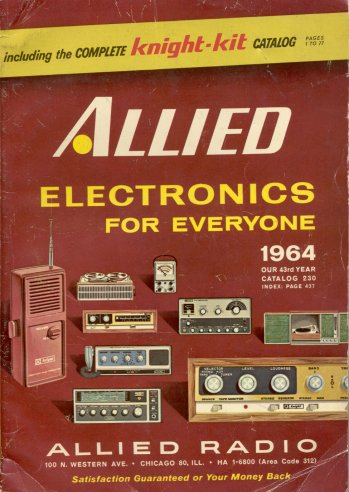 Harry Helms recently sent me something he thought I might enjoy: A copy of the 1964 Allied Radio catalog. When I opened the package and sat down with it, I realized that 1964 might well be my favorite year, if second to any then second only to the magical summer of 1969, when I met Carol. (1969 was painful at times for reasons that had nothing to do with Carol, first of which being that in 1964 my father was not dying of cancer.) I turned 12 in the summer of 1964, and had not yet begun to feel the hormone storm that would close in by the summer of '65 and make me crazy for years to come. Granted, many of the girls returned to IC School that September with a couple of things they didn't have the previous June, but apart from a passing fascination with a little girl named Laura that fall (which she never found out about—whew!) the whole girl thing blew past me. Halloween was on a Saturday that year—what luck!—and it was warm. Ten full hours to scavenge sugar from the neighbors, and we didn't need three sweaters under our costumes!
But for me in 1964, electronics was the thing. I had discovered electronics when I was 10, began seriously reading library books about it and building things when I was 11, and had begun to achieve some modest success by the time I turned 12. Simple radios were problematic, because my antenna looked right down the throat of hillbilly rock station WJJD's 50,000 watt directive array a mile or so northwest of me in Park Ridge, so I built other things: A two-transistor organ (with keys made of strips of tin can metal) a cigar-box intercom (put to good use by the Fox Patrol at Camp Owassipe that summer) and a capacity-operated proximity relay, which (being “spooky action at a distance”) was about as close to magic as it came.
 That summer my father taught me how to take the CTA bus down to Six Corners (over my mother's strident objection) and always gave me a couple of dollars to spend at Olson Electronics on Milwaukee Avenue, back at a time when a couple of dollars would buy a pocketful of resistors, capacitors, and transistors. Allied was also in town (at 100 N. Western Avenue) but that was a lot farther away, and not in an especially good neighborhood. I knew Allied from its catalog and its catalog alone.
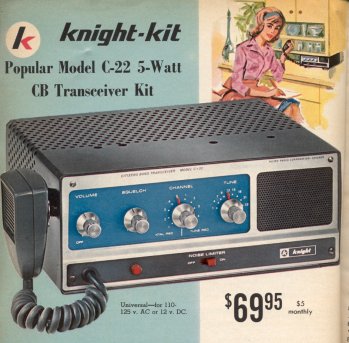
But what a catalog! Anything a boy teetering on the edge of the Age of Lust might want was right there: Ham radio, CB, shortwave, hi-fi stereo, tape decks, portable radios, test equipment, speakers, tools, parts cabinets, resistors, capacitors, transformers, Miniboxes, plugs and sockets and chassis punches and antenna insulators, everything. The first 77 pages of the catalog was the full list of Knight Kits, which were cheaper than finished gear because you put them together yourself. I later went on to build a few a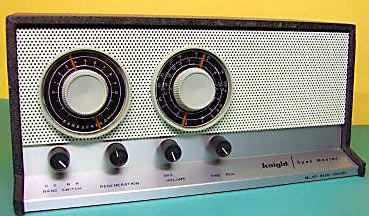 nd own many more Knight items, including the wonderful T-60 CW/AM transmitter, the nice LC-1 CPO, the so-so R-55A receiver, and the totally wretched T150A VFO transmitter, which wandered across more territory and with more brute persistence than an alley cat. Interestingly, the Knight Kit I wanted the most in 1964 I never got: The Span Master shortwave radio (at left) which I thought then (and may still) to be the coolest-looking radio in history.
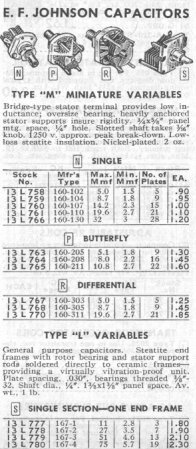 The back of the catalog was fascinating, as it listed in minuscule type endless small electronic parts and hardware, some of which I ordered through the mail, careful to send enough money to cover the goods and postage, and often (to be sure I hadn't messed up the shipping calculations) a little more—which Allied always honestly refunded, in the form of 4c and 7c credit slips to be applied to my next order. That part of the catalog is still useful as a reference: If you run across a Knight 61G466 power transformer at a hamfest, the catalog will tell you what the output voltages of its various windings are.
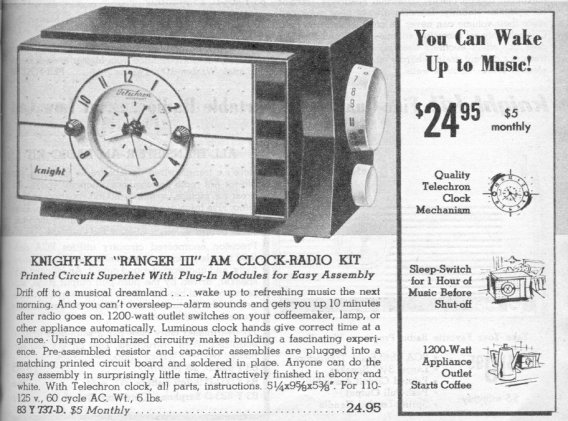
Some of the stuff I didn't want, and often had no clear concept of why it was useful: What good, after all, was a clock radio? I have an inner alarm clock that I can “set” to any arbitrary time and have never had any trouble bouncing out of bed at 6 ayem, often singing. (Carol is a very patient woman.) “You can wake up to music!” said the ad. Indeed. And you could plug your coffee pot into the back of the radio, which I just couldn't figure, as we were a gas household and an electric coffee pot was heresy, pure and simple. Tachometers and electronic ignition systems—no visceral response; when you're 12 and “small for your age” driving is almost unimaginable. The Blonder-Tongue (now there's a name for you!) TV mast signal amplifiers puzzled me; in Chicago you could practically get Channel 9 on your fillings. (You would, if WJJD hadn't already saturated them.)
1964 was the last great year of tube electronics, and the transmitters, receivers, and test gear units were not only big enough to see, they were big enough to cause serious injury if dropped on body parts. (I dropped a Central Electronics 100V transmitter on my thumb in 1998, and my thumbnail has never been the same since. And hey, in 1998 I was 46 and careful.) The prices on much of it were daunting: The Hallicrafters SR-150 SSB transmitter was $689—what the Inflation Calculator tells me would cost over $4600 today. The best a 12-year-old boy could do was look at the pictures and think, Hey, someday I may have this thing! The Allied catalog was the drool book of all drool books.
Yes, it was a great year. When my family went out to California on the Union Pacific that summer, my Allied catalog went with me (along with several issues of Popular Electronics and a couple of Alfred Morgan's books) and I got past the endless wheat fields of eastern Wyoming doodling chassis layouts on a pad of paper. That fall I built a regenerative receiver from a Popular Electronics article, with $15 worth of parts carefully ordered (and paid for by my saintly father) from the 1965 Allied catalog, which arrived without being summoned in October. I could never make it work well (though it picked up WJJD without any trouble) and there were times when I was tempted to give up electronics and just stare at Laura in English class like all the other guys did. But no: Girls were mysterious, and I would be years'n'years figuring them out. (I may still have a few years to go on that score.) But electronics? You flip a switch, and things happen. That was my kind of magic, and the Allied catalog was where it all came from, whether in grand dreams or grubby reality. I had both, and Halloween was on a Saturday! Life was good.
Odd Lots
- From Rich Rostrom comes a pointer to an amazing gallery of 50s-70s transistor radios and transistor radio ephemera. Almost every radio I had in that period or remember is here (including a nice one belonging to my grandmother) plus some true oddities, like phony transistor radio cases concealing liquor bottles, and a transparent pen with a single transistor floating loose in a little compartment full of oil, like a spider in formaldehyde. The photography is gorgeous, but the images are large and may take some time to come down. Nonetheless, don't miss it.
- Jim Strickland pointed out that CFLs are now available in high wattages in the Mogul base, but alas, the bulb shown will not fit in Aunt Kathleen's floor lamp, as it's too long and would hit the shade frame.
- From Pete Albrecht I got a link to a model rocket for people who aren't rocket scientists.
- I haven't been to Snopes in a while, but a recent post aggregated on Slashdot suggested that it has been pushing the infamous Zango adware package for several months. The firestorm seems to have changed their minds, according to a report issued only today. There is a difference between serving ads and pushing adware, and if you're going to be considered one of the world's Good Guys, you have to stay on the right side of that line.
- The video snippets taken by my late Kodak digital camera are all in QuickTime .mov format, which is a pain in the ass to edit unless you're a Mac guy. Pete and I recently found AVIDemux, a free open-source utility on SourceForge that converts .mov clips to .avi files, and in the limited testing I've been able to do, it seems to defy the codec chaos that reigns today and works beautifully.
- Lego was fifty years old yesterday, and I will have to admit here that I never owned Lego as a kid. Never. I had a significant Meccano set from the time I was eight, which was my favorite toy until I got into electronics in a big way several years later. (I built a differential when I was nine, and hence I know how these slightly mysterious mechanisms actually work.) I boggle at stats like the fact that there are 62 lego parts for every person on Earth, which must mean that a certain number of people have a lot of them. People have built Lego logic gates, Lego cathedrals, and (more recently) a Lego Stargate. Wow. I have a few more years to build my missing Lego skillset before Katie (and her as-yet unborn sibling) will be ready to build her own Stargate with some uncle-ish help, but time flies. I'd better be at it.