Jeff Duntemann's Contrapositive Diary Rotating Header Image

Daywander

Jeff&NanKress500Wide.jpgI’m preparing a writer’s autobiography for Gale Research, and they requested photos of me at various points in my career. One of the most interesting–and one I haven’t seen in a while–was taken by Peter Frisch back in 1983, when we lived in Rochester, NY. Nancy Kress and I had just finished “Borovsky’s Hollow Woman,” and I was in my Chester A. Arthur stage. I want to say it was in connection with a TV interview that she and I gave, but I’ve forgotten most of the details. It did occur to me that the facial hair/leather vest thing had a certain steampunkish air about it, but steampunk itself wouldn’t exist for another fifteen years or so, and once again I was too far ahead of the curve for it to do me any good.

ChesterAArthur.jpgPresident Arthur was an interesting guy in his own right, an unelected one-term, one-issue president hell-bent on reforming the civil service system, otherwise mostly famous for his linear facial hair and serving between James A. Garfield and Grover Cleveland. He appeared on what I believe is our nation’s only 21 cent stamp, issued because we had many more past presidents than postal rates back in 1938. I commemorated him by naming the President of Valinor (of my Drumlins saga) Chester A. Arthur Harczak mostly after him, but also after a well-known Chicago sausage factory. This fairly represents my opinion of most politics.

The other excitement in recent days is that we have a daytime bear here. Four times since Tuesday I’ve been driving through the neighborhood and seen him sitting nonchalantly in front of an overturned garbage can in broad daylight, feasting. Bears are generally nocturnal but this one didn’t read the manual, and he’s been raiding dog food bins in people’s garages and scaring the crap out of the unwary. I actually stayed in the garage yesterday tidying up, from 8 AM, when I put the cans out, until about 11 when the trash guys came by, to make sure he wouldn’t make a mess in our driveway as he’s made in so many others. Now, precisely what I was going to do if he decided to raid the can is unclear. Per my entry for September 8, 2010, I do have a hacksaw here, but not a pistol that a bear would understand. (And bears have been known to open freezers all by themselves.)

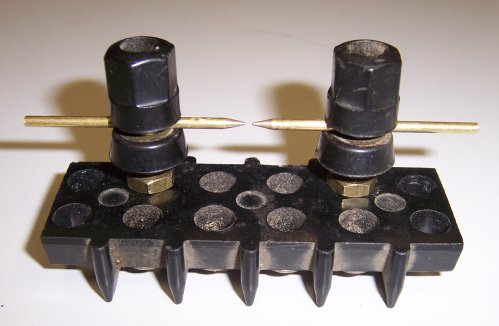
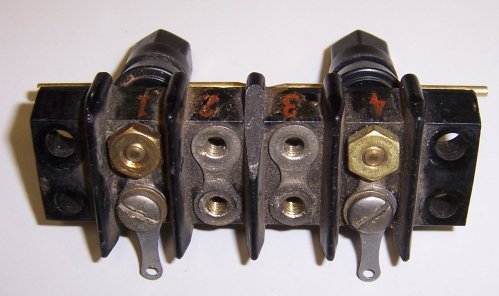
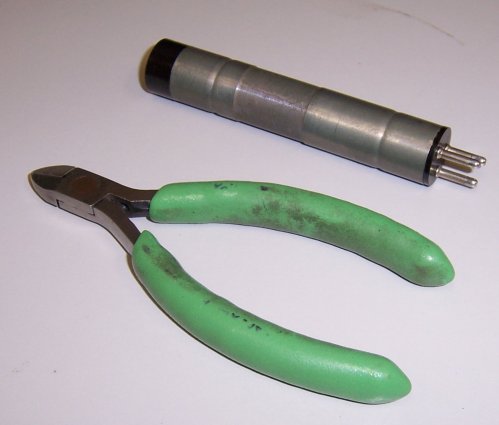
ForkAndStraightener.jpgNo bear action, alas (or whew) but I did get the garage about as tidy as it’s been since the day before we moved in back in 2004. Our rear wall full of brand-new Elfa shelving system absorbed a boggling amount of clutter, allowing me to get my tool shelves in order and compacted (I now have empty shelf space!) and actually schedule time to wipe down, oil, and maybe even use my lathe.

Given that we never saw the bear, yesterday’s highlights included finding my tube pin straightener and my father’s tuning fork (stamped “A”) neither of which I’d seen since the last century. I’m out of Diet Mountain Dew and my back hurts, but overall I still consider it a win.

Odd Lots

  • It keeps a very low profile somehow, but this NOAA site is the first place I go when I want to see what a hurricane is doing. We’re a little short of hurricanes this year, but I’m good with that.
  • This is what a pharmacy sign looks like in some parts of Europe. Thanks to Terry Dullmaier (in Germany) for the link. Terry didn’t know if the middle neon part goes off to indicate that the pharmacy is closed. Anybody?
  • I’ve discovered a great little free clock app for Linux, called the Cairo Clock. It can run in 24-hour mode and is skinnable, with about two dozen different skins available, some of them pretty weird. The skin I like is called Radium, and it (by choice) has a negative weirdness factor: It looks like an old wristwatch I got from my grandfather when I was a kid, which had radium paint on the hands and hour points. The second hand actually ticks forward and then falls back a little, as second hands driven by mechanical escapements used to do. I’d run it on Windows if I could.
  • From the No-Models-Were-X-Rayed-To-Produce-This-Calendar Department: The now-famous X-Ray pinup calendar floated as a promo by EIZO was a fake, albeit a mighty impressive one.
  • Bill Higgins put me on to NNDB, which is a biography site and useful for that alone…but take some time to poke at their mapping mechanism, which plots connections between significant people both living and dead. Cool factor 11 out of 10; making the maps useful probably takes more practice than I’ve been able to give it so far–and you must keep in mind that every relationship charted is somebody’s opinion of something.
  • There is a natural bridge on the Moon. (And I thought Straight Wall was impressive!) Thanks to Darrin Chandler for the link.
  • Numbers may be hard to grasp; precision and scale are even harder. This animation may help a little. (Thanks to Chuck Ott for the link.)
  • I don’t care how silly an idea it is. These guys get points for…something.

The Pulps Reconsidered, Part 3

SDMCover.jpg

Bet you thought I forgot about this series, huh? Not so: I needed a little time to take a broader look at the field. (Click here for Part 1 and Part 2.) Someone told me that a lot of 1930s/40s/50s pulps were being scanned and posted on Usenet at alt.binaries.pictures.vintage.magazines, so I went up there and pulled down a representative sample. And I’m not talking SF anymore; what I grabbed were things like Air Wonder Stories, Mammoth Western, Strange Detective Mysteries, Adventure, and Spicy Stories.

It’s been wonderful fun. In fact, it’s a lot like watching campy old b/w TV shows, only better, because I can decide how everybody and everything looks. I don’t have to be appalled (or giggle) at the cheap crappy special effects. I just willingly enter a world in which nobody rolls their eyes at a homicidal supermarket butcher about to strangle a square-jawed hero armed with a pistol in one hand and a hacksaw in the other. (See above. No, I didn’t read that story. I still wonder what the hacksaw was about.)

I’m not the first to suggest that the pulps vanished largely because TV took over their niche. The pulps were Saturday-morning movie serials that you could enjoy any time you wanted, and once TV started showing Commando Cody, Bomba the Jungle Boy, Flash Gordon, and made-for-TV adventures like The Texas Rangers, Sky King and Highway Patrol, much of the money went out of pulp publishing. The financial pressure was eventually fatal, but over the short term, as the pulps dwindled, their quality went up. And it wasn’t just that we knew more about science and technology and hence could write better SF. The SF of the Thirties was awful because the readership didn’t care. The pulps had a monopoly on cheap entertainment and people bought it because it was all there was, and reading it was better than staring at the wall.

Print entertainment evolved out of the pulps and into other print markets, particularly glossy mags. The railroad pulps died, but glossy, ad-supported magazines like Trains and Railroad picked up the readership, which after WWII had more money to spend on locomotive picture books and model railroading. Tacky text-porn mags like Spicy Stories (which had racy drawings and a handful of “artful” b/w nude photos) gave way to Playboy and its cheaper imitators as social strictures against visual porn weakened in the 50s. In the late 50s, pulp SF improved hugely, and bootstrapped itself into the new world of mass-market paperbacks by selling reprint anthologies of the best work to come out of the pulp era. (We can be fooled into thinking 30s and 40s pulp SF was better than it was because what we read of it was hand-picked for quality decades after its publication. Read a couple of original SF pulps circa 1935 and you’ll see what I mean.) Crime pulps went both up and down, to comics on the low end (much of “crime” fiction from the Depression was actually horror) and to book-length mysteries on the high end. The romance pulps like My Romance split similarly into gossip mags and mass-market romance novels.

Fewer people may be reading these days, but those who gave it up probably never liked reading that much to begin with. Again, reading was better than staring at the wall, but TV, when it arrived, was easier, especially for people with marginal education. The audience that remained was pickier, and many had been formally exposed at the college level to classic literature, which became the standard by which all fiction was measured.

And that may be a mistake. (I’ll come back to this point in a future entry.)

Leaving the quality of the writing itself as a separate issue, after a good long look around I’d say that the lessons of the pulps are these:

  • The pulps were about specific cultures. They were tightly linked to a time and a place and a generally understood cultural subtext. This was even true of early pulp SF, much of which might be characterized as “Depression-era Chicago on Mars.”
  • Characters were intended as costumes to be worn by readers, not fully realized individuals to be admired on their own merits as independent men and women. A lot of people don’t understand this, and many still won’t admit it. Make characters too vividly fluky and original, and readers will have a hard time identifying with them.
  • As a corollary to the above: Concepts, settings, and action were as important as characters, and much more vivid. Again, it’s the difference between imagining yourself driving a fast car and imagining someone else driving it.
  • The pulps were fun. They understood and accepted their role as immersive entertainment. They were not equipped to be literature and didn’t try to be literature.

With all that in mind, the big questions become: Is there unmet demand today for good-quality immersive (non-literary) fiction? How much of this legacy can we retrieve in 2010 and do well?

More next time.

Odd Lots

Drink Hard, Live Longer

Judging by the number of times I’ve seen links to it online yesterday and today, the liveliest Web story in recent memory is an item suggesting that heavy drinkers live longer than nondrinkers. The curve isn’t linear; moderate drinkers live longer than both heavy drinkers and nondrinkers. The WTF moment lies entirely in the correlation between nondrinking and shorter lifespans.

The science looks good here: The sample size was big enough to be trustable, and the researchers controlled for a lot of factors, including socioeconomic class, physical activity, social isolation, and so on. So we can’t write it off out of hand. But what in tarnation is going on? Is a little alcohol really good for you?

I think it may be. But let’s not get completely hung up on the alcohol. I have an intuition that what we’re seeing are not the effects of the alcohol itself, but consequences of the psychology of people who won’t touch the stuff.

I’m talking about scruples. That word is generally seen as religious jargon today, so I might better characterize it as “lifestyle panic.” There is a psychology that constantly walks on eggs, fretting at a very deep level that one false move in some direction (or many, or a multitude) will lead to early death or eternal damnation. This can be an inculcated attitude (the priests of my youth tried very hard to make us panic over “impure thoughts,” and often succeeded) but I think the underlying psychology is inborn. My mother basically died of scruples, and I’ve been fighting the tendency most of my life. If I’m “soft” on sex and divine judgment, that’s certainly a big part of the reason.

The New York Times published an article about food scruples some months back, quoting a researcher who said that “…all of these women I kept meeting…were scared to death if they didn’t eat a cup of blueberries a day they would drop dead.” This is of a piece with “fat panic,” which I see all the time. That pugnacious scientific fraud Ancel Keys has convinced hundreds of millions of people that fat will kill them, when more and more science is pointing in the other direction. Fatty acids are essential. Not eating enough fat will probably kill you a lot quicker.

My thought is this: People prone to lifestyle panic are the least likely to drink–but the most likely to live lives that are cortisol thrill rides, keeping their arteries in a continuous state of inflammation. That’ll kill you fersure if it goes on long enough.

So there’s a type of selection going on here that isn’t being adequately addressed. Some people worry constantly that they’re doing the wrong thing, no matter what it is that they’re actually doing, nor how virtuous their lives objectively are. The effect seems inborn and may not be curable. I’m not sure I buy the obvious objection, which is that alcohol makes you worry less. One reason I drink very little is that when I drink I worry that drinking will disrupt my sleep or give me headaches. It sounds weird, but becoming less inhibited does not mean worrying less. (That’s certainly been the case with me.) Inhibition and worry are two different (if perhaps related) things.

Moderate drinkers are people who are not panicked enough to avoid alcohol entirely, but still careful enough to know that too much will do permanent damage. In other words, they’re fundamentally sane. If they live the longest, well, that doesn’t surprise me at all.

Odd Lots

  • Well, I got the Mallo-Ware bowls I bought from eBay, and they were in better shape than they looked in the listing, and Dash has clearly busted his last bowl. Which leads to a thought: I used to prowl garage sales for entertainment, halfheartedly hoping to find something useful. (I once got a completely functional early-50s tube tester for fifty cents.) Now I just decide what I consider useful and go to eBay or Craigslist.
  • Adobe’s Flexnet copy protection system evidently writes to the MBR, and thus can make a system unbootable if it gets in a wrestling match with something else that also wants to be there. Flexnet, in fact, looks disturbingly like a rootkit from here. If I wasn’t sanguine about moving up to Adobe CS before, I sure as hell don’t intend to now.
  • Courtesy of Esther Schindler (who apparently was the editor who commissioned it) I give you a crackerjack tutorial by Tom Bunzel on how to do pivot tables in Excel.
  • From the Words-I-Didn’t-Know-Until-Yesterday Department: A luthier is one who makes or repairs stringed instruments. From “lute,” which is one of the most ancient instruments in its class.
  • Now that Apple has anointed the slate category, the usual suspects are coming up with their own surprisingly interesting takes on the concept. This is my favorite so far, and brings up the interesting question: Why not include both FM radio and TV tuners? If these things are to be travel toys, that’s a must-have. (I also want real GPS, not just cell-tower interpolation.)
  • Here’s a list of 100 resolutions (102, actually) that anyone aspiring to be an Evil Comic Book Overlord should make. Resolution #2 is particularly important: “My ventilation ducts will be too small to crawl through.”
  • My daily spam count felll significantly (about 30%) a few days ago, and I wonder if this had anything to do with it.
  • Somebody told me about this years ago and I didn’t pay attention. I have one of these in a drawer. Will attempt when time allows.
  • I used to call Hoag’s Object the “Here’s Looking At You, Kid” galaxy. I’m amazed that so few people have ever heard of it, or seen photos. You no longer have an excuse.
  • If the chemical elements played rock music (or if rock bands were set up like the Metal Men) this would be their periodic table.

The Last Box

GeorgeDoleSatEvePostGodIsDead350Wide.jpgWe moved here from Arizona in 2003, and (as usual) it took us literally years to unpack everything. Some stuff was not meant to be unpacked, really–I left my vinyl collection and 8″ reel-to-reel mix tapes in boxes on the big shelf in the mechanical room, knowing they’d be there if I needed them but not actually expecting to need them. (I admit, I’ve gone looking in the boxes for a vinyl album a couple of times.) But there’s one box on the high shelf here in my office, containing stuff that was in odd places in my Scottsdale office, stuff that I wasn’t really sure where to put or what to do with. Every so often I sift through the box for an hour or so, trashing some stuff and filing some stuff and putting the rest of it back in the box. It’s only about 1/4 full now, so I guess I’m making some progress. It should be empty by the time I’m 80.

One of the items was a favorite cartoon, from brilliant Maine cartoonist George Dole (George La Mendola) 1920-1997. Dole did a lot of work for the Saturday Evening Post, which is where the cartoon I show here came from. Year unknown; I’d guess the late 1960s. (The slogan “God is Dead” went viral in 1966, when it was the topic of a cover story in Time Magazine.) He did a lot of cartoons for both Playboy and the Wall Street Journal, which many of you probably didn’t realize even ran cartoons. (They do one each issue, in a well-hidden department called “Pepper…and Salt.”) Dole’s is one of only two cartoons that I would be willing to frame and hang on my office wall, and the other one is already there, signed by the artist. My copy is lousy, with one corner torn off, but I may frame it anyway, or perhaps photoshop it up a little and print it on new paper.

Oh, and the cartoon below, which goes back to 1973 and used to be stuck to my bedroom door when I was in college and writing unfinished novels with pompous titles like The Beast of Bronze. Does anybody here even remember the name of the strip? (I do–it’s a test for oldguyness these days.)

LionizedByLions1973-500Wide.jpg

Other oddments include a piece of faded green paper on which I scribbled the information for the interview I had with Xerox in September 1974, which led to my first full-time job; business cards from Xerox, PC Tech Journal, and Turbo Technix; a deck of FORTRAN Hollerith cards containing a program I wrote in high school; and a small plastic stock of holy chrism that Bp. Elijah of the Old Catholic Church FedExed to me in 2003 when I was depressed over losing Coriolis, with the message: Anoint yourself and move on. Oh, and a broken Handspring Visor. Fan letters not from flounders. Several of those stupid lanyards that used to come with every single thumb drive you could buy. Uncle Louie’s discharge papers from the Coast Guard.

Things like that. Everything that would easily fit in one of my existing file folders is already there. (I now have one for “cartoon clippings.”) The rest of it, well, I just don’t know. I think everybody has a box of stuff like that, and there should be a good, terse word for the concept. I’m willing to hear suggestions.

At the Sign of the Green Cross

The closest retail cluster to our house (a mile and a half down the hill) has a fair number of vacant storefronts, but the last time Carol and I went down for lunch at China Wok, we noticed that the storefront right next to the restaurant was no longer vacant. Who had moved in was unclear: There was no big sign, and the small sign under the portico was painted over and blank. It looked like a doctor’s office: a couple of couches and chairs and some flower arrangements in a waiting room with a receptionist’s window. If I were hipper (and I am about as hipless as they come) the neon sign in the window would have given it away immediately: a green neon cross with orange letters in the middle, reading “OPEN.”

Fast forward a week or so. Carol was reading the free paper, and in the back were something like fifteen or twenty ads for medical marijuana dispensaries, including one in the Safeway Plaza. Yup. That’s it.

You’re probably expecting a tirade here, but alas, you lose. I’d paid little attention to the whole issue (let’s just say that I am not a potential customer) but a little research left me fascinated by the speed with which this all got going after a referendum here made Colorado one of the most grass-friendly states in the union. Suddenly it’s an industry, to the extent that somebody is manufacturing green cross neon “OPEN” signs that I doubt you’ll see in the window of a dry cleaners.

The green cross has become the informal symbol of the organized medical marijuana industry. I think this goes back to a primordial cannabis delivery service in San Francisco, which publishes an online menu and will bring the goods right out to you.

Is this a good thing? On the balance, probably. I am fiercely against depriving the ill of medications just because they’re psychoactive. Furthermore, I’ve read a lot of history, and prohibition just doesn’t work. All it does is enrich and embolden the bad guys. And although the one time I (successfully) smoked the stuff back in 1971 I felt depressed and creepy for days, I may not be typical, and feeling a little creepy is probably better than dying in agony or going blind. Certainly I was grateful for post-surgery painkillers when I had a hernia fixed, even though they made me feel stupid enough to enjoy “The Dukes of Hazzard” on TV.

The bottom line is this: The violence of our reaction to marijuana seems out of scale to its hazards. I know that it sounds like a cliche, but I’d rather see it regulated (and yes, taxed) and ideally merged in with the rest of our prescription drug distribution mechanism and treated no differently than chemicals like codeine.

Anyway. That’s just me; I’m easy. It’ll be interesting to see what happens to the place next to China Wok when some of my fussier neighbors figure out what they’re doing down there at the Sign of the Green Cross.

Odd Lots

Dash and the Fruit Bowl Bomb Habit

DashWithBowl.jpg

All dogs have quirks, and Dash brought a new one into the house with him: When he’s done eating, he picks up his bowl and carries it around. He shows it to us, and if we don’t take it and re-fill it, he drops it from mouth height. When he was three months old (see photo above) he was closer to the floor, and the bowls sometimes survived. Now that his mouth is at adult bichon height, the bowls usually buy it.

In the photo above, Carol had just fed him, and he had bumbled into my office, standing in front of me with his bowl in his mouth, as if to say, “Please, sir, can I have some more?”

We feed the Pack out of a motley collection of small midlate 1950s fruit bowls, manufactured in an era when people ate less, particularly of the sort of fruit you got out of small cans in the 1950s. Such bowls are still made if not widely used, and we bought a couple of Corelle fruit bowls in our Shadow Iris pattern specifically for Pack meals. Supposedly they don’t break if dropped from modest heights. Dash hadn’t heard that, and when he dropped one, it exploded into dagger-like shards all over the kitchen. So the Corelle fruit bowls now await an era when we again embrace canned fruit cocktail (in heavy syrup.) They may wait awhile.

After we were married 34 years ago, Carol’s mom gave us a (mostly) complete set of Joni’s Dixie Dogwood tableware, and we used it for years as our everyday settings. A lot of it is gone now, having fallen from slippery hands at the sink or over the edge of the table, but because we rarely used the fruit bowls, we still had them until recently. That is, we still had them until Dash started dropping them.

He dropped another one yesterday, RIP (Rest In Pieces.)

The only bowls that are safe to give him are genuine Melmac, in our case Mallo-Ware, from Chicago’s now-extinct Mallory Plastics. Again, they came from Carol’s mom, and Carol used them when she was a kid. There are only two of the venerable #52 fruit bowls left, and both are usually in the dishwasher when another Pack meal time rolls around. I think there used to be more, but I don’t know where they went. Like all Melmac tableware they’re essentially indestructable, so they certainly didn’t break. I think I drilled and tapped one for a telescope attachment in the 80s. About the rest, clueless.

Even when the two Mallo-Ware bowls are clean, the problem is that we have four dogs, and after Dash scours out his own bowl, he will go hunting for other bowls to scour. The last one he finds gets carried around, and if it’s a Dixie Dogwood bowl, it’s soon off to rejoin Joni in Crockery Heaven.

So I slid over to eBay yesterday in search of more Melmac fruit bowls, to find that Mallo-Ware has become collectible. Used #52 fruit bowls now go for three bucks each…and up. I searched and grumbled until I found a pack of ten beat-to-hell pastel bowls for $25. That will certainly do the job, but…collectible Melmac? I hear Alf giggling somewhere.

I guess “collectible” is relative, and cyclical. As best I can tell, Melmac tableware was invented to prove to my Aunt Josephine that depression glass wasn’t so bad after all. Alas, Aunt Josephine didn’t get the message. She’d gathered an impressive set of iridescent orange depression glass while a teenager and used it well into the Fifties, but when Melmac came along, her depression glass was relegated to the kids table (and nobody got chewed out if it broke) with the adults dining on indestructable pastel plastic. To my aunt, depression glass was an emblem of poverty, whereas Melmac was totally Space-Age. Eventually the glass all went into the trash, which I suspect my cousins are now regretting.

There’s no real point to this essay other than a reminder that dogs are unpredictable. Mr. Byte used to chew up computer books, but only computer books. Chewy would dance on his toes for…peas. Jack will not eat raw meat, and will pick out the rice or the vegetables and leave the meat for Dash. QBit steals Carol’s ponytail Scruncis and hides them under the pillow in his kennel. I’m not sure these are mutant instincts, but they’re certainly not anything we taught them, and remain the best evidence I could cite that Behaviorism is really quite sincerely dead!