Jeff Duntemann's Contrapositive Diary Rotating Header Image

Victoria Duntemann and Lady Julian

VictoriaDrumMajoretteCropped1940.pngToday is Mother’s Day, and I celebrate it in eternal memory of Victoria Albina Pryes Duntemann 1924-2000. But today is also something else: May 8, the feast day of Lady Julian of Norwich, denied sainthood by the Roman Catholic Church for daring to suggest that God would triumph over Hell. Lady Julian is my personal patron saint, and I have declared her the Patron Saint of Gonzo Optimism: All manner of thing will be well. All. No exceptions. It don’t get much more gonzo than that.

Lady Julian was very careful of what she said, and had to be, lest she be burnt at the stake by her mass-murdering psychopath of a bishop, Henry Despenser, who ordered the Lollard Pits to be dug near Norwich and then gleefully filled them. The message of Lady Julian’s visions, which she hid well and could barely believe herself, was as simple as it was audacious: God will not settle for anything less than the salvation of everyone and everything.

It’s one of those painful ironies that I heard of Lady Julian only a couple of years before my mother’s death. Victoria Duntemann’s religion was an insane Polish peasant amplification of the fringes of Triumphal Catholicism, and basically consisted of Hell plus debris. That said, she took it only a little farther than the grim priests of my childhood parish, who gripped Hell to their hearts like an infernal teddy bear. Whether they understood it that way or not (and I think some did) they defined Catholicism as what you had to do to stay out of Hell, which ultimately cooked down to obeying them without question and having as little to do with sex as possible. My mother and countless other goodhearted and sensitive people swallowed this blasphemy whole, and in far too many cases (my mother’s included) it crushed all hope from them.

Hell haunted my mother her entire life. I was at her bedside when she died, and I am convinced that she died of despair, fearing that sins either wholly imagined or minor and long forgiven would land her in unending torment. (Right: She who was a nurse all her life, comforting countless people and tending to both of her parents and later her husband in their final years, and giving ceaselessly of her time and money to the church that had taken such pains to terrify her–Hell-fodder, of course.) Managing my consequent anger has become one of the great challenges of my life.

Hell has got to go. It no longer frightens the evil, and causes only suffering among the good. It is an emblem of either a sadistic or a defeated God. Do we have the guts to imagine a better God, one who will out-stubborn the worst of us and bring the whole shebang back into divine wholeness before the curtain falls?

LadyJulianCat.pngAlready done: “And so our good Lord answered to all the questions and doubts which I could raise, saying most comfortingly: I may make all things well, and I can make all things well, and I shall make all things well, and I will make all things well; and you will see yourself that every kind of thing will be well.” Julian of Norwich, Showings, Chapter XXXI.

I may. I can. I shall. I will. What does He have to do, hit us over the head with a #7 frying pan?

I’m convinced. Given a few more years, I might have persuaded my mother. She understood me poorly, but she listened to me, and she took me seriously, as all good mothers must of the children they bring into the world. I built telescopes on her front lawn, and she was always willing to give me a dollar for one more damned pipe fitting to twist into the declination axis. She read and approved of “Our Lady of the Endless Sky,” which was my first published story, written in some respects for her. She didn’t read the pile of my computer books that she kept in a corner of the livingroom, but I think they got the message across that her only son was neither crazy nor stupid. Perhaps more significant than any of that, I think she saw something of herself in me, and recognized the ache for God that she herself felt and had tried to instill in her children. She was ready to hear me out long before I knew enough to begin speaking, but I didn’t begin speaking until she could no longer listen.

I managed to avoid the trap she fell into, and maybe that’s triumph enough. Mothers want the best for their children, and what I got was what she should have had: a religion that celebrates the fundamental goodness of all creation, and the inescapable love of God. She knows the truth now. Could Lady Julian have told her? (Better late than never!)

If not, then what are patron saints for?

Dell’s USFF Internal Amplified Speaker

DellMiniSpeaker.jpgI bought a Dell Optiplex GX620 USFF (Ultra-Small Form Factor) machine last week, and it came without an internal speaker. I didn’t know the speaker was optional until a machine turned up without one, but a look at my three SX280 USFF machines (built in exactly the same case) showed a very small plastic unit that pulls easily out of the chassis when you lift a plastic tab. It’s wired to the mobo through a conventional 4-pin header. And most interesting of all, it has circuitry on its back.

A look through a loupe showed four solder pads (on the left in the photo above) labeled P5V IN, SPK DET, GND and AUD MONO. These correspond to the red, white, black, and green leads respectively. It took me ten minutes to lash up a test on my Heath ET-3200 breadboard. With 5V on the red lead, common on the black lead, and some sine wave from my audio generator on the green lead, that one tiny little doodad filled the shop with an 800 Hz tone.

I’m pretty sure the SPK DET lead allows the computer to know if there’s a speaker in place; my VOM shows it tied to ground. The IC is almost certainly an LM4871 1.1W audio amp. The National Semi logo is on the chip, and the printed number is RA4871. The Dell part number for the assembly as a whole is Y2298.

I needed to order one for the GX620, so I ordered two, and if I need a subminiature speaker amp for a project, it’ll be in the drawer with my other small speakers, ready to go. $2.69 at the CompuFlea eBay store.

Lazarus, Stay Where You Are!

…because when you came forth, you stepped on my bootloader.

I’ve tried to like Lazarus. I’ve tried for years. I can only assume that (as also evidenced by its similarly screwy cousin, Kylix) there is something in the Linux platform that makes Pascal compilers go a little bit whacko.

A few days ago I installed the KDE Fedora Spin in a new partition on my Linux box. It’s been a good education in the Plasma desktop. Plasma is all very blue and cold looking (way too blue for me, in fact, though the default wallpaper is striking) but unlike my first taste or two of KDE 4, it actually works.

So I started installing the software I’m familiar with to begin using it, and somewhere down the list was Lazarus, the Delphi-ish GUI front end for FreePascal. The package available from Fedora was V0.9.28.2, which is considerably newer than the one I have installed on Ubuntu Lucid, and only a little older than the one you can get from the project Web site. After it downloaded and installed all of its enormous pile of stuff, it asked me to restart Linux. I did.

And grub failed to run.

All I got was a blinking text cursor in the upper-left corner of the screen. This is the first time I’ve ever seen grub fail, apart from the well-known habit of Windows to overwrite grub with its own bootloader. (This is why Windows goes in first, if you’re going to have it at all.) I booted the Ubuntu 11.04 live CD I’d burned a few days after it was released, just to see if my MBR had been damaged. As best I could tell it had not, but I’m not good enough at grub’s internals to really be able to tell what was wrong with the software itself. Since I had plenty of free space on the 750 GB drive, I just installed Ubuntu on yet another partition, hoping that its update of grub would put things right. And it did.

So why would installing a compiler and an IDE mess up the OS bootloader? (Anybody?) I don’t have a lot of clues. The copy of Lazarus I installed looks like it works as well as Lazarus ever does, so I can’t assume that something in the installer or the package glitched and overwrote something unrelated. None of the other partitions on the disk were affected, as best I can tell. I’m tempted to install Lazarus under Ubuntu, to see if it will stomp on Ubuntu’s copy of grub as well…but that will happen another day, when I’m not as busy and not so grouchy.

Odd Lots

A Very Bright Line

Today’s Big Question cooks down to this: Is Bin Laden more valuable to Al Qaeda as a live leader or a dead martyr?

Hint: Name one Islamic martyr.

Here in the mostly unchurched West it’s easy to forget that Islam is an expression of radical monotheism. Islamic culture brooks no competitors to Allah, and takes the Old Testament proscription of “graven images” farther than any other major religion. It’s not about the images themselves, as we sometimes misunderstand, but about the underlying psychology of worship.

Catholicism’s great genius lay in absorbing the pagan cultures it converted rather than destroying them, and in consequence we revere saints and sometimes inanimate objects that are images of saints, are associated with saints (relics) or express sacred symbols. These are Christianized echoes of ancient polytheism, and looking at the myths of early Christianity, it’s easy to see the saints in the stories as small-g gods: They are larger-than-life because, well, they are larger than life, and have ascended into a graduated pantheon that from ancient times expressed the connectedness of humanity to the divine. A single, all-powerful God is a relatively recent addition to religious psychology, but Christianity simply placed God at the top of the pyramid, with all the saints below, revered but not worshipped. (I grant that drawing that line has always been a challenge.)

Here and now we’re comfortable with that, but a close reading of Eastern history shows the sometimes bloody tension between monotheism and these ancient echoes of polytheism. I just finished John Julius Norwich’s A Short History of Byzantium, which went into considerable detail about iconoclasm, a religious conflict that tore through the Byzantine Empire circa 750. People were killing one another over questions of what should be revered, and how. (I think it’s no coincidence that Islam itself appeared barely a century earlier.) Byzantium basically anathematized representational sculpture in the eighth century, and afterward confined religious artwork to painted (not graven; i.e., shaped or sculpted) images. This was a compromise. Many in the iconoclast faction at the time wanted no representational art at all.

Islam goes farther still. It reveres the ancient prophets (up to and including Mohammed, considered the greatest and the last) but demands that worship be directed to God and God only, and is constantly on guard against the temptation to idolatry. Living leaders provide inspiration and are given obedience, but once leaders die, they move into God’s territory, and some very strict rules begin to apply to those still on Earth. Revering a deceased leader too much begins to resemble idolatry, and Muslims have a very deep caution about idolatry.

We in the West don’t call it “hero worship” for nothing.

My thought is that Bin Laden’s death will be an inspiration to his followers, but not too much and not for long. He was a very bright guy, skillful and extremely lucky, and Al Qaeda will miss him sorely as a leader. His power as a martyr and a symbol will be limited, however, in a religion where history and hagiography are separated by a very bright line.

Fedora Spin: KDE Desktop

Sometime back I ran into a concept called Fedora Spins, which are customized Fedora installs with different desktops (KDE, LXDE, XFCE) or a slant in some direction like security, graphics, or games. I downloaded the KDE Spin ISO earlier today, burned it to CD, and this evening (having burned out on ebooks) took it for a…ride. I had 300 GB of free space on my Linux box, so there was no reason not to, and I’d like to get a little better at the KDE Plasma desktop.

Some reactions:

  • The Fedora partitioner is very good. I did a manual partition operation, and created a new 60 GB partition for Fedora, and a 12 GB swap partition. It helps to know a little bit about partitioners generally, but overall it was intuitive and gave me no trouble.
  • For some reason, Fedora installs grub with grub’s hiddenmenu option enabled. (It’s conceivable that I accidentally chose that somehow, but I don’t recall being asked.) This means that at boot time, grub’s menu isn’t displayed, and the system boots directly into Fedora. (The system already has Ubuntu Lucid and Windows XP on it.) You can get the boot menu by pressing F10 during grub’s timeout period, but otherwise you aren’t presented with an OS menu at all.
  • Fedora recognized the existence of my XP partition, but didn’t know what it was. In grub’s menu, XP is therefore listed as “Other.” However, if you select it, grub boots it just fine.
  • Fedora has a GUI bootloader configuration utility that allows selection of the timeout value and the default OS. However, the utility’s sole window does not have a Save or Apply button. You can make changes, but closing the utility throws them away. Wow. This is a bug, and not a brand-new one.
  • Unlike Ubuntu, Fedora does not automatically add the initial user account to the sudoers list. So try to do anything rootish like editing grub’s config file gives you that inane message “jduntemann is not in the sudoers list. This incident will be reported.”
  • Adding yourself to the sudoers list is seriously unintuive, but the best way is probably to use the visudo command, which opens a vi edit window with the sudoers list ready to change. Add USERNAME ALL=(ALL) ALL to the end of the file and save; it’s done. Details here.
  • Fixing grub requires editing the grub.conf file and commenting out the hiddenmenu option. While I was there, I also changed the description of the XP partition from “Other” to “Windows XP.”
  • A 2.8 GHz Dell SX280 does not have sufficient graphics chops to run Plasma’s desktop effects. I wanted to see just how slow they were, but within seconds of enabling desktop effects, Fedora disabled them again. I knew that the SX280 wouldn’t run them well from my online research (it’s one reason I’m getting a more powerful Linux box shortly) but I didn’t know the system would simply refuse to run the effects against my wishes. Interestingly, Ubuntu’s GNOME desktop effects subsystem works on the same machine.

Overall, getting to a usable configuration with Fedora is a lot more screwing around than with Ubuntu. But once done, it works well. More as I experience it.

Odd Lots

  • Ubuntu 11.04 Natty Narwhal is out, and hardly anybody’s even mentioned it. Could it be that nobody’s really upgrading every six months anymore? (My workaday Linux system is still running 10.04.) I’m not bullish on Unity, and may reconsider Kubuntu when I set up a GX620-based Linux box in coming weeks.
  • The formidable Al Williams has a three-part series on DDJ explaining how to use the visual tool App Inventor to create Android apps. I have not used App Inventor yet, but Al’s analysis of the challenges of using it (and of visual metaphors for programming generally) are worth reading. Part 1. Part 2. Part 3.
  • John Scalzi has written a brand new Fuzzies novel. (Not furries, Fuzzies–tiny aliens created by H. Beam Piper.) Scalzi’s good–this one could be fun. I’ve read all the Fuzzies books (by Piper and others) and truly only like Little Fuzzy (the original) and Fuzzy Bones by William Tuning. Fuzzy Sapiens is so-so, and Fuzzies and Other People is so awful that Piper chose not to submit it for publication after he wrote it in 1962. It was found in a box after he committed suicide in 1964, and not published until the late 1980s.
  • Interestingly, most of Piper’s copyrights were not renewed, and a great deal of his work (including Little Fuzzy) is now in the public domain. Go to the “P” author page on Project Gutenberg and scroll down.
  • I heard years ago that armadillos are the only other mammalian species that contracts leprosy, but now there’s evidence that virtually all human cases of the disease (which is vanishingly rare these days) were contracted from them. (Thanks to Pete Albrecht for the link.)
  • Illinois is banning trans fats in its schools (with a notable exception for doughnuts, how healthy!) but does anyone dare remind them that there is absolutely no trans fat in unhydrogenated lard? In terms of monounsaturated fat (the good fat) lard comes out better than butter, and both are far better than the vegetable oil spreads we call margarine. Funny how the more animal fat I eat, the more animal fat (my own!) that I lose. (Thanks to Pete Albrecht for the Illinois link.)
  • And the much-reviled Dr. Eades makes the point that Mediterranean people who supposedly take all their foods as olive oil are actually doing a lot of their cooking in animal fats, especially lard. (They export the olive oil to people like us, who think it’s healthier.)
  • This gets an award for something. I’m still not sure what.

Ebooks and Adding Value to the Public Domain

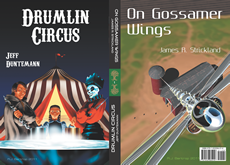
I just got our first two Copperwood Press ebooks posted to the Kindle store, and they’re now available for sale: Drumlin Circus / On Gossamer Wings and “Whale Meat.” No DRM. I’m still working with Ingram’s Lightning Source to get the double mounted and sellable in its print edition. It won’t be available from Lulu, and over time I will be migrating my other print books from Lulu to Lightning. Learning their relatively unforgiving system the first time involves a little hair-tearing, but once learned it’s learned.

There’s certainly plenty to do in coming months to get the rest of my material converted to good ebooks and posted on the major retailers. One issue I’ve found troubling for some months now is the ambiguity regarding public domain material. Both B&N and Amazon make a big deal about whether a work is in the public domain. PD titles get lower royalty rates and just generally seem libri non grati on the retailer sites. This isn’t surprising in some ways. The retailers are trying to avoid having 2,774 versions of The War of the Worlds on their servers, taking up space and confusing the readership. The definition of “public domain” varies legally by country, and what may be free in Australia or Chile is not necessary free here. So they do have to be careful on the rights front.

The issue matters to me because of The Old Catholic Studies Series, a project that I’ve been tinkering for ten years now. The goal was to scan, OCR, edit, and lay out clean, indexed versions of the foundational texts of Old Catholicism so that people wouldn’t have to pay $200 to read yellowed, crumbly, scribbled-in books printed in 1874. I have two such texts currently available in print editions: The New Reformation and The Pope and the Council. They were a lot of work, but they’ve sold reasonably well, and I consider the effort worthwhile. (It was also damned good practice in making books.) Not a lot of people want them, but the people who do want them have been very happy with them. I would have done another two or three, but John Mabry’s Apocryphile Press got there ahead of me, and put out facsimile print editions of the other major works I had considered. I prefer new layouts to facsimile editions, but Apocryphile’s scans are fairly clean and I do recommend them.

It’s true that the source materials are long in the public domain (which at least in the US includes all books published before 1923) but technically, what I’m offering are derivative works. I scanned them, page by page, OCRed them to extract the text, and then went over the text character by character to eliminate OCR errors. (Some were a hoot: “The Frankish King Pepin…” became “The Prankish King Pepin…”) The books were not indexed, and I indexed them. I fixed a few typos (especially in The Pope and the Council, which was a hurried English translation of a work written originally in German) and Americanized the British spelling. Although I don’t claim to have done a copy edit on either book, I fixed a number of examples of what I consider regrettable diction. I wrote an introduction explaining what I did and how. I gave them nice covers. If I had another hundred years to live and no need to make a living, I would do a strong edit on both.

By any legal definition what I’ve produced are derivative works that are not themselves in the public domain. That said, anybody who took an OCR of The War of the Worlds and changed three words could make the same claim, and if enough people do that, the noise level at ebook retailer sites would go through the roof. Nobody’s PD ebooks would sell well enough for it to make anything like a reasonable new edition of any PD book worthwhile.

I don’t know precisely what the answer is. Vetting tens of thousands of $2.99 ebooks is a labor-intensive business, and what sorts of standards would apply? Refusing facsimile editions is obvious and easy, but I doubt anyone would even try to read 50MB page-image PDF facsimiles on a Kindle. (On the Nook Color it might be practical; grab something 1875-ish from Google Books and let me know!) A better suggestion might be to require an up-front payment from publishers for posting anything either fully in the public domain or significantly derived from the public domain. That would cut down on bothouse publications and allow people like me to genuinely add value to public domain material without drowning in unmodifed or barely modified PD books. I’d think $25 would be about right. My books would earn that back in a month or six weeks, and the bothouses couldn’t justify it.

It’s not often that I’d willingly ask to have my own costs raised, but publishing has always been a weird business, and sometimes, well, free is less than worthless.

How Music Really Oughta Work

I just got back from Big Family Easter In Chicago, where it rained eight out of the ten days we were there. So I’m drying out, catching my breath, tinkering with the outline of Ten Gentle Opportunities, and trying to iron out a long list of wrinkles in several ebook projects. I’m crosseyed from poking at details, so I’ll take ten minutes out for a slightly tangled story. This may start to sound like an episode of James Burke’s Connections after awhile, but bear with me.

Marci Braun (scroll down a little) is a popular country/western DJ on Chicago’s big country station US99.5. She’s also Carol’s sister’s husband’s cousin’s daughter, and we’ve seen her here and there at family gatherings on Carol’s side since she was a pre-teen. The first time we took Dash to Chicago (he was nine weeks old at the time) he was a big hit at our nephew Matt’s college graduation party, and he bonded with Marci in a country hemidemisemiquaver. So I listen to her when I know she’ll be on the air, and she has a lot to do with my growing affection for country music. Oh, and the fact that pop music is now completely incoherent, lacking warmth, melody, harmony, and just about everything else that I value. Several of my friends among the Educated Elite grumble at me for listening to country music (“It’s so, so, well, Republican!“) but I just tell them that if they can bring back close harmony and clever lyrics to pop music, I’ll jump. In the meantime, I listen to country and classical. Draw whatever conclusions you wish. (No points for the obvious one that I take great pleasure in annoying the Educated Elite.)

Anyway. A week ago Monday night, while I was driving from our condo in Des Plaines to Crystal Lake after not seeing Carol for three days, I punched the 99.5 button on the car radio, and Marci was there. (Actually, odds are that she was a digital audio file at that moment, but that’s just how the radio business works.) She ran a commercial, and then introduced a song: Darius Rucker’s “This.” Great raving upbeat piece, celebrating a life that turned out very well somehow, in spite of all the mistakes we make and the bad luck that comes as a side dish to life’s main course, generally right there beside the lima beans.

Brilliant lyric, which you can read here. The gist:

I don’t really know how I got here
But I’m sure glad that I did;
And it’s crazy to think that one little thing
Could’ve changed all of it.

Maybe it didn’t turn out like I planned–
Maybe that’s why I’m such, such a lucky man!

For every stoplight I didn’t make;
Every chance I did or I didn’t take;
All the nights I went too far;
All the girls that broke my heart;
All the doors that I had to close;
All the things I knew but I didn’t know
Thank God for all I missed
Cause it led me here to
This.

If you like feel-good music, go buy that song, which will cost you the same as a small Diet Coke at McDonalds, and will stay with you a lot longer. Just as the song began I was coming out of the Union Pacific underpass on Northwest Highway just west of Des Plaines, and there was a freight train heading by overhead. At the song’s inspiration, I was reflecting on how much I like my life. I’ve gotten almost everything I’ve ever wanted, granting that some of it took awhile. I found my soulmate at 17, and my life’s work at 33. That may have been optimal: Had I not met Carol that early I would probably have lost her to someone else, because at 16 she didn’t know yet how hot she really was. (And anyone who knew me when I was 17 will recall how hot I wasn’t.) If I hadn’t worked at technical pursuits before I discovered that I was an editor and a tech writer, well, I might have tried to make a living on SF (ha!) or given up on writing entirely. Everything just seemed to flow, one small success from another, with equal parts luck and hard work to drive the machinery. I had it: Dogs, houses, sunsets, tube sockets, saints up and down the family tree, everything. (I even had a pickup truck once.)

Luck. Trains. Whew. In 1977 I was driving home from my mom’s house along Devon avenue, and I raced a train to a crossing. I made it by two car lengths. Why? I don’t know. It was by several orders of magnitude the stupidest thing I’ve ever done, and if my dad’s anemic, beat-to-hell ’74 AMC wagon had been just a little bit out of tune, I would have died in 1977. I had been married to Carol for less than a year, and had not yet completed wire-wrapping my first computer. I was just getting out of first gear. Damn, I’d barely gotten out of park.

Stupidity comes in smaller containers as well. I told my broker to buy $5,000 worth of Microsoft stock a month after they went public in 1986. She offered me a limited partnership instead, and I took it rather than chewing her ass to go back and do what I told her. But compared to being splatted by a General Electric U23B, hey, small potatoes.

Like I said, great song. I got home to Colorado, fired up Firefox, found the song among Amazon’s DRM-free 99c MP3s, and ninety seconds later it was playing. It’s not tied to a particular player or DRM technology, so there’s no reason to think I won’t be playing it twenty years from now. Certainly we’ll play it at our 40th wedding anniverary party in 2016, where I will wear my expensive cowboy hat and dare y’all to dance.

That’s how music ought to work: You hear a song somewhere that you’d like to hear again, so you find it online, pay for it quickly and easily, download it, and keep it forever. I remember 45s and LP vinyl. (Hell, I remember 78s.) I remember 8″ reel-to-reel. I remember 8-tracks and cassettes and CDs. I remember my Diamond Rio. I still have an iPod. Maybe we had to pass through all that to get where we are today, and maybe it might have turned out differently had some engineer been brighter or Sony not as dumb as they always turn out to be. Doesn’t matter. The message hasn’t gotten out to every last corner of the world, but as long as Amazon’s system or something like it exists, music is where it needs to be.

Play it again. Play it forever. We’ve arrived.

Odd Lots

  • Good Friday — bad weather, at least where I am. When I was in second grade, Good Friday included a whomping thunderstorm that rolled over the Northwest Side about 3PM. It got very dark and scary looking, and (after several days of intensive Holy Week preparation in school, especially about Christ’s death on the cross) it was natural for me to think that Good Friday was always dark and stormy, a reflection of what happened in our Bible stories. Alas, the next year Good Friday happened on a beautiful warm spring day. Lesson: Characterization matters more than setting. Don’t get distracted by the special effects.
  • Besides, Friday is, well, Friday. How bad could it get? (Jesus could have died on a Monday.)
  • Finally, if you haven’t seen this, do take a look. (2.4 MB PDF but well worth it.) You may miss some of the humor if you don’t know theology-geek things like who Bart Ehrman is, but overall it’s hilarious, and in a weird way rather touching. “Roman Soldier is considering early retirement.” I’ll bet.
  • Carl Elkin has given the Jewish Haggadah the Facebook treatment as well. I’m sure I miss most of the humor by simply not being Jewish, but I do like God’s comments.
  • This is an old article (2003) but allowing a little for inflation it looks to me like an accurate systematic treatment of the costs inherent in mass-market print book publishing. The takeaway is that print publishers were suffering even eight years ago (they’ve been suffering since midlate 2000, in fact) and that it’s miserable trying to turn a profit on an $8 mass-market paperback.
  • The author of the above piece doesn’t talk much about per-book author earnings, but some quick envelope math indicates that (with some variance by contract terms) MM paperback authors get about 35c – 40c per book sold. (Note that I have never sold a MM paperback myself, nor did my company publish them.) This may explain why indie authors are willing to sell ebook novels for 99c: Authors get about the same amount per sale on a dollar ebook as they do on an $8 print book.
  • Here is a slightly scary but as best I can tell accurate description of the problems confronting print publishers. From the same author come unsettling hints that traditional publishers are botching the ebook business, and botching it badly. Misfeasance or malfeasance? What’s going on here is unclear, but the situation bears watching. (Thanks to Amy Ranger for putting me on to it.)
  • Pointers to this article by Gary Taubes have been coming in from all sides, but Dave Lloyd was the first to send it to me. The question of whether or not sugar should be called “toxic” is far less important than the question of whether sugar makes you fat–and whether some types of sugar (i.e., that ol’ devil fructose) make you fatter faster than others. Sure looks like it from here.
  • I don’t know how well this works, but it’s a brilliant concept: Put a pico projector in an unused laptop optical drive bay. Not cheap. Not now, at least.
  • How well things work? Wow: I haven’t seen a hardware review this negative in a long, long time. A tablet that won’t do anything useful unless it’s tethered to your Blackberry? WTF?
  • Hey guys! Long integers!