My sister complained a year or two ago that most of Katie’s and Julie’s toys talk. Some talk and sing songs, though a few–I remember a circus train that was one of Katie’s first toys–actually play classical music. When most of your day is spent in the company of toddlers and their toys, I’m guessing silence is in short supply, because when the toddlers aren’t make noise themselves, their toys pick up the slack.
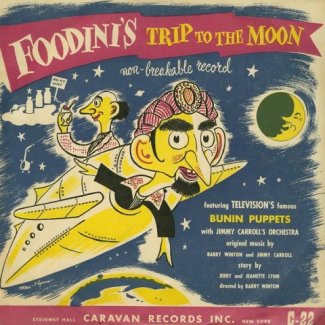
Which brings me back to 1957. My parents had a record player, though it was old and cranky and built into a piece of furniture. I’m sure they didn’t want me messing with it, so they bought a small, portable kiddie phonograph of my own. I had a few kid records, some that told stories, some that played songs, and some–like the Maury Bunin Puppets’ “Foodini’s Trip to the Moon” that did both. (Alas, none that I recall played classical music.) I enjoyed the phonograph a lot, and given that the single active component was a 117L7 tube (capable of 0.85 watts into a 4,000 ohm load) it didn’t generate enough volume to bother my folks much–until I discovered the speed lever.
 Like most record players in that era, it could do 33 1/3, 45, and 78 RPM. Most of my records were 45s. (The older ones, including Foodini, were 78s.) Playing a 45 at 33 1/3 was interesting for a moment but ultimately boring: Small children run at inherently higher clock rates than adults, and slow music is not a big draw. 78, now: I had a Disney extended-play 45 containing music from the 1955 “Lady and the Tramp” and I loved it a lot. One cut in particular was my favorite: “Lady,” the instrumental theme for the female cocker spaniel lead. It was bouncy (like me) and I quickly learned how to pick up the needle and drop it again at the beginning of the track, playing it again and again. And when that got boring, I nudged the speed lever up to 78.
Nirvana! I still remember the sped-up recording clearly, and I think it may well beat Khachaturian’s “Saber Dance” as the most manic single piece of music in my experience. I got bored with the item before my parents could sell me to the gypsies (maybe–I wonder if the 45 simply disappeared one day) but I continued my experiments with the speed lever.
We had the 45 of David Seville’s “The Chipmunk Song” (1958) and when I cranked the lever down to 33 1/3, I realized to my six-year-old astonishment that it wasn’t chipmunks at all, but ordinary guys singing the song reeeeeeeeeeeal slow. My cousin Diane had another similar 45, of The Nutty Squirrels doing a scat song called “Uh-Oh.” Same deal: Dial down the speed and it was just a couple of guys singing slower than I could imagine–or tolerate.
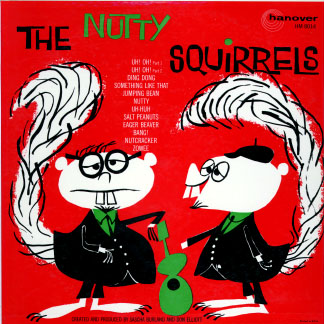 This was a fad in the late 1950s, starting with Sheb Woolley’s “Purple People Eater,” which had a couple of sped-up spoken vocals (“I wanna get a job in a rock and roll band…”) but no sped-up singing. That was a Seville invention, with his 1958 song “Witch Doctor,” setting the stage for The Chipmunks at Christmas time that year.
The Nutty Squirrels (basically, jazz musicians Don Elliot and Sascha Burland) had their own TV cartoon show, which came out about the same time as Rocky and Bullwinkle but was not as brilliantly silly and by now is mostly forgotten. Their music was better, and not as kid-centric as the Chipmunks always were, which I’m sure doomed them.
I’ve often wondered how one learns to scat-sing at half-speed without muffing the tempo for the sped-up version. Of all the peculiar and now-forgotten human skills that you might name, that may be the most peculiar of all.
 We’re going to see just how fat our pipes are tomorrow, when Canonical cranks open the spigot for Ubuntu 10.04 Lucid Lynx. It’s an LTS release, and I’m guessing that a lot more people will be grabbing it than usual. I may download it just to see how well the torrent works on Day One; in fact, I have a new hard drive on the shelf for my SX270 here and if abundant time presents itself this week (possible) I may swap in the new drive and install the release. This is the second-to-last machine I have that still uses the System Commander bootloader app, and I’d really much rather have grub everywhere.
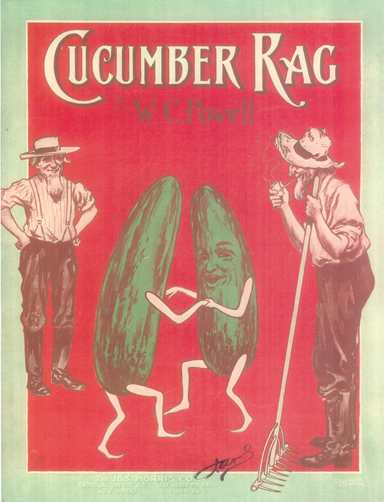
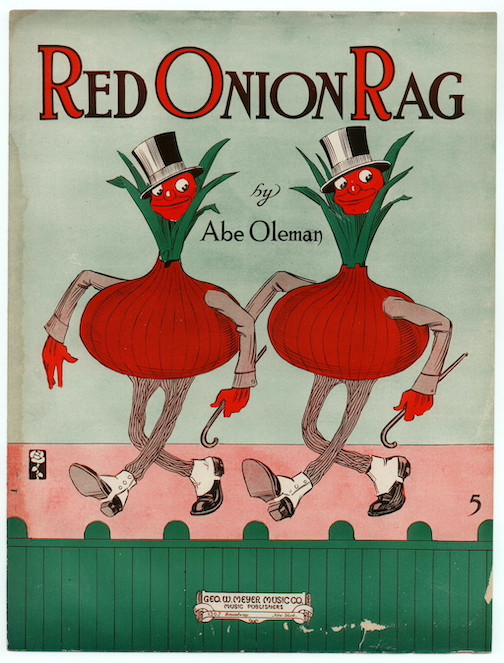
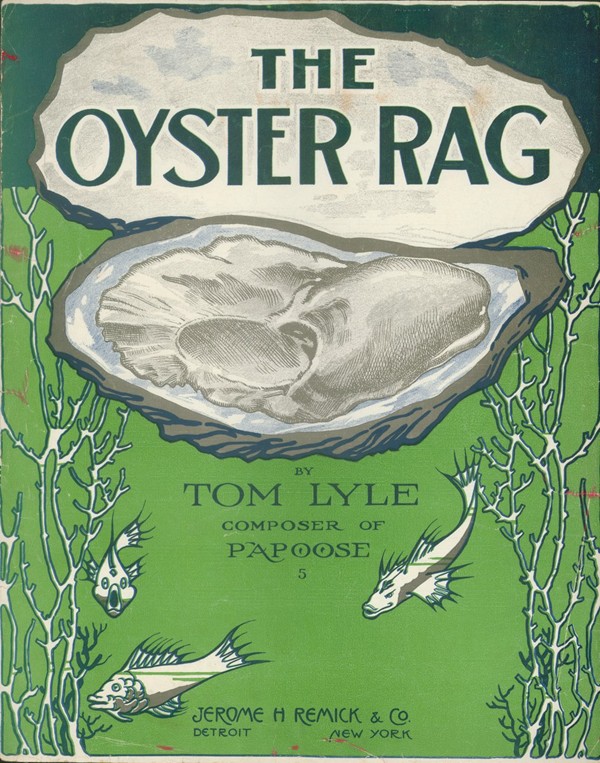
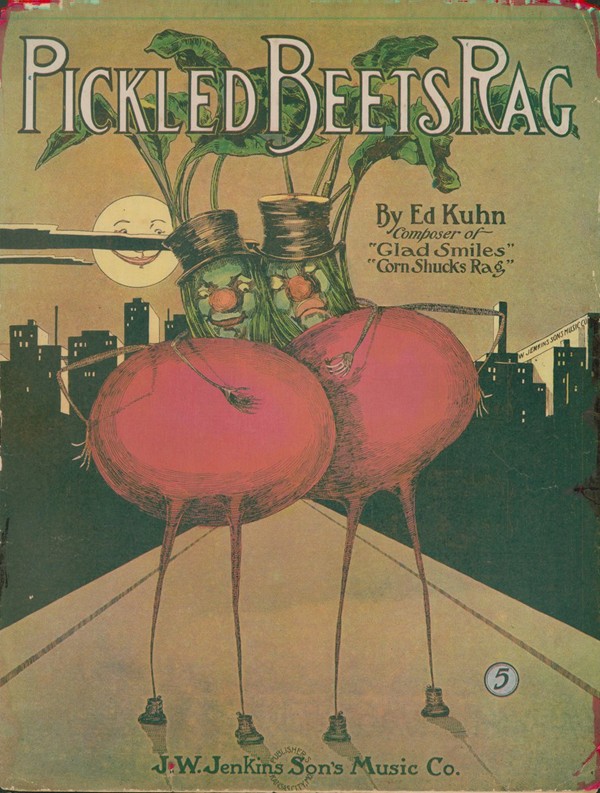
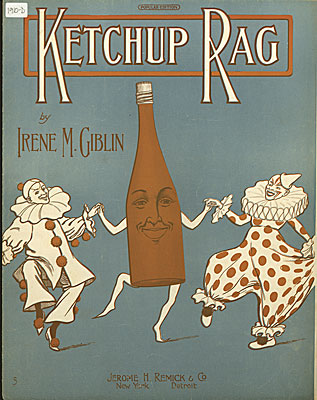
 We had dinner with the family the other night at Portillo’s in Crystal Lake, and whenever we eat at a place like that, I wander around gaping at what I call “junkwalls”–old stuff tacked to the wallboard to make the place look atmospheric and (in this case) 1925-ish. Close to our table was a framed piece of sheet music for a song called “Ketchup Rag.” It was published in 1910 and is now in the public domain, and