Jeff Duntemann's Contrapositive Diary Rotating Header Image

Disabling the Intel Boot Agent Admin Password on the Dell Optiplex 780

780 and SX270 350Wide.jpgI’m replacing my venerable Dell SX270s and SX280s with much newer Optiplex 780 USFFs running Windows 7. I have two here now and at some point will buy a third. They’re smaller than even the SX270 and almost dead silent. Not bad for a Core 2 Duo with 4 GB RAM. The machines date back to 2009 and are recently coming off 5-year depreciation schedules, so you’re now able to snag one for $200 or less.

As with the SX270s and SX280s (and in fact with most of Dell’s ultra-small form factor machines) the 780 is a cube farm box, not suitable for gaming or video editing but completely suitable for nearly all office work. The machine was designed for central management, and in both of the machines I’ve acquired, the Intel Boot Agent has first shot in the boot order, attempting a PXE boot through the 100BASE-T port. Boot Agent eventually gives up, but while it’s waiting for DHCP to pass down an operating system (these IP addresses don’t burn worth a cent!) the machine just sits there, adding at least thirty seconds to your boot time.

So I F2’d my way into Setup…only to find myself locked out by an admin password. I tried a few obvious ones, then looked online for some indication how to reset the password, to no avail. I downloaded the Dell tech doc, which sent me looking for a jumper that my machine doesn’t have. I then sent off a message to the eBay seller I bought it from with a polite complaint. Fortunately, the seller (who’s sold many of these things and doubtless hears this question a lot) told me to pull the blue jumper from a header marked “Clear Password” on the mobo near the fan. I opened it up, pulled the blue jumper off the header, and shazayum: No setup password. Once I got in, I pushed Intel Boot Agent way down to the bottom of the boot order. The machine now boots into Windows in seconds.

Bezel Tab Locator.png

If you’ve got a 780 in hand and want to nuke the setup password and get Boot Agent out of your way, here are some tips once you’ve removed the top panel:

  1. The plastic front-panel bezel has to come off first. There are three plastic tabs locking it in place. (See photo above.) Two are flat and easy to see. You pull those gently upward, while pressing the third and less obvious tab gently to the left. The bezel will pivot forward and down, and then off.
  2. There is a wire handle on the disk drive subassembly. Pull up and the whole business will left into your hands.
  3. Three SATA cables connect the disk subassembly to the mobo. You can pull them all and remove the subassembly completely, or you can remove the blue cable and rotate the subassembly 90 degrees to get it out of the way.
  4. Look for a blue jumper block near the fan, clearlly marked “Clear Password.” (See photo below.) Yank it with a needle-nose; your fingers probably won’t be able to get a purchase on it. I have a drawer for such things, but if you feel you may need to set a Setup password on it again someday, put it back on one (not both!) of the header pins.
  5. Reconnect the SATA cable, drop the disk drive subassembly back where it came from, and then put the front panel bezel back. Hook the two little feet at the bottom into their corresponding slots, then pivot the bezel upward until the three plastic tabs lock back into place.
  6. Button it up, connect it back to the peripherals, and boot it. The splash screen says “Press F12 for boot options” but that’s not useful. Press F2 repeatedly while it’s booting, until the Setup screen appears. From there it’s like any BIOS setup program, and you can set the boot order in the usual way.

Password Jumper Closeup 500Wide copy.png

That’s all you need to do, assuming there aren’t other Setup items you need to address.

Some other odd notes on the 780:

  • The Dell all-in-one mount for the 780 and its successors is hideous, compared to the SX270’s or the still better SX280’s. The 780 fits into a sleeve that then mounts to the stand. The fit is tight. You’re better off just leaving it on the desk. It won’t take up much room.
  • There is a PCIE Mini-Card slot on the mobo for a laptop-style Wi-Fi client adapter. I’ve got CAT5E in the walls and don’t need it, which is good, because I have yet to see the adapter itself for sale on eBay, and the tech doc says nothing about installing it. There is an external antenna that mounts on the rear panel and connects to the adapter with a coax cable. I’m guessing that without the antenna, the steel box will keep the adapter from connecting.
  • The 780’s video output connector is a DisplayPort, so if your monitor is DVI or HDMI, you’ll need an adapter cable. (Display Port is basically HDMI with additional DRM.)

So far I like it, though I’m still configuring and installing software. If anything interesting turns up in the future, you’ll read about it here.

Odd Lots

Pinging Jeff…

Pong, everybody. Relax. I’m still here. And I’m very glad to say that I’m probably 1200 words from the end of my current book project. If it weren’t for some home repairs and carpet cleaning I’d be done by now, and I expect to be done by EOD Friday. The publisher is still reluctant to say much about the book, for reasons I still don’t understand. I’m puzzled, but in publishing as in so many other realms, those who write the checks make the rules.

Much to do after the last word rattles out of the keyboard. Getting rid of XP is high on the list, given our April 8 deadline. This afternoon I ordered a refurbed Win7 laptop, a Dell e6400. How could such an old laptop be useful to me? Easy: I don’t do much on laptops. It’s a travel computer, for Web, email, and some light word processing–like writing Contra entries on the road. It cost me $240 postpaid, as they used to say. I’ve had very good luck with used Dell machines in the last ten years. Every machine in the house but my quadcore is a Dell refurb. I already have two Win7 Dell 780 USFFs for upstairs, and installed Win7 on my lab machine over a year ago. That leaves the laptop and the quad, basically, and if I didn’t need to use the quad to finish this book, the quad would be running Win7 by now as well.

The SX270s are now all bookends. They make very nice bookends.

Oh, and the computer junk pile is getting impressive.

The list of things to do Post Book is long. We need to replace our driveway slab, which is descending into rubble. Ditto the garage slab, the replacement of which will require putting my lathe, big drill press, tooling, and metal stock in storage somewhere. There’s a lesson here: Soil compaction matters. We spent thirty grand mudjacking the lower level, recarpeting, and repainting. Settling soil pulled our gas meter down so far the pipe cracked and damned near blew us over the top of Cheyenne Mountain. I made a number of mistakes having this house built, and I will never make those mistakes again.

Then there’s 3D. I drew 81 figures by hand for this book project, all of them in Visio. (I actually drew 83, but two of them won’t be used.) I’m very good at Visio. However, Visio is inextricably a 2D CAD program, and every time I’ve tried to use it for 3D, it makes me nuts. I took a lot of drafting and engineering graphics when I was in school and know how to do it. (Sure, it was with a T-square. Ya gotta problem widdat?) I need to be able to draw things in 3D. I downloaded the free version of Sketchup after Google bought it in 2006, but was too busy back then to spend much time with it. I see that Google sold it a year or two ago, and the new owners are positioning it as an architectural CAD system. That’s fine, since I know from earlier tests that Sketchup can do telescope parts, and if it can also design me an observatory, I’m good with that. I need somewhere to put an observatory, obviously, but that’s a separate challenge. So learning Sketchup is another priority.

Fiction, too. I’m going to try finishing Old Catholics. If that doesn’t work, I’ll start The Everything Machine, complete with a 3D scale drawing of a thingmaker, courtesy Sketchup. (I tried that in Visio years ago. Uggh.)

I will also be doing some intensive research on Oscar Wilde, for reasons that only a few people in my inner circle understand.

As I always say, Boredom is a choice. I may be tired, but I am not bored. And in a few days, I suspect I will no longer be tired. Bring it on!

The WhisperCup

WhisperCup1.png

Ok. Yesterday I told you what the problem was. Today I’ll show you what I think will solve it. I looked around online and didn’t see anything like this, not that that proves or disproves anything. If the idea wasn’t out there before, well, it’s out there now.

I call it the WhisperCup. It consists of a specially equipped USB thumb drive, and a cylindrical well that matches the thumb drive’s special equipment. The cup provides power to the thumb drive via induction. At the rounded end of the thumb drive is a wireless connection of some sort. I don’t know precisely what; such things may exist already, and if so, all the better. I call it “ultra-short range” because all it needs to do is link data into the thumb drive from the bottom of the cup. Its range could be as little as a half an inch. Certainly it should quit before the wireless end of the thumb drive clears the top of the cup. It doesn’t have to shout microwaves; hence the name WhisperCup.

The drive itself adheres to the Universal Flash Storage standard, which incorporates an interface that might as well be SATA-on-a-chip. I’ve never much likes USB as a storage interface. UFS is faster and supposedly more reliable. Adding USB to the tang end isn’t difficult; all this stuff is jelly-bean logic now. Toss it in the cup and the volume mounts. If you don’t have a cup to toss the drive in, plug it into a USB port.

The proper place for the cup is built into the top panel of a tower case. If you don’t have such a case, there’s nothing wrong with an external WhisperDock with eSATA and a wall wart. (eSATA doesn’t provide power to its devices–big mistake, but we have to live with it.) I have a Thermaltake VB9 BlacX, and there are two toaster-dock style SATA slots in the top panel. Damned handy, though I mainly use them to do my monthly offsite backups onto naked drives. I’d gladly trade one slot for a pair of WhisperCups.

The thumb drive has no internal power source. If it’s in the cup, it gets power from the cup. If it’s in a USB port, it gets power from the USB port. I don’t want the damned thing whispering while it’s in my pocket. I want to emphasize that this isn’t anything like AirStash, which is a portable wireless Web server for file sharing. That certainly has its uses, but it’s not what I’m talking about.

That’s the basics. If you’re nervous about just dropping the thumb drive into a cup, you could line the cup with plastic bristles, which would both center the thumb drive and keep it in the cup until a firm tug yanks it out.

That would do it. No plugging into a fragile port. Put the drive in the cup, and you’re ready to go. If you take the drive somewhere that doesn’t have a cup, well, the wear is on their USB port, not yours.

What’s not to like?

USB Connectors Are Lousy

I finished Chapter 6 yesterday, and have only one more chapter to write. When I was exporting my Visio drawing files to .png for submission, I discovered that a figure I drew two weeks ago had gone bad. It went bad in a way I’ve seen before: It was smaller than similar figures…and it crashed Visio. That happened to another Visio drawing file of mine a couple of years ago, when the front-panel USB port on my Antec 900 case went intermittent. I’m guessing that the data connection opened up while the file was being written, and not everything made it from the Windows filesystem to the Cruzer Micro Skin on which the file was stored. This happened to another couple of files, most of them Word documents. In those cases, I found out before I did my weekly backups. This time I didn’t, and the bad file had already propagated to my backups and overwritten the intact copy of the file. I have a hardcopy and can probably redraw it in an hour or so. Mercifully, it’s not anywhere near as complex as some of the 79 other figures I’ve drawn for the book in Visio so far. But man, I don’t want to go this way again. The Thermaltake V9 BlacX case has worked very well for me since I first described it in this space. I don’t think it’s the case’s fault, nor the fault of the Antec 900 before it.

It’s the USB ports. And I don’t know quite what to do about it.

I’ve had a personal computer since 1979, and have trudged my way through generations of removable storage since then. Here’s the list:

1979: 8″ floppies

1982: 5 1/4″ floppies

1985: Original “cafeteria tray” Bernoulli box. (Tick…tick…tick…)

1991: Original Syquest 44MB cartridge hard drive

1995: SyQuest EZ-Drive cartridge hard drive.

1996: Zip 100

1997: Zip 250

1997: Jaz. Got rid of it almost immediately, went back to Zip 100s and 250s.

2004: Thumb drives

Trouble is, I don’t know what, if anything, comes next. The problem isn’t with thumb drives themselves, nor with the Flash technology inside them. Granted, MLC makes me nervous, and I’d pay extra for SLC thumb drives if they still exist. (I don’t think they do.) The problem is entirely with the crappy connectors on the front panels of modern PCs, and with how badly we’ve abused them.

The USB interface wasn’t designed with removable storage in mind. USB was intended for interfacing to things like printers and scanners, for which you plug a cable into the port on the PC and leave it there. IBM invented the USB thumb drive in 2000, and I bought my first one in 2001. They work beautifully, but plugging and unplugging thumb drives all day can’t be good for the thin shim stock from which the port’s electrical interface is formed. It may also put stress on the copper traces on the circuit board behind the port socket. However it happens, the damned things die, and when they die, they take files (and cases) with them.

We have to be able to do better than this. The obvious solution is to recess the ports behind a channel that aligns the USB plug and keeps it from putting angular force on the port–i.e., a wiggle suppressor. Alas, there’s no standard for the bodies of USB plugs, whether for printers or thumb drives. A recessed port would keep all those rubber duckie-shaped thumb drives from plugging in, and who knows what Federal intervention that would trigger.

There have actually been eSATA thumb drives for several years now, but because eSATA ports don’t provide power (big mistake!) you have to run a cable from the thumb drive into a nearby USB port. Furthermore, even if there were eSATA ports on the front panels of tower cases (I have yet to see one) I’m not sure that the physical port would fare much better than a USB port with constant plugging and unplugging over a period of years. The eSATA spec didn’t anticipate that either. Both USB and eSATA ports seem to be made of the same flimsy stuff.

Carol made a suggestion that is functional but not elegant: Find a short USB adapter cable with a male Type A on one end and a female Type A on the other end. Leave the male plugged into the desktop, and swap out thumb drives on the female end of the cable. I actually found a 40″ specimen in the bottom of my cable snake pit, and it works. Shorter cables of that species may be available. Needless to say, it looks like hell. Cables are cheaper than cases, though.

Now, a clever hardware hacker could build the female end of the cable into some sort of base that sits beside the tower and plugs into the back. I could see that. Can see that. Will see that.

When I do, you’ll see it here.

Odd Lots

The Weather Channel as Weak King

Back in mid-January, the Weather Channel went dark on DirecTV. There’s been a great deal of drama since then. Losing 20M viewers is one helluva kick in the crotch when you have, at best, 100M viewers and are struggling to keep the ones you have. If online comments can be believed, they’re bleeding eyeballs bigtime.

Carol and I are two of them.

I’m not a big fan of TV, which eventually turns everything it touches to crap. Carol and I never even had cable until we moved to Colorado ten years ago. The Weather Channel was a pleasant surprise. It was founded by John Coleman (of “thunderboomers” fame in Chicago) and Frank Batten in 1981. We appreciated having a detailed forecast with radar every ten minutes, and some of their people were inexplicably likeable, especially Mark Mancuso, Mike Bettes and Stephanie Abrams. We’d put it on during breakfast or anytime it looked like things were getting ugly outside.

In 2008, NBC bought TWC. That was the beginning of the end. They fired about 10% of their on-air staff, started airing content-free MSNBC news, began pushing weather/climate hysteria of every species every chance they got, and then…the coup de gras…went to the Reality TV Model. They weren’t the first; Discovery Channel and others had pounded that unmistakable path in the grass long before TWC ever found it. One lame series after another began airing anytime there wasn’t a storm that they could get breathless about. I almost understand “Storm Stories,” which at least had photos of things you’d just as soon not see every day, or maybe ever. After that, each season got weirder and weirder. “Turbine Cowboys” croaked early, because there are only so many shots you can get of daredevils repairing 100-foot-tall wind turbines. But…”Prospectors”? It’s “Duck Dynasty” with pickaxes. Now their big deal is “Highways Through Hell,” which is about roughneck Canadian tow-truck operators pulling semis out of ditches in the Canadian Rockies and getting in arguments. There’s no Local on the 8’s during any of these increasingly irrelevant reality shows. Nor, I’ll tell you with fair confidence, is there a great deal of reality.

That’s my big gripe. There are others. People online seem peculiarly agitated by TWC’s recent gimmick of naming winter storms. After Creon and Dion I was expecting Eon, Freon, Leon, Neon and Peon, and perhaps Xenon before this long, cold, ugly winter peters out. No luck so far. (After all the high-end mythological characters, the “W” storm is named “Wiley.” The hell?) Naming winter storms may be dumb. Getting upset about it is dumber.

The business model puzzles me a little. Is it cheaper to buy episodes about trash-talking Canadian truck drivers than just present the weather? Perhaps it is, once you lay out major cash for irritating New York celebrities like Al Roker. However, the people are on staff, the studios are paid for…where’s the win in reality TV? TWC seems to think that people turn on their TVs and sit down to watch The Weather Channel as a species of entertainment. For the most part, they don’t.

Anyway. DirecTV replaced TWC with WeatherNation, which resembles what TWC was when they first started out. The formula is simple: all weather, all the time. The cameras are on tripods rather than dollies, the studio is small, and there are no expensive celebrities. The computer graphics are good, and if I could get it on cable I’d wave bye-bye to TWC. I’ve begun to experiment with streaming video, now that our local Blockbuster has closed down. Said experiments have shown that I can stream WeatherNation, and once the new technology is all in place (more on which in an upcoming entry) I will.

Most of this wouldn’t even be worth mentioning at length if The Weather Channel had not begun to throw increasingly desperate tantrums, slandering DirecTV by name in house ads and claiming to be some sort of essential disaster management information service; i.e., if we don’t have a monopoly on weathercasting, people will die.

Puh-leez.

This is typical behavior of the Coastal Elite: We know what’s good for you, and if you don’t like it you’re an evil something-or-other funded by the infinitely rich Koch Brothers, or maybe the Illuminati. NBC has long had that sort of internal culture. I smell the presence of one or more Right Men–and maybe a few Right Women, though women are generally too smart for that sort of BS. Leaders earn our respect by acting with calm confidence. Calm confidence is what wins. Leaders who throw tantrums are the archetype of The Weak King. Once the tantrums start, those wooden-wheeled gallows carts can’t be far away.

What broke it all open for me was this video, which shows some guy acting like a Jack Nicholson-class psycho, tearing his DirecTV dish out by the roots and beating it with a baseball bat, until the neighbor kids run screaming and local mothers start to cover their toddlers’ eyes. C’mon. I’m supposed to flee back to The Weather Channel after seeing a revenge fantasy like this? Not fracking likely.

Being a strong king means taking your lumps, learning from your mistakes, and turning the situation around by setting ego aside and just making things work–all with calm confidence. In TWC’s case, this means dumping the unreality shows, firing Al Roker and Sam Champion, and just presenting the damned weather.

Sheesh. How hard could that be?

The Original Hard Disk

I know I have an original Bernoulli Box 10 MB cartridge somewhere. I saved one because I was sure that nobody would believe me when I waved this huge slab of plastic at them and said, “This holds 10 MB.” I think I was right. I won’t know until I find it. So I looked…

…and I found something else instead. See the photo above. Anybody recognize it? It’s part of one of the earliest hard drives in computer history. It’s such an old hard drive that it wasn’t even a hard drive. No. It was main memory.

I honestly don’t remember who manufactured it, though Sperry-Univac sounds familiar. (I threw out the case when we left Rochester in 1985.) I bought it at a hamfest for a couple of bucks just for curiosity’s sake; the old guy I bought it from said it was a hard disk, and I was skeptical. He was right, and it was probably fifteen years until Google allowed me to look for an explanation. I took the case apart and found a motor, a fairly heavy aluminum disk coated on one face with red iron oxide, and the assembly above, which has 160 magnetic heads in eight spiral groups. Roughly half the heads look like gray ferrite, and the other half like white ceramic. I’m guessing that the gray heads are write heads, and the white heads are read heads. (It could be the other way around.) The whole assembly is 9″ in diameter; the magnetic disk is 8″ with the outer 2 1/4″ coated with oxide.

So what we have here is a device that imposes 80 tracks on 2 1/4″ of oxide. The number of bits on each track remains a mystery. 1000? 2000? Somewhere in there, which suggests a total of 100,000 or perhaps 120,000 bits, which would provide about 16KB. This was RAM, not mass storage. The principle is basically the same as the magnetic drum memory systems that IBM sold with its vacuum tube machines like the 650. There were no moving parts other than the disk itself, and you can spin a disk faster than you can spin a drum. I’m guessing that the magnetic disk units like mine filled the (narrow) gap between magnetic drums and core memory. I’ve seen writeups indicating that magnetic disk storage was used for swap storage as late as the PDP 11/45 in 1972. The unit I have seemed a lot older than that.

One of the problems in researching a unit like this is that “hard disk” and “magnetic disk” have other, more modern meanings. So what needles may be are lost in the titanic haypile of newer technologies. If any of you know anything more about the technology send me a quick description or links, and I’ll post them in a future entry.

I had 8″ floppies in my first CP/M machine, and 5″ floppies in all my PCs until the 90s. I used SyQuest cartridge hard drives for years after my 1986-1992 romance with Bernoulli Box drives, which drove me nuts with their constant indexing of heads across the medium. (Tick…tick…tick…) The SyQuest cartridges spun fast and died young. There followed three generations of Zip drives, culminating in the monumentally awful Jaz. It was only in 2004 that I set aside moving parts in my removable storage, and began using thumb drives. I’ve had an SSD on my main system for eighteen months, and will be putting them in most of my lab machines as well, spurred by the need to get XP out of daily use here.

It’s sobering to remember: We’ve been spinning magnetic disks for what may well be sixty years now. We’re still spinning them, and we will be for another ten years or so at least. What other computer technology has been in wide use for that many years? Tape–maybe. That’s the end of my list.

Damn. That’s a lot of angular momentum. Will I miss spinning disks when they’re gona entirely?

Hah. Guess.

Odd Lots

  • There’s lots more Neanderthal in us than we previously thought. My knobby Neanderthal head is poking me in my conical ribcage…
  • Google just sold Motorola to Lenovo, but will be keeping the Motorola skunkworks.
  • Saturation radio advertising in the early 70s has left their jingle stuck in the far corners of my head, but I never actually tasted Zapple cinnamon-apple wine. Weird wines fascinate me (I stop well short of baby mice wine, thanks) and that sounds better than some of the gimmick wines I’ve tried in my life.
  • However, I did try Mateus and Lancers back in the day, both of which were handed out to all passengers on those noisy old Fokkers I used to ride between Chicago and Rochester MN when Carol was in grad school. Both still exist. I wonder if I have the will to buy one of each and see if those old golden memories were about the wine or the woman? (Three guesses. None of them count.)
  • So is it “assortive” mating, or “assortative” mating? I see both spellings online, but having internalized “preventive” I’m loath to endorse”assortative.”
  • A heads-up on something I’m investigating when time allows: Running the Atlantis word processor on Windows 7 fails the first time, but launches the Windows 7 Game Explorer module gameux.dll, which for some reason causes rundll32.exe to use about 50% of my CPU cycles thereafter. This problem arises with games, but Atlantis is not a game. The machine does not have a network connection, which seems key. Still poking at it, but if you’ve seen this problem and fixed it, do let me know how. I’m starting to think that there’s a game called “Atlantis” somewhere and that Game Explorer is looking for a network connection to “do something.” If there’s a way to carve Game Explorer out of Win7 without breaking anything else, that would be not only useful, but damned useful.
  • People in Colorado are already skinnier than people in other states. They may be about to become skinnier yet.
  • Another revelation from the Ministry of the Painfully Obvious: Political discussions damage Facebook relationships. Since a huge fraction of Facebook posts seem to be hatehurling anyway, this should surprise no one.
  • Perhaps a new way to look at the dichotomy: Weather is anecdotes. Climate is data.

The March of Computer Time

Last night I turned in my chapter on programming–just think, all of software development summarized in 55 book pages!–and am gathering my thoughts on mass storage for the chapter I’ll begin later today or tomorrow. Again, if you haven’t seen me much lately that’s the reason.

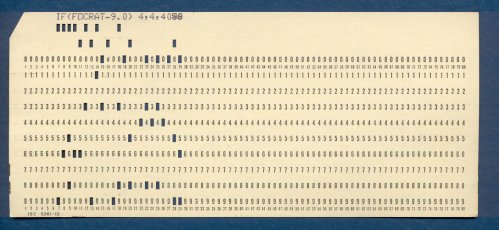
Each of my chapters has begun with a historical perspective on that chapter’s computer technology topic. This has brought lots of things to mind that I haven’t thought about in years, like IBM cards, FORTRAN, punched tape, and Bernoulli Boxes. I still have the card deck from the first program I ever wrote, in the spring of 1970. (See above.) I did some work with paper tape as well in my COSMAC days, but whatever tape I kept has been hiding well. I’d love to get a scan of a length of ASR-33 style punched tape, or a length (8″ or so) of the tape itself to scan here. Doesn’t matter what’s on it as long as it’s not greasy or physically damaged. Contact me if you have some you could spare, or least scan.

Time marches on. I have a 10MB Bernoulli Box cafeteria tray cartridge–probably in a box somewhere with the paper tape–and an original 1983 Microsoft Mouse. Obsolescence doesn’t bother me as long as I can keep functionality. I had to buy a copy of Office 2007 to keep writing commercially, since Word 2000 doesn’t understand .docx files, and Atlantis doesn’t do annotation. Yup, time marches on.

It does. Right now we’re looking down the throat of something a little unprecedented: On April 9, Microsoft turns off security updates for Windows XP.Most of my nontechnical friends seem unaware of this, and my nerd friends have long since moved on to Win7 or 8. I’m in the middle: I’ve been using Win7 on my GX620 for about a year, and have a new Win7 Optiplex 780 on the shelf ready to be populated and configured when time allows. (I’ve done almost nothing but this book for what seems like–hell, has been!–months.) I’m about to take my quadcore in for a new sled-mounted SSD and Windows 7 Pro. The 780 will become Carol’s office machine. I will keep an SX270 XP machine basically forever, because it has pop-in drives for both 3.5″ floppies and Zip cartridges, some of which are piled in odd boxes here for no compelling reason other than they’re paid for. (Yes, most of them have probably gone to bitrot by now.) However, it will no longer be on my network, and will be powered up only as needed.

Here’s an interesting wrinkle that few people seem aware of: Win7 Professional comes with a special-purpose copy of VirtualPC, with a VM containing an instance of XP. (Win7 home does not.) I’m thinking that if I don’t enable the Ethernet connection to the XP VM, it doesn’t matter whether the instance gets security updates or not. I have some stuff here that won’t run on Win8, and possibly not on Win7 either. I can install it on my poor SX270 survivor, of course, but it will be interesting to see what limitations may exist on the XP VM. If something weird turns up in the VM, I can always revert to an archival image.

The real problem with this, of course, is that a lot of nontechnical people are still using ancient machines that won’t run Win7 ever. Only five or six years ago, I still saw Windows 95 on 486 machines owned by older people at my parish. I’ll bet there are plenty of doddering Pentia XP boxes with 512MB of RAM still crunching email and (maybe) Web, along with Office 97. What happens to them? They may well get pwned. On the other hand, I’ve seen several with updates turned off that aren’t pwned. How bad is the problem, really?

I’m sure nobody knows. Sometime this spring we’re going to find out. How many exploits are likely to be left in a 12-year-old codebase? There will be some. Not all exploits are the result of bad coding practices, though I’m sure plenty can be walked back to unbounded string functions in libc, which the C community just can’t seem to give up. XP’s security model is generally lousy, especially for people who don’t understand the implications of what they do, double-especially with Internet-facing apps. That being the case, how far does Microsoft’s responsibility extend? As big as they are, can’t they keep a few security fanatics on staff to fix the exploits that do appear?

I’m thinking that questions like this may soon be asked in the courts of law. We’ll see.

Anyway. I can fix things here, and in extended family. I do worry about nontechnical retirees at our church and elsewhere. When you’re 80, a 12-year-old OS may not seem like any kind of problem, and those on fixed incomes may not feel like $500 for a new box is worthwhile to solve a problem that remains hypothetical. (Hell, my 4Runner is older than XP.) Those of us who remember Y2K hysteria can be forgiven for a strong dose of skepticism. I expect pwnage. There’s pwnage today. The only question is how bad it gets, and how much bad PR it will earn Microsoft. My prediction: If it gets bad enough, and the lawsuits get thick enough, the updates will return.

Pass the popcorn and dig your 3-D glasses out of the drawer. This is gonna be good.