Jeff Duntemann's Contrapositive Diary Rotating Header Image

culture

Prayers and Squares

prayerquilt.jpg

St. Raphael’s parish surprised Carol this past Sunday with a prayer quilt. It’s an interesting church ministry called Prayers and Squares that I’d never seen before coming to St. Raphael’s, but it’s evidently quite common and his its own Web site. It works this way: A parish’s quilters (we have several) make small quilts about 30″ by 40″. At each corner of the quilt squares is a knot with two threads about 3″ long left free. Before the quilt is presented to its recipient (often while they’re still in the hospital) it is placed at the rear of the church or in the parish hall, and people tie a knot in one of the pairs of threads while saying a prayer for the recipient. There’s enough thread so multiple knots can be tied at any given corner, and thus the quilt is never “full.”

It’s a sign to people who are in the hospital that the parish is thinking of them and that they are not alone. Carol was not in the hospital all that long, but she was touched by the gesture, and later that afternoon while she rested on our bed, she put the quilt over her. The Pack stood guard, and vowed to shred any squirrel that dared attack her. (Aero is actually in the photo, but he went undercover to Carol’s right, so as to surprise any squirrel who managed to get past the others.)

QuiltEmblem.jpgIn the corner of the quilt is an insignia with Carol’s name and the date the quilt was presented.

Religion as a concept is taking a lot of flak these days for various reasons, but few recognize the force for healing and comfort that religion can be when it remains true to its purpose. Small as it is, our parish does all sorts of things that might be listed under “aid and comfort,” including a food pantry that was recognized last year as the best in the Colorado Diocese. Nobody talks it up, nobody brags. They just do it.

Carol puts the quilt over herself every night, and I suspect she will long after her illness is just a memory. Whether or not you believe in God, I think it’s always possible to believe that helping others is the highest good that we can aspire to, and an awful lot of that happens where nobody but those involved ever notice.

Odd Lots

  • I’m still pretty sore from lingering shingles pain on my back, and a little grouchy in consequence, though I’m trying manfully not to show it. On the good news end, Carol is much better, and we both had cheese ravioli last night. I think it was the first meal worthy of the name that she’s had in almost two weeks.
  • Anger really does make you lose: Sony has condemned “No Pressure” and completely disassociated itself from 10:10.
  • From the Terms-I-Didn’t-Know-Until-Yesterday Department: milk float, a small delivery vehicle (often electric) used to deliver milk in urban England. Some photos here.
  • And another from that department: steamdevil, a small vortex of condensed water vapor rising into cold air from a warm body of water like a lake or a river. This is the time of year you tend to see them, and Spaceweather posted a nice example from Wisconsin.
  • I’ve always suspected that grains aren’t good for me, but here’s some analysis as to why. Your Body May Vary, but a lot of this sure sounds familiar. Note well the caution on soybeans, which give both Carol and me a lot of trouble.
  • Napa’s cool summer has winemakers biting their nails: They may lose much (and perhaps all) of their harvest if a freeze comes before the grapes mature, but if they can walk the tightrope to harvest without falling, this year’s late-harvest wines (my favorite kind) could be spectacular. (Thanks to Pete Albrecht for the link.)
  • The Colorado Springs marijuana industry has made the New York Times , and has injected new life into local newspapers. I like The Independent, our quirky little free paper (its offices are in an old church with interesting architecture) and every issue I flip through down at the Black Bear Coffeehouse has another page of MMD ads. The latest issue had a 48-page pull-out supplement, devoted entirely to You Know What. The world is clearly crazier than we can imagine.
  • Mars may have had not only oceans, but (c’mon, this is obvious!) also icebergs. (Thanks to Frank Glover for the link.)
  • Australia is about to get its first native-born Roman Catholic saint: Sister Mary Helen MacKillop, who in 1870 got a child-abuser priest removed from his position. In retaliation, friends of the priest orchestrated her excommunication, but she was exonerated in 1872. She will be canonized later this month, and I’d say she now stands fair to become the patron saint of whistleblowers.

Anger Makes You Lose

When the emails started coming in a couple of days ago, I thought it was an urban legend. I really did. (I get a lot of those here.) I went to Snopes automatically, as I always do when someone sends me an email telling me to “forward this to everyone in your address book!” Appallingly, as a single Google search showed, this time the topic was true: Well-known British director Richard Curtis (Love, Actually; Four Weddings and a Funeral) and a global warming group of some significance have created a short film showing True AGW Believers murdering those who disagree with them…including a couple of grade-school children.

The organization is 10:10. The film is “No Pressure.” I won’t post a link to the film itself here because it has been withdrawn from its original location and reposted in lots of other places. I also hesitate because if you have anything like respect for human life you will find it hideously disturbing. Seek it out at risk of nightmares, and don’t say you weren’t warned.

Quick representative summary of a scene from the film: Smug teacher is indoctrinating a group of grade schoolers about the dangers of global warming. A couple of them refuse to buy in. Teacher then pushes a button, and the dissenting kids explode into a realistic cloud of blood and guts, splattering on the walls and on their classmates.

You think I’m kidding? Then grab your barf bag and go find the movie. You won’t have to look far. (It’s on YouTube as I write this.)

No pressure. Right. Disagree with us and we’ll kill you.

This entry is not about global warming, which I’m still researching and will discuss when I’m ready. This entry is about a theme I’ve touched on here again and again over the years: Anger makes you stupid. The level of anger-driven stupidity in this case boggles the mind. To science’s sorrow, anger is now the driving force in the global warming debate. The stupidity comes in when your anger compels you to hand a cudgel to your opponents, which they will then gleefully use to bash your head in again and again and again…forever.

This is galactic-class stupidity. The film will never go away. It will become a legend, and “no pressure” will become a meme for “wanting to kill people who disagree with you.” The Right will broaden the film’s scope and cite it repeatedly as evidence that the environmentalist left is a sort of Stalinist religion that hates humanity and advocates violence against its opponents. The whole thing will inflate far past absurdity. It will tip elections and put more Republicans in power. It will reverse years of gains on environmental issues, and will make it even more difficult to entertain rational debate on any environmental topic at all.

Small price to pay for a piece of delicious tribal poo-flinging, eh?

Bottom line: Anger makes you stupid. And when you get stupid enough, you do things that make you lose.

Geiger Counter Articles from the Uranium Rush

I ran across a couple of Geiger counter circuits while preparing the Carl & Jerry books a few years back, but it wasn’t until I went looking in Google Books for other articles that I got a sense for the time period 1950-1960, when there was a certain Uranium madness in the air. At first it was about prospecting, but later on as the 50s drew to a close, it was mostly about fallout.

There were articles not only on building Geiger counters, but also reviews of commercial units and practical tips on how to search for the minerals. Sometimes it was a cover story (as with Popular Electronics for July 1955; scroll down) but mostly it was just a part of the electronics hobbyist zeitgeist in that era. There was a certain grim exuberance about it all: The evil Soviet Union was breathing gamma rays in the faces of our collective cultural consciousness, and we were ready to respond with our archetypal American can-do spirit. Some of us understood that the unspoken clause after “duck and cover” was “and die.” Most, I think, did not. (Especially naturally optimistic 11-year-olds like me who just wanted to build a cool gadget with a Geiger tube he already had.)

So below is a list of the construction articles I’ve discovered for Geiger counters in the 1950-1960 era. Many are on Google Books, and I’ve posted the circuits from a couple of the others. If you have any more not listed here, please pass along links or scans so I can add them. I’m considering a standalone Web article for my Junkbox site on building “legacy” Geiger counters based on my current experience, so whatever you have that might be relevant, please share.

  • Popular Mechanics, February 1949: “How to Build a Geiger-Muller Uranium Survey Meter“. Brute force power supply consisting of three 300V batteries in series! Uses K-EX GM tube in series with headphones. No audio amp.
  • Popular Mechanics, July 1950: “Uranium Survey Meter With Audio Amplifier.” Much like February 1949 PM item, plus an audio amplifier. Uses CK-1021 GM tube (others are suggested as usable) and a 3V4 battery miniature tube for audio, which requires a 1.5V filament supply and a 45V plate supply.
  • Popular Science, April 1955: “Prospecting with a Geiger Counter.” Uses a CK-1026 GM tube, with HV generated by a pushbutton interrupter. 3S4 tube audio amplifier. Basically the same circuit as in Alfred Morgan’s Boys’ Second Book of Radio and Electronics.
  • Popular Science, May 1955: “Super Geiger Counter You Can Build.” Ambitious circuit with six (!) GM tubes in parallel plus a 2-tube audio amplifier, and a vibrator high-voltage supply. The GM tubes are all Anton 310 units. Has an averaging count meter.
  • Popular Electronics, July 1955: “Home-Built 700V Geiger Counter”. Two circuits, both using batteries (300V + 67.5V) in a simple voltage doubler. (No sparks!) One circuit has no audio amplifier, and the “deluxe” circuit has a 3S4 tube audio amp and an averaging count meter. Both use the Victoreen 75NB3 GM tube.
  • Popular Electronics, June 1956: “Simple Transistorized Geiger Counters”. Calls out either a CK1026 or a Victoreen 1B85 GM tube. Three circuits: two using 300V batteries, and a third with a pushbutton interrupter for HV. Tube audio amps are replaced by transistor amps, using general-purpose devices (2N35, CK722) that are not critical.
  • Popular Mechanics, March 1957: “Prospector’s Partner.” A combination 4-tube battery superhet AM radio (with canonical 1R5/1U4/1U5/3V4 lineup) using a 1B85 GM tube patched into the grid of the first audio stage. Uses a pushbutton interrupter HV supply for the GM tube; 67 1/2 V battery for the radio.
  • Popular Electronics, July 1957: “Geiger Gun”. Compact gun-shaped hand-held counter counter using a CK1026 GM tube, pushbutton interruptor, and 2N107 transistor audio amp. Article is not online, but there are images of the counter as built in a junction box by someone here. (Scroll down.) Circuit is here.
  • Popular Mechanics, August 1961: “Treasure Finder’s Pal.” A combination metal detector and geiger counter. Uses a CK-1026 GM tube and a CK-722 transistor oscillator into a universal output transformer to generate HV. GM tube output is patched into a transistor radio for audio amplification.

Odd Lots

  • The base for the Geiger-Muller tubes used in all of the early Cold War era Victoreen counters (including both tubes now on my bench) is called a standard Peewee 3-pin, JEDEC A3-1. Many thanks to Jonathan O’Neal for sending along this link to a detailed spec sheet (PDF) for one of the tubes. Now I can wire up the counter I’m building for initial tests.
  • A couple of people have suggested using a Leyden jar instead of ordinary capacitors to collect charge for my (supposedly) steampunk Geiger counter. I imagine that a Leyden jar would be more period, and it’s certainly a good excuse to build something that I saw in every single one of the kid books on electricity I read back in the early 60s. Not real portable, though.
  • There is indeed an organization that helps to keep Latin functional, 2000-odd years from its original coalescence as a major world language. No psychic powers points for guessing that the organization is…the Roman Catholic Church. (Thanks to Michael Covington for the link, which, I must say ahead of things, is in…Latin.)
  • And Finland just racked up a huge mess of cool points with me for being the only country in the world that broadcasts the news in Latin. (Thanks to Aki Peltonen for the link.)
  • Jim Furstenberg put me on to photos of a round dozen Victorian submarines. The site looks to be a marvelously engaging time-waster, er, experience broadener. (Have done much of both in recent hours.)
  • Google just announced its own URL shortener, which will do some reasonable screening against malware. I have avoided using URL shorteners for that reason until now.
  • Furthermore, the new Google URL shortener will generate a QR code for you if you tack a .qr onto the end of the shortened URL.
  • Amazon is creating an Android app store. Peculiar? Not if the next (or next after that) Kindle generation is more than just an ebook reader.
  • I’m proud to say that my good sister Gretchen long ago declared that she is raising free-range kids. I wasn’t quite sure what she meant (Carol and I have none of our own) until I read this. Bravo! Now, can we make zero-tolerance policies in schools a felony? (Thanks to Pete Albrecht for the link.)
  • The other day I mentioned to Carol that, with “Drumlin Circus” taking on a certain steampunk flavor (it’s certainly nothing like “Drumlin Boiler”) I would probably have to buy a top hat. Her reply: “Um…you already have a top hat.” I looked on the high shelf in the closet, and shore ’nuff! I bought it for the 1999 Coriolis Millennium Christmas Party at the Biltmore Hotel in Scottsdale. I wore it exactly once, and then forgot about it. So what’s next? Spats? Or my seriously ahead-of-the-curve Chester A. Arthur facial hair?

The Pulps Reconsidered, Part 4

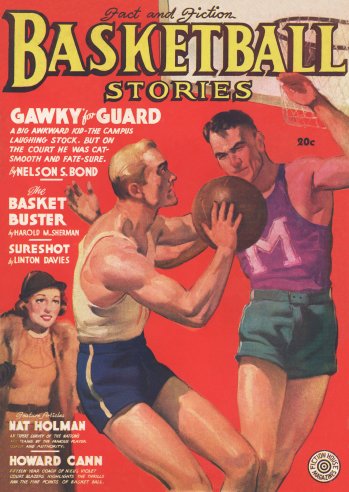
BasketballStoriesCover350Wide.jpgThe essential difference between literary (as we define it today) and non-literary fiction didn’t crystallize for me until first-person shooters happened. I’m not one for games in general, but an hour or two playing early shooter games like Doom and Quake back in the 90s was an epiphany: This is a species of fiction. The following years proved me right. Most ambitious action games have at least a backstory of some kind, and some modern MMORPG systems have whole paperback novels distilled from them. (See Tony Gonzales’ EVE: The Empyrean Age, based on EVE Online.)

Of course it’s not literature. Did anybody say it was?

What it is is something else, something important: immersive. You get into a good game, and you’re there. I can do the same thing with a decent SF novel, but the phenomenon is in no way limited to SF. I’m guessing that Farmville or almost any reasonably detailed simulation works the same way.

Immersivity is the continental divide between literary fiction and pulp fiction. Like anything else in the human sphere it’s a spectrum, placing World of Warcraft on one end and Finnegan’s Wake on the other, with everything else falling somewhere in the middle. The term measures the degree to which you can lose yourself in a work, where “lose yourself” means “forget that you’re reading/playing and enter into experiential flow.”

Don’t apply a value scale to immersivity. It’s only one dimension of many to be found in fiction, and my point here isn’t to dump on Finnegan’s Wake. Literature is intended to evoke a response in the reader, but that response is not necessarily immersion. (It can be, particularly with classics like Huckleberry Finn that are new enough to be culturally familiar to us–dare you to read Chaucer without footnotes!–and yet not so new as to be afraid of Virginia Woolf.)

Pulling the reader in and carrying him/her along requires a smooth, linear narrative style, a vivid setting, and enough going on to maintain the reader’s interest after a long day working a crappy job. Pulp characters are often types, but that’s not necessarily due to a lack of skill on the writer’s part. A carefully chosen and well-written type allows room for a reader to imagine being that character, which is important in immersive fiction. As much as I enjoyed Gene Wolfe’s massive Book of the New Sun (and I’ve read it three times since its publication) I had a very hard time imagining myself as Severian. I empathize with him and certainly enjoyed watching him against the dazzling surreality of Urth (though I had to read numerous sections several times to be sure I knew what was going on) but being him? No chance. Keith Laumer’s Retief, on the other hand, no problem. Louis Wu? Same deal.

And for the umptieth time: (I can hear the knives being sharpened) This is not to denigrate literary fiction, of which I’ve read a lot and still do. My point is that immersive fiction is a valid entertainment medium, requiring different mechanisms and different skills than literary fiction. Let’s not dump on things for simply being easy to read. Easy is good if easy is what you want–and (on the author side) if easy is what people are willing to pay for.

Which should not suggest that easy to read is necessarily easy to do. The immersive magic of the pulps is obscured by the fact that a lot of it was just badly done, and could not have been otherwise, given that some pulp titles paid a quarter cent a word and published eighty thousand words twice a month. We can do much better these days, at least on the quality side. A brilliant potboiler is eminently possible–if we as readers give authors some sense that it’s ok to take up the challenge, and that they’ll be paid for their efforts when they succeed.

More in this series as time allows.

The Pulps Reconsidered, Part 3

SDMCover.jpg

Bet you thought I forgot about this series, huh? Not so: I needed a little time to take a broader look at the field. (Click here for Part 1 and Part 2.) Someone told me that a lot of 1930s/40s/50s pulps were being scanned and posted on Usenet at alt.binaries.pictures.vintage.magazines, so I went up there and pulled down a representative sample. And I’m not talking SF anymore; what I grabbed were things like Air Wonder Stories, Mammoth Western, Strange Detective Mysteries, Adventure, and Spicy Stories.

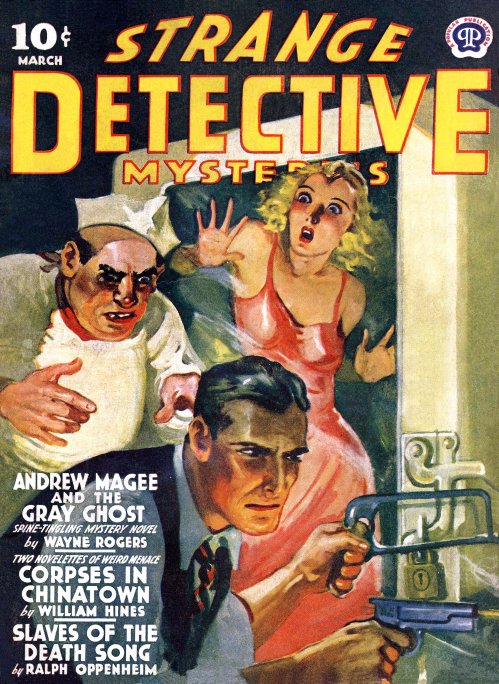
It’s been wonderful fun. In fact, it’s a lot like watching campy old b/w TV shows, only better, because I can decide how everybody and everything looks. I don’t have to be appalled (or giggle) at the cheap crappy special effects. I just willingly enter a world in which nobody rolls their eyes at a homicidal supermarket butcher about to strangle a square-jawed hero armed with a pistol in one hand and a hacksaw in the other. (See above. No, I didn’t read that story. I still wonder what the hacksaw was about.)

I’m not the first to suggest that the pulps vanished largely because TV took over their niche. The pulps were Saturday-morning movie serials that you could enjoy any time you wanted, and once TV started showing Commando Cody, Bomba the Jungle Boy, Flash Gordon, and made-for-TV adventures like The Texas Rangers, Sky King and Highway Patrol, much of the money went out of pulp publishing. The financial pressure was eventually fatal, but over the short term, as the pulps dwindled, their quality went up. And it wasn’t just that we knew more about science and technology and hence could write better SF. The SF of the Thirties was awful because the readership didn’t care. The pulps had a monopoly on cheap entertainment and people bought it because it was all there was, and reading it was better than staring at the wall.

Print entertainment evolved out of the pulps and into other print markets, particularly glossy mags. The railroad pulps died, but glossy, ad-supported magazines like Trains and Railroad picked up the readership, which after WWII had more money to spend on locomotive picture books and model railroading. Tacky text-porn mags like Spicy Stories (which had racy drawings and a handful of “artful” b/w nude photos) gave way to Playboy and its cheaper imitators as social strictures against visual porn weakened in the 50s. In the late 50s, pulp SF improved hugely, and bootstrapped itself into the new world of mass-market paperbacks by selling reprint anthologies of the best work to come out of the pulp era. (We can be fooled into thinking 30s and 40s pulp SF was better than it was because what we read of it was hand-picked for quality decades after its publication. Read a couple of original SF pulps circa 1935 and you’ll see what I mean.) Crime pulps went both up and down, to comics on the low end (much of “crime” fiction from the Depression was actually horror) and to book-length mysteries on the high end. The romance pulps like My Romance split similarly into gossip mags and mass-market romance novels.

Fewer people may be reading these days, but those who gave it up probably never liked reading that much to begin with. Again, reading was better than staring at the wall, but TV, when it arrived, was easier, especially for people with marginal education. The audience that remained was pickier, and many had been formally exposed at the college level to classic literature, which became the standard by which all fiction was measured.

And that may be a mistake. (I’ll come back to this point in a future entry.)

Leaving the quality of the writing itself as a separate issue, after a good long look around I’d say that the lessons of the pulps are these:

  • The pulps were about specific cultures. They were tightly linked to a time and a place and a generally understood cultural subtext. This was even true of early pulp SF, much of which might be characterized as “Depression-era Chicago on Mars.”
  • Characters were intended as costumes to be worn by readers, not fully realized individuals to be admired on their own merits as independent men and women. A lot of people don’t understand this, and many still won’t admit it. Make characters too vividly fluky and original, and readers will have a hard time identifying with them.
  • As a corollary to the above: Concepts, settings, and action were as important as characters, and much more vivid. Again, it’s the difference between imagining yourself driving a fast car and imagining someone else driving it.
  • The pulps were fun. They understood and accepted their role as immersive entertainment. They were not equipped to be literature and didn’t try to be literature.

With all that in mind, the big questions become: Is there unmet demand today for good-quality immersive (non-literary) fiction? How much of this legacy can we retrieve in 2010 and do well?

More next time.

At the Sign of the Green Cross

The closest retail cluster to our house (a mile and a half down the hill) has a fair number of vacant storefronts, but the last time Carol and I went down for lunch at China Wok, we noticed that the storefront right next to the restaurant was no longer vacant. Who had moved in was unclear: There was no big sign, and the small sign under the portico was painted over and blank. It looked like a doctor’s office: a couple of couches and chairs and some flower arrangements in a waiting room with a receptionist’s window. If I were hipper (and I am about as hipless as they come) the neon sign in the window would have given it away immediately: a green neon cross with orange letters in the middle, reading “OPEN.”

Fast forward a week or so. Carol was reading the free paper, and in the back were something like fifteen or twenty ads for medical marijuana dispensaries, including one in the Safeway Plaza. Yup. That’s it.

You’re probably expecting a tirade here, but alas, you lose. I’d paid little attention to the whole issue (let’s just say that I am not a potential customer) but a little research left me fascinated by the speed with which this all got going after a referendum here made Colorado one of the most grass-friendly states in the union. Suddenly it’s an industry, to the extent that somebody is manufacturing green cross neon “OPEN” signs that I doubt you’ll see in the window of a dry cleaners.

The green cross has become the informal symbol of the organized medical marijuana industry. I think this goes back to a primordial cannabis delivery service in San Francisco, which publishes an online menu and will bring the goods right out to you.

Is this a good thing? On the balance, probably. I am fiercely against depriving the ill of medications just because they’re psychoactive. Furthermore, I’ve read a lot of history, and prohibition just doesn’t work. All it does is enrich and embolden the bad guys. And although the one time I (successfully) smoked the stuff back in 1971 I felt depressed and creepy for days, I may not be typical, and feeling a little creepy is probably better than dying in agony or going blind. Certainly I was grateful for post-surgery painkillers when I had a hernia fixed, even though they made me feel stupid enough to enjoy “The Dukes of Hazzard” on TV.

The bottom line is this: The violence of our reaction to marijuana seems out of scale to its hazards. I know that it sounds like a cliche, but I’d rather see it regulated (and yes, taxed) and ideally merged in with the rest of our prescription drug distribution mechanism and treated no differently than chemicals like codeine.

Anyway. That’s just me; I’m easy. It’ll be interesting to see what happens to the place next to China Wok when some of my fussier neighbors figure out what they’re doing down there at the Sign of the Green Cross.

Rant: Higgsism and the Moral Dimension of Health

As most of you know (or can guess) I’m not content to accept received opinions about things like health insurance reform. I’ve been researching it and working it out for myself for a couple of years now. Most of the discussion online has been tribalist bullshit and not particularly useful, but I’ve managed to define a few things that make the whole issue of health insurance a lot harder to deal with than otherwise might be. What surprises me the most is that these issues almost never come up.

The first of these, in fact, I had to coin a name for: Higgsism, from the clueless protagonst of Samuel Butler’s wicked little gem, Erewhon. If you recall, while Higgs is jailed in Erewhon, he befriends his keeper’s daughter, Yram. Higgs watches, astonished, as people who fall into bad health are convicted of a criminal offense, yet people who have been caught embezzling are treated as though they were suffering from a headcold. When Higgs himself gets a headcold, Yram scolds him severely, and only at that point does he put two and two together. As poor Higgs puts it: “I never remember to have lost a cold so rapidly.”

It’s a great book; a sort of steampunk Gulliver’s Travels, and bears close reading. In a nutshell, what I call Higgsism is this: the belief that we have complete (or almost complete) control over our health, and that when we get sick, it’s because we have done something wrong, making illness our own damned fault. Just as the lucky prefer to ascribe their success to hard work, the healthy generally ascribe their health to pure clean livin’.

Alas, the more we look, the more evidence we see that health is more luck than skill. Matt Ridley’s 2004 book The Agile Gene describes the emergent nature of the human body, and how we’re at the mercy of not only our genes but also poorly understood environmental stressors of gene expression that come into play starting at the moment of conception. Beyond avoiding a handful of obvious hazards like smoking, recreational drugs, and promiscuity, there’s not a whole lot we can do. Eat moderately, walk a little, and get your sleep–but hell, if body weight is almost 80% heritable, health may be a steep climb indeed.

I’ve lived long enough to see a fair number of people die for no known reason. A healthy, trim, athletic nonsmoking man like Harry Helms with no family history of colon cancer dies of it. What did he do wrong? Carol’s late Aunt Berenice lived a modest life and never held a lit cigarette, yet she died of lung cancer. What did she do wrong? The truth is that they did nothing wrong at all. Yet these days, when somebody gets cancer, everybody starts thinking back to try and identify what the poor slob’s sin was.

The truth is grim: We control little of our own health, and what little we do control is often misunderstood (like carbohydrate metabolism) and not always universally applicable across the human species. (Milk is great for you–if you can digest it.)

The health insurance industry can only get away with medical underwriting because of the implied moral culpability of the unhealthy: If you’d just lived a cleaner, healthier life you wouldn’t have cancer or diabetes or ALS or whatever, so you’re a poor risk and deserve to go bankrupt and die. This widespread belief is why high-deductable catastrophic health insurance is unpopular: People see it as money going out of their pockets directly into the pockets of heedless reprobates who can’t or won’t adopt a healthy lifestyle, whateverthehell that is, while those who practice clean livin’ still have to pay for their own broken ankles and flu shots.

As long as we continue to believe that, we’ll be unwilling to face the truth: Health insurance is a sort of luck tax. The lucky pay the money while getting little back in terms of benefits. The unlucky get their lives saved through expensive treatments that they could never afford out-of-pocket. The moral dimension of health is almost entirely an illusion.

What’s the solution? I didn’t say I knew of one; in fact, I’ve often wondered if universal health insurance as we understand it is even possible. Yet even if it is possible, as long as we embrace Higgsism, I guarantee you we’re not going to get anywhere with it. You might as well give antibiotics to embezzlers.

There’s another part to this, which I’ll try to get to in coming days.

Fedora Anxiety

JeffAndHatDehalftoned1992.jpgThis morning’s Wall Street Journal persuaded me that I am, for once, way ahead of the curve. The A-head story documents the Millennials’ puzzlement over hat etiquette: When should I wear them indoors? They are baffled. They are struggling. Deep within their sensitive souls, they are suffering.

Perhaps I can help: Listen up, people! Outdoors is for hats! Indoors is for heads! Sabe?

Deafening silence. So it goes.

My father wore a felt fedora to work every day, even when he had to change it out for a hard hat when he arrived at a job site to help clueless technicians figure out why an industrial gas main was delivering only half the methane that it was supposed to. A felt fedora was part of the company uniform, and he was unapologetically a company man.

The uniform changed in the first half of the 1960s, and the canonical felt fedora almost became extinct. The newly hip in the Sixties thought that hats smelled too much like the Fifties. Ewwwww, can’t have that. (This is the same reason that Unix fanatics in the First Age declared that Capital Letters Are For Engraving In Stone: Capital letters smelled too much like COBOL. Ewwwww, can’t have that.) My father reluctantly complied, reluctantly because he had only a little more hair than I do. It turned out all right because he was working in Chicago, where we saw the sun maybe once every three weeks in the winter.

Fast-forward to 1990: Jeff and Carol move to Arizona to launch PC Techniques. Down there it’s the other way around: We saw clouds maybe once every three weeks in the winter. And in the summer. (Except for two months’ worth of late summer monsoon, when we saw a few every afternoon. A few.) Jeff (who has less hair than his father, and almost none since the late 1980s) gets scorched a time or two, up top where your skin is so thin that you can feel bottom.

Jeff, doing what makes sense, buys a hat. I had one by late summer 1990, but it wasn’t until the April/May 1992 issue of the magazine that I appeared along with my hat. (See my editorial photo above.)

Oh, the humanity. Half the readership seemed to think I’d be better off wearing a dead skunk. The other half said nothing. Even the ever-so-always-polite-and-considerate George Ewing (peace be upon him, and is) wrote in a letter-of-comment: “I dunno about the hat.”

I stuck with it. Pace Woody Allen, my brain is my first favorite organ, and this was Arizona we were talking about. (Your brain doesn’t need drugs down there. No questions.) Over subsequent years I bought a lot more hats, and now a quick count shows eleven, plus a twelfth that I leave in Chicago just in case the sun ever comes out when I’m in town. True, a couple are special-purpose, like my Ben Franklin Kite-Flying Hat, and a formal felt business cowboy hat that I had custom-made by Ronald Reagan’s hatmaker in 2000, during which I had my idiosyncratic skull measured by a mechanical hat sizer machine built in 1910.

Wearing a hat was a contrarian act in 1992, so it was a good fit for me. And now in 2010, a fifty-year ice age in the hat industry has come to an end. Having tasted the sweet nectar of hattedness, the Millennials can’t bear to take them off for a second, perhaps fearing that another Ice Age is just around the corner. One is. Wearing your hat in the bathroom won’t help.

A hat is a roof over your brain. You only need one roof. When you step under one, take off the other. It’s that simple.